
Teacher Portal:
Inheritance and Adaptations
Investigation 2 – PreLab
 MINDSET
This Investigation is designed to:
- provide students with the understanding that DNA is broken into smaller sections called genes that contain specific genetic information.
- encourage students to realize that most living things have two copies of each chromosome and gene in the nucleus of their cells.
- encourage students to realize that alleles contain similar, but not identical, genetic information.
- allow students to compare dominant and recessive alleles.
- give students an opportunity to manipulate a model in order to visualize how dominant and recessive alleles are inherited.
- provide students with an understanding of how different combinations of dominant and recessive alleles will result in a specific expression of a trait.
SCIENTIST’S GLOSSARY
- Allele: Different form of the same gene containing slightly different genetic information that encodes a slight difference in a trait.
- Cell: The smallest level of organization found in living things.
- Chromosome: Structures of DNA and protein found in the nucleus of cells. It is also where a gene is located.
- DNA: Deoxyribonucleic acid that carries genetic information in cells.
- Dominant: An allele that will produce a trait that masks another trait for the same characteristic (prevents it from being expressed).
- Gene: A small portion of DNA that carries specific genetic information.
- Inheritance: The passing of genetic information and traits from parents to offspring.
- Recessive: An allele that produces a trait that is masked by a dominant trait.
- Trait: One form of a physical characteristic determined by a specific
BE PREPARED
Watch the Investigation 2 Teacher Video and Student Video below to prepare for the PreLab.
SET FOR SUCCESS
- Tell students that they are going to continue learning about Inheritance and Adaptation.
- Ask students to share the kinds of things they might learn in these Investigations.
Begin the PreLab Concept Slides to start students on their learning journey. Then watch the Pre-Lab Student Video as a class.
NAVIGATE IT
Once the slide presentation is launched
- use your left and right arrows to advance or go back in the slide presentation, and
- hover your mouse over the left edge of the presentation to get a view of the thumbnails for all the slides so that you can quickly move anywhere in the presentation.
- Click HERE to launch the slide presentation for the CELL.
SHARE IT
SLIDE INHERIT2-pre-1
Begin the slide set by having a discussion about what students learned in Investigation 1 and the direction they will be heading in Investigation 2. Ask the following question:
Which structure in a cell contains the genetic information? The genetic information of a cell is found in the nucleus.
How is the genetic information organized inside of a nucleus? The genetic information is organized into long strands of DNA.
Do you think all living things have the same genetic information? Do animals, birds, fish, plants, and humans have the same genetic information? Students should indicate that all living things do not have the same genetic information. All living things have characteristics that are different from one another.
Do you think that family members share any genetic information? Why or why not? Students should indicate that family members share some genetic information because families usually have some characteristics or traits in common.
Direct students to look at the lists they created in Problem 11 of Investigation One. This problem asked: Do members of your family share any physical characteristics? Do members of your family have different physical characteristics from one another? Allow several student volunteers to share examples of their family’s characteristics from their lists. Student answers may vary.
How do you think those traits, or characteristics, are passed from parents to their children? Student answers may vary.
Why do you think that some traits are not seen in all members of a family? Student answers may vary.
______________________________________________
SLIDE INHERIT2-pre-2
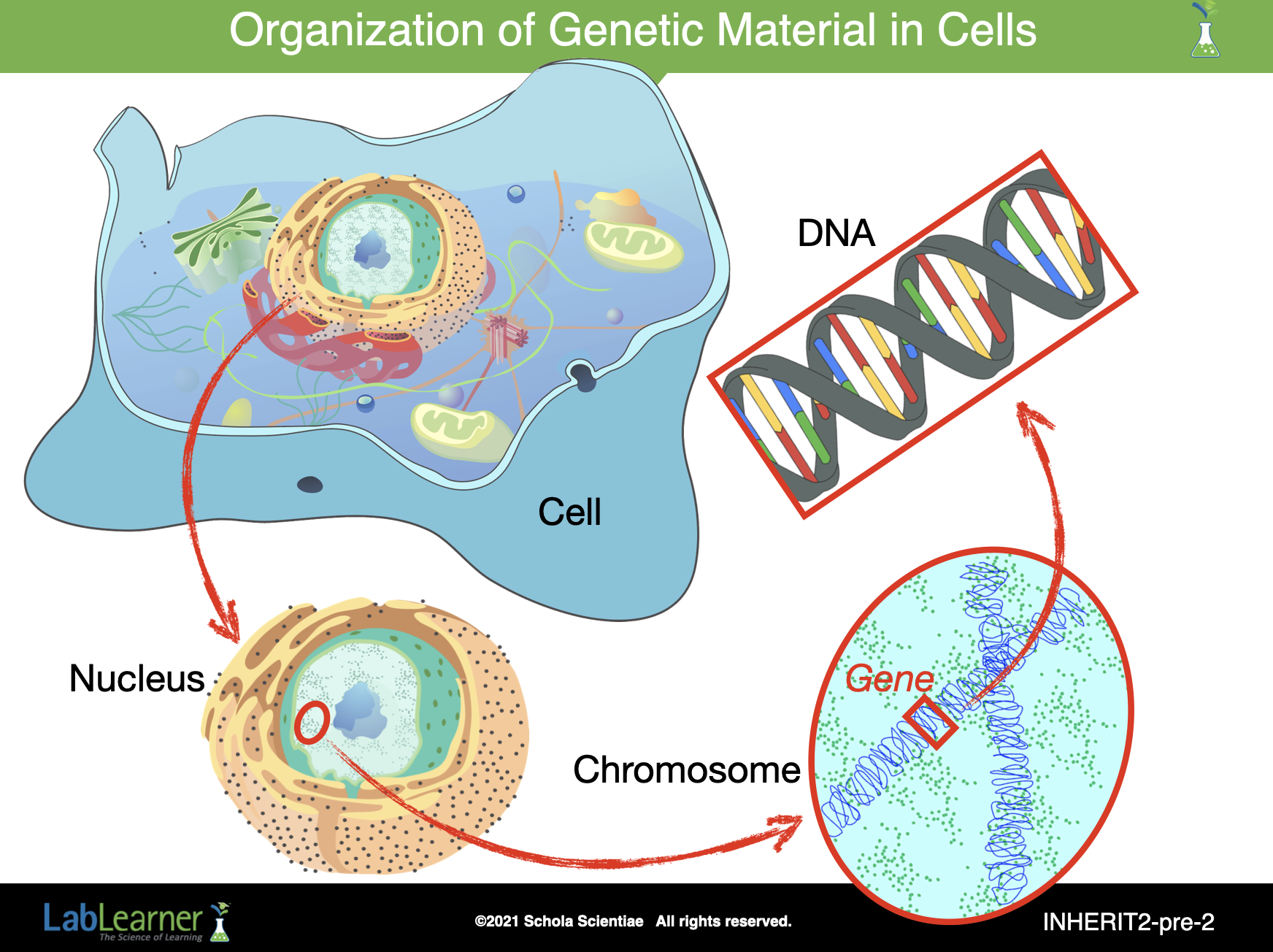
Tell students that in this Investigation they will be examining how traits are inherited so that they can understand why some traits are not seen in all members of a family.
Referring to this slide, Ask students: Which part of this sequence did you examine in Investigation One? Students should indicate that they examined DNA in Investigation One.
Ask students: Think about the DNA you extracted in Investigation One. What did it look like? Students should indicate that the DNA appeared as long, white strings.
Ask students: Before you unraveled the DNA in the lab, how do you think it was organized? Student answers may vary. Encourage students to realize that the strands of DNA are raveled around proteins and twisted together to form chromosomes.
- Ask a student volunteer to read the definition of chromosome from the Scientist’s Glossary:
“Chromosome: Structures of DNA and protein found in the nucleus of cells. It is also where a gene is located.”
______________________________________________
SLIDE INHERIT2-pre-3
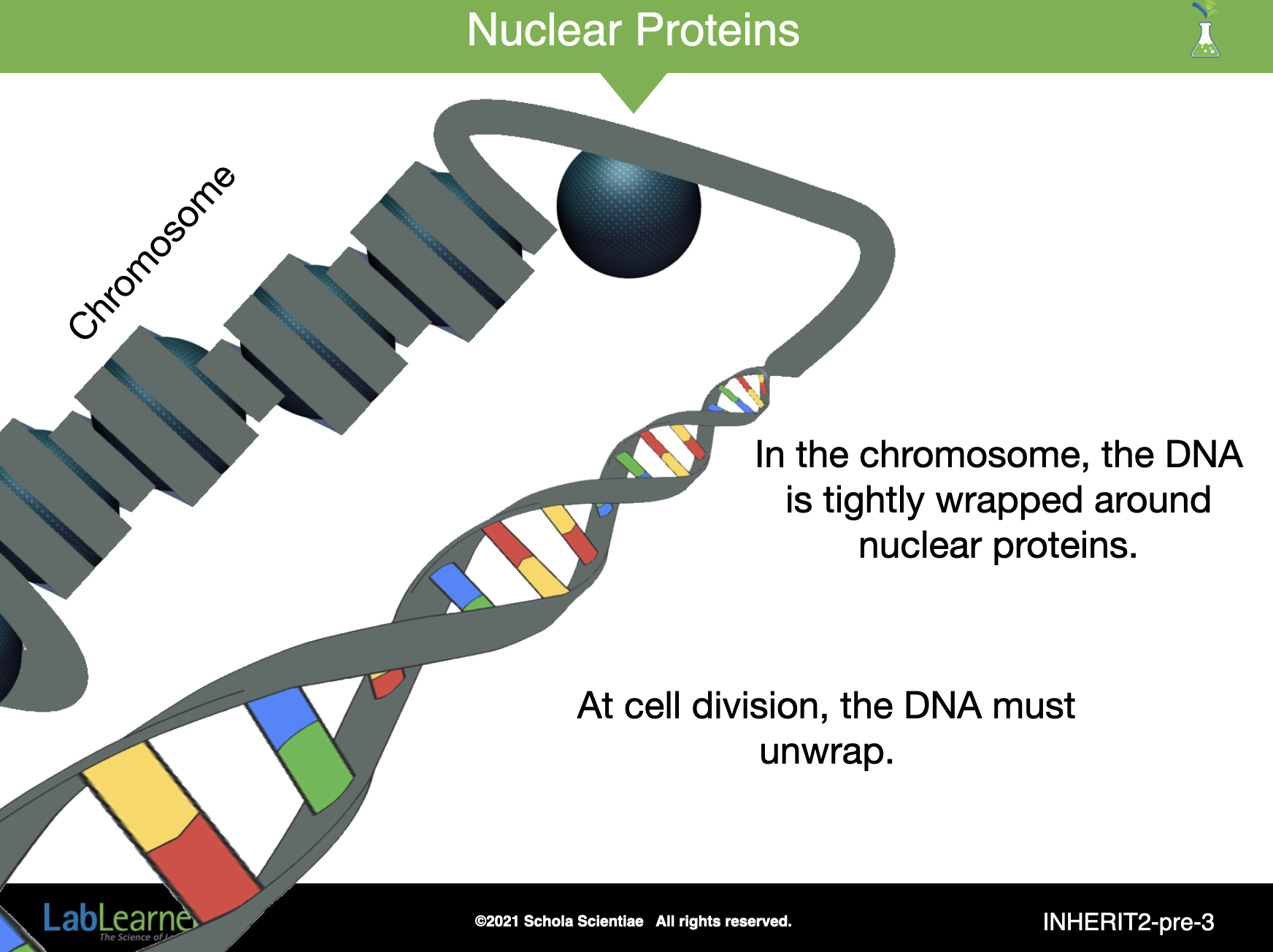
During this Investigation, students will be focusing on chromosomes. As shown in this slide, in the chromosome, the long DNA molecule is wrapped around protein molecules.
Many thousands of genes may be located on one strand of DNA. The DNA is wound around many proteins. Many strands of DNA are twisted and wound together. When the strands of DNA are wound together, they form a chromosome.
______________________________________________
SLIDE INHERIT2-pre-4
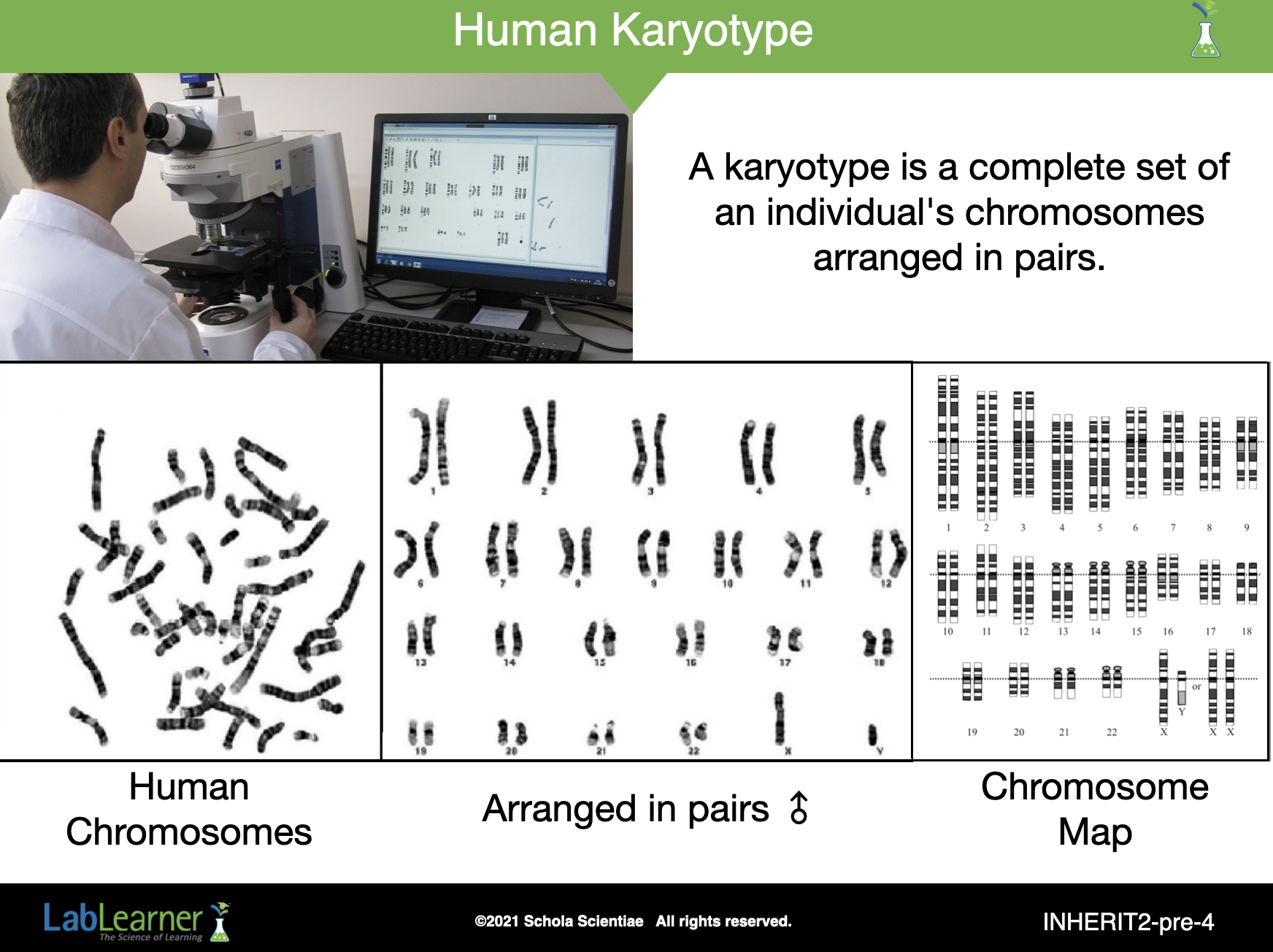
This slide shows a human karyotype. The individual chromosomes are photographed through a microscope. The unique pairs of chromosomes are then carefully separated, identified, and arranged in pairs for ease of analysis.
The chromosome map on the right is from the Human Genome Project. The bars on the arms of the chromosomes represent specific stretches of DNA and gene locations. The dotted line is where the individual chromosomes join each other to form pairs.
______________________________________________
SLIDE INHERIT2-pre-5
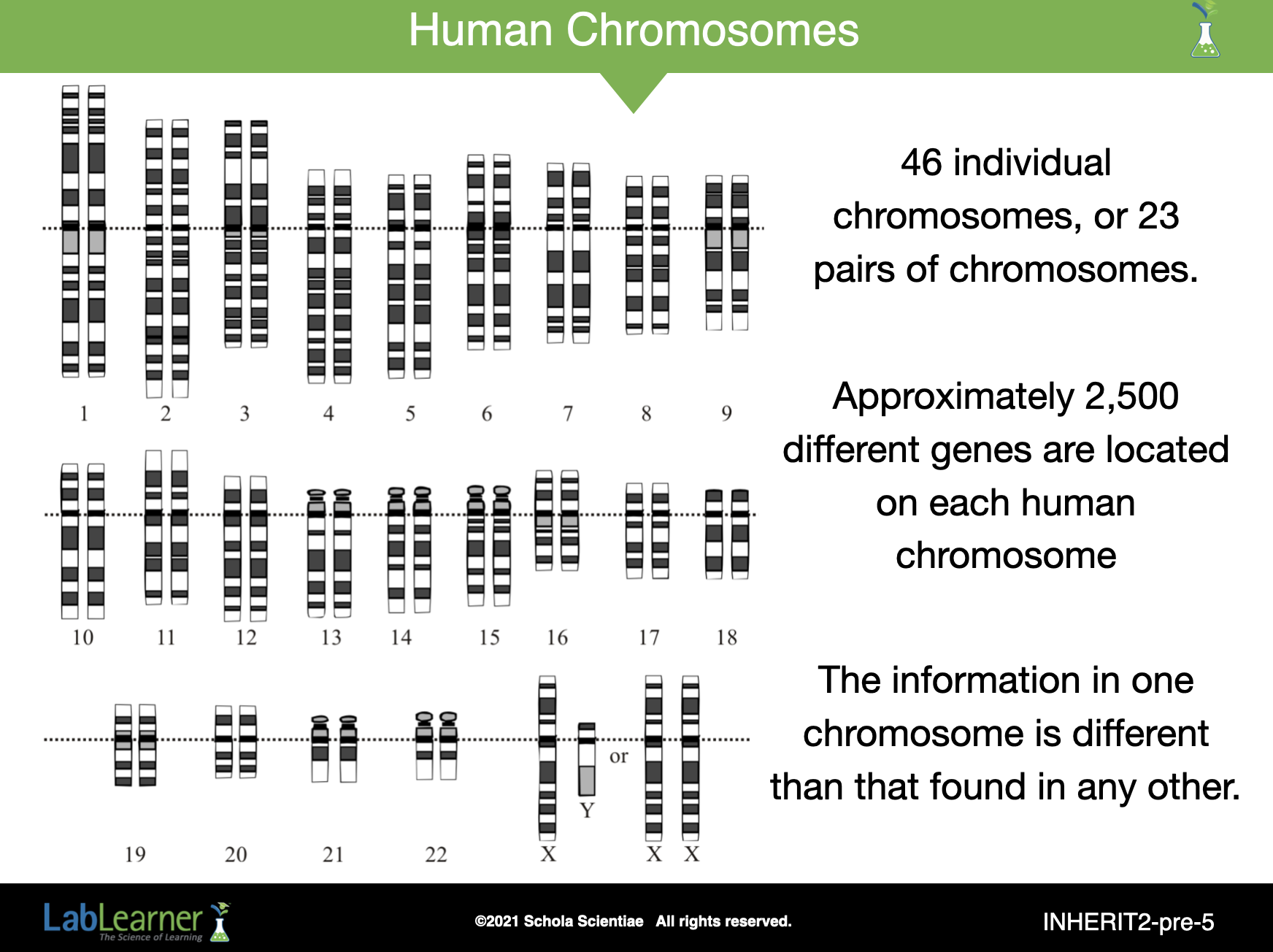
Tell students that humans have 23 different pairs of chromosomes in each cell.
Explain to students that if the nucleus of a human cell were broken open, it would contain 46 individual chromosomes or 23 pairs of chromosomes.
All living things have two copies of each chromosome but may have more or fewer than the 23 pairs that humans have.
Approximately 2,500 different genes are located on each human chromosome.
The genes found on one pair of chromosomes are different from the genes found on another pair of chromosomes. That is, each pair of chromosomes contains different types of information. For example, the information (genes) found on chromosome pair 2 is different than the information (genes) found on chromosome pair 12.
______________________________________________
SLIDE INHERIT2-pre-6
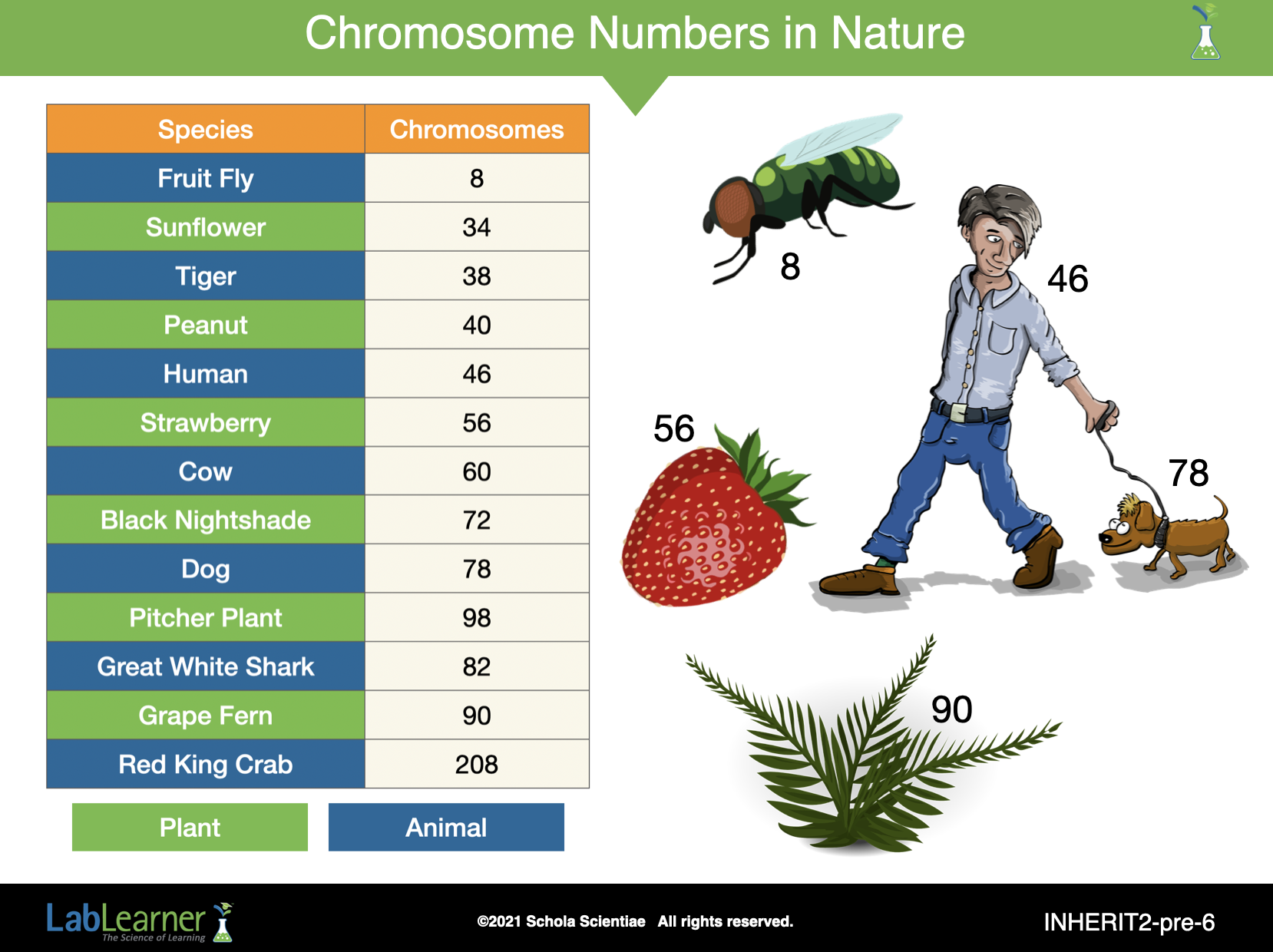
As can be seen in this slide, humans have less chromosomes than some plants and animals and more than others.
______________________________________________
SLIDE INHERIT2-pre-7
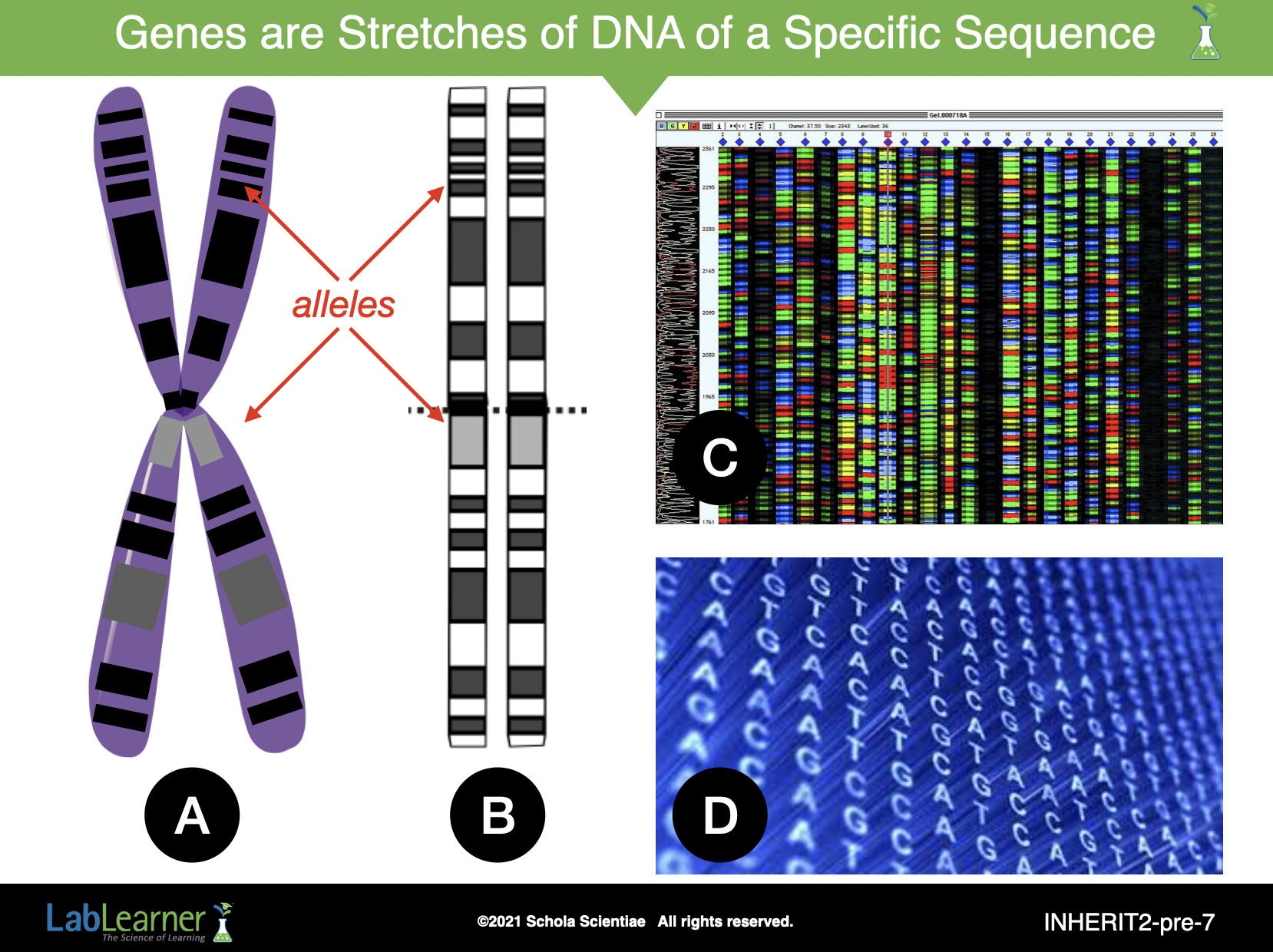
Each chromosome pair has a copy of the same genes. The two copies of each gene are called alleles. Ask a student volunteer to read the definition of an allele from the Scientist’s Glossary:
Allele: Different form of the same gene containing slightly different genetic information that encodes a slight difference in a trait.
A. Cartoon of a chromosome with multiple alleles shown as different color bands.
B. A chromosome map of human chromosome pair 1.
C. A DNA sequencing gel showing the sequence of a stretch of a DNA molecule.
D. This is simply a graphic showing the massive number of individual “bases” that make up a sequence of DNA:
A = adenine
T = thymine
G = guanine
C= cytosine
Point out to students the different genes on one chromosome and its corresponding alleles on its chromosome pair. Each band corresponds to a different gene. On this diagram, each chromosome has ten different genes. That is, the pair of chromosomes share ten pairs of alleles.
Ask students: One chromosome of each pair comes from the father and one chromosome of each pair comes from the mother. Do you think that the information found on the pair of chromosomes is identical? Do you think that the information on the pair of chromosomes is different? Student answers may vary. Students may or may not indicate that the information found on a pair of chromosomes is not identical. The alleles from the father and the alleles from the mother will contain slightly different information.
Ask students to look at the lists they created in Problem 11 of Investigation One. This problem asked students to list characteristics of family members. Explain to students that all of the characteristics that they listed are called traits. Ask a student volunteer to read the definition of trait from the Scientist’s Glossary:
“Trait: One form of a physical characteristic determined by a specific allele.”
Explain to students that scientists have found out that pairs of alleles exist for every characteristic or trait. The alleles provide the information for the version of every trait observed (expressed) in all living things. Refer students to examples of the traits they listed in Problem 11. Guide students towards understanding that for the different traits (eye color, hair color, hair type, etc) there are alleles on chromosomes that determine what is observed.
______________________________________________
PRELAB EXERCISE
To help students better understand this concept; engage them in the following activity. •
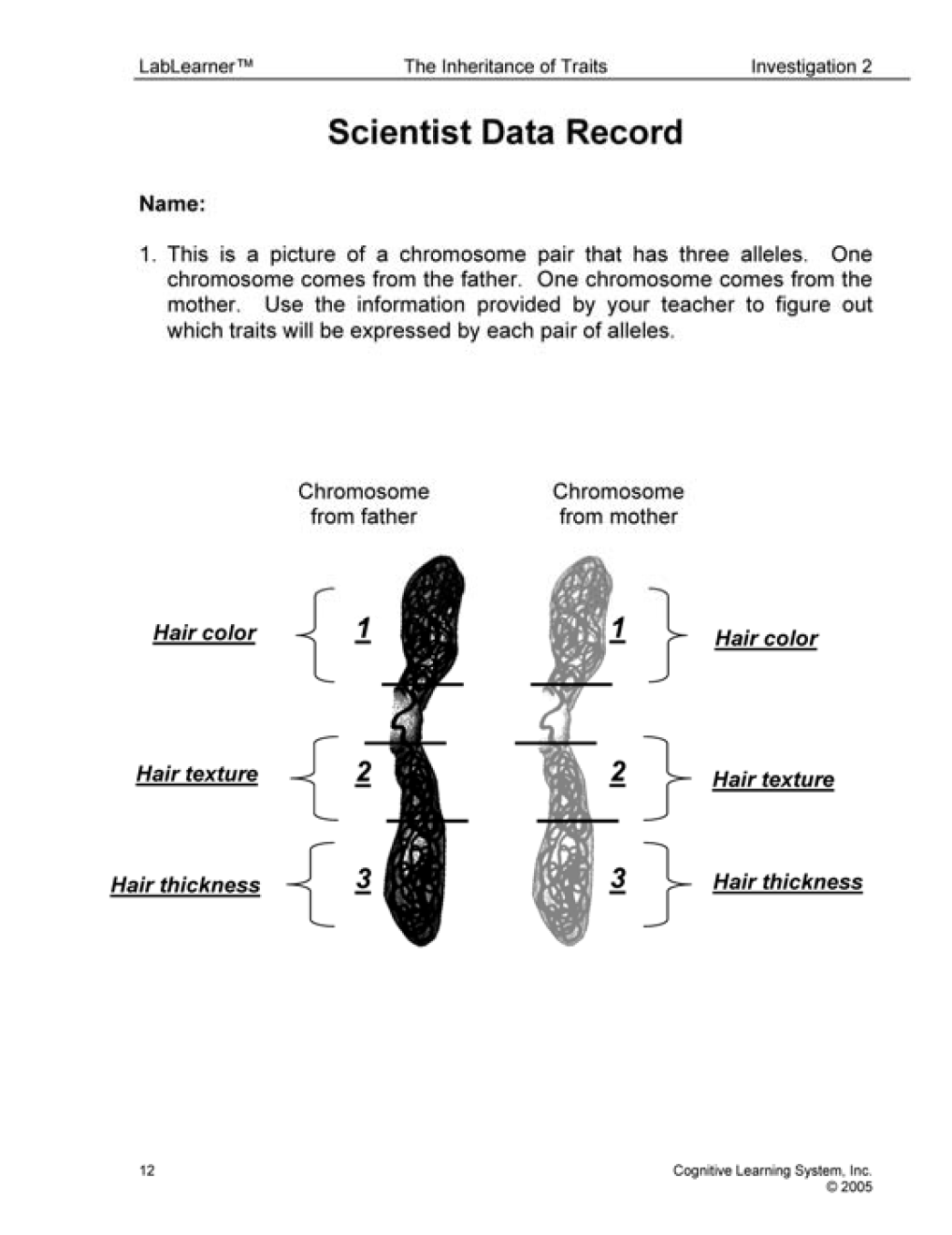
- Ask students to locate problem 1 of their Scientist Data Record.
- Explain to students that this diagram shows a picture of a chromosome pair that has three alleles. That is, each chromosome has three genes.
- The chromosome on the left came from the father and the chromosome on the right came from the mother.
- Ask students to number each pair of alleles with a “1,” “2,” and “3.”
- Direct students to color allele 1 red, allele 2 yellow, and allele 3 green.
- Inform students that in this example, the chromosome pair will carry the information for the expression of three traits: hair color, hair texture (curly or straight), and thickness of hair.
- Ask students to look at the chromosome on the left (father). Direct students to label gene 1 as “hair color,” gene 2 as “hair texture,” and gene 3 as “hair thickness.”
- Ask students: How do you think the genes on the second chromosome (mother) should be labeled? Why? Student answers may vary. Students may or may not indicate that the second chromosome should be labeled exactly as the first chromosome is labeled. This is because each chromosome pair has the same copy of genes.
- Encourage students to label the second chromosome in Problem 1 of their Scientist Data Record.
- Ask students: Do you think that the alleles for hair color will be exactly the same for each parent? Hair texture? Hair thickness? Student answers may vary. Students should indicate that each parent may have a different hair color. One parent may also have curly, thick hair, while the other parent may have straight, thin hair. This would indicate that the alleles are not exactly the same for each parent.
- Ask students: If the father has brown hair and the mother has red hair, what color hair do you think their offspring will have? Student answers may vary. Some students may indicate the offspring will have brown hair, others may indicate the offspring will have red hair, while others may indicate a completely different hair color (e.g. reddish-brown).
This should lead to a discussion of dominant and recessive alleles on slide INHERIT2-pre-8 (below).
KEYS: PRELAB EXERCISE
SHARE IT (Continued)
SLIDE INHERIT2-pre-8
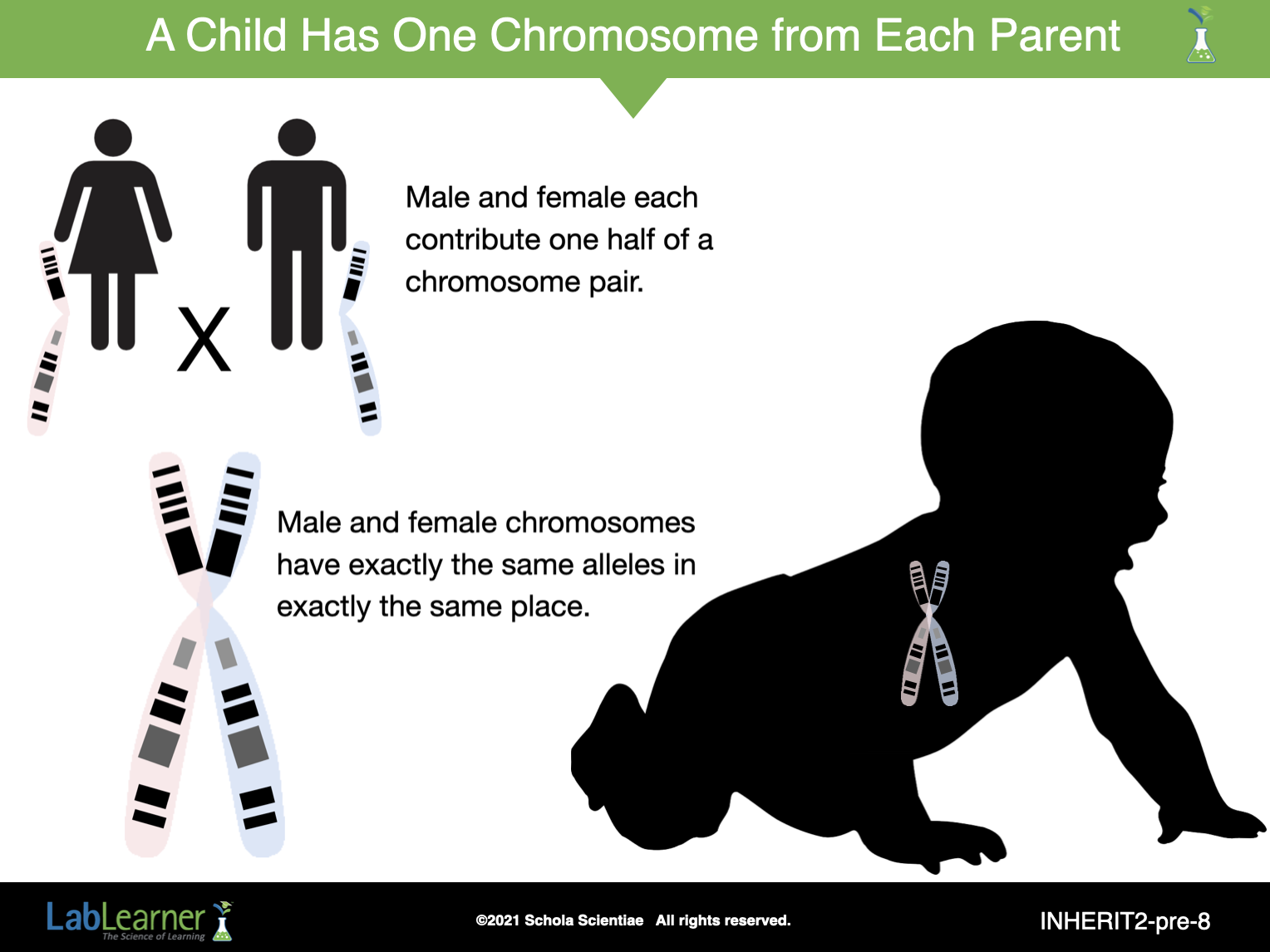
This simple slide states that every chromosome pair is composed of one chromosome from the mother and one from the father. Therefore:
No two individuals have exactly the same genetic information as either of their parents, but rather a “blend” of the multiple characteristics and traits of both parents contained on the chromosomes from each.
______________________________________________
SLIDE INHERIT2-pre-9
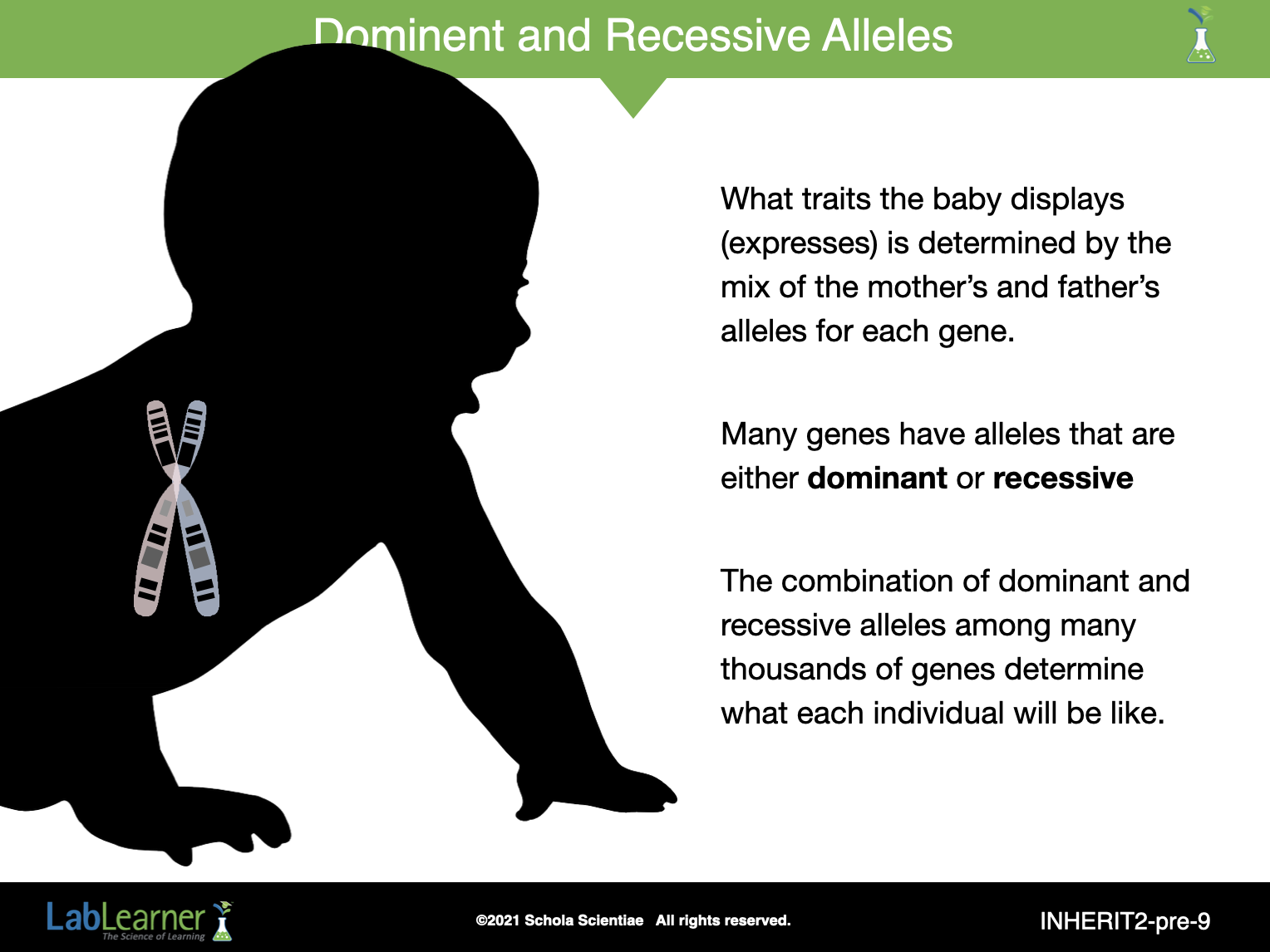
There are dominant and recessive alleles that determine how any given genetic trait is express, or shown, in a new individual.
If a dominant allele is inherited from one parent and a recessive allele of the same trait is inherited from the other parent, the outcome of the trait will be determined by the dominant or recessive nature of the alleles. This is described further on the next slide.
______________________________________________
SLIDE INHERIT2-pre-10
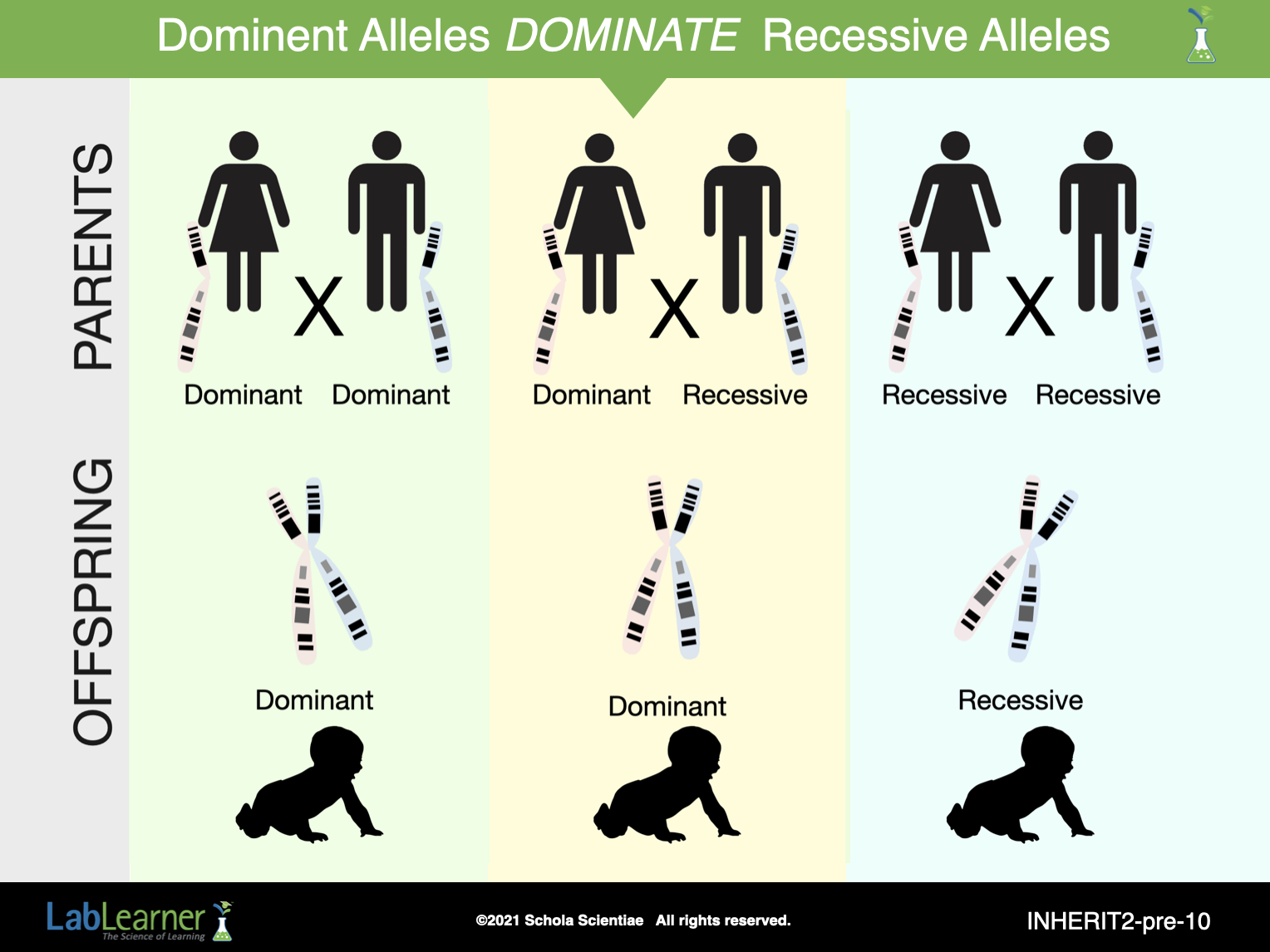
There are dominant and recessive alleles that determine how any given genetic trait is express or shown.
If a dominant allele is inherited from one parent and a recessive allele of the same trait is inherited from the other parent, the outcome of the trait will be determined by the dominant or recessive nature of the alleles.
This slide shows that the only way a recessive trait can be expressed is if the offspring (first use of this term) inherits a recessive allele from EACH parent. Whereas a dominant trait can be expressed either by inheriting either two dominant alleles from the parents OR a dominant allele from one parent and one recessive allele from the other.
______________________________________________
SLIDE INHERIT2-pre-11
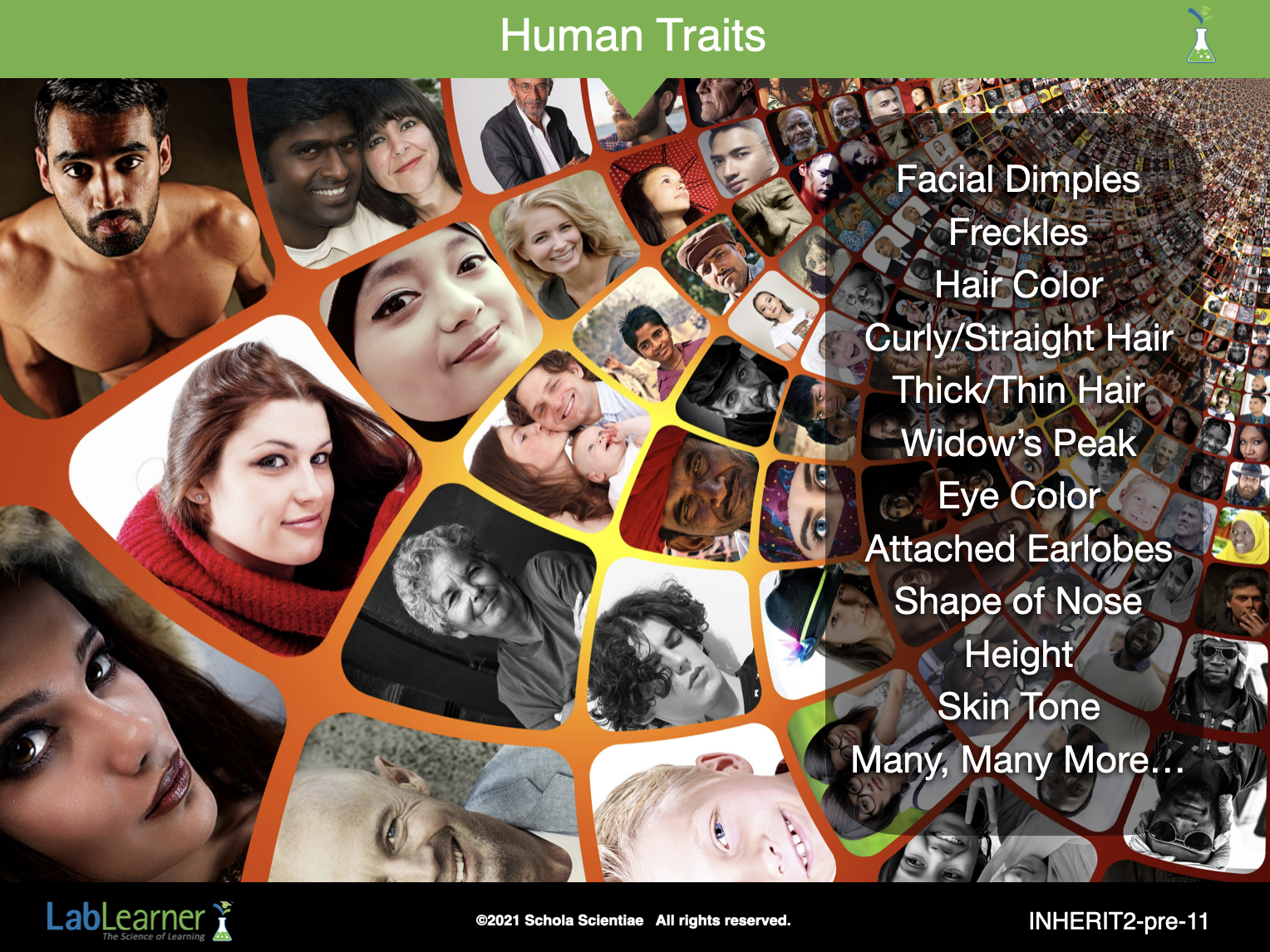
This slide shows only a partial list of heritable traits. There are many others. Taken together there is an endless combination of genes and alleles. This results in a world of diversity of traits in humans all over the globe.
Note: It is important to remember that, while we have focused on human genetics, the exact same rules apply to all plants and animal that are on Earth today or have every existed. Therefore, the same essential genetic rules that exist for humans also exists or existed for tomato plants and dinosaurs!
______________________________________________
SLIDE INHERIT2-pre-12
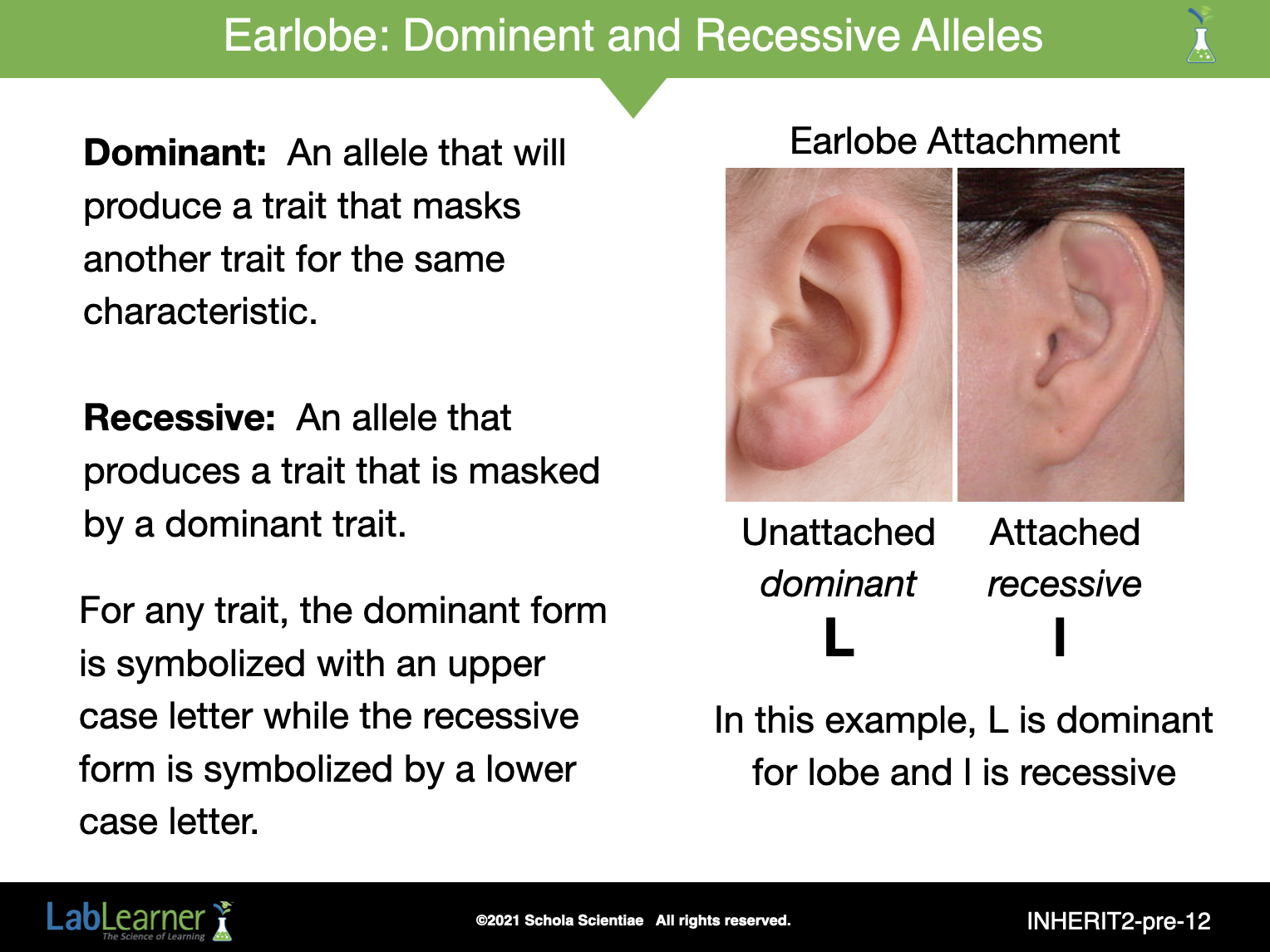
Each trait found on an allele can be a dominant trait or a recessive trait. Begin a discussion of dominant and recessive traits with this slide.
Ask students: Have you ever heard of the word dominant? What do you think it means? Student answers may vary.
______________________________________________
SLIDE INHERIT2-pre-13
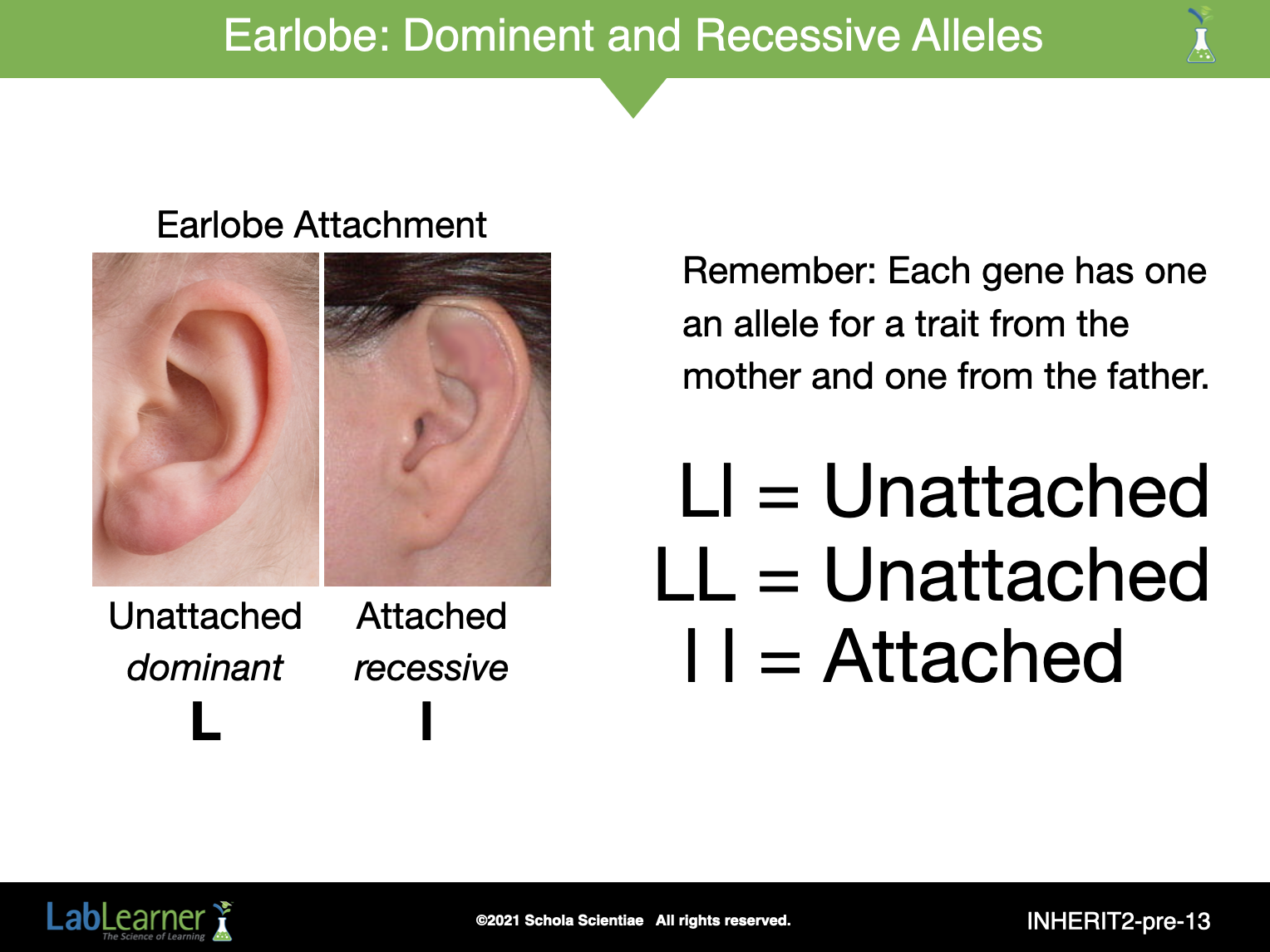
This final slide shows the result of combinations of dominant and recessive alleles for earlobe attachment. Notice that the only combination that results in the expression of the recessive trait (attached earlobes) is when an individual inherits TWO copies of the RECESSIVE allele.
Explain to students that, in the Lab, they are going to look at how dominant and recessive alleles are passed from parents to their offspring and how different traits are inherited. As they conduct their experiments, they should consider the following questions:
• Which trait will be expressed when two dominant alleles are crossed?
• Which trait will be expressed when two recessive alleles are crossed?
• Which traits will be expressed when a dominant and recessive allele are crossed?
______________________________________________
VIEW IT
Play the following student video to the class and/or assign it as homework for students to prepare for Investigation Two lab.