Teacher Portal:
Inheritance and Adaptations
Investigation 2 – PostLab
 PRINT IT
Use your browser to download a printable PDF as help during the slide presentation and to make additional notes. In your browser, go to File > Print and then choose to save as PDF.
NAVIGATE IT
Once the slide presentation is launched
- use your left and right arrows to advance or go back in the slide presentation, and
- hover your mouse over the left edge of the presentation to get a view of the thumbnails for all the slides so that you can quickly move anywhere in the presentation.
- Click HERE to launch the slide presentation for the CELL.
SHARE IT
SLIDE INHERIT2-post-1
We will begin PostLab by discussing the results students obtained in the Lab for Investigation 2.
______________________________________________
SLIDE INHERIT2-post-2
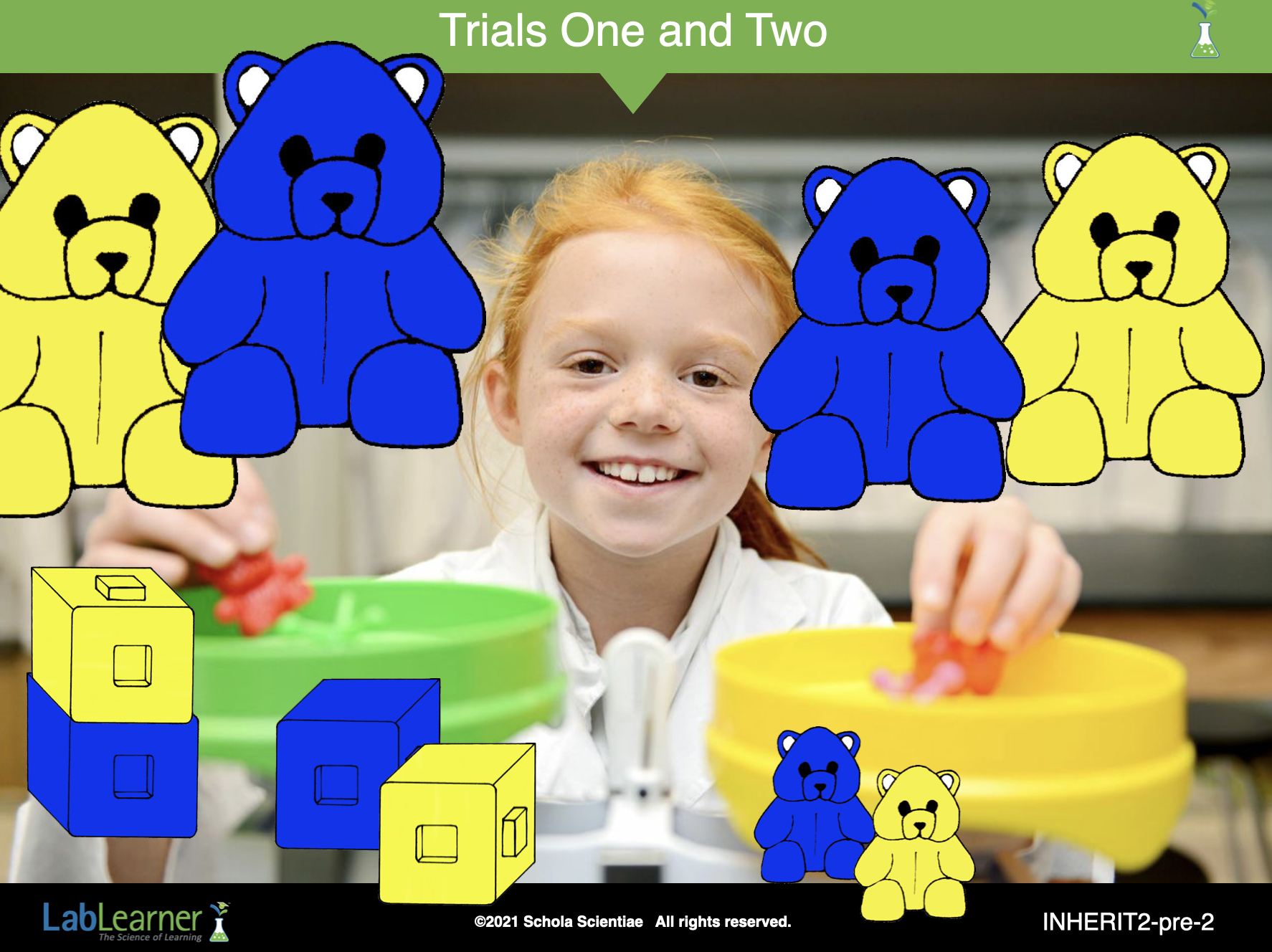
Begin analysis of the Investigation by reviewing the experiments students performed in the Lab. Use the following questions to promote a discussion:
Think about Trials 1 and 2. What were the questions you investigated and how did you answer them? Students should indicate that the questions investigated were: Which trait will be expressed when two dominant alleles are crossed? Which trait will be expressed when two recessive alleles are crossed? Which traits will be expressed when a dominant and a recessive allele are crossed? These questions were answered by conducting crosses of two-gram bears and determining which trait would be expressed.
How would you explain the word “trait”? Student answers may vary. A sample answer includes: A trait is something that is a characteristic or feature. A trait comes from a pair of alleles that are present on a chromosome. Depending on the alleles that are inherited, a trait may or may not be inherited.
What did you use to represent an allele? The alleles were represented by gram cubes.
What is the difference between a dominant and recessive allele? Give an example from the lab. Students should indicate that when a dominant allele is present it hides the expression of a recessive allele. In the Lab, when a dark/blue fur allele (dominant) was present, the bear always had dark/blue fur. When two recessive alleles are present in pairs, the recessive trait is expressed. In the Lab, when a bear had two light yellow fur alleles (recessive), the bear always had light/yellow fur.
______________________________________________
SLIDE INHERIT2-post-3
Begin analysis of the experiments by asking students to recall Trials 1 and 2. Refer students to the Scientist Data Record.
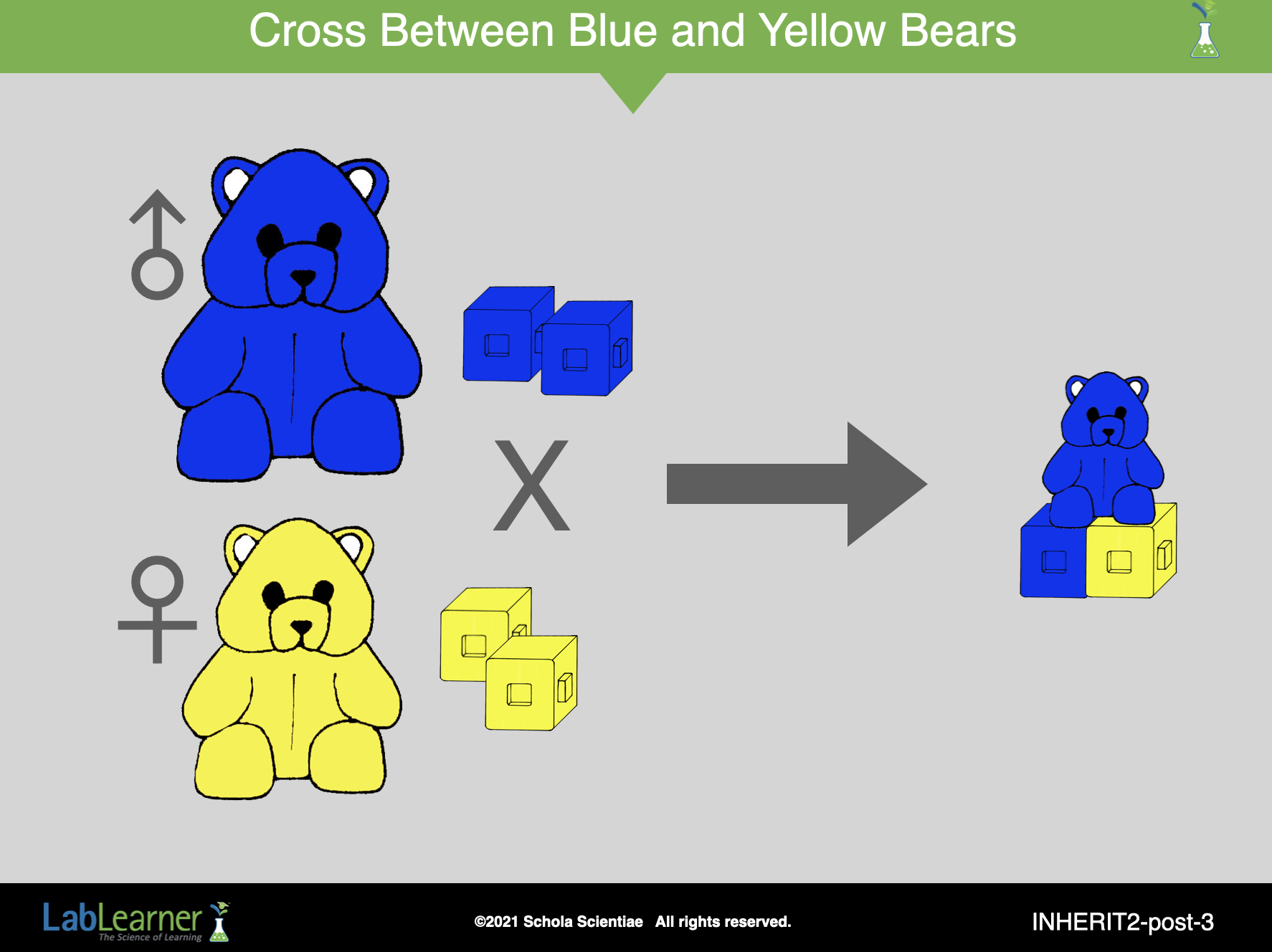
Remind students that during Trial 1 they crossed a father bear that had a dominant allele (dark/blue fur) with a mother bear that had the recessive allele (light/yellow fur). Encourage students to refer to Problem 4 of their Scientist Data Record.
Ask students: What color fur did the offspring inherit? The offspring inherited dark/blue fur.
Ask students: Can you describe the allele combination that was inherited by the baby bear? The baby bear inherited one dominant allele from its father (dark/blue fur) and one recessive allele from its mother (light/yellow fur).
Ask students: The baby bear inherited a light/yellow fur allele from its mother. Why did the baby bear not have light/yellow fur? Students should indicate that the light/yellow fur allele was recessive. The baby bear also inherited one dominant allele from its father. The dominant trait hides the recessive trait so it cannot be expressed
______________________________________________
SLIDE INHERIT2-post-4
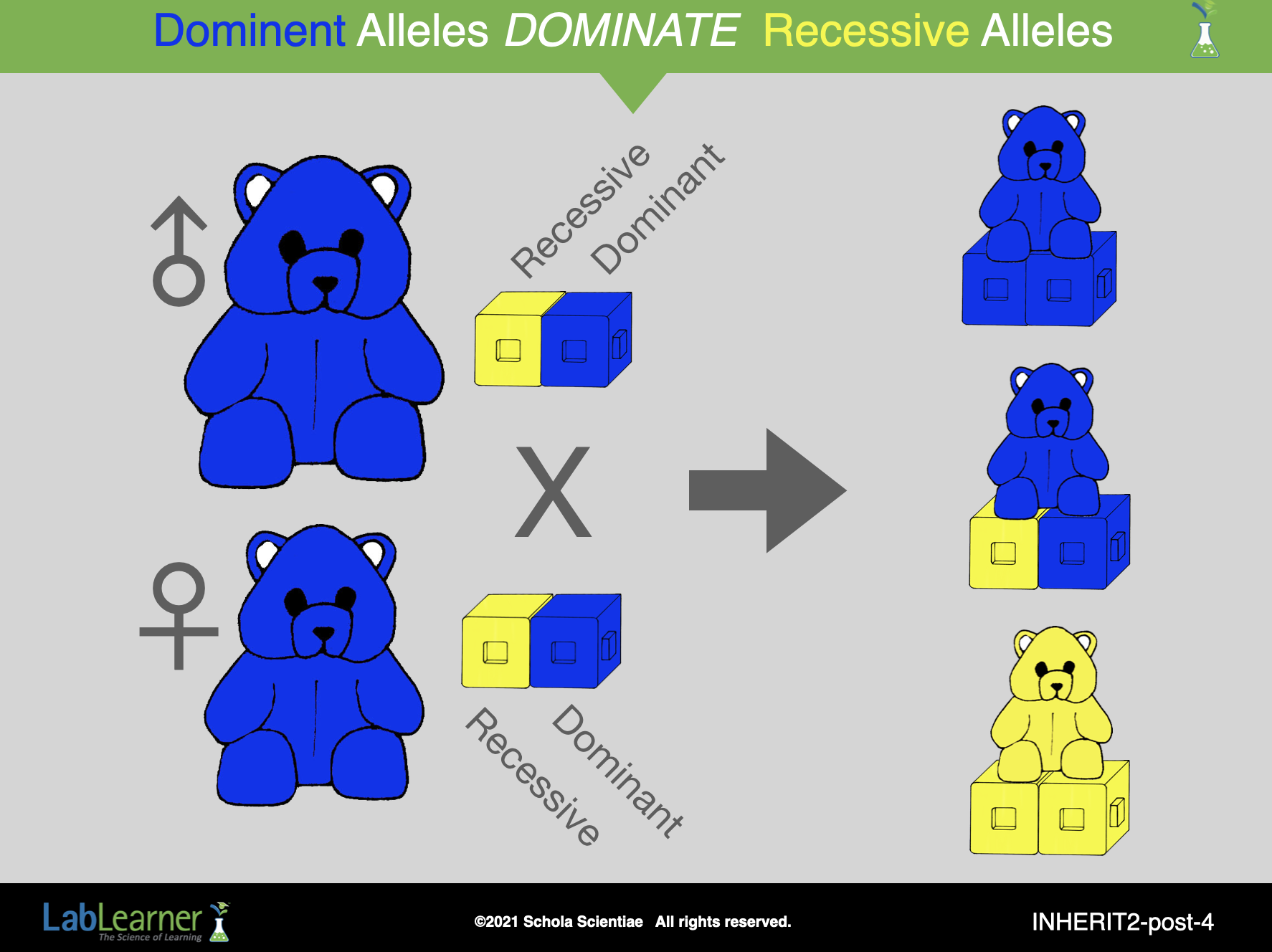
Remind students that during Trial 2 they crossed a father bear that had one dominant and one recessive allele (dark/blue fur) with a mother bear that also had one dominant and one recessive allele (dark/blue fur). Encourage students to refer to Problem 5 of their Scientist Data Record.
Ask students: What color fur did the offspring inherit? Students should indicate that different combinations were possible. In their exercise, two baby bears had dark/blue fur and one baby bear had light/yellow fur.
Ask students: Can you describe the allele combination that was inherited by the baby bears? Students should indicate that one bear inherited two dominant alleles (dark/blue fur), one bear inherited two recessive alleles (light/yellow fur), and one bear inherited one dominant and one recessive allele (dark/blue fur).
Ask students: Two baby bears inherited a light/yellow fur allele from their mother. How can you explain that only one baby bear had light/yellow fur? Students should indicate that the light/yellow fur allele was recessive. If a baby bear also inherited one dominant allele from its father in addition to the recessive allele from its mother, then the recessive trait would be hidden. The dominant trait hides the recessive trait so it can not be expressed. The baby bear with the light/yellow fur also inherited a recessive light/yellow fur allele from its father giving it two recessive alleles. The two recessive alleles resulted in the baby’s light/yellow fur.
______________________________________________
SLIDE INHERIT2-post-5
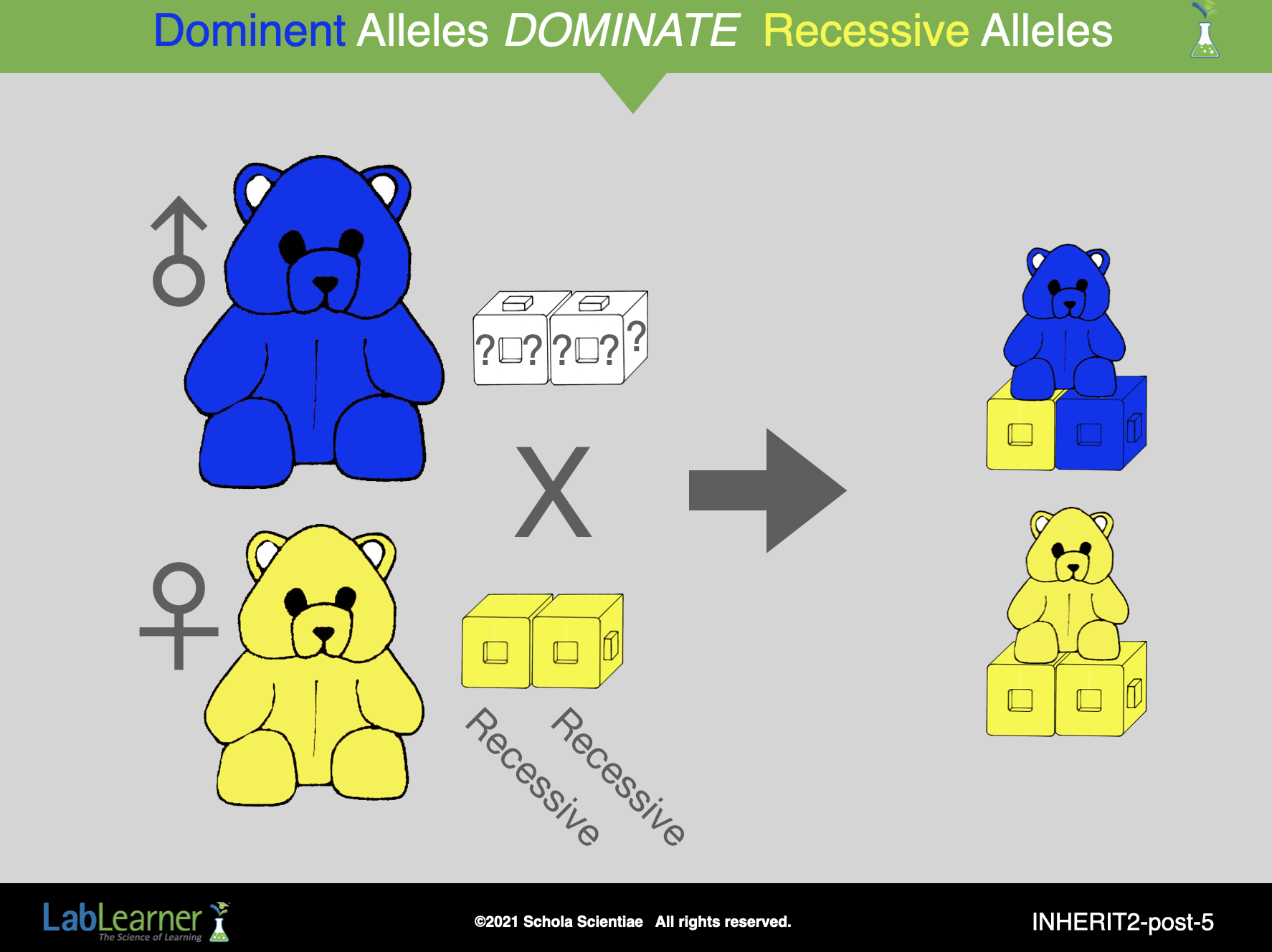
In order to reinforce the concepts introduced in the Lab, engage students in solving the following problem.
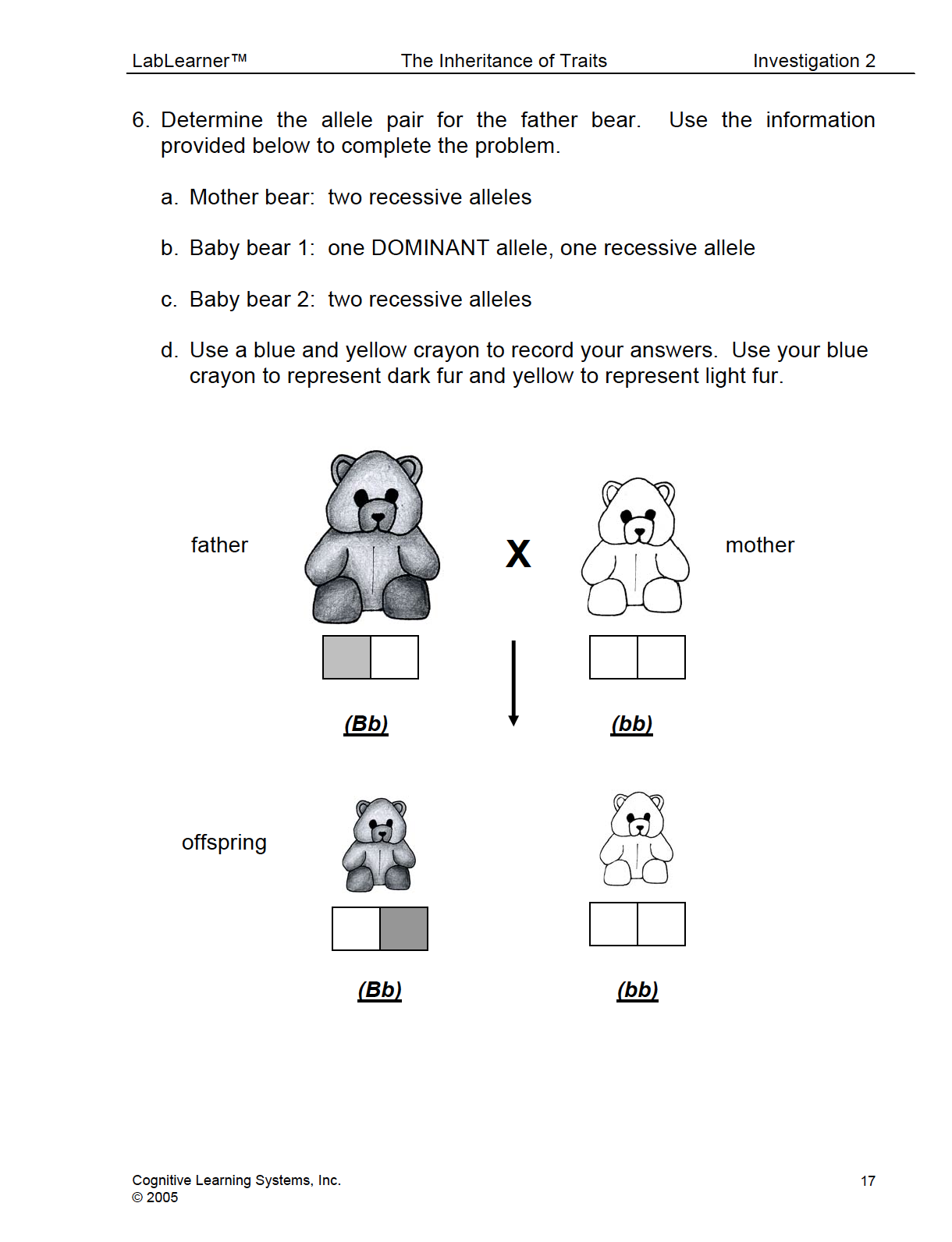
Ask students to locate Problem 6 of the Scientist Data Record.
Explain to students that in this cross, the alleles of the mother bear and the baby bears are known. The alleles for the father bear are unknown.
- The mother has two recessive alleles and has inherited light/yellow fur.
- The first baby bear has one dominant allele and one recessive allele and has inherited dark/blue fur.
- A second baby bear has two recessive alleles and has inherited light/yellow fur.
Divide the class into groups of two. Encourage students to work with their partners to determine the pair of alleles for the father bear. Students should use blue and yellow crayons to record their answers. Blue will represent dark fur, yellow will represent light fur.
Allow sufficient time for student pairs to complete the activity. Encourage several student pairs to share their answers with the rest of the class. The following questions may be used to facilitate the discussion:
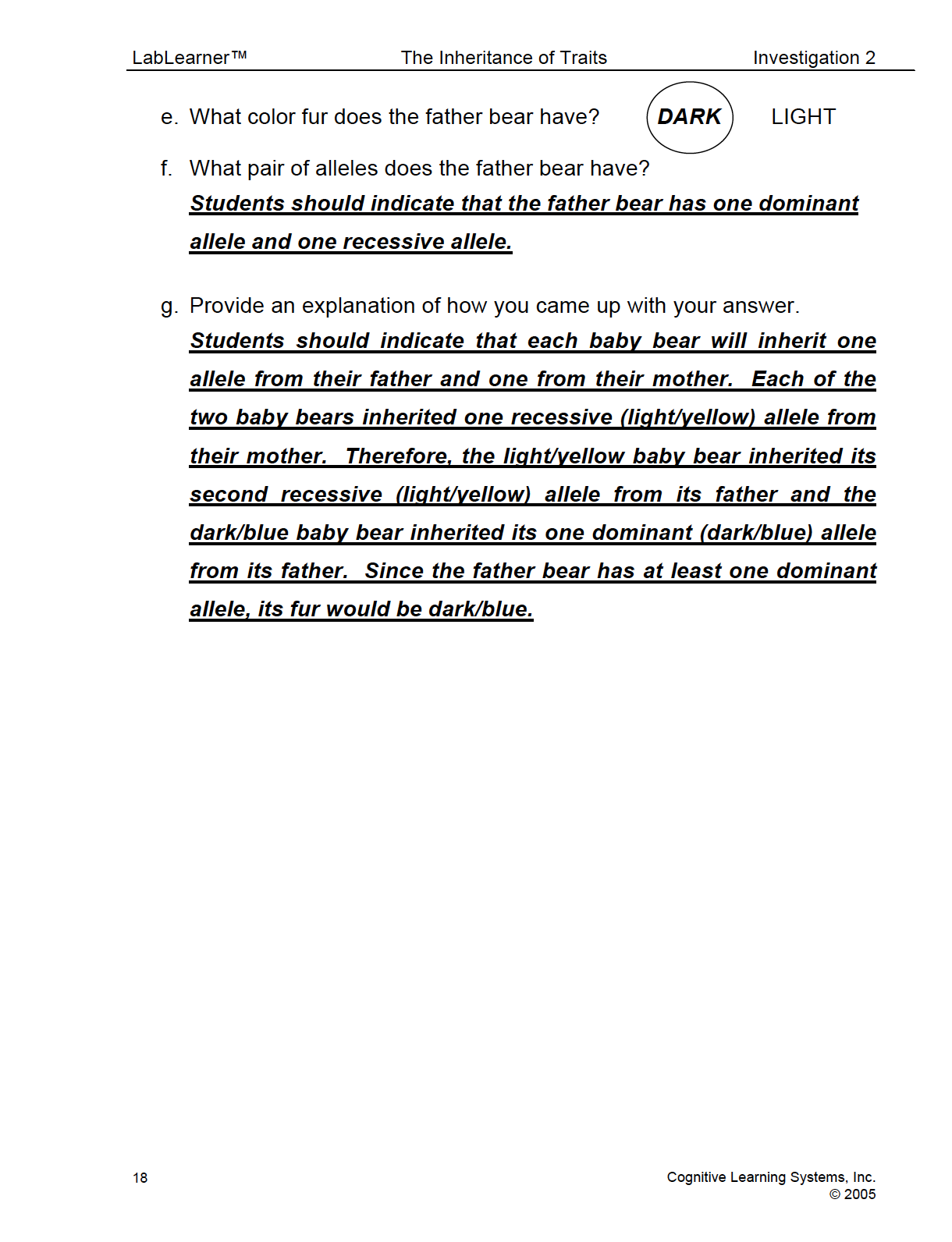
What color fur does the father bear have? The father bear has dark/blue fur.
What pair of alleles does the father bear have? The father bear has one dominant allele and one recessive allele.
Can you explain how you came up with this result? Students should indicate that each baby bear will inherit one allele from their father and one from their mother. Each of the two baby bears inherited one recessive (light/yellow) allele from their mother. Therefore, the light/yellow baby bear inherited its second recessive (light/yellow) allele from its father and the dark/blue baby bear inherited its one dominant allele (dark/blue) from its father. Since the father bear has at least one dominant allele, its fur would be dark/blue.
______________________________________________
SLIDE INHERIT2-post-6
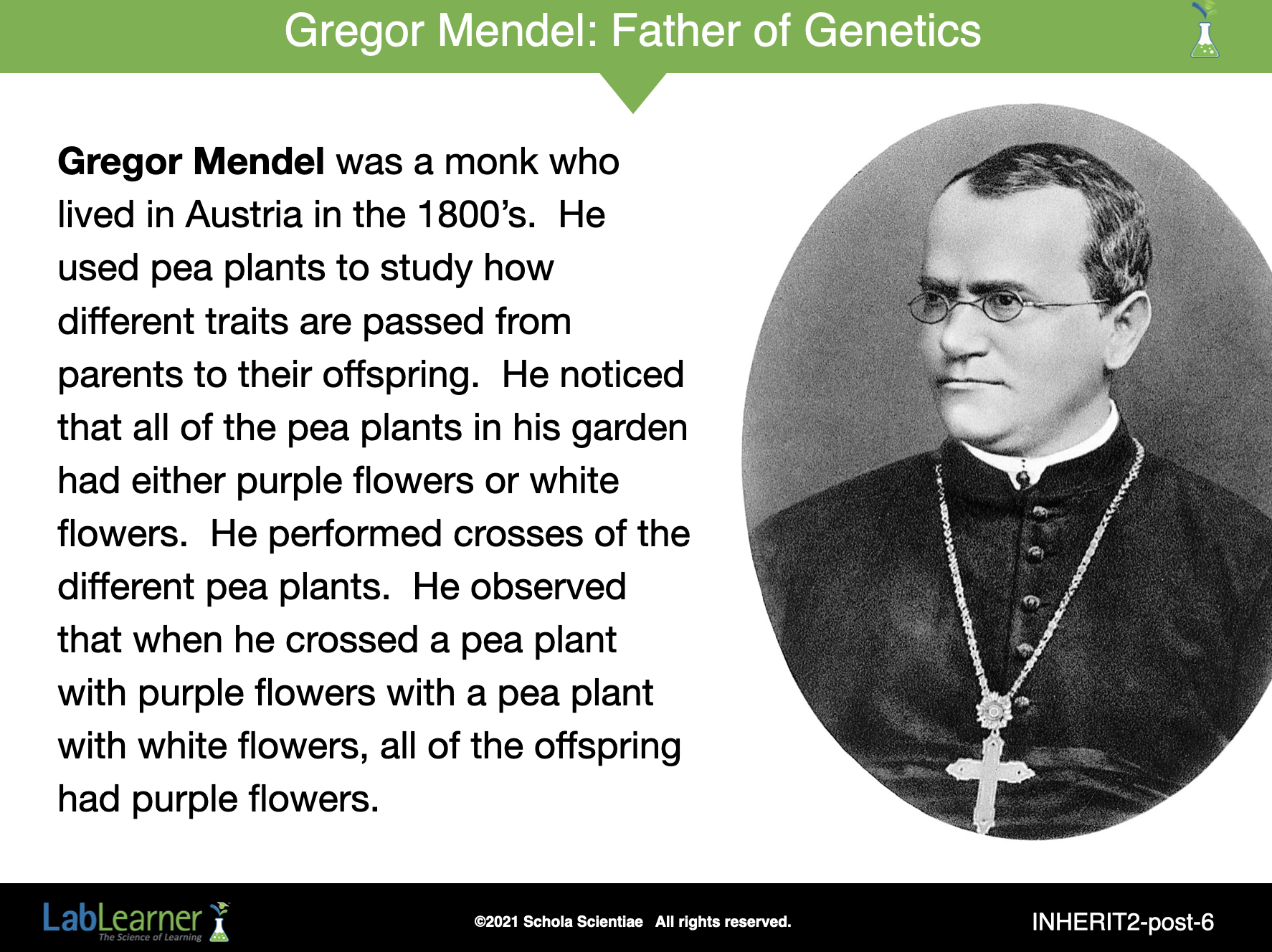
During this portion of the investigation, introduce students to a scientist named Gregor Mendel. Gregor Mendel is considered to be the “father of genetics.” He conducted genetic experiments with pea plants and determined the basis for the inheritance of different traits.
Ask students to locate the Scientific Background found in the Scientist Data Record. The Scientific Background may be read independently, as a group, or as a class.
“Gregor Mendel was a monk who lived in Austria in the 1800’s. He used pea plants to study how different traits are passed from parents to their offspring. He noticed that all of the pea plants in his garden had either purple flowers or white flowers. He performed crosses of the different pea plants. He observed that when he crossed a pea plant with purple flowers with a pea plant with white flowers, all of the offspring had purple flowers.”
______________________________________________
SLIDE INHERIT2-post-7
Ask students to locate Problem 6 of their Scientist Data Record.
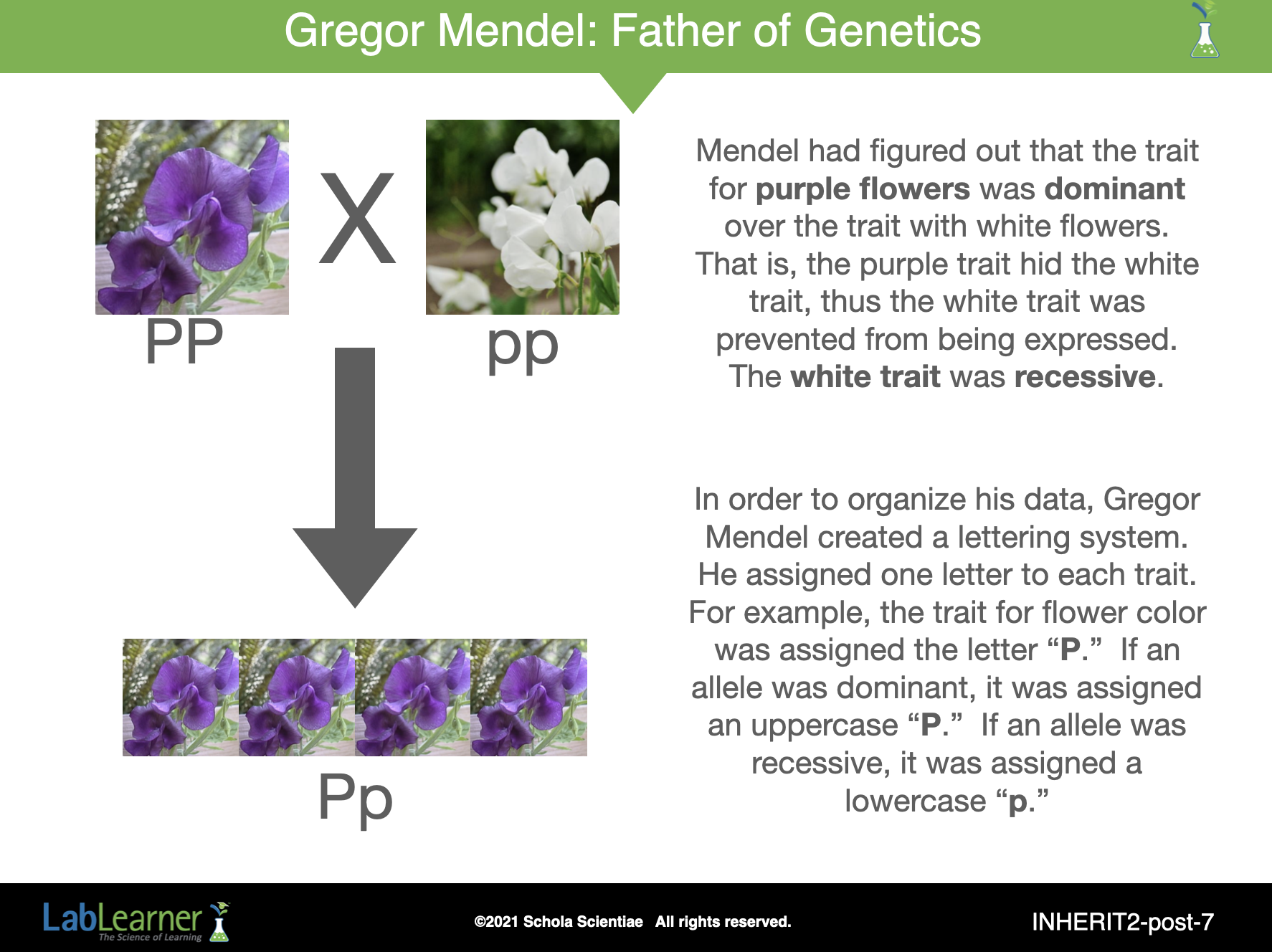
Ask students: What letter could you assign to the trait of “fur color?” Student answers may vary. It should be noted that any letter can be assigned to this trait. For the purpose of this exercise, the letter “B” has been arbitrarily chosen.
Ask students: How would you use symbols to show the pair of alleles for the father bear? Mother bear? Baby bears? Students should indicate the father bear would be Bb, the mother bear would be bb, baby bear 1 would be Bb, and baby bear 2 would be bb. Encourage students to record the letters in Problem 6. Encourage students to realize that Bb and bB are the same. however, the convention is that the capital letter is always written first.
______________________________________________
SLIDE INHERIT2-post-8
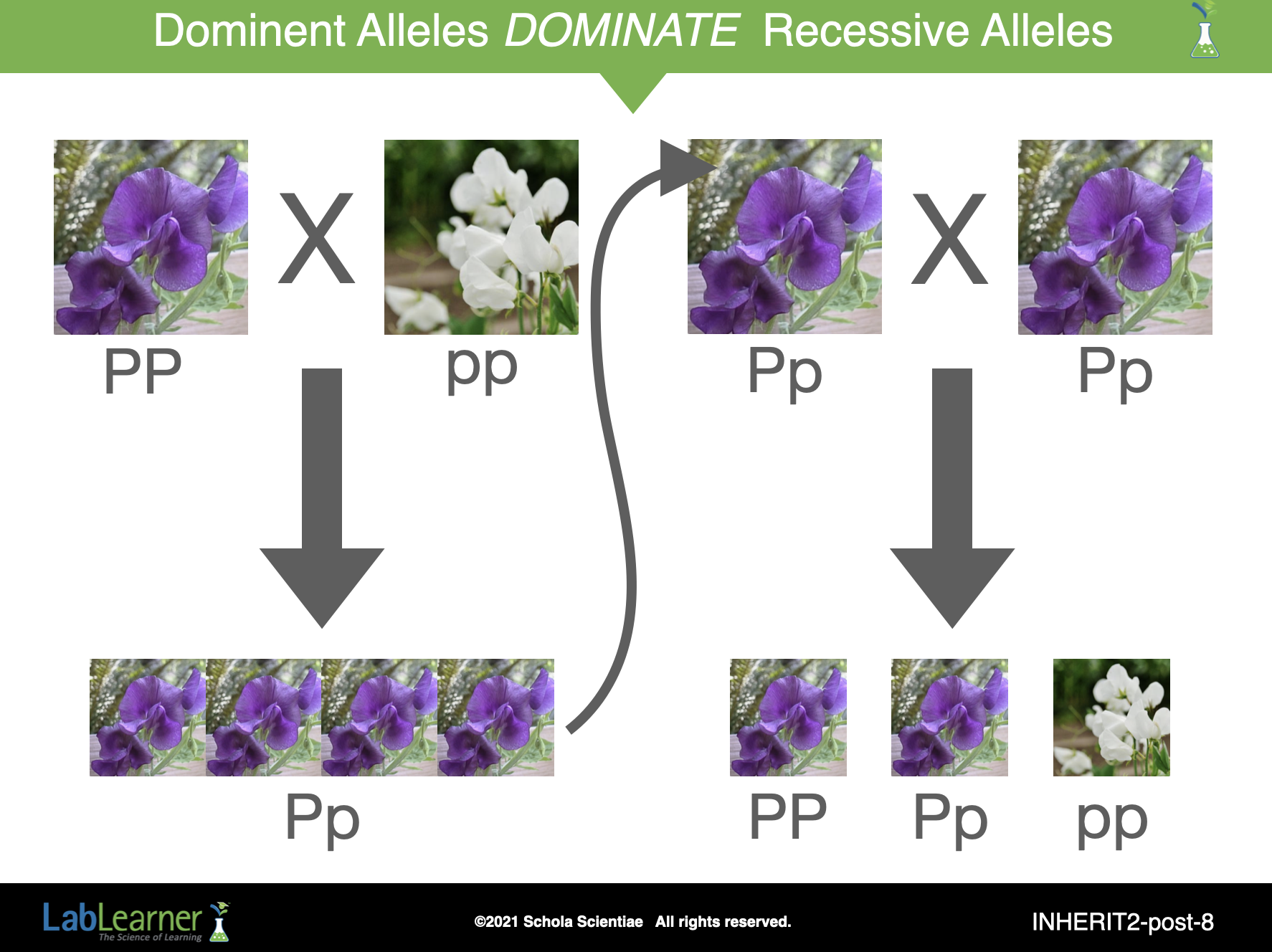
There are dominant and recessive alleles that determine how any given genetic trait is express or shown.
If a dominant allele is inherited from one parent and a recessive allele of the same trait is inherited from the other parent, the outcome of the trait will be determined by the dominant or recessive nature of the alleles.
This slide shows that the only way a recessive trait can be expressed is if the offspring (first use of this term) inherits a recessive allele from EACH parent. Whereas a dominant trait can be expressed either by inheriting either two dominant alleles from the parents OR a dominant allele from one parent and one recessive allele from the other.
______________________________________________
SLIDE INHERIT2-post-9
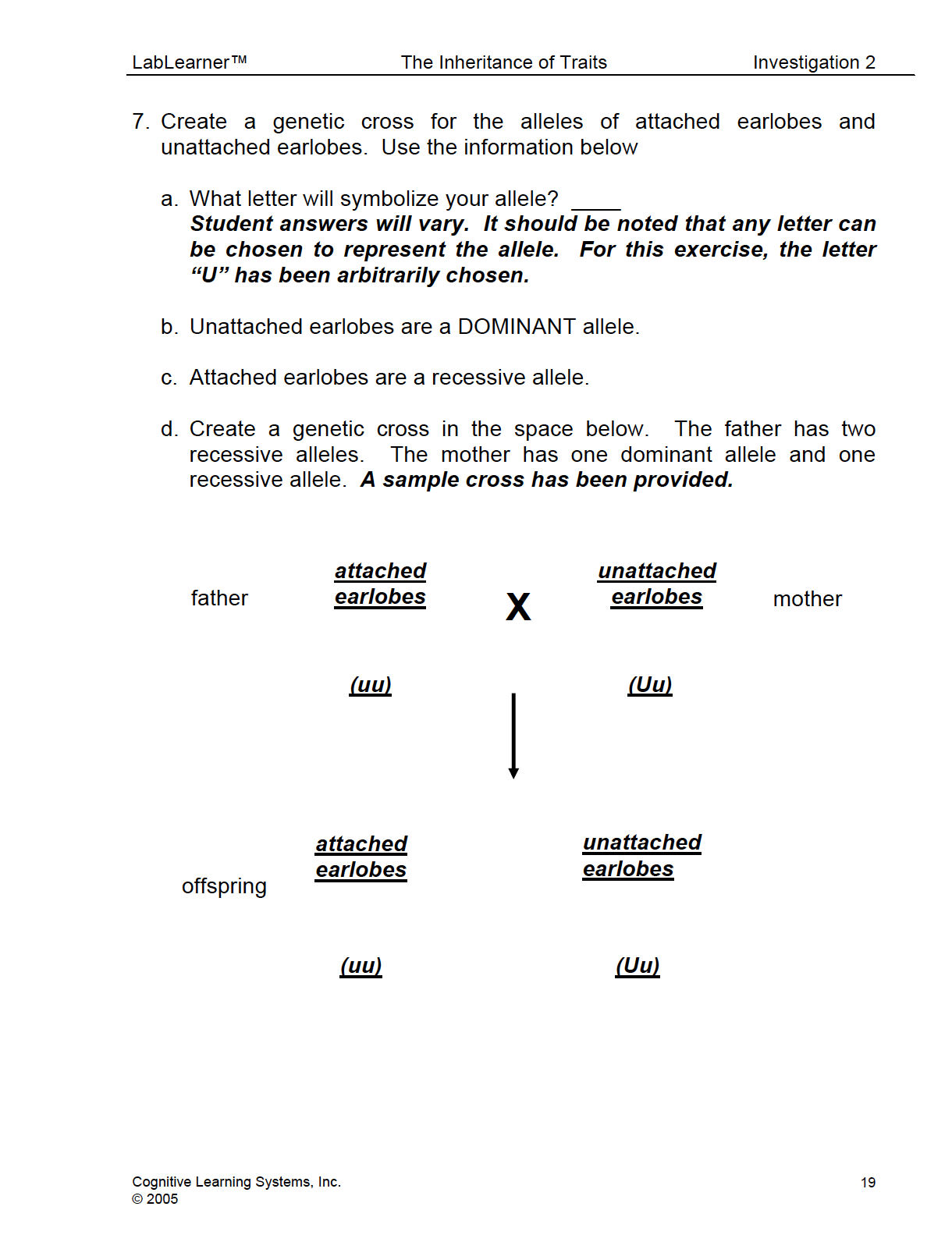
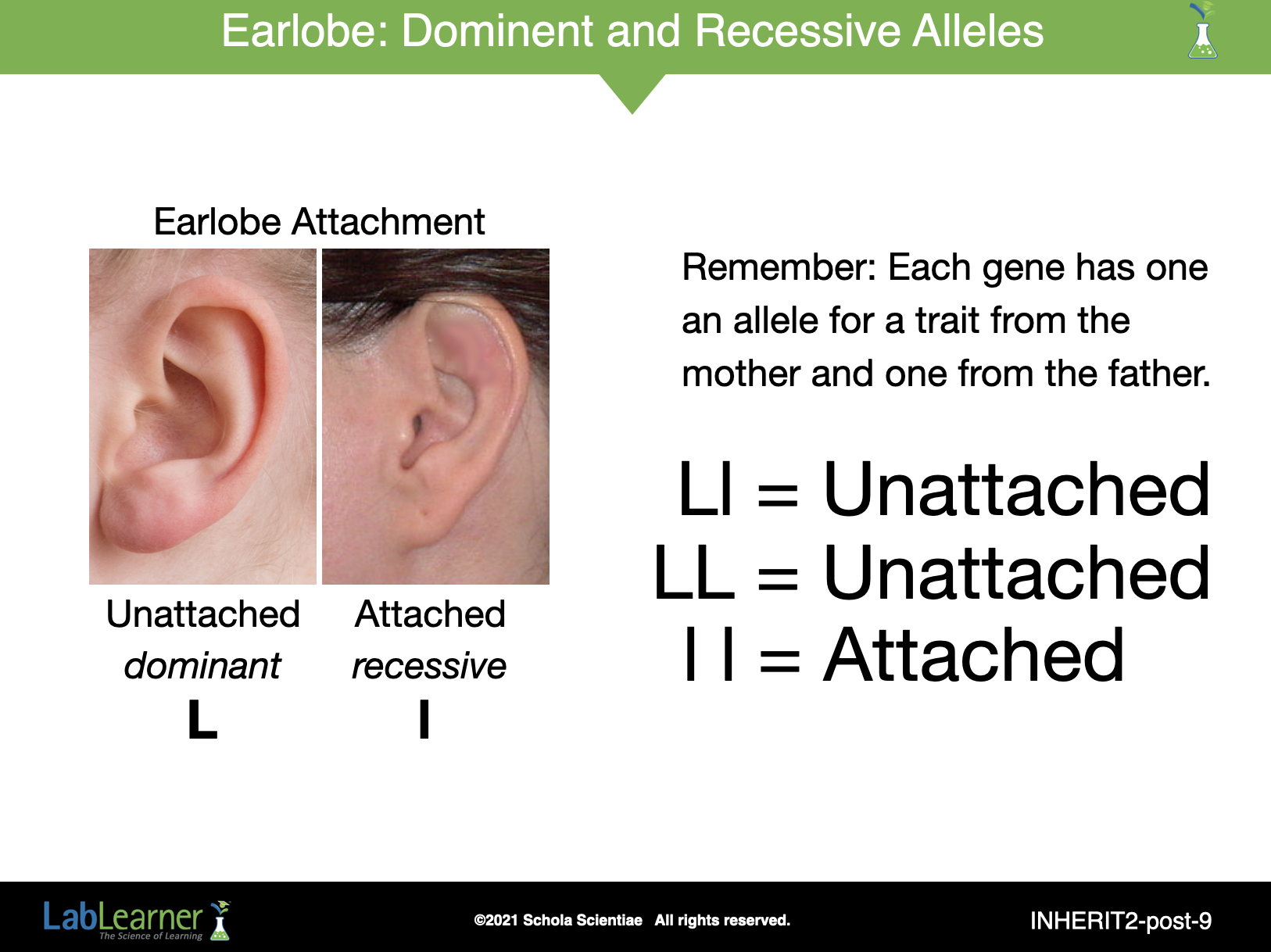
Inform students that, like pea plants, humans also have certain traits that are dominant and recessive. One example is attached and unattached earlobes as we discussed in Investigation 2 PreLab. Unattached earlobes are a dominant trait and attached earlobes are a recessive trait. Explain to students that in the last step of PostLab, they are going to cross two parents and determine which type of earlobes their offspring will inherit.
- Direct students to locate Problem 7 of their Scientist Data Record.
- Inform students to determine which letter is going to represent the trait. It should be noted that any letter can be assigned to this trait. For the purpose of this exercise, the letter “U” has been arbitrarily chosen.
- Remind students that the dominant allele will be denoted by a capital letter and the recessive allele will be denoted by a lowercase letter.
- Allow sufficient time for student groups to complete their cross. After completed, ask several student groups to share their answers with the class.
Finally, explain that in Investigation 3, they will be looking at different allele pairs for traits found on the human face. They will use the information they collect to create a model of a human face that contains dominant and recessive traits.
______________________________________________
KEYS: POSTLAB EXERCISE