
Teacher Portal:
Inheritance and Adaptations
Investigation 2 – Lab
 BE PREPARED
| Group materials |
|
| Individual materials: |
|
Teacher Preparation
1. Organize the required materials at a distribution point.
2. Divide students into groups of three.
Teacher Preparation
Direct each student group to obtain the following necessary materials from the distribution point: one (1) yellow large (12 g) bear, one (1) blue large (12 g) bear, one (1) yellow medium (8 g) bear, one (1) blue medium (8 g) bear, two (2) yellow small (4 g) bears, two (2) blue small (4 g) bears, five (5) yellow gram cubes, five (5) blue gram cubes, one (1) yellow crayon, and one (1) blue crayon.
GET FOCUSED
Explain to students that they are going to look at how dominant and recessive alleles are passed from parents to their offspring and how different traits are inherited in the Lab. As they conduct their experiments, they should consider the following questions:
• Which trait will be expressed when two dominant alleles are crossed?
• Which trait will be expressed when two recessive alleles are crossed?
• Which traits will be expressed when a dominant and recessive allele are crossed?
INVESTIGATE
1. During this Investigation, students will perform two trials that look at dominant and recessive alleles. Each chromosome found in the nucleus of a cell consists of DNA which has smaller parts called genes. A gene contains information about a specific trait or characteristic. Each gene has two copies or two alleles. An allele can be dominant or recessive. A dominant allele always takes priority over a recessive allele. After performing these trials, students should discern that different combinations of dominant and recessive alleles will result in a specific expression of a trait. As students perform their trials, ask them to consider the following questions:
Which trait will be expressed when two dominant alleles are crossed?
Which trait will be expressed when two recessive alleles are crossed?
Which traits will be expressed when a dominant and a recessive allele are crossed?
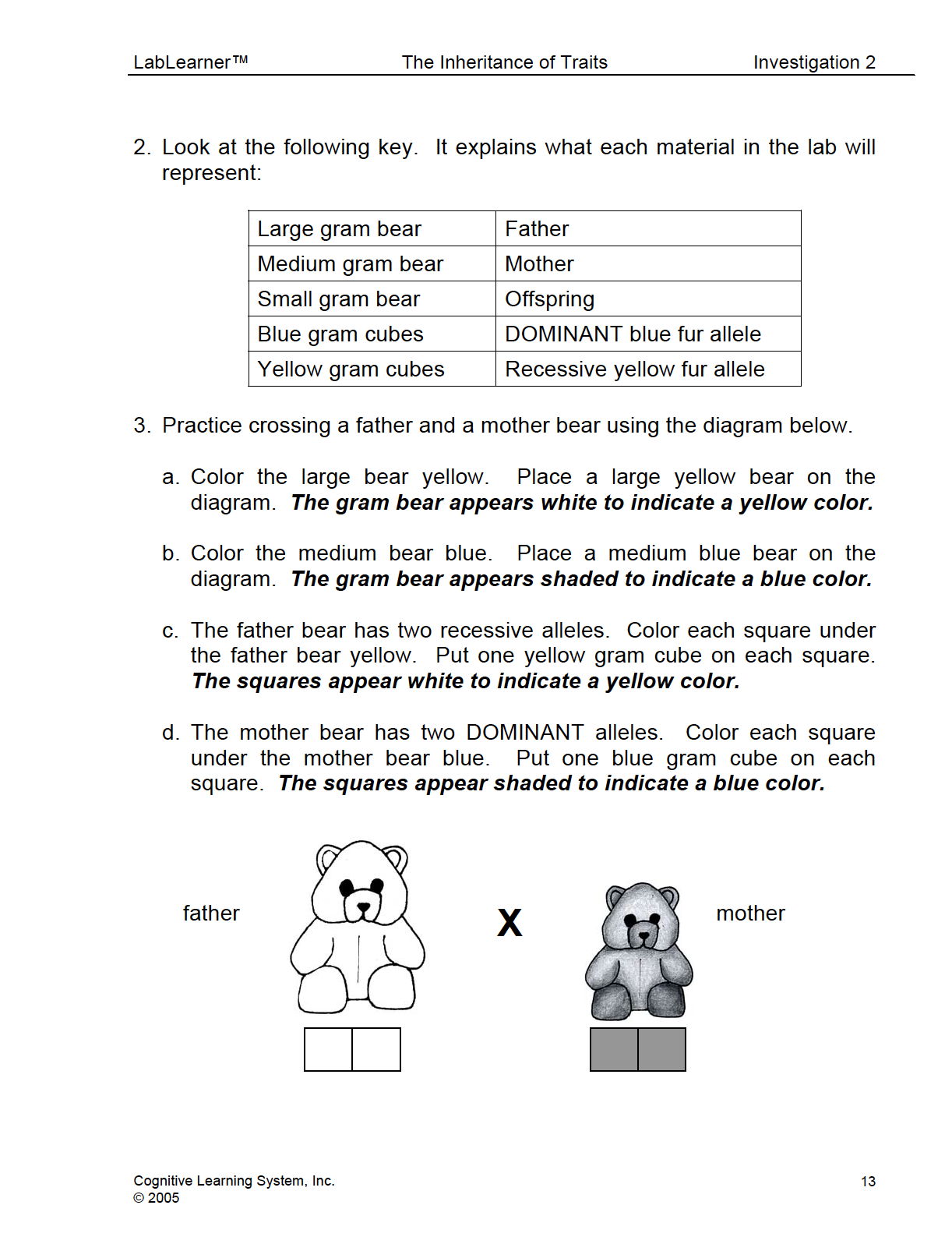
2. Before performing the Trials, direct students to complete Problems 2 and 3 of their Scientist Data Record.
Trial 1
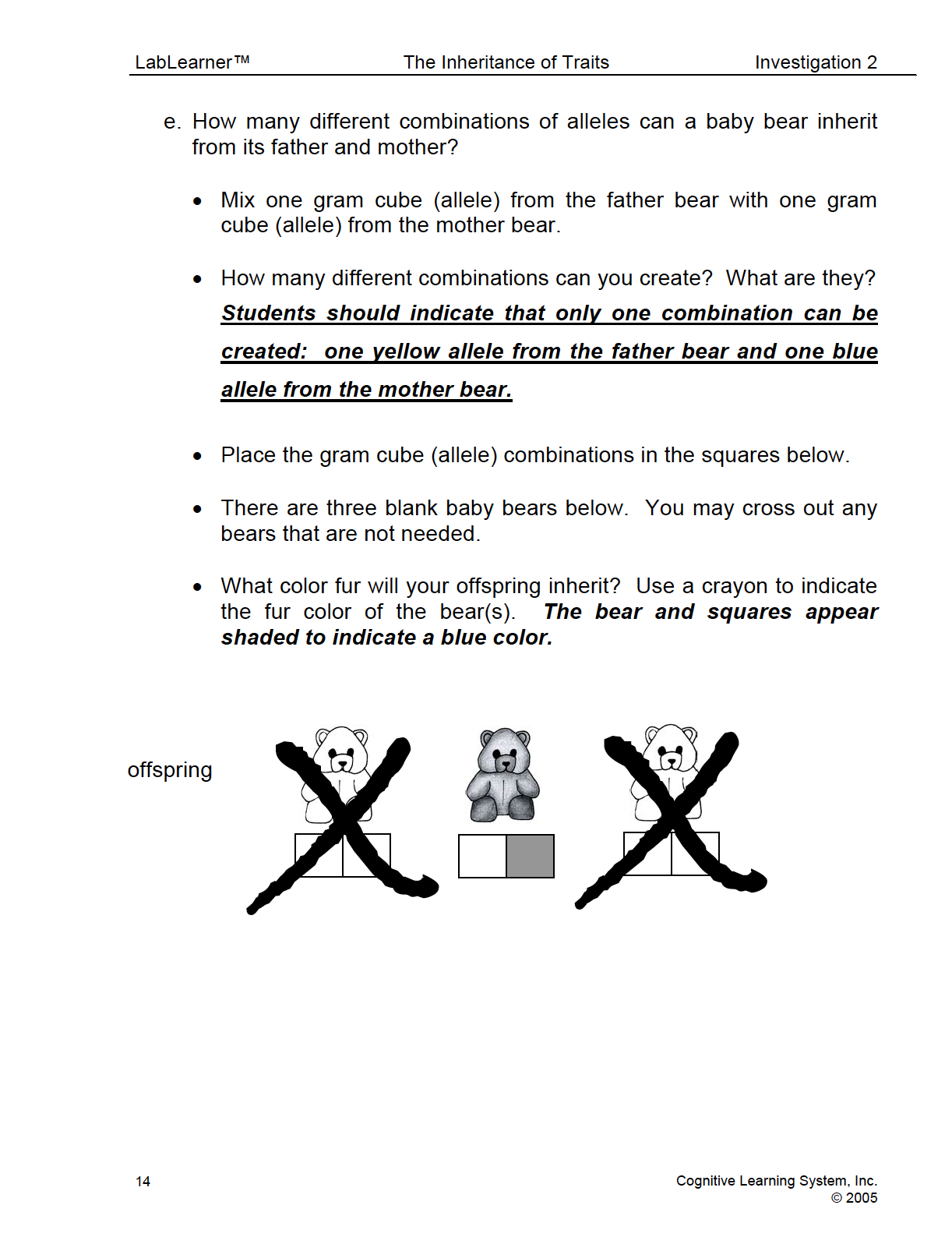
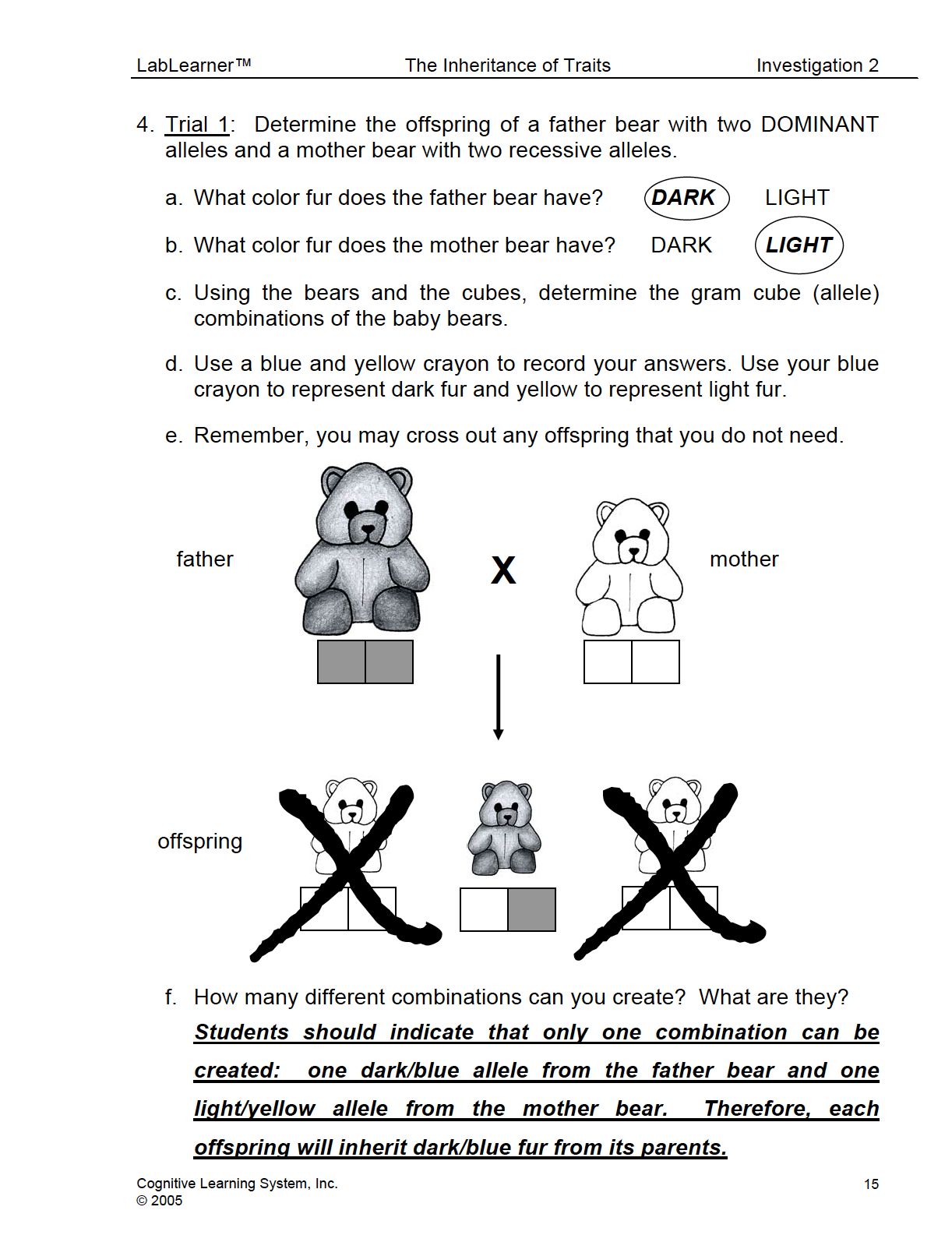
During this Trial, students will cross a father bear that has a dominant trait (dark/blue fur) with a mother bear that has the recessive trait (light/yellow fur). By manipulating the alleles of each parent, students will be able to determine that all offspring will inherit one recessive allele from the mother and one dominant allele from the father. This results in all offspring expressing the dominant trait of dark/blue fur. The question students will answer during this trial is:
Which trait will be expressed when a dominant and a recessive allele are crossed?

Trial 2
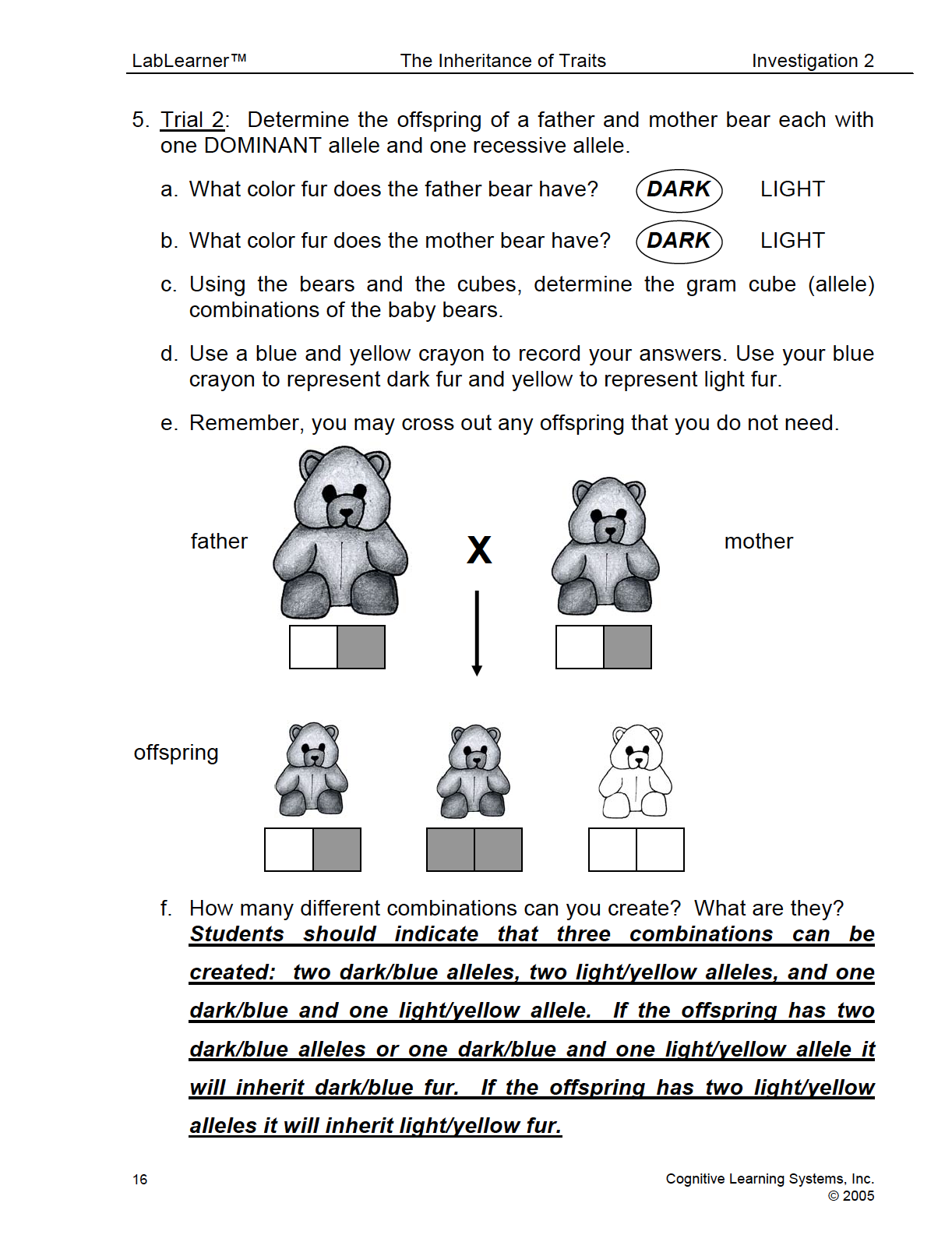
During this Trial, students will cross a father bear that has one dominant and one recessive allele (dark/blue fur) with a mother bear that also has one dominant and one recessive allele (dark/blue fur). By manipulating the alleles of each parent, students will be able to determine that the offspring will inherit one of three allele pairs: two dominant alleles, two recessive alleles, or one dominant and one recessive allele. This results in an offspring that can inherit one dominant and one recessive allele (dark/blue fur), two dominant alleles (dark/blue fur), or two recessive alleles (light/yellow fur). The questions students will answer during this trial are:
Which trait will be expressed when two dominant alleles are crossed?
Which trait will be expressed when two recessive alleles are crossed?
Which traits will be expressed when a dominant and a recessive allele are crossed?
KEYS
CLEAN UP
Let students know your expectations for clean-up. Ask them to clean up.