Teacher Portal:
Inheritance and Adaptations
Investigation 1 – PostLab
 PRINT IT
Use your browser to download a printable PDF as help during the slide presentation and to make additional notes. In your browser, go to File > Print and then choose to save as PDF.
NAVIGATE IT
Once the slide presentation is launched
- use your left and right arrows to advance or go back in the slide presentation, and
- hover your mouse over the left edge of the presentation to get a view of the thumbnails for all the slides so that you can quickly move anywhere in the presentation.
- Click HERE to launch the slide presentation for the CELL.
SHARE IT
SLIDE INHERIT1-post-1
Begin the PostLab of the Investigation by encouraging students to summarize their activities in the Lab. Prompt student discussion by posing the following questions:
What were the main questions we wanted to investigate in this Lab? Students should indicate that the questions were: How is DNA extracted from individual onion cells? What does DNA look like?
______________________________________________
SLIDE INHERIT1-post-2
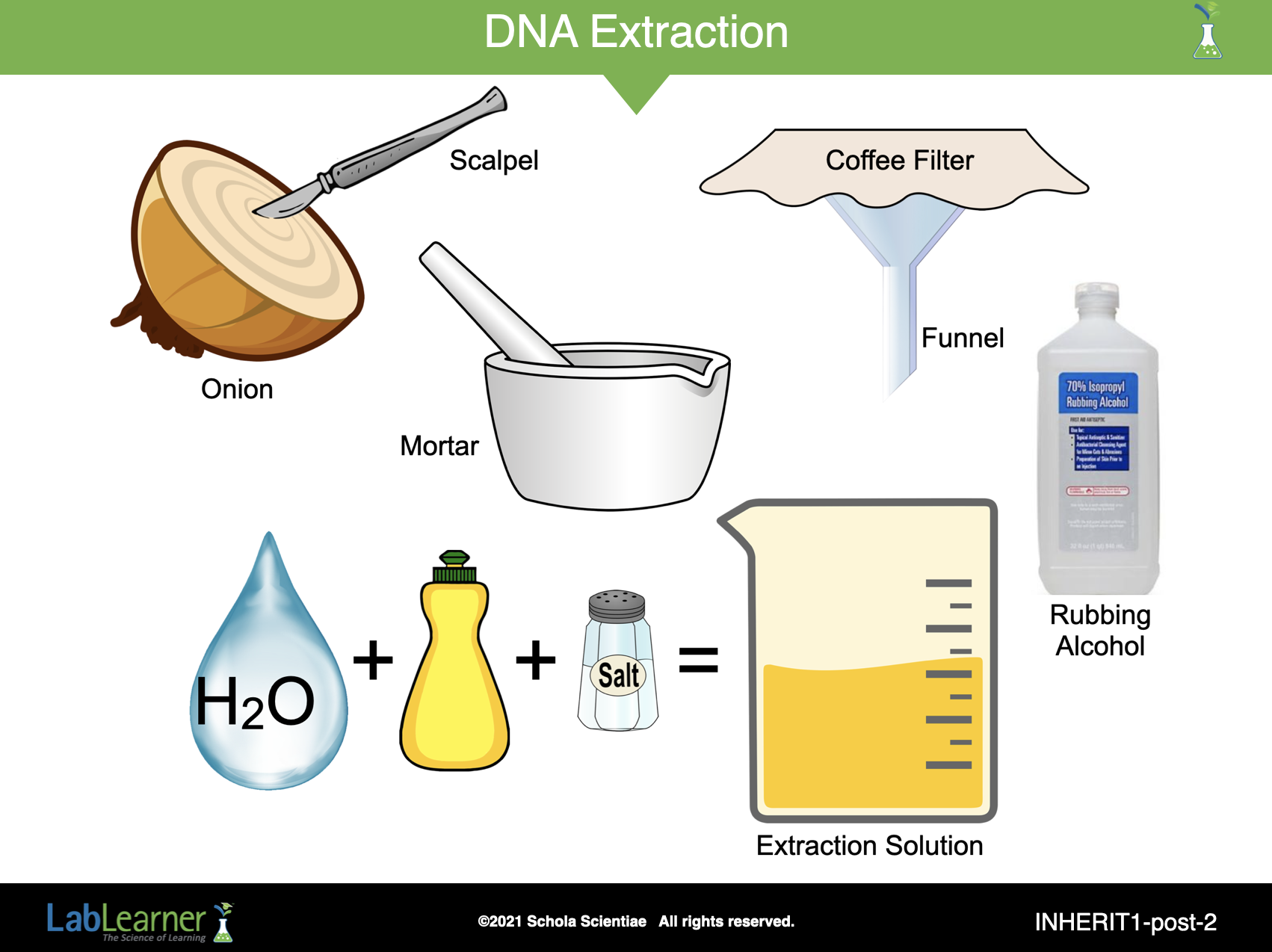
Begin the analysis of the experiment by asking students to think more deeply about the DNA that they extracted from the onion cells.
Ask students: Can you see DNA when you look at a whole onion? Why? Students should indicate that they cannot see DNA when they look at a whole onion. This is because a whole onion contains billions of microscopic cells. The DNA is located in the nucleus of the cells and cannot be seen with the naked eye.
Ask students: After grinding and filtering your onion mixture, what did the extracted DNA look like? Students should indicate that the DNA appeared as long, white strings in the centrifuge (Falcon) tube.
Ask students: Why do you think it was important to follow the steps of the procedure in order? Students should indicate that if the steps of the procedure were not followed in order, the DNA would not have been released by the cells. The cells may not have been able to be broken open or the DNA could have been damaged if steps were skipped or not followed in order.
______________________________________________
SLIDE INHERIT1-post-3
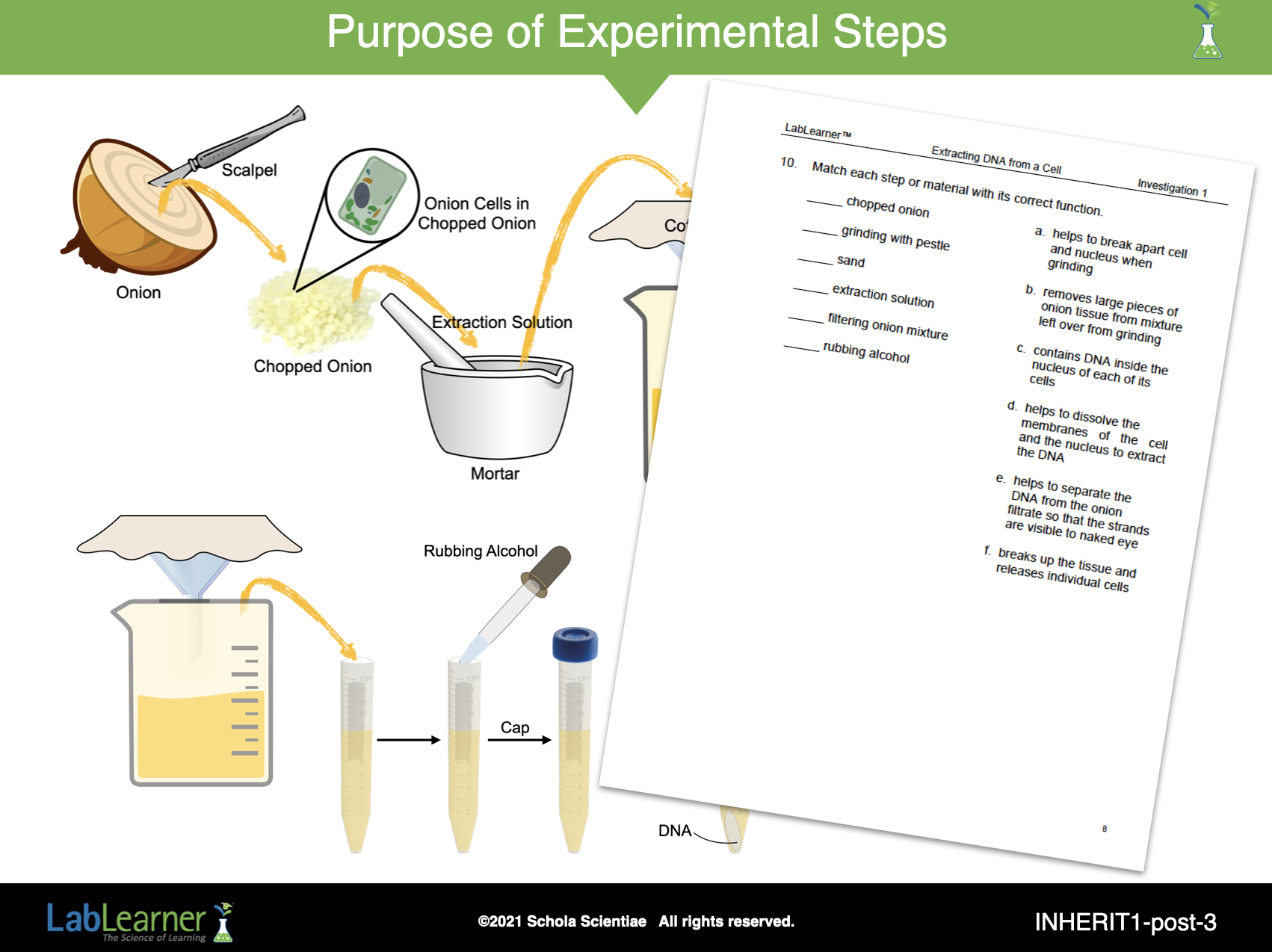
Divide the class into groups of three.
- Ask student groups to locate Problem 10 of their Scientist Data Record.
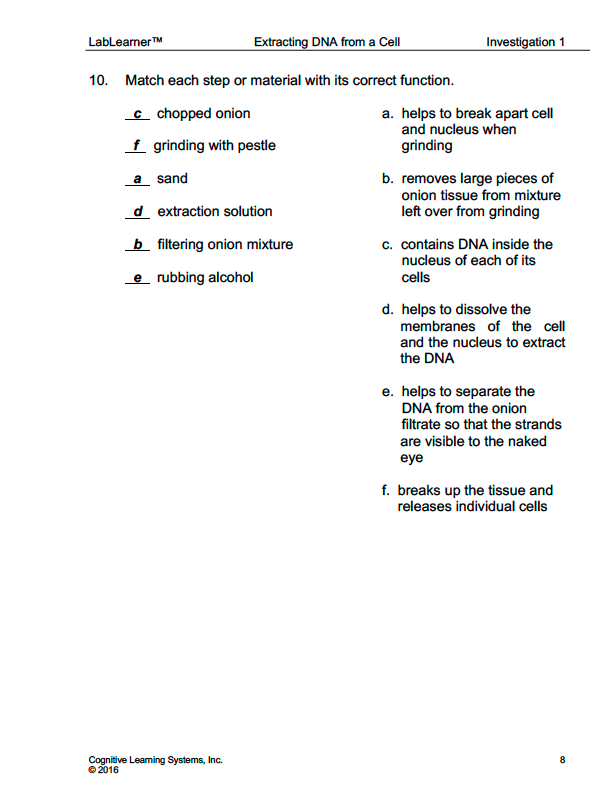
b. Explain to students that contains a list on the left-hand side of the steps and materials that were used during the experiment. Each step and material had to be used during the procedure in order for the DNA to be extracted from the cells.
c. Inform student groups that there is a list on the right-hand side of the page that gives the function, or purpose, of performing each step or using each material. Student groups should match the step or material to its corresponding function. To assist students in this process tell them to think about going from tissue to cell to DNA and about the order in which they completed the steps in the Lab.
d. Allow sufficient time for student groups to complete the activity. When complete, ask several student volunteers to share their answers with the class.
______________________________________________
SLIDE INHERIT1-post-4
Reiterate that each step had a specific purpose. Grinding the onion allowed for the onion tissue to be broken up. The extraction solution was made of salt and dish detergent. The salt made the DNA molecules group together. The dish detergent broke the cell membrane open and also broke open the nucleus of the cell, where the DNA was located. Since DNA cannot be dissolved in water, the rubbing alcohol made the clumps of joined DNA stand out so that they were visible.
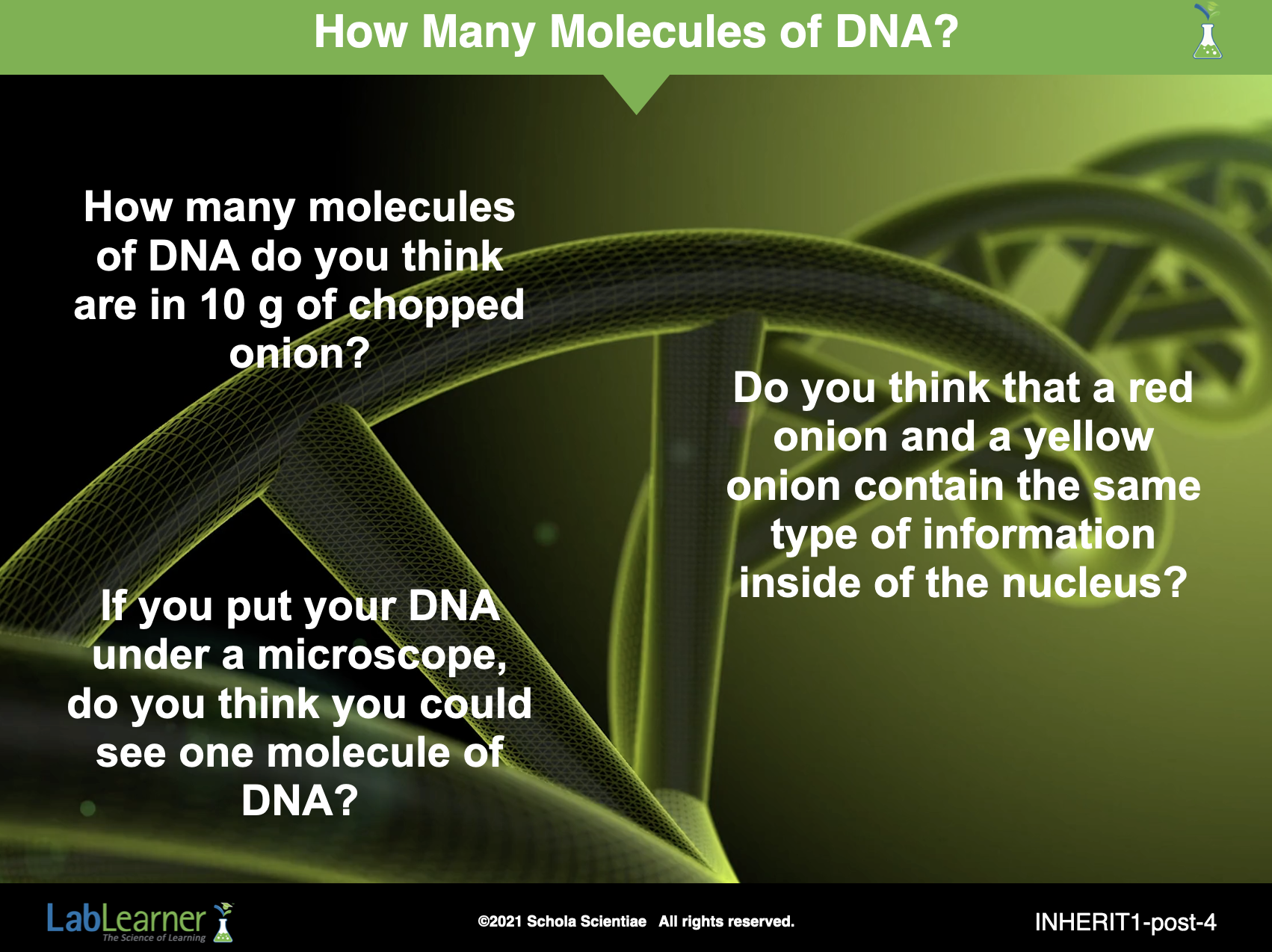
Ask students: Each group received approximately 10 g of chopped onion in the lab. How many cells do you think were in your onion sample? Student answers may vary. Encourage students to realize that their sample of onion contained approximately one billion cells.
Ask students: How many molecules of DNA do you think are in 10 g of chopped onion? Student answers may vary. Encourage students to realize that their sample of onion contained several billion molecules of DNA.
Ask students: Think about the white strings that you extracted from your onion. Do you think you could see one molecule of DNA? If you put your DNA under a microscope, do you think you could see one molecule of DNA? Student answers may vary. Encourage students to realize that one individual molecule of DNA cannot be seen by the naked eye or by a compound microscope from the lab. Students saw a cluster of several billion molecules of DNA in their falcon (centrifuge) tubes.
Ask students: Do you think that a red onion and a yellow onion contain the same type of information inside of the nucleus? Different types of information? Can you give an example? Students should indicate that a red and yellow onion contain some of the same type of information inside of their nuclei. For example, they are both onions that contain many different layers. Students should also indicate that a red and yellow onion contain different types of information inside of their nuclei. The genes code for the onions being of a different color and having a different taste.
______________________________________________
SLIDE INHERIT1-post-5
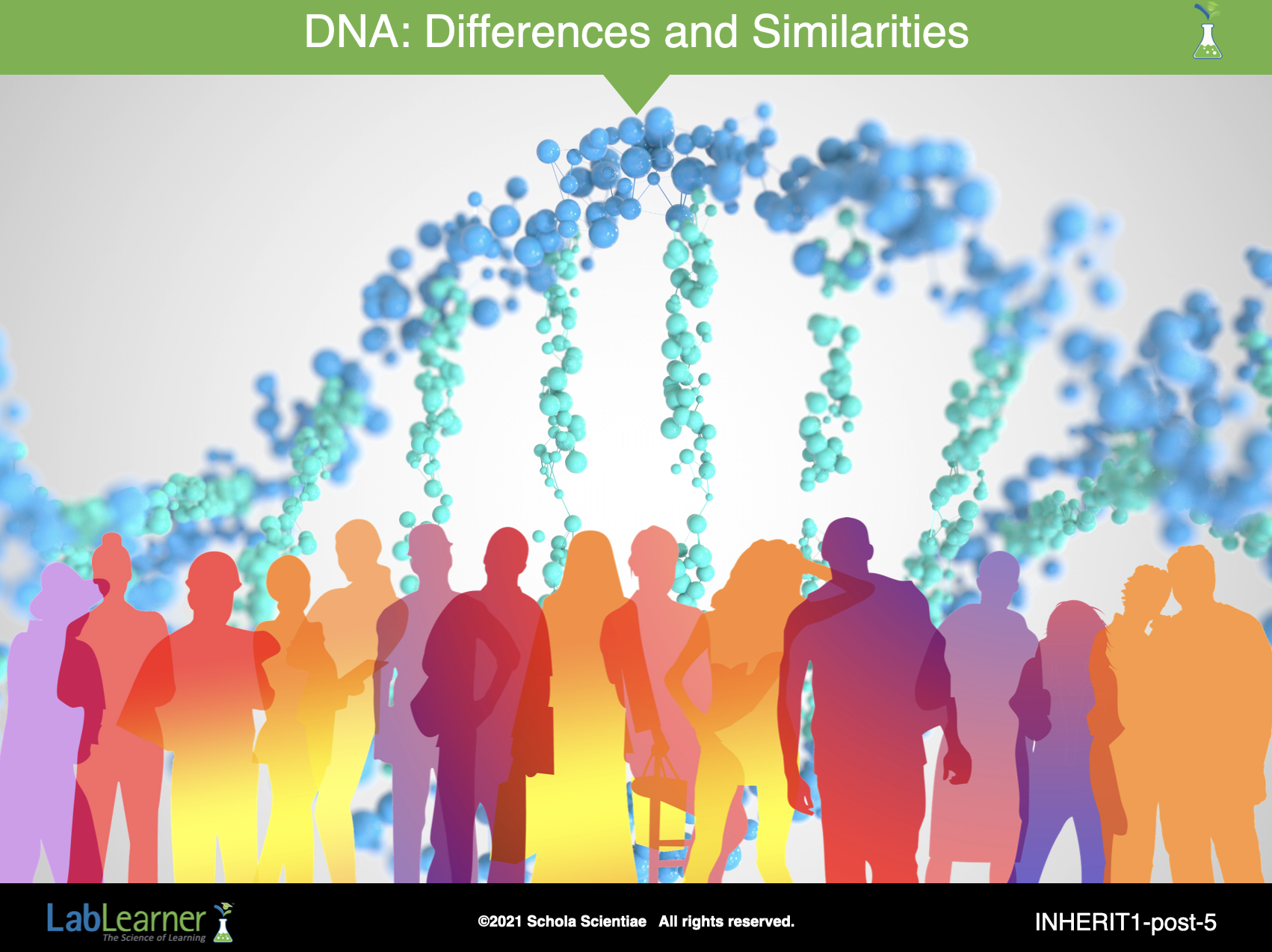
Continue discussing the practical and visible aspects of inheritance and the function of genetics and DNA.
Look around the class at the different people. Do you think the cells in each person are similar? Are the cells in each person different? Students should indicate that all students in the class have similar cells. All human cells have similar structures and functions. The information found in each student’s cells is different.
Do you think that each person in this class has the same DNA? Why or why not? Students should indicate that the students in the class have some of the same DNA. For example, they all have two legs and arms, all have a heart, and all have blood. Students should also indicate that each student also has different DNA. For example, they all have different hair and eye colors and all have different shaped noses.
Do you think that people in the same family have similar DNA? Students should indicate that people in the same family will share more similar DNA than with people outside of their family.
______________________________________________

SLIDE INHERIT1-post-6
Engage students in the following activity:
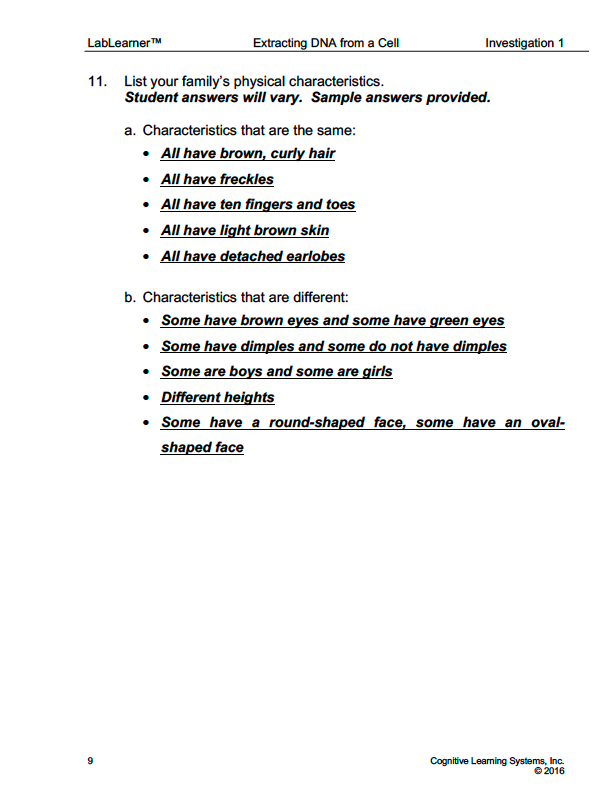
a. Ask students to locate Problem 11 of their Scientist Data Record.
b. Inform students that you would like them to think about different people in their family.
c. Ask students to create two lists in the space provided. The first list should name physical characteristics that they find similar among members of their family. The second list should name physical characteristics that they find different among members of their family.
d. Allow sufficient time to complete the activity. When complete, allow several student volunteers to share their lists with the class.
e. Inform students that they will examine these lists during Investigation Two to determine how genetic information is passed between parents and their offspring.
______________________________________________
KEYS: POSTLAB