
Teacher Portal:
Inheritance and Adaptations
Investigation 1 – Lab
 BE PREPARED
| Class materials: |
|
| Group materials: |
|
| Individual materials: |
|
Teacher Preparation
1. Make the extraction solution.
a. Using a 1000 ml graduated cylinder, pour 490 ml of water into a 500 ml flask.
b. Add 25 g of salt and 10 ml of dish soap to the 500 ml flask. Stir with a glass stir rod until the salt is dissolved and the dish soap is thoroughly mixed. The solution will appear cloudy.
c. Fill five 100 ml beakers with 50 ml of the extraction solution. Label each beaker “extraction solution.”
2. Prepare chopped onion.
a. Use a knife to chop the onion as finely as possible.
b. Use a lab scoop to fill five mortars with 10 g of chopped onion. This can be approximated by filling a 100 ml beaker to the 25 ml mark with chopped onion. Alternatively, use the triple beam balance and weigh dish to obtain the correct amount.
NOTE: The onion may be prepared the night before students perform the experiment. However, it must be kept refrigerated until use in class.
3. Fill five falcon tubes with 8 ml of rubbing alcohol. Label falcon tubes “rubbing alcohol.”
4. Fill five 100 ml beakers up to the 20 ml mark with sand.
5. Fill one 4.9 gallon plastic container with water. Add several drops of dish soap. This container will be used to soak the glassware used in this investigation.
6. Organize the required materials at a distribution point.
7. Divide students into 5 cooperative groups.
GET FOCUSED
1. During this investigation, students will be extracting DNA from onion cells. Students will use an extraction solution, sand, and a mortar and pestle to break up the onion tissue and “break open” individual onion cells and nucleus. Students will then filter the ground onion mixture and use rubbing alcohol to separate the DNA from the onion filtrate. If extracted correctly, the DNA will appear as long, white strings in the rubbing alcohol. As students perform this Investigation, they should consider the following questions:
Where is the DNA located in a cell?
How is DNA extracted from individual onion cells?
What does DNA look like?
NOTE: In order for students to extract DNA from the onion cells they must perform the steps precisely and accurately. The instructor may wish to read the procedure aloud or demonstrate each step provided to the students as they move through this investigation.
INVESTIGATE
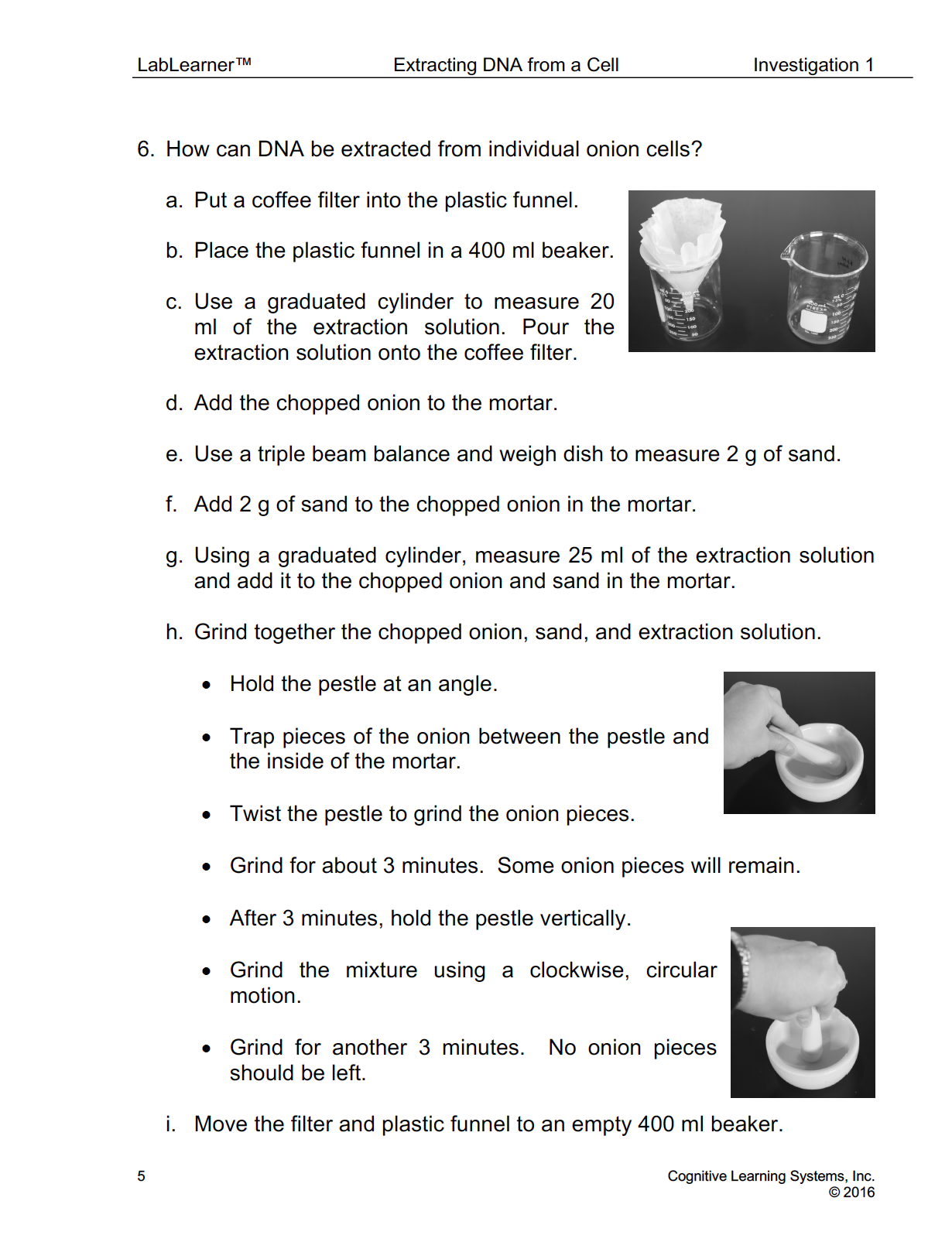
2. Direct each group of students to place the coffee filter into the mouth of the plastic funnel. Instruct students to place the coffee filter and plastic funnel in a 400 ml beaker.
3. Ask one student from each group to use a graduated cylinder to measure 20 ml of the extraction solution. Ask the student to pour the extraction solution onto the coffee filter to moisten it. Explain to students that this will prevent the ground onion mixture they are making from being absorbed by the coffee filter.
4. Direct students to use the triple beam balance and weigh dish to measure 2 g of sand. If students are having difficulty, you may wish to refer them to their Procedural Toolbox, Triple Beam Balance Equilibration, and Triple Beam Balance Use and Operation.
5. Ask students to prepare the onion for DNA extraction using the following steps:
a. Locate the mortar containing the chopped onion.
b. Pour 2 g of sand into the mortar. Explain to students that the sand will aid in the grinding and breaking open of the onion cells.
c. Add 25 ml of extraction solution to the mortar using a graduated cylinder.
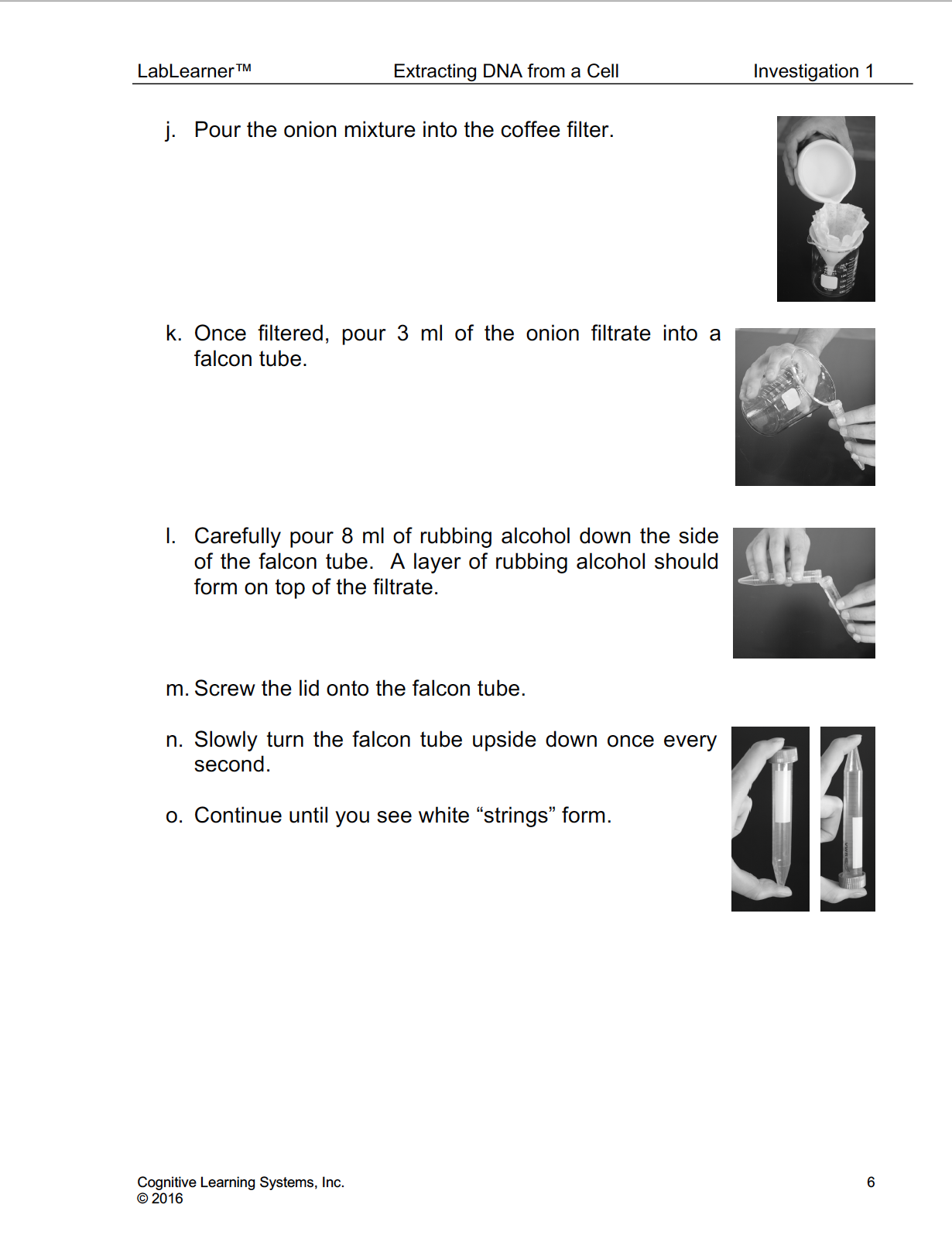
d. Demonstrate to students how to use the pestle to grind the chopped onion. Use the directions contained in number 6h of the Scientist Data Record.
e. After students have ground the onion for 3 minutes, demonstrate another grinding method that will complete the grinding of the chopped onion. Use the directions contained in the Scientist Data Record.
• Explain to students that grinding breaks the onion into individual cells, and the dish detergent in the extraction solution dissolves the membranes of the cell and the nucleus.
6. Direct students to transfer the plastic funnel containing the moistened coffee filter to an empty 400 ml beaker.
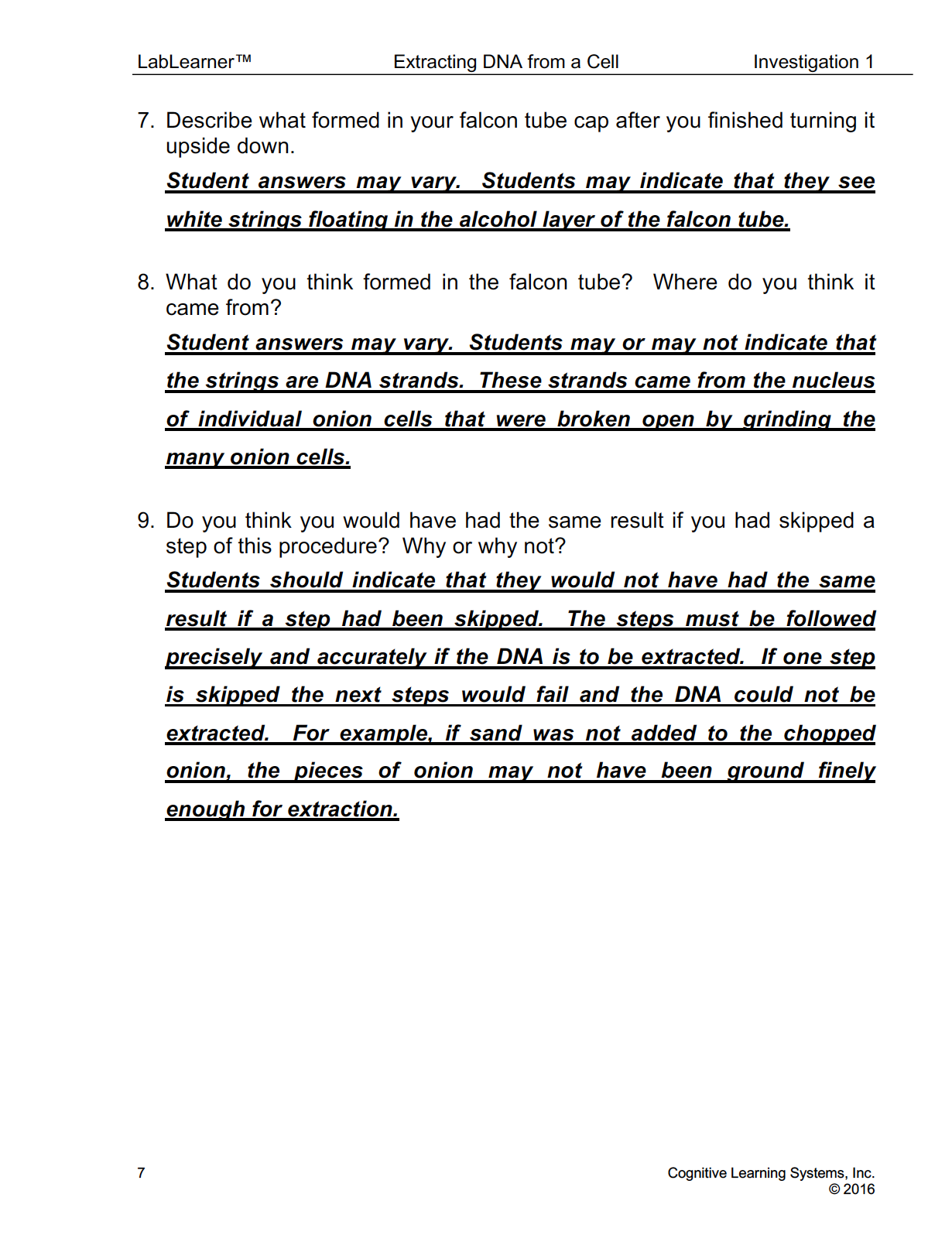
a. Instruct students to pour the onion mixture into the coffee filter. Inform students that the filter removes large pieces of onion that still remain.
b. If the rate of filtration is too slow, demonstrate to students how to slowly and carefully swirl the 400 ml filtration.
c. After at least half of the onion mixture is filtered, direct students to remove the plastic funnel containing the coffee filter from the 400 ml beaker and place it back in the original 400 ml beaker.
d. Demonstrate to students how to extract the DNA from the onion filtrate using steps 6k – 6o contained in the Scientist Data Record.
7. Instruct students to answer problems 7-9 in the Scientist Data Record.
8. Direct each group to carry their falcon (centrifuge) tube and coffee filter to the trash. Direct each group to carefully place the glassware and plasticware into the 4.9-gallon plastic container containing soap and water.
KEYS
CLEAN UP
Let students know your expectations for clean-up. Ask them to clean up.