Teacher Portal:
Inheritance and Adaptations
Inheritance and Adaptations: Investigation 1 - Extracting DNA from a Cell
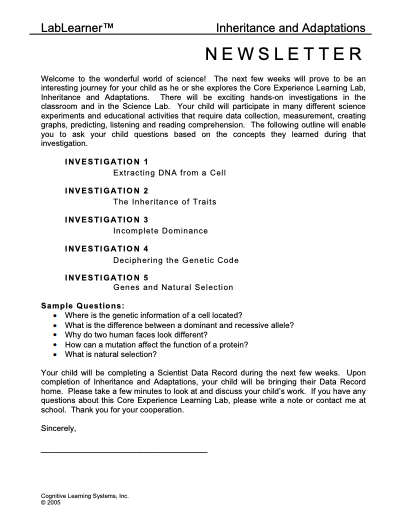
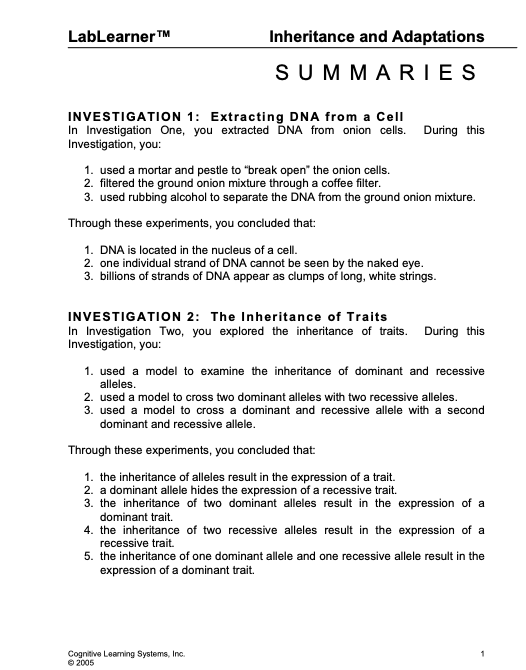
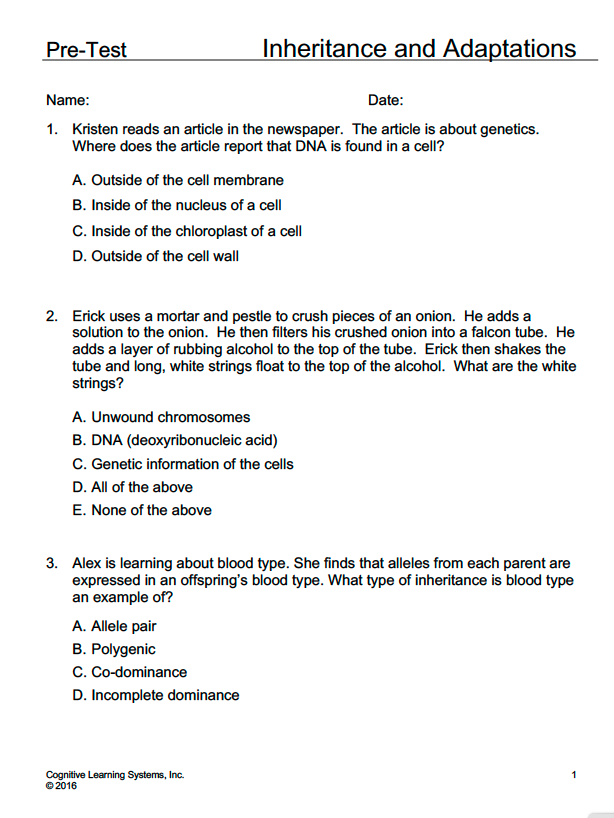
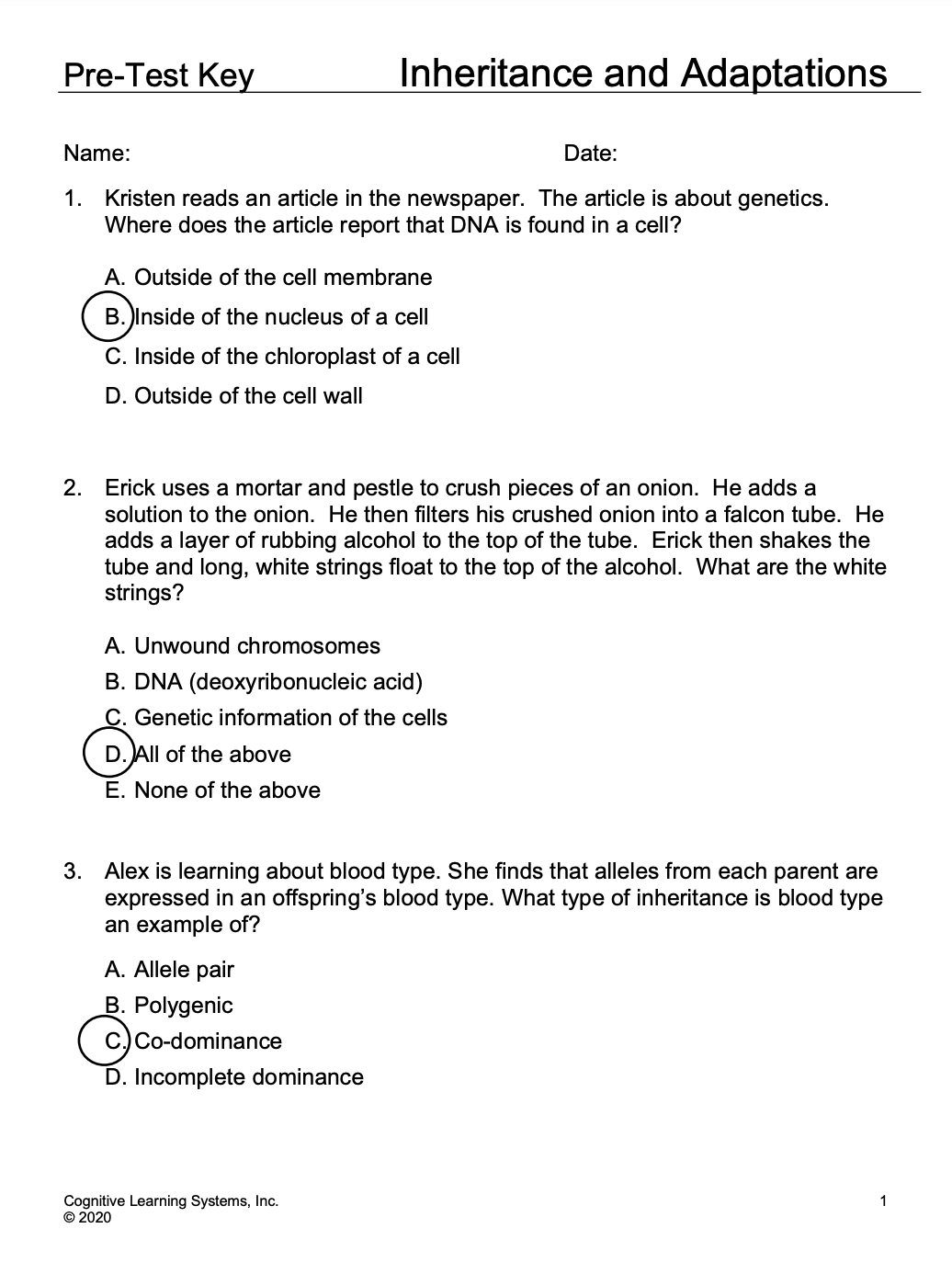
Investigation One introduces students to the science of genetics. Through observation and experimentation, students will learn that DNA is located in the nucleus of a cell. Students will use a procedure that combines many techniques that scientists may use for DNA extraction to extract DNA from the cells of an onion. Their observations will enable them to realize that one individual molecule of DNA cannot be seen by the naked eye or by a compound microscope from the lab.
Inheritance and Adaptations: Investigation 2 - The Inheritance of Traits
In Investigation Two, students will examine dominant and recessive alleles. Students will use a model to perform several genetic crosses to determine the allele combinations inherited by offspring. The crosses will be between organisms that possess either dominant alleles, recessive alleles, or both types of alleles. Students will discover that different combinations of dominant and recessive alleles will result in a specific expression of a trait.
Inheritance and Adaptations: Investigation 3 - Incomplete and Co-Dominance
During Investigation Three, students examine genetic traits that are found on the human face. Students will select allele pairs for several facial traits and then analyze the alleles that were selected to draw a picture of a human face. Through their experiment, students will discern that some traits found on the face display incomplete dominance. They will also come to realize that the high level of biological variation found in the human face will result in the unique appearance of each face that is drawn.
Inheritance and Adaptations: Investigation 4 - Deciphering the Genetic Code
Investigation Four gives students an opportunity to construct a protein using a set of “RNA” instructions and then test whether their protein will be able to perform its function. Students will also decode a sequence of nucleotides. Students will discover how a cell deciphers the genetic information found in the nucleus to create proteins. Their observations will enable them to realize that a mutation, or mistake, in a sequence of nucleotides may change the translation of the sequence but will not always change whether that sequence can be read by a cell.
Inheritance and Adaptations: Investigation 5 - Genes and Natural Selection
In Investigation Five, students will use a model to test the effects of natural selection on a population of beetles over a three-year time period. Students will perform a simple test that will demonstrate camouflage to be an advantageous trait. By observation and experimentation, students will come to the understanding that the better-camouflaged beetles will have a higher survival rate than beetles that are not well camouflaged.
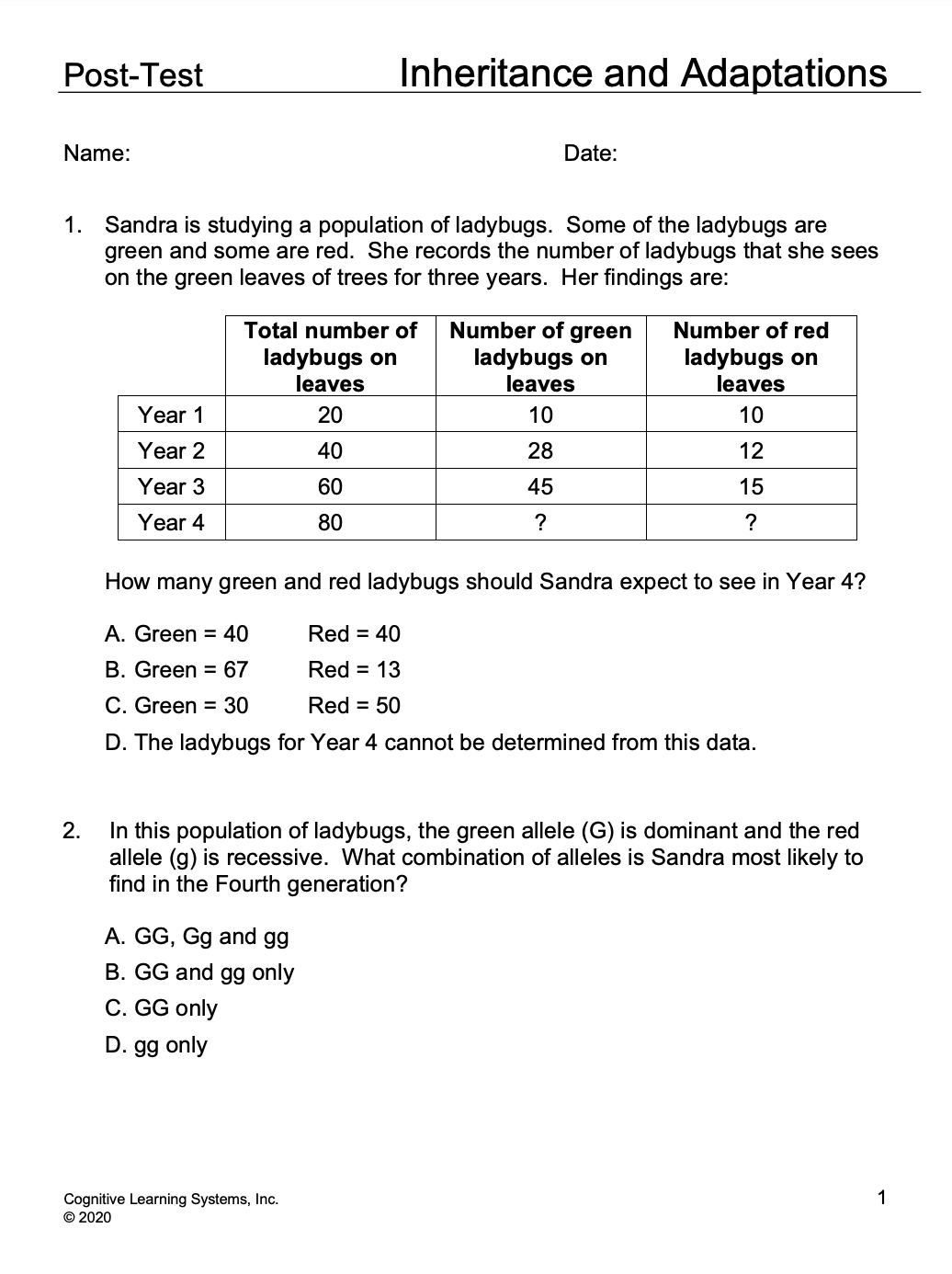
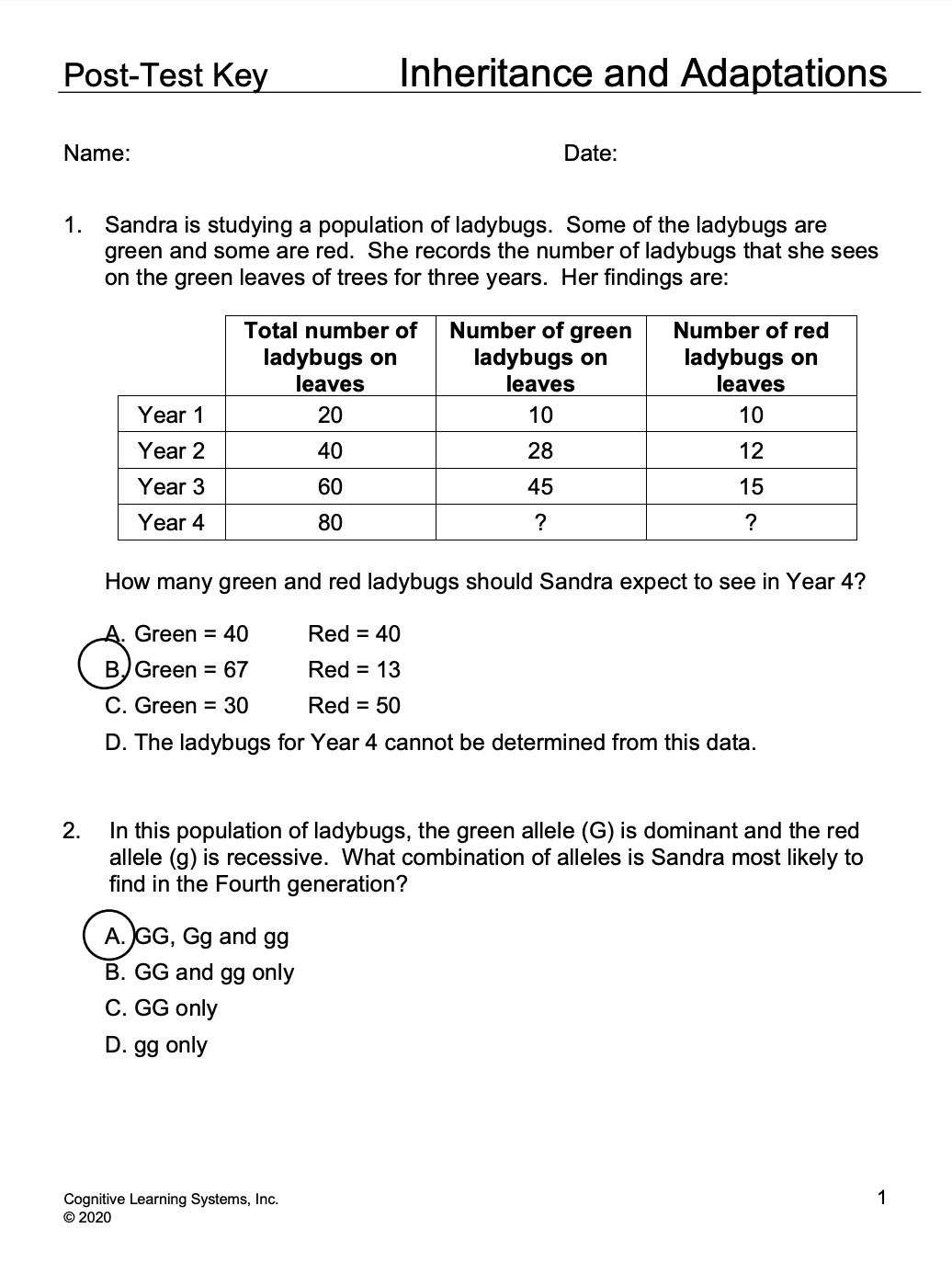
Post-Test Key
Includes NGSS correlations