Teacher Portal:
Investigating Heat
Investigation 5 – PreLab
 MINDSET
This Investigation is designed to:
- introduce students to the concept that the rate of heat transfer is affected by many factors, including mass and surface area
- promote student understanding that as mass increases, the rate of heat transfer decreases
- promote student understanding that as surface area increases, the rate of heat transfer increases
- provide students with an opportunity to correlate laboratory experiments with real-life situations
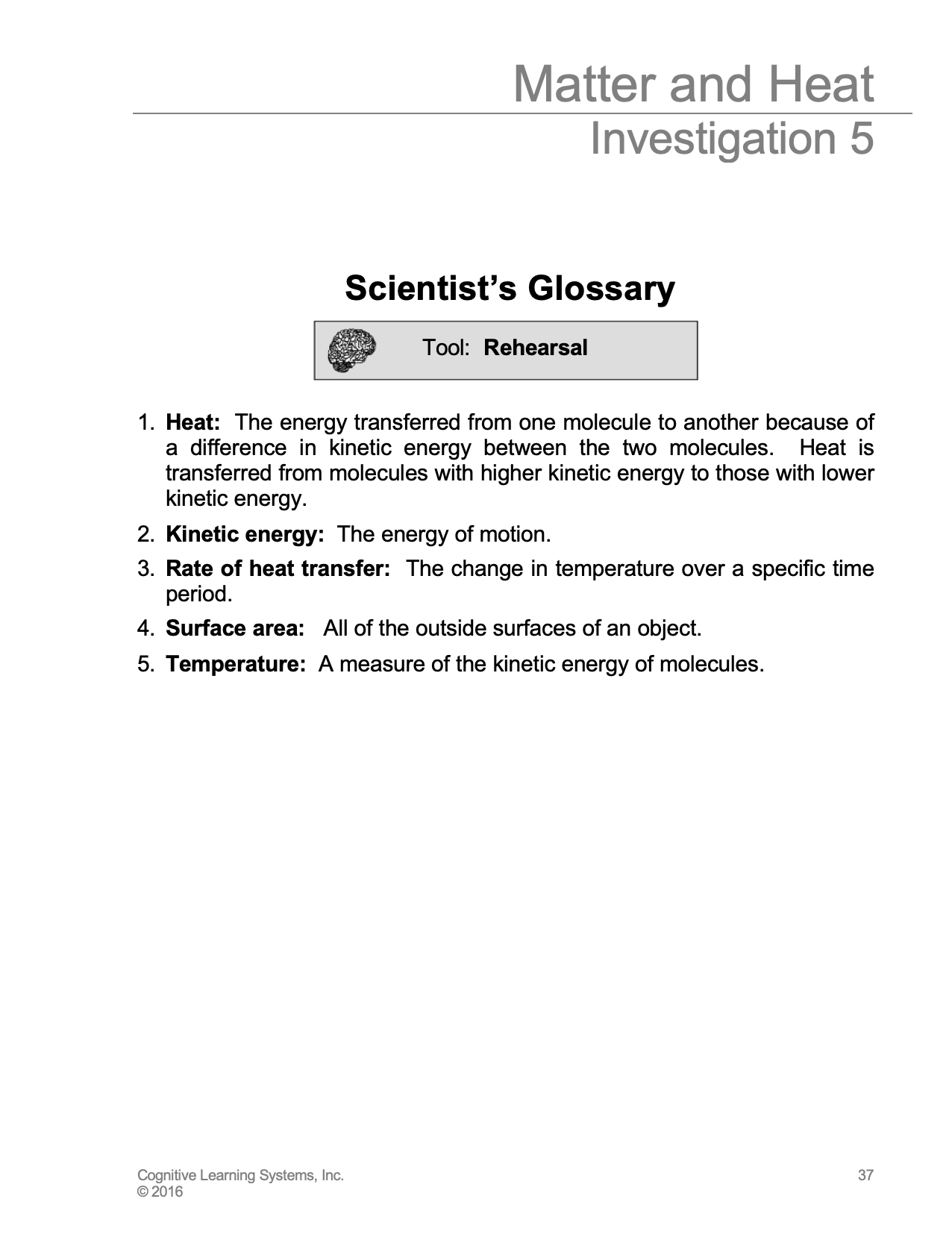
SCIENTIST’S GLOSSARY
1. Heat: The energy transferred from one molecule to another because of a difference in kinetic energy between the two molecules. Heat is transferred from molecules with higher kinetic energy to those with lower kinetic energy.
2. Kinetic energy: The energy of motion.
3. Rate of heat transfer: The change in temperature over a specific time period.
4. Surface area: The sum of all the areas of the outside surfaces of an object.
5. Temperature: A measure of the kinetic energy of molecules.
BE PREPARED
Watch the Investigation 5 Teacher Video (below) and Student Video (at end of PreLab SHARE IT) to prepare for the PreLab.
SET FOR SUCCESS
- Tell students that they will continue with the Investigating Heat CELL.
- In this Investigation, students will learn how total mass and surface area influence the rate of heat transfer.
- Ask students to share the kinds of things they think they might learn in this Investigation.
Begin the PreLab Concept Slides to start students on their learning journey. Then watch the Pre-Lab Student Video as a class.
NAVIGATE IT
Once the slide presentation is launched
- use your left and right arrows to advance or go back in the slide presentation, and
- hover your mouse over the left edge of the presentation to get a view of the thumbnails for all the slides so that you can quickly move anywhere in the presentation.
- Click HERE to launch the slide presentation for the CELL.
SHARE IT
SLIDE VHEAT5-pre-1
This is the last regular Investigation of the Investigating Heat LabLearner CELL. In it, students will explore the involvement of mass and surface area on heat transfer.
______________________________________________
SLIDE VHEAT5-pre-2
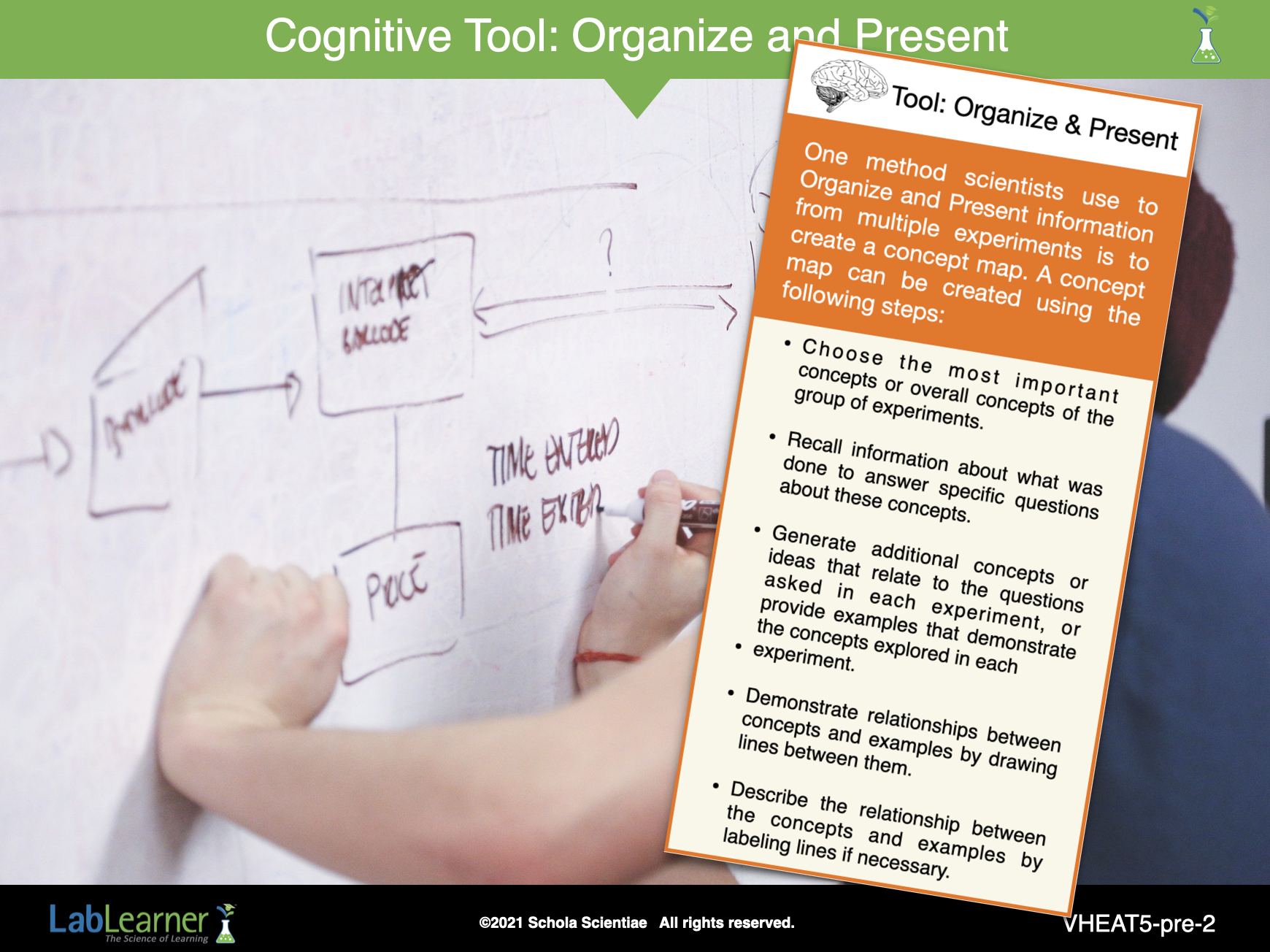
Scientists often perform several experiments to explore a concept, and need to arrange this information in a way that shows how the results of the different experiments relate to one another. One method scientists use to Organize and Present information from multiple experiments is to create a concept map. A concept map can be created using the following steps:
1. Choose the most important concepts or overall concepts of the group of experiments.
2. Recall information about what was done to answer specific questions about these concepts.
3. Generate additional concepts or ideas that relate to the questions asked in each experiment, or provide examples that demonstrate the concepts explored in each experiment.
4. Demonstrate relationships between concepts and examples by drawing lines between them.
5. Describe the relationship between the concepts and examples by labeling lines if necessary.
______________________________________________
SLIDE VHEAT5-pre-3
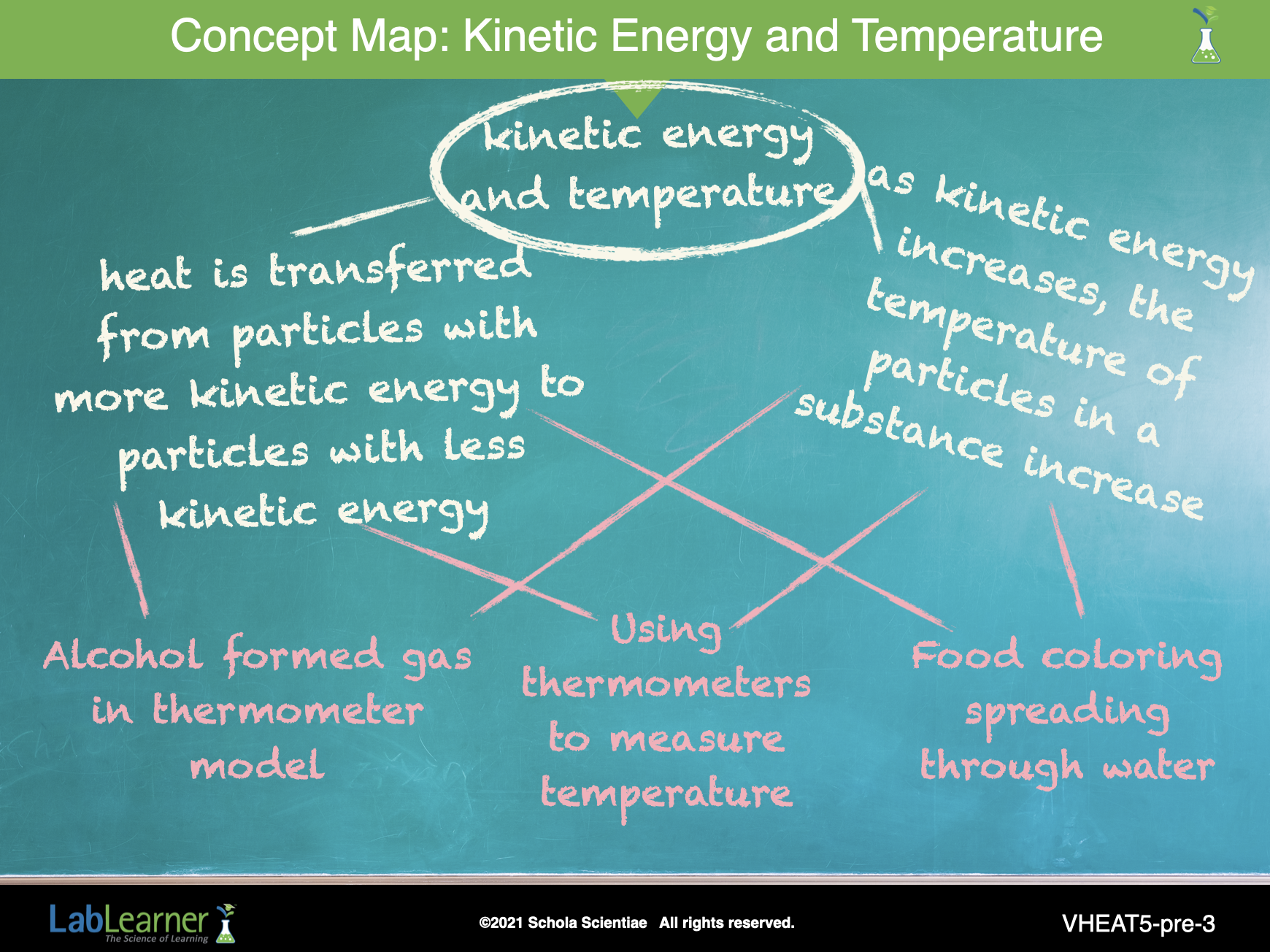
1. Direct students’ attention to the concept map for kinetic energy and temperature. Ask for volunteers to read the main ideas recorded thus far.
Ask students: What are some examples of these ideas that you have seen during this CELL? Student answers may vary but may include the following: (1) heat from boiled water causing the alcohol to form a gas in the thermometer experiment, (2) thermometers registering temperature throughout the CELL, (3) food coloring spreading through water, and (4) heat moving from the metal cube into cold water. As students provide examples, record their examples under the appropriate main idea. Students’ suggestions may fit more than one main idea. Draw lines for all appropriate connections between main ideas and examples. Examples are included on the slide.
______________________________________________
SLIDE VHEAT5-pre-4
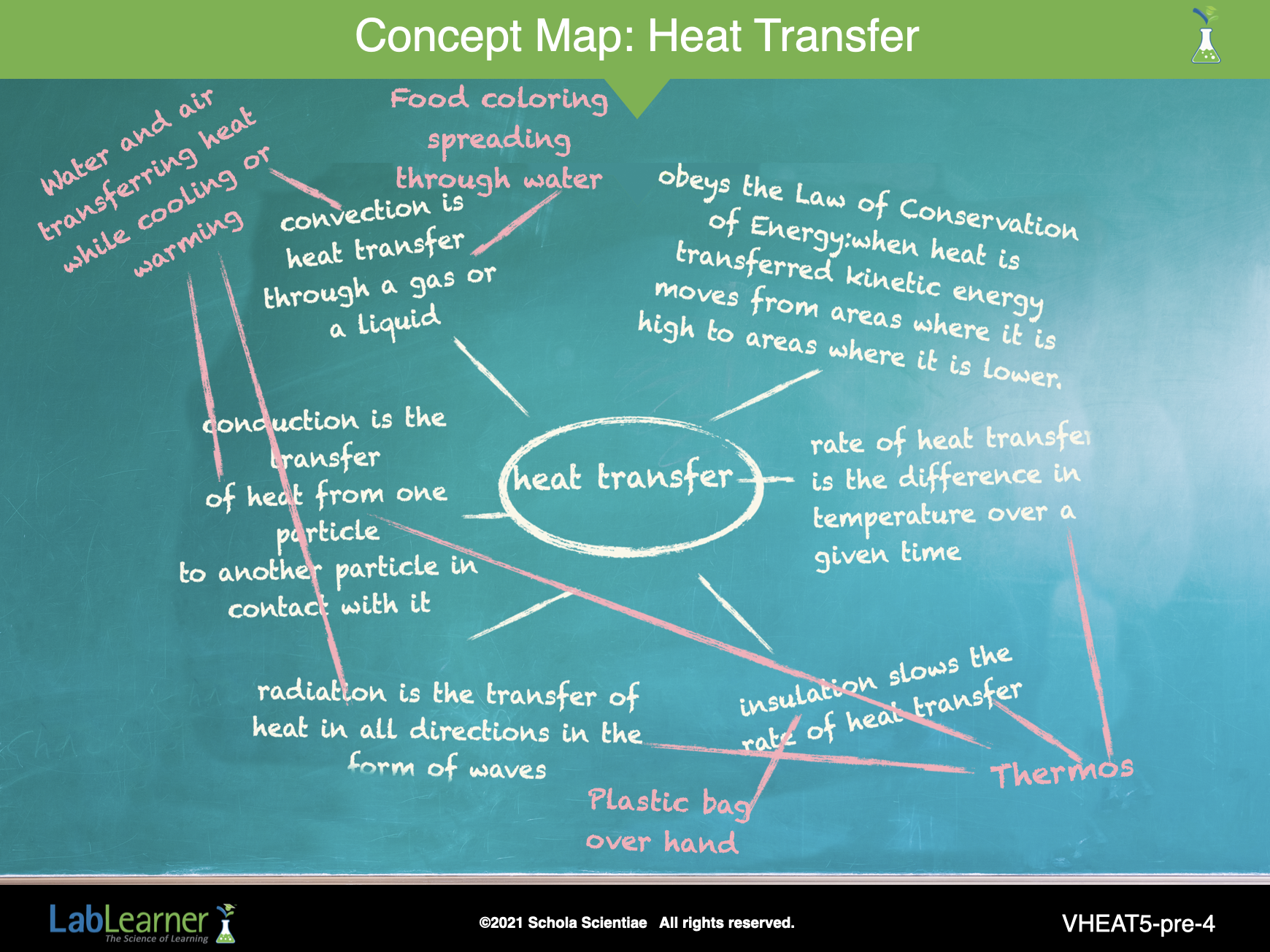
2. Direct students’ attention to the concept map for heat transfer. Ask for volunteers to read the main ideas recorded thus far.
Ask students: Can you think of examples of each of these main ideas from Investigations One through Four? Student answers may vary but may include examples such as those shown here.
As students make suggestions, have them add them to their own concept map. Encourage students to make all connections between main ideas and examples that are appropriate.
______________________________________________
SLIDE VHEAT5-pre-5
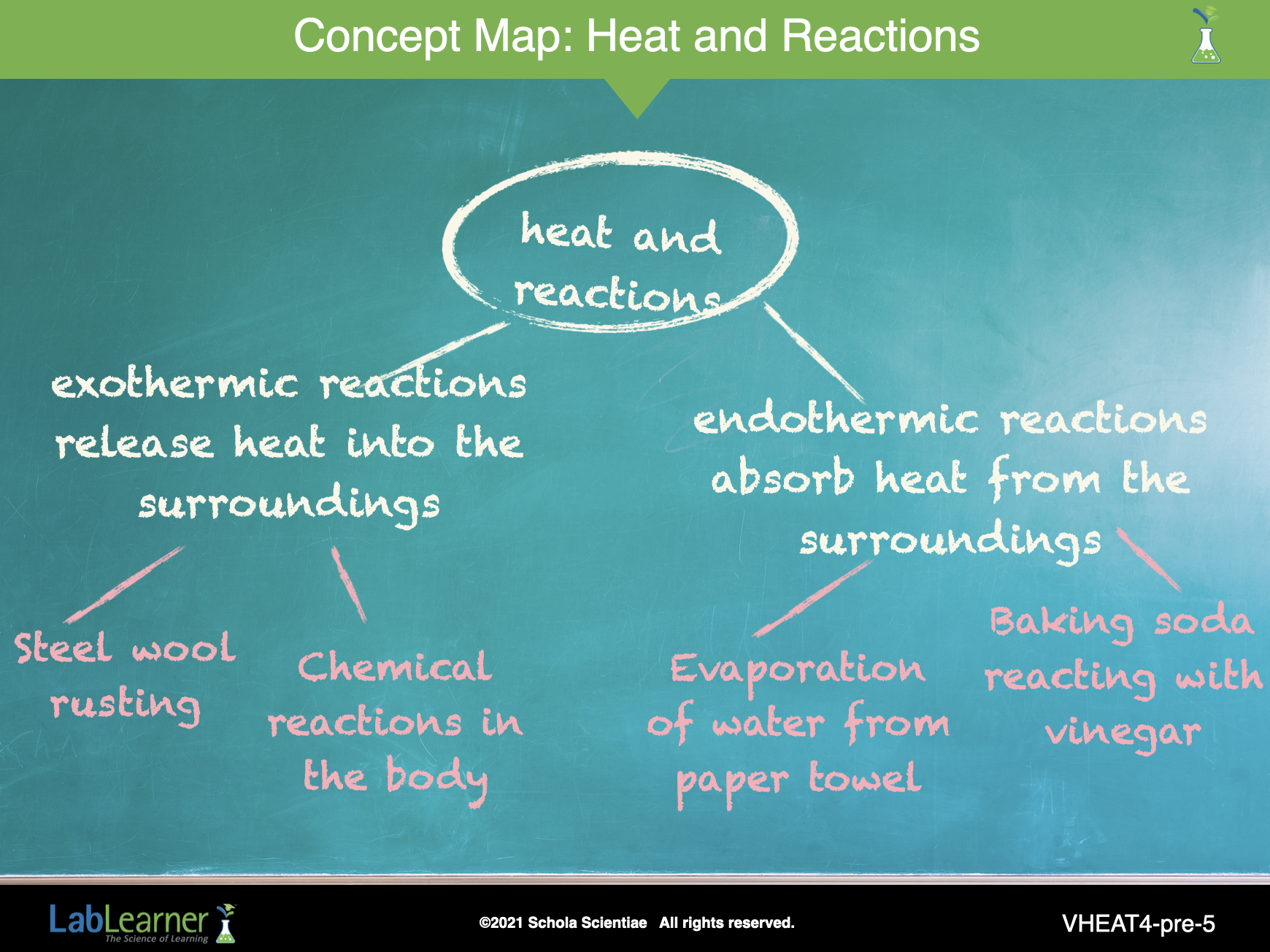
3. Draw students’ attention to the concept map for heat and reactions. Ask for student volunteers to read the main ideas to the class.
a. Ask students: What is the difference between endothermic and exothermic reactions? Student answers may vary. Endothermic reactions are reactions that absorb heat. In chemical reactions, there is often a decrease in the temperature of the surroundings in an endothermic reaction. Exothermic reactions are reactions that release heat. In chemical reactions, there is often an increase in the temperature of the surroundings in exothermic reactions.
b. Ask students: What are some examples you investigated or discussed for endothermic and exothermic reactions? Student answers may vary, but examples of endothermic reactions may include evaporation of water from paper towels and baking soda reacting with vinegar. Examples of exothermic reactions may include steel wool rusting and chemical reactions in the body releasing heat.
Have students add information to their own concept maps.
______________________________________________
SLIDE VHEAT5-pre-6
B. Continue the discussion by encouraging students to think about some factors that may affect the rate of heat transfer.
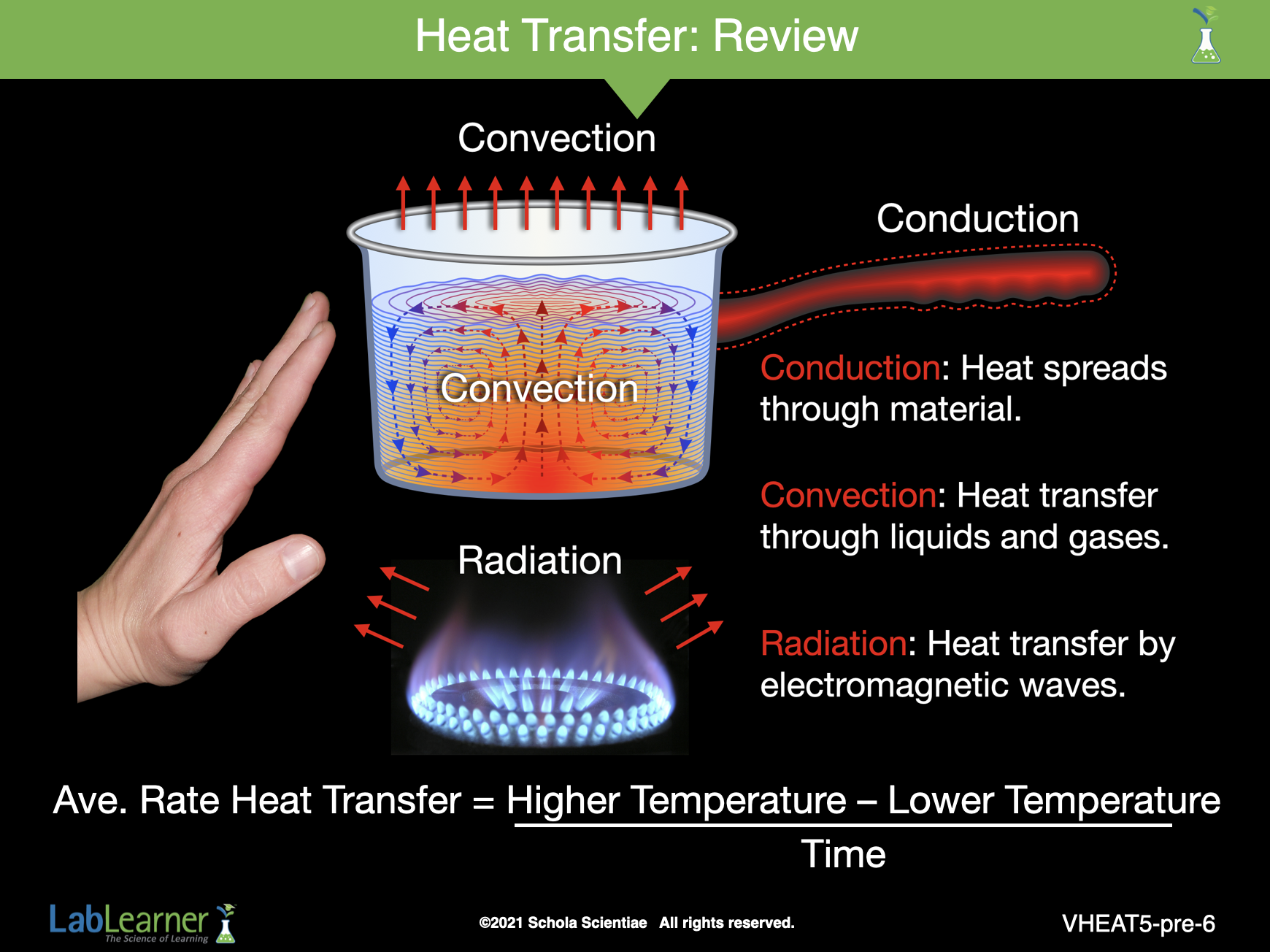
1. Ask students: How is heat transferred? When is it transferred? Heat is transferred through conduction, convection, and radiation. It is transferred when the temperature of one area is higher or lower than the temperature of the area around it.
2. Ask students: What is the average rate of heat transfer? How is it calculated? The average rate of heat transfer is the change in the temperature of a substance over time. The average rate of heat transfer tells how quickly or slowly kinetic energy, or heat, is transferred from one substance to another. It is calculated by subtracting the lower temperature from the higher temperature in a situation of heat transfer and dividing the result by the amount of time over which the heat transfer occurred.
3. Ask students: What have we investigated so far that can affect the rate of heat transfer? The rate of heat transfer is affected by the type of material involved. Conductors are materials that transfer heat easily. Metals are examples of materials that are good conductors of heat. Insulators are materials that do not transfer heat easily. Plastic and wood are examples of materials generally considered as insulators of heat. If a chemical reaction is involved, the types of substances in the reaction determine how quickly heat is transferred and whether heat is absorbed from or released into the surroundings.
Explain that in this Investigation students will explore other factors that affect how quickly heat is transferred.
______________________________________________
SLIDE VHEAT5-pre-7
4. Use the following activity to encourage students to continue to think about what affects the rate of heat transfer.
a. Divide students into cooperative groups.
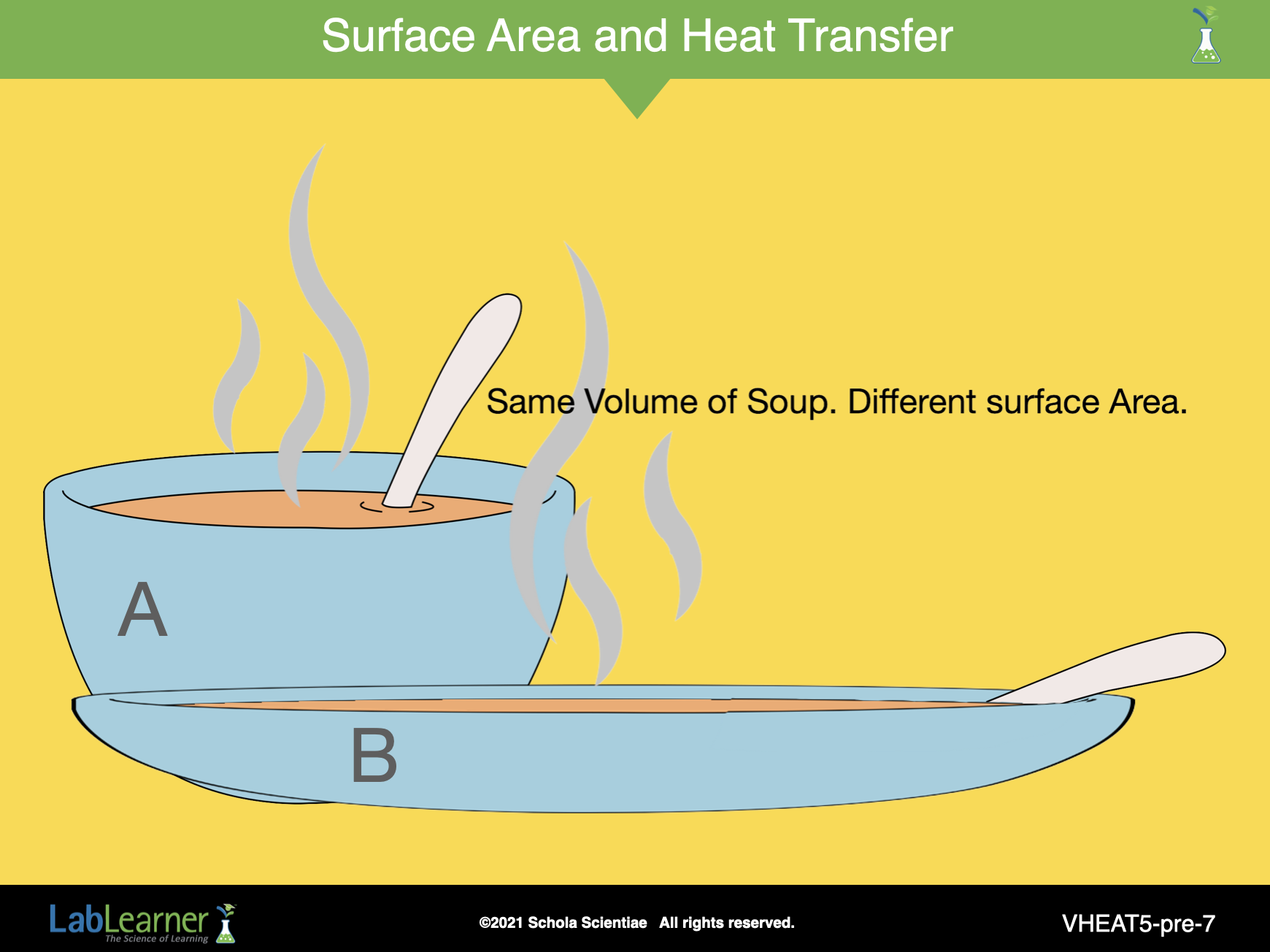
b. Have students look at the two soup bowls on the slide
c. Explain to students that you have cooked a pot of soup for supper. The soup is ready, but you are concerned that if you fill the bowl you have chosen, it will take too long for it to cool down, and you are ready to eat now. Tell students that you are trying to decide whether the following two methods could help you cool your supper cool quickly:
-
- Fill Bowl A halfway instead of to the top and then refill it after eating the first portion.
- Put the original amount of soup in Bowl B that is wider, shallower bowl.
d. Direct student groups to discuss whether each of these methods would work to cool the soup, and why the methods may work.
e. Provide 5 – 10 minutes for groups to create their lists.
f. Ask students to share their ideas with the class. Student answers will vary. Accept all answers, encouraging students to elaborate on their hypotheses. Avoid indicating whether students are correct or incorrect. Tell students that they will have an opportunity to answer the question again after they conduct their experiments in the lab.
______________________________________________
SLIDE VHEAT5-pre-8
C. Explain to students that the experiments they will conduct in Lab are related to the questions about the soup and to heat transfer.
1. Tell students they will investigate two questions in the lab:
How does the mass of liquids affect the rate of heat transfer?
How does the surface area of the containers holding liquids affect the rate of heat transfer?
2. Explain that in order to be ready to perform the experiments, students need to understand what is meant by the terms mass and surface area. Use the questions below to facilitate a discussion of both terms:
a. Ask students: What do you think the term surface area means? Student answers may vary. The surface area is the area of a substance exposed to another substance.
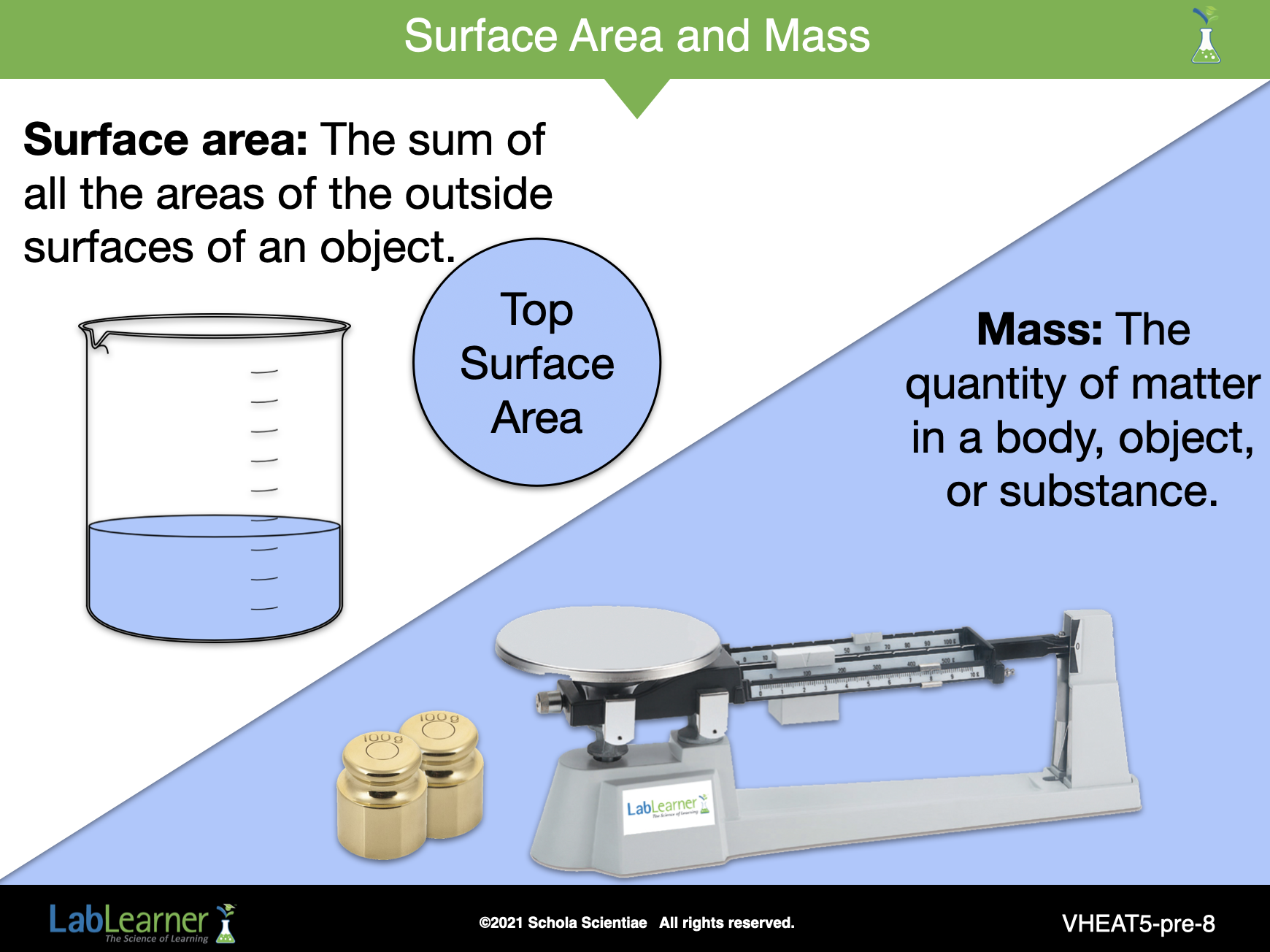
b. Point out the diagram of a beaker on the slide. Tell students to imagine a beaker of water.
Ask students: Where are the beaker and water exposed to the air? Student answers may vary. The beaker has 3 surfaces: the top surface, the side surfaces, and the bottom surface.
c. Ask students: Can surface area be calculated? What do you think might be important when calculating the surface area of the beaker with water? Student answers may vary. Students should suggest that surface area could be calculated by adding all the surfaces of the beaker of water.
Note to Teacher: The water in the beaker forms a cylinder of water. Therefore, the total surface area of the water is determined by the radius (one half of the diameter) of the top and the bottom surfaces and the height of the cylinder. The calculations for the surface area of circles and cylinders require the use of the constant pi and squared values. These calculations may be beyond the scope of students’ current math abilities. For this reason, students are not expected to calculate surface area in their experiments. Surface area values will be provided where necessary. However, it is important that students have a basic understanding of the concept of surface area and how it is determined.
d. Ask students: Do you recall what mass is? How do we measure mass? Mass is the quantity of matter in a body, object, or substance. Mass can be measured using a triple beam balance.
3. After sharing the two questions with the class, provide time for students to speculate as to how these two questions might relate to the problem they were asked about the soup. Encourage all points of view in the discussion, reassuring students that if they do not see a connection now, the lab experiments may help them to do so.
WATCH IT
Play the following Student Video in preparation for the lab. Discuss as necessary to answer student questions.
KEYS