Student Portal:
Investigating Heat
Investigation 4 – PreLab
 MINDSET
This Investigation is designed to:
- allow students to review the main ideas about heat and temperature addressed thus far in this CELL.
- encourage students to realize that the body monitors its internal temperature and tries to maintain a temperature at which it is able to function.
- promote understanding of the effect of perspiration on body temperature by encouraging students to conclude that the evaporation of perspiration cools the body.
- enable students to find that, due to the Joule-Thompson Effect, students are able to decrease the temperature of the air exhaled from their body by compressing the air before it exits.
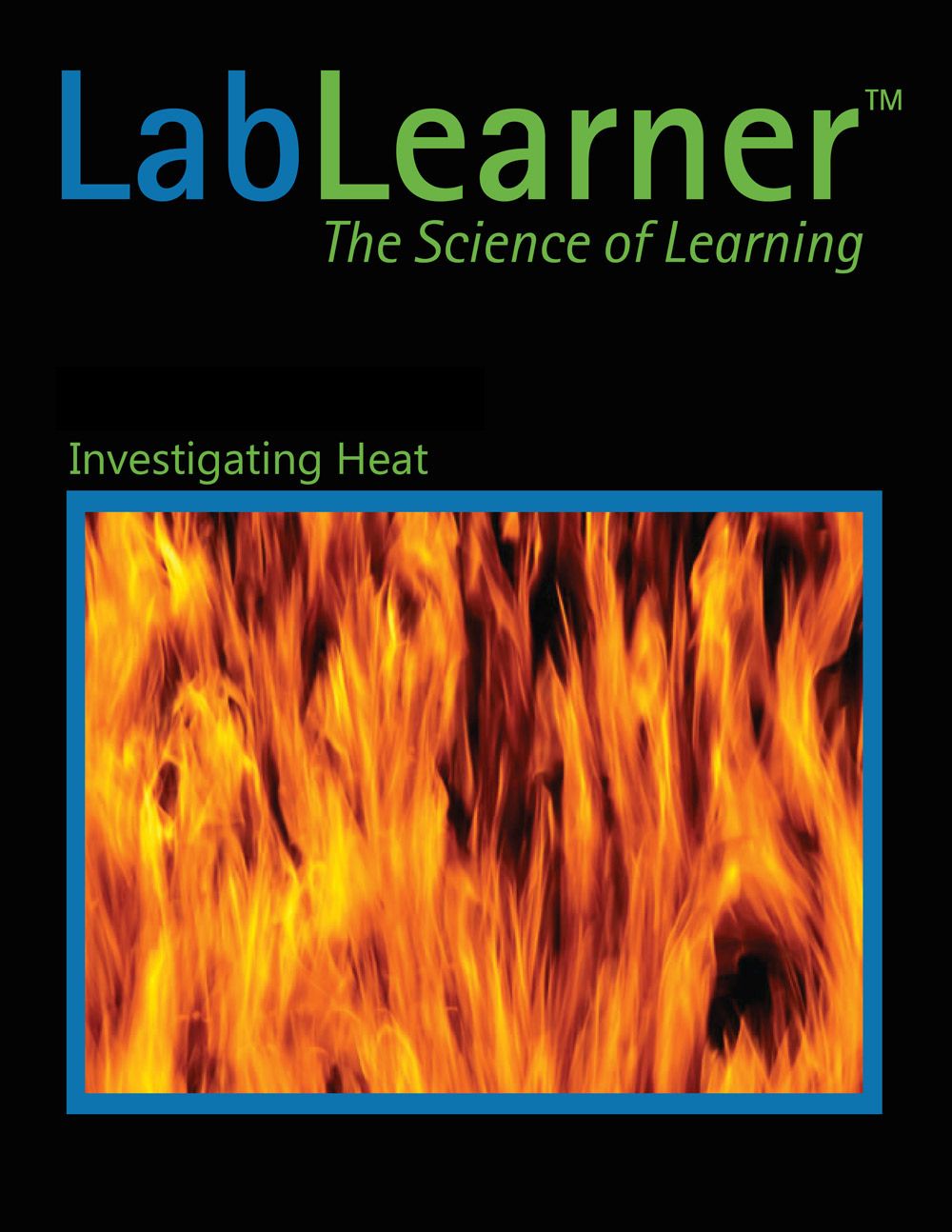
SCIENTIST’S GLOSSARY
1. Evaporation: The process by which liquid water becomes water vapor (a gas).
2. Heat: The energy transferred from one molecule to another because of a difference in kinetic energy between the two molecules. Heat is transferred from molecules with higher kinetic energy to those with lower kinetic energy.
3. Joule-Thompson effect: The decrease in temperature observed when compressed gas is allowed to expand rapidly.
4. Kinetic energy: The energy of motion.
5. Law of conservation of energy: Energy is neither created nor destroyed, it simply changes form.
6. Molecule: A particle of matter.
7. Temperature: A measure of the kinetic energy of molecules.
BE PREPARED
Watch the Investigation 4 Teacher Video (below) and Student Video (at end of PreLab SHARE IT) to prepare for the PreLab.
SET FOR SUCCESS
- Tell students that they will continue with the Investigating Heat CELL.
- In this Investigation, students will learn how the body uses the physical and chemical properties of heat that they have studied in precious Investigations to regulate its temperature.
- Ask students to share the kinds of things they think they might learn in this Investigation.
Begin the PreLab Concept Slides to start students on their learning journey. Then watch the Pre-Lab Student Video as a class.
NAVIGATE IT
Once the slide presentation is launched
- use your left and right arrows to advance or go back in the slide presentation, and
- hover your mouse over the left edge of the presentation to get a view of the thumbnails for all the slides so that you can quickly move anywhere in the presentation.
- Click HERE to launch the slide presentation for the CELL.
SHARE IT
SLIDE VHEAT4-pre-1
In this Investigation, students will continue their study of heat. They will focus on how the body controls its temperature.
______________________________________________
SLIDE VHEAT4-pre-2
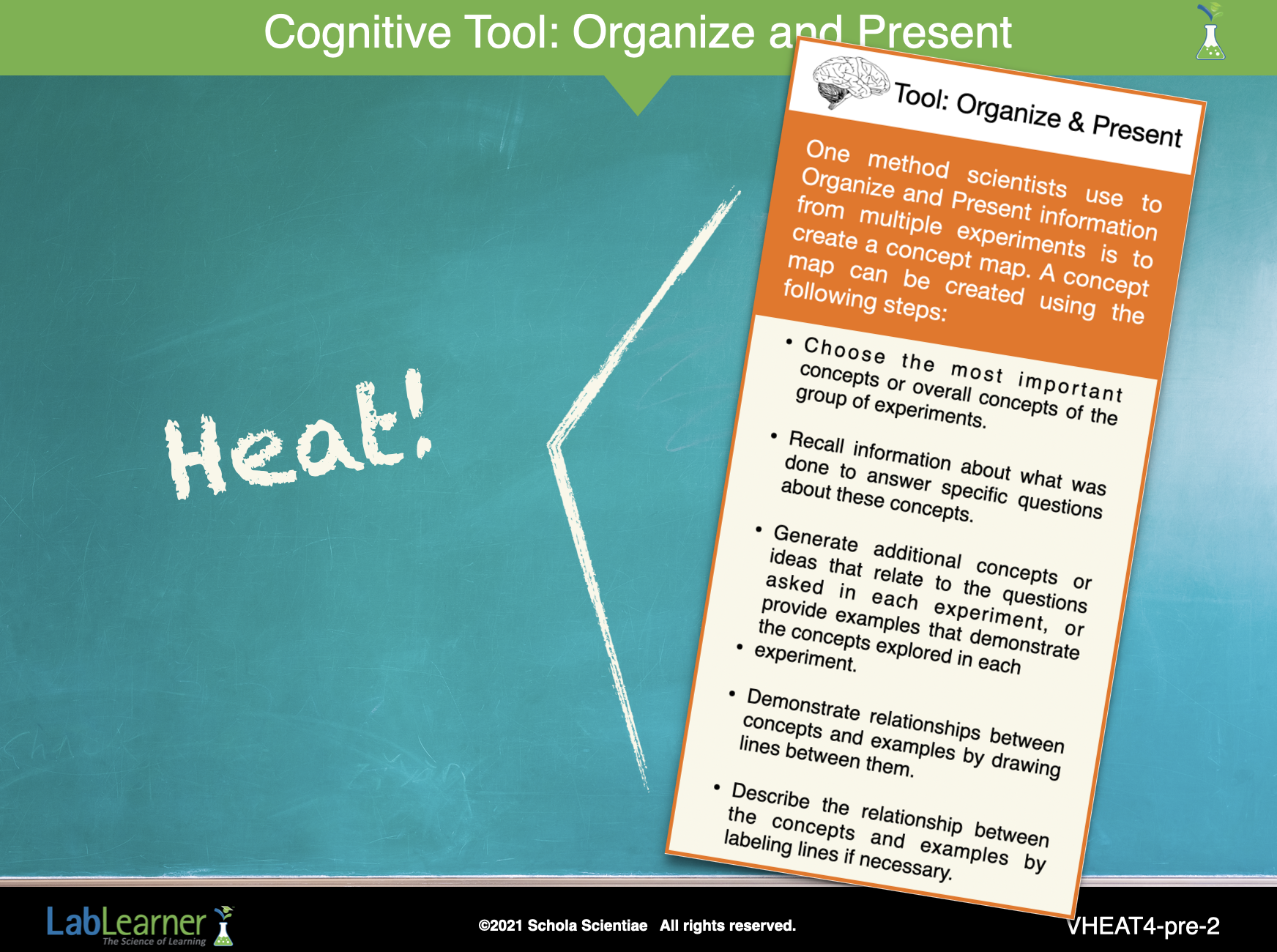
A. Begin the lesson by reviewing what students have learned about heat in Investigations One through Three. Tell students that one way to present what they have learned is to create a diagram or a concept map. Guide students in creating a concept map focused on heat.
______________________________________________
SLIDE VHEAT4-pre-3
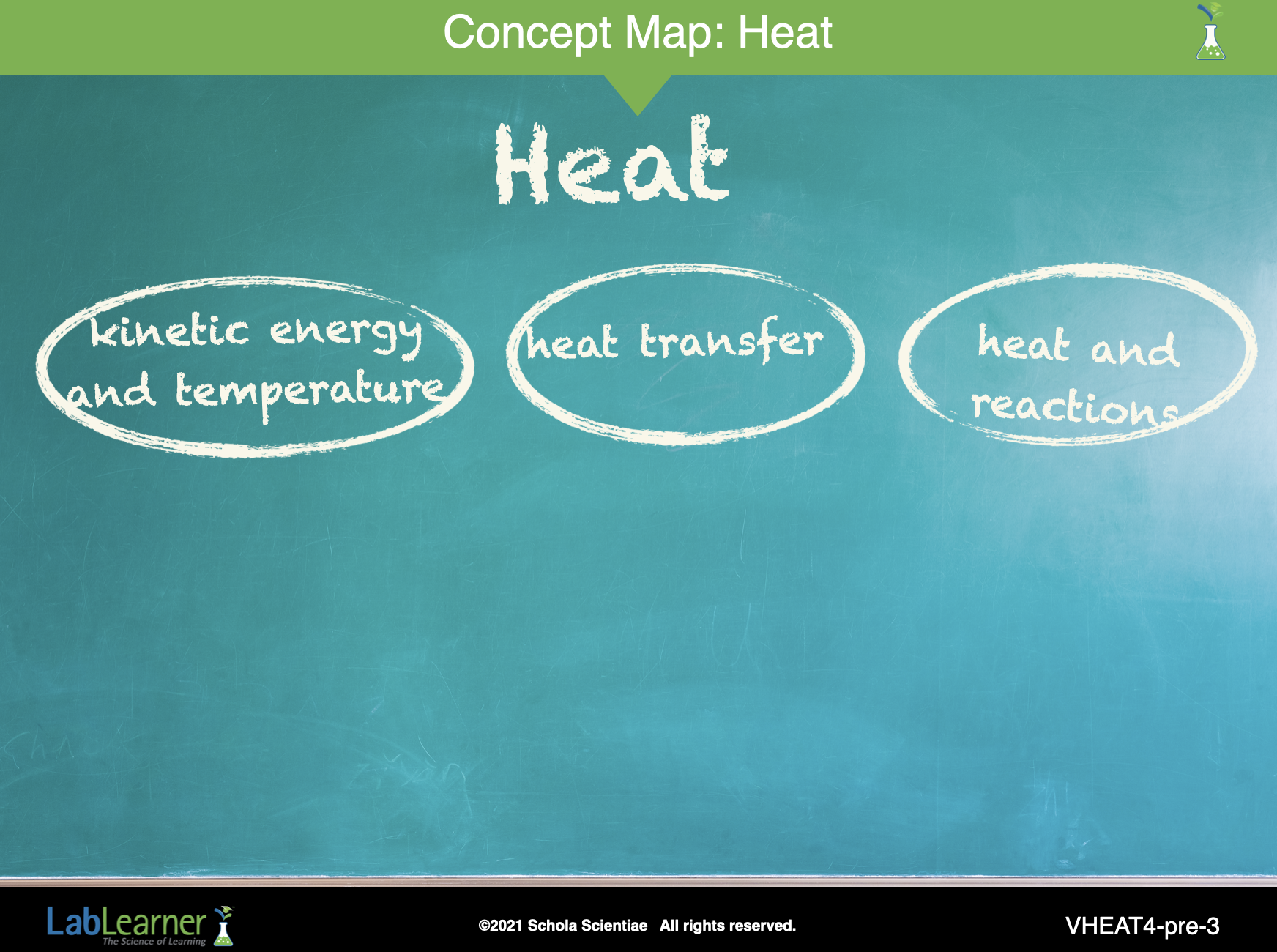
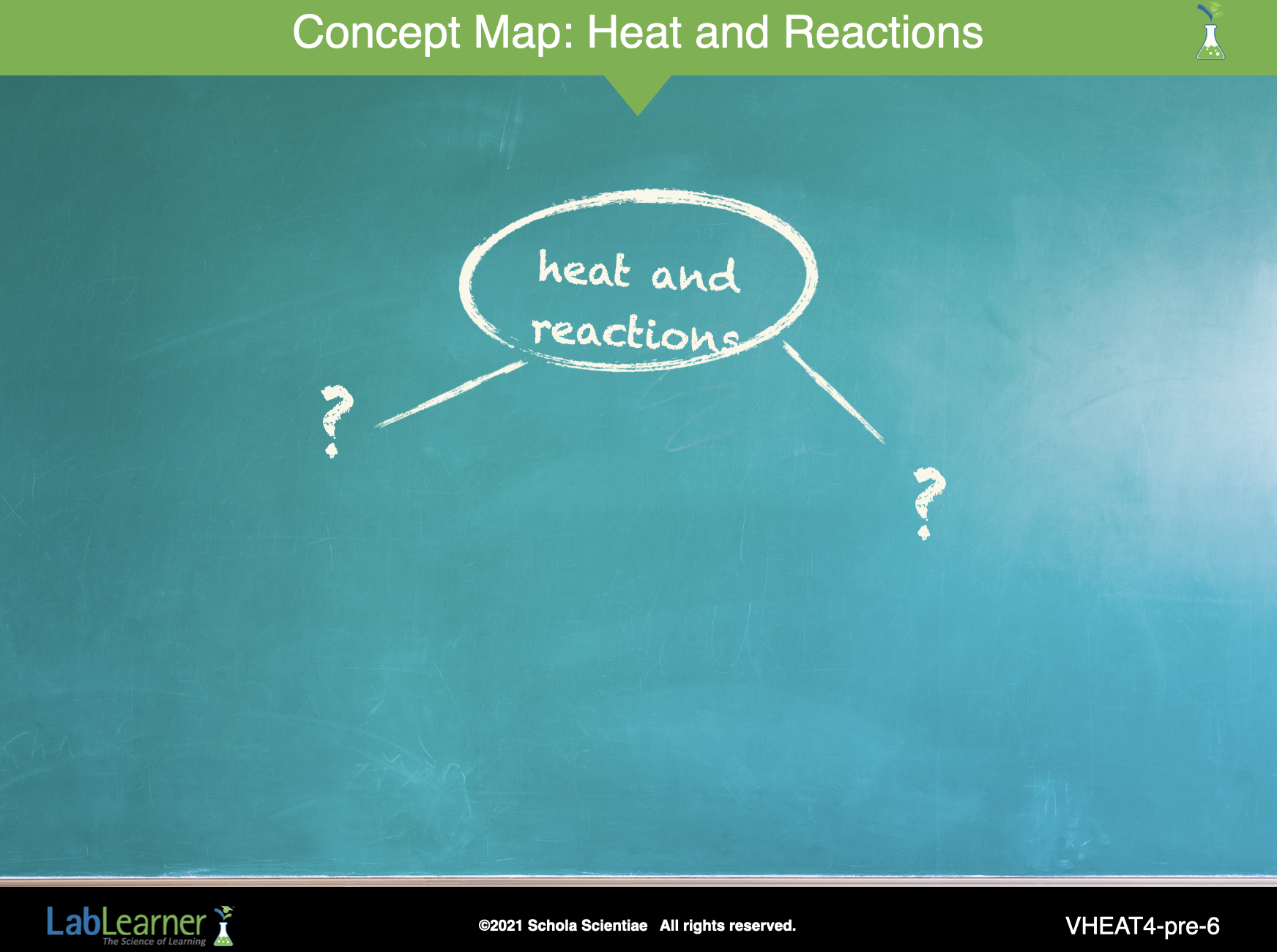
1. To begin, write the term heat on the board as a title to the concept map. The concept map will be continued in Investigation Five.
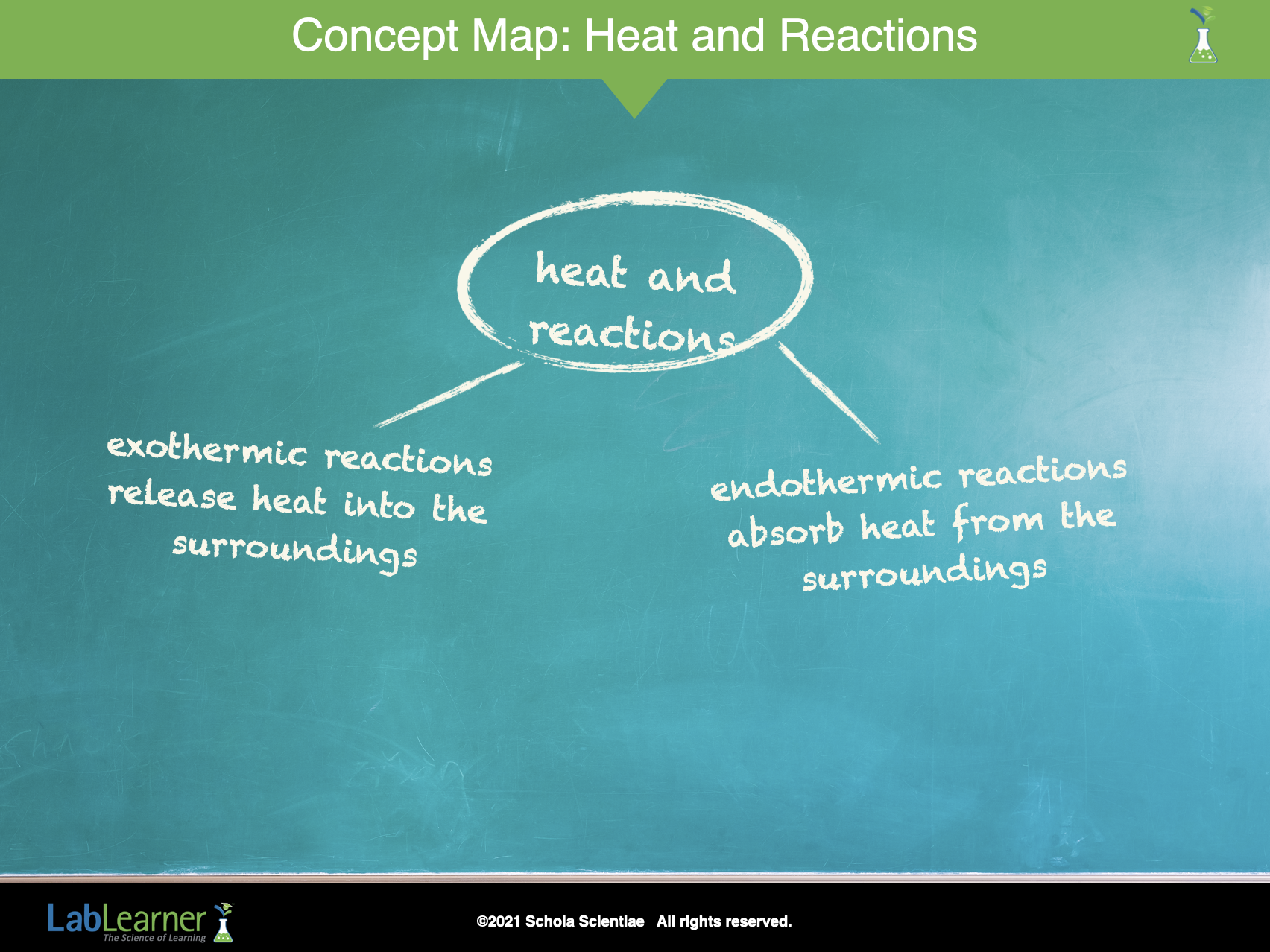
2. Ask students: What large concepts or ideas have you focused on during the first three Investigations? Student answers will vary. Students should suggest that they have studied heat transfer, kinetic energy and temperature, and heat and reactions.
Determine three or four major concepts and create headings on the board to represent these concepts. Leave enough space between the headings to place text around each heading.
______________________________________________
SLIDE VHEAT4-pre-4
1. To begin, write the term heat on the board as a title to the concept map. The concept map will be continued in Investigation Five.
2. Ask students: What large concepts or ideas have you focused on during the first three Investigations? Student answers will vary. Students should suggest that they have studied heat transfer, kinetic energy and temperature, and heat and reactions.
Determine three or four major concepts and create headings on the board to represent these concepts. Leave enough space between the headings to place text around each heading.
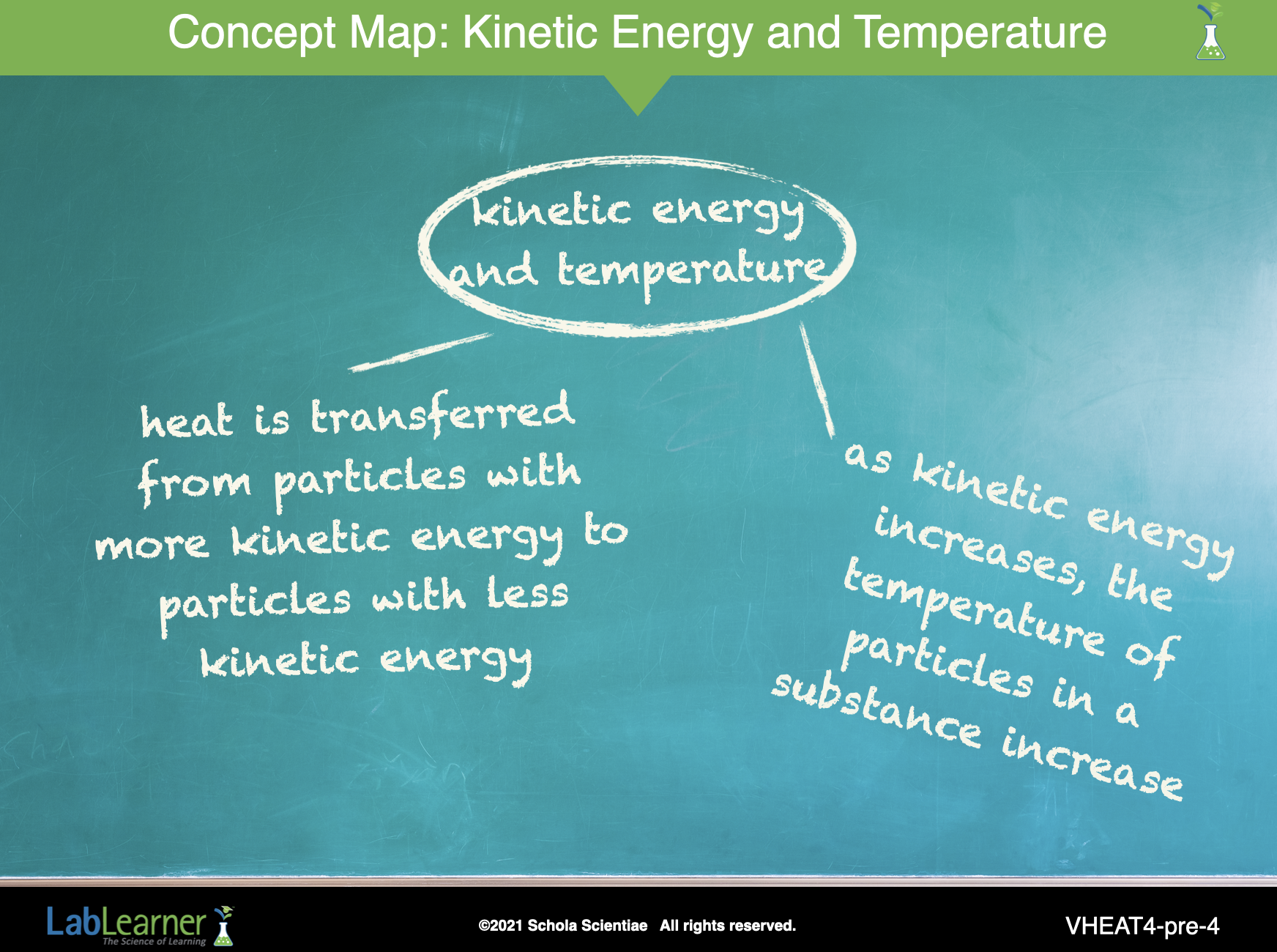
3. Choose one heading to focus on first. For example, you may choose to focus on kinetic energy and temperature.
Ask students: What did you learn about kinetic energy and temperature? What conclusions did you draw? What are some main ideas about kinetic energy that you think are important? Student answers may vary, but may include the following: (1) heat is transferred from molecules with more kinetic energy to molecules with less kinetic energy and (2) as kinetic energy increases the temperature of a substance increases.
As students suggest responses, record their ideas under the kinetic energy and temperature heading.
______________________________________________
SLIDE VHEAT4-pre-5
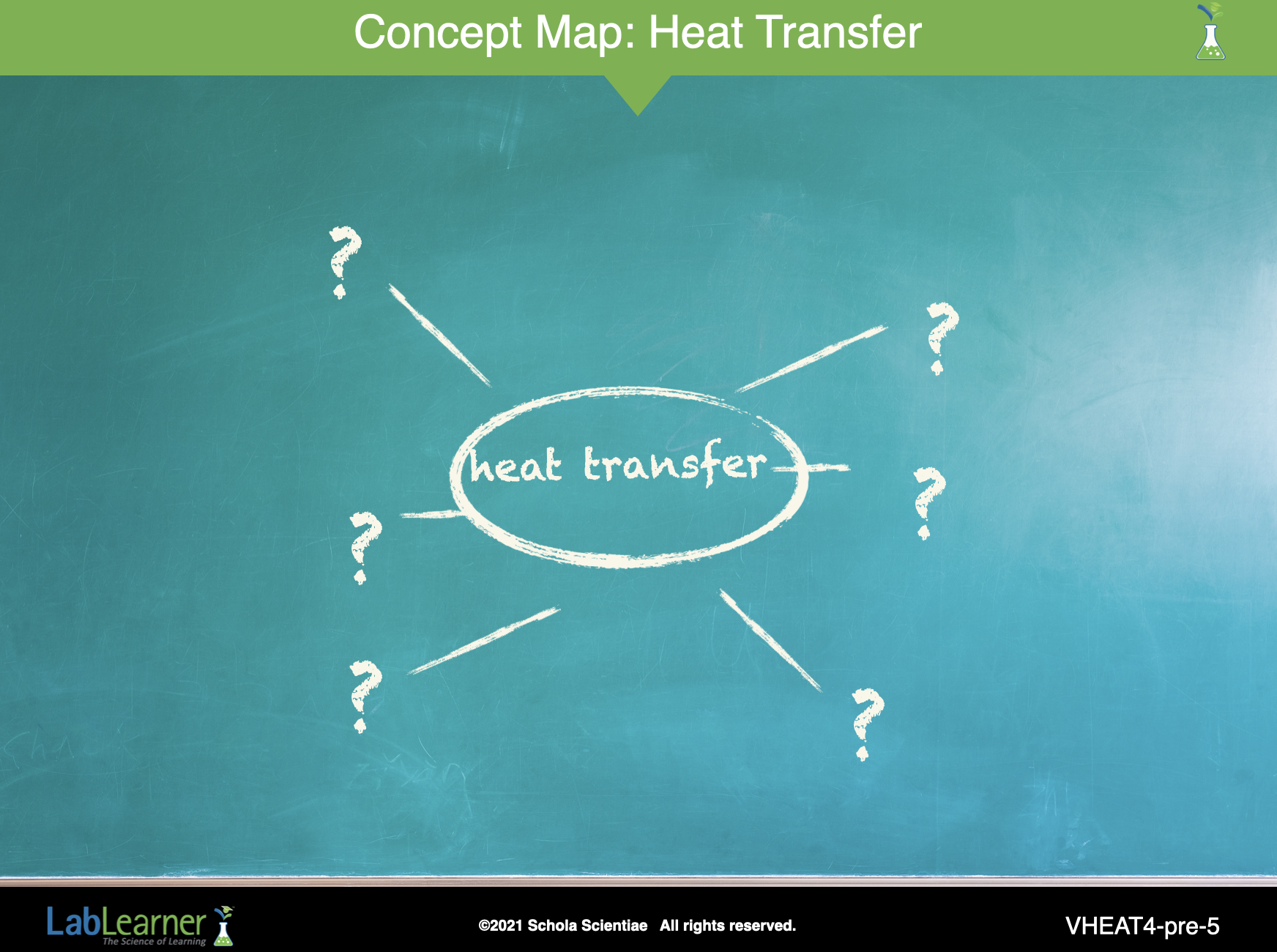
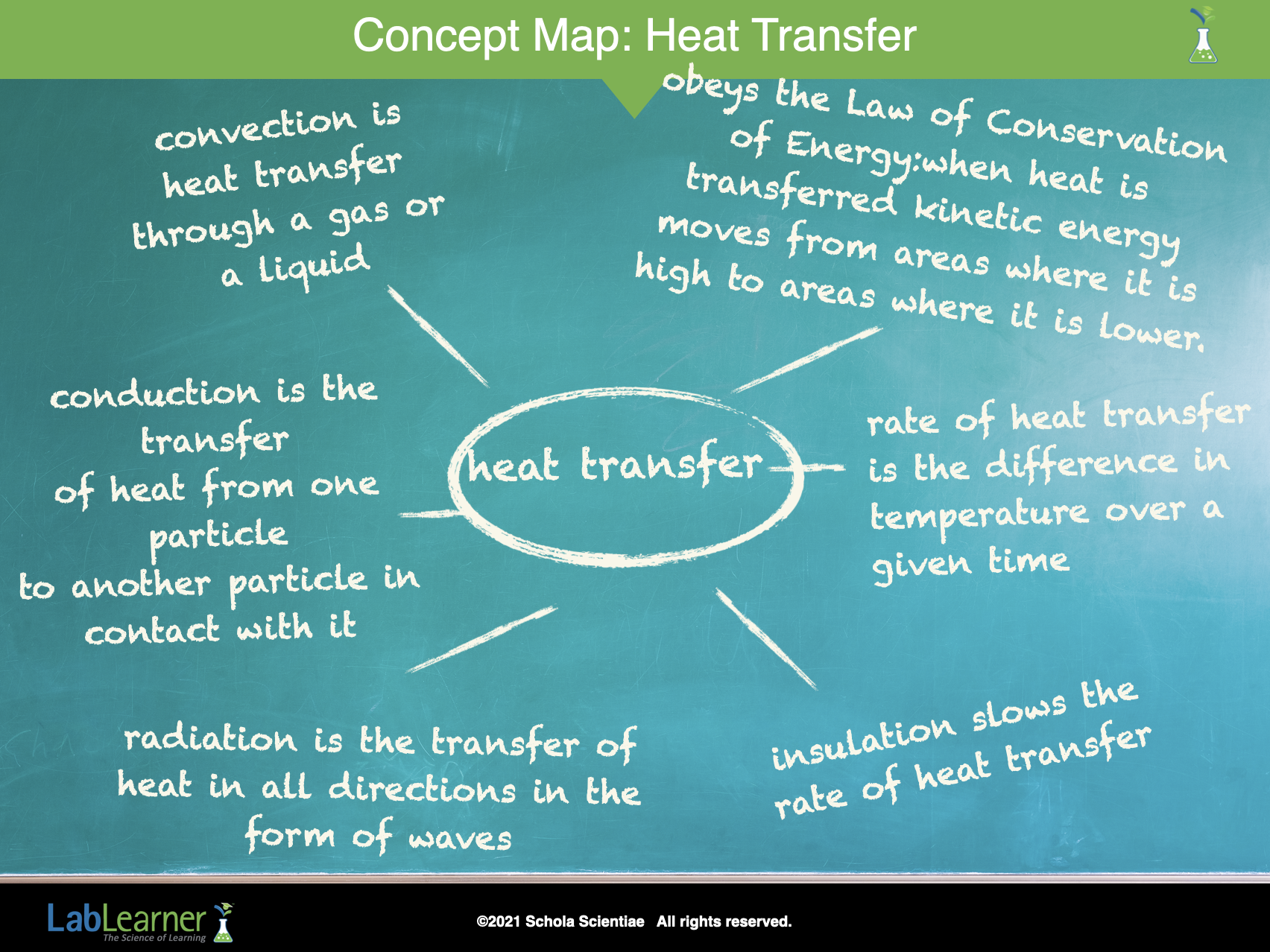
Students do not have the graphic below:
______________________________________________
SLIDE VHEAT4-pre-6
Students do not have the graphic below:
______________________________________________
SLIDE VHEAT4-pre-7
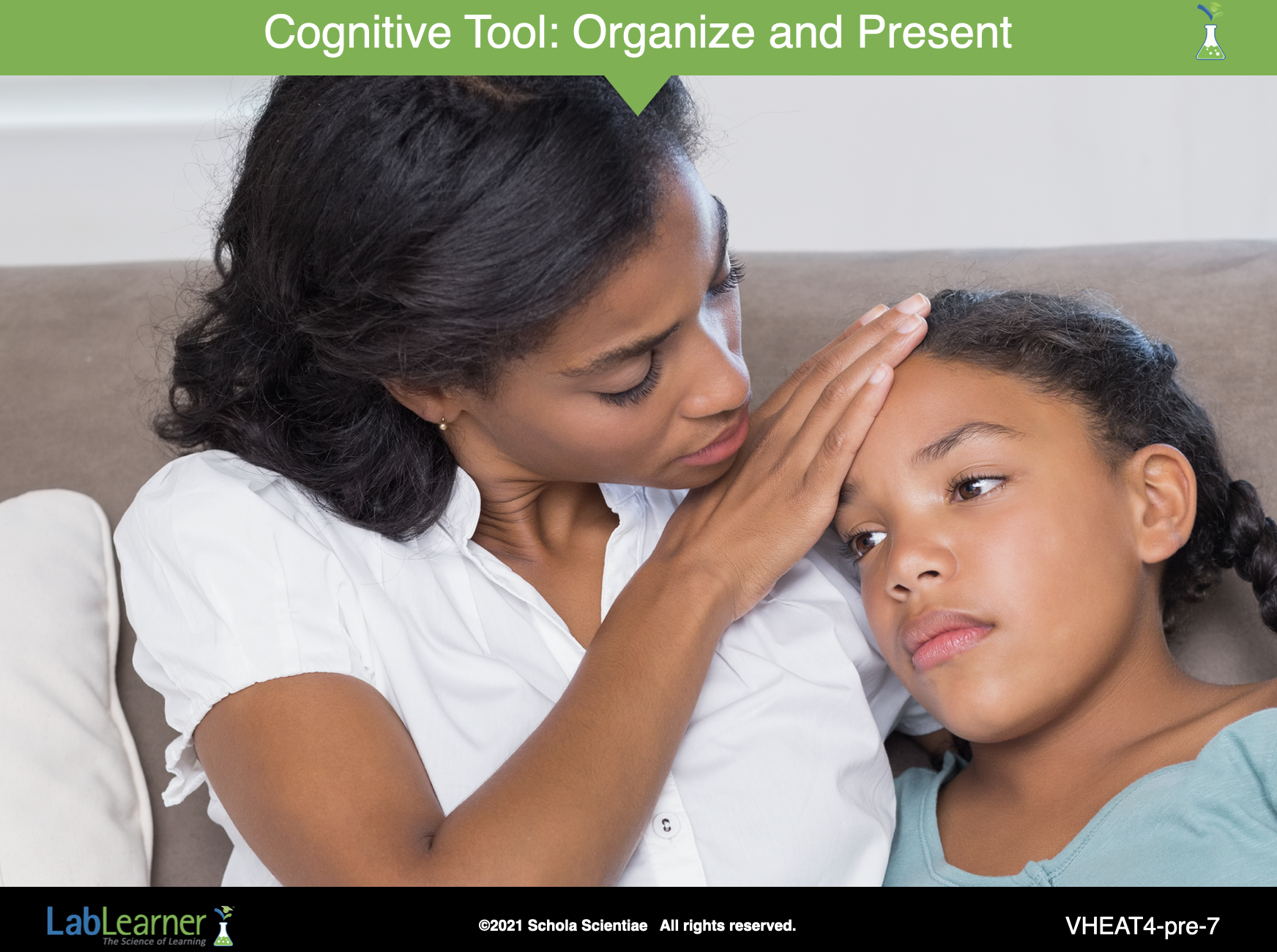
B. Tell students that in Investigation Four, they will continue their exploration of heat, this time focusing on heat and the body.
1. Ask students the following questions to promote discussion:
Ask students: What do you know about heat and the body? Student answers will vary. Students may respond that our bodies give off heat, that excessive heat is harmful to the body, or that normal internal body temperature is 98.6°F (37°C).
Ask students: How do you know that the body produces heat? Student answers may vary. Students may have felt the body heat of another person when standing close to someone, they may have felt a room get warm with many people present, or they may have blown on their cold hands in the winter in order to warm them.
2. If students have not suggested it, tell them that the body has a small range of temperatures at which it is able to function.
a. Ask students: What is normal body temperature? Student answers may vary.
b. Tell students that normal body temperature is approximately 37°C (98.6°F). If the body temperature remains between approximately 36°C and 39°C (96°F and 103°F) it is able to function. Outside of these temperatures, the organs in the body are unable to function as effectively or efficiently as they normally do.
3. Explain to students that their bodies are equipped with an internal body temperature sensor, which communicates to the brain when their bodies are too warm or too cold. The brain then automatically determines what is an appropriate way to reach it’s normal temperature range.
4. Ask students: Do you think your body is able to do anything to control its temperature? Can your body do anything to change the heat that is transferred from it? Student answers will vary.
______________________________________________
SLIDE VHEAT4-pre-8
5. Encourage students to discuss these questions further. Ask them the following questions to promote discussion of body temperature and ways to control it:
a. Ask students: What do you do when you become too cold? Student answers may vary. Students may put on more clothing, find shelter and heat, rub their hands together, or stand close to other people in a group.
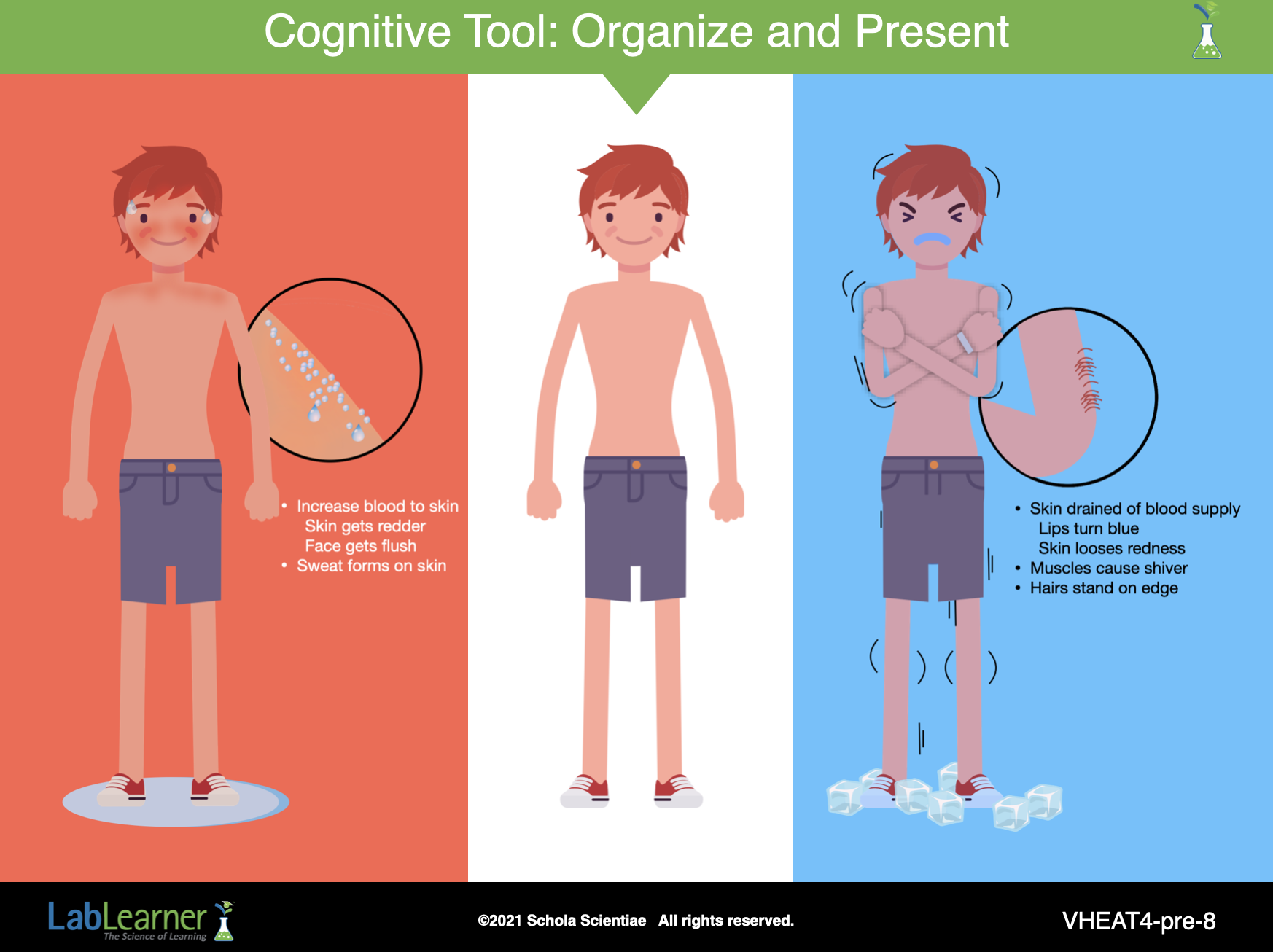
b. Ask students: Can you think of any automatic responses of your body? Are there things your body does that you do not control when you are cold? Student answers may vary. Students may recall that they shiver when they are cold, that their lips turn blue, and that sensation in their fingers and toes is decreased.
c. Tell students that when their bodies become too cold, the body automatically determines which parts are most important to keep warm. Most of the body’s important organs are in the torso, or abdomen, and in the head (brain), and the body automatically chooses to send most of the blood there to ensure that the vital organs are able to function. This causes fingers and toes to become cold and numb. In addition, the body begins to shiver. Shivering warms the body as muscles contract rapidly. When this happens, some of the body’s potential energy is converted to kinetic energy, thus generating heat.
d. Ask students: What do you do when you become too hot? Student answers may vary. Students may try to find shelter or shade, take off extra clothing, jump in a pool or lake, or fan themselves.
e. Ask students: Can you think of any automatic responses of your body? Are there things your body does that you do not control when you are hot? Student answers may vary. Encourage students to realize that when they are too hot, their bodies perspire, or sweat.
f. Tell students that when their bodies become too hot, they begin to perspire. Explain to students that during the lab experiments, they will determine why the body perspires when it becomes overly warm.
______________________________________________
SLIDE VHEAT4-pre-9
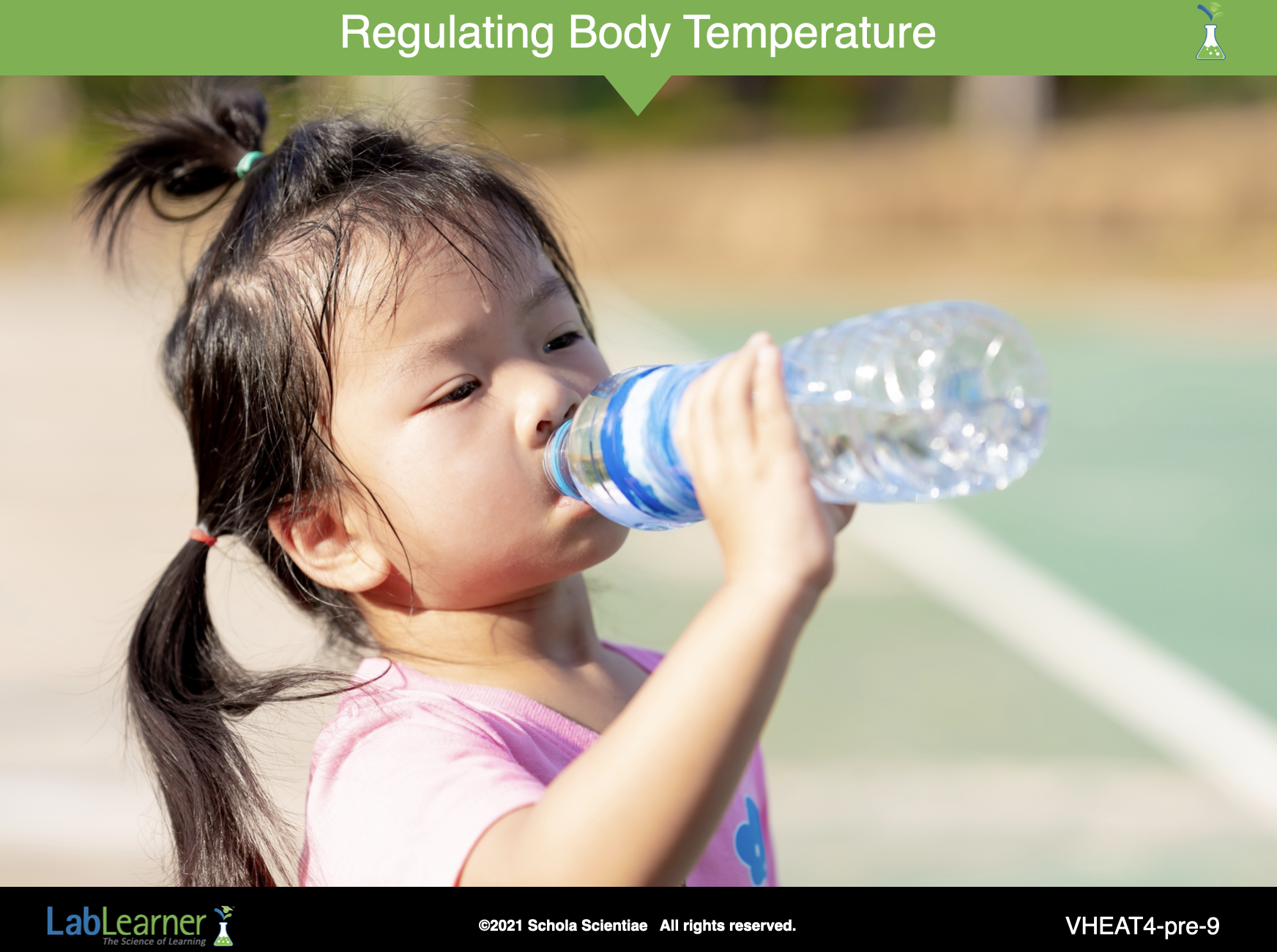
C. Tell students that by performing their lab experiments, they will begin to answer the following questions:
Why does the body perspire when it is overly warm?
Can we change the temperature of the air exhaled from our bodies?
WATCH IT
Play the following Student Video in preparation for the lab. Discuss as necessary to answer student questions.
KEYS