Teacher Portal:
Investigating Heat
Investigation 3 – PostLab
 PRINT IT
Use your browser to download a printable PDF as help during the slide presentation and to make additional notes. In your browser, go to File > Print and then choose to save as PDF.
NAVIGATE IT
Once the slide presentation is launched
- use your left and right arrows to advance or go back in the slide presentation, and
- hover your mouse over the left edge of the presentation to get a view of the thumbnails for all the slides so that you can quickly move anywhere in the presentation.
- Click HERE to launch the slide presentation for the CELL.
SHARE IT
SLIDE VHEAT3-post-1
In Investigation Three, students continued their study of heat kinetic energy. They performed experiments that focused on endothermic and exothermic chemical reactions.
______________________________________________
SLIDE VHEAT3-post-2
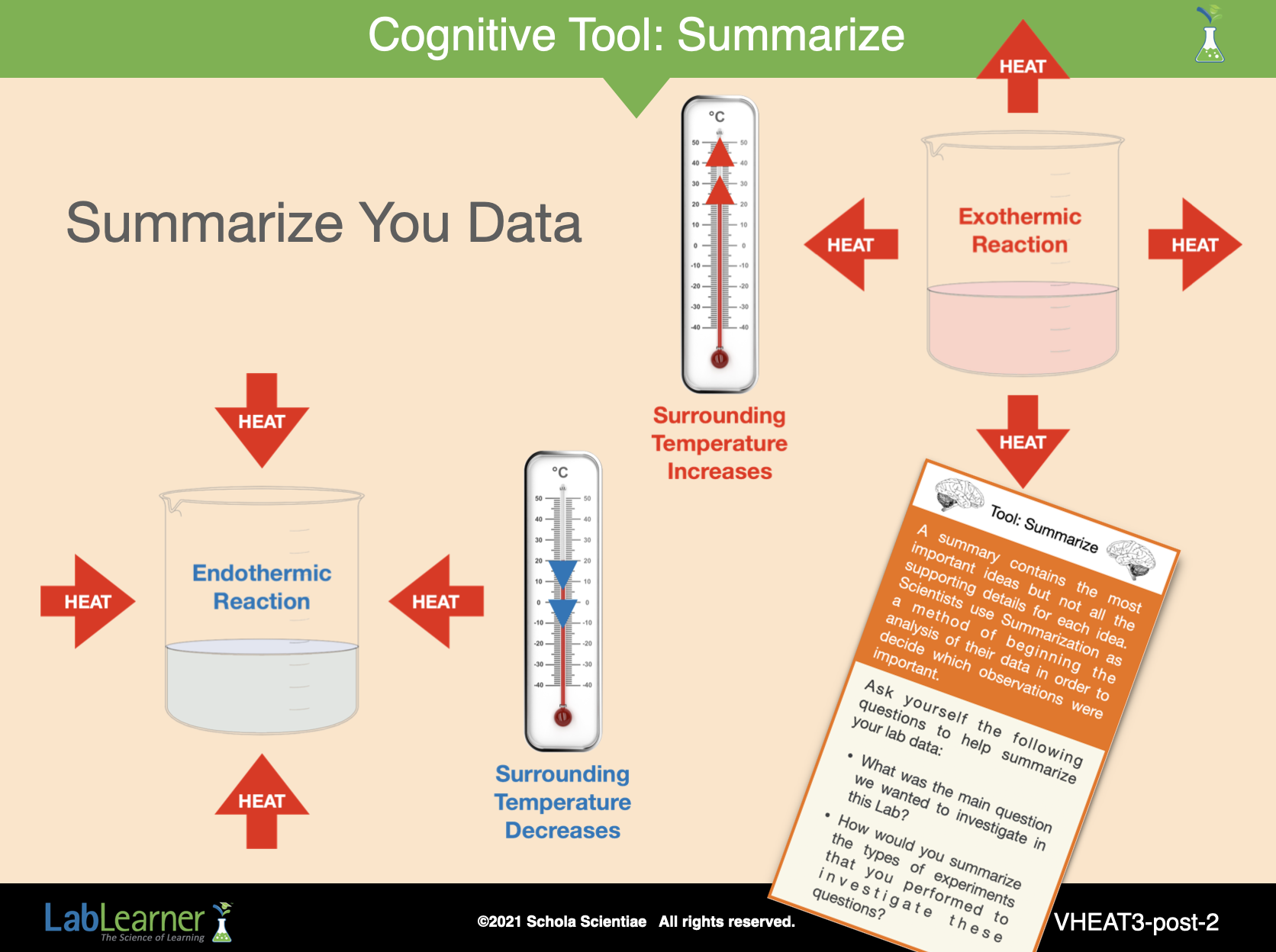
Scientists use Summarization as a method of beginning the analysis of their data in order to decide which observations were important. Begin the analysis of this Investigation by encouraging students to summarize the experiments they conducted in the lab and the purpose of those experiments. The following questions may be used to prompt student discussion:
1. Ask students: What was the main question we wanted to investigate in this lab? The main question was: What is the difference in heat transfer between an endothermic reaction and an exothermic reaction?
2. Ask students: How would you summarize the types of experiments that you performed to investigate these questions? Students conducted experiments involving heat transfer. These experiments demonstrated an example of an endothermic reaction and an exothermic reaction. In the exothermic reaction, heat was released, resulting in an increase in temperature. In the endothermic reaction, heat was absorbed, resulting in a decrease in temperature.
______________________________________________
SLIDE VHEAT3-post-3
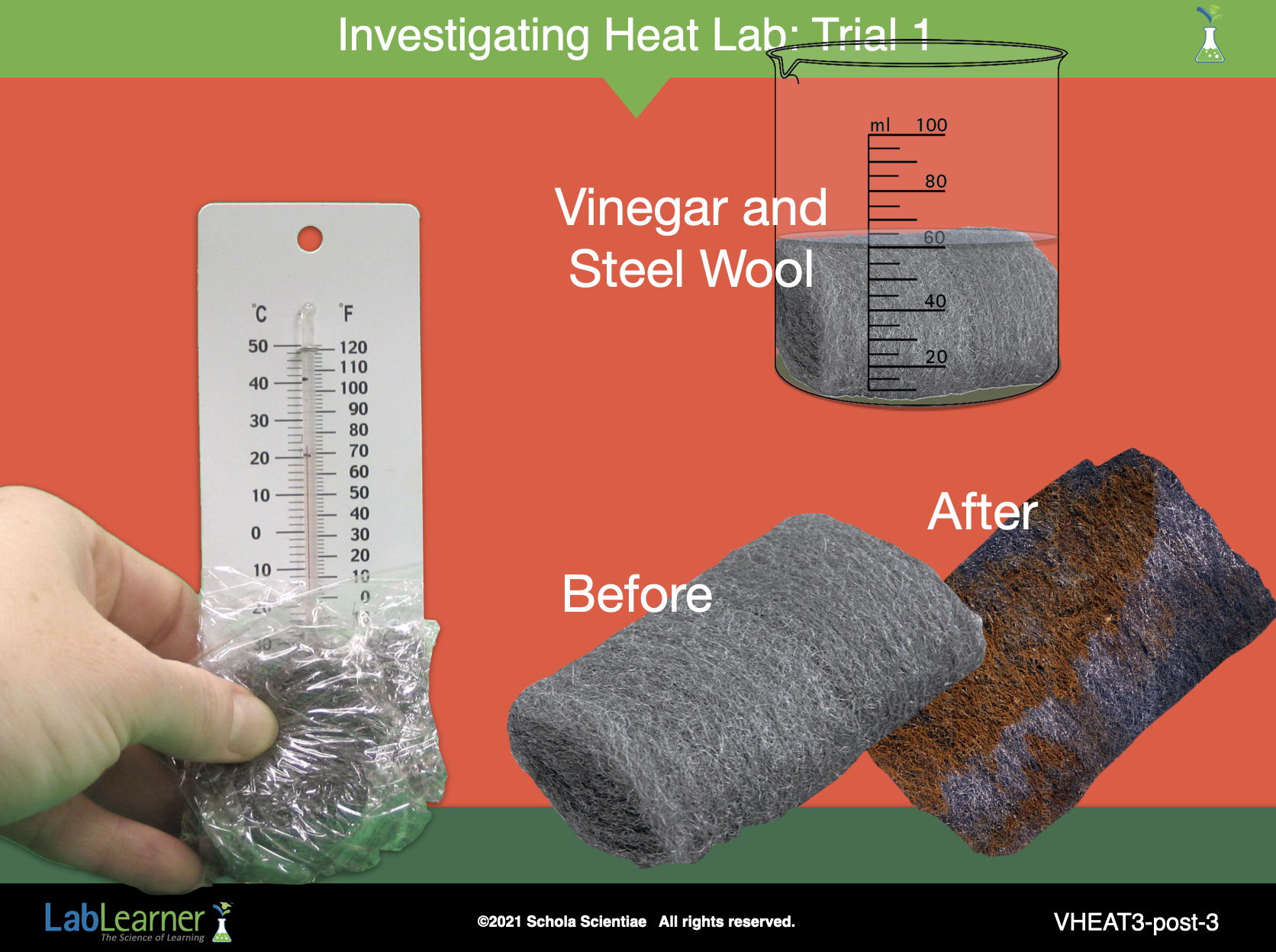
A. Continue the discussion by reminding students that a temperature change often occurs during a chemical change. Encourage students to identify the reactions that caused the chemical changes by identifying the signs of chemical change that occurred in each reaction. The following questions may be useful in prompting student discussion:
1. Ask students: What observations indicated a chemical change occurred in Trial 1? The steel wool changed color when rust formed. This was an unexpected color change. It was unexpected because vinegar is often added to other substances which are then exposed to air but do not change color. For example, vinegar is added to a salad. The salad, however, does not rust! In addition, the reaction was accompanied by a temperature change. This can also be a sign of a chemical change. The temperature of the steel wool after being cleaned and exposed to air was greater than the initial temperature of the steel wool.
______________________________________________
SLIDE VHEAT3-post-4
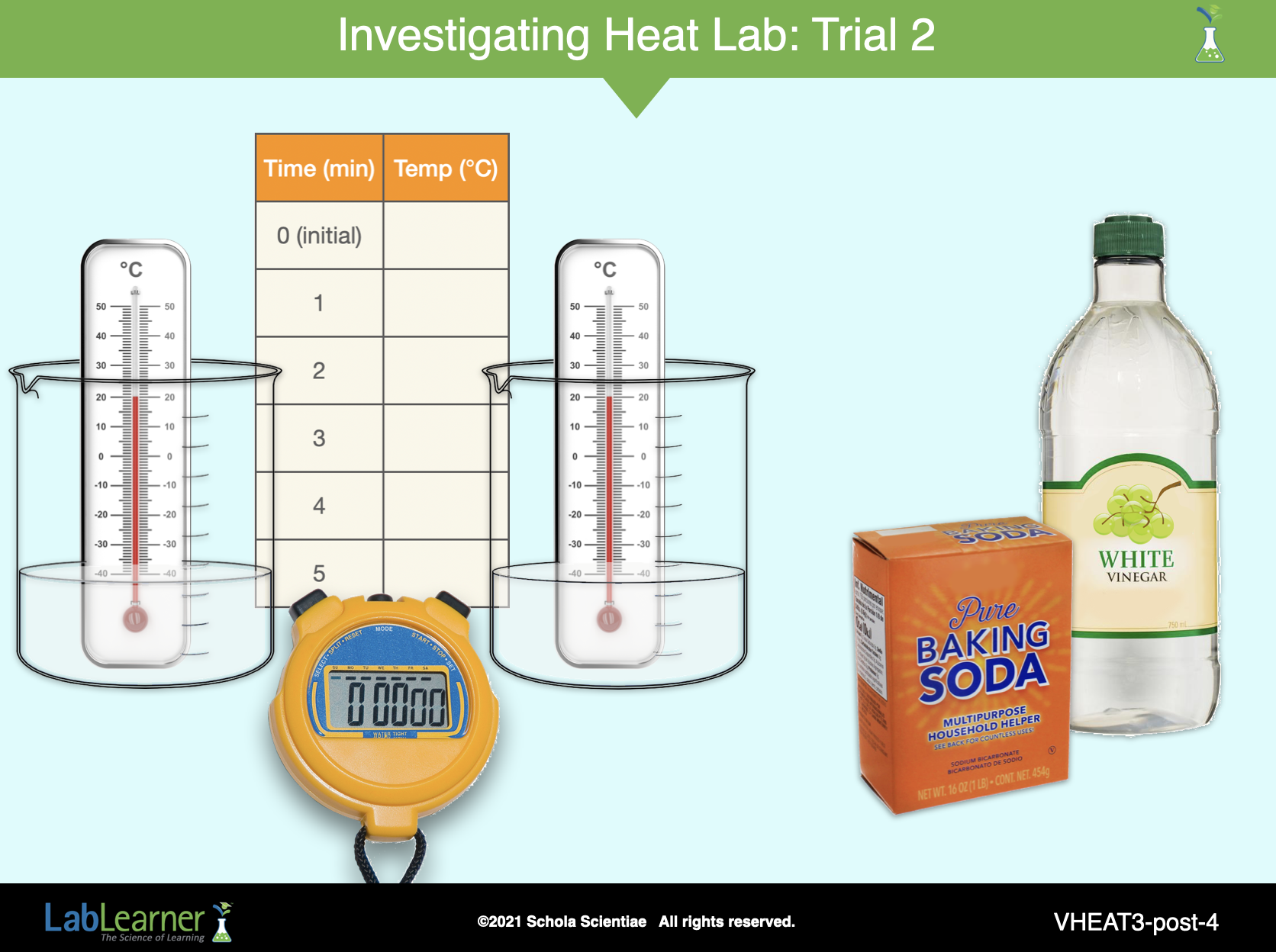
2. Ask students: What observations indicated a chemical change occurred in Trial 2? Bubbles formed, indicating a gas had been produced. The formation of bubbles was due to the addition of baking soda to the vinegar. The formation of bubbles indicates a chemical reaction occurred that resulted in the production of gas because adding baking soda to other liquids such as water does not result in the formation of bubbles. The bubble formation was accompanied by a temperature change as well. The final temperature of the vinegar solution after the baking soda was added was less than the initial temperature of the vinegar.
3. Ask students: What observations suggest that the temperature changes in Trials 1 and 2 were due to chemical changes and not physical changes? The changes were not the result of adding or removing heat through heating or chilling, or examples of boiling, freezing, or evaporation, three physical changes that are accompanied by a change in temperature. In addition, the changes in temperature occurred after a substance was added.
In Trial 1, oxygen was added to the steel wool after the protective coating was removed. In Trial 2, baking soda was added to the vinegar. In addition, other signs of chemical change accompanied the changes in temperature. In Trial 1, an unexpected color change occurred on the steel wool. In Trial 2, bubbles formed, indicating the production of a gas. The occurrence of multiple signs of chemical change during a reaction is a strong indication that a chemical change has occurred.
______________________________________________
SLIDE VHEAT3-post-5
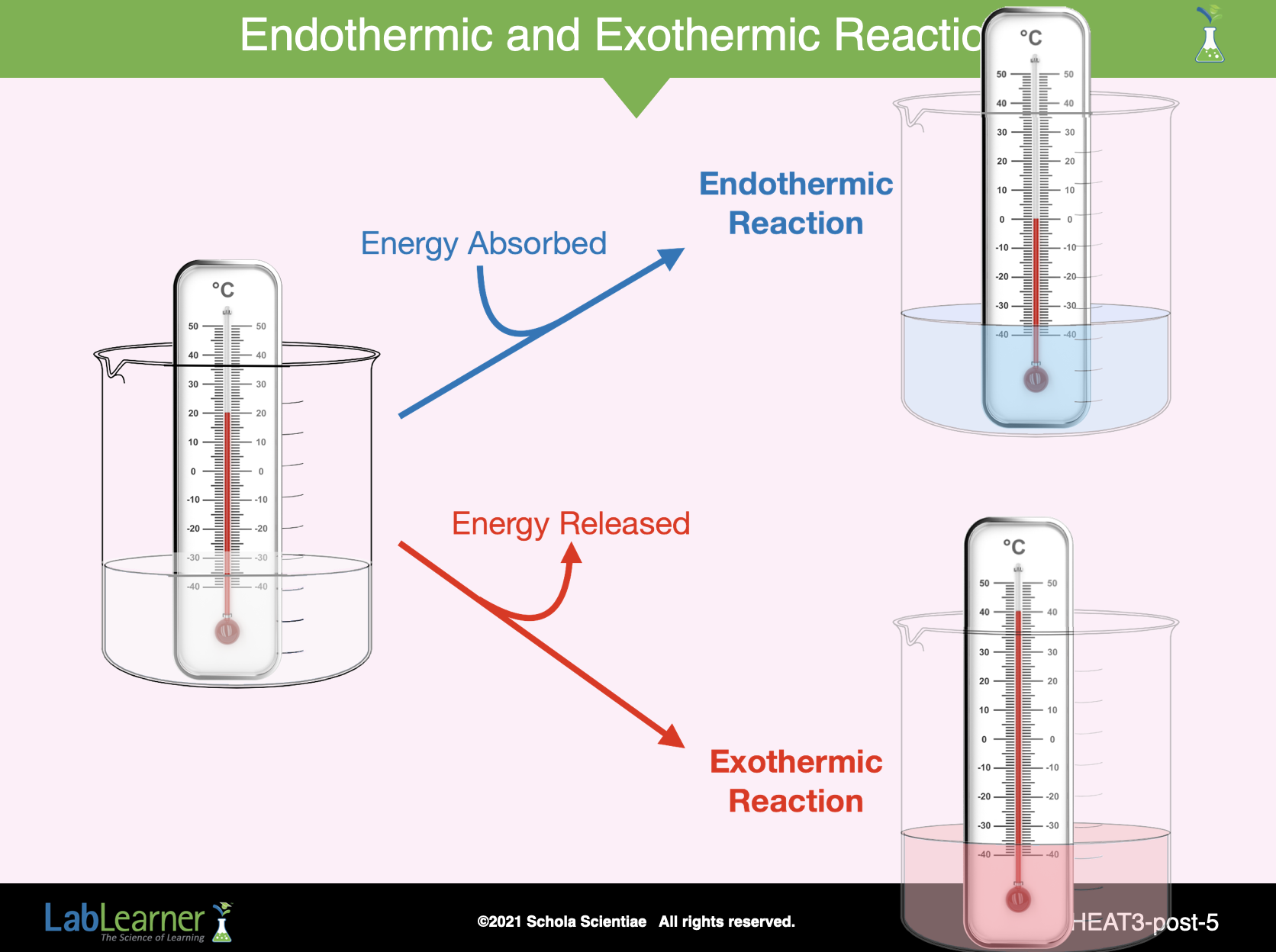
B. In chemical reactions, a change in temperature indicates a transfer of energy occurred between the reaction and its surroundings. This occurs because the amount of energy in the initial substances is different from the amount of energy in the products. When the energy content of the products is less than the energy content of the initial substances, the excess energy is released to the surroundings as heat, which increases the temperature of the surroundings. The reaction is described as releasing heat. It is an exothermic reaction.
When the initial substances require additional energy in order to form the products, energy moves into the reaction from the surroundings to make up the difference. This causes the temperature of the surroundings to decrease. Thus, the reaction is described as absorbing heat from its surroundings.
In this Investigation, students measured the temperature of the surroundings. Therefore, Trial 1 demonstrates an exothermic reaction because the temperature of the surroundings increases due to the release of heat from the reaction. Trial 2 demonstrates an endothermic reaction because the temperature of the surroundings decreases due to the absorption of heat from the surroundings into the reaction.
__________________________________________________________
Continue the analysis of the experiments by encouraging students to consider what the results of their experiments represent. Ask the following questions to assist students in connecting the temperature changes with heat transfer resulting from chemical reactions.
1. Ask students: How can you determine whether the heat was transferred into or out of the reaction? Student answers may vary. The direction of heat transfer is determined by whether the reaction releases heat to the surroundings or absorbs heat from the surroundings. Heat release is generally demonstrated by a temperature increase. Heat absorption is generally demonstrated by a temperature decrease. Students should indicate that the direction of energy transfer can be determined by studying the temperature changes in each reaction.
2. Ask students: How will determining the direction of heat transfer help you identify whether the reactions were endothermic or exothermic? Student answers may vary. Determining the direction of heat transfer will help identify whether the reactions were endothermic or exothermic because the direction of heat transfer differs for each type of reaction. Heat is absorbed by endothermic reactions, meaning that heat is transferred into the reaction. Heat is released by exothermic reactions, meaning that heat is transferred out of the reaction.
______________________________________________
SLIDE VHEAT3-post-6
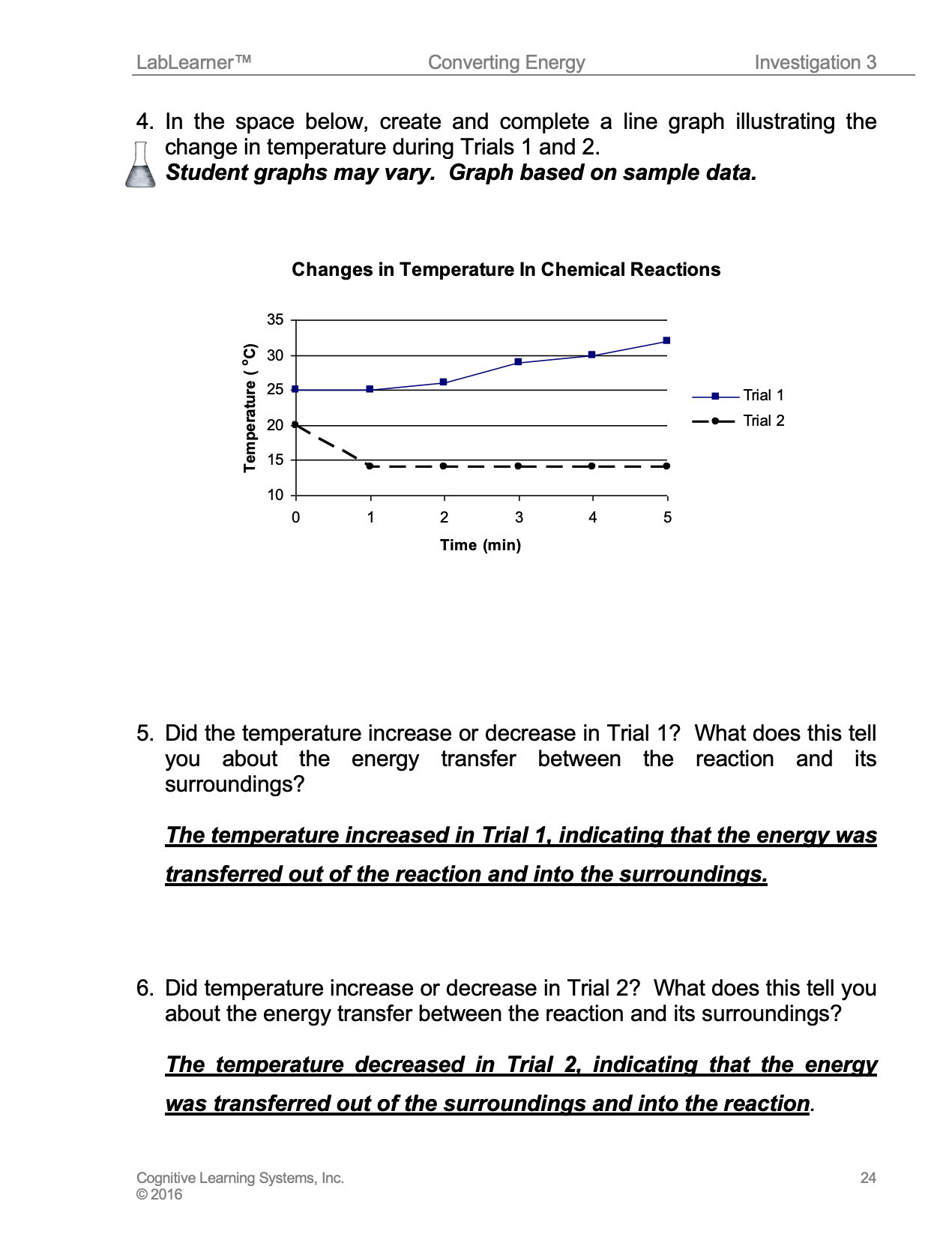
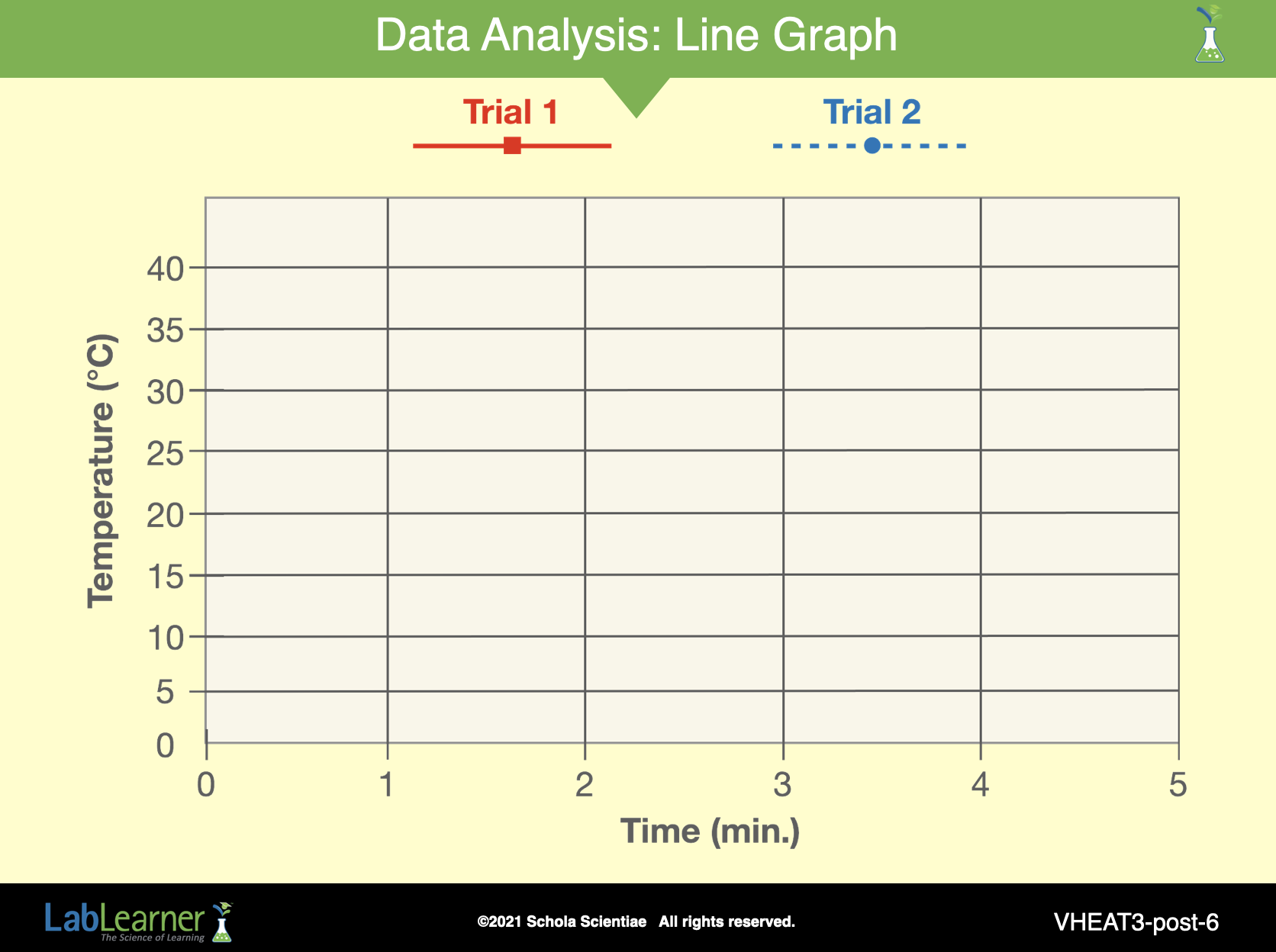
3. Ask students: How could you present the temperature changes graphically so they can be more easily compared? Students should suggest that the temperature changes could be shown using a line graph. Students observed the temperature changes in each reaction by recording the temperature at regular intervals. A line graph is appropriate to use when data is collected continuously such as at various time points. Illustrating these changes with line graphs allows students to visualize the difference between endothermic and exothermic reactions. The data for each trial can be plotted on the same graph, using a different point and line style for each trial. A legend should be included to identify the trial results.
a. Divide students into their cooperative groups from Lab.
b. Encourage students to work together to create and complete line graphs demonstrating the change in temperature of each reaction over time. Allow 10 – 15 minutes to complete the activity.
c. Remind students that their Procedural Toolbox is an excellent reference for analytical tools.
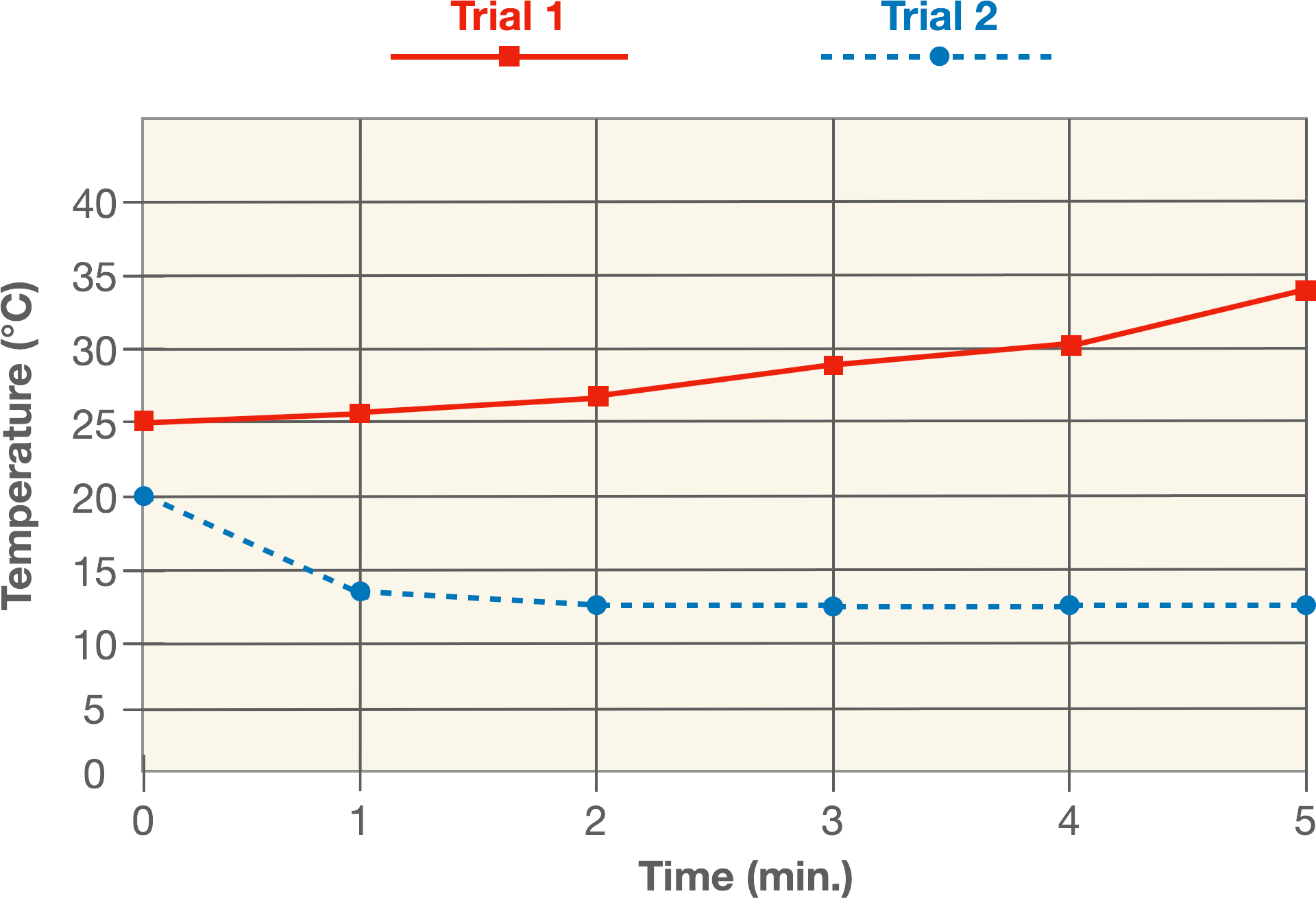
d. The graph should be recorded in Problem 4 of the Student Data Record. A sample graph is shown on the slide. Example data is shown for the teacher below:
4. Encourage student volunteers to share their groups’ results by drawing their graphs on the board.
5. Pose the following questions to assist students in evaluating their graphs:
a. Ask students: Did temperature increase or decrease in Trial 1? What does this tell you about heat transfer between the reaction and its surroundings? The temperature of the surroundings increased in Trial 1, indicating that the energy was transferred from the reaction into the surroundings.
b. Ask students: Did temperature increase or decrease in Trial 2? What does this tell you about heat transfer between the reaction and its surroundings? The temperature of the surroundings decreased in Trial 2, indicating that the energy was transferred from the surroundings into the reaction.
6. Direct students to record their answers in Problems 5 and 6 of their Student Data Record.
______________________________________________
SLIDE VHEAT3-post-7
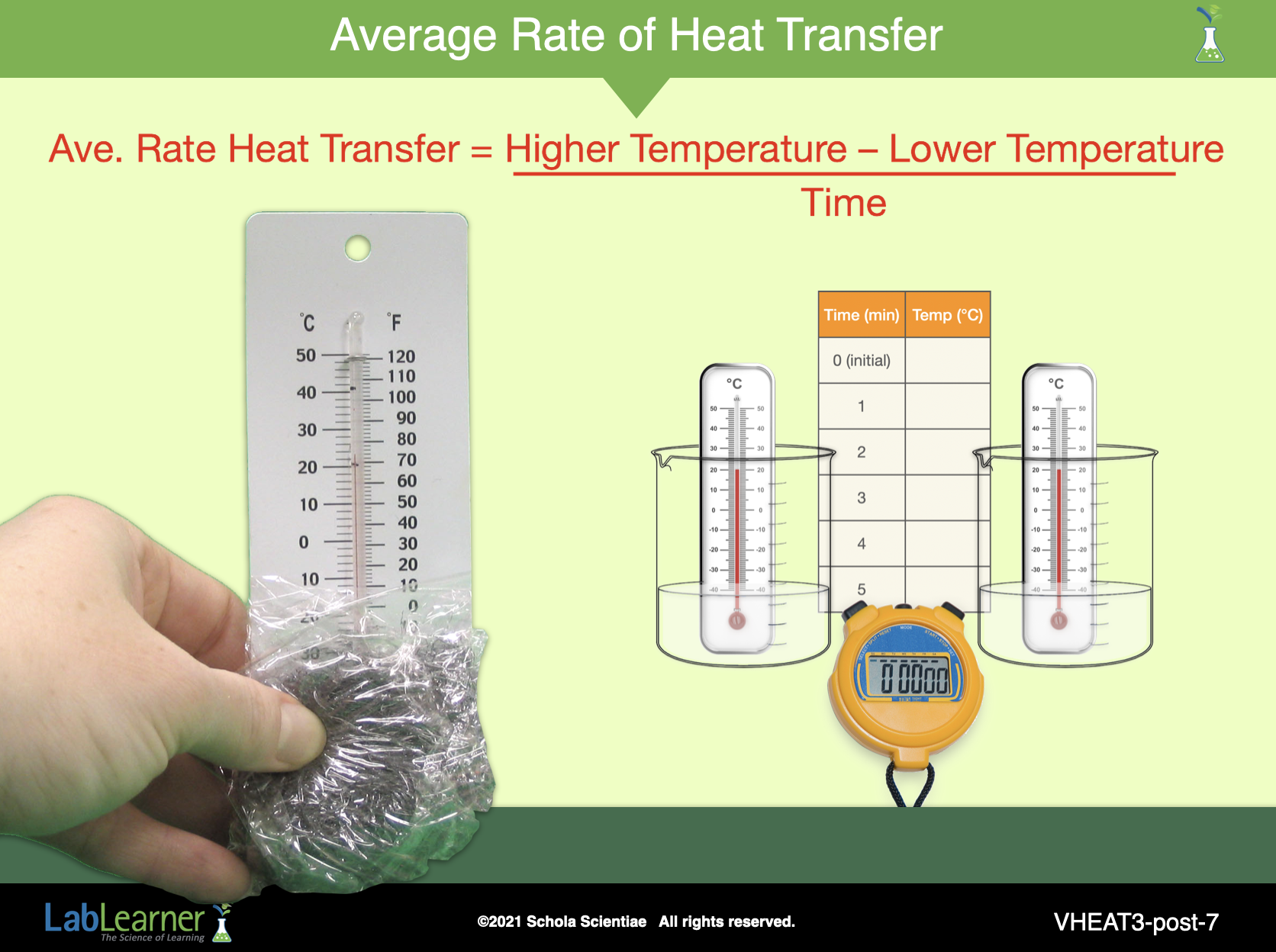
C. The line graph demonstrates the direction of heat flow but does not provide information about the speed at which heat moved between the reactions and their surroundings. Continue the analysis of the data by reminding students that heat has speed as well as direction.
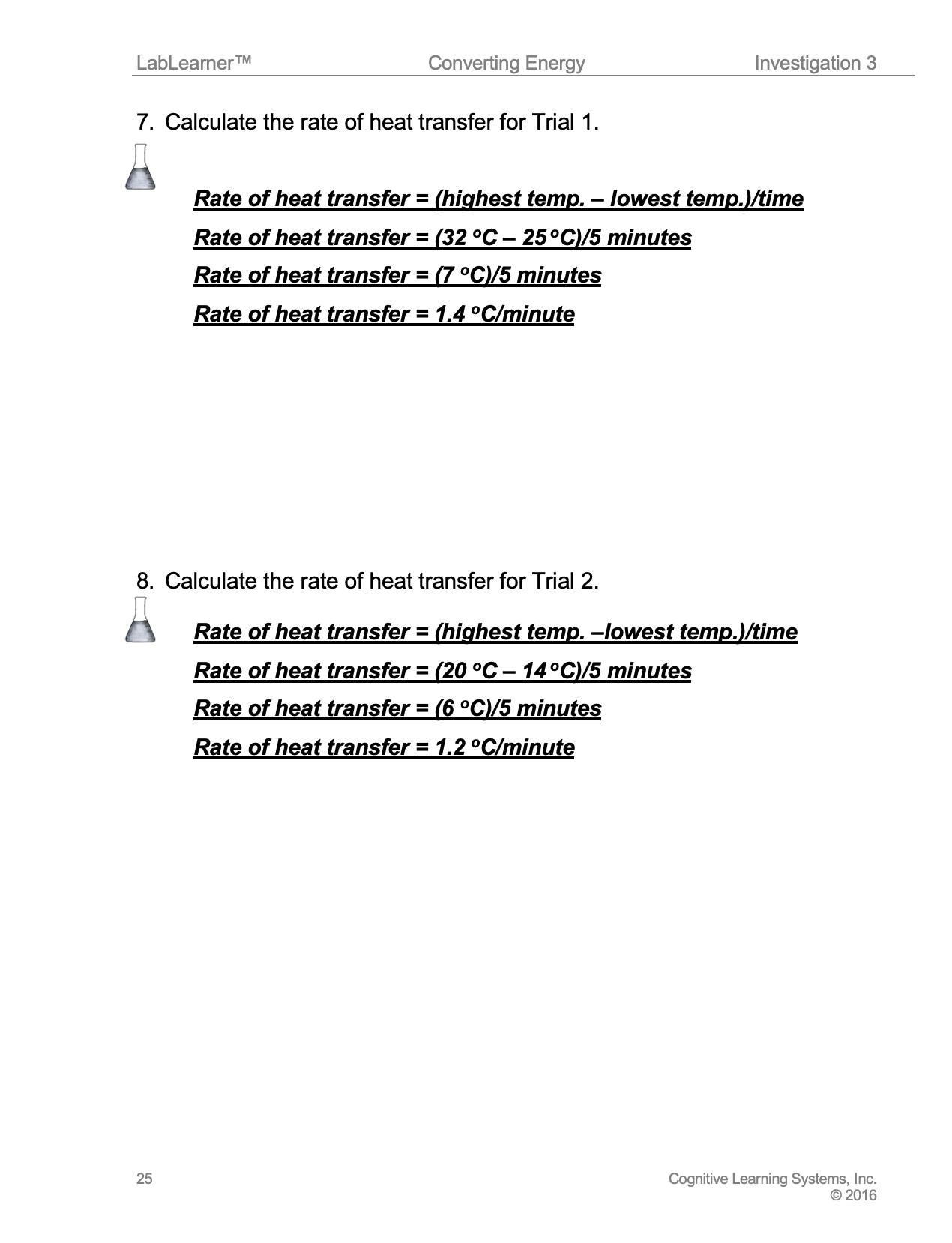
In Investigation Two, students learned that the speed at which the temperature of a substance changes is called its average rate of heat transfer. The average rate of heat transfer is calculated as the change in temperature over time.
1. Ask students: How can we determine how rapidly heat was transferred between the reactions and their surroundings? Student answers may vary. The average rate of heat transfer can be used to determine the speed at which heat was transferred between the surroundings and the reactions.
2. Ask students: What is the formula for the rate of heat transfer?

3. Refer to the formula on the slide for student reference. Encourage students to calculate the average rates of heat transfer for Trials 1 and 2 and record their calculations in Problems 7 and 8 of their Student Data Record.
______________________________________________
SLIDE VHEAT3-post-8
D. Conclude the analysis by encouraging students to discuss how their results in Lab answered the main question of this Investigation:
What is the difference in heat transfer between an endothermic reaction and an exothermic reaction?
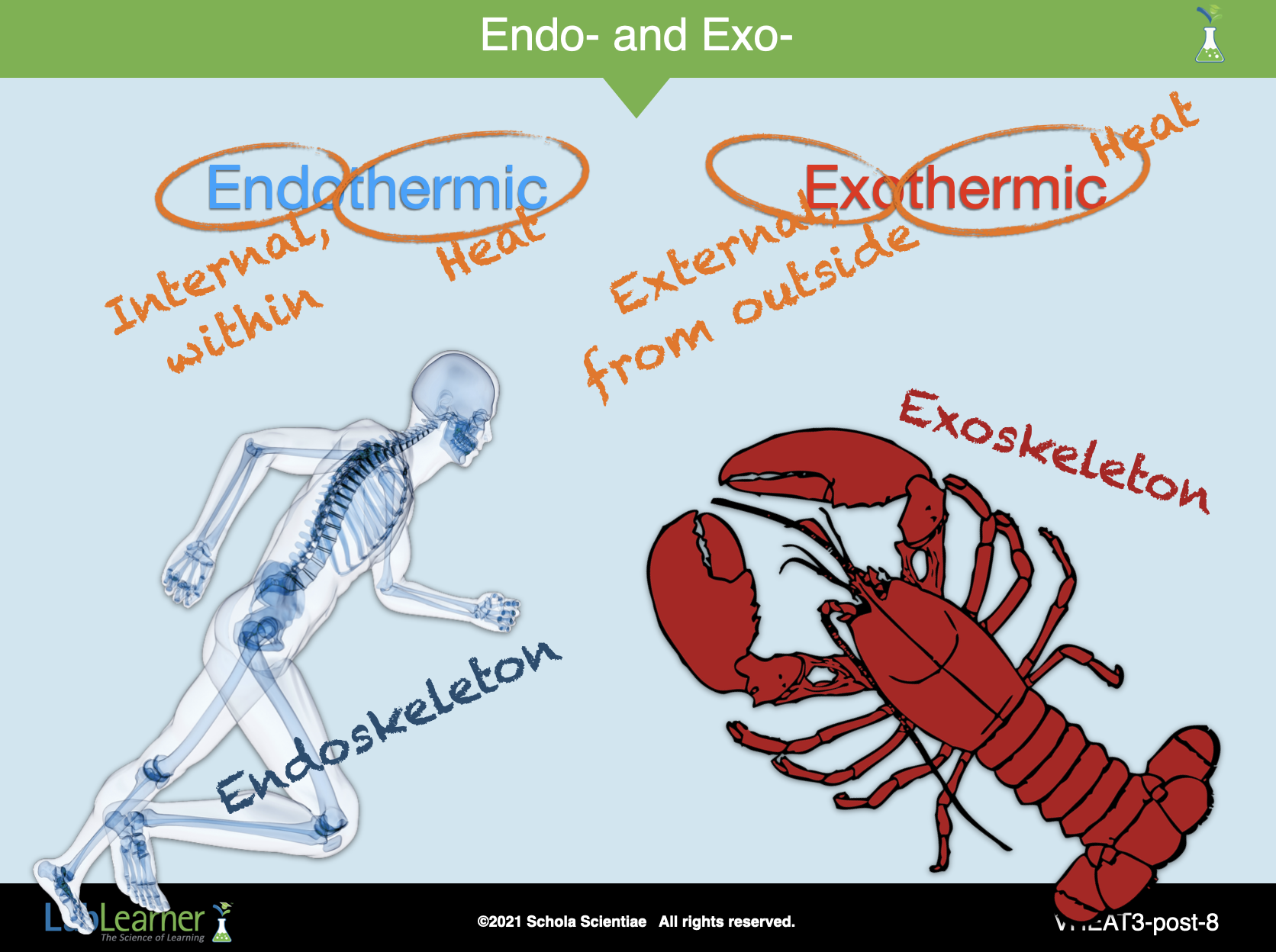
1. The concept of heat absorption in terms of a chemical reaction can be confusing, as students often equate both heat absorption and heat release with making a substance warm, thus causing its temperature to increase. However, in a chemical reaction heat absorption means that energy is transferred into a reaction from its immediate surroundings. This causes the temperature of the surroundings to decrease. In contrast, heat release indicates that heat is transferred out of a reaction into its immediate surroundings. This causes the temperature of the surroundings to increase. Students can use the composition of the words endothermic and exothermic to decide whether heat was absorbed or released and associate the terms with the appropriate temperature change.
a. Direct students’ attention to the terms endothermic and exothermic in their Scientist’s Glossary.
“Endothermic process: a chemical reaction or physical change that absorbs heat.”
“Exothermic process: a chemical reaction or physical change that releases heat.”
Ask students: How can you use the composition of these words to determine the direction of heat transfer? Student answers may vary. Students may note that “endo-“ is similar to “in” or “enter”, and “exo-” is similar to “exit”.
b. Explain that scientists use the prefix endo- when they want to indicate that something is inside of something else, or moves into something else. For example, a human has an endoskeleton because its skeleton is inside its body. Scientists use the prefix exo- when they want to indicate that something is outside of something else, or moves out of something else. For example, a lobster or an insect has an exoskeleton because its skeleton is on the outside of its body.
c. Explain that “therm-“ refers to heat. Therefore, endothermic means heat moves into a reaction from its surroundings, and exothermic means heat moves out of a substance or reaction. Students can remember this by imagining the direction of heat movement in an endothermic reaction as moving down into a beaker. Many times this is associated with temperature moving downward or decreasing. Heat movement in an exothermic reaction can be imagined as heat moving up out of a beaker. Many times this is associated with temperature rising.
______________________________________________
SLIDE VHEAT3-post-9
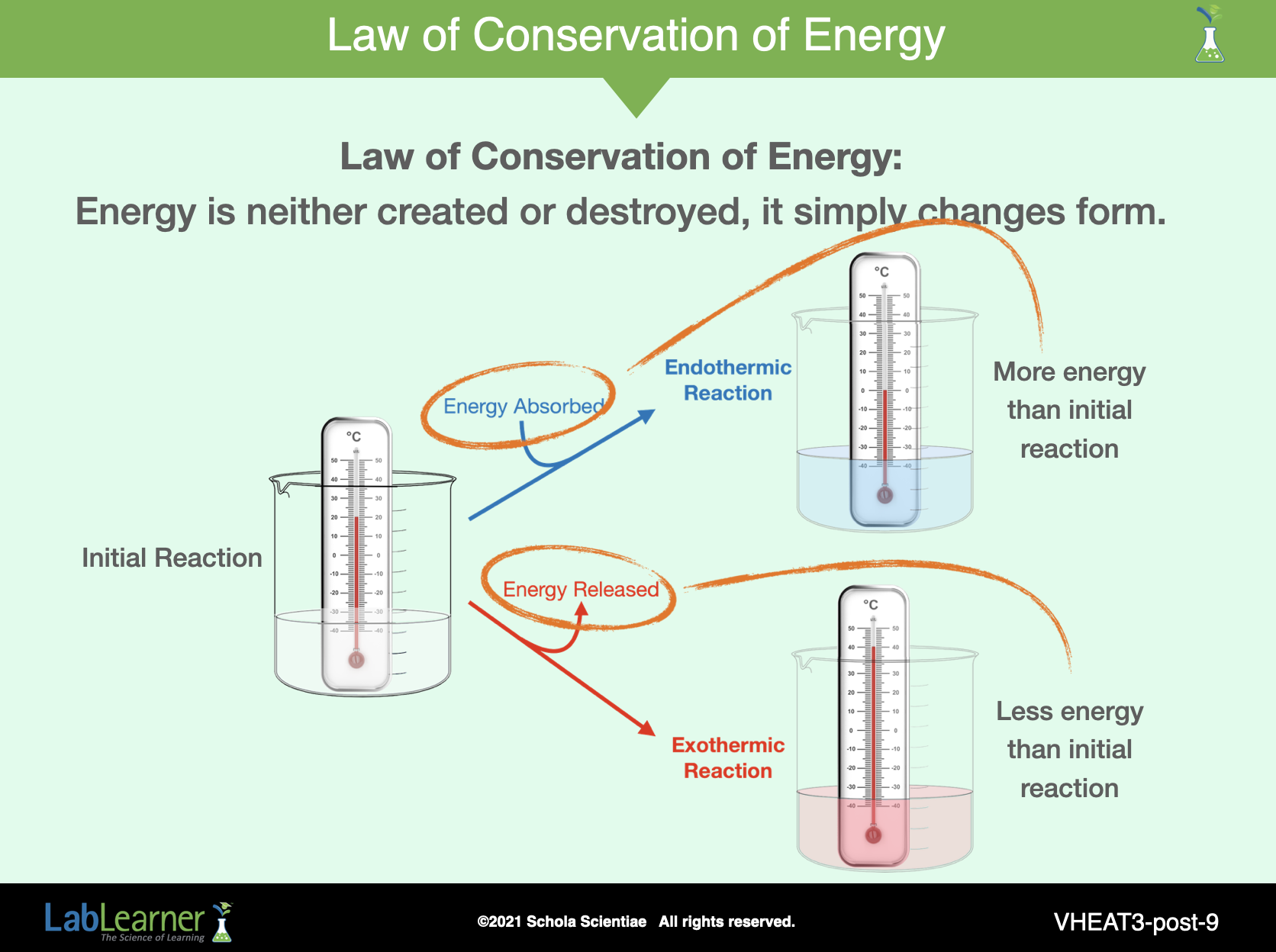
2. Direct students’ attention to the term Law of Conservation of Energy in their Scientist’s Glossary. Pose the following questions to assist students in understanding how this Law can help them determine what happened during their endothermic and exothermic reactions.
a. Ask students: Why do you think this law is included in your Glossary? Student answers may vary. The Law of Conservation of Energy is included because it explains that energy that is absorbed into a reaction comes from the surroundings rather than being created for the reaction and that energy released by a reaction is not lost or destroyed.
b. Ask students: How would you describe heat transfer in terms of the Law of Conservation of Energy? Student answers may vary. In terms of the Law of Conservation of Energy, heat transfer is the changing of energy from one form to another. Chemicals contain energy. When an exothermic reaction occurs, energy stored in the starting substances is converted to kinetic energy and released to the surroundings as heat. In an endothermic reaction, kinetic energy in the surroundings (heat) is absorbed and converted into energy stored in the final products.
3. Ask students: Which reaction was endothermic? Why? The reaction of baking soda and vinegar in Trial 2 was endothermic because heat was absorbed, causing the temperature to decrease.
4. Ask students: Which reaction was exothermic? Why? The reaction of steel wool with air in Trial 1 was exothermic because heat was released, causing the temperature to increase.
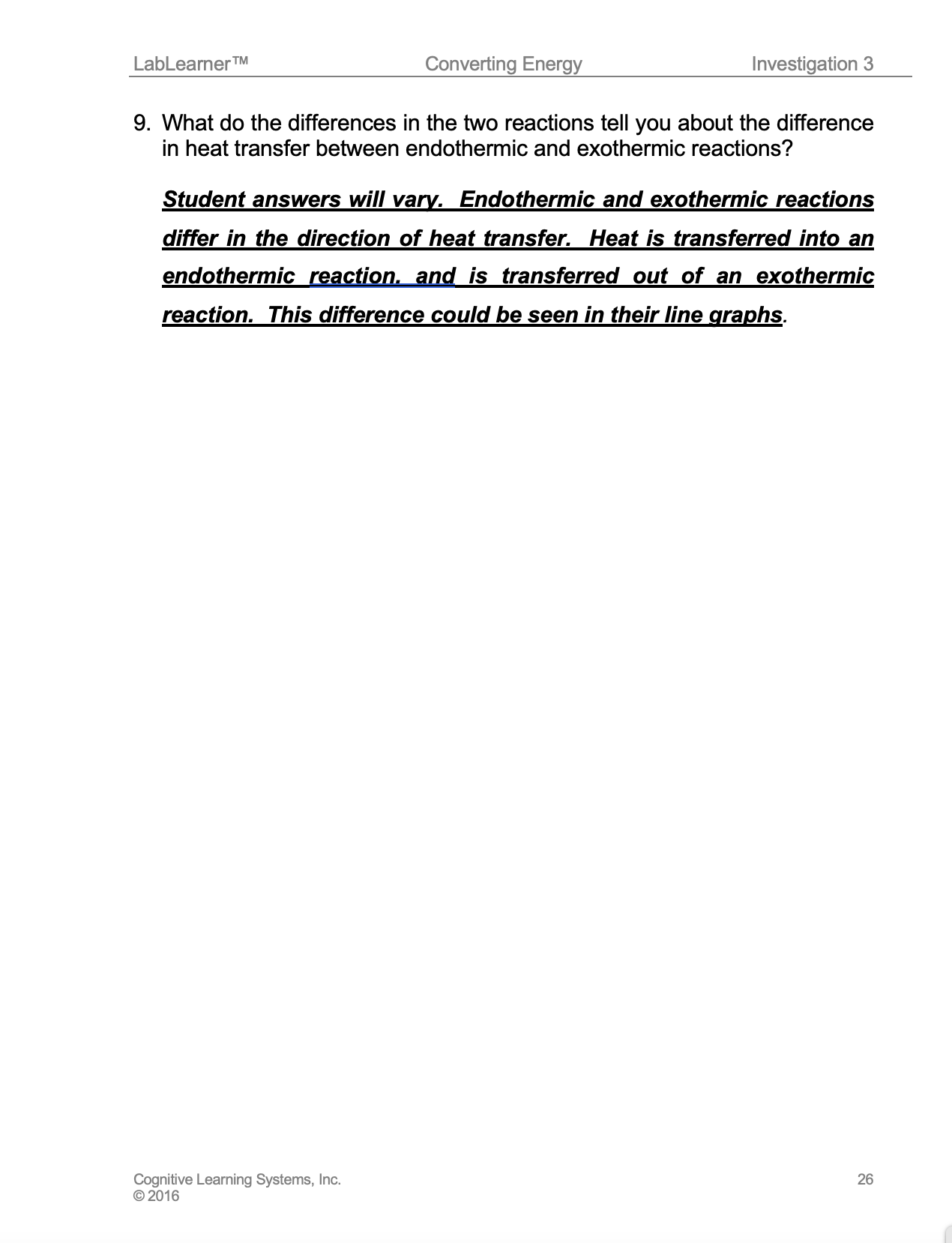
5. Ask students: What do the differences in the two reactions tell you about the difference between endothermic and exothermic reactions? Student answers will vary. Endothermic and exothermic reactions differ in the direction of heat transfer. Heat is transferred into an endothermic reaction and is transferred out of an exothermic reaction. This difference could be seen in their line graphs.
6. Direct students to record their answers in Problem 9 of their Student Data Record.
KEYS: LAB/POSTLAB