
Teacher Portal:
Investigating Heat
Investigation 1 – PreLab
 MINDSET
This Investigation is designed to:
- introduce students to the concept that heat is the transfer of energy.
- promote understanding that temperature is a measure of the kinetic energy of molecules.
- demonstrate that a thermometer measures temperature because the alcohol inside responds to heat through a change in volume.
- promote understanding that heat causes a change in temperature by causing a change in kinetic energy (speed of molecules).
SCIENTIST’S GLOSSARY
- Celsius: Basic unit in the metric system for measuring temperature. Degrees Celsius are represented mathematically as “oC”.
- Degrees: equal divisions of units of temperature.
- Fahrenheit: Basic unit in the English system for measuring temperature. Degrees Fahrenheit are represented mathematically as “oF”.
- Heat: The energy transferred from one molecule to another because of a difference in kinetic energy between the two molecules.
- Kinetic energy: The energy of motion.
- Molecule: A particle of matter.
- Temperature: A measure of the kinetic energy of molecules.
- Thermometer: A scientific tool that measures temperature in degrees Celsius (oC) and degrees Fahrenheit (oF).
BE PREPARED
Watch the Investigation 1 Teacher Video (below) and Student Video (at end of PreLab SHARE IT) to prepare for the PreLab.
SET FOR SUCCESS
- Tell students that they are about to begin the Investigating Heat CELL.
- Ask students to share the kinds of things they think they might learn in this Investigation.
Begin the PreLab Concept Slides to start students on their learning journey. Then watch the Pre-Lab Student Video as a class.
NAVIGATE IT
Once the slide presentation is launched
- use your left and right arrows to advance or go back in the slide presentation, and
- hover your mouse over the left edge of the presentation to get a view of the thumbnails for all the slides so that you can quickly move anywhere in the presentation.
- Click HERE to launch the slide presentation for the CELL.
SHARE IT
SLIDE VHEAT1-pre-1
This is the first slide in the CELL Investigating Heat. Investigation One introduces students to the concept of heat as kinetic energy.
______________________________________________
SLIDE VHEAT1-pre-2
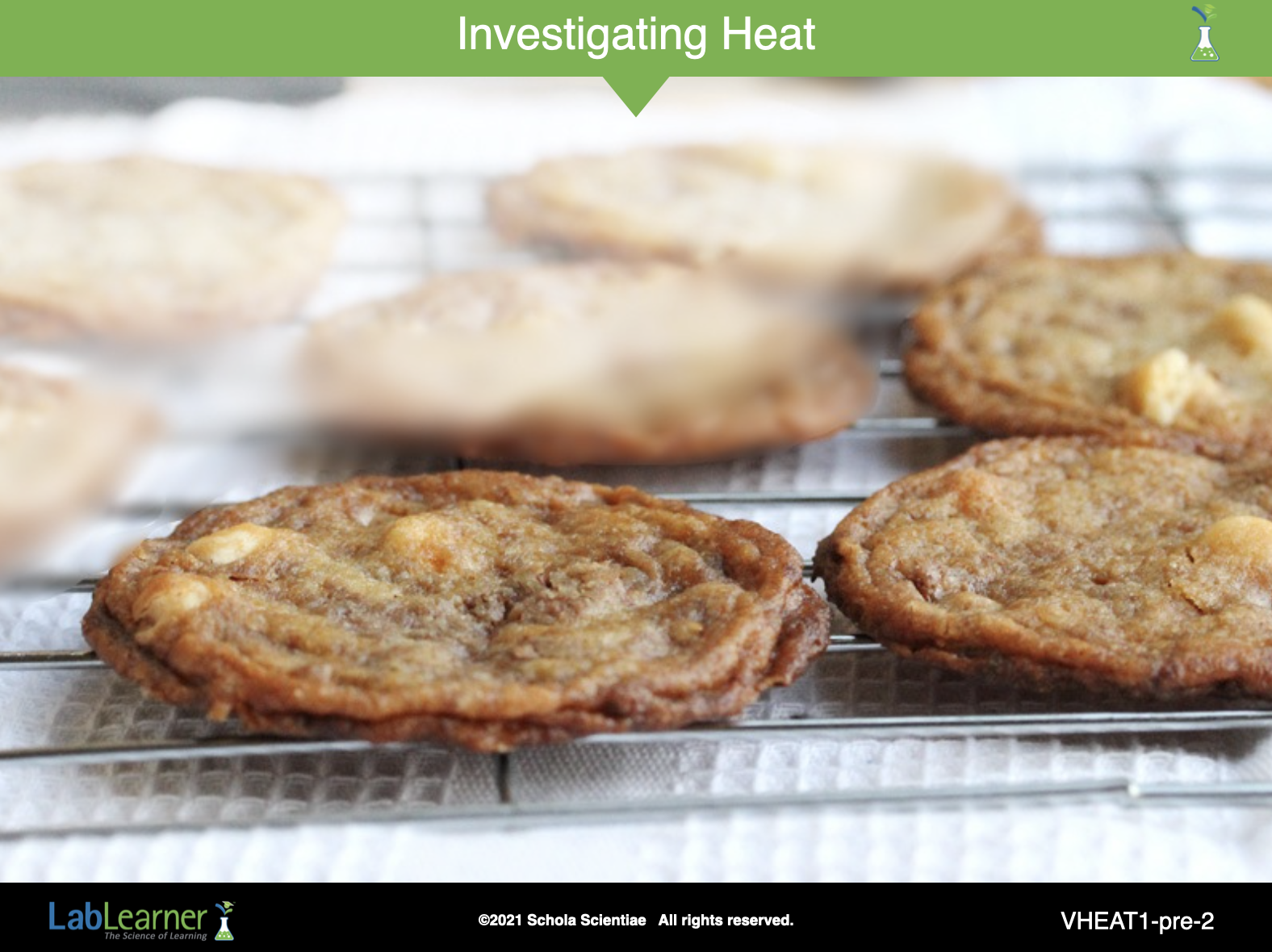
A. Begin this Investigation by explaining the focus of the CELL to students.
1. The central themes of this CELL are heat, temperature, and heat transfer.
During this CELL, students will explore heat and its relationship to temperature. Students will discover how the composition of materials influences their abilities to conduct heat. Students will learn that heat is a component of chemical reactions and learn to distinguish between two types of reactions: endothermic and exothermic reactions. Students will also investigate how other properties of matter can affect the ability to transfer or dissipate heat.
2. Encourage students to think about what the term heat means by asking them to describe the relationship between the terms hot, cold, and warm. Students should demonstrate the understanding that hot and cold are relative opposites, and that warm is intermediate to hot and cold.
3. Ask students: How do we make things hot? Student answers will vary. Suggestions will include methods of applying heat.
4. Ask students: How do we make things cold? Student answers will vary. Suggestions will include methods such as refrigeration or freezing.
5. Ask students: Why are we able to make things become hot or cold? Why do hot things cool off and cold things get warm? Student answers will vary. Explain that students will explore these questions further as they proceed through the CELL.
______________________________________________
SLIDE VHEAT1-pre-3
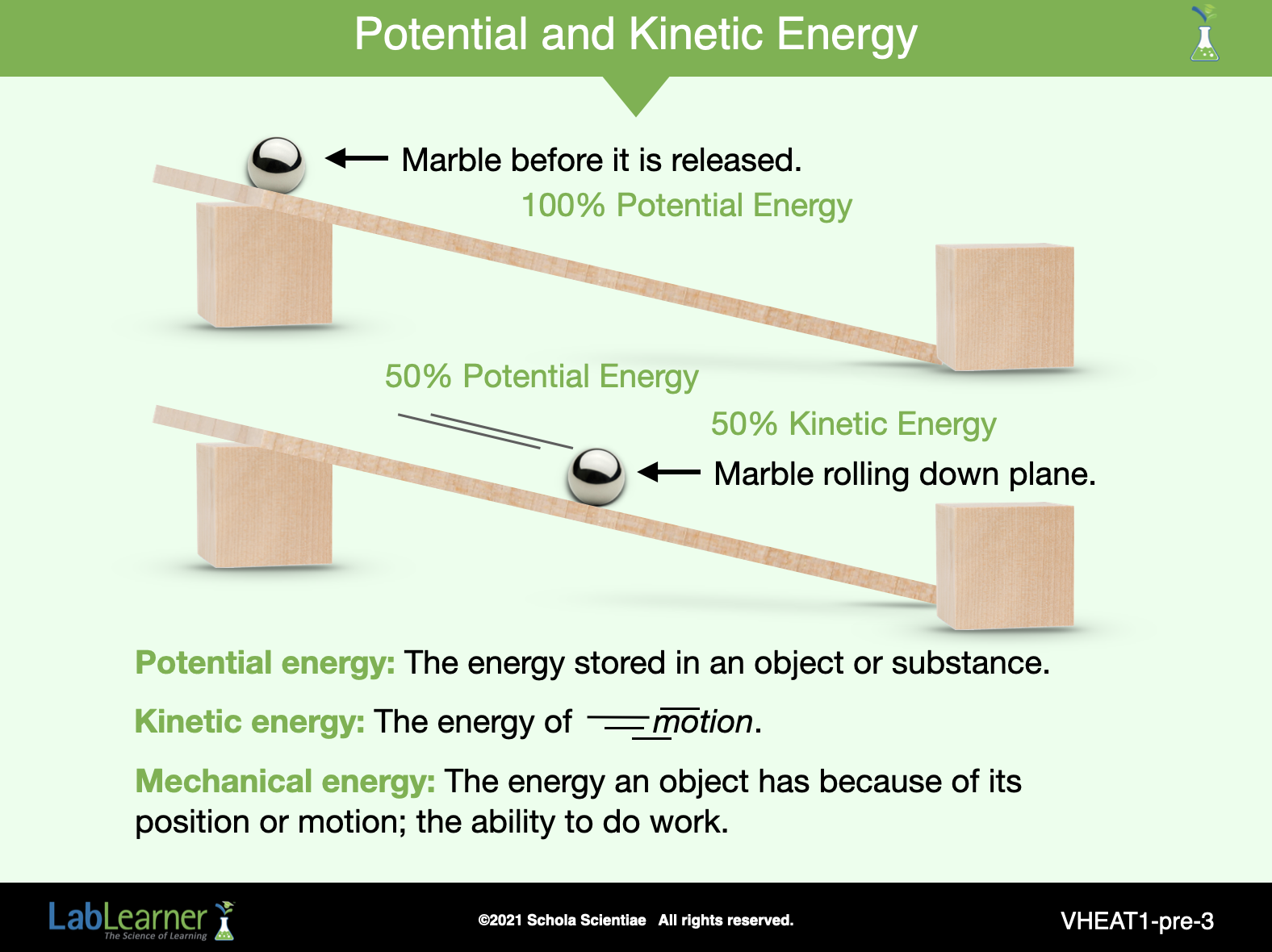
B. Direct the focus of the discussion to the central theme of this Investigation by explaining that students will begin their study of heat by exploring the relationship between heat, temperature, and energy.
Explain to students that in science, the term heat refers to the transfer of energy between molecules.
1. Ask students: What do you recall about energy? Student answers will vary. Students may give examples of types of energy such as light, electrical energy, or describe the ability to cause a car to move as the result of energy.
2. If students have difficulty recalling information about the term energy, remind them that energy is the ability to do work. There are two types of energy: potential and kinetic. Potential energy is stored energy. Kinetic energy is the energy of motion.
3. Ask students: Where have you encountered kinetic energy before? Can you give an example? Student answers may vary. Student examples should demonstrate that they are able to distinguish between the potential energy of a book lying on a desk and the kinetic energy of the same book falling after being pushed off the desk. Additional examples might be the kinetic energy in a rubber band that is released after being stretched or the kinetic energy in a spring that is allowed to expand after being compressed.
4. Encourage students to recall what they know about how energy is transferred. Ask students: What happens to the energy of a marble if you roll it into a flower pot? The energy of the marble is transferred to the flower pot, making the flower pot move.
5. Ask students: What do you recall about molecules? Do molecules display motion? How do they move? Do they have kinetic energy? Student answers may vary. Molecules are types of particles that make up matter. Solids, liquids, and gases are composed of molecules. Molecules move randomly. Because molecules move, they have kinetic energy.
______________________________________________
SLIDE VHEAT1-pre-4
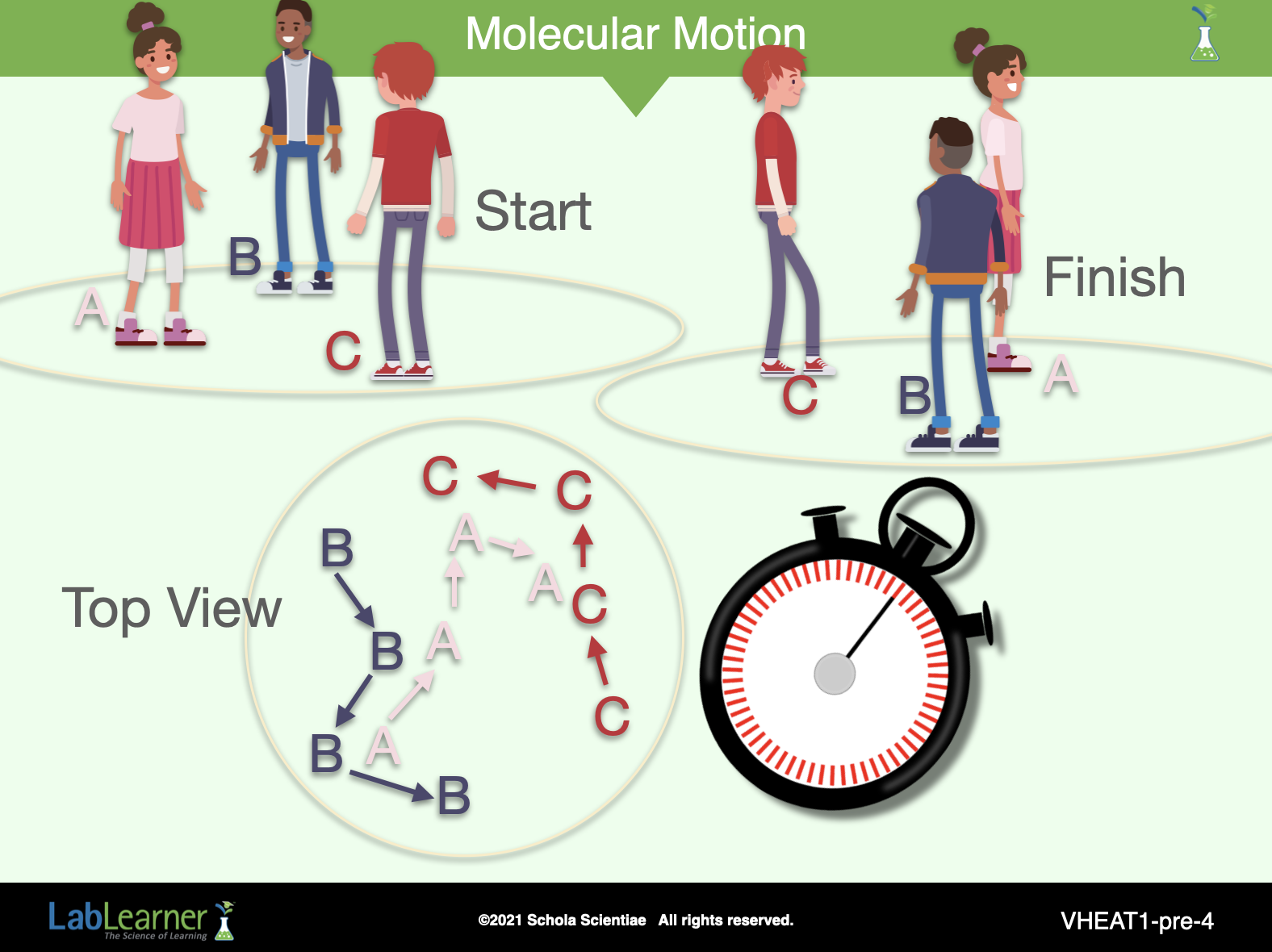
1. Use the following activity to illustrate the kinetic energy of molecules.
a. Select three students to act as molecules.
b. Direct students to stand inside the circle of tape.
c. Explain that you will count off 5 seconds, and students are to take 3 steps, spacing them evenly so that they finish on the fifth second. The rules for movement are as follows:
-
- Students must change direction with each step.
- Students should not retrace their steps.
- Students should not end up where they started.
- Students should change direction if their toe touches the tape.
- An example of random movement is illustrated in the slide (Top View)
d. The remainder of the class should observe the “molecules” as they move.
e. Repeat step c, this time counting off 3 seconds.
f. Repeat step c a second time, counting off 2 seconds.
2. Allow the students to return to their seats. Ask students: What did you observe about the speed of the “molecules” as the time allowed for movement decreased? The molecules moved faster as time decreased.
3. Ask students: If a molecule speeds up, does it have more or less kinetic energy than it did when it moved more slowly? A molecule that speeds up has more kinetic energy than it did when it moved more slowly.
4. This activity demonstrated that molecules with more kinetic energy move more rapidly than molecules with less kinetic energy. Ask students: How can you measure the kinetic energy of a molecule? Can the kinetic energy of molecules be transferred? Is there a term in your Scientist’s Glossary that refers to measuring the kinetic energy of molecules? Temperature is a measure of the kinetic energy of molecules. Heat refers to the transfer of energy from molecules with different kinetic energies.
______________________________________________
SLIDE VHEAT1-pre-5
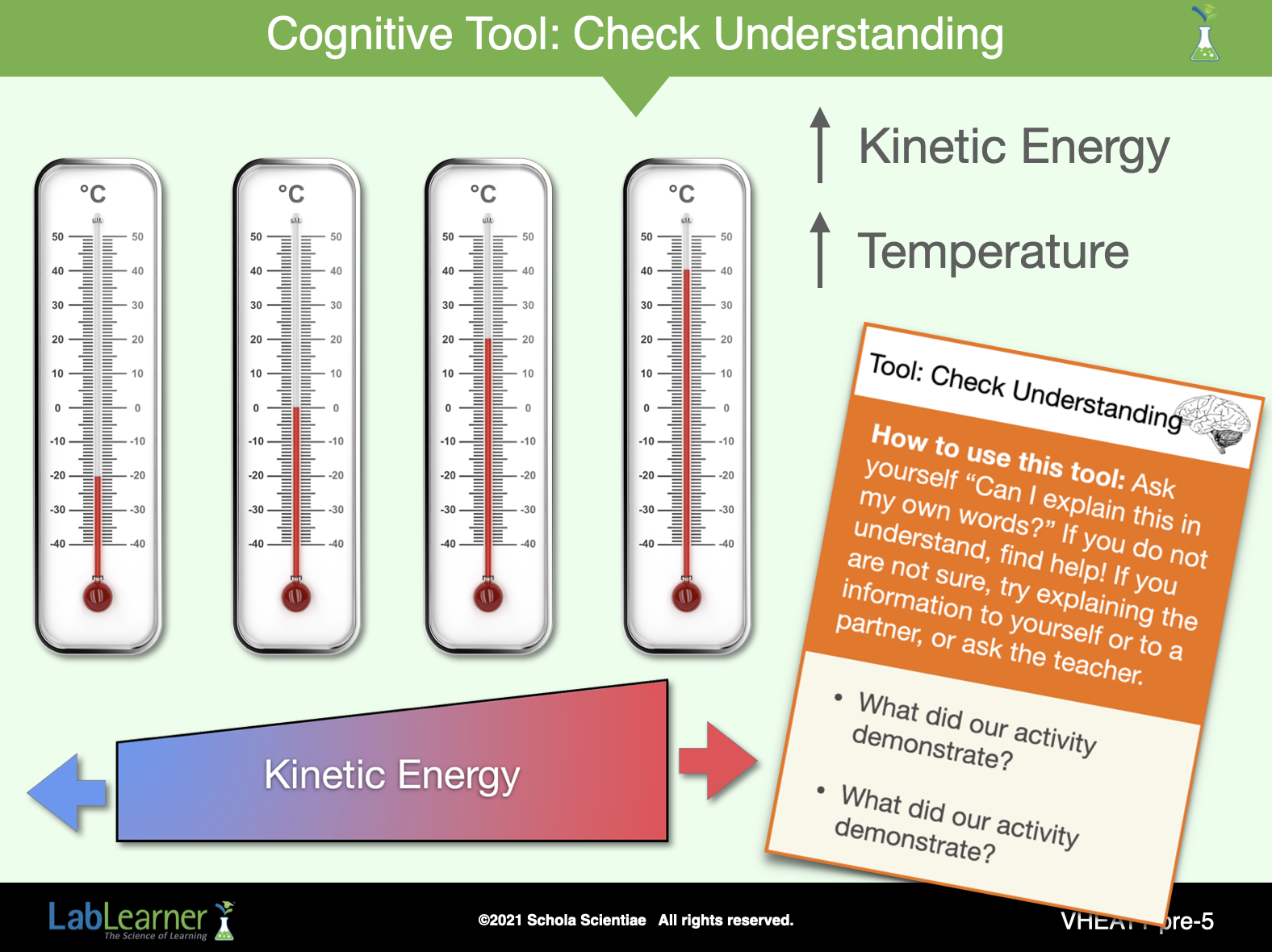
C. Encourage students to think of temperature in terms of kinetic energy and molecular motion as they perform their experiments in the Lab. The graphic on the left of this slide simply illustrates that as kinetic increases, the temperature increases as well. Increased kinetic energy increases molecular motion which, in turn, increases the temperature.
- Point out the terms thermometer, degrees, Celsius, and Fahrenheit in the Scientist’s Glossary.
Thermometer: A scientific tool that measures temperature in degrees
Celsius (oC) and degrees Fahrenheit (oF).
Degrees: equal divisions of units of temperature.
Celsius: Basic unit in the metric system for measuring temperature.
Degrees Celsius are represented mathematically as ℃.
Fahrenheit: Basic unit in the English system for measuring temperature.
Degrees Fahrenheit are represented mathematically as ℉.
2. Encourage students to think about how these terms relate to temperature and explain that students will have the opportunity to explore how a thermometer measures temperature in the Lab.
3. Explain to students that they will want to consider the following question as they conduct their experiments:
What is the relationship between temperature and the kinetic energy of molecules?
WATCH IT
Play the following Student Video in preparation for the lab. Discuss as necessary to answer student questions.