Teacher Portal:
Investigating Heat
Performance Assessment – Lab
 BE PREPARED
Materials
Class materials:
- 100 g baking soda
- 750 ml vinegar
- 5 pads of steel wool
- 5 L hot water
- 10 plastic shopping bags 30 sheets of paper
- 5 1 L Erlenmeyer flasks
- 5 500 ml Erlenmeyer flasks 10 400 ml beakers
- 10 100 ml beakers
- 10 white buckets
- 1 roll aluminum foil
- 1 roll plastic wrap
- 1 roll masking tape
Table materials
1 triple beam balance
1 liter pitcher
1 1000 ml graduated cylinde
Group materials
- 2 thermometers
Individual materials
- Student Data Record
TEACHER PREPARATION
1. Place one triple beam balance on each table.
2. Fill five (5) 1000 ml graduated cylinders with 1 L hot tap water adjusted to 30 oC immediately prior to class.
3. Place one (1) liter pitcher and one (1) 1000 ml graduated cylinder on each table.
4. Separate the class into groups of three.
INSTRUCTION
Direct each student pair to obtain the following necessary materials from the distribution point: two (2) falcon tubes, one (1) weigh dish, two (2) 100 ml beakers, two (2) 400 ml beakers, two (2) glass stir rods, one (1) lab scoop, one (1) 100 ml graduated cylinder, and one (1) 15 cm length of masking tape for labeling.
PROCEDURE
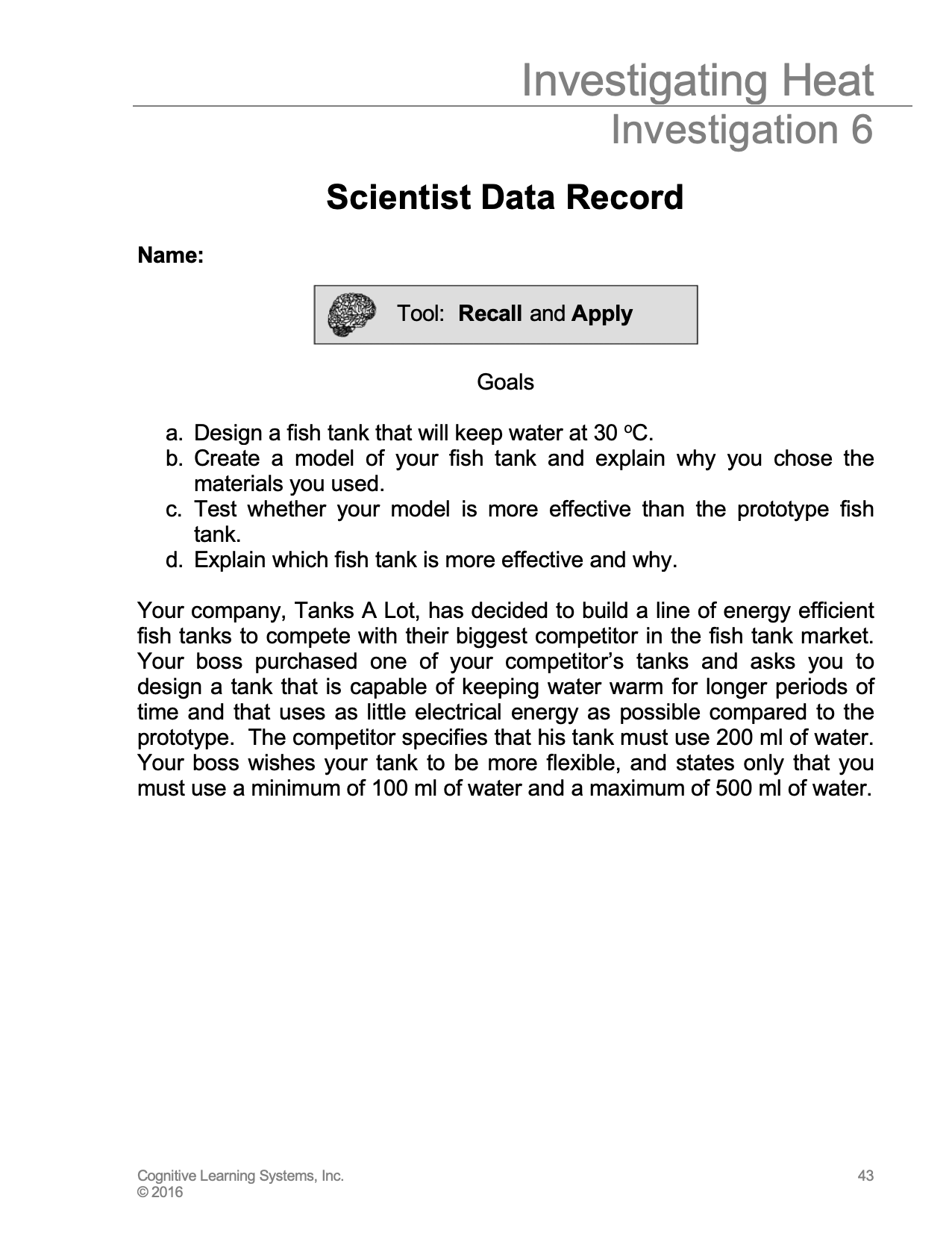
1. Tell students that they work for Tanks A Lot, a company that makes fish tanks. Explain that their company has decided to build a line of fish tanks that are better at maintaining water temperature than their competitor’s newest model. Their boss will supply them with a prototype, or model, of a fish tank from the competitor. They are to build a tank that is capable of keeping water warm for longer periods of time while using as little electrical energy as possible compared to the prototype. They may use any of the materials provided at the distribution point to construct their fish tank.
2. Briefly outline the specific goals of this project to the class. Read aloud the goals from the list on the Student Data Record:
a. Design a fish tank that will keep water at 30 oC.
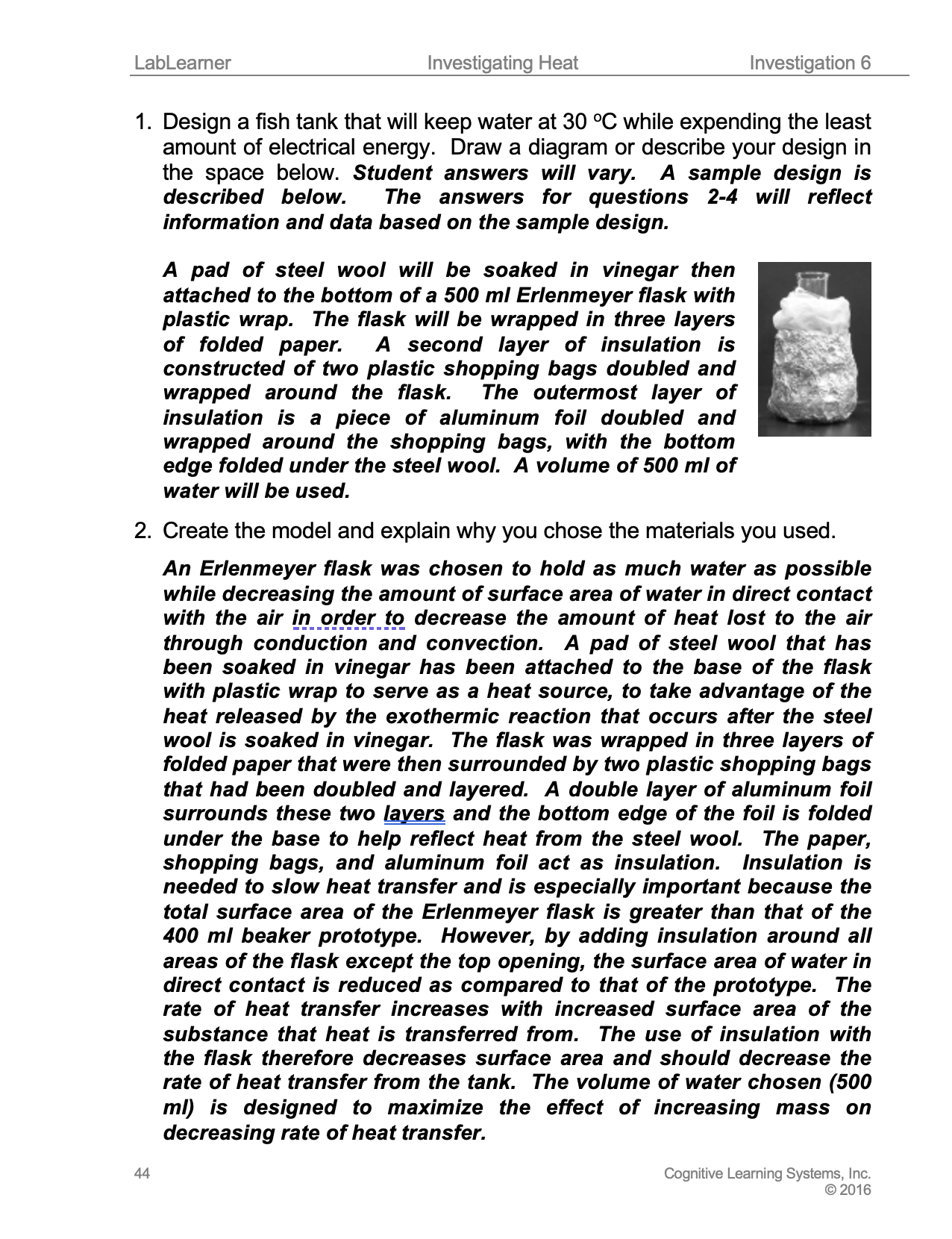
b. Create a model of your fish tank and explain why you chose the materials you used.
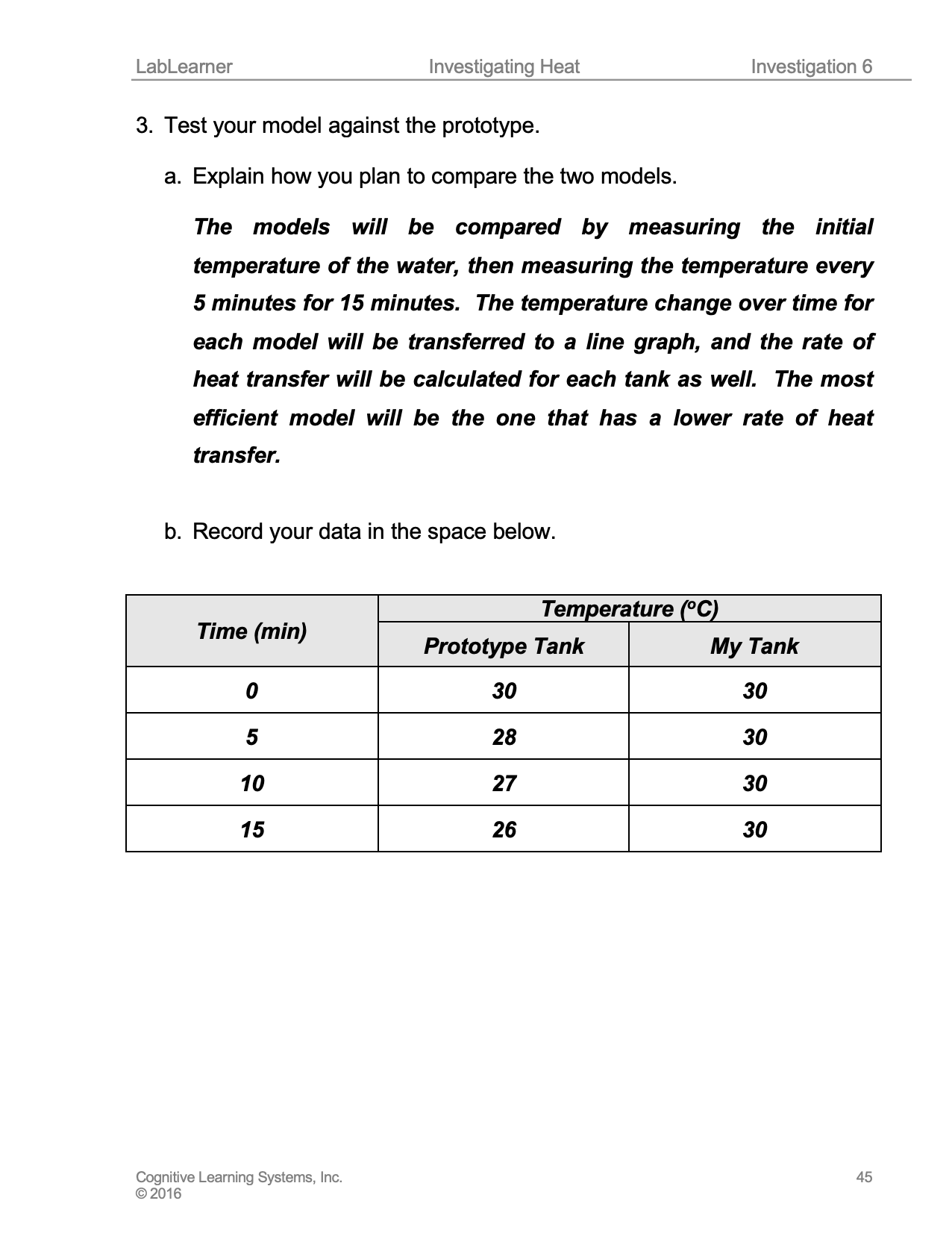
c. Test whether your model is more effective than the prototype fish tank.
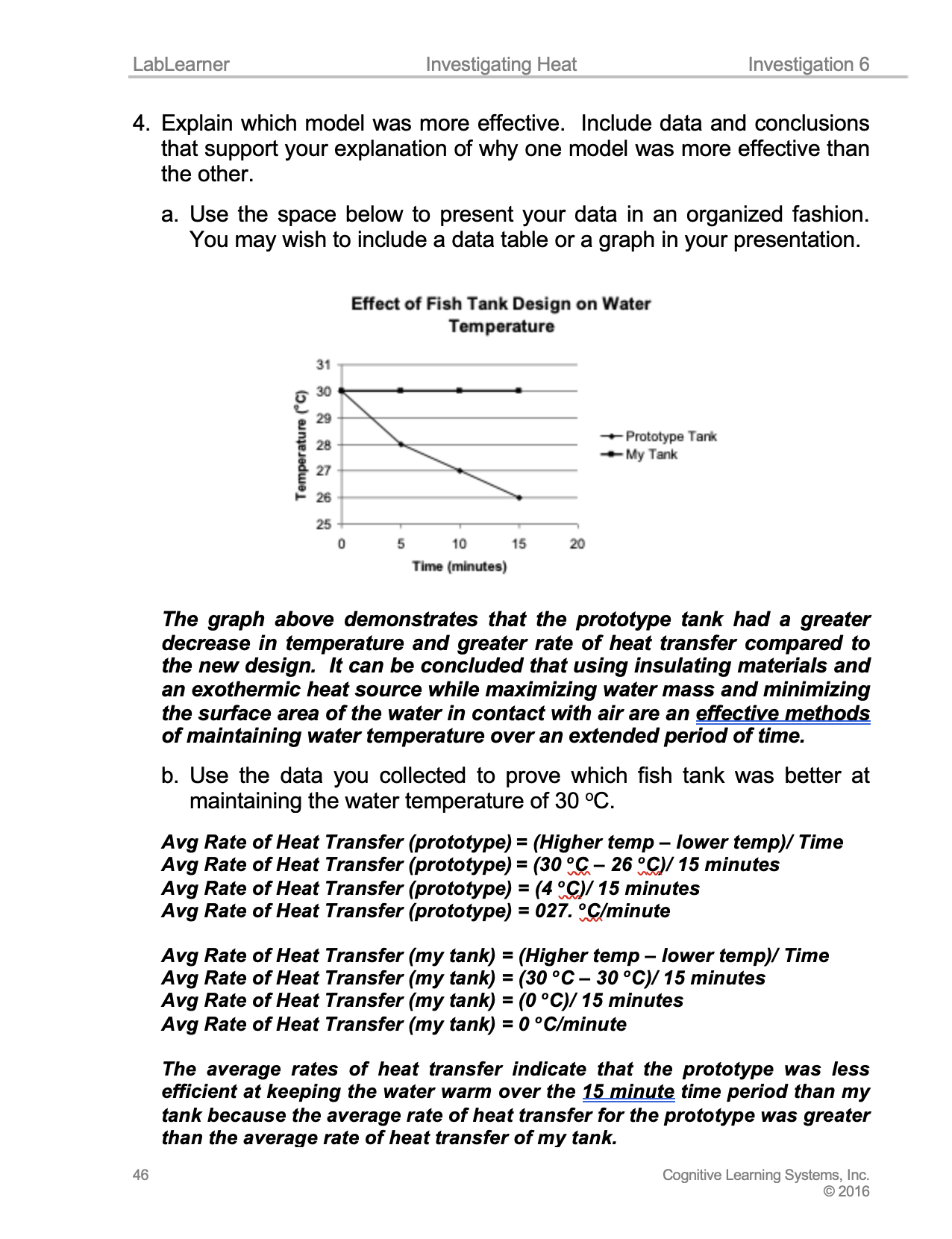
d. Explain which fish tank is more effective and why.
Your company, Tanks A Lot, has decided to build a line of energy-efficient fish tanks to compete with their biggest competitor in the fish tank market. Your boss purchased one of your competitor’s tanks and asks you to design a tank that is capable of keeping water warm for longer periods of time and that uses as little electrical energy as possible compared to the prototype. The competitor specifies that his tank must use 200 ml of water. Your boss wishes your tank to be more flexible and states only that you must use a minimum of 100 ml of water and a maximum of 500 ml of water.
3. With the students, walk through the four steps in the project. Encourage students to draw on their understanding of heat from the first five Investigations.
4. Explain to students that they are to use the liter pitcher as their prototype tank. The prototype tank is required to use 200 ml of water. The minimum amount of water students may use in their tank is 100 ml. The maximum amount of water students may use in their tank is 500 ml.
5. Allow students to complete their Performance Assessments. You may wish to informally or formally evaluate students as they work on their Performance Assessments. An evaluation rubric for the performance assessment has been provided to aid in the evaluation process.
6. Upon completion of the project, permit enough time to clean up the lab and return the materials and equipment to their assigned location.
CLEAN UP
Let students know your expectations and instruct them to clean up their lab bench after the Performance Assessment.
KEYS: PERFORMANCE ASSESSMENT