Teacher Portal:
Forms of Energy
Investigation 5 – PreLab
 PRINT IT
Use your browser to download a printable PDF as help during the slide presentation and to make additional notes. In your browser, go to File > Print and then choose to save as PDF.
MINDSET
This Investigation is designed to:
- reinforce the concept that energy has properties and promote the understanding that chemical energy and heat have different properties from mechanical energy, sound energy, light energy and electrical energy.
- reinforce the concept of potential energy as stored energy and demonstrate that chemicals have potential energy.
- reinforce the concept of kinetic energy as energy in motion and promote the understanding that heat is a form of kinetic energy.
- promote the understanding that chemical energy can be transformed into mechanical energy.
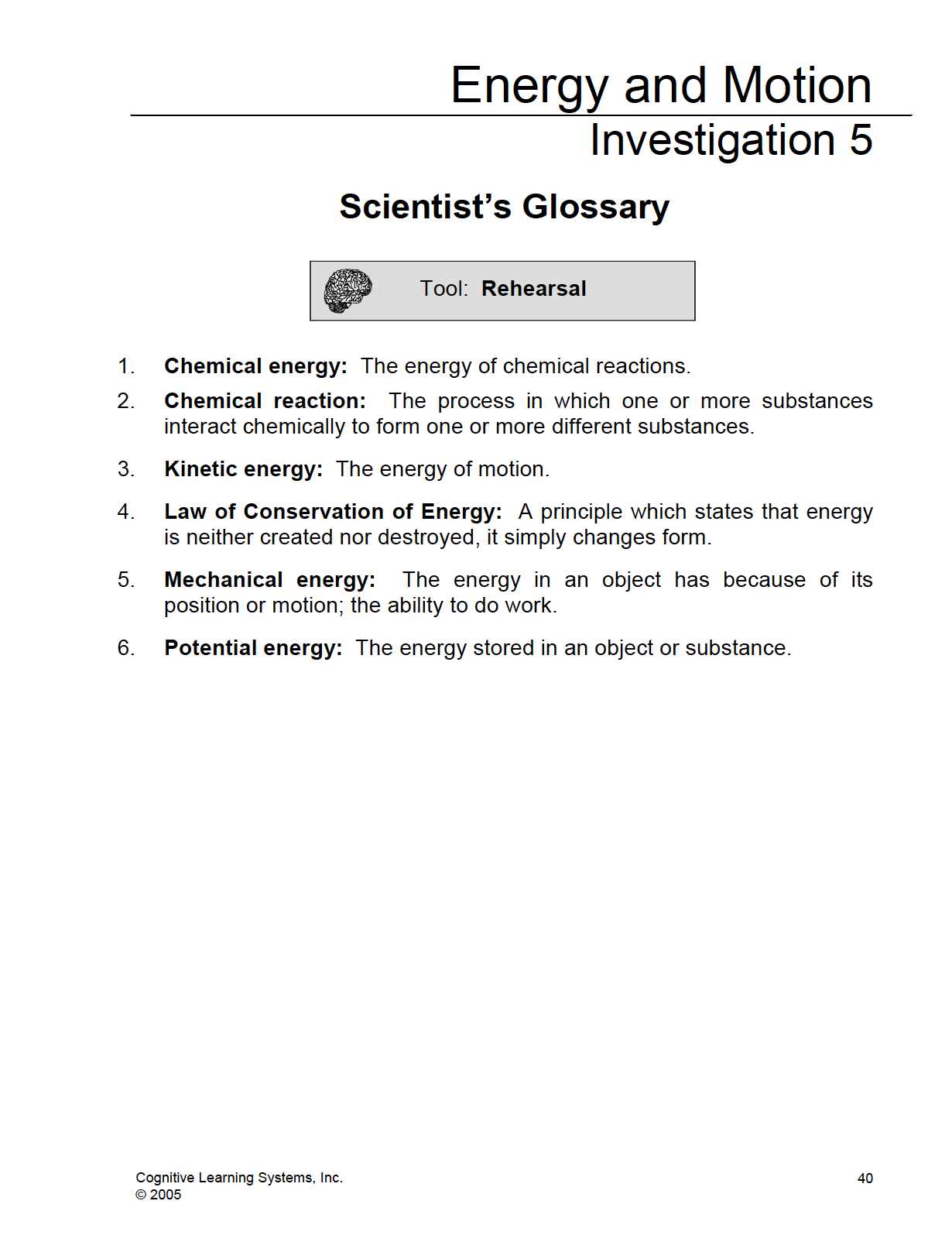
SCIENTIST’S GLOSSARY
- Chemical energy: The energy of chemical reactions.
- Chemical reaction: The process in which one or more substances interact chemically to form one or more different substances.
- Kinetic energy: The energy of motion.
- Law of Conservation of Energy: A principle which states that energy is neither created nor destroyed, it simply changes form.
- Mechanical energy: The energy in an object has because of its position or motion; the ability to do work.
- Potential energy: The energy stored in an object or substance.
BE PREPARED
Watch the Investigation 5 Teacher Video and Student Video below to prepare for the PreLab.
SET FOR SUCCESS
- Tell students that they continue working with the Forms of Energy CELL.
- Tell students that they will focus on kinetic energy and motion.
- Ask students to share the kinds of things they might learn in this Investigation.
Begin the PreLab Concept Slides to start students on their learning journey. Then watch the Pre-Lab Student Video afterward as a class.
NAVIGATE IT
Once the slide presentation is launched
- use your left and right arrows to advance or go back in the slide presentation, and
- hover your mouse over the left edge of the presentation to get a view of the thumbnails for all the slides so that you can quickly move anywhere in the presentation.
- Click HERE to launch the slide presentation for the CELL.
SHARE IT
SLIDE VFENERGY5-pre-1
This is the final regular Investigation of the Forms of Energy CELL. Students will apply much of what they have already learned about the different forms of energy as they learn about the importance of energy transformations.
______________________________________________
SLIDE VFENERGY5-pre-2
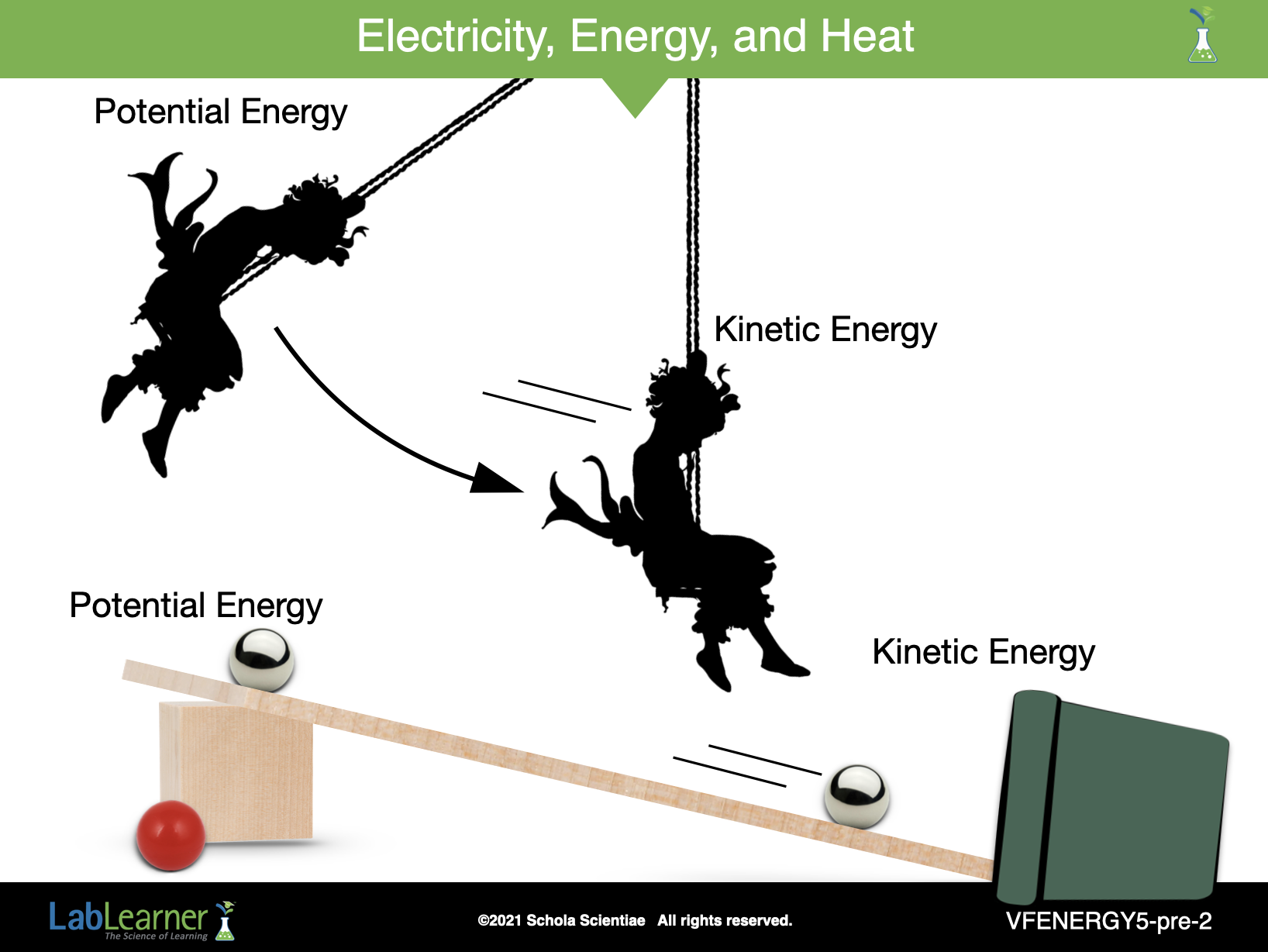
A. In this Investigation, students will use what they have learned about potential and kinetic energy and energy transfer to investigate the transformation of chemical energy into mechanical energy. Begin this portion of the Investigation by encouraging students to review what they have discovered about potential and kinetic energy. The following questions may be useful in prompting student discussion:
1. What are the five forms of energy you have investigated in this CELL? Students have investigated chemical, electrical, heat, mechanical and sound energy.
2. How would you describe energy transformation to a younger brother or sister? Student answers will vary. Energy transformation is the change of energy from one form to another.
3. Can you transform potential energy into kinetic energy? What are some examples of this type of transformation you have observed in the lab? Potential energy can be transformed into kinetic energy. Students have observed this type of energy transformation when the marbles began to roll down the inclined plane when a tuning fork and rubber band were activated when a beaker was activated with a pencil, when a battery was connected into a simple circuit, and when non-chlorine powdered bleach was stirred into water.
4. Can you transform one form of kinetic energy into another form of kinetic energy? What are some examples of this type of transformation you have observed in lab? One form of kinetic energy can be transformed into another form of kinetic energy. Students have observed this type of transformation when the mechanical energy of the marbles generated the mechanical energy of the flowerpot; the sound energy of the activated tuning fork and activated beaker generated mechanical energy of the water, ping-pong ball, pepper, and skin of the hand; the electrical energy of circuits was transformed into light and heat energy in the light bulb, and the heat from the hot plate transformed into the chemical energy of the caramelized sugar.
5. Can you transform kinetic energy into potential energy? What are some examples of this type of transformation you have observed in the lab? Kinetic energy can be transformed into potential energy. Students have observed this type of transformation when the marbles stopped moving after impacting the flowerpot, when the tuning fork stopped vibrating, and when the beaker stopped vibrating.
______________________________________________
SLIDE VFENERGY5-pre-3
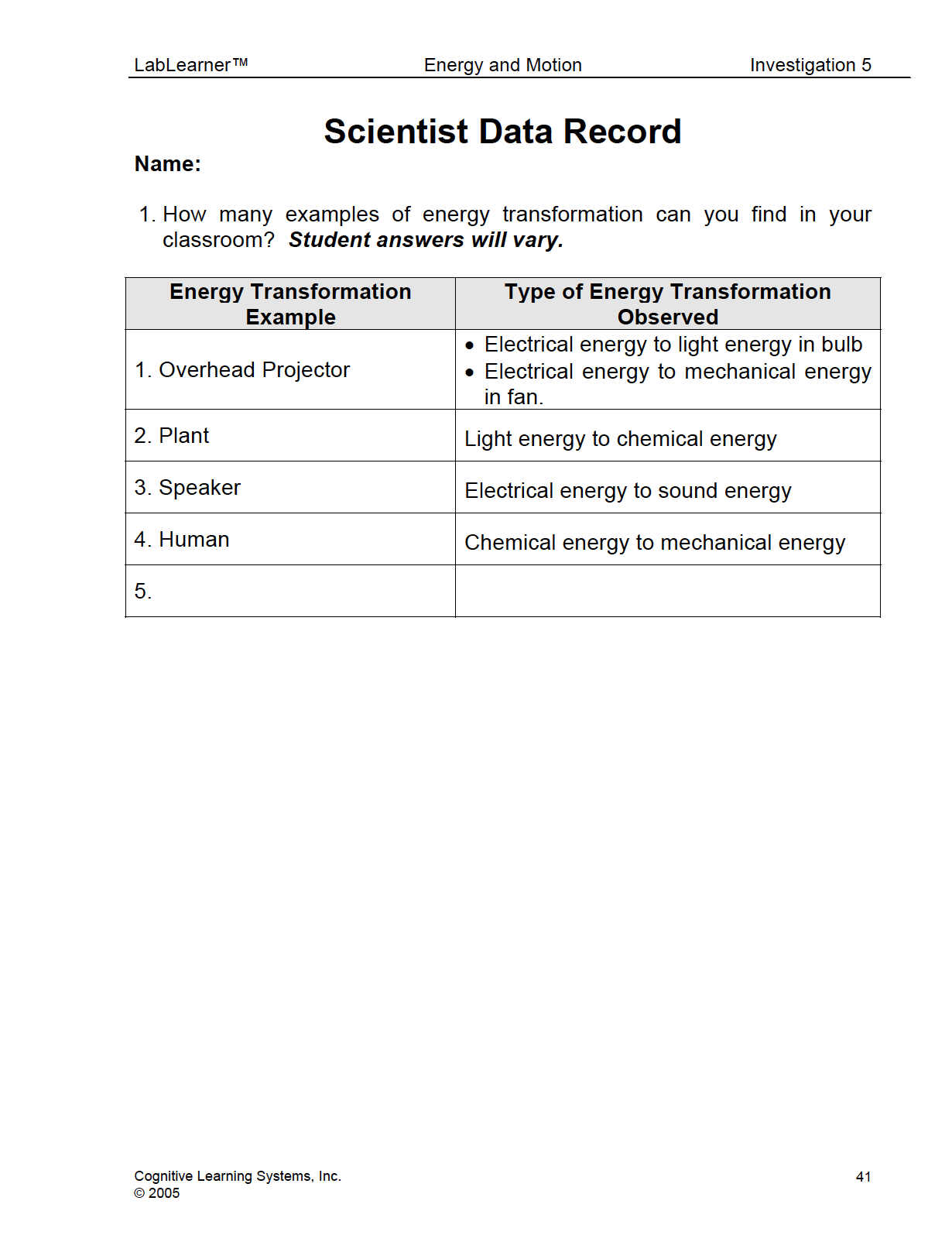
B. Continue students’ review of energy transformation by engaging students in an energy treasure hunt.
1. Ask students: Can you find examples of energy transformation in our classroom? Student answers will vary.
2. Explain to students that they will go on a treasure hunt to find examples of energy being transformed or is capable of being transformed.
3. Divide students into five cooperative groups. Direct students’ attention to the Table in Problem 1 of their Student Data Record.
4. Explain that as they locate an item or example of energy transformation they should write a description of the item in the left column of the Table and explain as many of the energy conversions associated with that item or example as they can. For example, students might list the overhead projector as an item associated with energy transformation. An overhead projector converts electrical kinetic energy into light energy and heat energy in the bulb and mechanical energy in the cooling fan.
5. Provide approximately 10 minutes for the treasure hunt.
6. Once students have completed their treasure hunt and recorded their energy transformation descriptions, encourage students to share their groups’ results with the remainder of the class.
7. Refer to the Table on this slide or draw it on the board.
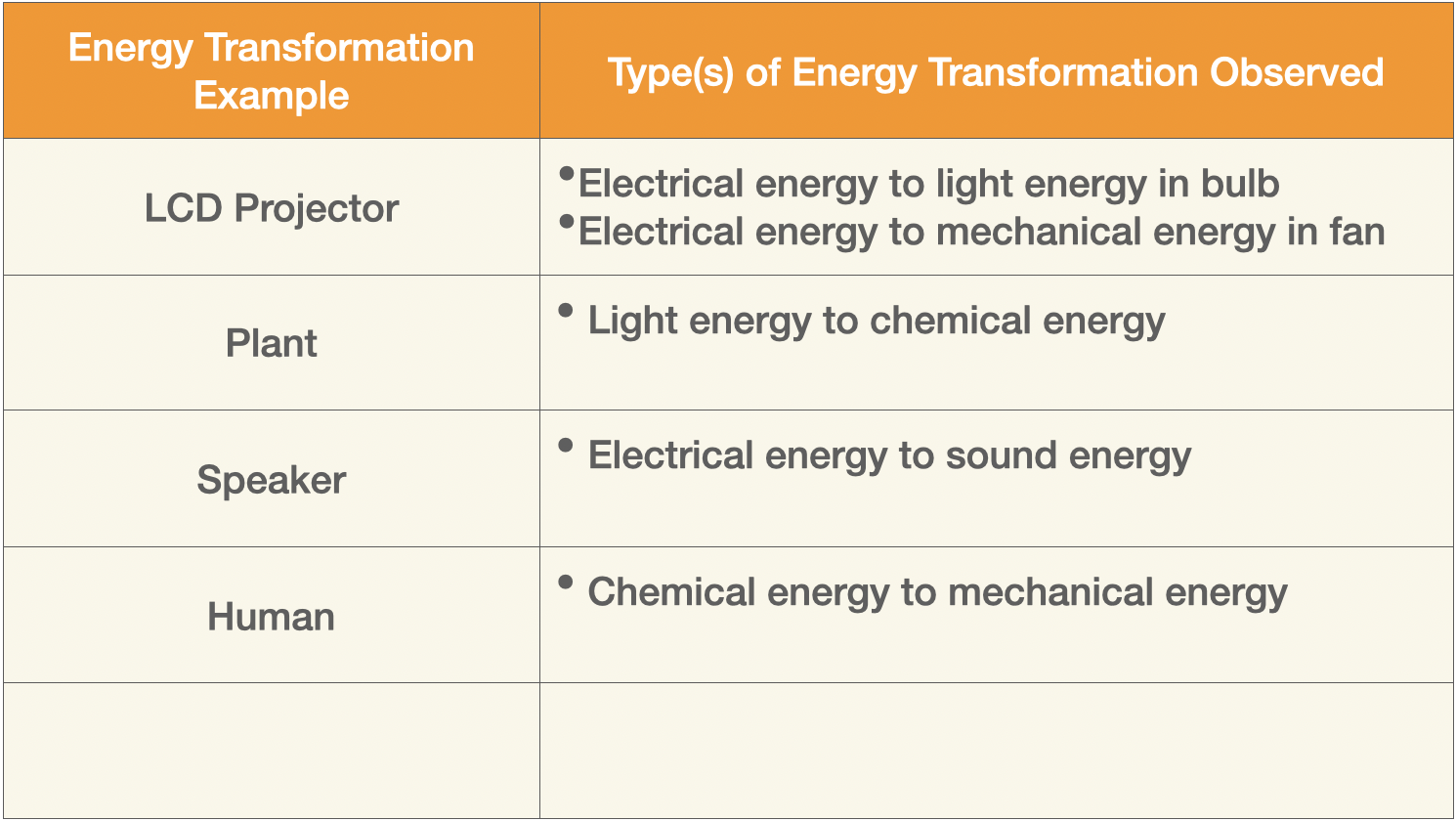
8. Record each item mentioned by the various groups. Encourage each group to share the energy transformations they associate with their items, then encourage the rest of the class to add any additional energy transformations they might have associated with that item. Examples have been included in the Table above you the teacher.
______________________________________________
SLIDE VFENERGY5-pre-4
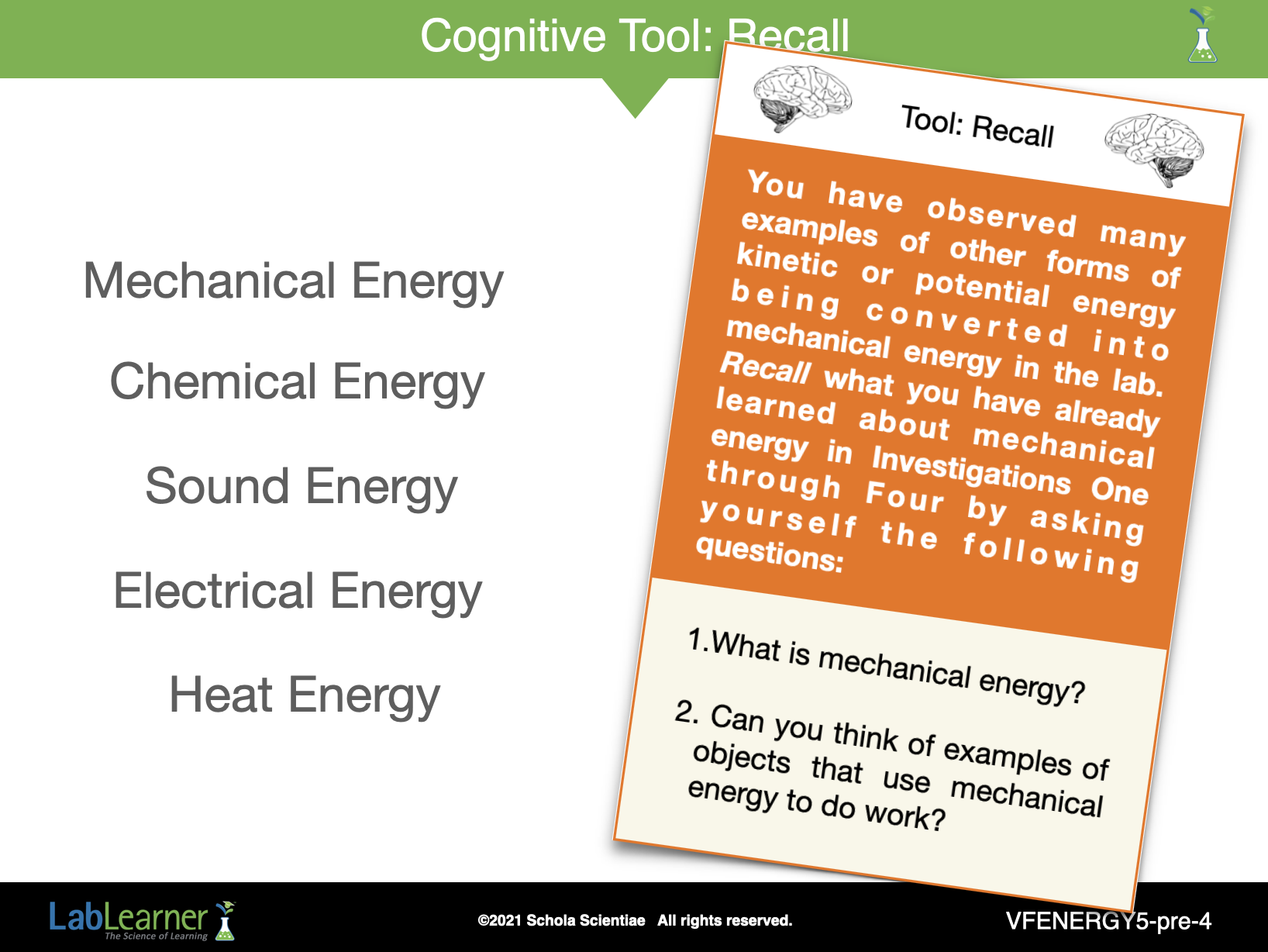
C. Conclude this portion of the Investigation by encouraging students to think about why it is important for energy transformation to occur.
1. Ask students: Why is it important for energy to be able to be converted from one form to another? Student answers may vary. It is important for energy to be convertible from one form to another because energy needs to be able to be used.
2. Ask students: Why does energy need to be able to be used? Student answers will vary. At one point in time or another, energy needs to be able to perform work. The energy of work is mechanical energy. Therefore, other forms of energy need to be able to be transformed into work energy.
3. List the five forms of energy (mechanical, chemical, sound, electrical, and heat) on the slide. Ask students: Which of these forms of energy can be converted into mechanical energy? Students should indicate that all five forms of energy can be converted into mechanical energy.
4. Explain to students that they will explore the answers to the following questions in the lab:
• Can an object’s position be used to convert potential energy into mechanical energy?
• Can the mechanical energy of one object be converted to the mechanical energy of another object?
• Can chemical energy be converted to mechanical energy?
Student Video
Watch the Investigation 4 Student Video after the Share It presentation to prepare for the PreLab.
KEYS: PRELAB