Teacher Portal:
Forms of Energy
Investigation 5 – PostLab
PRINT IT
Use your browser to download a printable PDF as help during the slide presentation and to make additional notes. In your browser, go to File > Print and then choose to save as PDF.
NAVIGATE IT
Once the slide presentation is launched
- use your left and right arrows to advance or go back in the slide presentation, and
- hover your mouse over the left edge of the presentation to get a view of the thumbnails for all the slides so that you can quickly move anywhere in the presentation.
- Click HERE to launch the slide presentation for the CELL.
SHARE IT
SLIDE VFENERGY5-post-1
This is the final regular Investigation in the LabLearner CELL Forms of Energy. Students will investigate various means of forming kinetic mechanical energy.
______________________________________________
SLIDE VFENERGY5-post-2
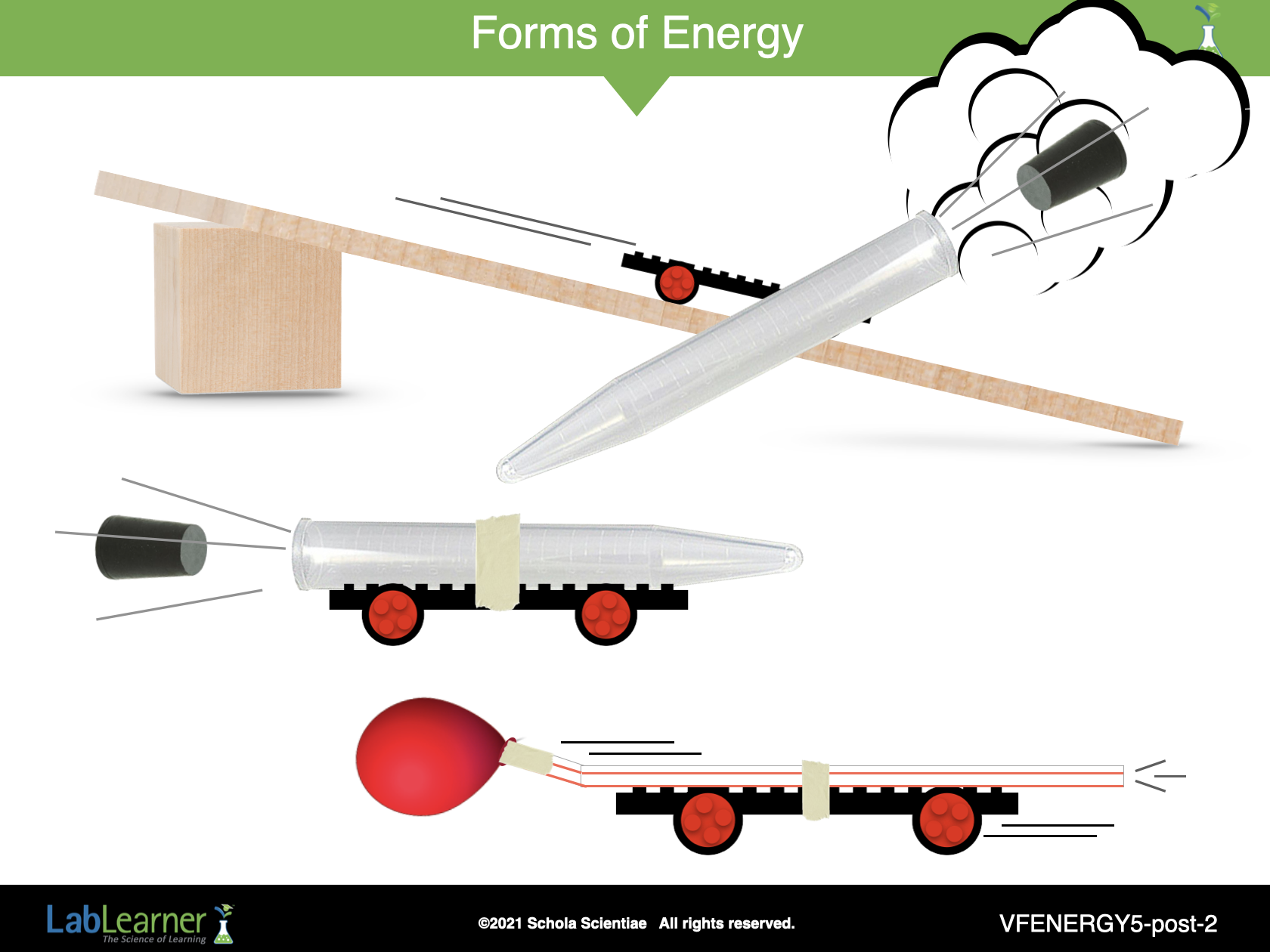
A. Begin this part of the investigation by encouraging students to consider the types of energy present in their experiments.
1. Ask students: What kinds of energy were present in your experiments? Potential energy and kinetic energy were both present.
2. Ask students: What forms of potential energy did you see? Chemical potential energy, gravitational potential energy, and the potential energy of the air trapped in the balloon.
3. Ask students: What forms of kinetic energy did you see? There was mechanical kinetic energy in the form of the cars moving down the ramp, the air being expelled from the balloon, and the carbon dioxide pushing the rubber stopper.
______________________________________________
SLIDE VFENERGY5-post-3
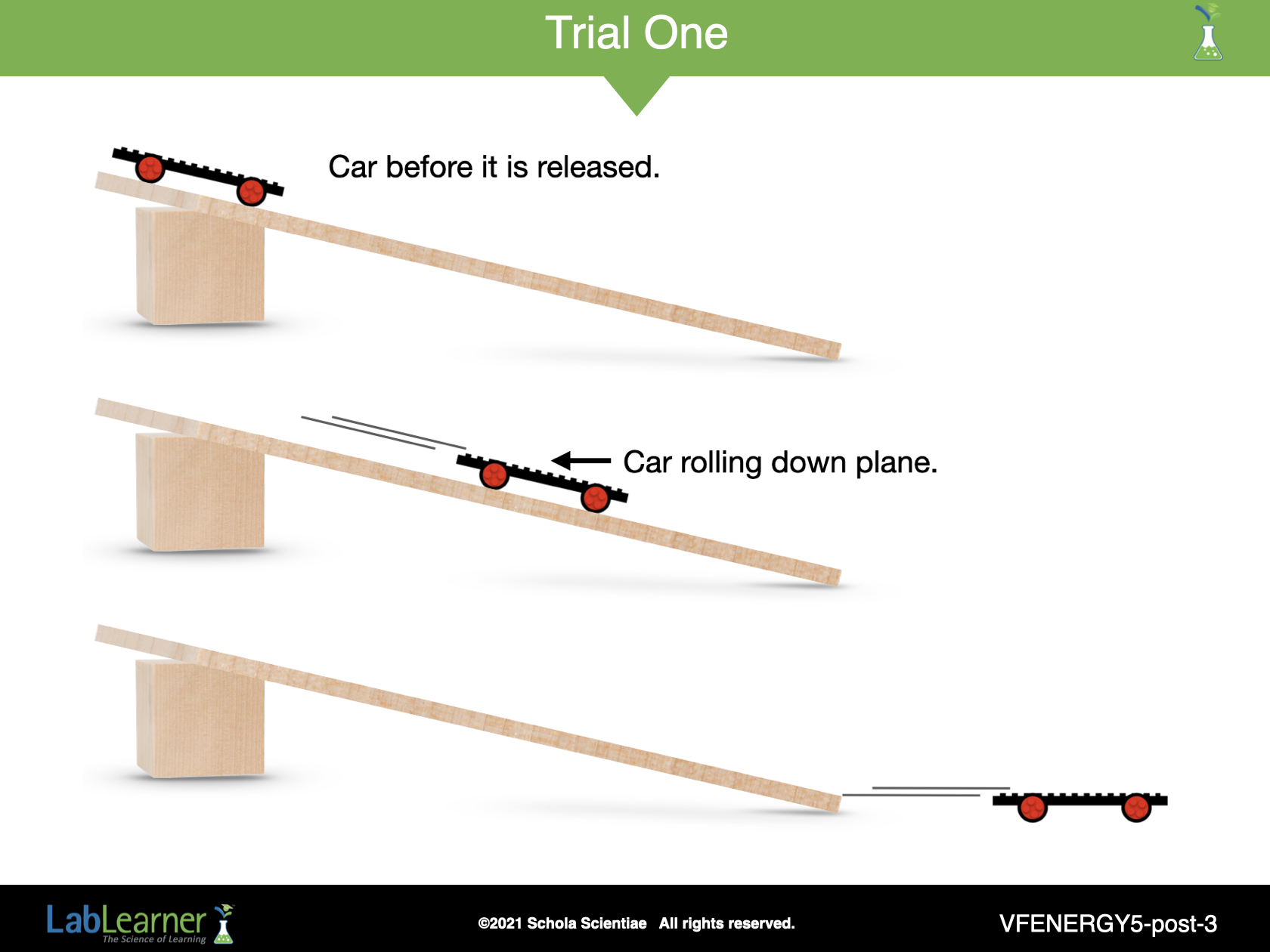
B. Continue by encouraging students to recall the first model they constructed and tested in the lab.
1. Ask students: What form of kinetic energy was present in all three models? Mechanical kinetic energy was present.
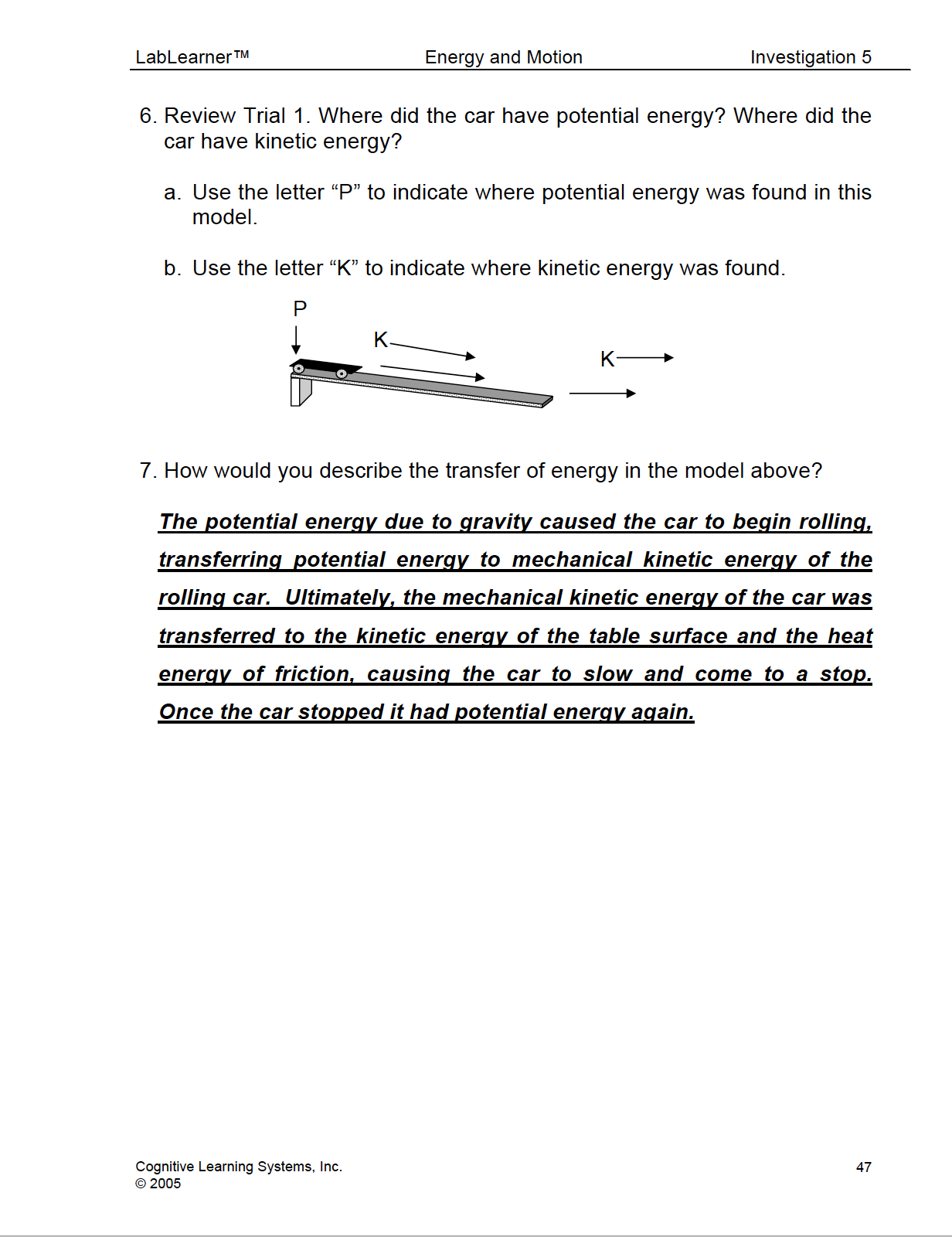
2. Direct students’ attention to Problem 6 in their Student Data Record. Ask students: Where was potential energy in this model? There was gravitational potential energy when the car was at the top of the ramp.
3. Direct students to indicate where they found potential energy by using the letter “P” and drawing an arrow to show where the potential energy occurred.
4. Ask students: Where was kinetic energy in this model? There was kinetic energy as the car traveled down the ramp and across the table.
5. Direct students to indicate where they found kinetic energy by using the letter “K” and drawing an arrow to show where the potential energy occurred.
6. Ask students: How would you describe the transfer of energy in this model? The potential energy due to gravity caused the car to begin rolling, transferring potential energy to mechanical kinetic energy of the rolling car. Ultimately, the mechanical kinetic energy of the car was transferred to the kinetic energy of the table surface and the heat energy of friction, causing the car to slow and come to a stop. Once the car stopped it had potential energy again.
______________________________________________
SLIDE VFENERGY5-post-4
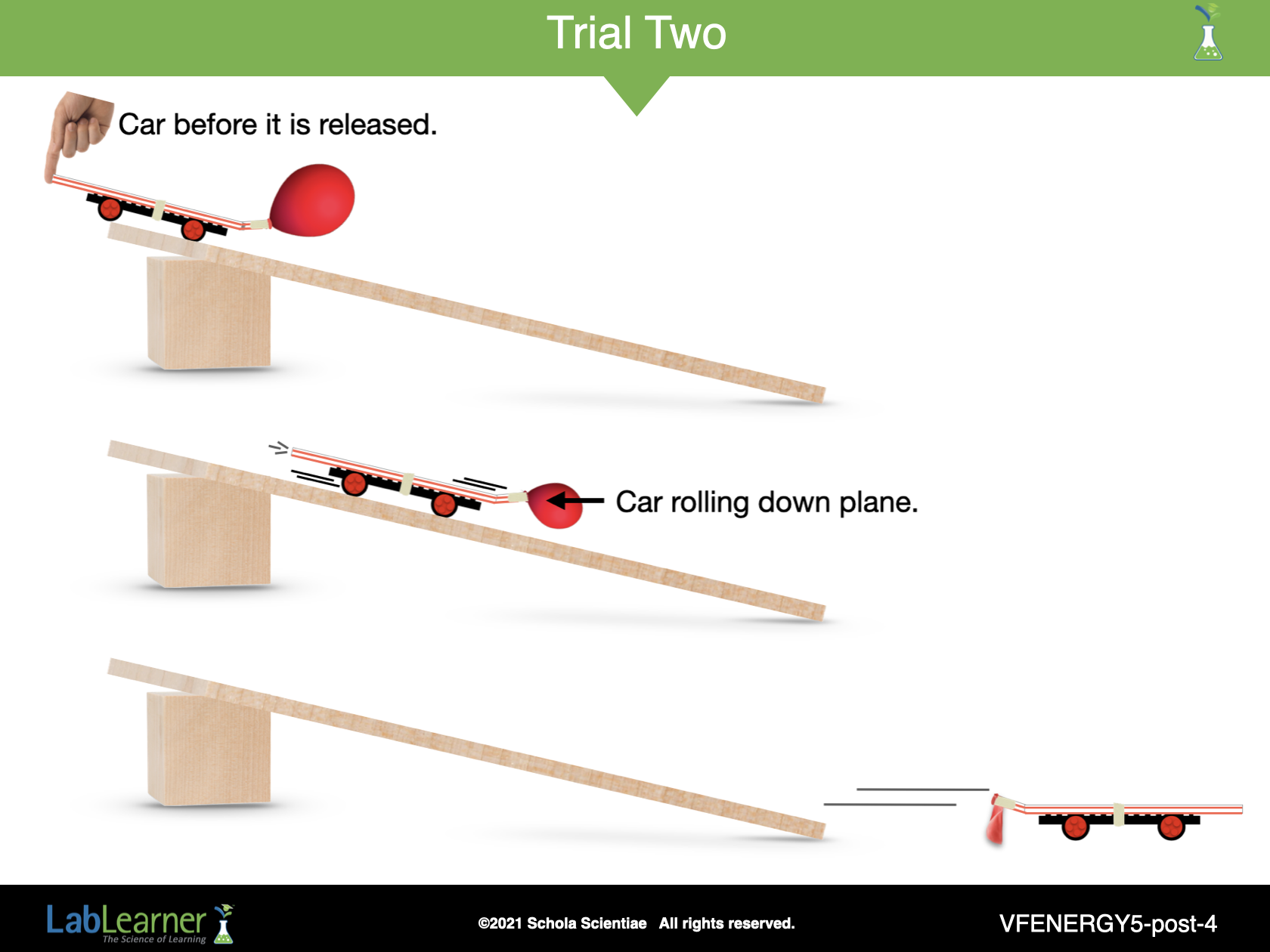
C. Direct students’ attention to the second model of the car.
1. Ask students: How did this model differ from the first model? The car had an additional source of energy in the form of a balloon filled with air.
2. Ask students: Do you think it changed the energy in the model? How? Student answers may vary. The balloon gave the car more energy as it started down the ramp and also as it traveled across the table.
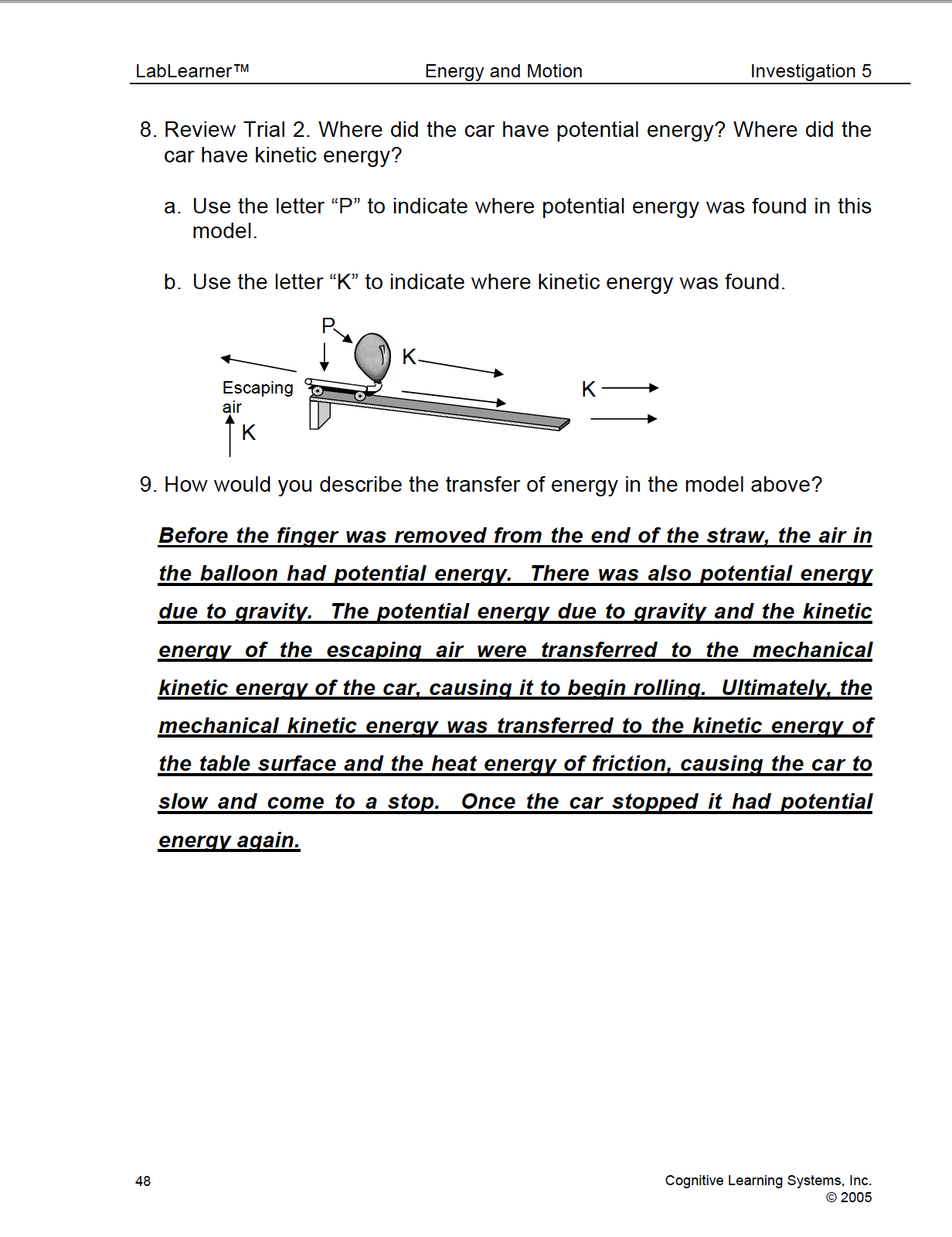
3. Direct students’ attention to Problem 8 in their Student Data Record. Ask students: Where was potential energy in this model? The car had gravitational potential energy at the top of the ramp. In addition, there was potential energy in the air of the balloon while the straw was blocked by the student’s finger.
4. Direct students to indicate where they found potential energy by using the letter “P” and drawing an arrow to show where the potential energy occurred.
5. Ask students: Where was kinetic energy in this model? There was kinetic energy in the air escaping from the balloon, the car traveling down the ramp, and the car traveling across the table.
6. Direct students to indicate where they found kinetic energy by using the letter “K” and drawing an arrow to show where the potential energy occurred.
7. Ask students: How would you describe the transfer of energy in this model? Before the finger was removed from the end of the straw, the air in the balloon had potential energy. There was also potential energy due to gravity. The potential energy due to gravity and the kinetic energy of the escaping air was transferred to the mechanical kinetic energy of the car, causing it to begin rolling. Ultimately, the mechanical kinetic energy was transferred to the kinetic energy of the table surface and the heat energy of friction, causing the car to slow and come to a stop. Once the car stopped it had potential energy again.
______________________________________________
SLIDE VFENERGY5-post-5
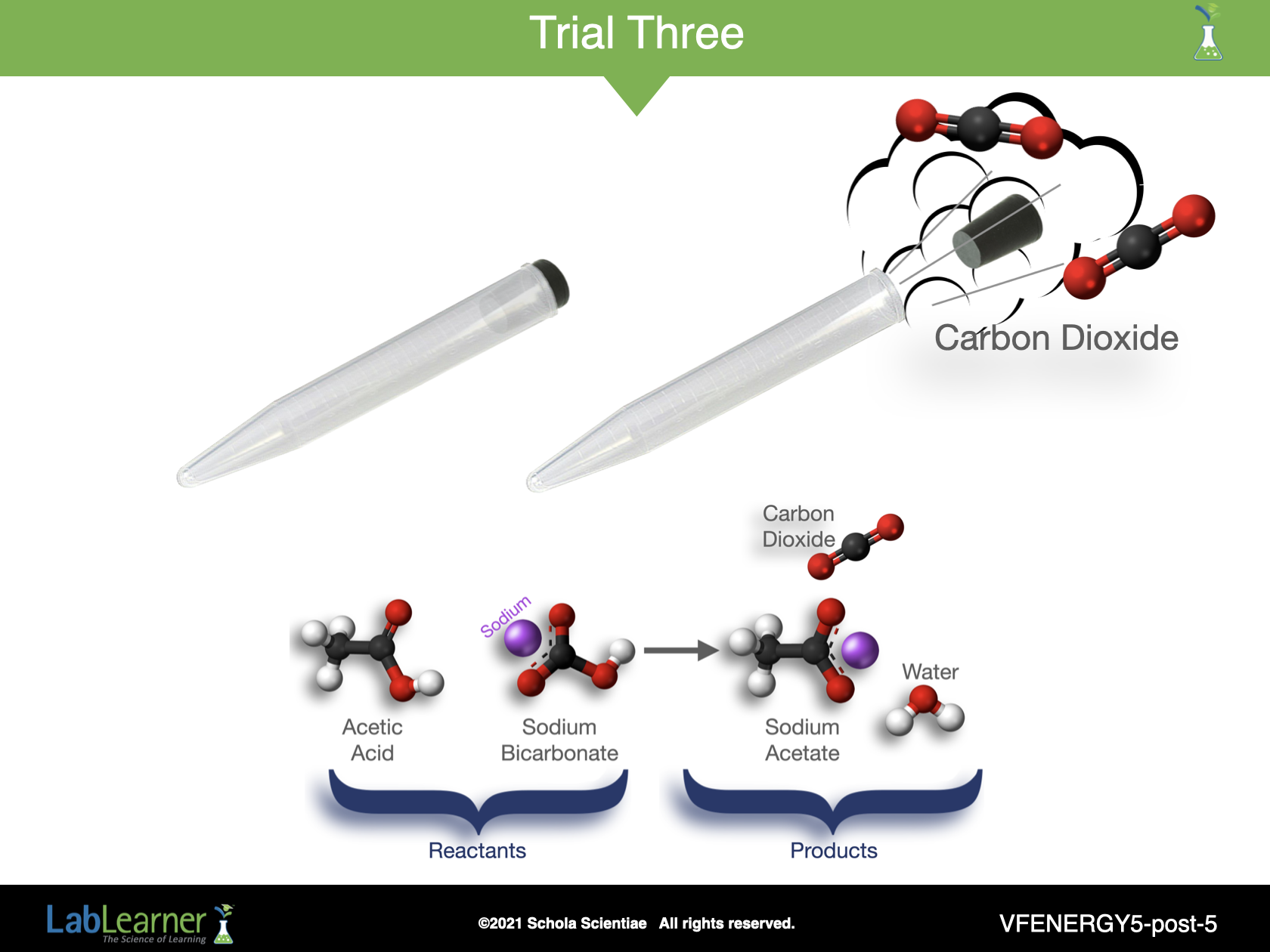
D. Direct students’ attention to the falcon (centrifuge) tube and rubber stopper model.
1. Ask students: How did this model differ from the first two models? It used a chemical reaction to generate energy rather than gravity.
2. Ask students: How was it similar to the first two models? Mechanical energy was generated in the form of motion.
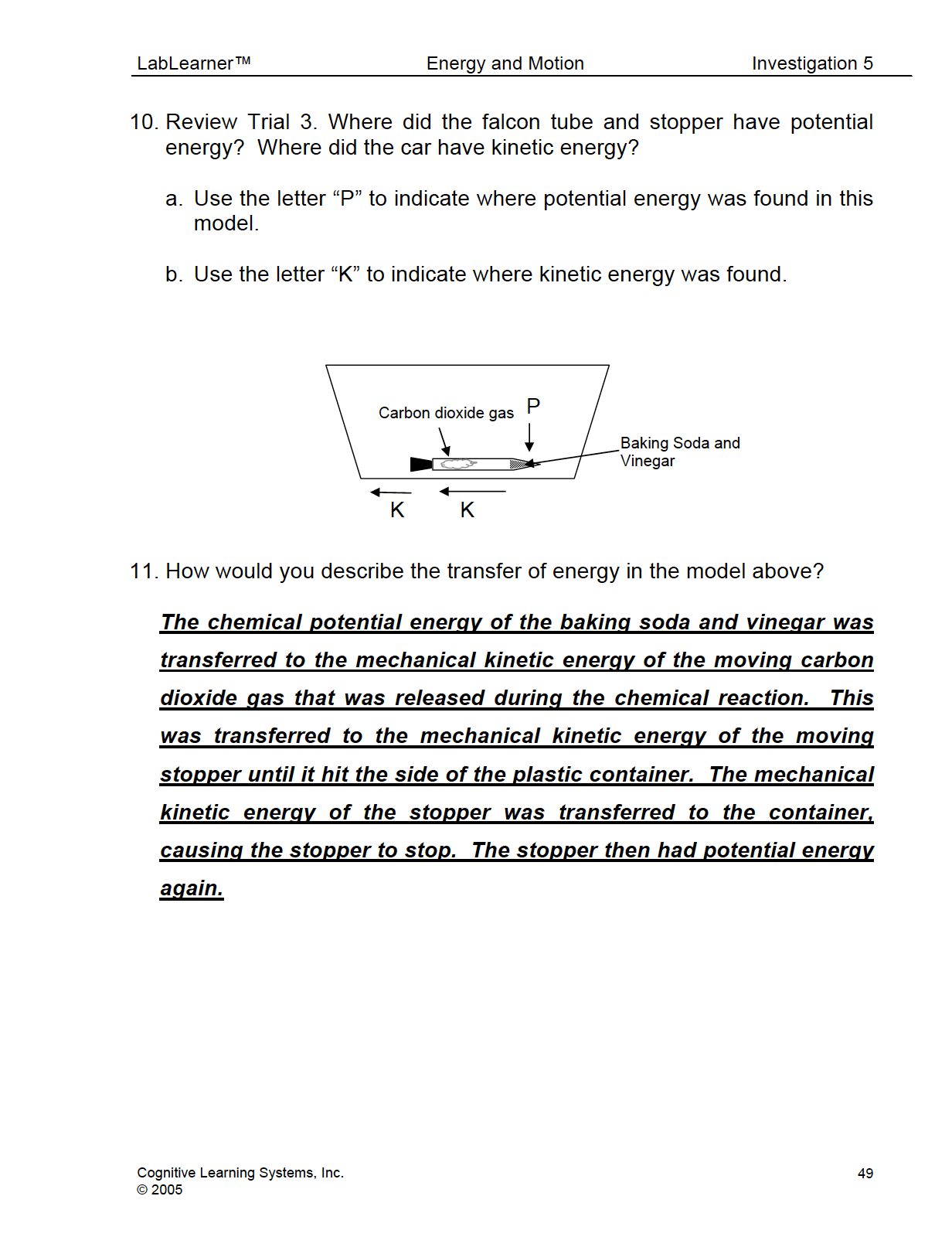
3. Direct students’ attention to Problem 10 in their Student Data Record. Ask students: Where was potential energy in this model? Students should indicate that the potential energy was in the chemicals: baking soda and vinegar.
4. Direct students to indicate where they found potential energy by using the letter “P” and drawing an arrow to show where the potential energy occurred.
5. Ask students: Where was kinetic energy in this model? The kinetic energy was present in the molecules of gas inside the falcon tube and in the stopper moving away from the tube.
6. Direct students to indicate where they found kinetic energy by using the letter “K” and drawing an arrow to show where the potential energy occurred.
7. Ask students: How would you describe the transfer of energy in this model? The baking soda and vinegar possessed chemical potential energy. This was transformed into mechanical kinetic energy of the moving molecules of carbon dioxide gas. This was transferred to the mechanical kinetic energy of the rubber stopper as it was released from the tube and traveled across the container. Once the stopper came to a stop, it possessed potential energy.
______________________________________________
SLIDE VFENERGY5-post-6
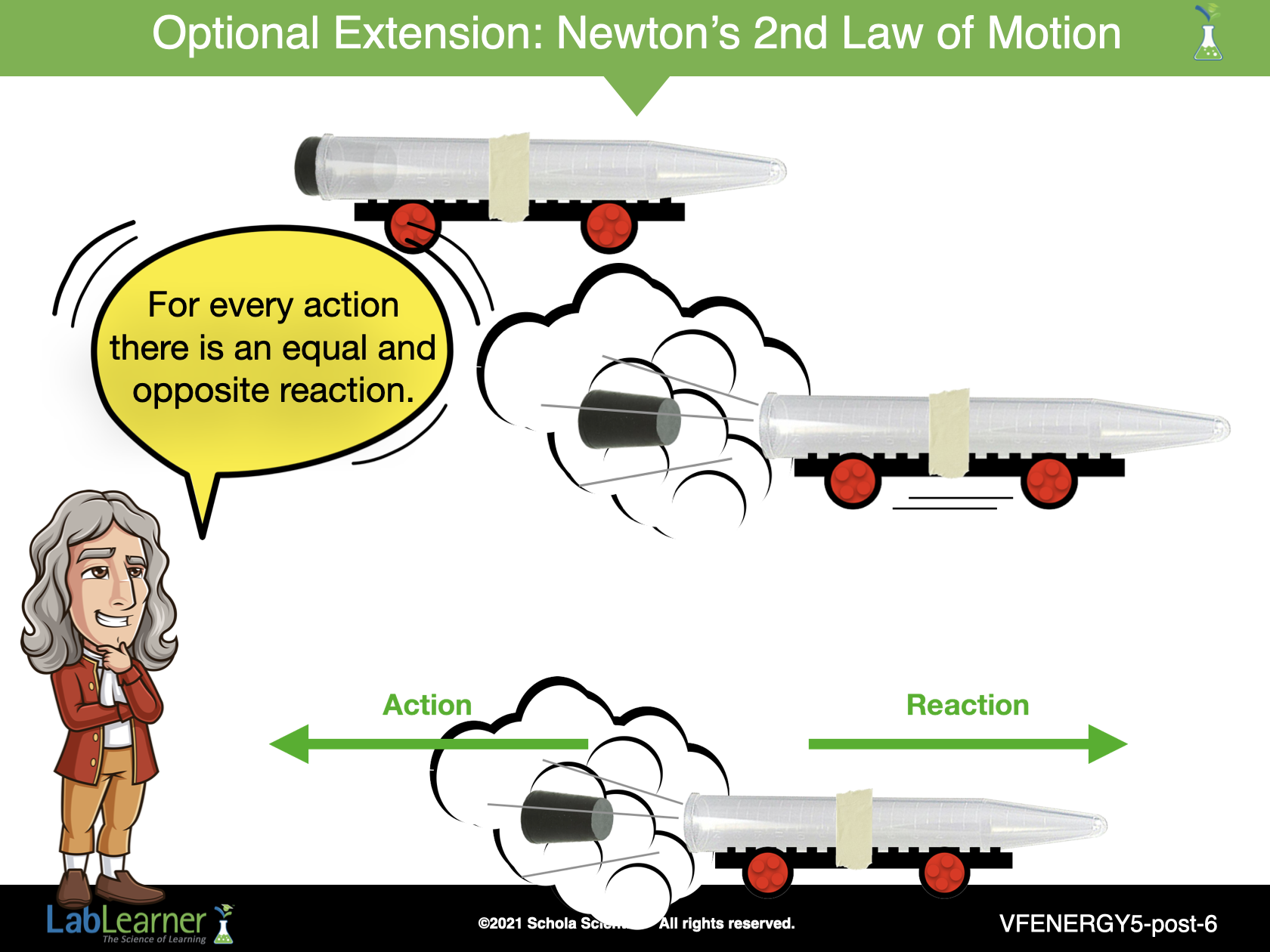
This slide shows the Optional Activity from the Lab. Notice that the same chemical reaction was used as in the previous Trial.
This Trial is also a wonderful demonstration of Newton’s Third Law of Motion, which states:
For every action, there is an equal and opposite reaction.
As shown at the bottom of the slide, the action is the pressure of the escaping carbon dioxide gas (to the left), while the reaction is the kinetic mechanical energy of movement in the opposite direction, in this case to the right.
______________________________________________
SLIDE VFENERGY5-post-7
Conclude this Investigation by encouraging students to think about additional forms of energy.
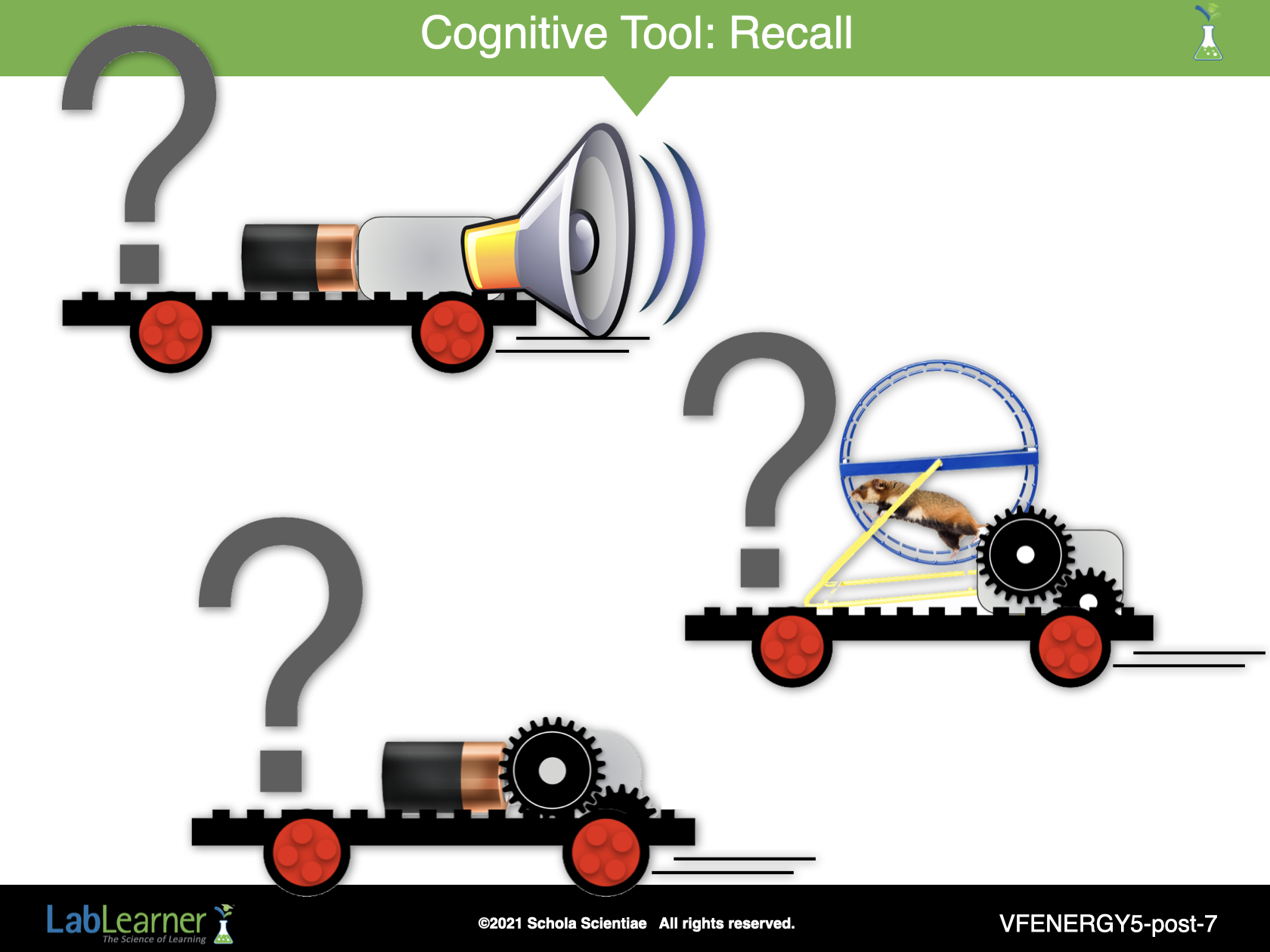
1. Ask students: Were there any forms of energy used in this CELL that were not used to power the models in this investigation? Electrical energy and sound energy were not used to generate mechanical energy.
2. Ask students: Could you have used any of these forms of energy to power the models? Student answers may vary. Electrical energy could be transferred from a battery to a miniaturized motor or fan in order to power the car. A tuning fork could be used to generate a vibration that would stimulate the car to roll down the ramp.
3. Ask students: What other forms of energy do you know about that might be used more often in the future? Why? Student answers will vary. Students may suggest such forms as nuclear energy, solar energy, and wind energy. The choices of alternative energy sources will most likely be driven by efficiency, cost, the renewability of the resource, and how well the source contributes to the reduction in pollution.
This final slide is obviously intended to be humorous. However, use it to encourage students to brainstorm other ideas of how mechanical kinetic energy might be formed from alternative energy forms. Crazy ideas are sometimes the first seeds of more thought-out concepts and discoveries!
______________________________________________
KEYS: POSTLAB