
Teacher Portal:
Forms of Energy
Investigation 4 – PreLab
 PRINT IT
Use your browser to download a printable PDF as help during the slide presentation and to make additional notes. In your browser, go to File > Print and then choose to save as PDF.
MINDSET
This Investigation is designed to:
- reinforce the concept that energy has properties and promote the understanding that chemical energy and heat have different properties from mechanical energy, sound energy, light energy, and electrical energy.
- reinforce the concept of potential energy as stored energy and demonstrate that chemicals have potential energy.
- reinforce the concept of kinetic energy as energy in motion and promote the understanding that heat is a form of kinetic energy.
- promote the understanding that heat is absorbed in an endothermic reaction.
- promote the understanding that heat is released from an exothermic reaction.
SCIENTIST’S GLOSSARY
1. Chemical energy: The energy of chemical reactions.
2. Chemical reaction: The process in which one or more substances interact chemically to form one or more different substances.
3. Endothermic reaction: A chemical reaction that absorbs heat from its surroundings.
4. Exothermic reaction: A chemical reaction that releases heat into its surroundings.
5. Heat energy: The energy transferred from one molecule to another because of a difference in kinetic energy between the two molecules.
6. Law of Conservation of Energy: A principle that states that energy is neither created nor destroyed, it simply changes form.
BE PREPARED
Watch the Investigation 4 Teacher Video and Student Video below to prepare for the PreLab.
SET FOR SUCCESS
- Tell students that they continue working with the Forms of Energy CELL.
- Tell students that they will focus on chemical energy.
- Ask students to share the kinds of things they might learn in this Investigation.
Begin the PreLab Concept Slides to start students on their learning journey. Then watch the Pre-Lab Student Video afterward as a class.
NAVIGATE IT
Once the slide presentation is launched
- use your left and right arrows to advance or go back in the slide presentation, and
- hover your mouse over the left edge of the presentation to get a view of the thumbnails for all the slides so that you can quickly move anywhere in the presentation.
- Click HERE to launch the slide presentation for the CELL.
SHARE IT
SLIDE VFENERGY4-pre-1
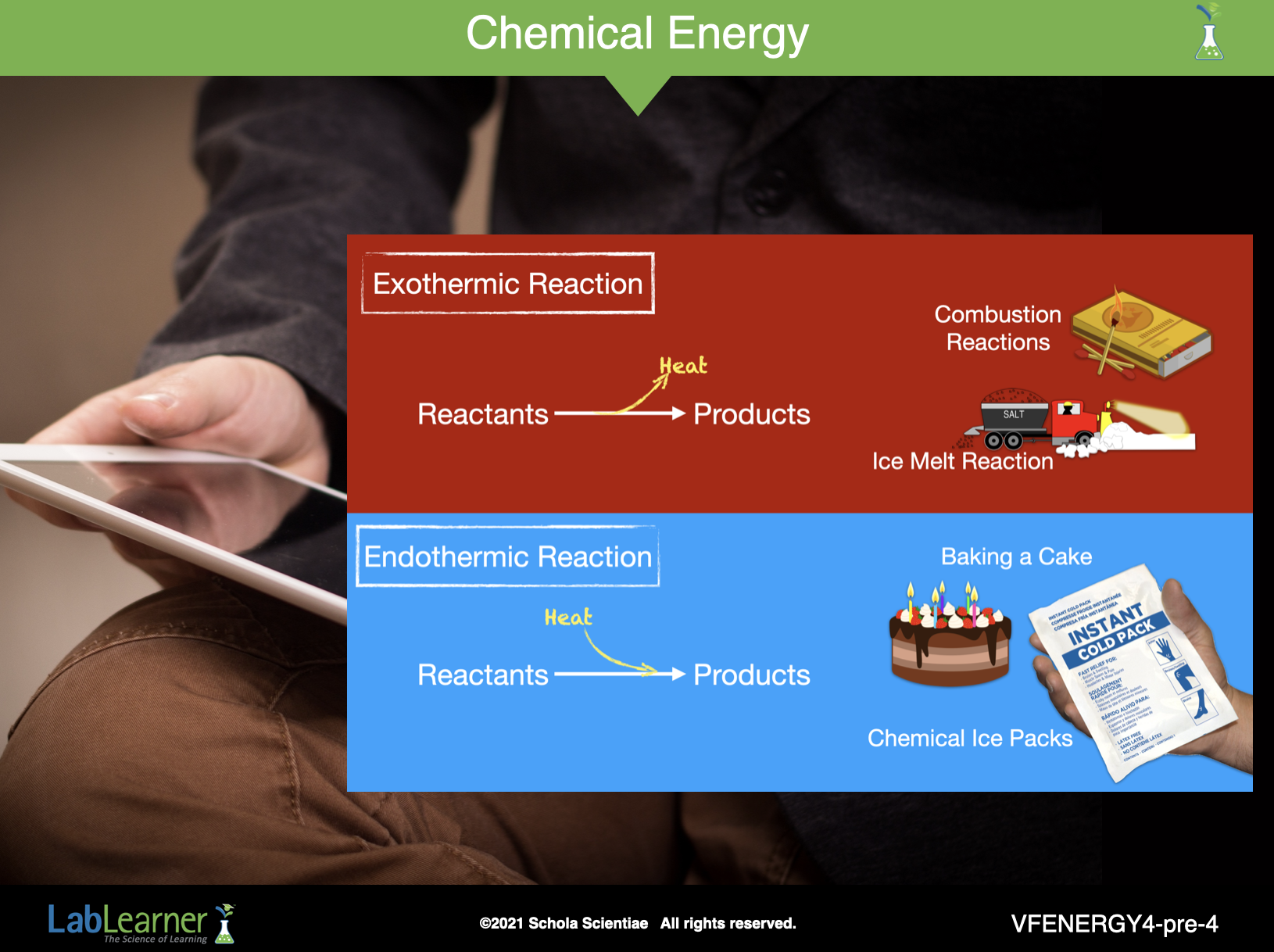
In this Investigation, students will learn about chemical energy. They will also learn about two different types of chemical reactions: exothermic reactions, which release heat energy, and endothermic reactions, which absorb heat.
______________________________________________
SLIDE VFENERGY4-pre-2
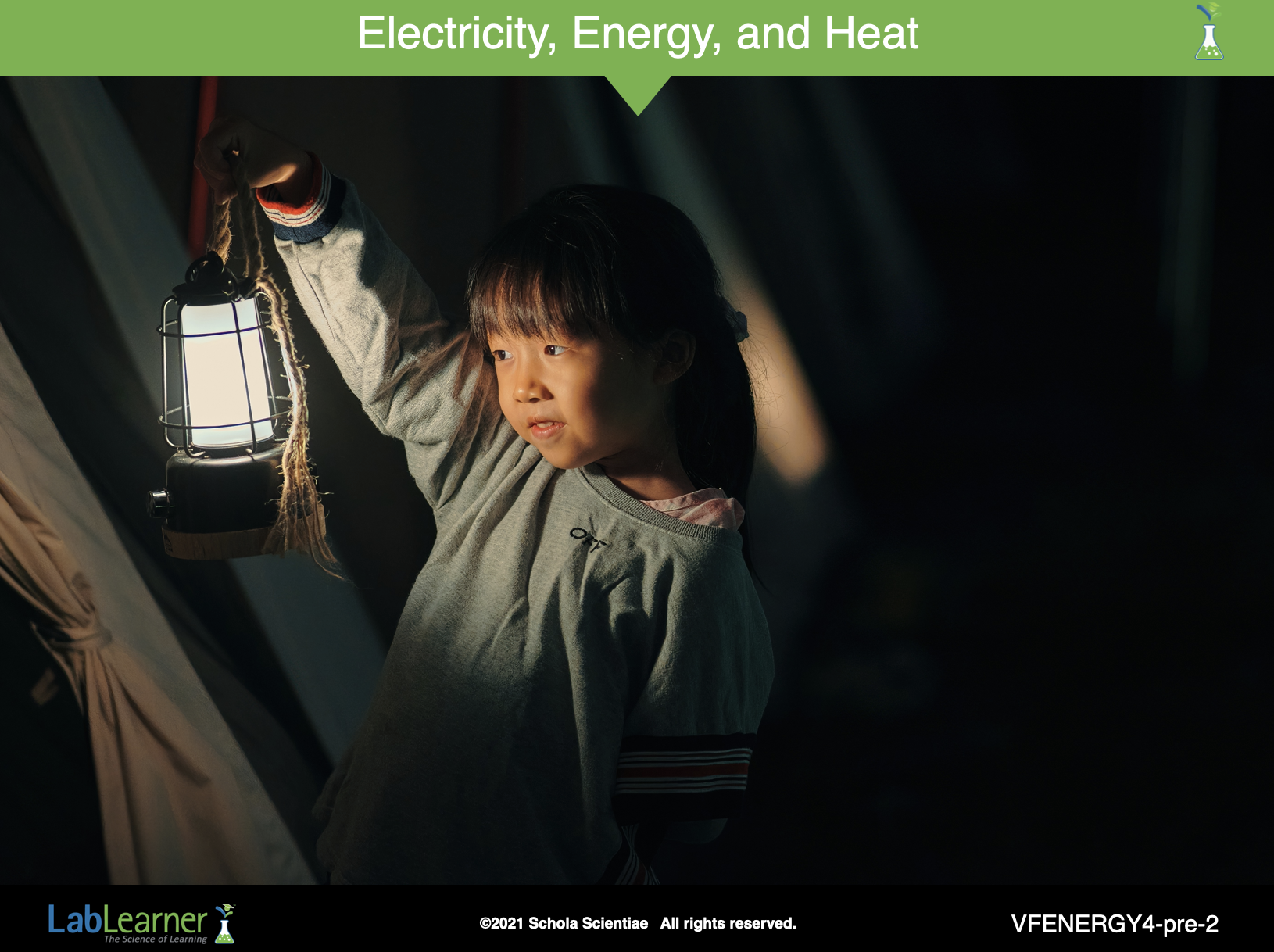
A. Begin the investigation by reviewing the concepts learned in their previous Investigations by asking students to think about the following story as you read it aloud.
Catherine and Madeline were on a camping trip with their family. One night the girls were sitting outside their tent playing a game by the light of a battery-powered camping lantern. Catherine asked her mother for a cookie. Her mother passed Catherine a cookie and said, “Be careful reaching across the lantern, Catherine. The light bulb makes the lantern very hot.” Catherine carefully reached across the lantern for the cookie. “Wow, Mommy! I can feel the heat without touching it!”
Madeline listened carefully to their mother’s warning before reaching for her own cookie. Later, the girls’ mother turned the lantern off and told the girls to get ready for bed. Madeline decided the lantern could not be hot since the light was off and touched the glass with her finger. “Ouch! Mommy!” she cried, running after her mother.
1. Ask students: What do you think happened to Madeline’s finger? Madeline burned her finger on the lantern glass.
2. Encourage students to think about why the lantern glass was hot when the light was turned off. Ask students: Why was the glass still hot, if the lantern bulb was switched off? The lantern glass was still hot because it had absorbed heat from the light and had not had time to cool.
3. Ask students: How can you describe the energy transfer in the story? Chemical energy from the lantern battery was converted to electrical energy. The electrical energy flowed through the bulb and was transformed into light energy and heat. The heat was transferred to the glass and the top of the lantern.
4. Ask students: If light energy can be converted to heat, do you think heat can be converted to other types of energy? Student answers will vary.
______________________________________________
SLIDE VFENERGY4-pre-3
B. Continue the discussion by using the letter below to encourage students to voice any misconceptions they may possess about energy. Explain to students that it is a letter written to a chemist by a fourth-grade student. Direct students to follow along in Problem 1 of their Student Data Record as you read it aloud:
Dear Dr. Conrad,
Today one of the sixth graders told us about a kind of energy she called chemical energy. She said that chemicals need chemical energy to react with each other. We did some chemistry experiments at school yesterday. I don’t think that chemical energy was present in those experiments, because I didn’t see any signs of energy. I know that when mechanical energy is present, I can see something move. When electrical energy is present, I can see light or hear sounds. When I hear a sound, I know that sound energy is being caused by vibrations.
When we made a simple circuit in an experiment, I know that electrical energy was present because the light bulb glowed. I told the sixth grader about my circuit, and she said the light bulb glowed because the chemical energy in the batteries was changed into electrical energy when the circuit was completed. Dr. Conrad, I didn’t believe her because I looked and looked at that battery and didn’t see anything that looked like chemicals!
Then the sixth grader said when you make and stir some solutions, heat energy can be measured as a result of chemical energy in the solution. How can this be true? I never see anything that looks like energy when I stir solutions in science class. The sixth grader’s big brother said that heat energy can be changed into chemical energy. This doesn’t make any sense to me. I can feel heat energy, but I have never seen, felt, or heard chemical energy.
I am very confused. Can you help me understand chemical energy so I can explain it to my friends at school?
Yours truly,
Peter Sanchez
1. Use the following questions to help students review the content of Peter’s letter to Dr. Conrad:
a. What form of energy did the sixth-grader explain to Peter? The sixth-grader explained chemical energy.
b. Why does Peter not believe that chemical energy is real? Peter does not believe chemical energy is real because he cannot see, hear, or feel it.
______________________________________________
SLIDE VFENERGY4-pre-4
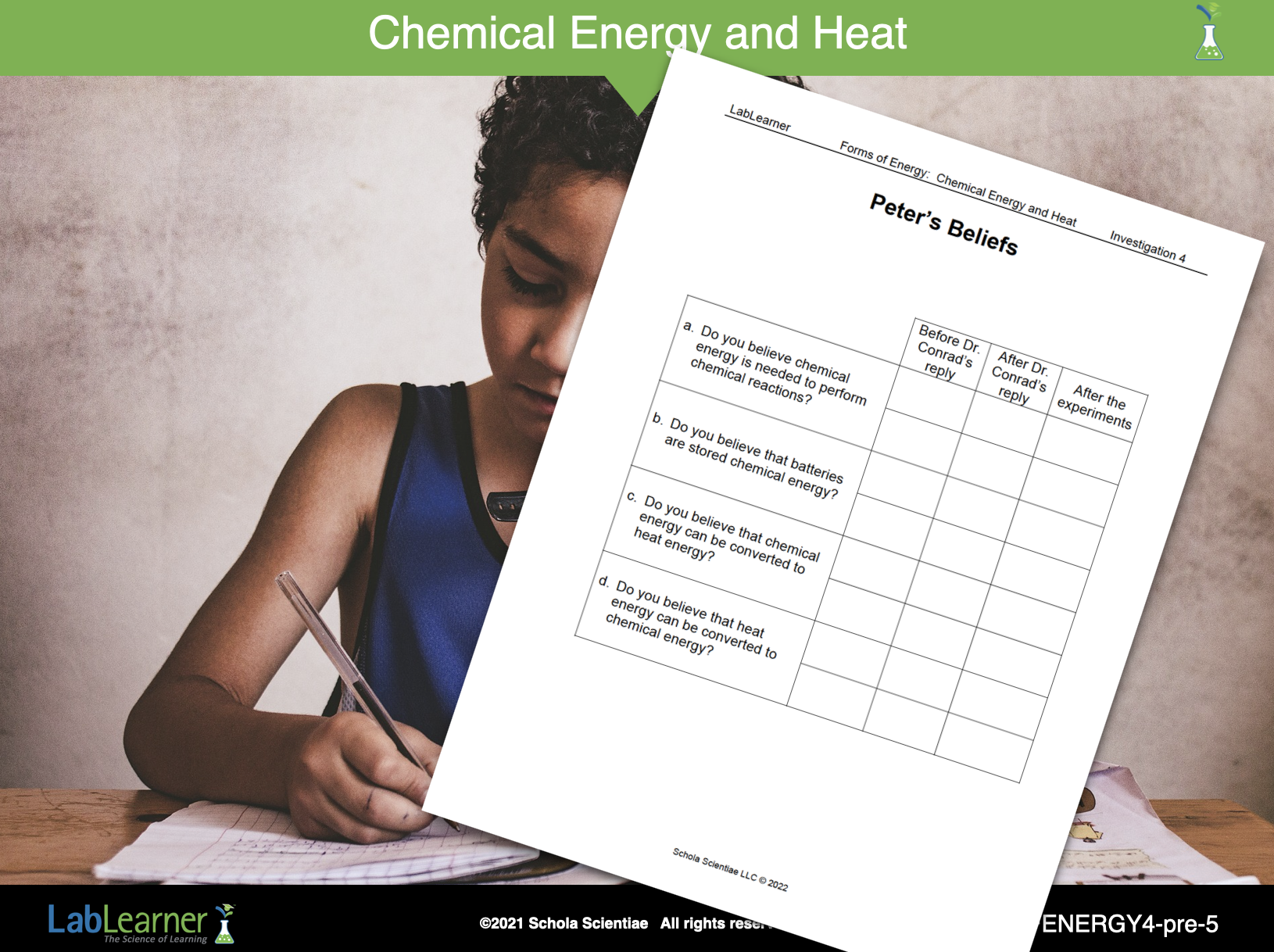
Surveys can often be used to Check Understanding of science concepts and determine if any misconceptions are held by students. Use the survey below to assess students’ feelings about Peter’s misconceptions in the letter in Problem 1 of the Student Data Record.
1. Instruct students to read Problems 2 a-d in their Student Data Record and answer “yes” or “no” for each question in the column titled “Before Dr. Conrad’s reply”.
2. Allow approximately 5 minutes for students to answer the questions, then take a survey of “yes” and “no” answers for each question.
3. Record the tallies of the number of students who believe “Yes” and “No” in each box in the table.
4. Read Dr. Conrad’s reply aloud and encourage students to read along silently in Problem 3:
Dear Peter,
I am happy to help you try to understand chemical energy. Remember that in a chemical reaction two or more substances can interact to form a different substance or substances. Also, you have learned that everything that happens requires energy. This means that for substances to interact and form new substances, energy is needed. This is the form of energy we call chemical energy.
Think about what you know about electrical energy. Did you see electrons moving through the circuit when you tested it? No, because electrons are too small to be seen. So how did you know that electrical energy was present? You knew electrical energy was present because you saw the light bulb glow with light energy.
Now think about what the Law of Conservation of Energy tells us: energy cannot be created or destroyed, it simply changes form. This means that the light energy must have been transformed from another kind of energy. The light energy was transformed from electrical energy. What was your energy source for the circuit? The battery was your energy source. The battery held energy stored in chemicals inside it until you were ready to use it. When you completed the circuit, this allowed the stored chemical energy in the battery to be converted to electrical energy. Electrical energy is kinetic energy.
You were told that chemical energy can also be transformed into heat energy. This type of reaction is an exothermic reaction. Exothermic reactions release heat. What happens if a reaction absorbs heat instead of releasing it? The reaction is called an endothermic reaction. In endothermic reactions, heat energy is converted to chemical energy.
Show your teacher my letter and ask him or her to help you do experiments with these kinds of reactions. This will help you see that what I said is true.
Yours truly,
Dr. Conrad
5. Encourage students to read the questions again and answer yes or no in the column titled “After Dr. Conrad’s response”.
6. Complete the survey by tallying students’ responses to the questions after reading Dr. Conrad’s response.
______________________________________________
SLIDE VFENERGY4-pre-5
After completing the Check Understanding activity, determine students’ reaction to Dr. Conrad’s letter by asking the following questions:
a. Ask students: Does Dr. Conrad think chemical energy is real?
b. Ask students: Does Dr. Conrad believe that chemical energy is needed for chemical reactions?
Conclude this portion of the Investigation by determining how Dr. Conrad’s letter influenced students’ beliefs about chemical energy and heat energy.
1. Ask for a show of hands: Did Dr. Conrad’s letter influence your beliefs about chemical and heat energy? Did you change your mind about chemical and heat energy after hearing and reading Dr. Conrad’s reply to Peter? Did you learn more, but not change your mind? Student answers will vary.
2. Explain to students that they will follow Dr. Conrad’s advice and test his facts about chemical and heat energy in the lab.
Student Video
Watch the Investigation 4 Student Video after the Share It presentation to prepare for the PreLab.