Teacher Portal:
Forms of Energy
Investigation 4 – PostLab
PRINT IT
Use your browser to download a printable PDF as help during the slide presentation and to make additional notes. In your browser, go to File > Print and then choose to save as PDF.
NAVIGATE IT
Once the slide presentation is launched
- use your left and right arrows to advance or go back in the slide presentation, and
- hover your mouse over the left edge of the presentation to get a view of the thumbnails for all the slides so that you can quickly move anywhere in the presentation.
- Click HERE to launch the slide presentation for the CELL.
SHARE IT
SLIDE VFENERGY4-post-1
In this Investigation, students learned about chemical energy. They also learned about two different types of chemical reactions: exothermic reactions, which release heat energy, and endothermic reactions, which absorb heat.
______________________________________________
SLIDE VFENERGY4-post-2
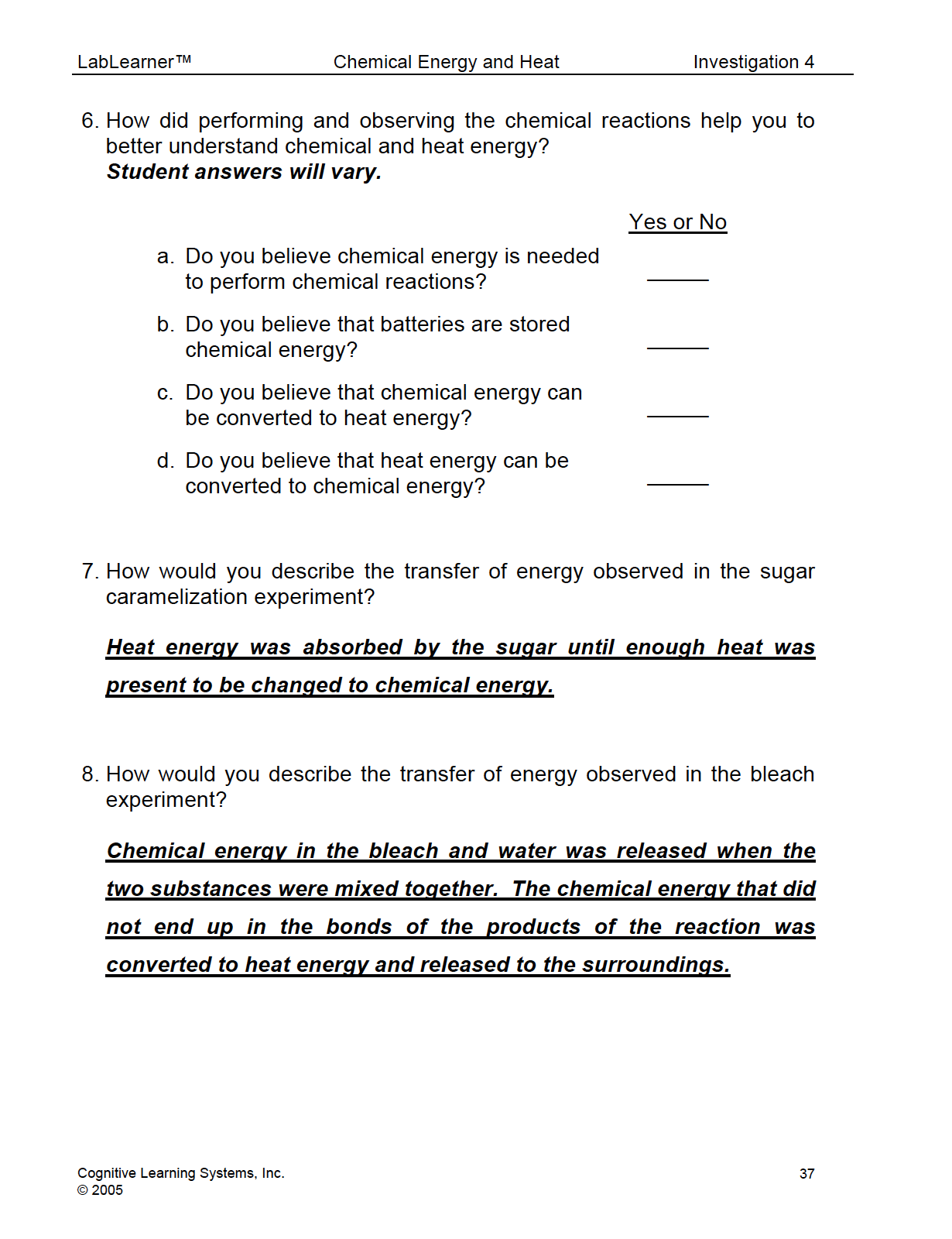
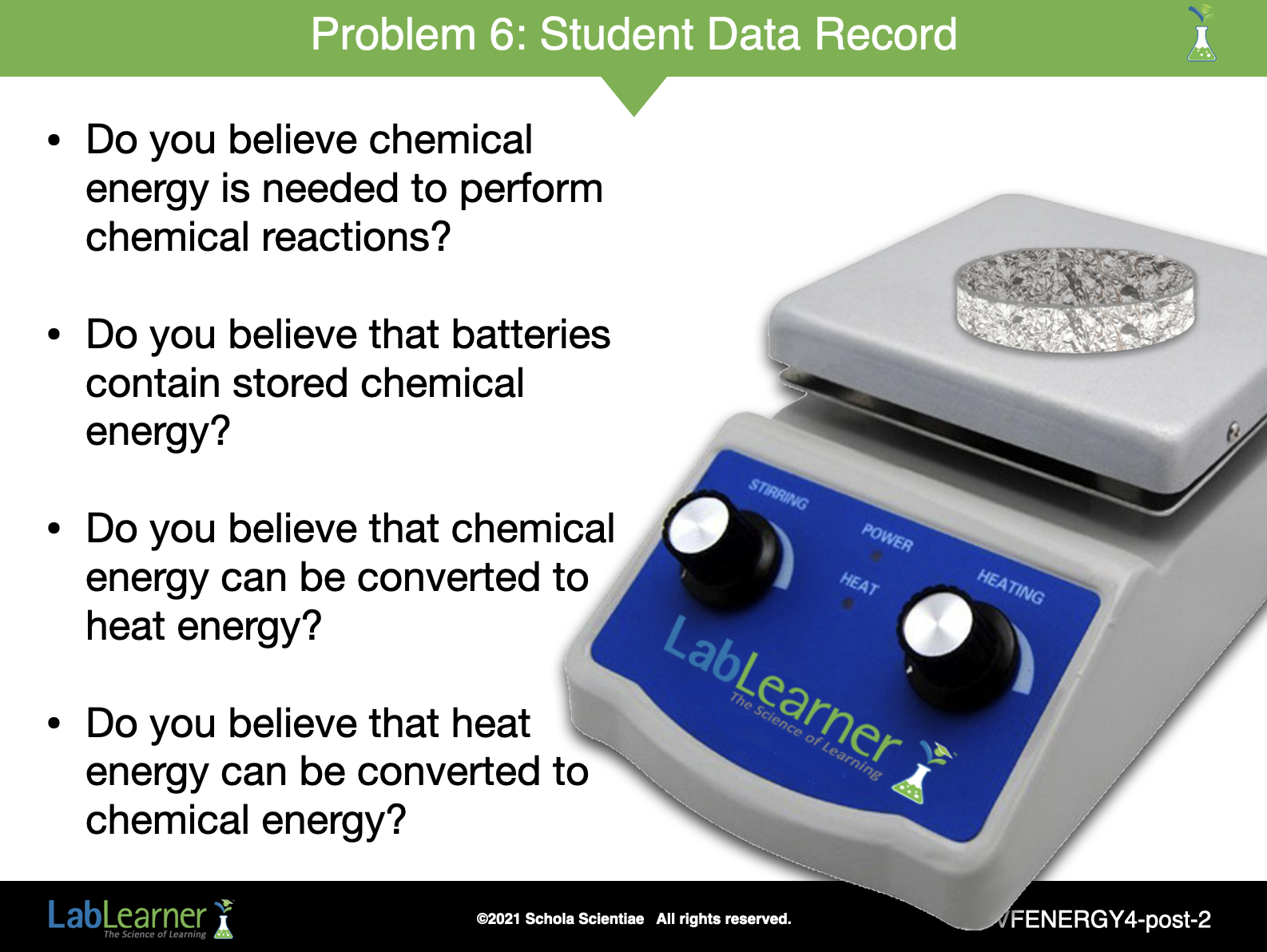
A. Begin this part of the Investigation by reviewing the survey from the PreLab in order to evaluate how students’ perceptions of chemical energy and heat energy have changed as a result of performing the lab.
1. Direct students’ attention to Problem 6 of their Student Data Record and instruct them to answer the questions based on their results in the lab.
2. Conduct the survey again by asking how many students answered yes and no.
______________________________________________
SLIDE VFENERGY4-post-3
Continue the discussion by encouraging students to summarize and analyze their results.
Begin by encouraging students to share their observations of the experiments that they observed and performed.
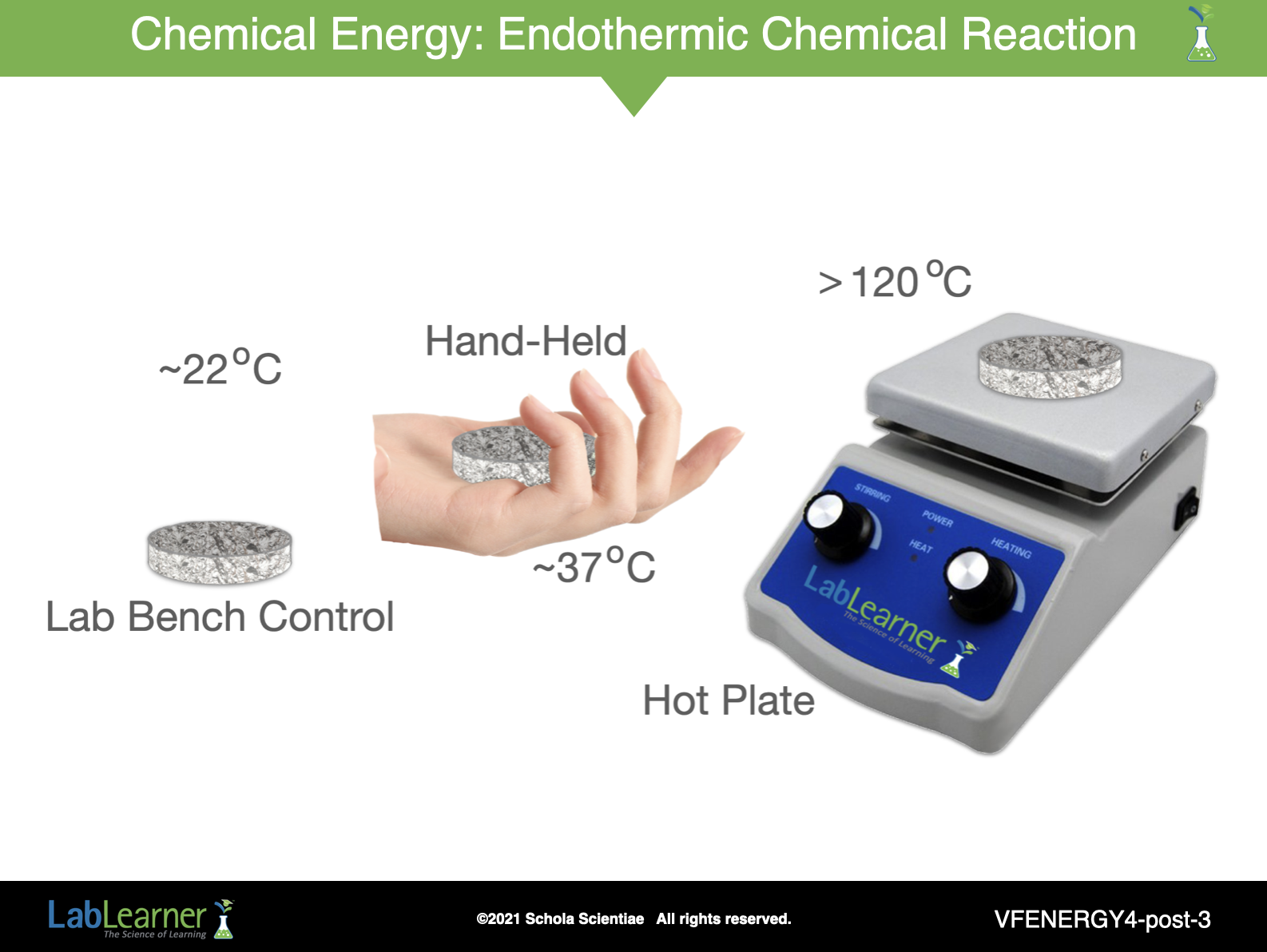
Ask students: Describe what you observed during the two experiments. Students observed that the sugar placed on the table and the sugar held by their classmate did not develop any signs of chemical or physical change during the demonstration because the appearance and physical state of each sample was not altered over time. In contrast, students observed that the sugar placed on the hot plate melted and turned into a brown bubbling liquid during the time it was exposed to heat. In addition, students discovered that adding non-chlorine powdered bleach to water resulted in the bleach dissolving into the water. There was no change of color observed, but the powder dissolved into the liquid and the temperature of the water increased after the powder was added to the water.
Ask students: Why do you think you saw a change in the sugar placed on the hot plate and not in the other two samples of sugar? Student answers may vary. Students should indicate that they saw a change in the sugar placed on the hot plate because the heat was applied to the sugar.
Ask students: Was the change that you observed in the sugar a chemical change or a physical change? How do you know? The change was chemical because a color change and a physical change occurred.
Ask students: What kind of energy was needed to perform this reaction. How do you know? Heat energy was needed to perform this experiment because only the sample on the hot plate was able to change. The hot plate added enough heat to the sugar to cause the change in color and physical state to occur.
______________________________________________
SLIDE VFENERGY4-post-4
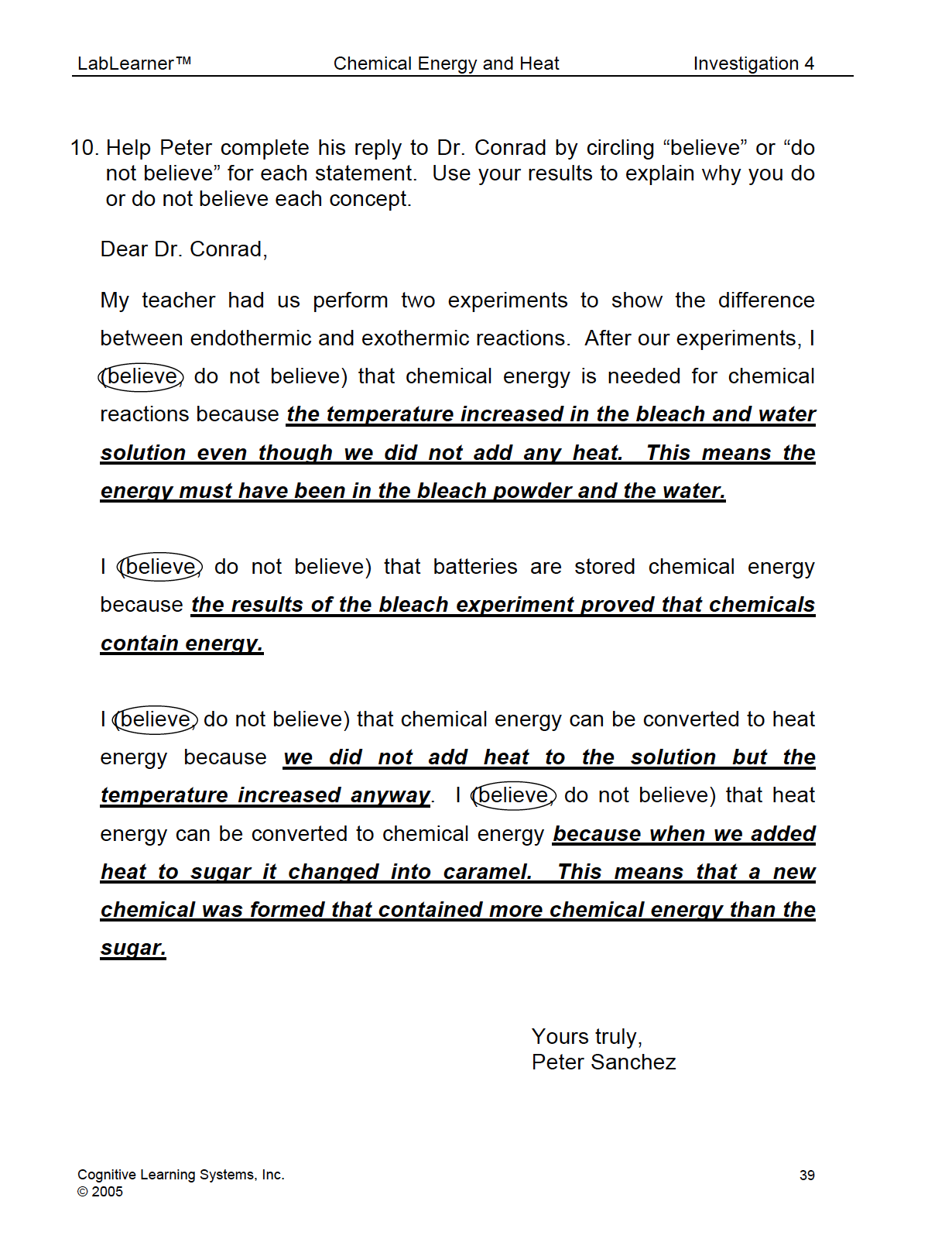
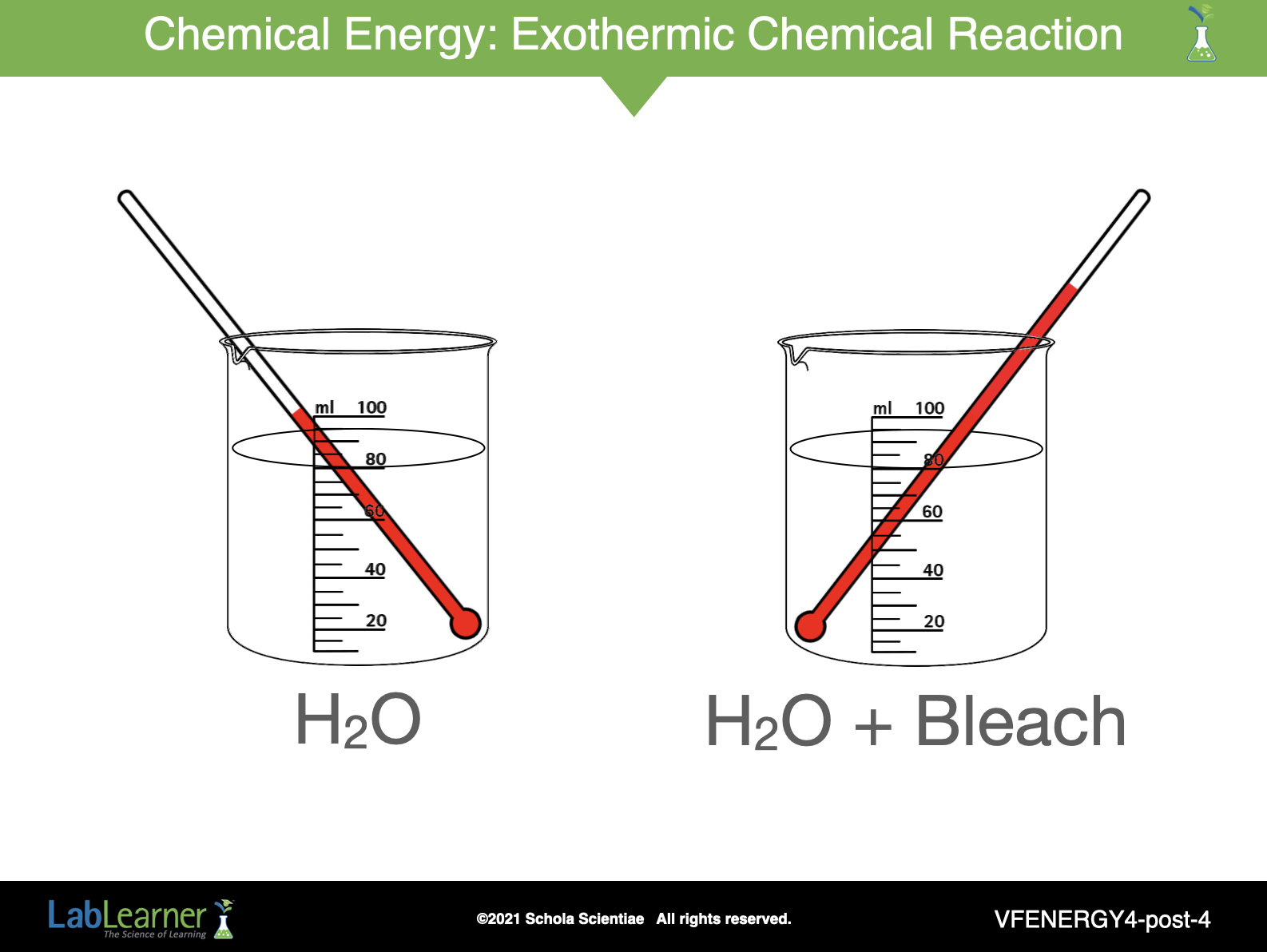
Focus students’ attention on the bleach dissolution experiment. Ask students: Did you observe any signs of chemical change in this experiment? Student answers may vary. Students should indicate that they observed an increase in temperature after the bleach powder was added to the water.
Ask students: Was the change physical or chemical? How do you know? Student answers may vary. Guide students to an understanding that the change was chemical because no heat source was present, yet the temperature rose after the bleach was added.
Ask students: What kind of energy was needed to perform this reaction? Explain. Student answers may vary. Chemical energy was needed to perform this reaction because when the bleach was added, no source of heat energy was visible. Therefore, chemical energy must have been the energy involved in the reaction.
______________________________________________
SLIDE VFENERGY4-post-5
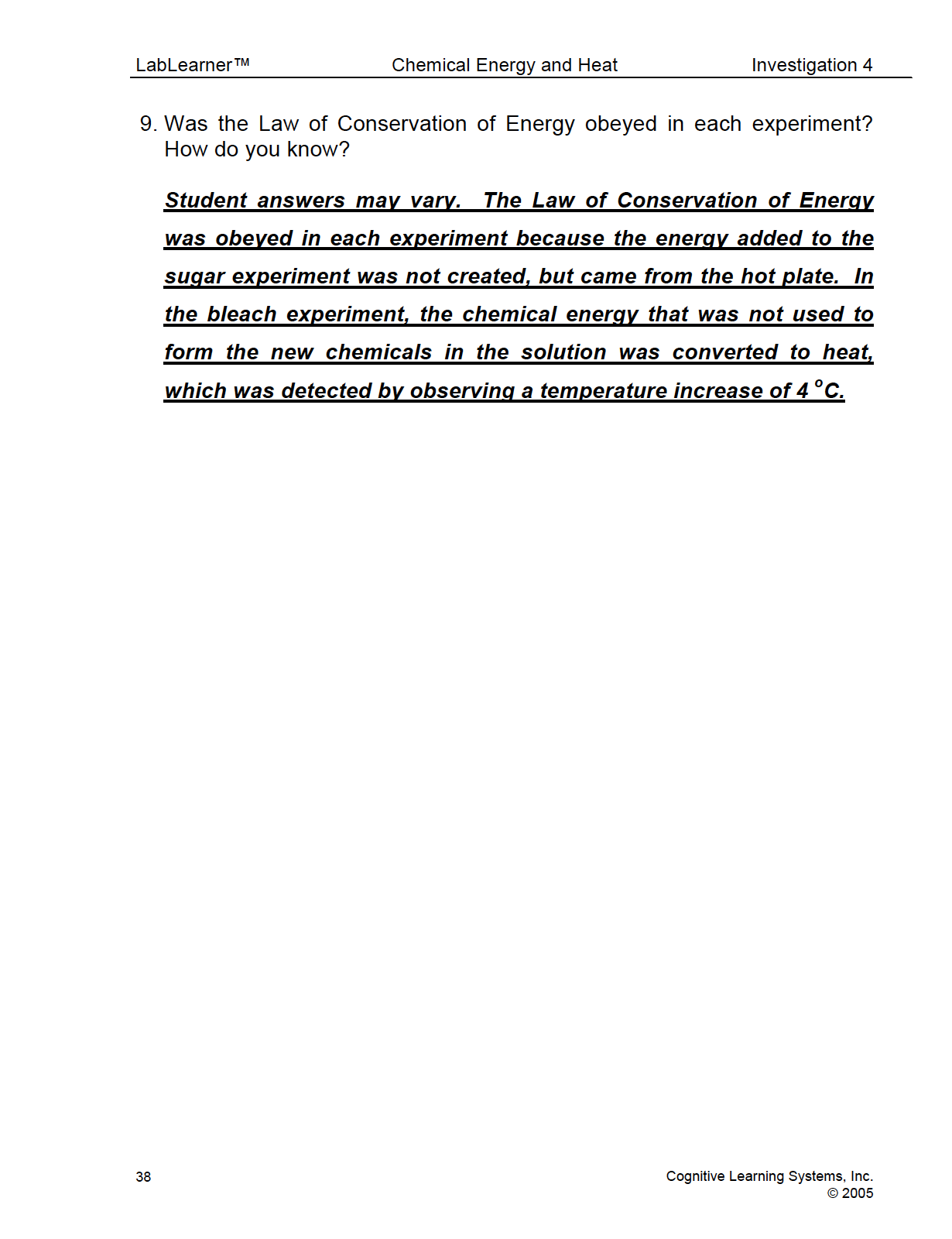
Continue by encouraging students to apply the Law of Conservation of Energy to the two experiments.
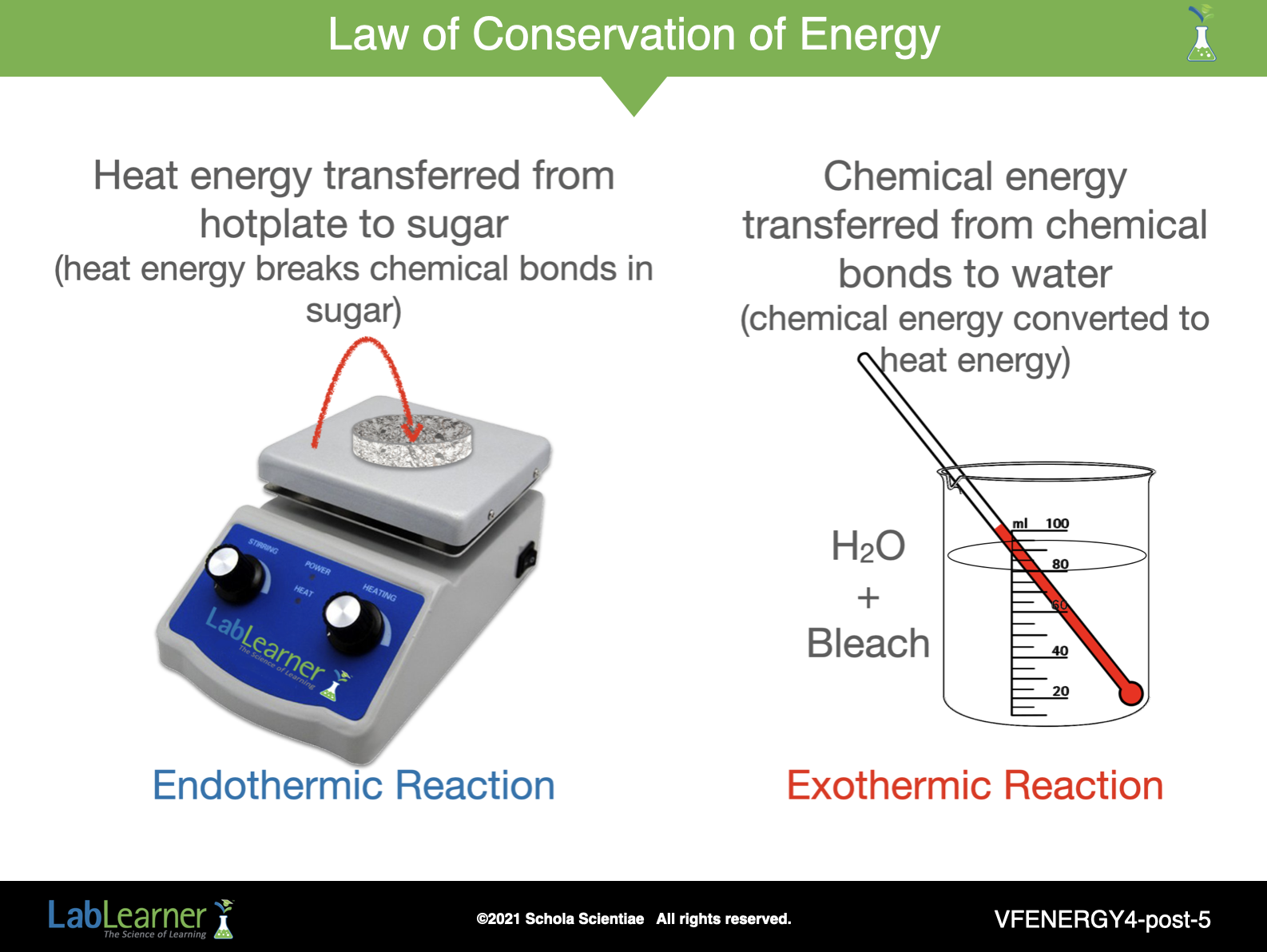
Ask students: How would you describe the transfer of energy observed in the sugar caramelization experiment? Heat energy was absorbed by the sugar until enough heat was present to be changed to chemical energy.
Ask students: How would you describe the transfer of energy observed in the bleach experiment? Chemical energy in the bleach and water was released when the two substances were mixed together. The chemical energy that did not end up in the bonds of the products of the reaction was converted to heat energy and released to the surroundings.
Ask students: Was the Law of Conservation of Energy obeyed in each experiment? How do you know? Student answers may vary. The Law of Conservation of Energy was obeyed in each experiment because the energy added to the sugar experiment was not created, but came from the hot plate. In the bleach experiment, the chemical energy that was not used to form the new chemicals in the solution was converted to heat, which was detected by observing a temperature increase of 3 oC.
- Direct students to answer Questions 7 through 9 in their Student Data Record.
______________________________________________
KEYS: POSTLAB