
Teacher Portal:
Forms of Energy
Investigation 2 – PreLab
 PRINT IT
Use your browser to download a printable PDF as help during the slide presentation and to make additional notes. In your browser, go to File > Print and then choose to save as PDF.
MINDSET
This Investigation is designed to:
- reinforce the concept that energy has properties, and promote the understanding that sound energy has different properties from mechanical energy.
- reinforce the concept of potential energy as stored energy.
- reinforce the concept of kinetic energy as energy in motion and promote the understanding that sound is a form of kinetic energy.
- demonstrate to students that sound travels as a wave and is transmitted by the vibration of molecules of matter.
SCIENTIST’S GLOSSARY
1. Amplitude: The height of a sound wave which determines both the volume of a sound and the strength of the vibration which causes the sound.
2. Decibels: A unit for measuring the loudness of volume.
3. Frequency: The number of times the molecules of matter vibrate within a specified interval of time.
4. Hertz: A unit of frequency equal to one cycle per second. Pitch can be described in terms of hertz.
5. Law of Conservation of Energy: A principle that states that energy is neither created nor destroyed, it simply changes form.
6. Pitch: The highness or lowness of a sound dependent on the frequency of sound waves.
7. Sound energy: The energy of molecular vibration.
8. Sound waves: A specific ordered movement of molecules in solids, liquids, or gases. Sound waves are categorized as longitudinal waves and are the compression and spreading apart of molecules in solids, liquids, and gases. Sound waves are caused by vibrations.
9. Vibration: A back and forth motion.
10. Volume: The loudness or softness of a sound.
BE PREPARED
Watch the Investigation 2 Teacher Video and Student Video below to prepare for the PreLab. There are two Teacher Videos. The first provides a general introduction. The second Teacher Video provides information for setting up the stations in the lab.
SET FOR SUCCESS
- Tell students that they continue working with the Forms of Energy CELL.
- Tell students that they will focus on a certain type of kinetic energy – sound energy.
- Ask students to share the kinds of things they might learn in this Investigation.
Begin the PreLab Concept Slides to start students on their learning journey. Then watch the Pre-Lab Student Video afterward as a class.
NAVIGATE IT
Once the slide presentation is launched
- use your left and right arrows to advance or go back in the slide presentation, and
- hover your mouse over the left edge of the presentation to get a view of the thumbnails for all the slides so that you can quickly move anywhere in the presentation.
- Click HERE to launch the slide presentation for the CELL.
SHARE IT
SLIDE VFENERGY2-pre-1
This Investigation is devoted to the study of sound energy. It will become clear to students during the course of the Investigation that sound energy is kinetic energy. In the case of sound, the movement that is characteristic of kinetic energy is in the form of sound waves.
______________________________________________
SLIDE VFENERGY2-pre-2
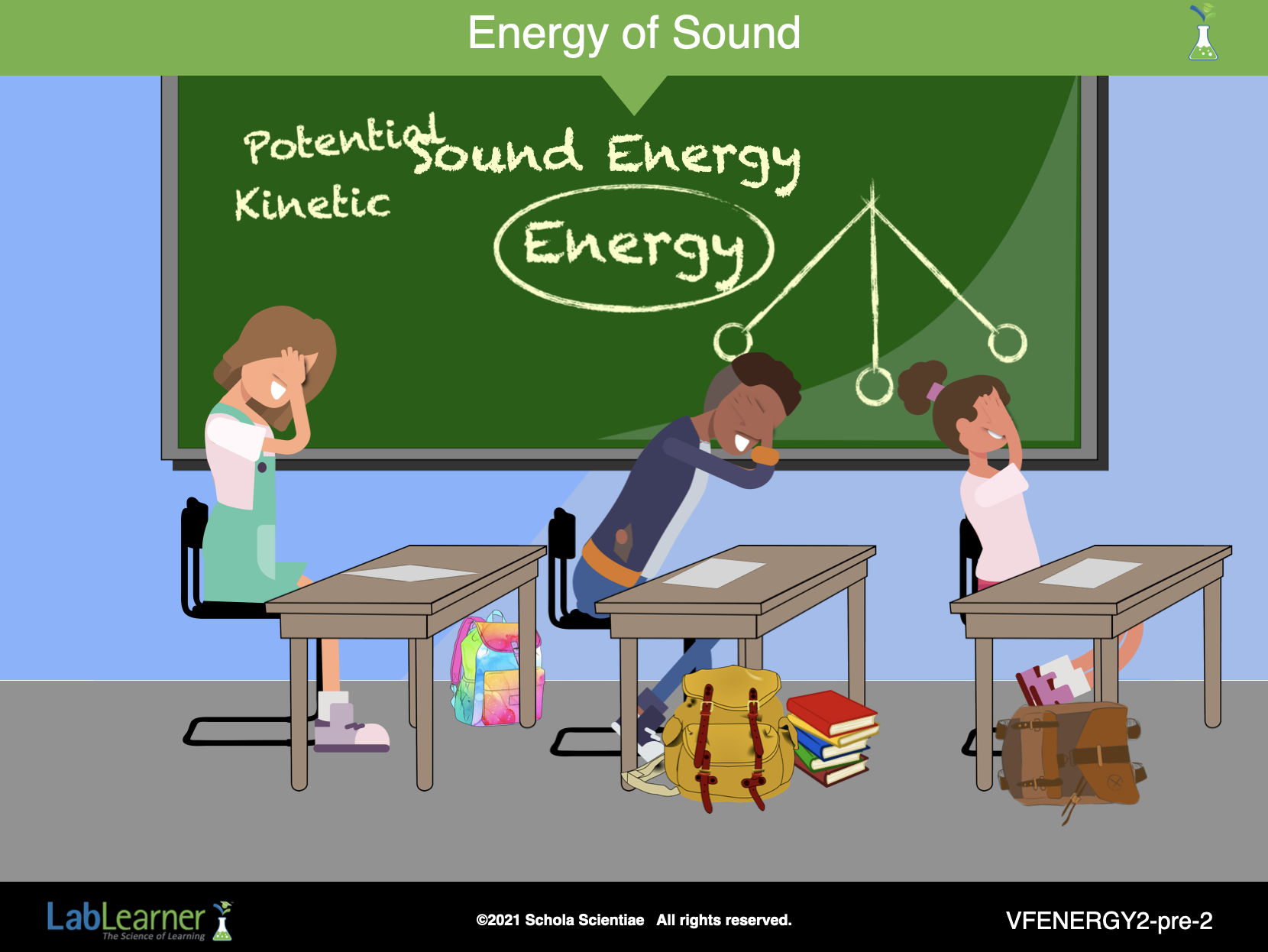
Begin the Investigation by engaging students in a listening activity as a method of introducing students to the relationship between sound energy and vibrations.
1. Direct students to close their eyes and sit very still in their seats without talking.
2. Tell students they will remain completely quiet in this fashion until you direct them to open their eyes.
3. Direct students to listen carefully to their surroundings for two minutes.
4. At the end of two minutes, direct them to write down all the sounds they heard during the time period in Problem 1 of their Student Data Record. Student answers will vary. Possible sounds include students or teachers walking and/or talking in the hallway, someone clearing their throat, doors closing, someone coughing or sneezing, papers or clothing rustling, loudspeaker announcements, feet shuffling, sirens or vehicles passing by outside.
5. Repeat the activity, allowing students to record any additional sounds they may hear.
6. Encourage students to share the sounds that they heard with the rest of the class.
Continue this portion of the Investigation by discussing the sounds that students heard during the listening activity as a method of determining students’ understanding that a sound is a form of energy.
Ask students: Do you think any of the sounds you heard contained energy? Student answers will vary.
Remind students that they discussed different forms of energy during Investigation One.
Ask students: Which form of energy do you think was in the sounds you heard? Student answers may vary. Students should indicate that the sounds contained sound energy.
______________________________________________
SLIDE VFENERGY2-pre-3
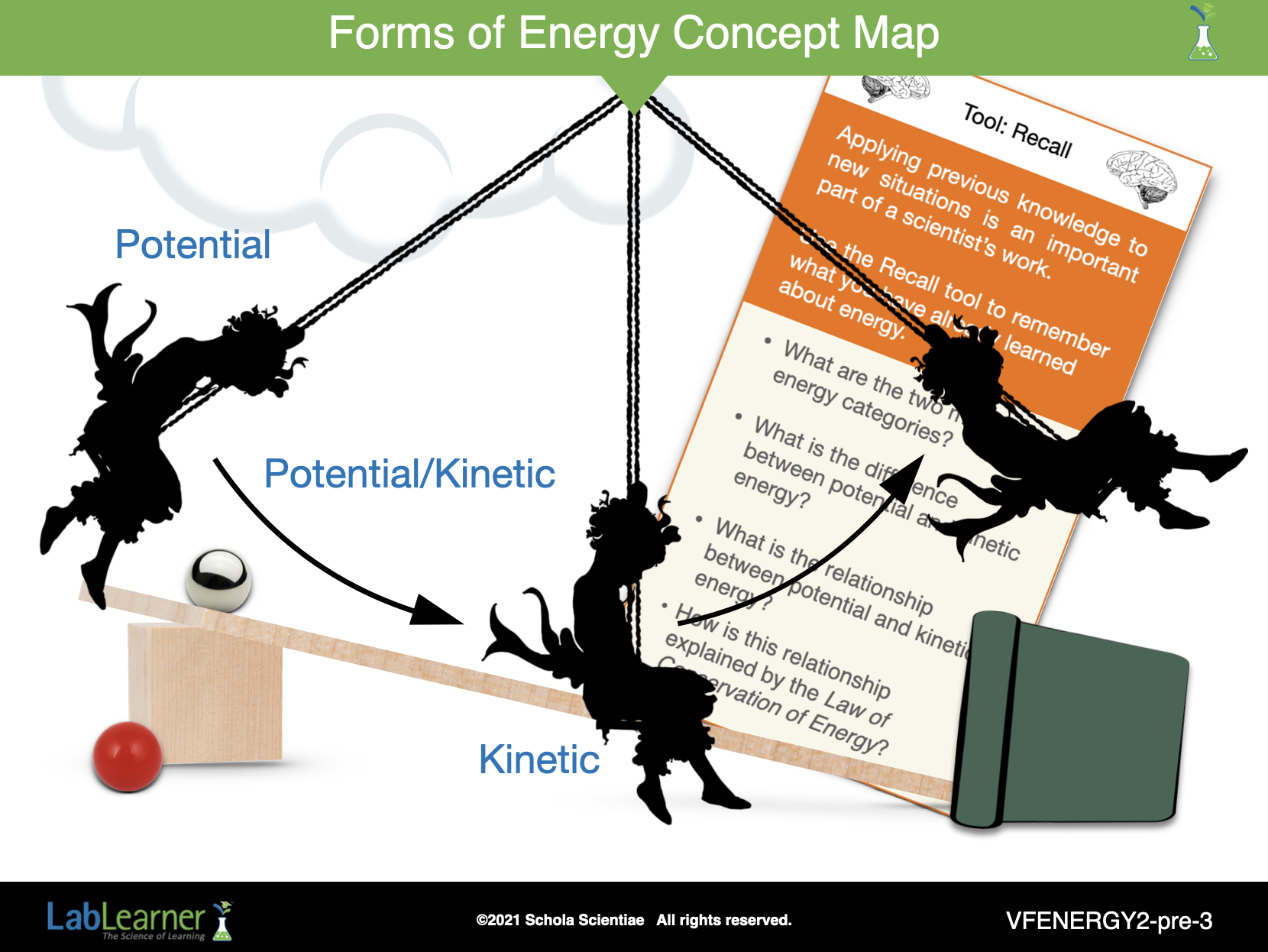
Applying previous knowledge to new situations is an important part of a scientist’s work. Encourage students to use the Recall tool to remember what they have already learned about energy.
Ask students: What are the two major categories of energy? Potential and kinetic energy.
Ask students: What is the difference between potential and kinetic energy? Potential energy is stored energy. Kinetic energy is the energy of motion. Potential energy is inactive energy, while kinetic energy is active energy.
Ask students: What is the relationship between potential and kinetic energy? Potential and kinetic energy have an inverse relationship, which means they are opposites. Together, potential and kinetic energy make up the total mechanical energy of an object. This relationship can be represented by the equation:
TME = PE + KE
This equation shows that because the total mechanical energy (TME) of an object remains the same, its kinetic energy (KE) increases as its potential energy (PE) decreases. Likewise, as the kinetic energy decreases, the potential energy of the object increases. This represents an inverse relationship. We would say that the PE and KE of an object are “inversely related”.
Ask students: How is this relationship explained by the Law of Conservation of Energy? Student answers may vary. The relationship between potential and kinetic energy is explained by the Law of Conservation of Energy because the law states that energy cannot be created or destroyed, but changes form. Since TME must equal the sum of an object’s potential and kinetic energy, the object’s kinetic energy must decrease by the same amount as potential energy increases, or increase by the same amount as potential energy decreases.
______________________________________________
SLIDE VFENERGY2-pre-4
Continue the discussion by assisting students to understand the nature of sound energy in relation to potential and kinetic energy.
Ask students: Is sound energy potential energy or kinetic energy? Why? Student answers will vary.
The following activity is designed to introduce students to the relationship between sound energy and vibrations:
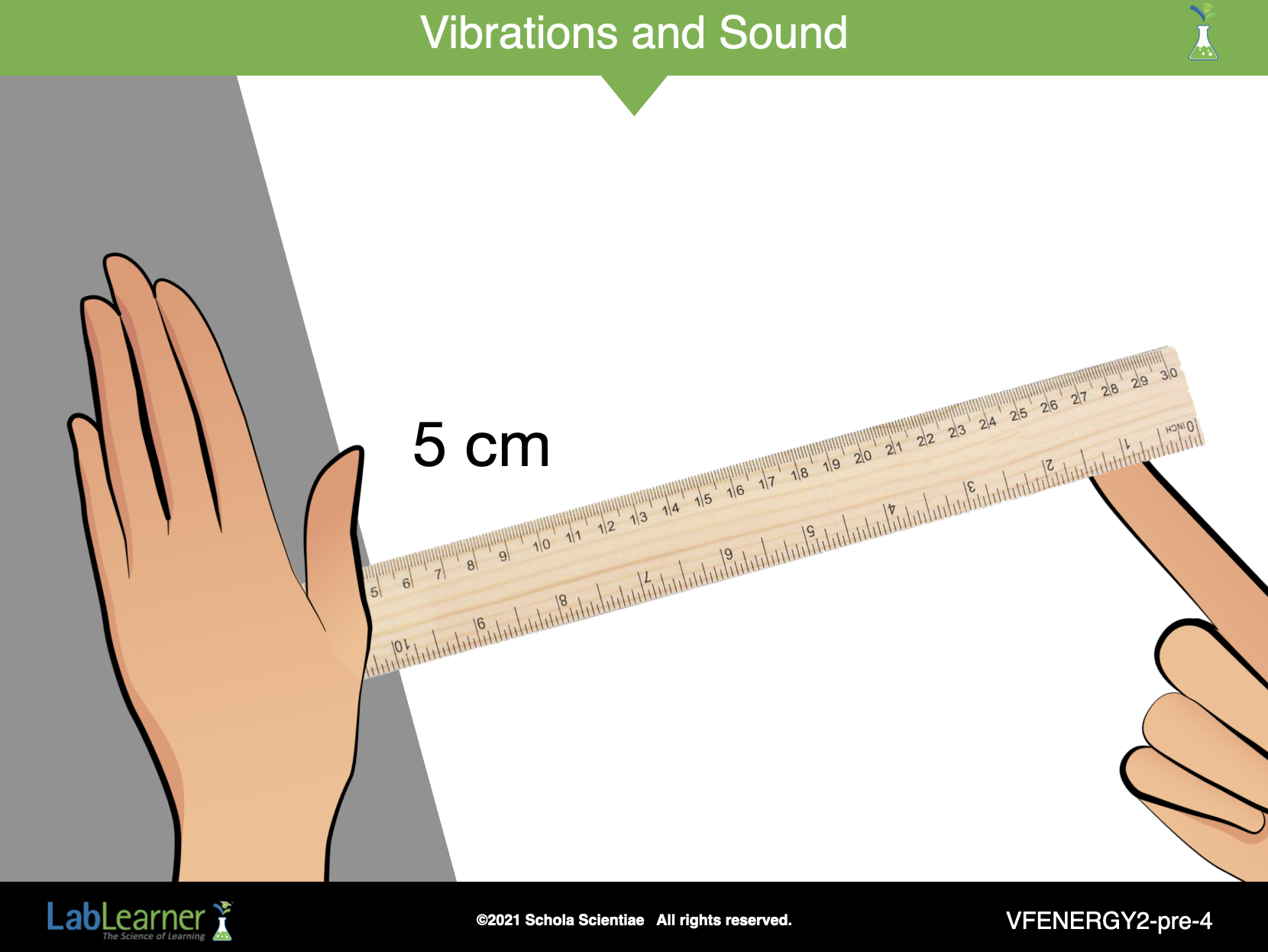
1. Direct students to place their rulers on the edge of their desks so that the 0 cm mark is pointing toward the center of the desk and the 5 cm mark is lined up with the edge of the desk. The remainder of the ruler should extend over the edge (see slide for illustration).
2. Ask students to hold the 0 end of the ruler in place with one hand.
3. Direct students to use the extended forefinger of the free hand to pluck the ruler gently as shown in the slide.
Ask students: What happened when you plucked the ruler?
Direct students’ attention to their Scientist’s Glossary.
Ask students: Do you see a term in your Scientist’s Glossary that describes the motion of the ruler? Vibration describes the motion of the ruler.
“Vibration: A back and forth motion.”
______________________________________________
SLIDE VFENERGY2-pre-5
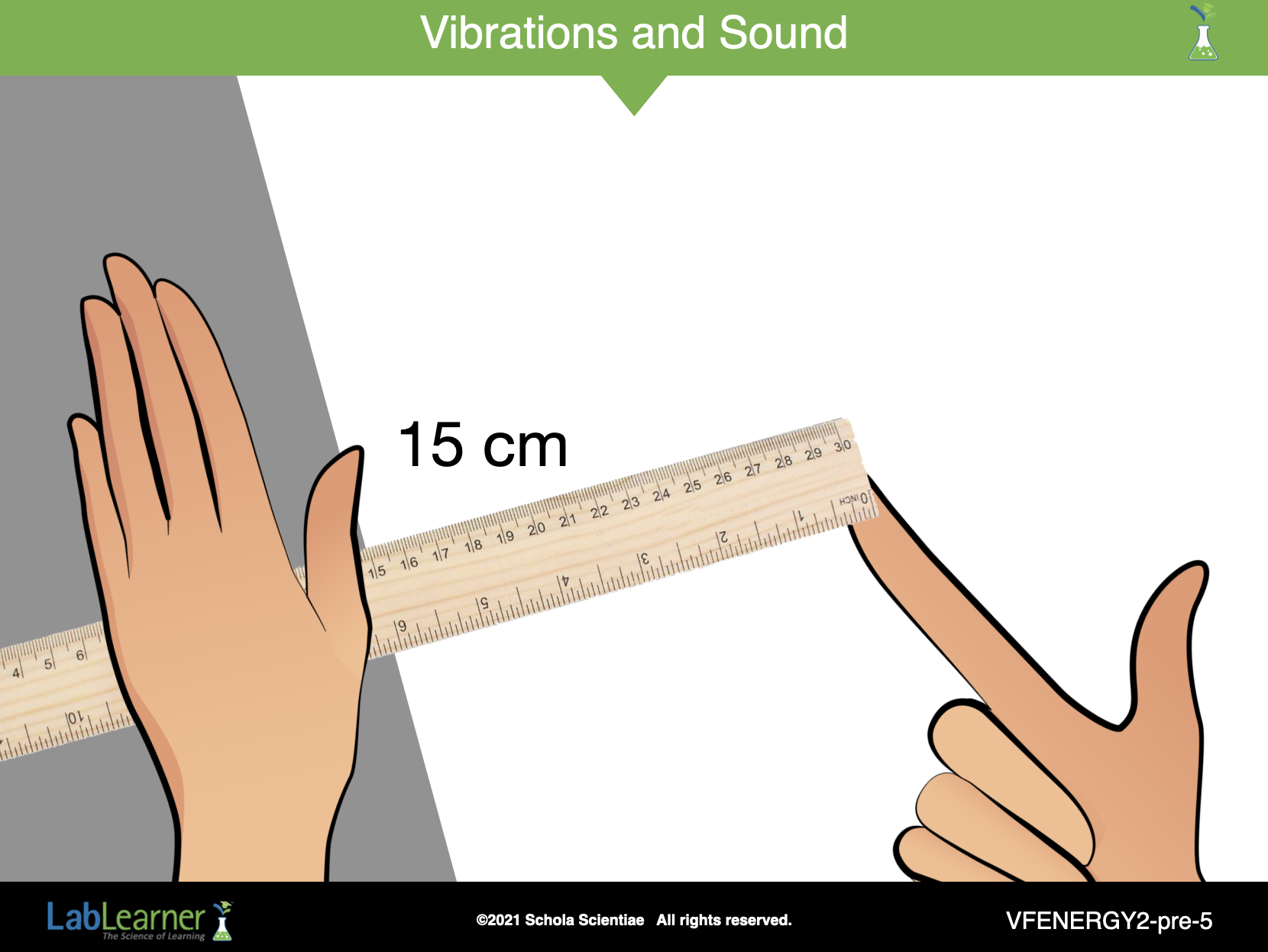
1. Direct students to slide the ruler so that the 15 cm mark is on the edge of the table.
2. Ask students to pluck the ruler again and watch the motions of the ruler. If desired, encourage students to repeat with the ruler at the 5 cm mark again.
Ask students: Did you notice any difference in how fast the ruler vibrated between the two positions? Student answers may vary. However, students should indicate that the ruler appeared to vibrate faster when the end that was plucked was short.
Below is a video that shows a ruler vibrating after being plucked. It is in slow motion so it is easy to see the motion.

Ask students: Which term in your Scientist’s Glossary refers to the speed of vibrations? Do you think frequency is a property of sound?
“Frequency: The number of times the molecules of matter
vibrate within a specified interval of time.”
Therefore, frequency describes how fast the ruler vibrates. Students may or may not indicate that frequency is a property.
However, students should notice that the sound changed as the frequency changed. Guide students to an understanding that because the sound changed with the change in frequency, this indicates that frequency is a property of sound energy.
______________________________________________
SLIDE VFENERGY2-pre-6
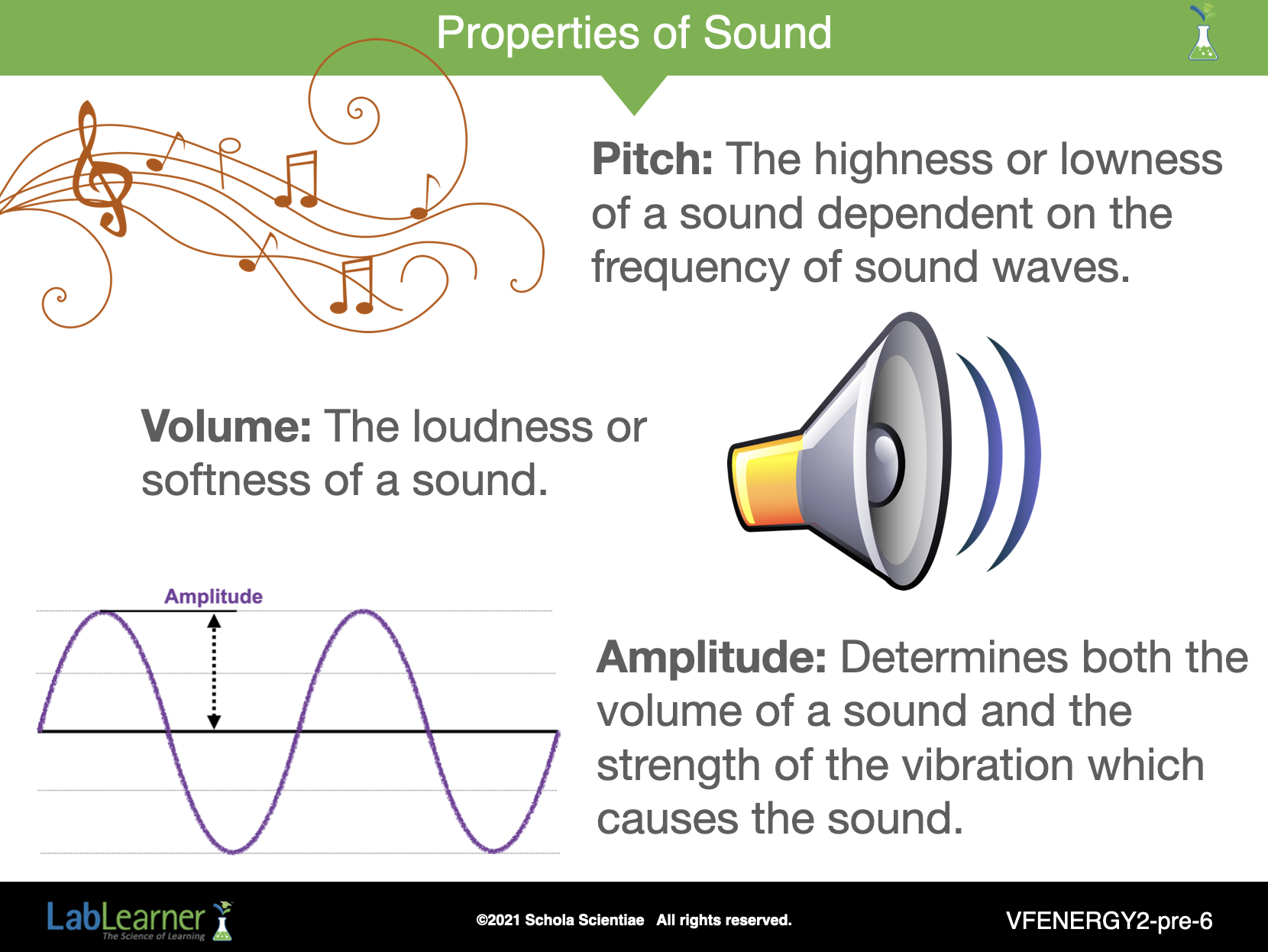
Ask students: Which other terms in your Scientist’s Glossary do you think are properties of sound? Why? The terms pitch, volume, and amplitude are also properties of sound. Amplitude is the height of a sound wave. Pitch varies with frequency. Volume varies with amplitude.
Explain that changes in frequency can produce a change in pitch or the highness or lowness of sounds. Changes in amplitude can produce a change in the volume of sounds.
Remind students that sound is generated by vibrations.
______________________________________________
SLIDE VFENERGY2-pre-7
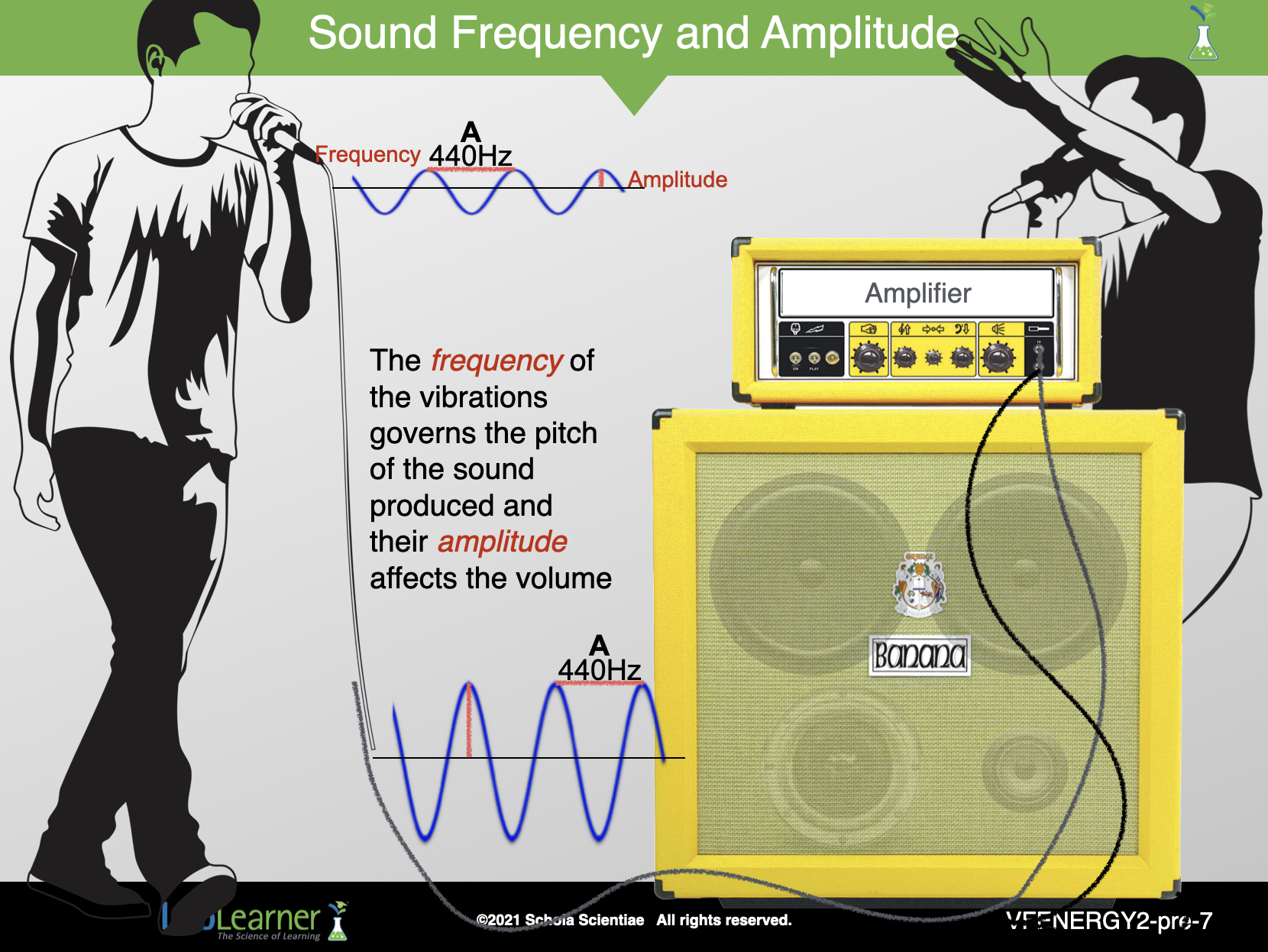
This slide simply illustrates how important frequency and amplitude are in music. Notice how amplifiers are used to increase the amplitude of sound.
The upper sound wave (next to the singer on the left) in this slide shows the amplitude of the sound produced by the singer. The lower sound wave (next to the amplifier) shows how the amplitude of the singer’s voice is increased (amplified) by the amplifier.
Anyone that has plugged into an amplifier or felt the vibrations caused by volume and amplitude from speakers should understand that sound is kinetic energy, the energy of movement!
______________________________________________
SLIDE VFENERGY2-pre-8
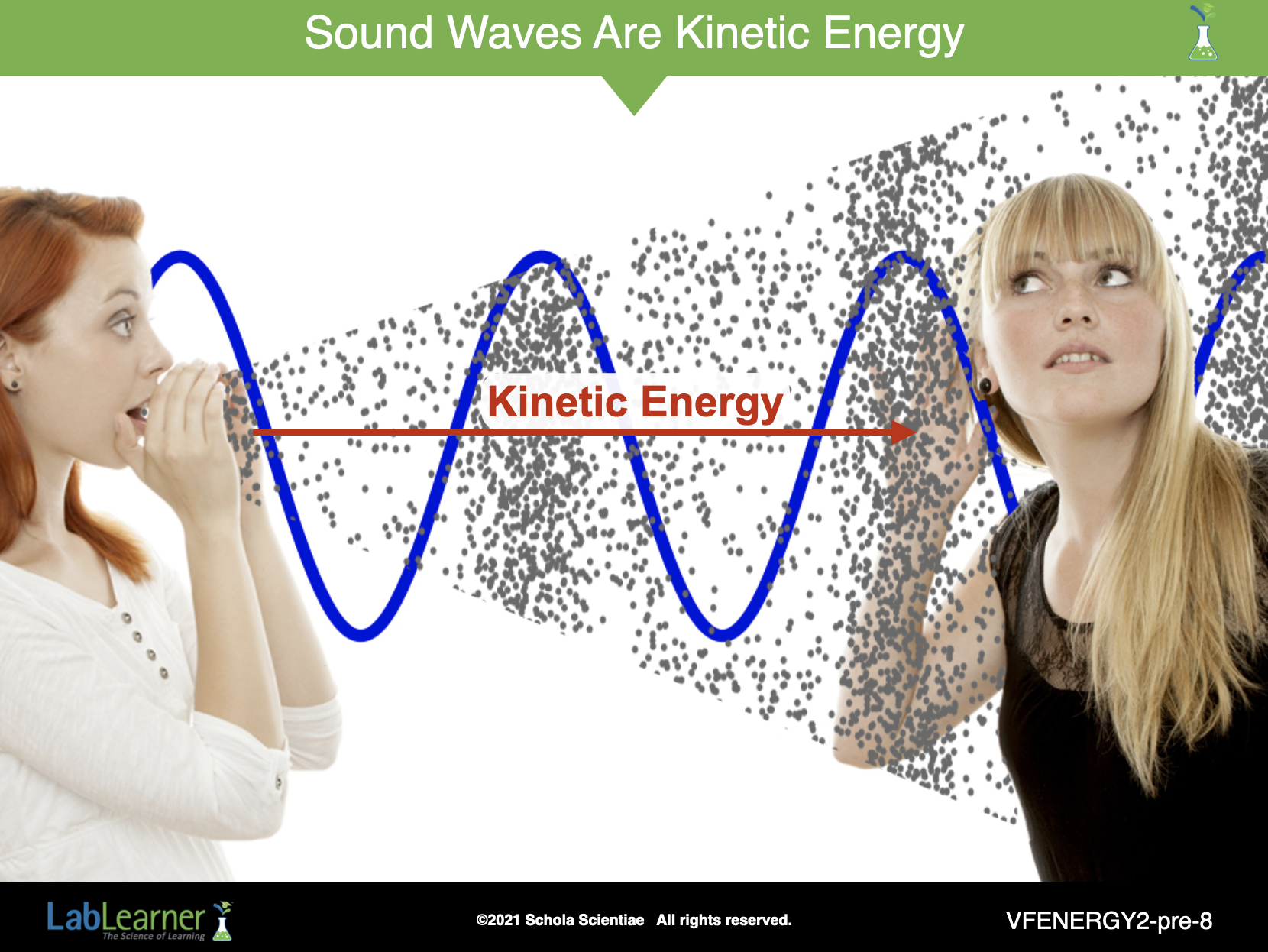
This slide focuses on the concept that sound energy really is kinetic energy. The energy emitted from the woman on the left’s vocal cords vibrates air molecules that travel from one location to another.
The woman on the right is able to detect the kinetic energy of the vibrating air molecules and hear the sound that her friend is making.
Ask students: How does sound travel? Is there a term in your Scientist’s Glossary that suggests what form it travels in? Student answers may vary. Sound travels in the form of waves.
“Sound waves: A specific ordered movement of molecules in solids, liquids, or gases. Sound waves are categorized as longitudinal waves and are the compression and spreading apart of molecules in solids, liquids, and gases. Sound waves are caused by vibrations.”
Ask students: What do you know about sound that tells you sound can be measured? Student answers will vary. Speed and height of a sound wave are quantities that can be measured.
______________________________________________
SLIDE VFENERGY2-pre-9
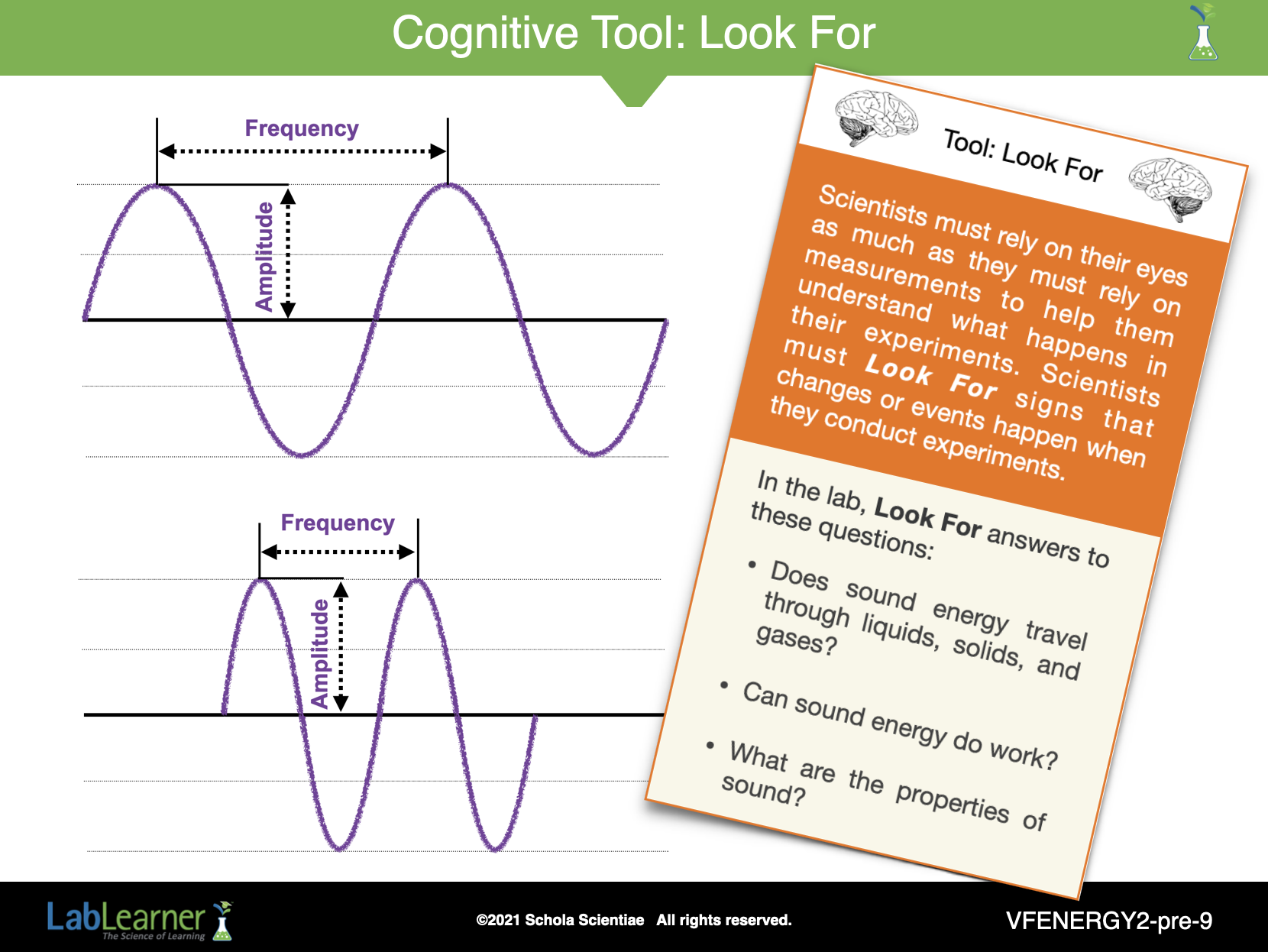
Ask students: How does sound travel? Is there a term in your Scientist’s Glossary that suggests what form it travels in? Student answers may vary. Sound travels in the form of waves.
Ask students: What do you know about sound that tells you sound can be measured? Student answers will vary. Speed and height of a sound wave are quantities that can be measured.
Guide students to the understanding that because frequency indicates speed, it can be measured. Frequency is measured in hertz. Amplitude determines the volume. Amplitude is the height of a sound wave and is measured in decibels.
Conclude this portion of the investigation by explaining to students that they will perform experiments in the lab to explore how sound energy moves and acts. Tell students that they
will use their results to answer the following questions about sound energy:
- Does sound energy travel through liquids, solids, and gases?
- Can sound energy do work?
- What are the properties of sound?
______________________________________________
Student Video
Watch the Investigation 2 Student Video after the Share It presentation to prepare for the PreLab.