Teacher Portal:
Forms of Energy
Investigation 2 – PostLab

PRINT IT
Use your browser to download a printable PDF as help during the slide presentation and to make additional notes. In your browser, go to File > Print and then choose to save as PDF.
NAVIGATE IT
Once the slide presentation is launched
- use your left and right arrows to advance or go back in the slide presentation, and
- hover your mouse over the left edge of the presentation to get a view of the thumbnails for all the slides so that you can quickly move anywhere in the presentation.
- Click HERE to launch the slide presentation for the CELL.
SHARE IT

SLIDE VFENERGY2-post-1
This Investigation is devoted to the study of sound energy. It will become clear to students during the course of the Investigation that sound energy is kinetic energy. In the case of sound, the movement that is characteristic of kinetic energy is in the form of sound waves.
______________________________________________

SLIDE VFENERGY2-post-2
Begin this part of the Investigation by encouraging students to review the experiments they performed in the lab. The following questions may be useful in prompting student discussion:
Ask students: What signs did you observe that told you sound energy could be seen? Students may indicate that they were able to see the tuning fork vibrate after it was activated. Students observed water move when the activated tuning fork was placed in the water. Students also observed the ping-pong ball bounce off the activated tuning fork because of the tuning fork’s vibrations. In addition, students also observed the pepper move in response to the movement of air caused by the tuning fork vibrations.
Ask students: Were you able to see amplitude? Where? Students observed amplitude when they plucked the rubber band. Students may suggest that this was similar to the movement of the ruler in the PreLab activity. When they plucked the rubber band with greater force, they observed that the rubber band had a wider path of travel than when it was plucked gently.
Ask students: Was sound energy able to move objects? Students should indicate that the sound energy is able to move objects because the vibrations of the tuning fork made the ping-pong ball bounce.
Ask students: Was sound energy able to move air? Students should indicate that the sound energy is able to move air because they observed pepper move when the activated tuning fork was held above the pepper, even though the tuning fork did not touch the pepper.
Ask students: Could sound energy be felt? Students should indicate that sound energy could be felt because they could feel the vibrations of the tuning fork when they held the tines in their hand.
Ask students: What is pitch? How did you demonstrate it? Students should indicate that pitch is the highness or lowness of a sound and that they demonstrated it by tapping beakers with different amounts of water. Each beaker produced the same volume of sound but at different pitches.
______________________________________________
SLIDE VFENERGY2-post-3
Begin the analysis of the experiment by directing students to the first two questions they wanted to investigate in their lab.
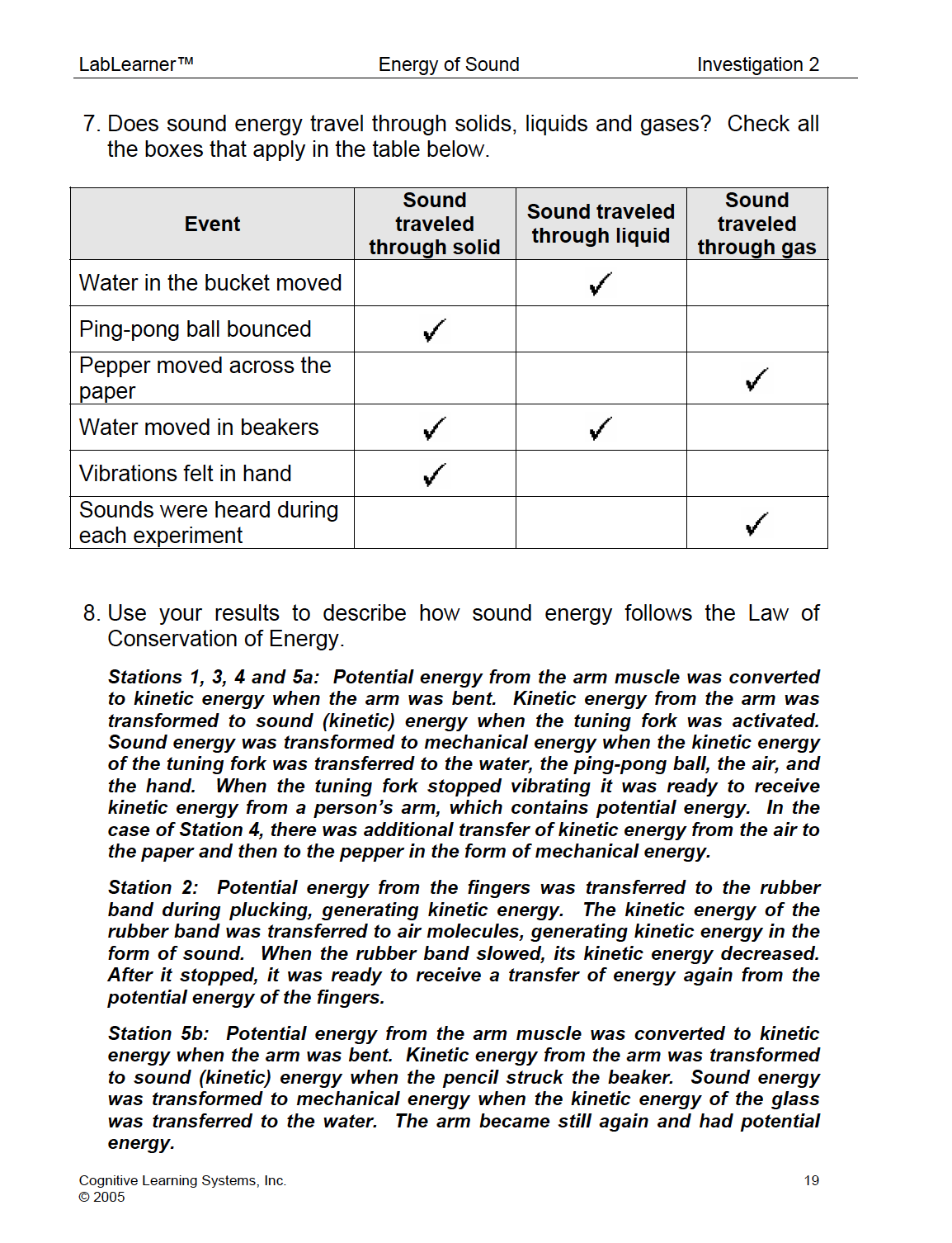
Direct students’ attention to Problem 7 in their Student Data Record.
Ask students: Does sound energy travel through solids, liquids, and gases? Student answers may vary.
Sound energy traveled through a solid when the ping-pong ball bounced against the tuning fork because the tuning fork was in contact with the ping-pong ball. Sound energy also traveled through a solid when the beakers were tapped with a pencil because the energy had to move through the glass to the water to make the water move as well as creating the sound that was heard.
Sound energy traveled through a liquid when the water moved in the bucket and the beakers. Sound energy moved through a gas when the pepper moved while the activated tuning fork was held over the pepper but did not touch it.
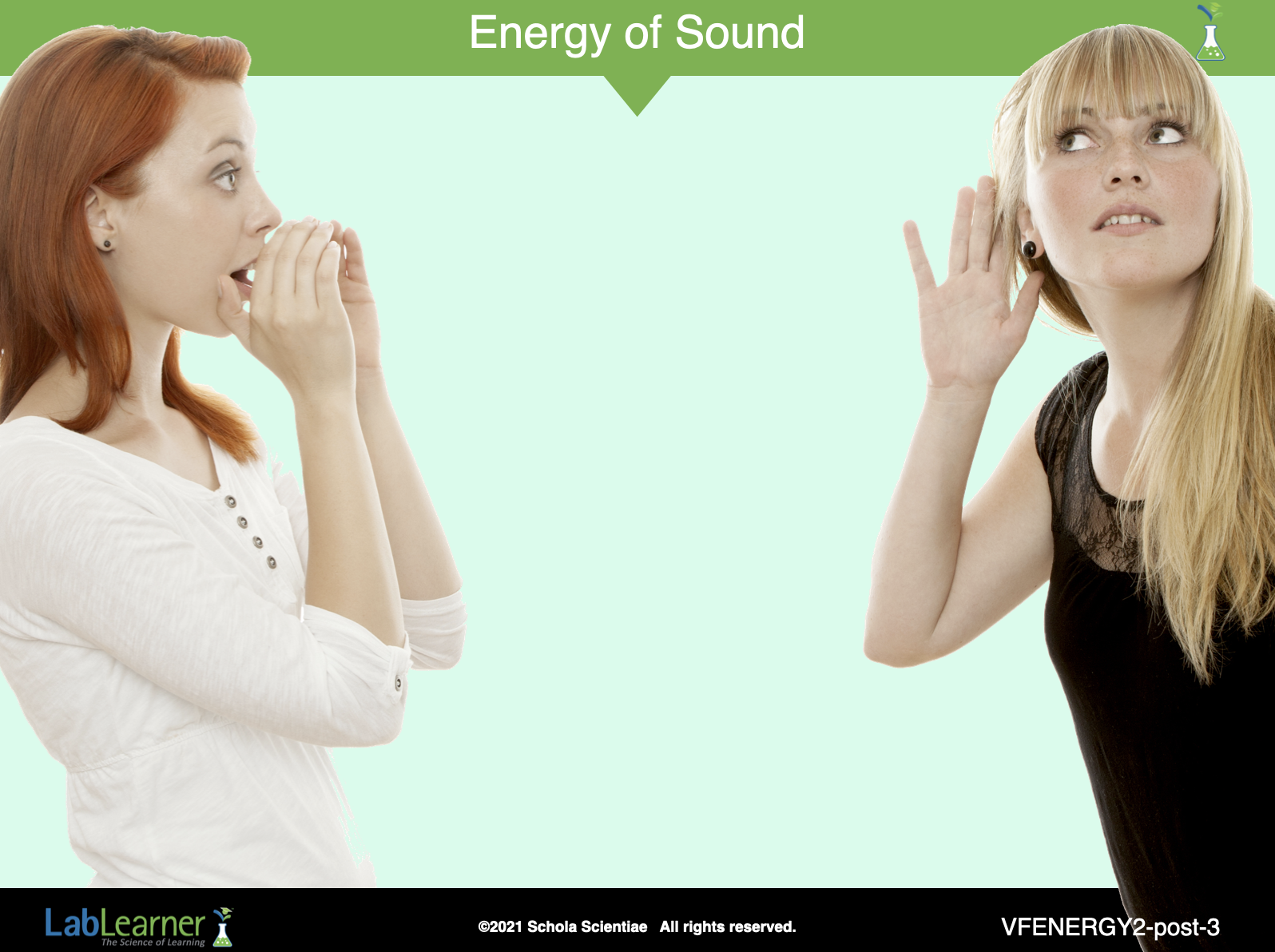
Sound energy also traveled through a gas when sounds were heard, because the sounds had to travel through air (a gas) to students’ ears.
Direct students to record their answers as each item is discussed.
______________________________________________
SLIDE VFENERGY2-post-4
Ask students: Can sound energy do work? Student answers may vary.
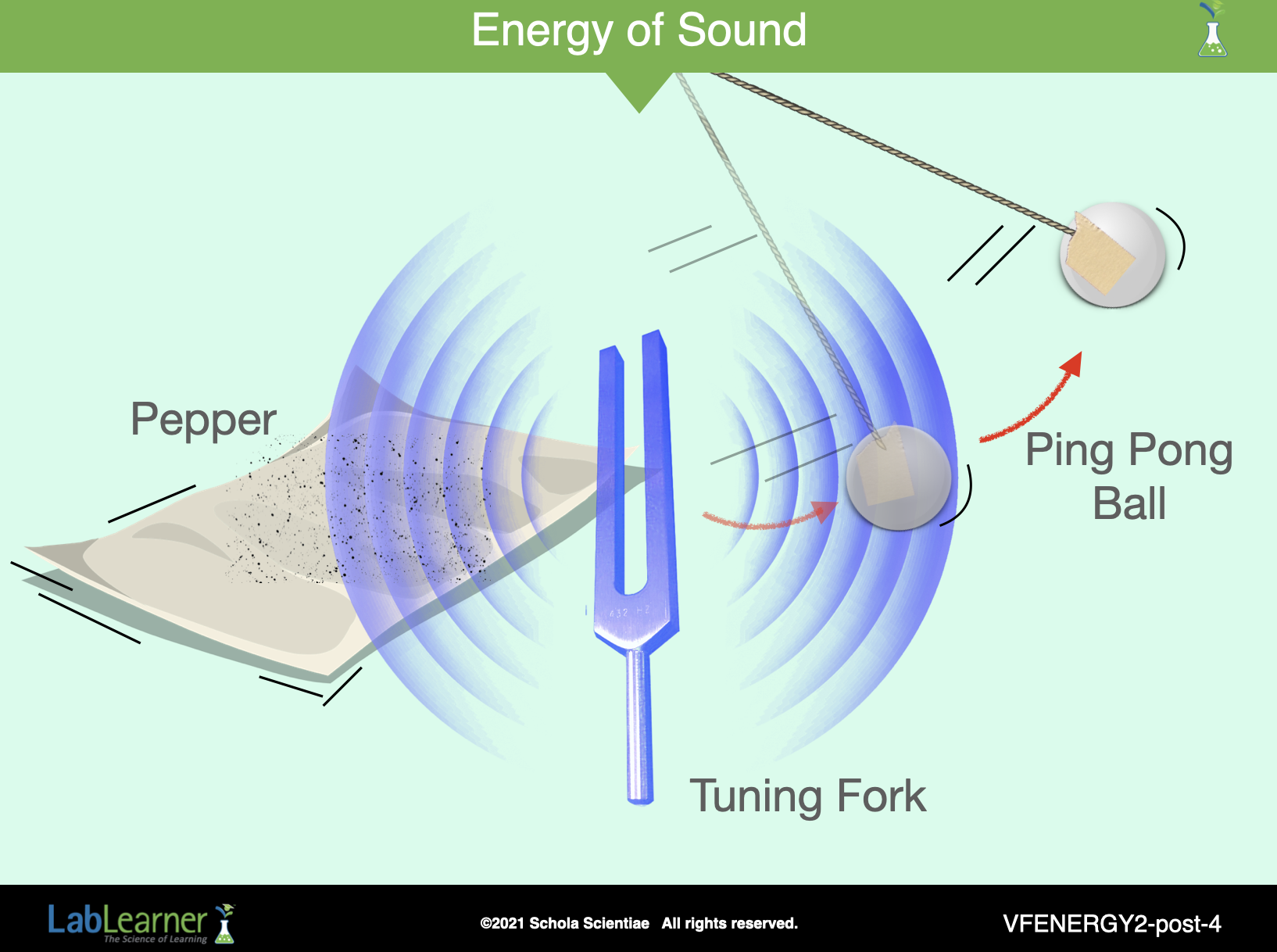
Ask students: What events did you observe that suggest sound energy might be able to do work? Based on their experience with mechanical energy in Investigation One, students should observe that when energy causes movement over a distance, it has performed work. Students should indicate that when the water moved and the ping-pong ball moved, sound energy was performing work. When the pepper moved, sound energy performed work on the air molecules, causing them to perform work on the folded paper. The paper moved, causing the pepper grains to bounce.
NOTE: While it may be tempting to accept that the air was the direct cause of the pepper’s movement, the type of movement (bouncing) of the pepper grains indicates that the movement of the paper caused the pepper to move. Had the pepper been placed directly on the tabletop or a flat piece of paper, it would have been difficult to see the effect of air moving the pepper. By placing the pepper on the raised paper, the effect of the movement of air by the sound waves was magnified, making the movement of the pepper more obvious to students. This allowed students to see the effects of sound waves on air more easily.
______________________________________________

SLIDE VFENERGY2-post-5
The remaining analysis is devoted to promoting students’ understanding of sound energy as kinetic energy.
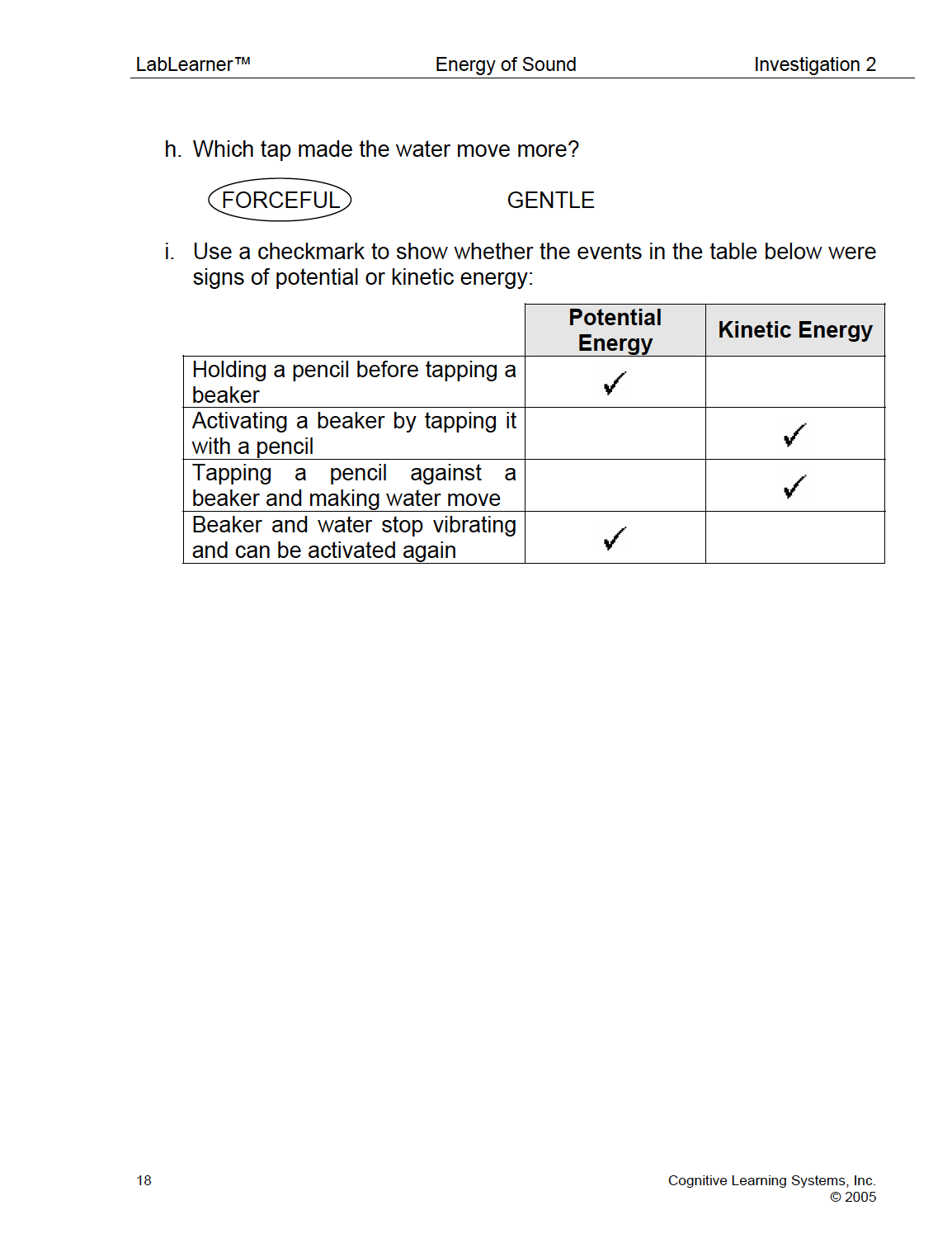
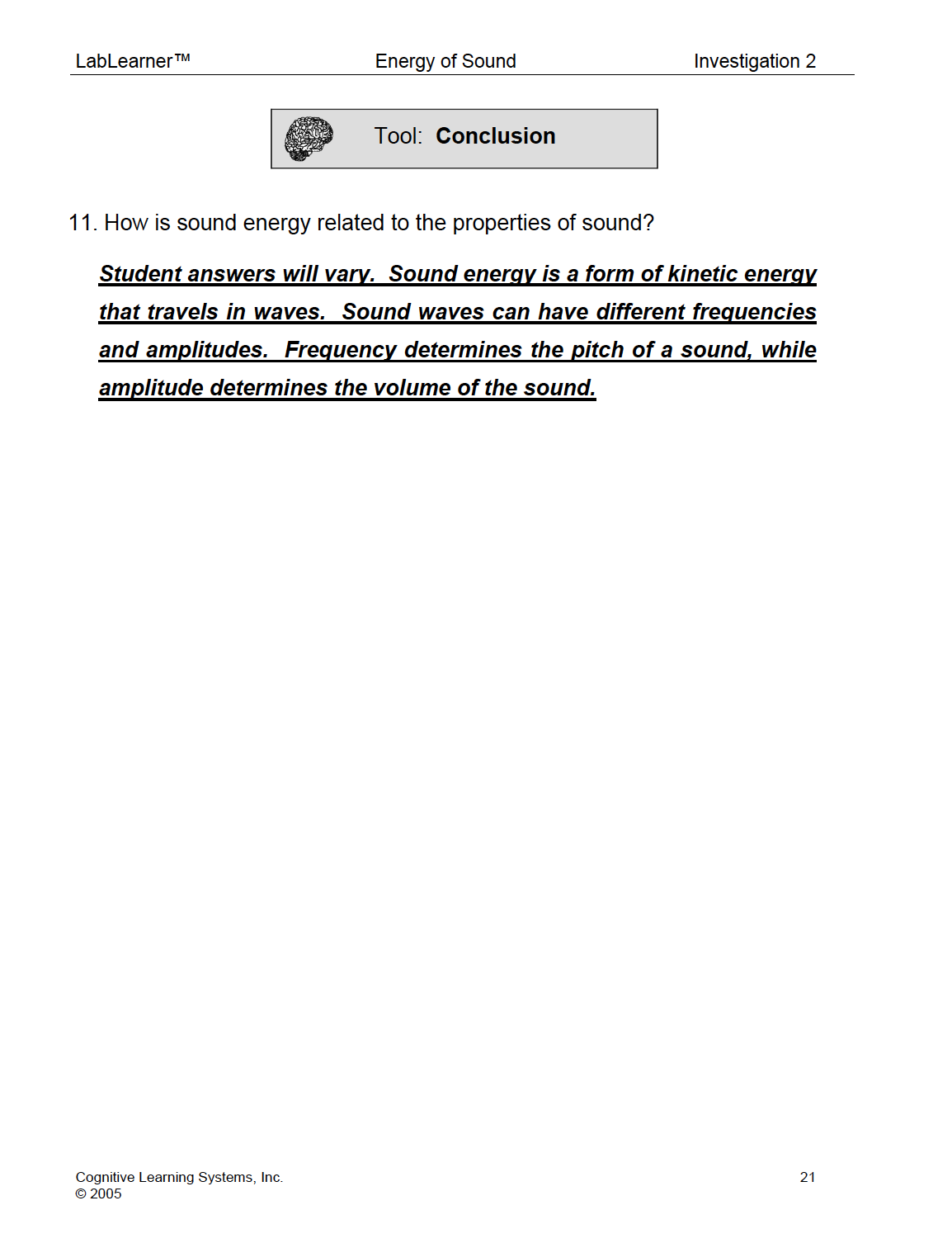
Ask students: Is sound energy potential energy or kinetic energy? Student answers may vary. Based on their results, students should indicate that sound energy is kinetic energy.
Ask students: Does sound energy follow the Law of Conservation of Energy?
Divide students into their cooperative groups from Lab and assign each group a station from the Lab to analyze.
Direct students’ attention to Problem 8 in their Student Data Record. Explain that they will use their results from the assigned station to answer this question.
______________________________________________
SLIDE VFENERGY2-post-6
To assist students in understanding the flow and conversion of energy in their experiments, ask the following questions before beginning the group discussions:
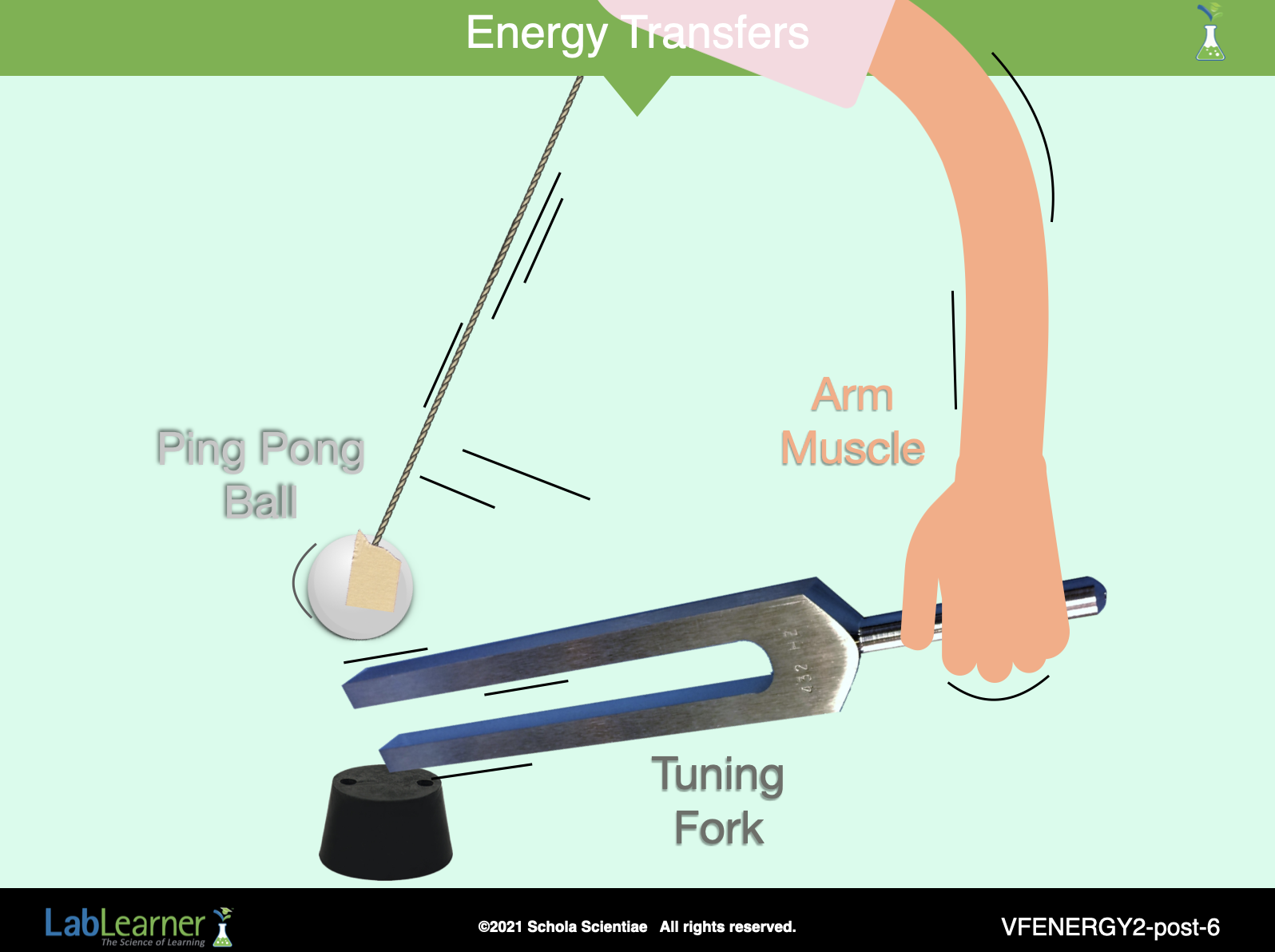
Ask students: Did the tuning fork have energy before it was activated? The tuning fork did not have energy before it was activated.
Ask students: Where did the energy in the activated tuning fork come from? The energy came from the muscles in the arm used to activate the tuning fork.
Ask students: What kind of energy was in your muscles? The energy in the muscles was potential energy.
Ask students: How was it transformed into sound energy? The potential energy was transformed into kinetic energy when the muscle contracted to strike the tuning fork against the rubber stopper. This transferred the kinetic energy of the arm in motion to the tuning fork in the form of sound energy.
Provide approximately 5 to 10 minutes for group discussion.
Encourage groups to share their results with the rest of the class. In the process of class discussion, promote students’ understanding of the different energy conversions observed by asking each group to highlight all conversions between sound and mechanical energy.
Students should indicate that sound energy was transformed to mechanical energy when the tuning fork made the water move in the bucket, the tuning fork made the ping pong ball move, the tuning fork made the air move the paper, and the tuning fork made the skin of the hand move.
In addition, mechanical energy from the pencil caused the beaker to vibrate, creating sound energy that was transformed to mechanical energy when the vibrations of the beakers in Station 5b made the water move.
______________________________________________
SLIDE VFENERGY2-post-7
Continue the analysis by focusing students’ attention on their observations of one property of sound: volume.
Remind students that sound can both cause vibrations and be caused by vibrations.
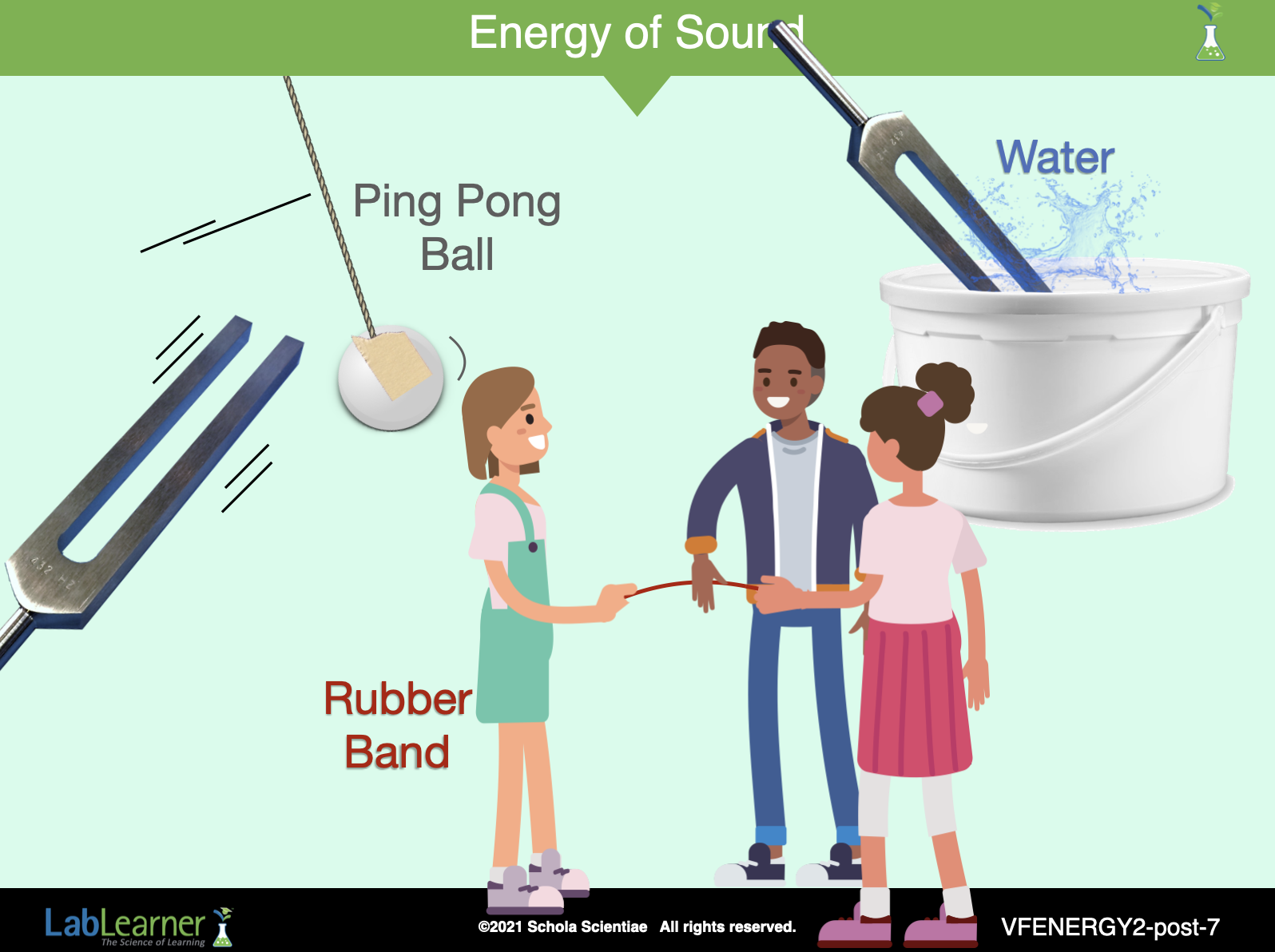
Ask students: Did you observe vibrations in your experiments? Where? Students should indicate that they observed vibrations in the movement of the water, the swing of the ping pong ball on the string, the movement of the tuning fork, the movement of the rubber band, and the movement of the pepper.
Ask students: Did you observe vibrations of different heights in any of your experiments? If so, where? Students observed vibrations of different heights during the rubber band experiment.
Ask students: How did the sound change when the vibrations got higher or bigger? The sound became louder.
______________________________________________
SLIDE VFENERGY2-post-8
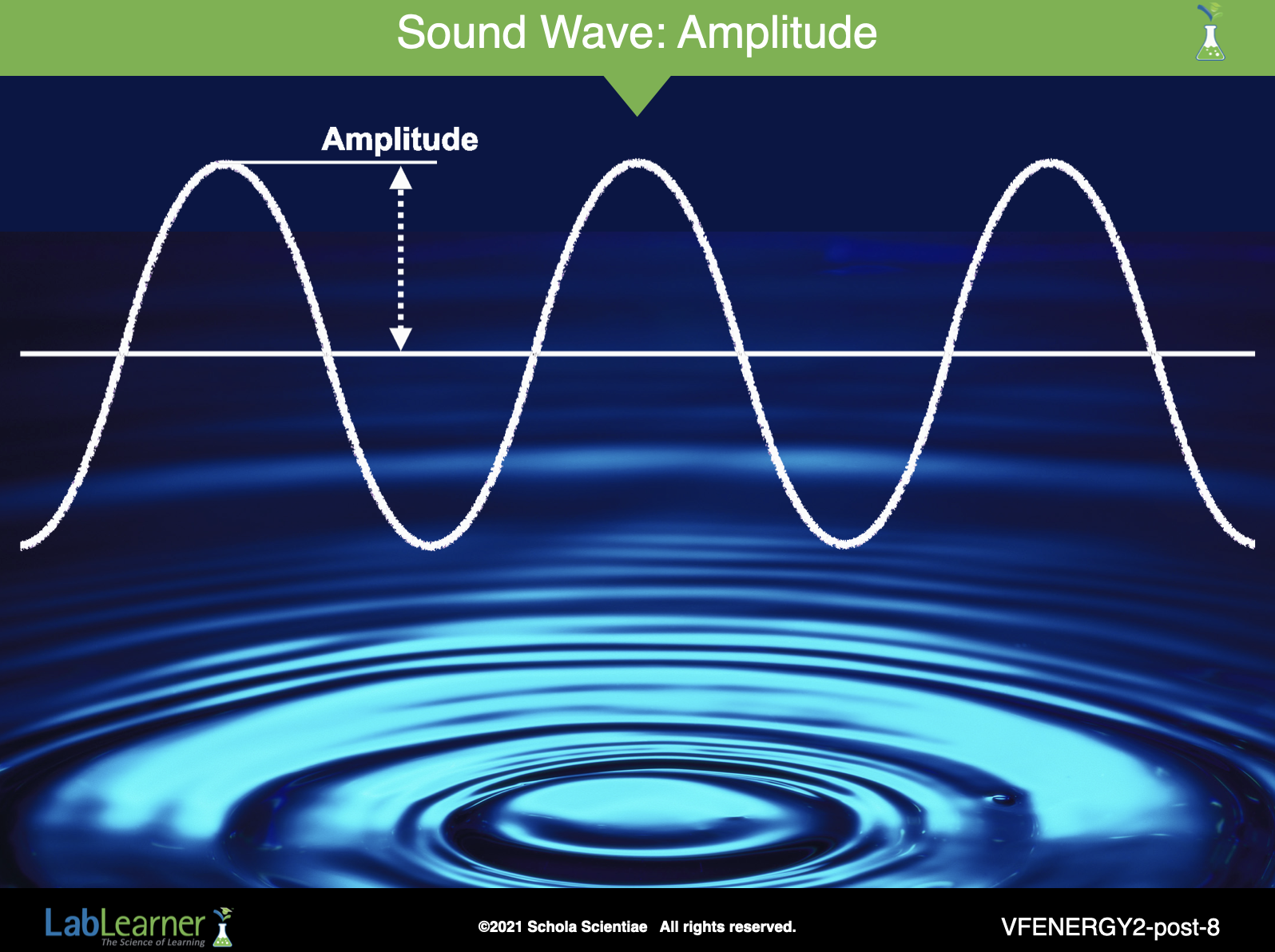
This slide shows a representation of a sound wave.
- Explain to students that the wavy line represents a sound wave.
- Point to the straight line in the center of the wave. Explain to students that this line represents the position of a molecule at rest.
- Point to the wavy line. Explain that each hump represents a vibration of the molecule in a different direction.
- Explain that even though the molecule represented by the diagram seems to move in only two directions, the vibrations actually occur in all directions from the molecule.
- Scientists use this type of drawing to make sound properties easier to understand.
- Explain to students that the distance between that line and the horizontal line that divides the wave in half is the amplitude, or height, of the wave.
Ask students: In your rubber band experiment at Station 2, when was the sound the loudest? When was it the softest? The sound was loudest when the amplitude of the rubber band was greatest. The sound was softest when the amplitude of the rubber band was smallest.
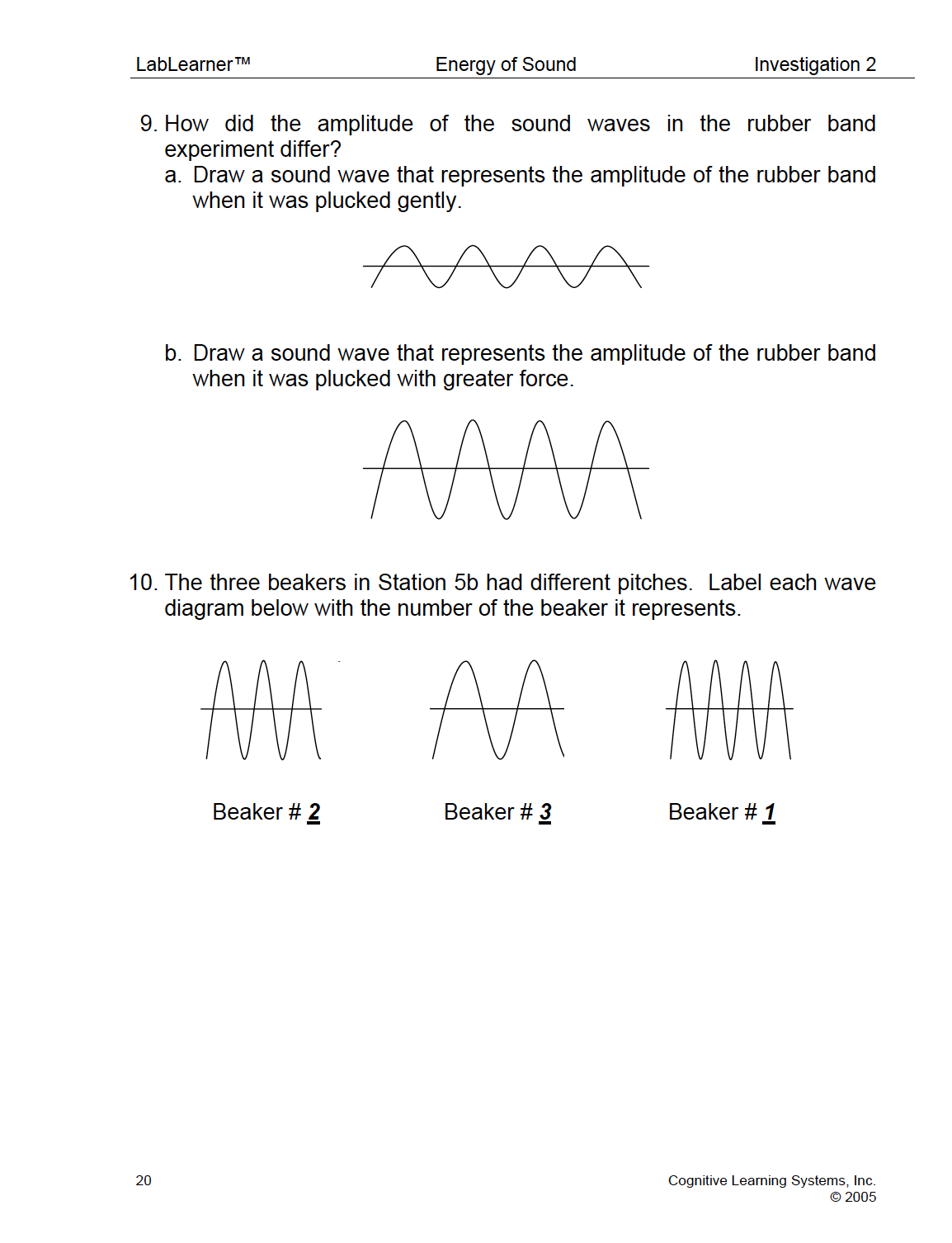
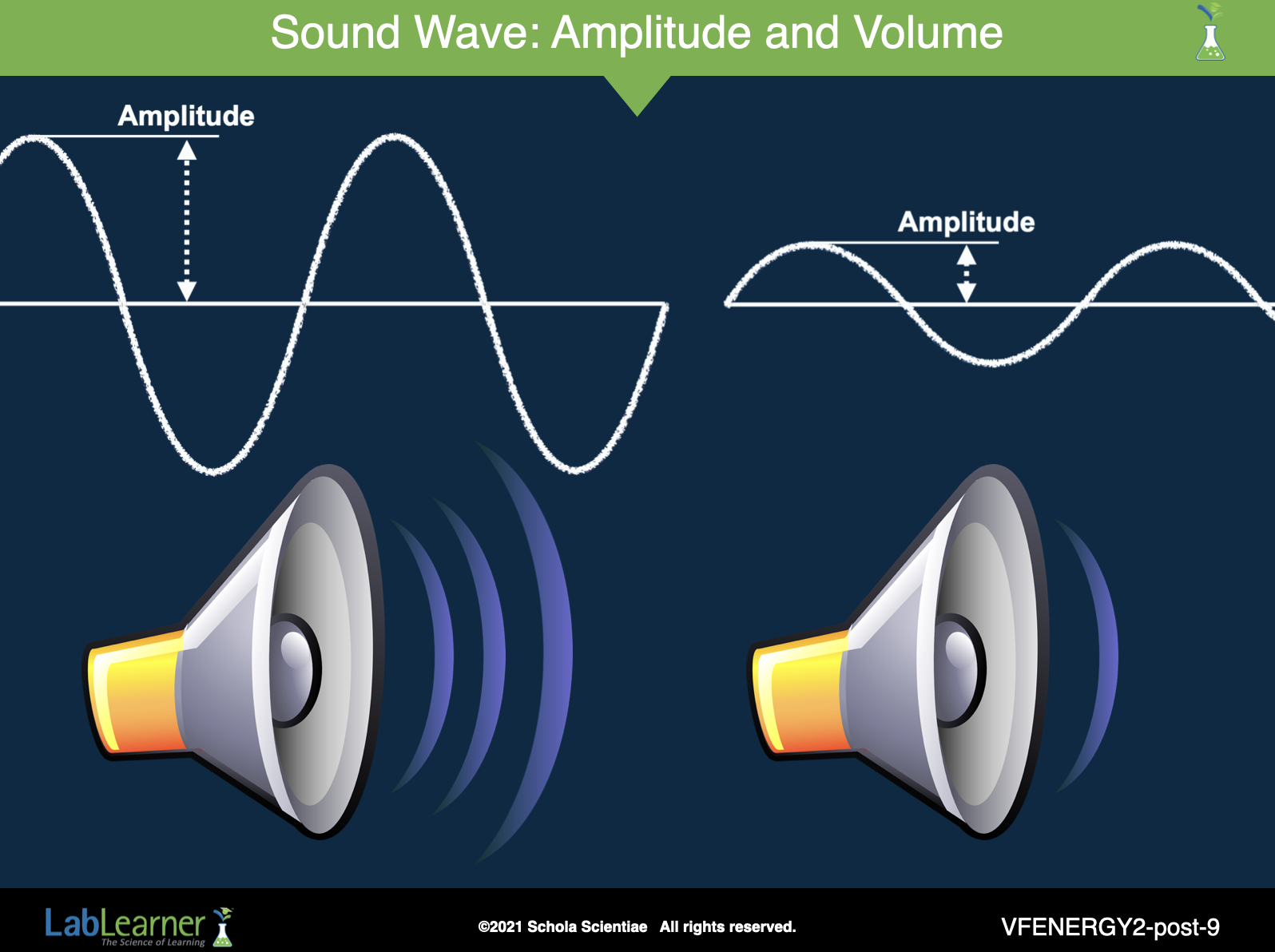
Direct students’ attention to Problem 9 in their Student Data Record. Instruct students to draw two sound waves representing the volume of the rubber band when it was plucked gently and when it was plucked with greater force. Remind students to label their diagrams.
______________________________________________
SLIDE VFENERGY2-post-9
Explain to students that their figures should look something like the ones on the screen. The diagram for the volume of the rubber band when it was plucked gently should look like the wave on the right.
The diagram for the volume when the rubber band was plucked with greater force should look like the wave on the left.
______________________________________________
SLIDE VFENERGY2-post-10
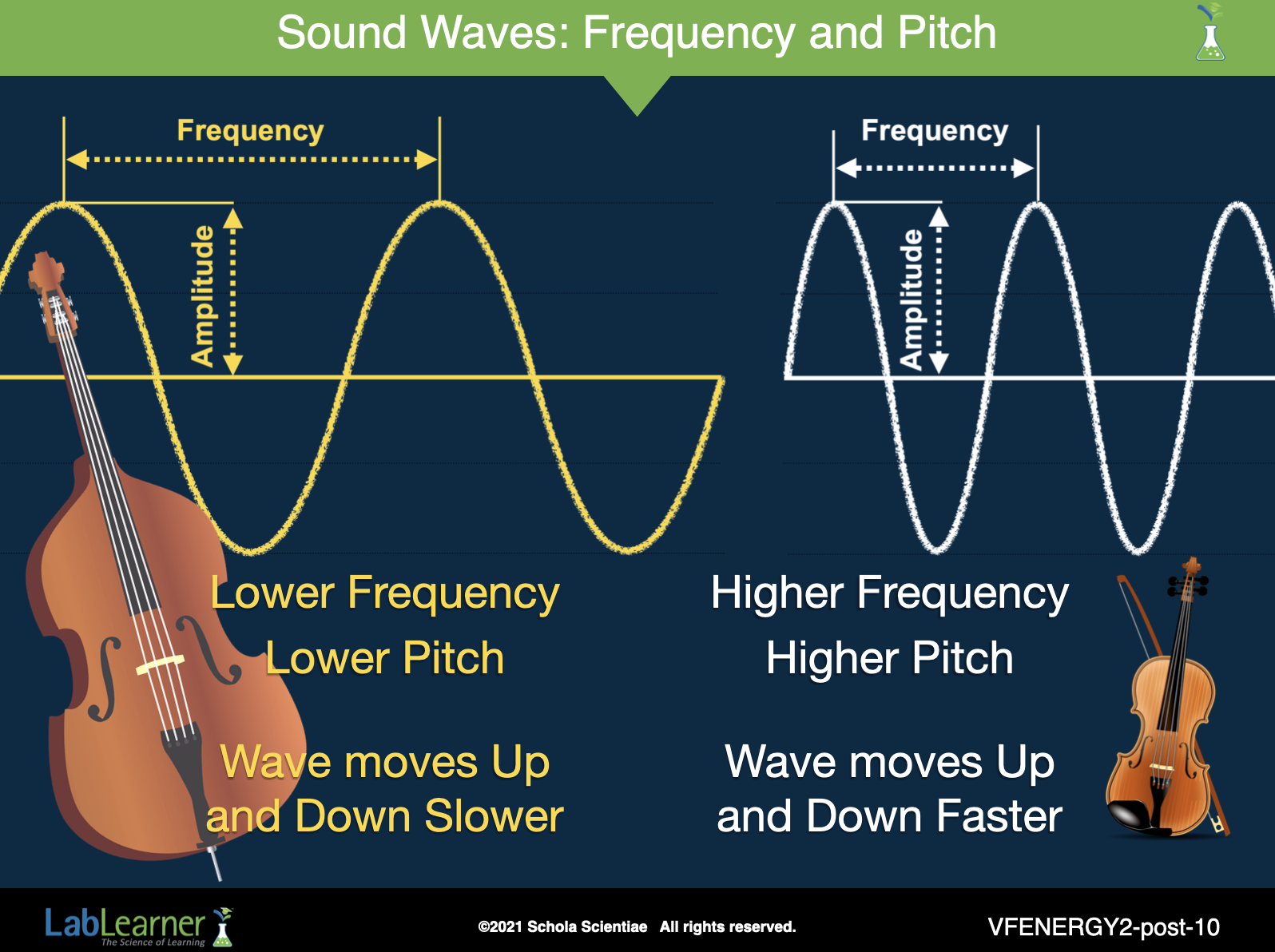
Now focus students’ attention on the property of pitch. Remind students that pitch is related to the frequency of a sound wave.
Ask students: How did we define frequency? Frequency is the number of times the molecules of matter vibrate within a specified period of time. If necessary, refer students to the Scientist’s Glossary in their Student Data Record.
Explain to students that on the sound wave diagram, the number of times the molecule vibrates back and forth represents the frequency of vibration.
Point to the sound waves on the slide. Explain that each wave represents the same amount of time.
Ask students: Which wave has a greater frequency, the one on the left or right? Why? The wave on the right has a greater (higher) frequency because it shows more vibrations than the wave on the left.
Tell students that changes in frequency relate to pitch. Sound waves with higher frequencies have higher pitches (like the wave on the right). Sound waves with lower frequencies have lower pitches (like the wave on the left).
Notice that certain instruments, like the double bass on the left, produces lower pitches (lower frequencies) while other instruments, like the violin on the right, produce higher pitches (higher frequencies). One of the main reasons for this difference in frequency and pitch is the length of the strings on the two instruments. The double bass strings are very long and produce slower vibrations and lower frequencies and pitches than the much shorter strings on the violin. The short violin strings vibrate very rapidly and produce very high frequencies.
Ask students: Referring to Station 5b ( the three beakers), when was pitch highest? When was pitch lowest? The sound from Beaker 1 had the highest pitch. The sound from Beaker 3 had the lowest pitch.
Ask students: When did you observe frequency change in your experiments? Frequency was observed in the beaker experiment.
Ask students: When do you think the frequency was the highest? When was it the lowest? Frequency was highest in beaker 1. Frequency was lowest in beaker 3.
Direct students to indicate the beaker each wave diagram represents in Problem 10 of their Student Data Record.
______________________________________________
SLIDE VFENERGY2-post-11
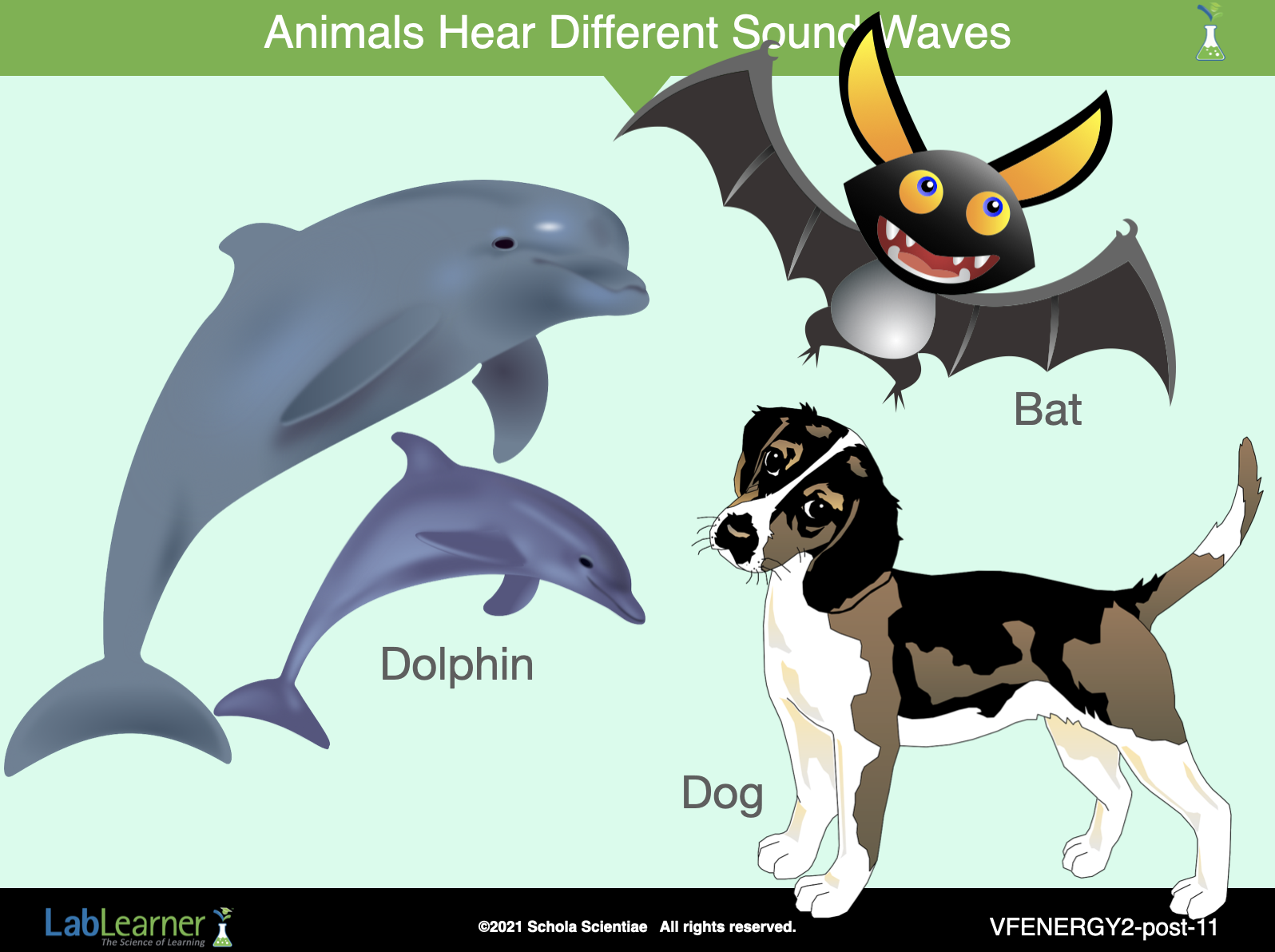
Conclude this Investigation by encouraging students to think about how and what they can hear compared to other animals.
Ask students: Can you think of an example where an animal might hear something you cannot hear? Student answers will vary. Examples might include a sea mammal such as a dolphin hearing another dolphin a long distance away, a dog hearing a dog whistle, or a bat hearing its sonar signal.
Ask students: Do all animals hear the same sounds or sounds of the same frequency? Student answers will vary. Students should indicate that some animals might be able to hear frequencies that we cannot hear.
______________________________________________
SLIDE VFENERGY2-post-12
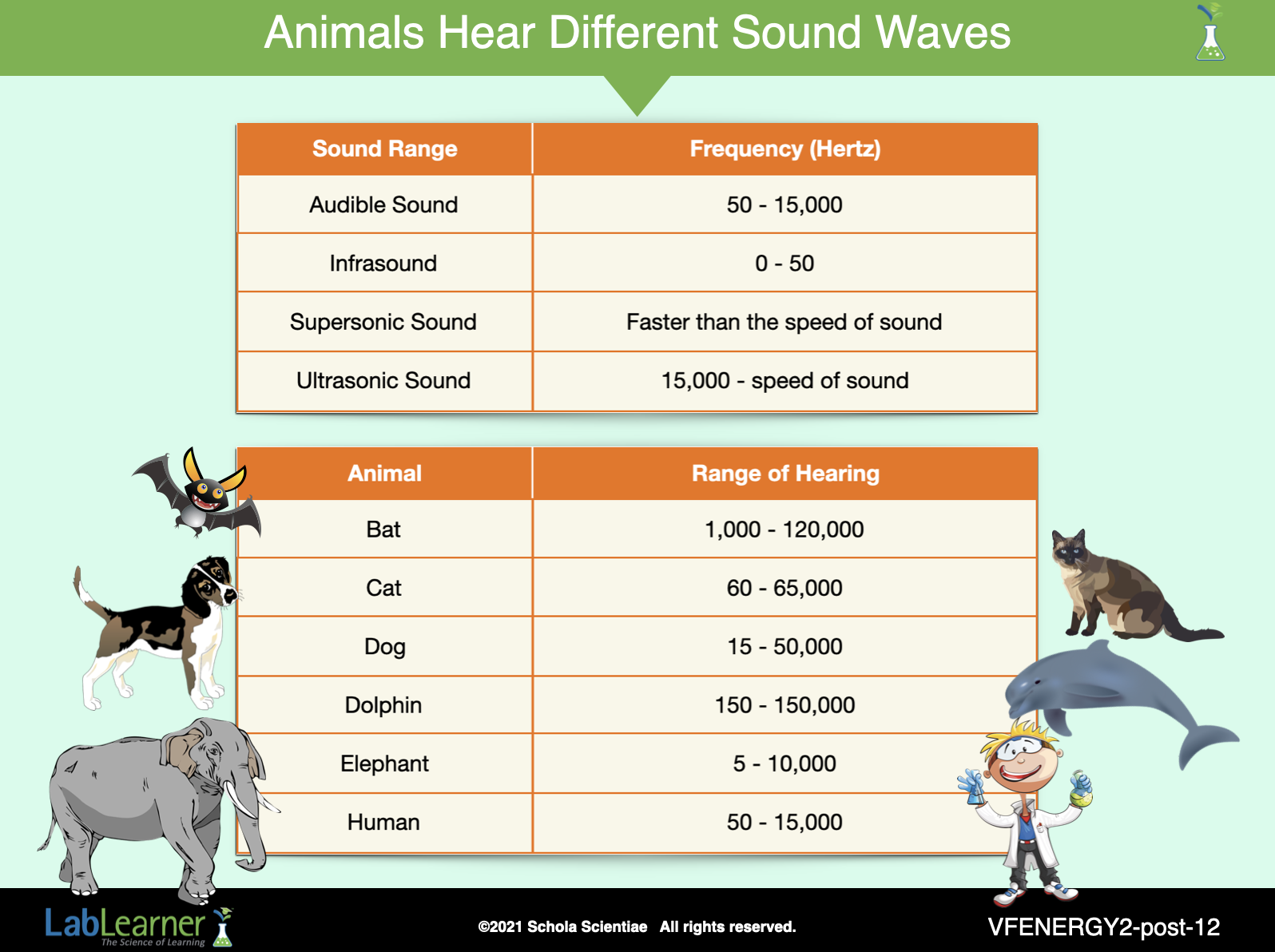
Look at the frequencies shown in this slide. Point out the range of hearing for humans. Ask them if it resembles any other range they see on the slide. Students should indicate that the human range resembles the audible sound range.
Ask students: What ranges can we not hear in? Humans cannot hear in the infrasound, supersonic sound, or ultrasonic sound ranges.
Ask students: Are there any animals that can hear in the ultrasound range? What about the infrasound range? How about the supersonic range? Bats, cats, dogs, and dolphins can hear in the ultrasonic range. Elephants can hear in the infrasound range. None of the animals listed can hear in the supersonic range.
Ask students: Why might it be important for some animals to hear in different ranges from humans? Student answers will vary.
The lower the frequency of a sound, the farther it can travel. Animals hear best in the ranges in which their voices are pitched. For example, bats send out high-frequency sounds that they use to determine where they are and where their prey is around them. Therefore, they need to be able to hear these sounds to find food and avoid colliding with objects and each other while they are flying. This is especially important, as bats have poor eyesight and hunt in conditions where there is very little light.
Elephants have very large vocal cords that vibrate very slowly and produce low-pitched sounds. They need to be able to hear these sounds, which can travel very long distances. This allows elephants who are scattered over large areas to communicate with each other easily. Therefore, animals hear in the ranges that match the frequencies produced by their vocal cords and the frequencies of the sounds produced by their prey.
______________________________________________
KEYS: POSTLAB