
Teacher Portal:
Forms of Energy
Investigation 2 – Lab
 BE PREPARED
Supplies and Equipment:
- Class Materials:
- 1 liter pitcher
- 1 graduated cylinder
- 1250 ml water
- 3.5 g black pepper
Station Materials:
- 6 tuning forks
- 4 rubber stoppers, size 07
- 2 metric rulers
- 1 white bucket
- 1 glass stirring rod
- 1 bottle green food coloring
- 5 paper towels
- 1 rubber band, 7” ! 1/8”
- 1 ping-pong ball
- 1 ring stand with ring clamp
- 1 50 cm piece of string
- 2 pieces of paper
- 5 ml (3.5 g) pepper
- 5 falcon tubes
- 3 400 ml beakers
- 1 pencil
- 1 5 cm piece of masking tape
Individual Materials:
- 1 Student Data Record
Teacher Preparation:
1. Fill the white bucket with 700 ml of water using the liter pitcher. Add 2 drops of green food coloring and stir thoroughly with the glass stirring rod.
2. Fill the beakers with water as follows:
a. Use the graduated cylinder to fill one (1) 400 ml beaker with 50 ml of water. Label ‘beaker 1’ with masking tape.
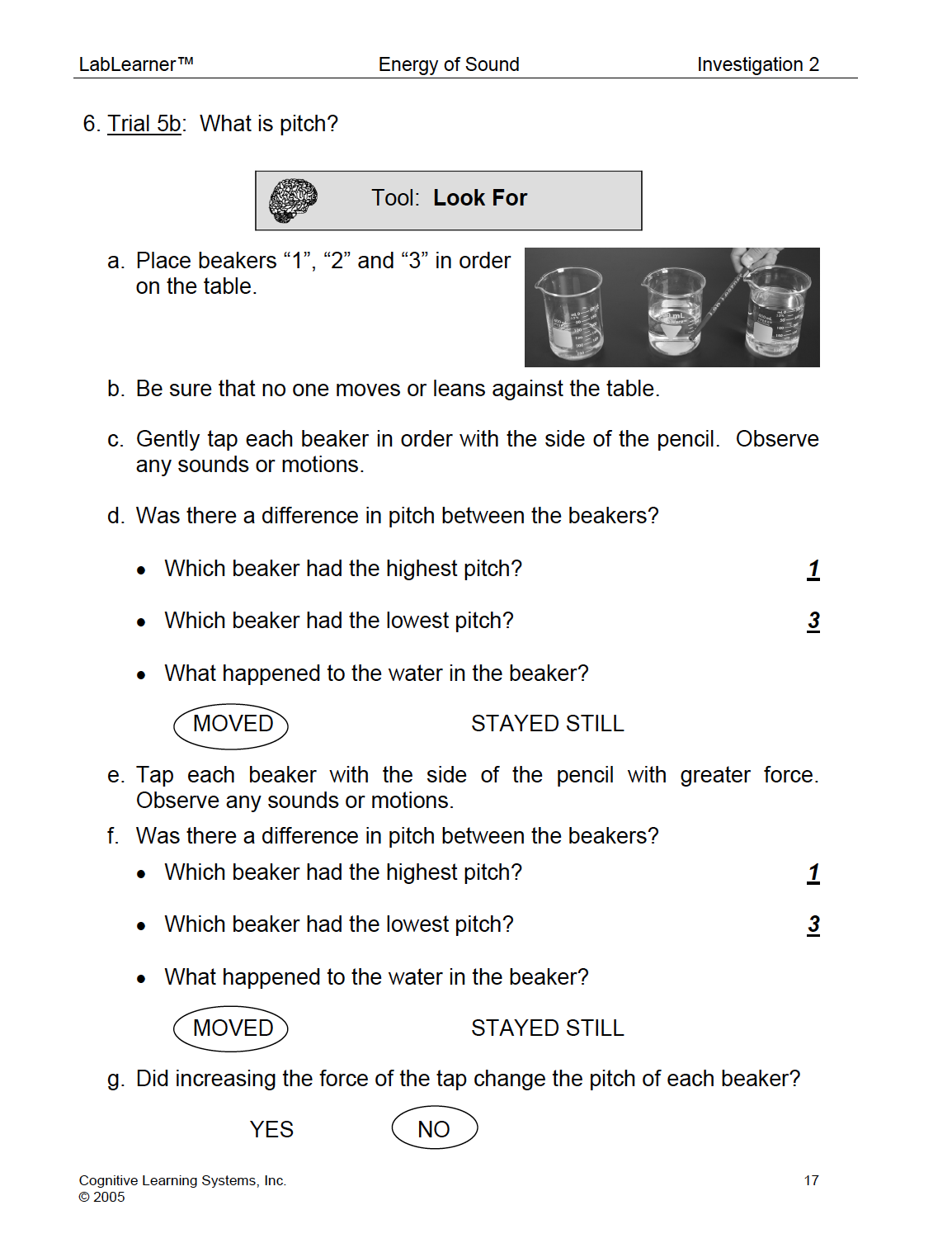
b. Use the liter pitcher to fill one (1) 400 ml beaker with 200 ml of water (label ‘beaker 2’) and one (1) 400 ml beaker with 300 ml of water (label ‘beaker 3’).
3. Fill five (5) falcon tubes to the 1 ml mark (0.7 g) with pepper.
4. Fold one (1) piece of paper in half cross-wise. Crease the paper but do not flatten it. The paper should still have a slight arch.
5. Attach one end of the 50 cm string to the ping-pong ball with the 5 cm piece of masking tape. Tie the free end of the string to the ring stand creating a pendulum at least 45 cm long.
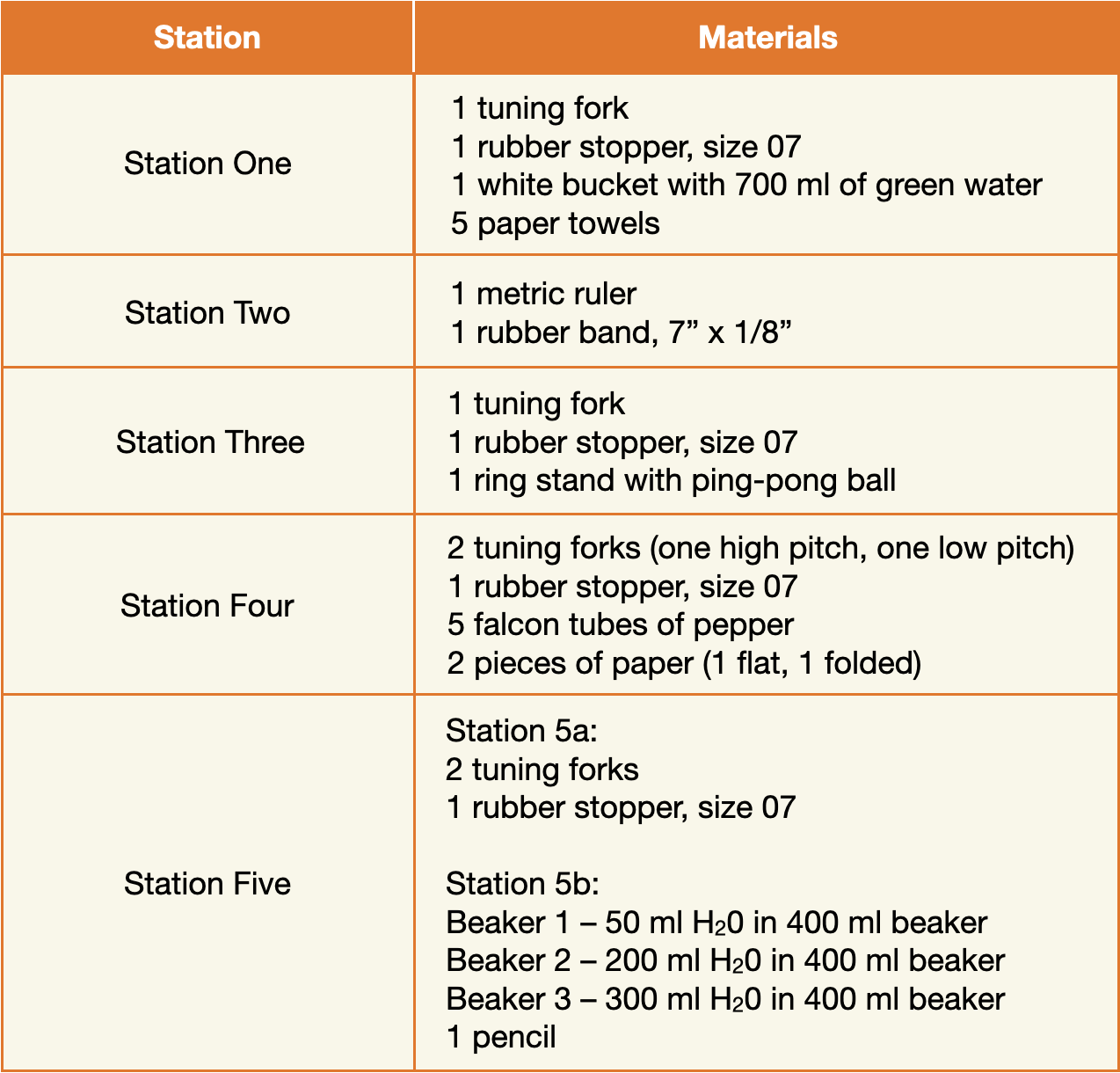
6. Organize the materials into five (5) different stations around the classroom as shown in the table on the following page. Label each station with a piece of masking tape.
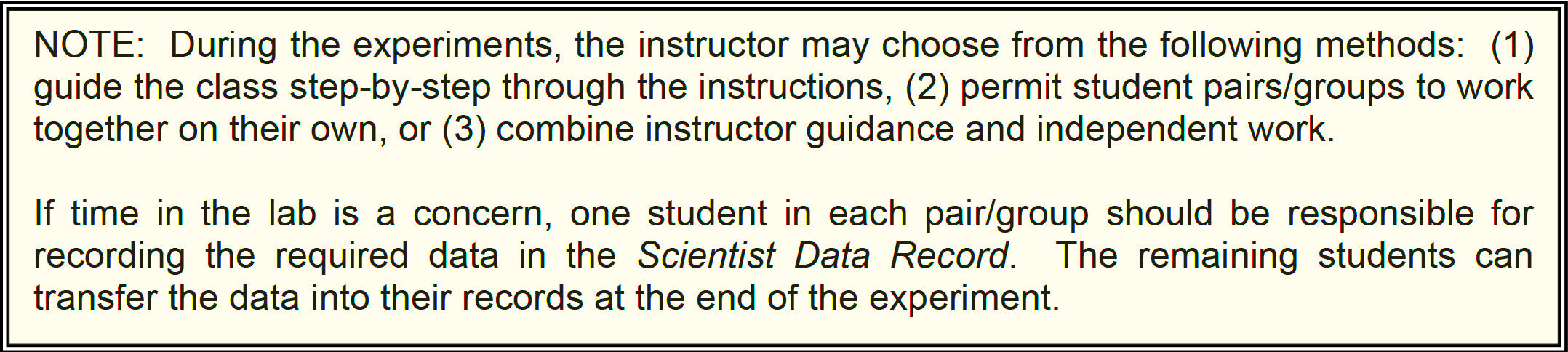
7. Divide students into 5 cooperative groups.
Instruction:
1. As a class, review the proper way to activate a tuning fork before beginning the Lab. Direct each student to practice striking the tuning fork smartly against a rubber stopper as shown in the Tuning Fork Use and Operation Procedural Tool. Remind students never to strike the tuning fork against a hard surface. Striking a tuning fork against a hard surface can damage the tuning fork and alter its pitch.
GET FOCUSED
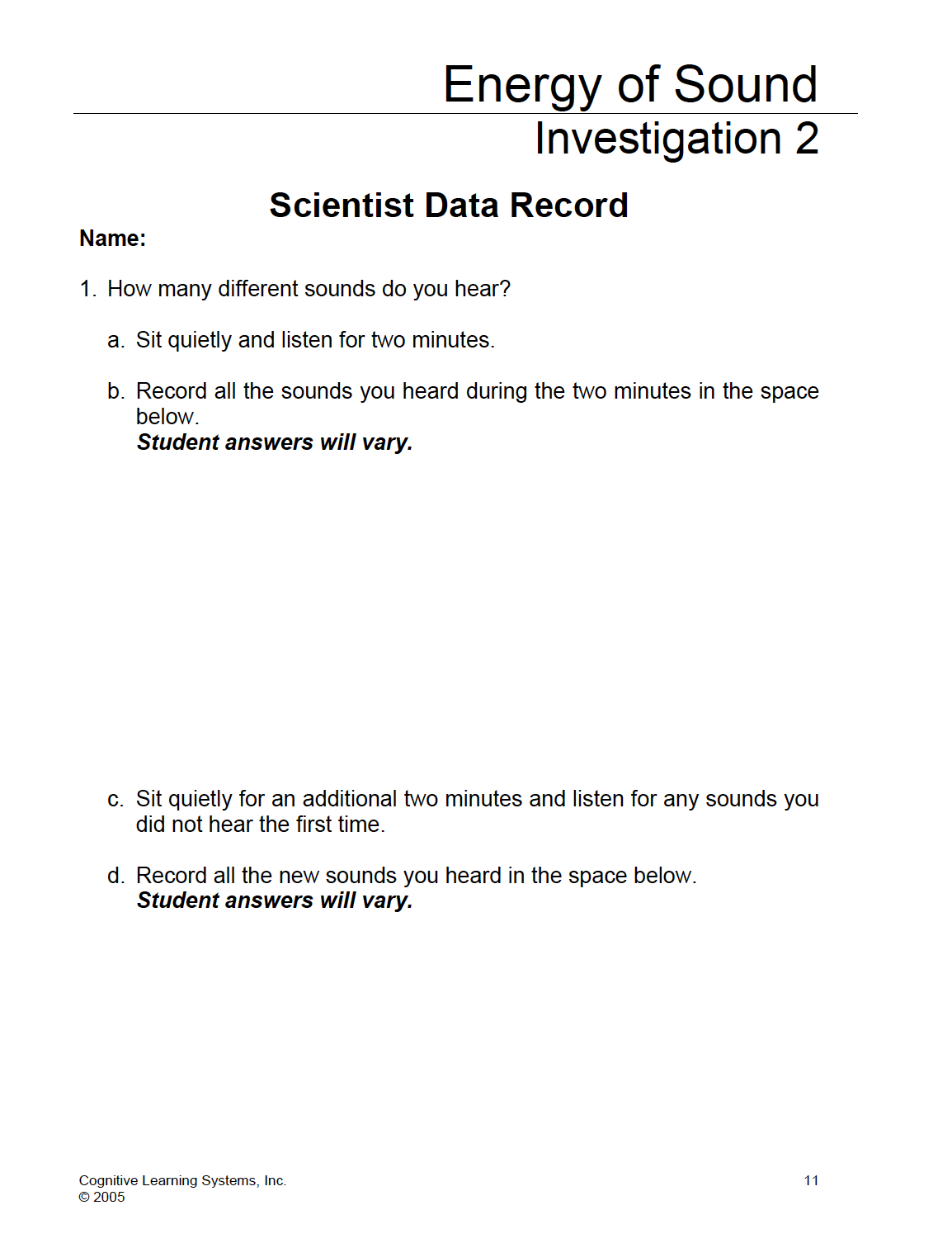
Investigation Two introduces students to the relationship between kinetic energy and sound energy.
Students will conduct a series of experiments to determine the properties of sound energy.
INVESTIGATE
Trials 1-5
Sound energy is kinetic energy. Sound energy travels through different mediums when the vibrating molecules of the first medium transfer their kinetic energy to the molecules of the second medium: Sound energy’s ability to pass through different mediums allows the wave nature of sound energy to be visualized. In addition, this ability to be transferred from one medium to another will allow students to explore amplitude, a property that is unique to forms of energy that travel in waves.
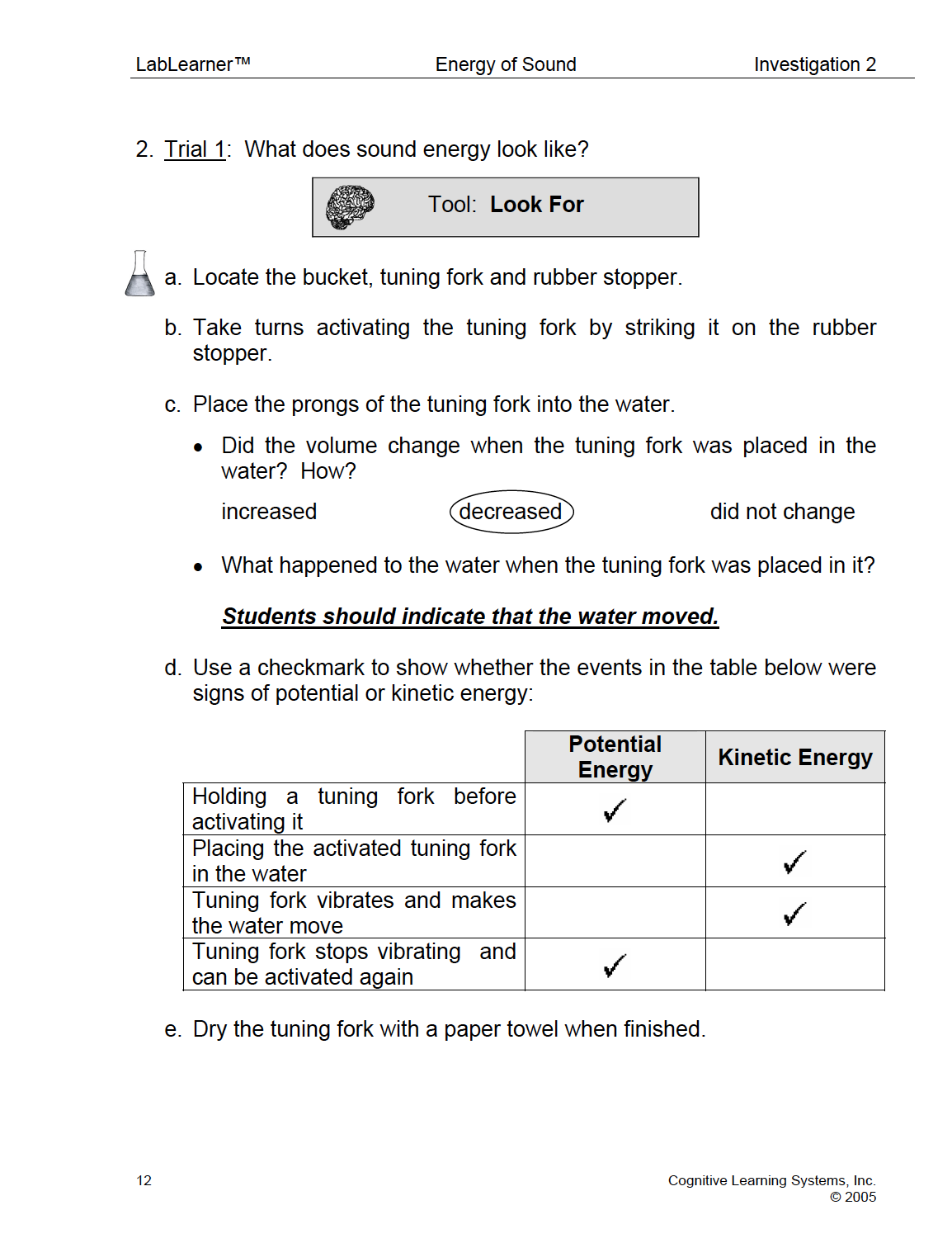
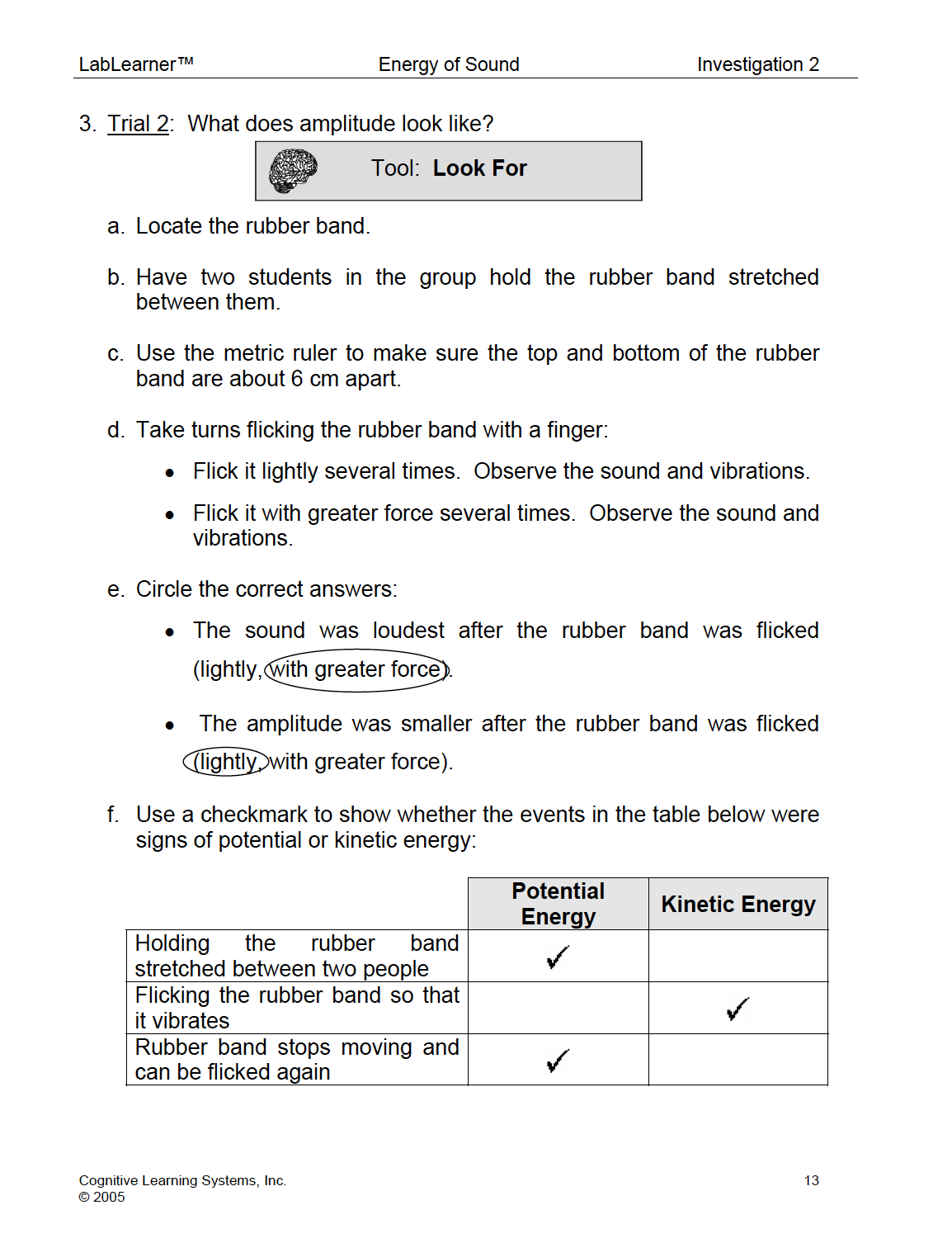
In Trial 1, students will observe the ability of sound to travel through liquids as they dip an activated tuning fork in a bucket of colored water. Students will then explore one of the properties of sound energy, amplitude, by plucking a large rubber band with different degrees of force in Trial 2. This experiment provides students an opportunity to visualize the concept of amplitude while correlating the amplitude of a sound wave with the volume of the sound.
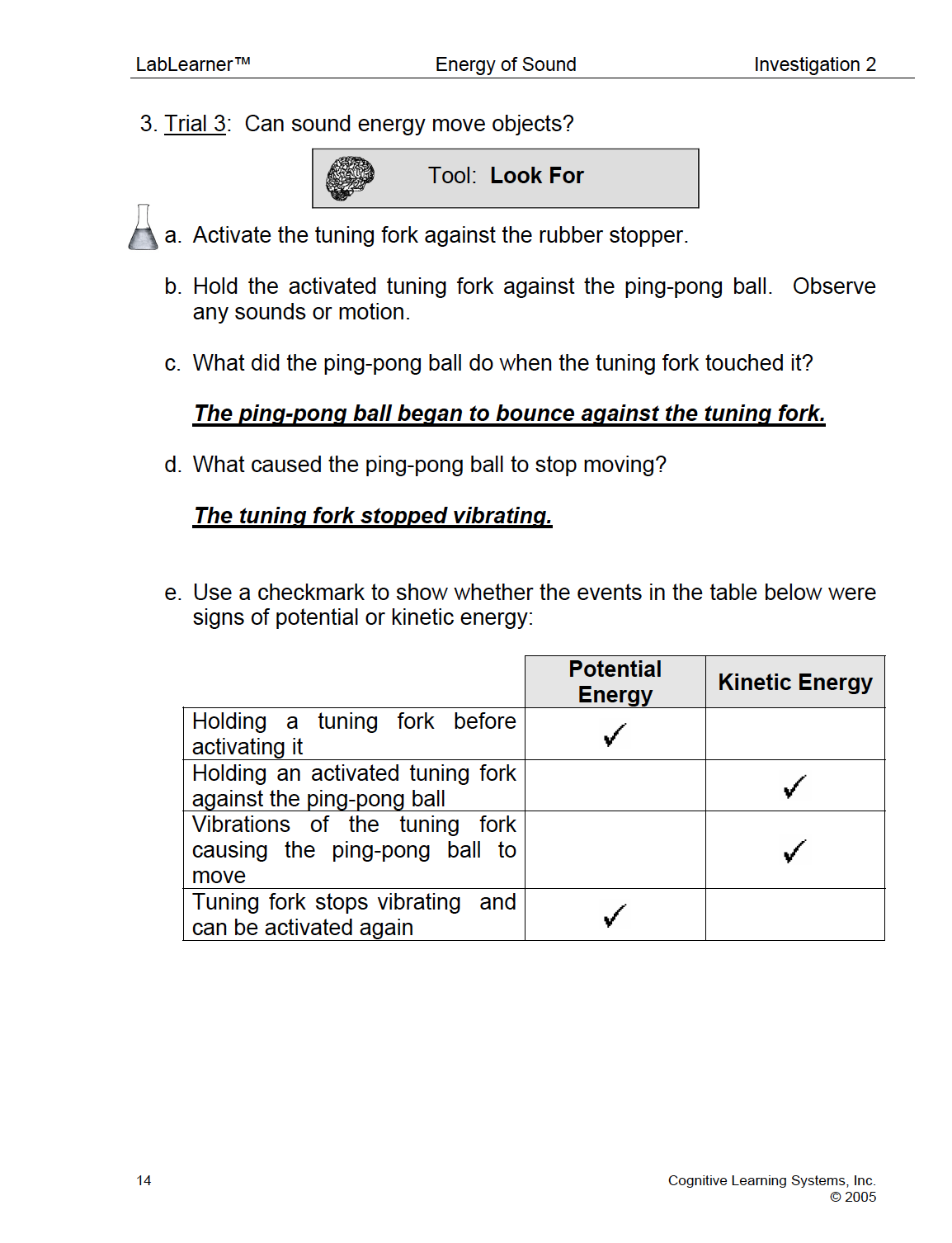
Trial 3 allows students to explore how sound energy can move objects by touching an activated tuning fork to a ping-pong ball suspended from a ring stand.
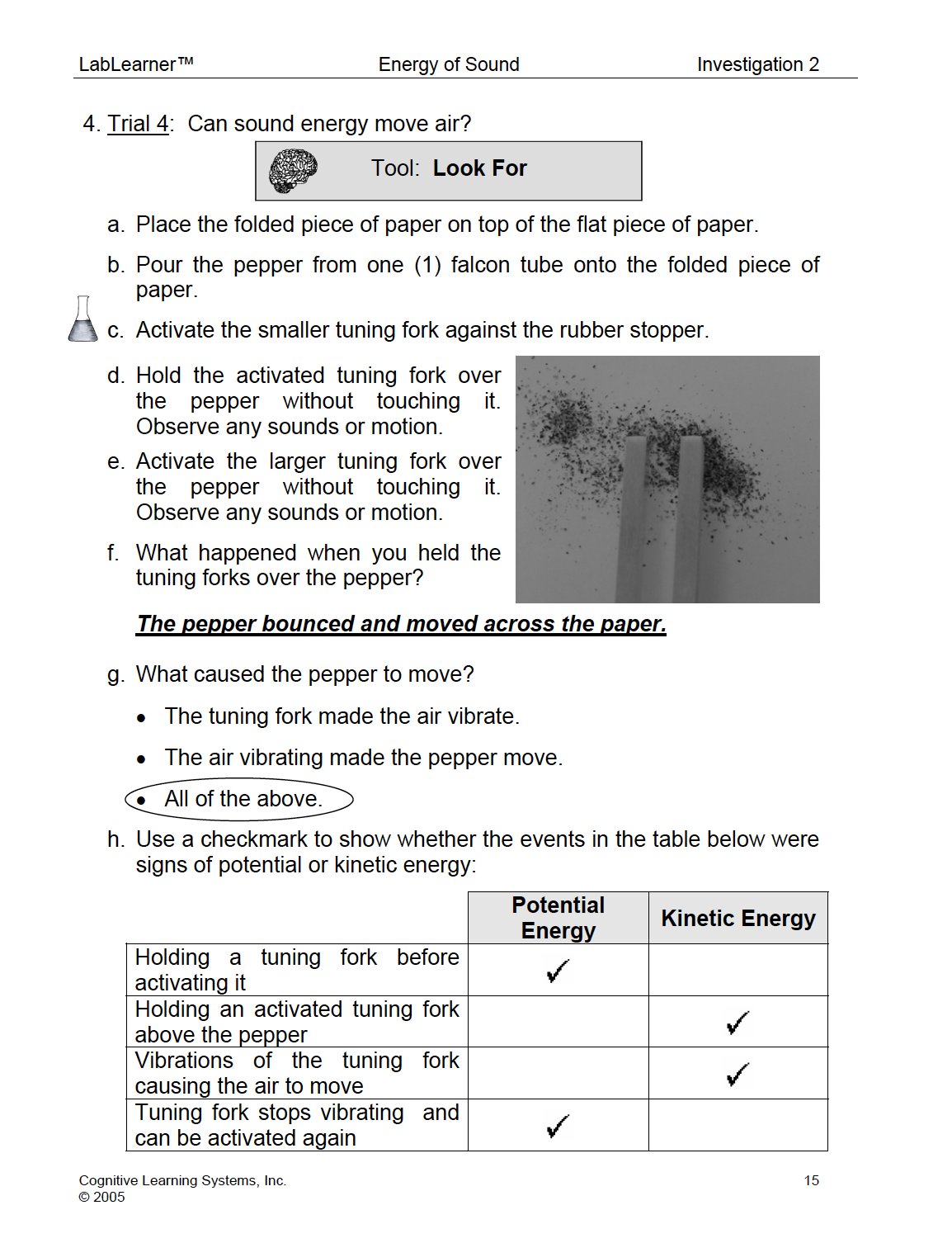
In Trial 4, students will explore how sound moves through air by holding activated tuning forks over a sample of pepper on a piece of folded paper. The students will discover that the pepper moves even though the tuning forks never touch the paper.
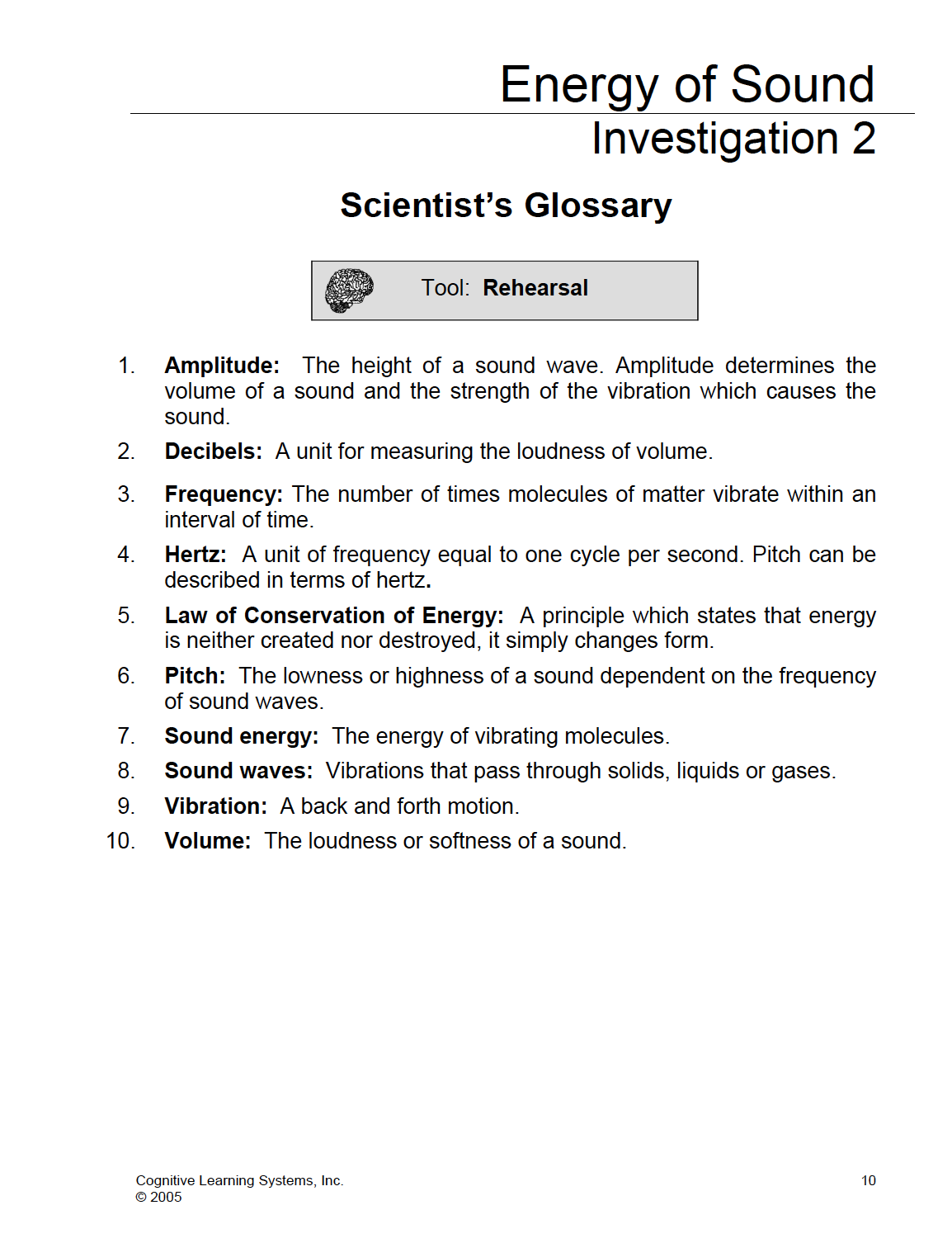
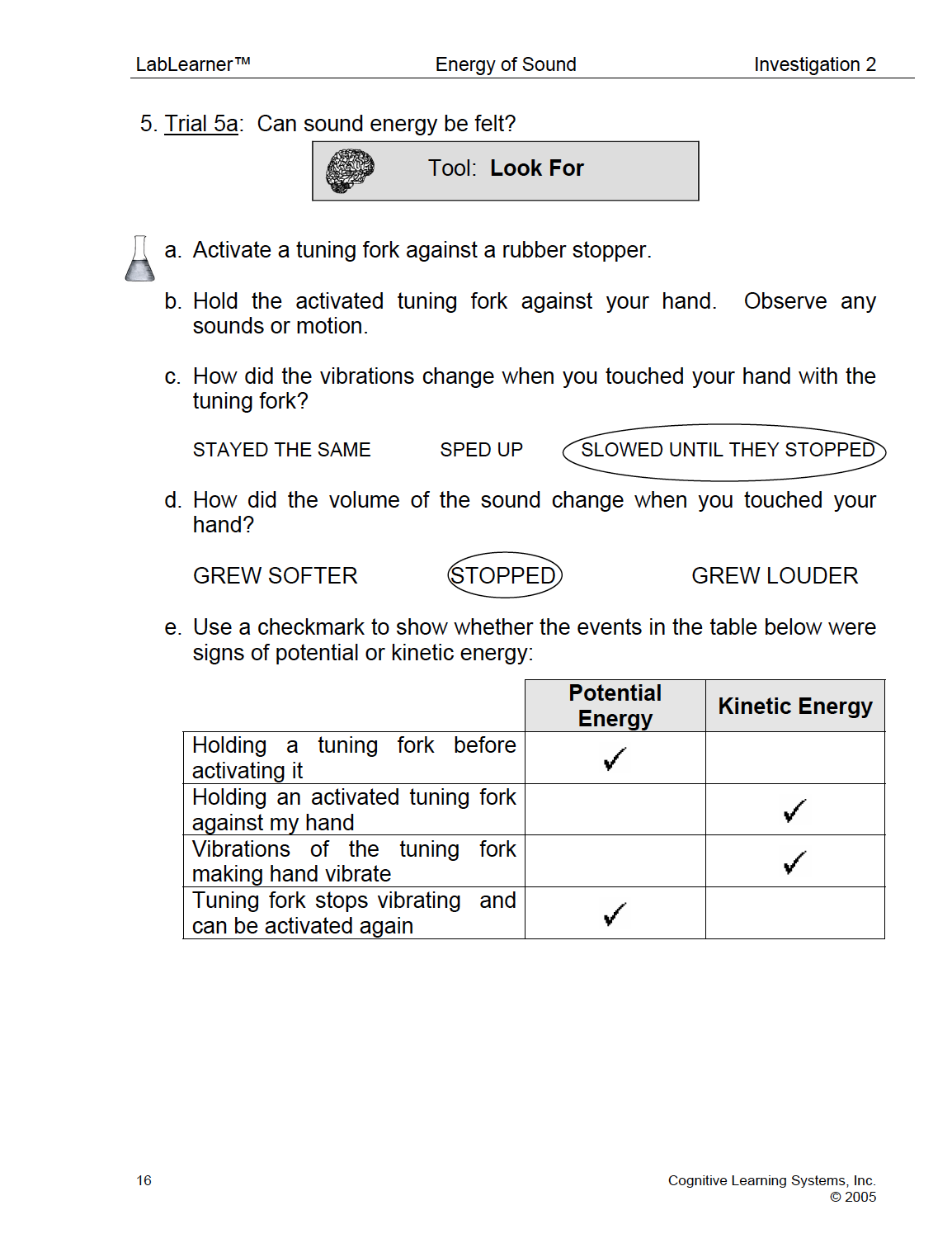
Trial 5a provides students an opportunity to feel sound energy by touching an activated tuning fork. In Trial 5b, students will explore pitch, a property unique to sound energy. Their experiment should help reinforce the concept that sounds can vary in their “highness” or “lowness,” and that these differences are described as differences in pitch.
As students proceed through the various stations, they will gather information that will allow them to answer the following questions:
- What does sound energy look like?
- What does amplitude look like?
- Can sound energy move objects?
- Can sound energy move air?
- Can sound energy be felt?
- What is pitch?
Movement Through the Stations:
a. Direct students to start with the Trial represented by the station at their current table. For example, students sitting at Station 3 will start with Trial 3.
b. Allow students five to seven minutes per station, then direct students to rotate to the next station. Students at Station Five should rotate to Station One.
c. Trial 5b instructs students to listen for differences in the pitch of sounds. Prior to their start of Trial 5b, it may be necessary to remind students that pitch refers to the highness or lowness of a sound.
Upon completion of the investigation, permit enough time to clean up the lab and return the materials and equipment to their assigned locations.
KEYS

CLEAN UP
Let students know your expectations for clean-up. Ask them to clean up.