Teacher Portal:
Forms of Energy
Investigation 1 – PreLab
 PRINT IT
Use your browser to download a printable PDF as help during the slide presentation and to make additional notes. In your browser, go to File > Print and then choose to save as PDF.
MINDSET
This Investigation is designed to:
- promote students’ understanding that energy has properties.
- introduce the concept of potential energy as stored energy.
- introduce the concept of kinetic energy as energy in motion.
- promote students’ understanding of the Law of Conservation of Energy.
- demonstrate the difference between potential and kinetic energy.
- promote students’ understanding that energy can be transformed from potential to kinetic and from kinetic to potential forms.
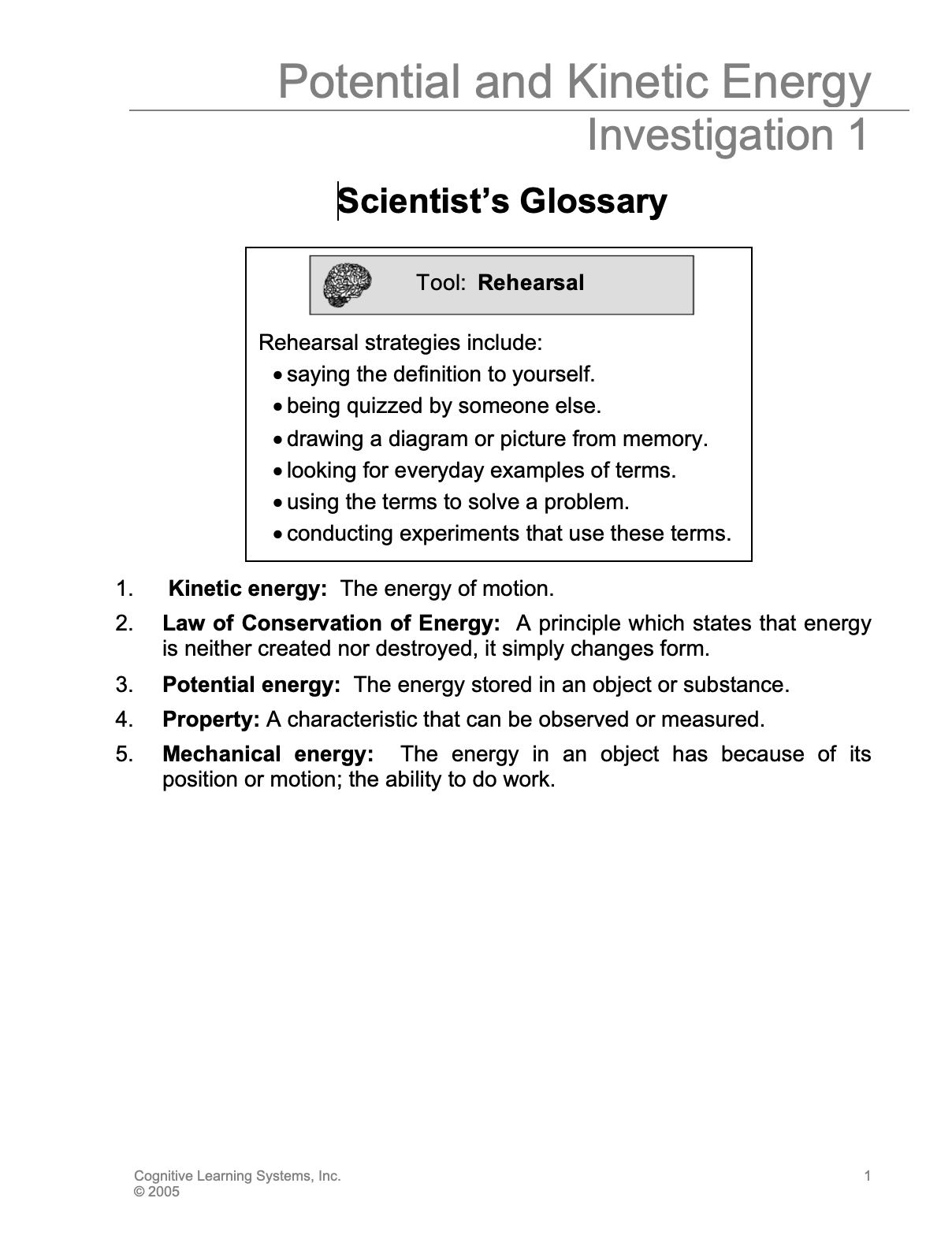
SCIENTIST’S GLOSSARY
1. Energy: The capacity to do work.
2. Property: A characteristic that can be observed or measured.
3. Kinetic energy: The energy of motion.
4. Law of Conservation of Energy: A principle that states that energy is neither created nor destroyed, it simply changes form.
5. Potential energy: The energy stored in an object or substance.
6. Mechanical energy: The energy an object has because of its position or motion; the ability to do work.
BE PREPARED
Watch the Investigation 1 Teacher Video and Student Video below to prepare for the PreLab.
SET FOR SUCCESS
- Tell students that they are about to begin the Forms of Energy CELL.
- Ask students to share the kinds of things they might learn in these Investigations.
- Tell students to think about all of the different things around them, that they come in contact with every day that depends on energy.
Begin the PreLab Concept Slides to start students on their learning journey. Then watch the Pre-Lab Student Video afterward as a class.
NAVIGATE IT
Once the slide presentation is launched
- use your left and right arrows to advance or go back in the slide presentation, and
- hover your mouse over the left edge of the presentation to get a view of the thumbnails for all the slides so that you can quickly move anywhere in the presentation.
- Click HERE to launch the slide presentation for the CELL.
SHARE IT
SLIDE VFENERGY1-pre-1
This is the first slide for the CELL Forms of Energy. Investigation One introduces two very important and quite different forms of energy – potential energy and kinetic energy.
______________________________________________
SLIDE VFENERGY1-pre-2
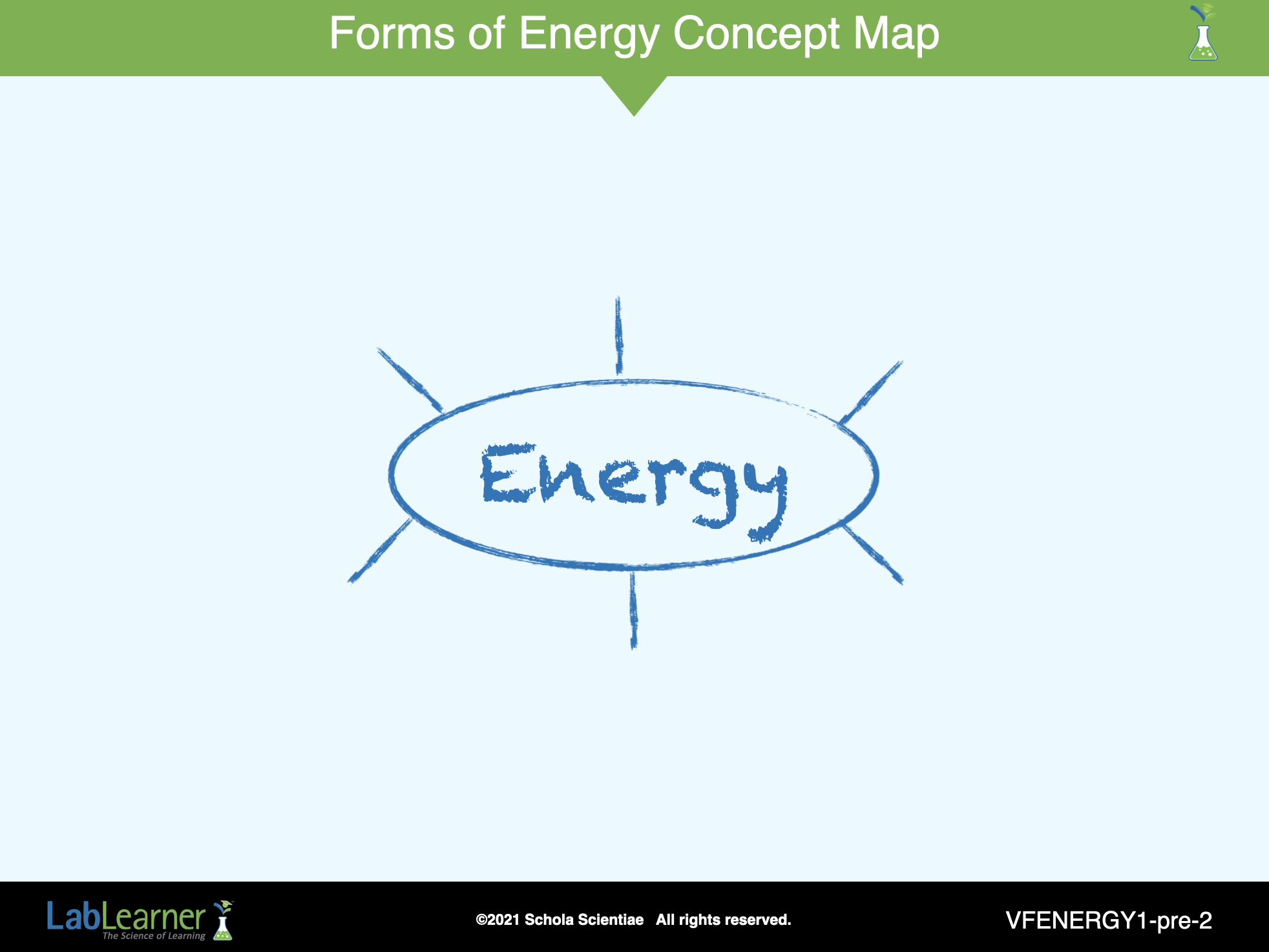
Begin the Investigation by explaining to students that this CELL will explore the different forms that energy can take.
Ask students: What is energy? Student answers will vary. Energy is the capacity to do work.
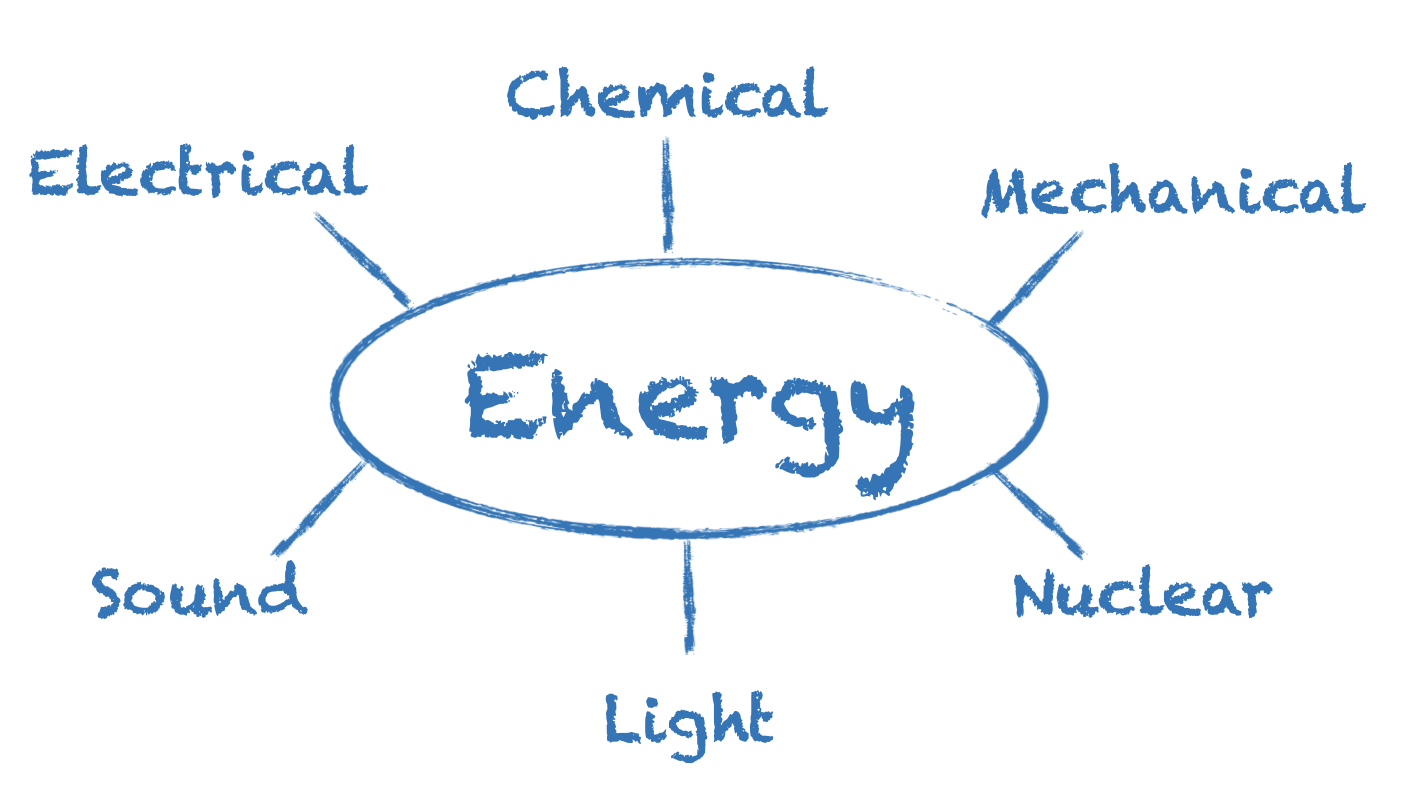
Begin a concept map on the board. Have each student copy the map precisely, as they will refer to it and add to it during the course of the Forms of Energy CELL. The teacher may wish to copy or take a quick photo of the final concept map for reference as well.
Begin the concept map by placing the word “ENERGY” in the center as the main concept. Ask students: What forms can energy take? Student answers will vary but may include a mix of types, forms, and sources of energy. Student answers may include types (potential and kinetic) and sources (food, batteries, oil, gasoline, etc.) of energy.
Add student responses to the concept map. A sample concept map showing forms of energy is presented for the teacher below. However, the concept map generated during class discussion may differ from the sample shown here:
______________________________________________
SLIDE VFENERGY1-pre-3
Continue the discussion of energy by explaining that energy, like matter, has properties.
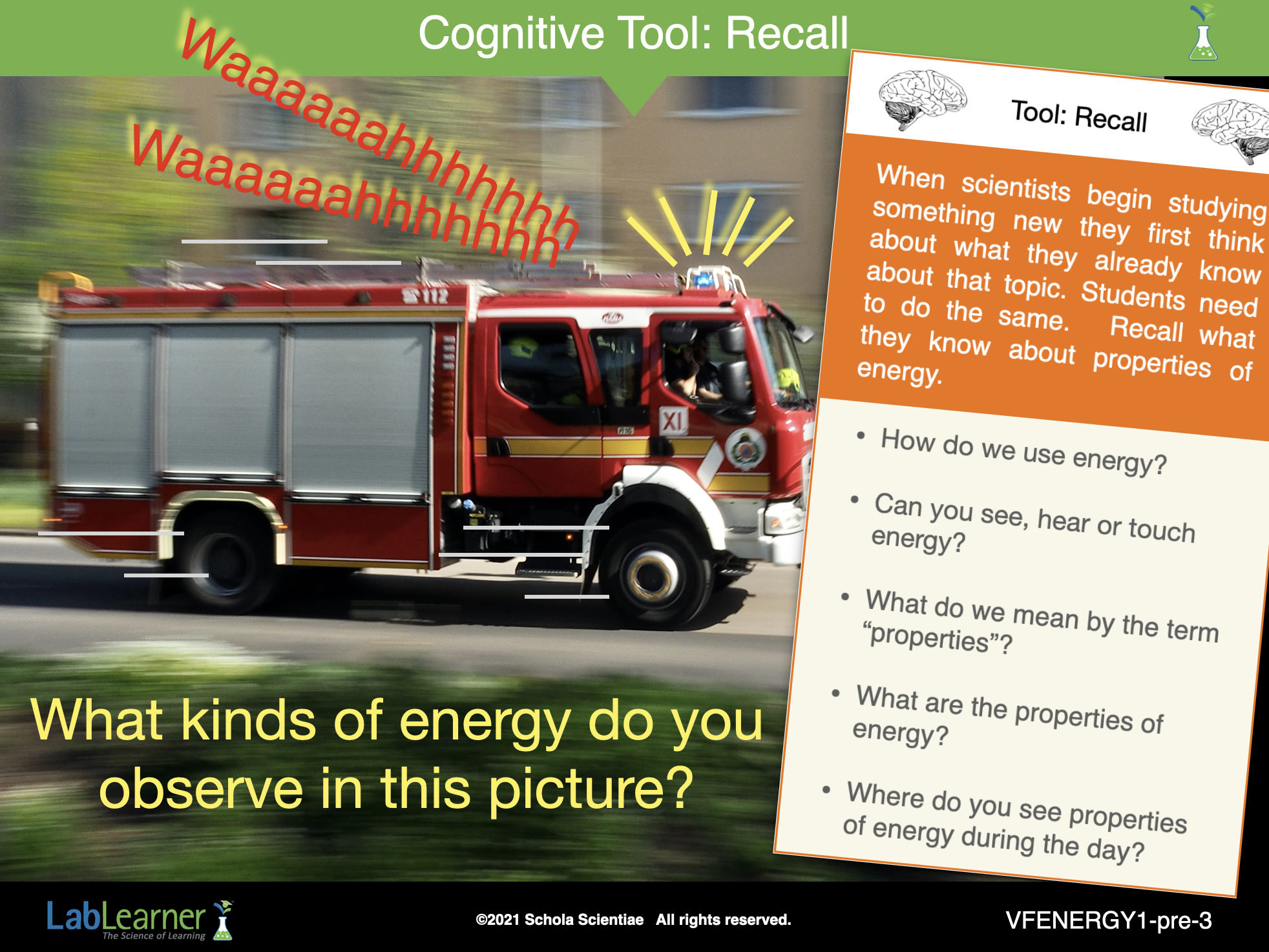
Remind students that whenever scientists begin studying something new they first think about what they already know about that topic. Students need to do the same. Ask students: What tool in your Cognitive Toolbox would scientists use to do this? Students should suggest that scientists would use the Recall tool.
Encourage students to recall what they know about properties of energy by asking the following questions:
Ask students: How do we use energy? Student answers will vary. Examples of energy usage includes heating homes, making vehicles run, making machines and appliances do work, providing light, and making animals and plants grow.
Ask students: Can you see, hear or touch energy? Student answers may vary. Light and vibrations can be seen, sound can be heard, and vibrations and motions can be felt.
Ask students: What do we mean by the term “properties”? Properties are characteristics that can be seen or measured.
Ask students: What are the properties of energy? Student answers will vary. The ability to be detected by our senses is a property of energy. Another property is whether or not the form of energy can do work. A third property is whether the energy is inactive or active. Explain to students that they will investigate these properties further as they continue with the CELL.
Ask students: Where do you see properties of energy during the day? Student answers will vary. Energy can be seen and felt in the sunlight as light and heat. Plants use the energy from the light to create sugars during photosynthesis. Sugars are chemical energy. A person eats the plant, using mechanical and chemical energy to digest the plant, and uses the chemical energy from the sugar to power muscles. Muscles contract when a child climbs a ladder to a slide, providing mechanical energy to move the child up the slide.
Finally, ask students: What kinds of energy do you observe in this picture? Student answers may vary. You can see the motion or mechanical energy of the speeding vehicle, the light energy from the flashing lights, and sound energy from the siren, Waaaaaahhhhhhh!!! You might also feel the vibration of the ground (more mechanical energy), as the emergency vehicle races by.
______________________________________________
SLIDE VFENERGY1-pre-4
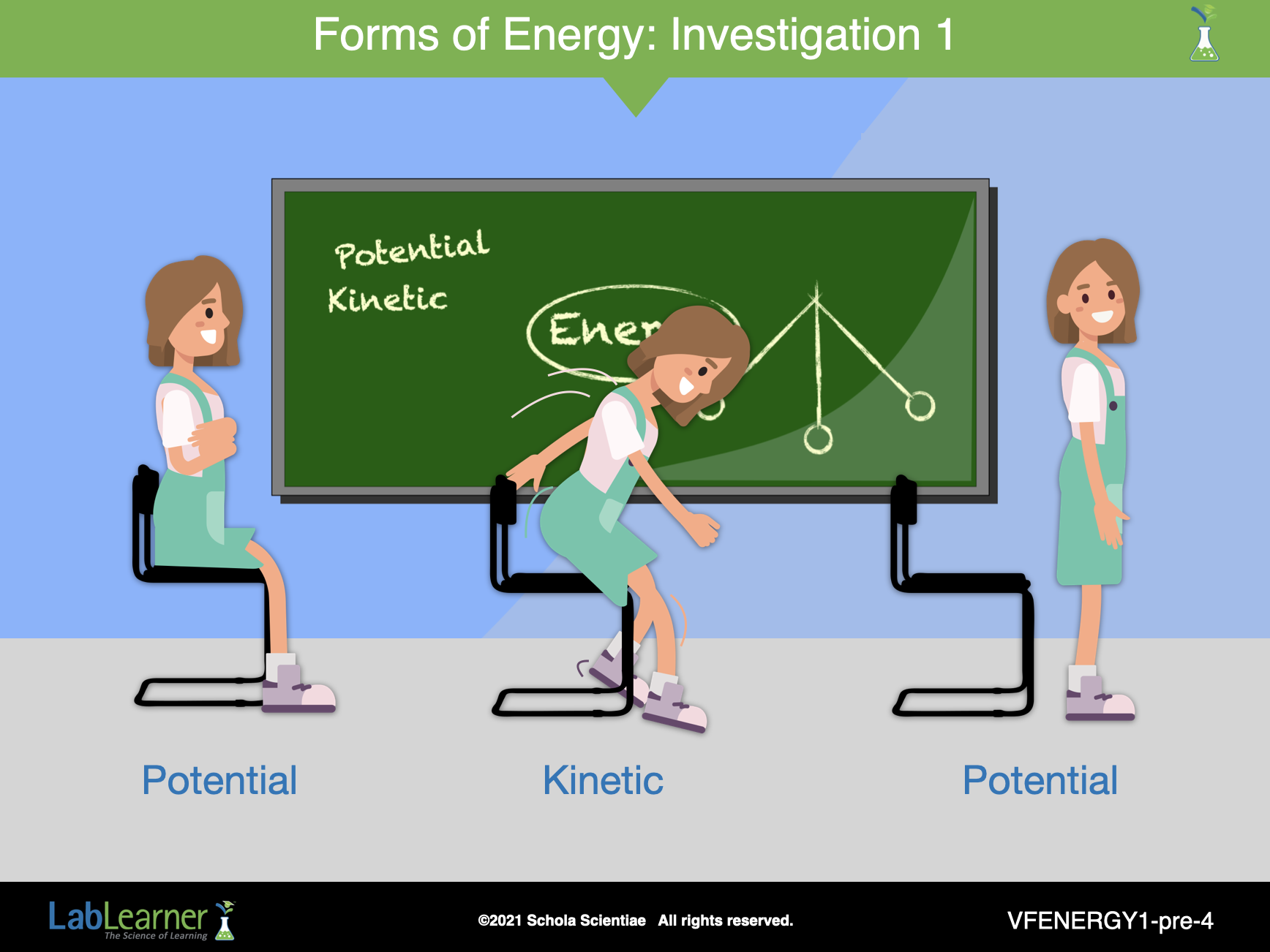
Continue the discussion by explaining to students that all forms of energy can be classified into one of two categories.
1. Direct students attention to their Scientist’s Glossary. Ask students: What term refers to energy that is stored? Potential energy is energy that is stored.
2. Direct students’ attention to the term kinetic energy. Explain to students that any form that cannot be classified as potential energy is classified as kinetic energy.
3. The following activity is designed to help students understand the difference between potential and kinetic energy:
a. Tell students to sit completely still in their seats with their arms crossed and their feet flat on the floor.
b. Ask students: Does your body have potential energy or kinetic energy? Students should indicate that because their bodies are not moving but have stored energy that could be used to move, their bodies have potential energy.
c. Tell students to stand. Ask students: Did your body have potential or kinetic energy while you were in the process of standing? How do you know? Student answers may vary. From the times students initiated the process of standing until they were fully upright and still again, their bodies had kinetic energy, as kinetic energy is the energy of motion. Students’ bodies also had potential energy during the process of standing. However, students may experience difficulty in understanding that something can have potential and kinetic energy at the same time. Explain that they will explore this further in the Lab.
d. Ask students: Which term in your Scientist’s Glossary refers to work? Mechanical energy refers to work.
Mechanical energy:
The energy an object has because of its position or
motion; the ability to do work.
e. Allow students to sit back down. Encourage students to think about the energy in their bodies once they were in a standing position. Ask students: Did your bodies have potential or kinetic energy once you were in a standing position? How do you know? Student answers may vary. Students’ bodies had potential energy once they were fully upright and still.
______________________________________________
SLIDE VFENERGY1-pre-5
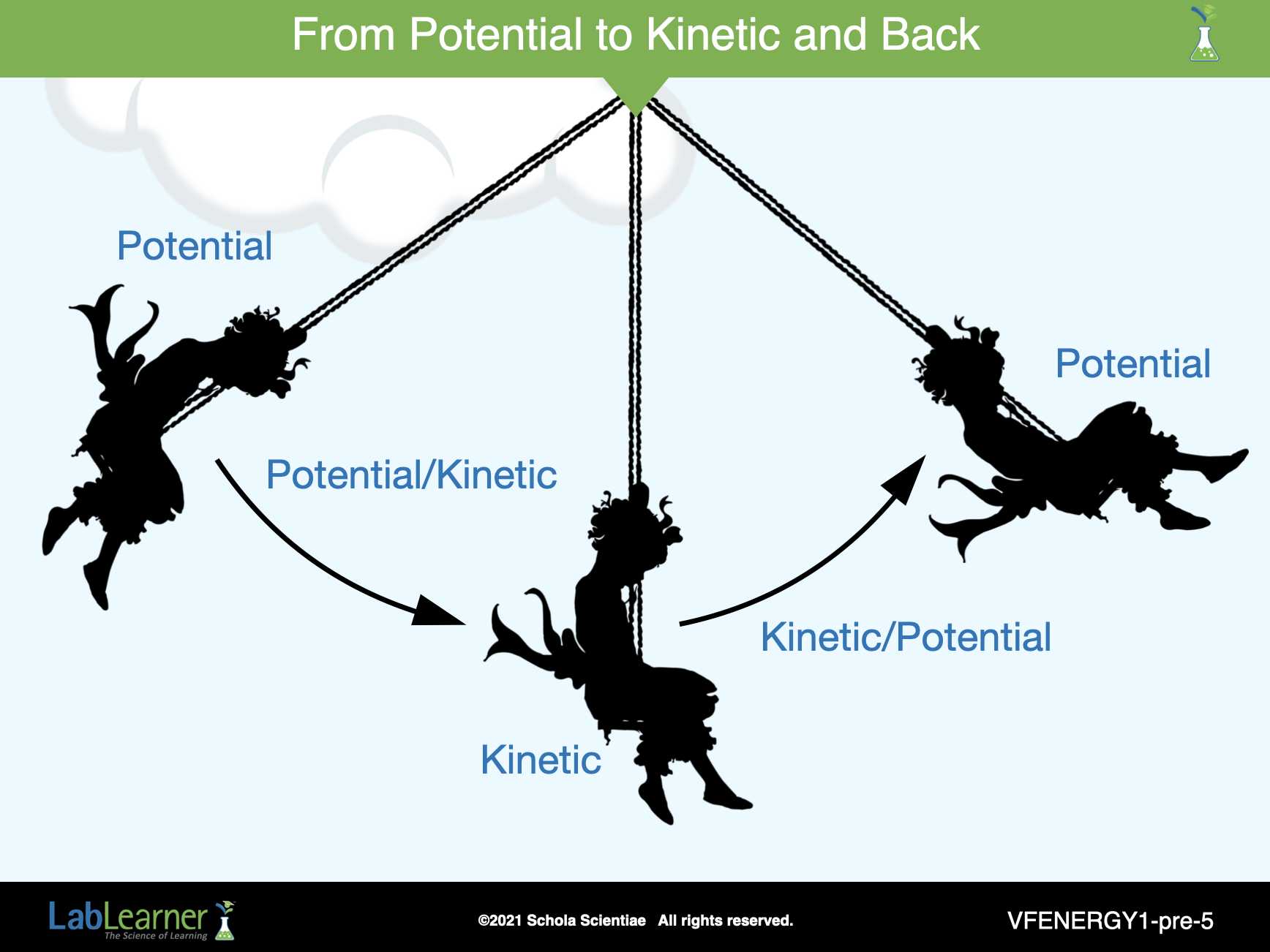
Ask students to look at the little girl swinging on this slide. Encourage students to think about swinging on a swing at the playground. Ask the following questions to introduce the concept that objects can have varying amounts of potential and kinetic energy at the same time:
Ask students: At which point or points does the person in the swing have the greatest potential energy? The person in the swing has the greatest potential energy at the highest points of the swing’s path.
Ask students: At which point or points does the person in the swing have the greatest kinetic energy? The person in the swing has the greatest kinetic energy at the bottom of the swing’s path.
Ask students: Are there any points in the swing’s path where the person in the swing has both potential and kinetic energy? The person in the swing has both potential and kinetic energy in the two regions of the path between the highest and lowest points. As the swing descends from its highest point, the potential energy decreases and the kinetic energy increases as potential energy transforms to kinetic energy.
IF PRACTICAL: Take the class outside to the swings and have children shout out “potential!” as they reach the extreme position of both the forward and backward swing. Then shout “kinetic!” as they speed up and move in the opposite direction after the brief pause. The student has 100% potential energy at each extreme of the swing. Kinetic energy is at 100% when they are moving and are perpendicular to the ground. In between the two extremes, there is a mix of potential and kinetic energy. Therefore, exactly halfway down or up, the total energy is in the form of 50% potential and 50% kinetic energy.
______________________________________________
SLIDE VFENERGY1-pre-6
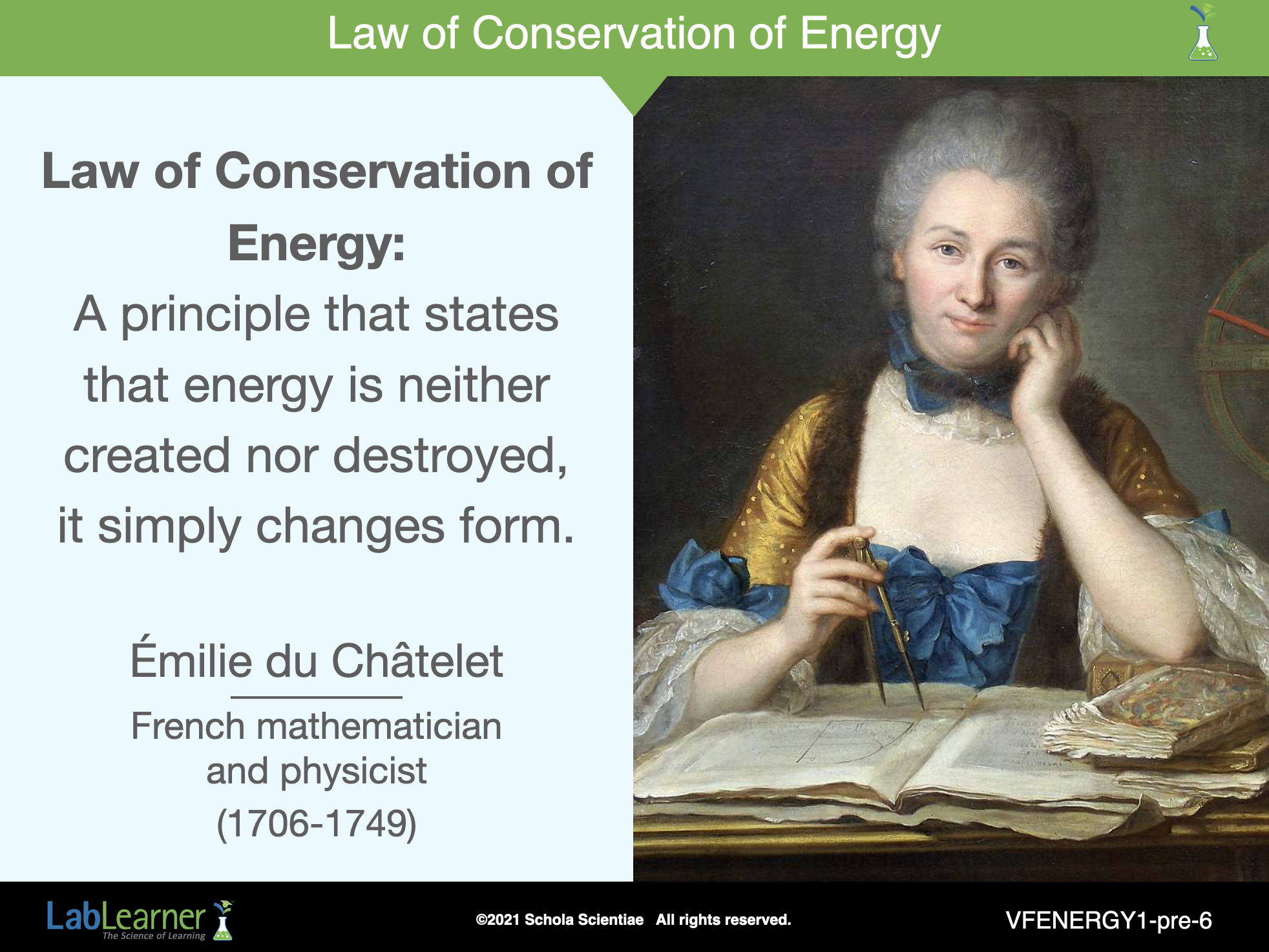
Continue the concept of energy transformation by initiating a discussion of the Law of Conservation of Energy. Today the Law is credited to Émilie du Châtelet, a French mathematician and physicist. It is among the most important physical laws of science.
Direct students’ attention to the term Law of Conservation of Energy in their Scientist’s Glossary:
Law of Conservation of Energy:
A principle that states that energy is neither created nor destroyed,
it simply changes form.
Explain to students that during the activity they performed (sitting still then standing up at their desks), they demonstrated the Law of Conservation of Energy. When students were sitting still their bodies had potential energy. When they started to stand up, that energy transformed to kinetic energy as they stood because their bodies were in motion. Once they were upright and still, the kinetic energy was transformed back to potential energy.
Ask students: What do you think happened to the potential energy when you sat back down? Students should indicate that the potential energy changed back to kinetic energy as they proceeded to sit from a standing position.
Explain to students that the total amount of energy in their bodies did not change when they performed their activity. The potential energy simply changed to kinetic energy but was not destroyed. Likewise, the kinetic energy was not destroyed but changed back to potential energy when they reached the standing position.
Also, point out that the swing example (previous slide) is an excellent demonstration of the interchange between kinetic and potential energy.
______________________________________________
SLIDE VFENERGY1-pre-7
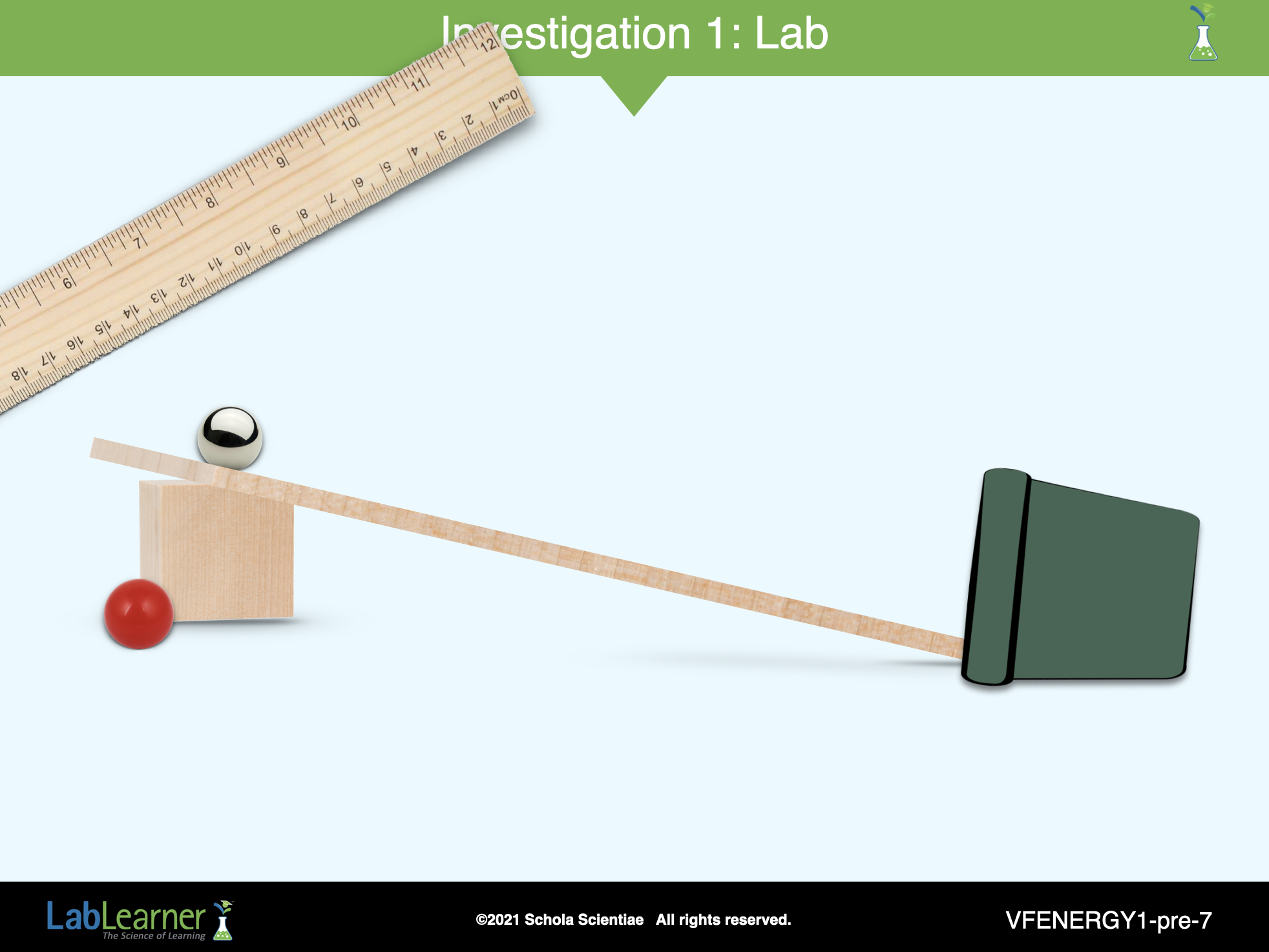
Conclude this portion of the investigation by explaining to students that they will perform experiments in the lab to explore the Law of Conservation of Energy and answer the following questions:
How does the mass of an object affect its potential energy?
How does the mass of an object affect its kinetic energy?
How can the potential or kinetic energy of an object be changed?
How can the mechanical energy of an object be changed?
Student Video
Watch the Investigation 1 Student Video after the Share It presentation to prepare for the PreLab.
KEYS