Teacher Portal:
Forms of Energy
Investigation 1 – PostLab

PRINT IT
Use your browser to download a printable PDF as help during the slide presentation and to make additional notes. In your browser, go to File > Print and then choose to save as PDF.
NAVIGATE IT
Once the slide presentation is launched
- use your left and right arrows to advance or go back in the slide presentation, and
- hover your mouse over the left edge of the presentation to get a view of the thumbnails for all the slides so that you can quickly move anywhere in the presentation.
- Click HERE to launch the slide presentation for the CELL.
SHARE IT

SLIDE VFENERGY1-post-1
Begin this part of the investigation by encouraging students to review the experiments they performed in the lab. The following questions may be useful in prompting student discussion:
Ask students: What questions were investigated in the Lab? Students should indicate that the questions were:
- How does the mass of an object affect its potential energy?
- How does the mass of an object affect its kinetic energy?
- How can the potential or kinetic energy of an object be changed?
- How can the mechanical energy of an object be changed?
______________________________________________
SLIDE VFENERGY1-post-2
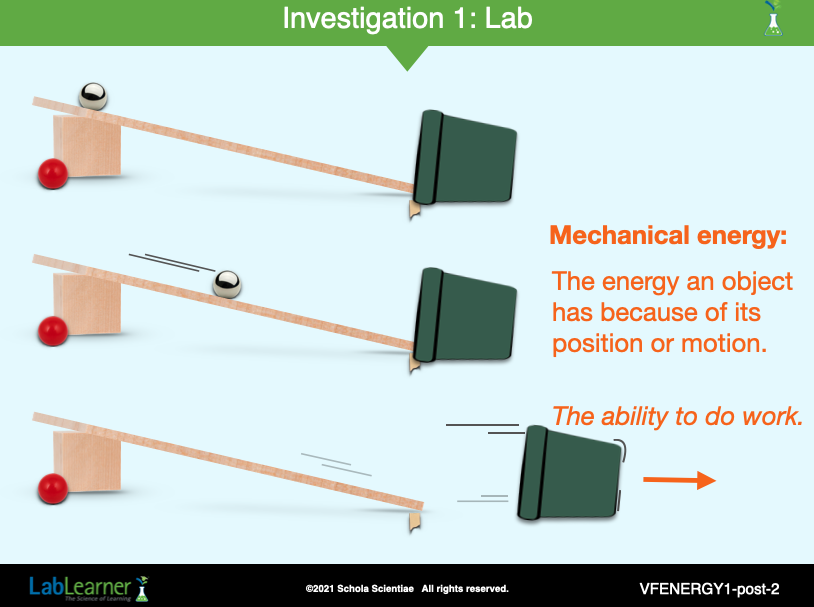
Ask students: What experiments did you perform to try to answer these questions? Students should indicate that in both Trials, they built inclined planes from a ruler and woodblocks. The first ramp used one block, and the second ramp used both blocks so that the second ramp was higher than the first. The masses of a plastic marble and a steel marble were measured as were the heights of the ramps. Students then released each marble to roll down the planes into a flower pot. Students measured the distance the flowerpot moved with each marble.
Ask students: Was work done in your experiments? How was it done? Work was done on the flower pot by the marbles. The marbles made the flower pot move when they rolled into it.
Ask students: Which form of energy involves work? Mechanical energy involves work.
______________________________________________
SLIDE VFENERGY1-post-3
- Explain to students that potential and kinetic energy are types of mechanical energy.
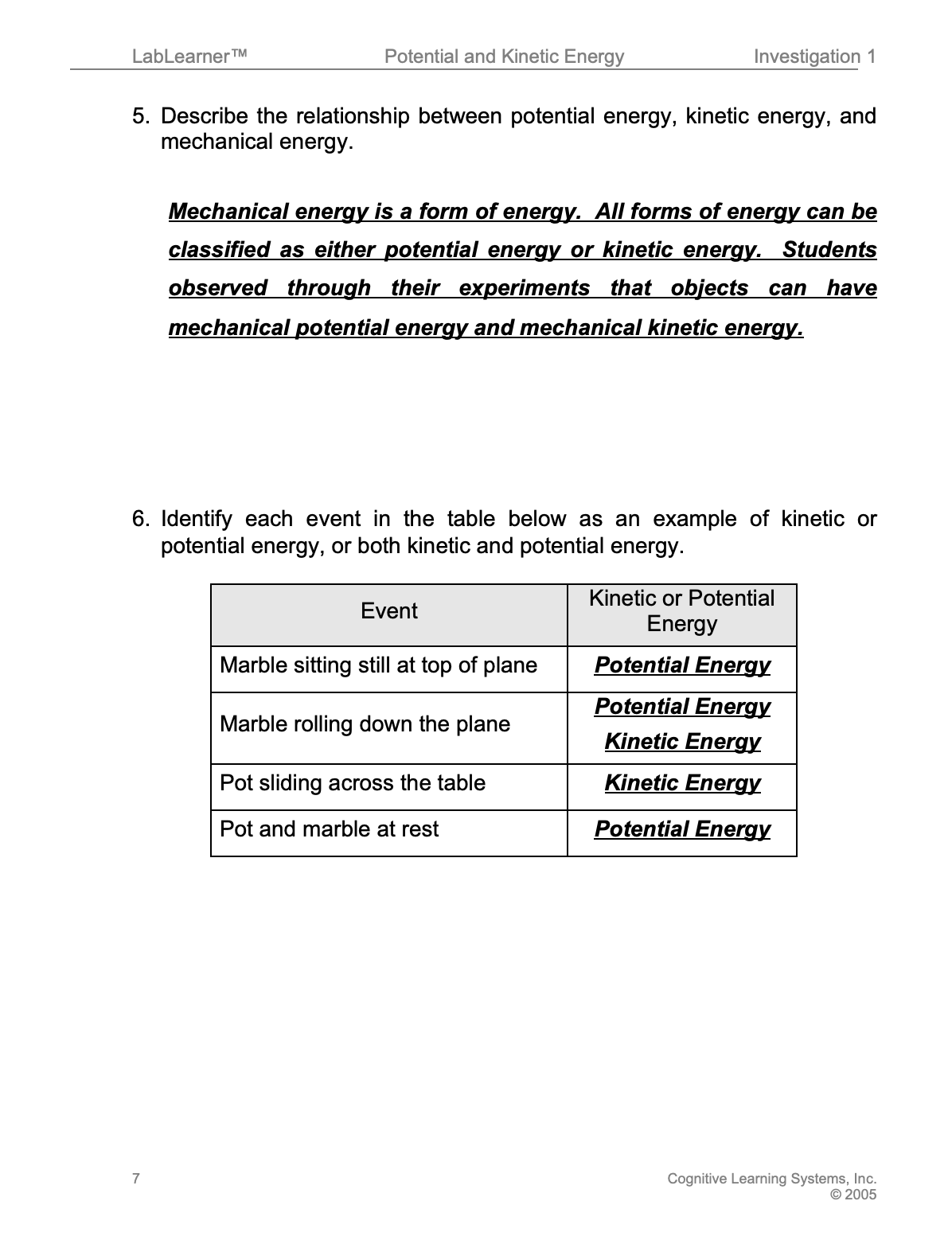
Ask students: How could you describe the relationship between potential energy, kinetic energy, and mechanical energy? Mechanical energy is a form of energy. All forms of energy can be classified as either potential energy or kinetic energy. Students observed through their experiments that objects can have mechanical potential energy and mechanical kinetic energy.
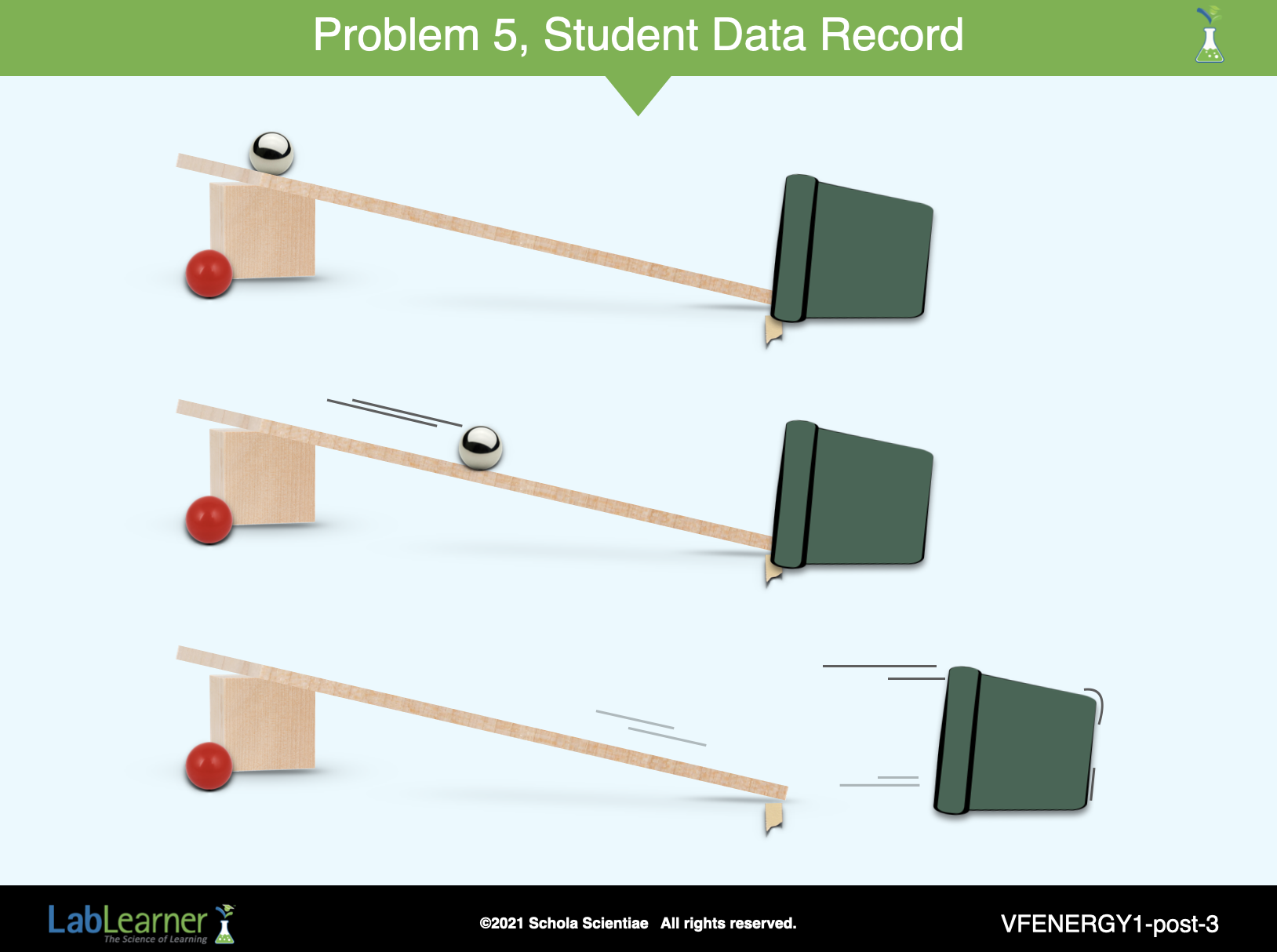
- Direct students to record their answers in Problem 5 of their Student Data Record.
Ask students: Where did you observe mechanical potential energy in your experiment? How do you know it was mechanical potential energy? The marbles had mechanical potential energy before they were released at the top of the plane. The energy was mechanical potential energy because the marble had the potential to do work on the flower pot at the bottom of the plane.
Ask students: Where did you observe mechanical kinetic energy in your experiment? How do you know it was mechanical kinetic energy? The marbles had mechanical kinetic energy when they rolled down the ramp and caused the flower pot to move. The energy was mechanical kinetic energy because the marbles were in motion and performed work on the flower pot. When the marbles hit the end of the flower pot, their kinetic energy was transferred to the flower pot, causing it to move. The flower pot then had mechanical potential energy because it was in motion and had the ability to do work. The flower pot had the ability to do work when it was in motion because it could have caused another object to move.
Ask students: Did you observe potential energy being transformed to kinetic energy in your experiments? What happened? Potential energy was transformed to kinetic energy when the marble began rolling down the inclined plane. The kinetic energy in the marbles was transformed into the kinetic energy of the flower pot. This caused the marbles to stop rolling.
Ask students: Did you observe kinetic energy being transformed into potential energy? How do you know? Students should indicate that they observed kinetic energy transformed into potential energy when the marbles stopped rolling. They transferred their kinetic energy to the flower pot causing it to move but then had potential energy again because they could have done additional work if a force had been applied to them to make them move again.
Remind students that the marbles transferred their kinetic energy to the flower pots. Ask students: What happened to the flower pots? The flower pots moved a short distance, then stopped.
Ask students: Did the flower pots transfer their kinetic energy to some other object? Student answers will vary. Students are likely to suggest that the flower pots did not transfer their kinetic energy to another object. However, the kinetic energy of the flower pot caused it to slide across the table. As the surface of the pot and the surface of the table rubbed together, the molecules in the flower pot caught on molecules in the tabletop. This catching action is called friction. Friction causes some mechanical kinetic energy to transform into heat, which is another form of kinetic energy. The rest of the mechanical kinetic energy of the flower pot was transferred to the tabletop. Because the tabletop is very large compared to the amount of kinetic energy transferred by the flower pot, it is impossible to see the kinetic energy of the table with our eyes.
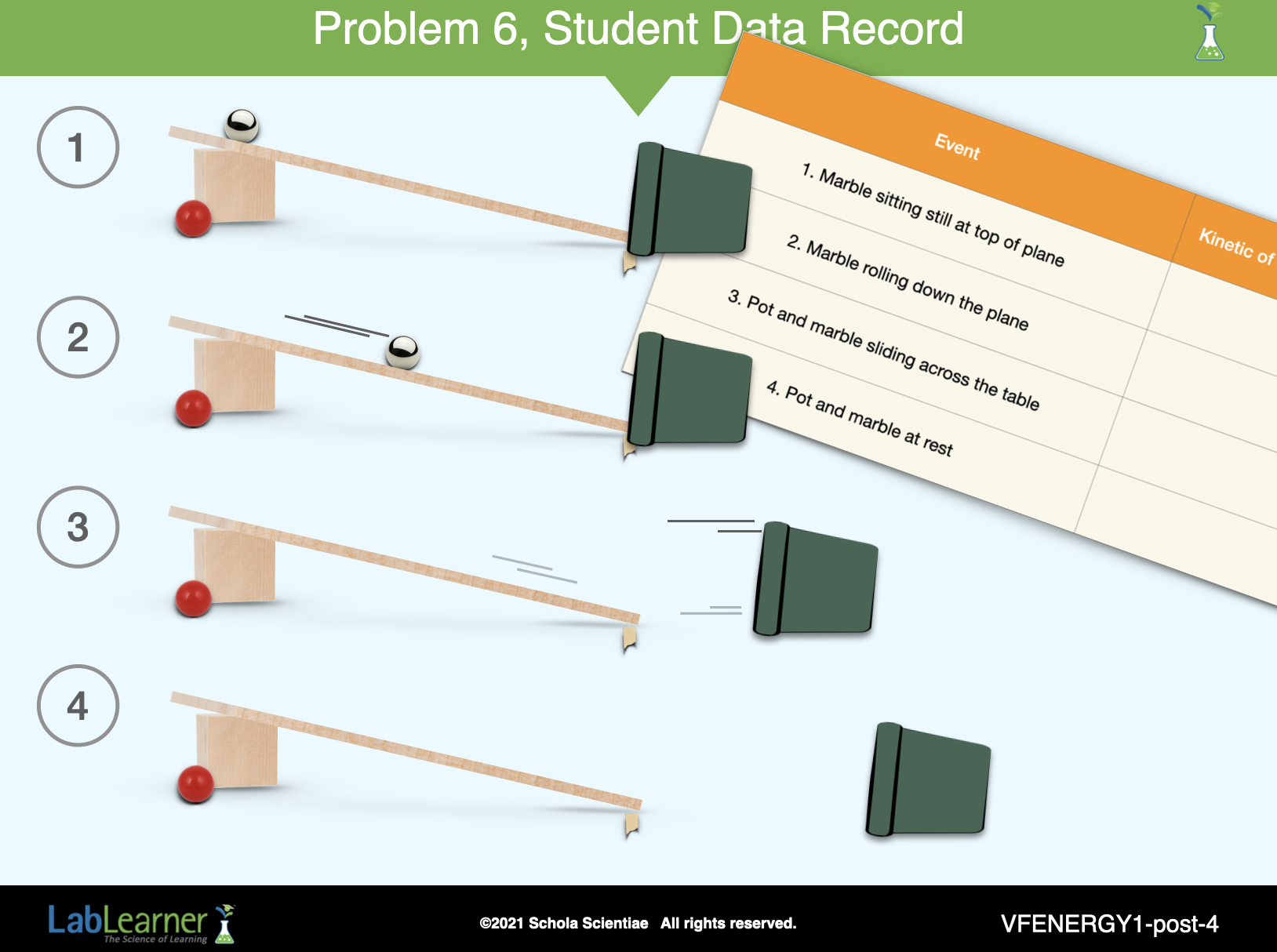
- Again remind students that their experiments in the lab demonstrated the Law of Conservation of Energy. Direct students’ attention to Problem 6 in their Student Data Record. Instruct students to identify each event as evidence of kinetic or potential energy. Students should identify the marble sitting still and the pot and marble at rest as evidence of potential energy. The marble rolling and the pot sliding are evidence of kinetic energy.
______________________________________________
SLIDE VFENERGY1-post-4
Remind students that the marbles transferred their kinetic energy to the flower pots.
Ask students: What happened to the flower pots? The flower pots moved a short distance, then stopped.
Ask students: Did the flower pots transfer their kinetic energy to some other object? Student answers will vary. Students are likely to suggest that the flower pots did not transfer their kinetic energy to another object. However, the kinetic energy of the flower pot caused it to slide across the table. As the surface of the pot and the surface of the table rubbed together, the molecules in the flower pot caught on molecules in the tabletop. This catching action is called friction. Friction causes some mechanical kinetic energy to transform into heat, which is another form of kinetic energy. The rest of the mechanical kinetic energy of the flower pot was transferred to the tabletop. Because the tabletop is very large compared to the amount of kinetic energy transferred by the flower pot, it is impossible to see the kinetic energy of the table with our eyes.
- Again remind students that their experiments in the lab demonstrated the Law of Conservation of Energy.
- Direct students’ attention to Problem 6 in their Student Data Record. Instruct students to identify each event as evidence of kinetic or potential energy. Students should identify the marble sitting still and the pot and marble at rest as evidence of potential energy. The marble rolling and the pot sliding are evidence of kinetic energy.
______________________________________________
SLIDE VFENERGY1-post-5
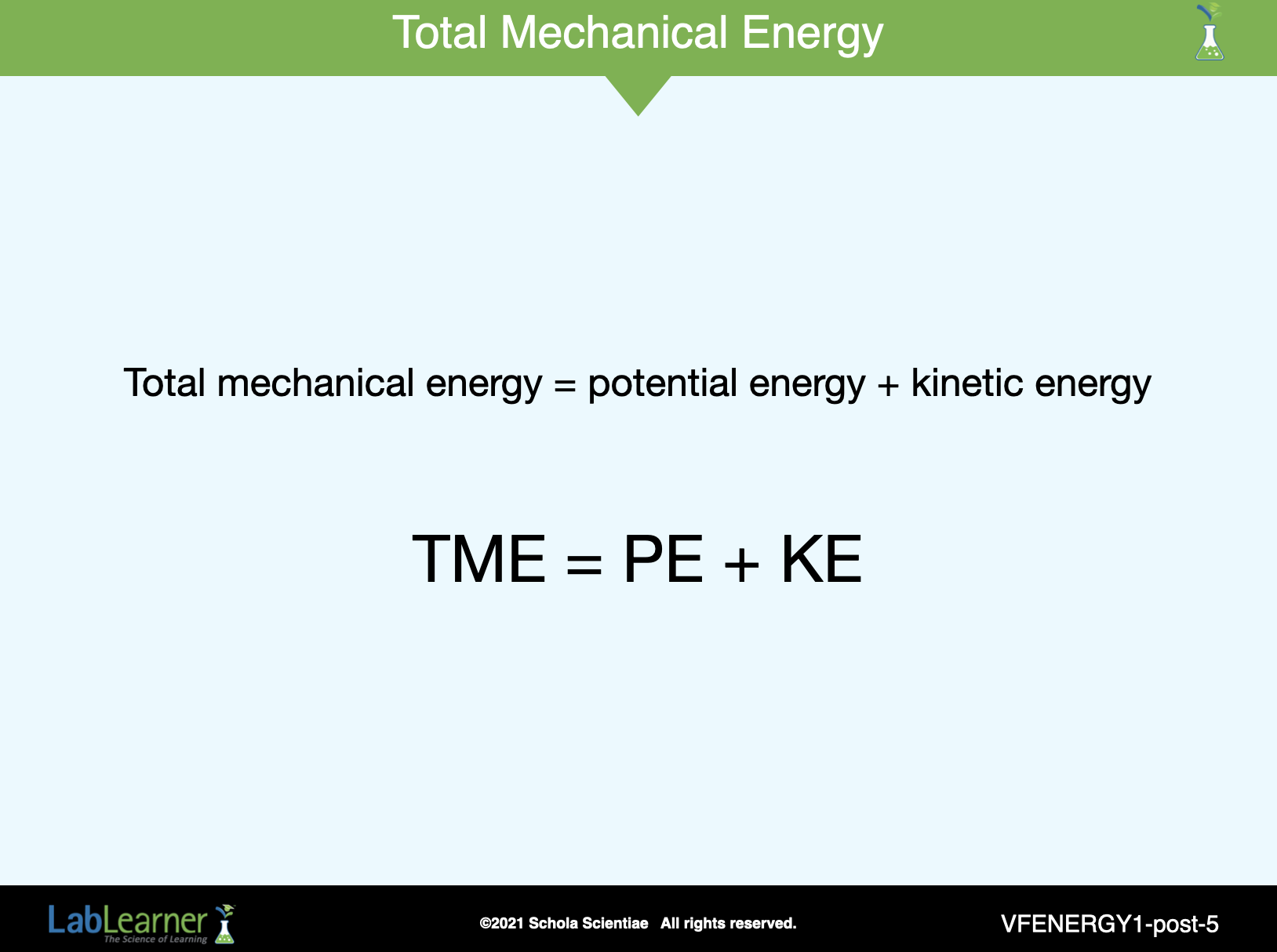
Continue the analysis by introducing students to the concept that the total mechanical energy is the sum of an object’s potential energy plus its kinetic energy.
- Explain to students that potential and kinetic energy make up mechanical energy. When there is more potential energy, there is less kinetic energy. When there is more kinetic energy, there is less potential energy.
- Refer to the following equation:
Total mechanical energy = potential energy + kinetic energy
Ask students: What type of energy is stored energy? What type of energy is the energy of motion? Stored energy is potential energy. Kinetic energy is the energy of motion.
- Explain that the equation shows that the mechanical energy of an object is the sum of its potential energy plus its kinetic energy.
Ask students: How can the equation for total mechanical energy be used to explain what happened in the lab? Student answers will vary. The equation shows that the total amount of energy that an object has is the sum of its kinetic and potential energies. Students should recall that when an object moves its potential energy transforms to kinetic energy or its kinetic energy changes to potential energy.
______________________________________________
SLIDE VFENERGY1-post-6
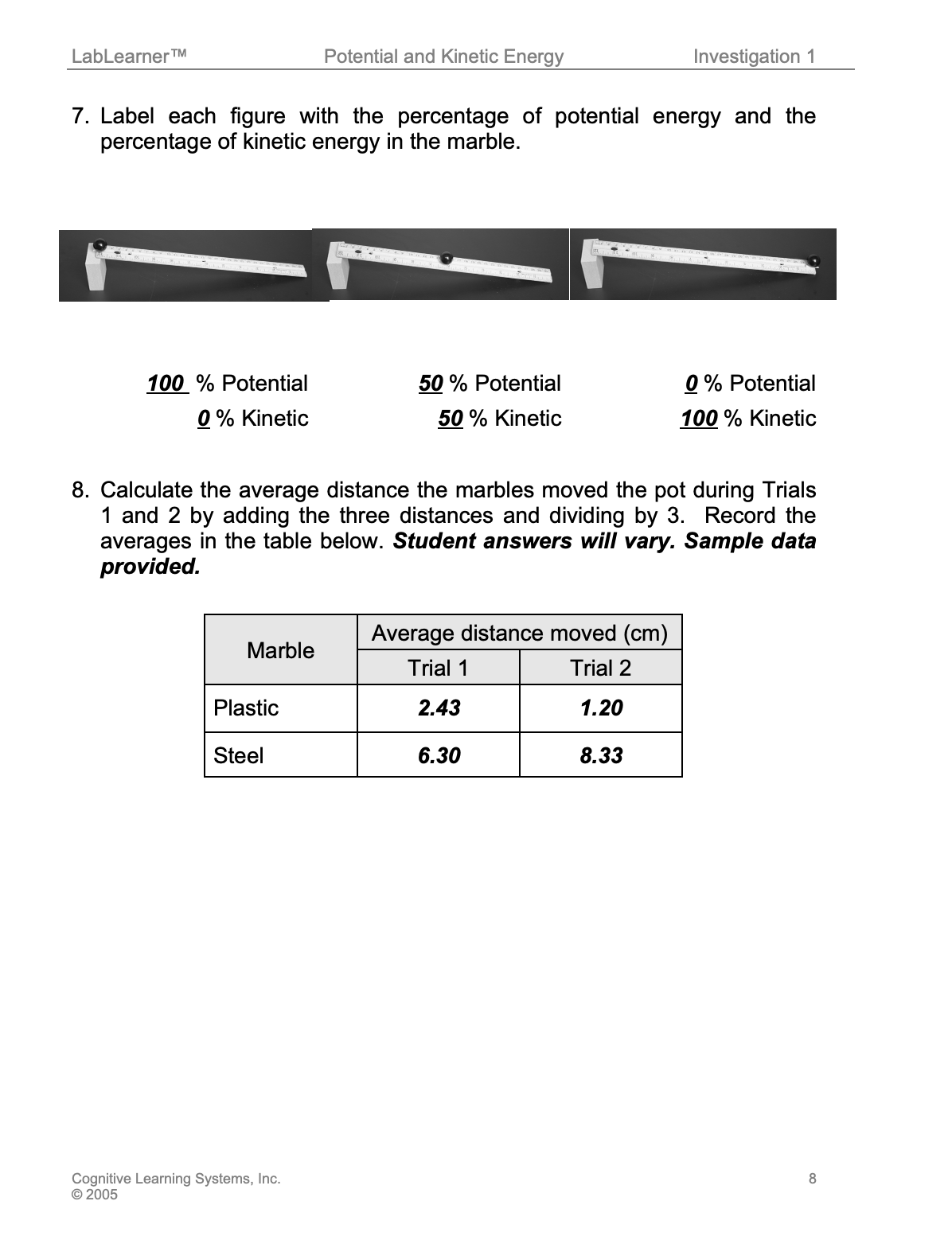
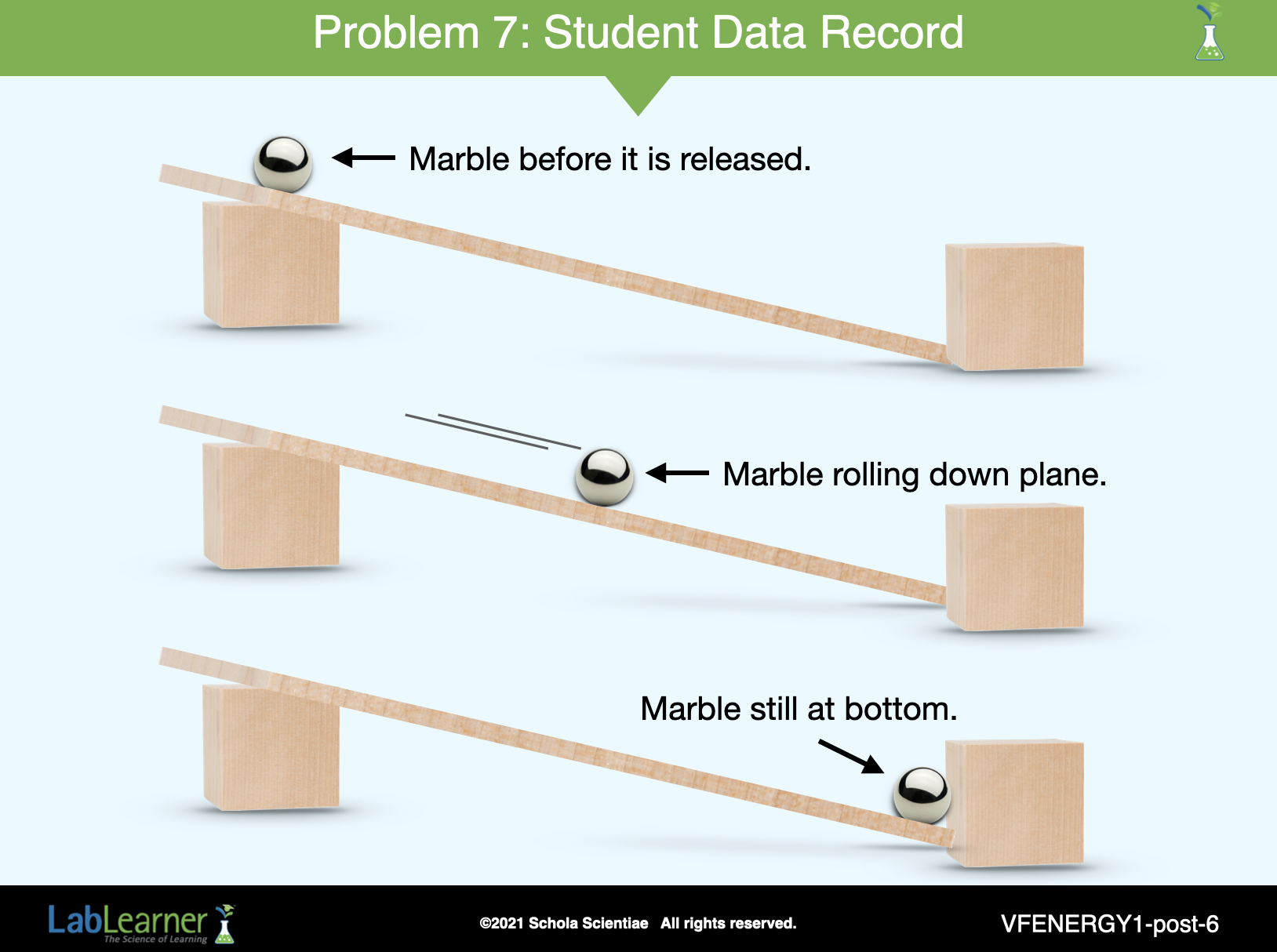
Direct students’ attention to Problem 7 in their Student Data Record.
Tell students to look at the top figure in this slide. Ask students: Where did the marble have the greatest potential energy? Students should indicate that the marble had the greatest potential energy at the top of the plane.
Ask students: Where did the marble have the least kinetic energy? Students should indicate that the marble had the least kinetic energy at the top of the plane.
Ask students: Could this relationship be represented by using numbers or percentages? How? Because all of the energy was in the form of potential energy at the top of the plane, we can say that the marble had 100% potential energy and 0% kinetic energy when it was at the top. Instruct students to write the percentages under the left-most picture in Problem 7.
Ask students: Where did the marble have the greatest kinetic energy? Students should indicate that the marble had the greatest kinetic energy just as it reached the bottom of the plane.
Ask students: Where did the marble have the least potential energy? Students should indicate that the marbles had the least potential energy at the bottom of the plane.
Ask students: Could this relationship be represented by using numbers or percentages? How? At the bottom of the plane, the marble had 0% potential energy and 100% kinetic energy. Instruct students to write the percentages in Problem 7 under the middle picture.
Ask students: Where might the kinetic and potential energies be equal? Could this relationship be represented with numbers or percentages? When the marble is halfway down the plane, one-half of its energy is potential energy and one half of its energy is kinetic energy. In number form this would be written as 50% potential energy and 50% kinetic energy.
- Instruct the students to write the percentages in Problem 7 under the right most picture in their Student Data Record.
______________________________________________
SLIDE VFENERGY1-post-7
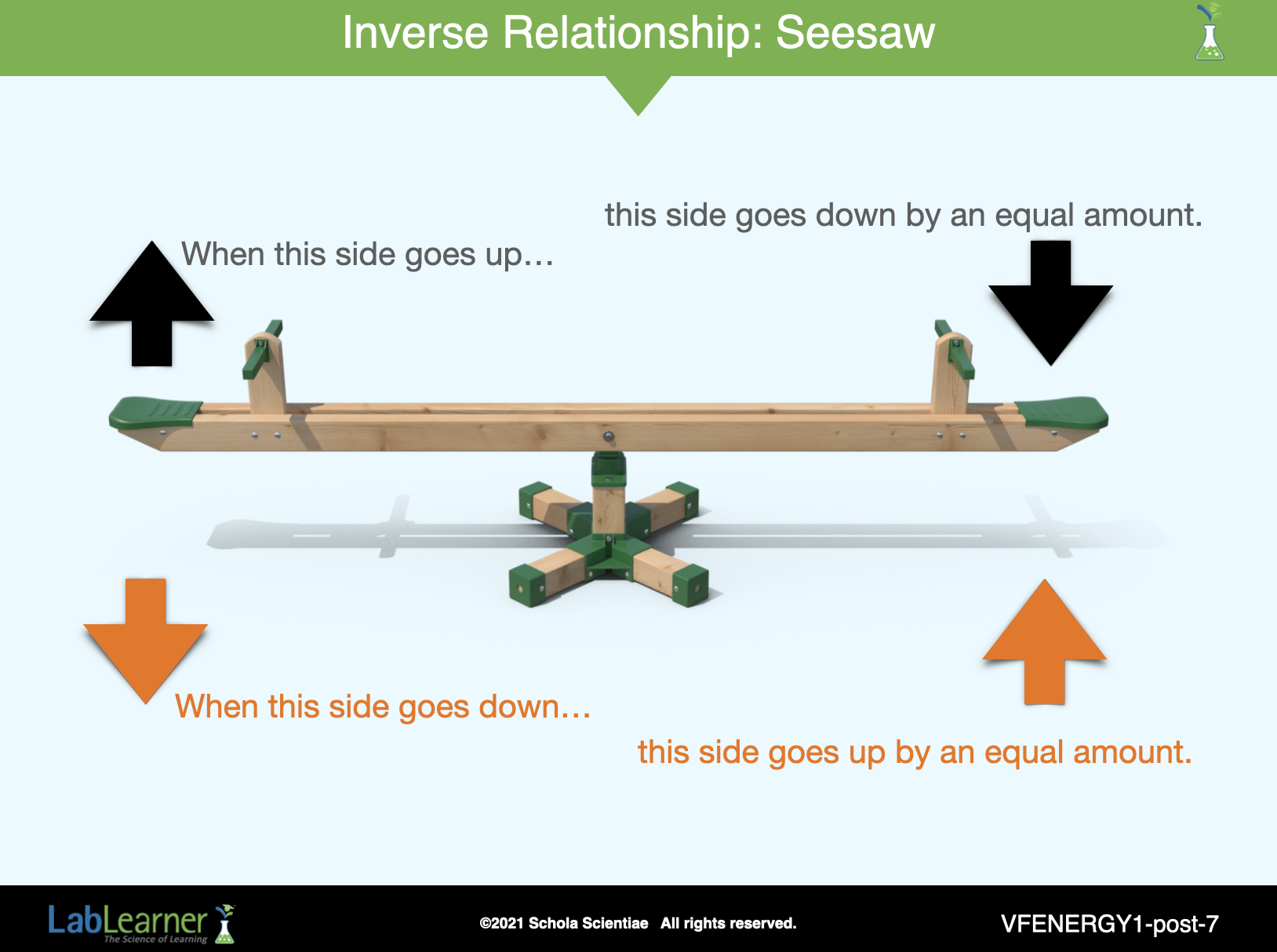
Tell students that because equations demonstrate or explain relationships, they can be used to create rules regarding these relationships.
Explain to students that one way to describe the relationship between potential energy and kinetic energy is that they are inversely related. When an inverse relationship is observed, it means that as one thing increases, the other decreases.
Assist students in understanding the inverse relationship between potential and kinetic energy by asking the following questions:
Ask students: What happened to the potential energy as the marble rolled down the platform? Potential energy decreased.
Ask students: What happened to kinetic energy as the marble rolled down the platform? Kinetic energy increased.
Ask students: Can you put these two statements together to make a rule? As the potential energy of an object decreases its kinetic energy increases.
Ask students: Did you observe this in your experiments? Where? As the marbles rolled down the plane, the potential energy decreased from 100% to 0%. At the same time, the kinetic energy was increasing from 0% to 100%.
______________________________________________
SLIDE VFENERGY1-post-8
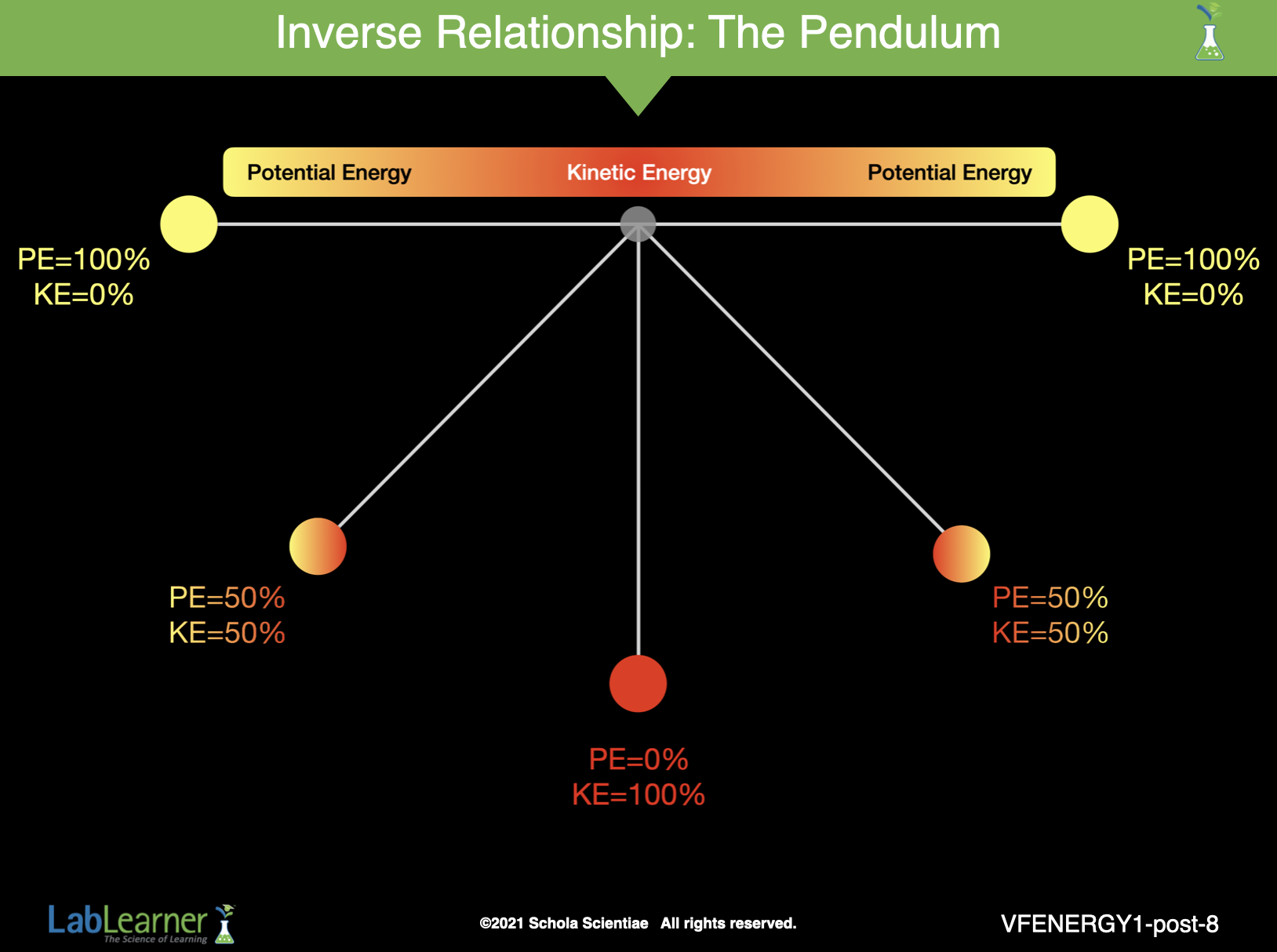
This slide of a pendulum shows a different way to consider the relationship (an inverse relationship) between potential and kinetic energy.
At the highest point of the swing of a pendulum, the object essentially comes to a stop in order to reverse direction. As we have discussed, an object at rest is 100% potential energy.
As the swing or pendulum begins falling, it loses potential energy as it is converted into kinetic energy of motion. It is very important to notice that the conversion of potential into kinetic energy occurs smoothly, percent by percent, during a complete swing cycle.
In this, kinetic energy is indicated by the color red and potential energy is represented by the color yellow. Look at how gradually the change occurs. At no time in the swing-cycle does the amount of potential energy plus kinetic energy ever equal greater than or less than 100% total energy. That would break the Law of Conservation of Energy. That can’t happen!
______________________________________________
SLIDE VFENERGY1-post-9
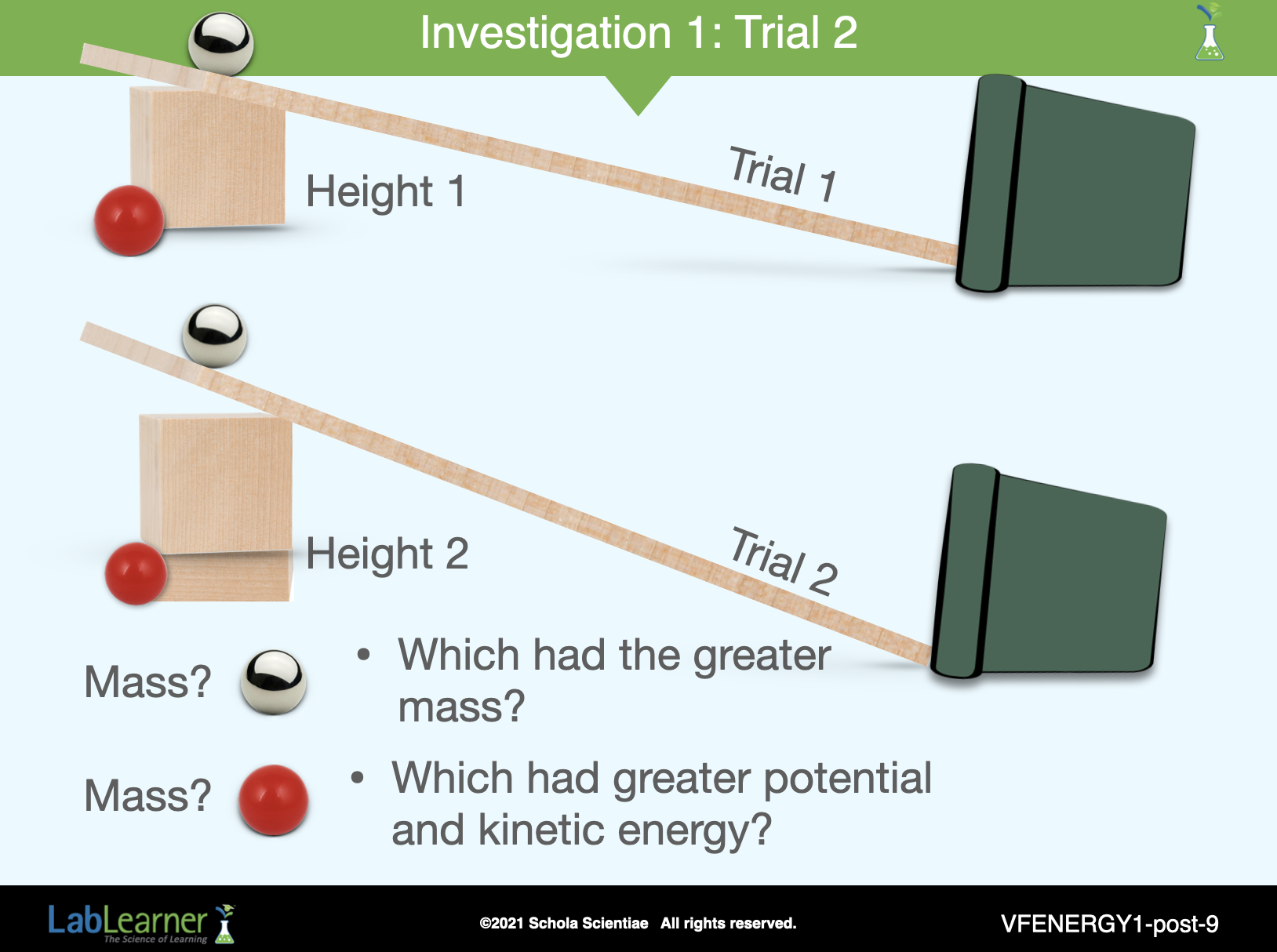
Complete the analysis by examining the effect of varying mass on potential and kinetic energy.
Direct students to calculate the average distance each marble traveled in the two Trials by adding the three distances and dividing by 3.
Direct students to record their averages in the Table in Problem 8 of their Student Data Record. Space has been provided below the table for students to show their math. Student answers will vary.
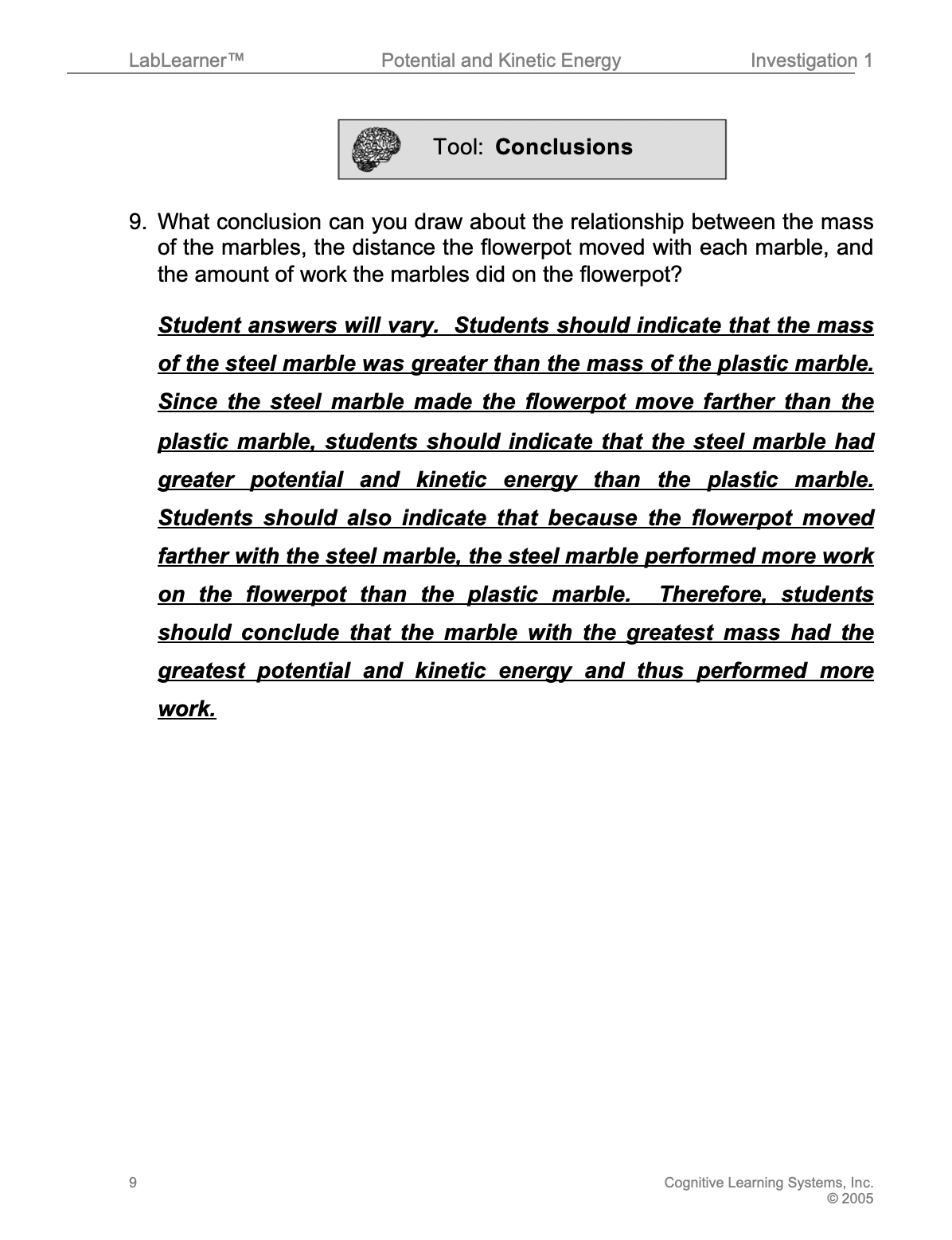
Ask students: Which marble had the greater mass? The steel marble had the greater mass.
Ask students: Which marble made the flower pot move the greatest distance in Trial 1? In Trial 2? The steel marble made the flower pot move the greatest distance in each trial.
Ask students: How does the mass of an object affect its potential energy? Students should indicate that the greater the mass of an object, the greater its potential energy.
Ask students: How does the mass of an object affect its kinetic energy? Students should indicate that the greater the mass of an object, the greater its kinetic energy.
Ask students: How can the potential or kinetic energy of an object be changed? Student answers may vary. Students should indicate that changing an object’s mass should change its potential and kinetic energy. Some students may also point out that the potential and kinetic energy of each marble increased when the height of the ramp increased.
Ask students: How can the mechanical energy of an object be changed? Students should indicate that changing the mass of an object will change its mechanical energy. In addition, changing the height of an object will change its mechanical energy.
______________________________________________
KEYS: POSTLAB