
Teacher Portal:
Earth and Space Journey
Two: Earth’s Place in the Universe
 PRINT IT
Use your browser to download a printable PDF as help during the slide presentation and to make additional notes. In your browser, go to File > Print and then choose to save as PDF.
NAVIGATE IT
Once the slide presentation is launched
- use your left and right arrows to advance or go back in the slide presentation, and
- hover your mouse over the left edge of the presentation to get a view of the thumbnails for all the slides so that you can quickly move anywhere in the presentation.
- Click HERE to launch the slide presentation for the CELL.
SHARE IT
SLIDE 2VES-1
______________________________________________
SLIDE 2VES-2
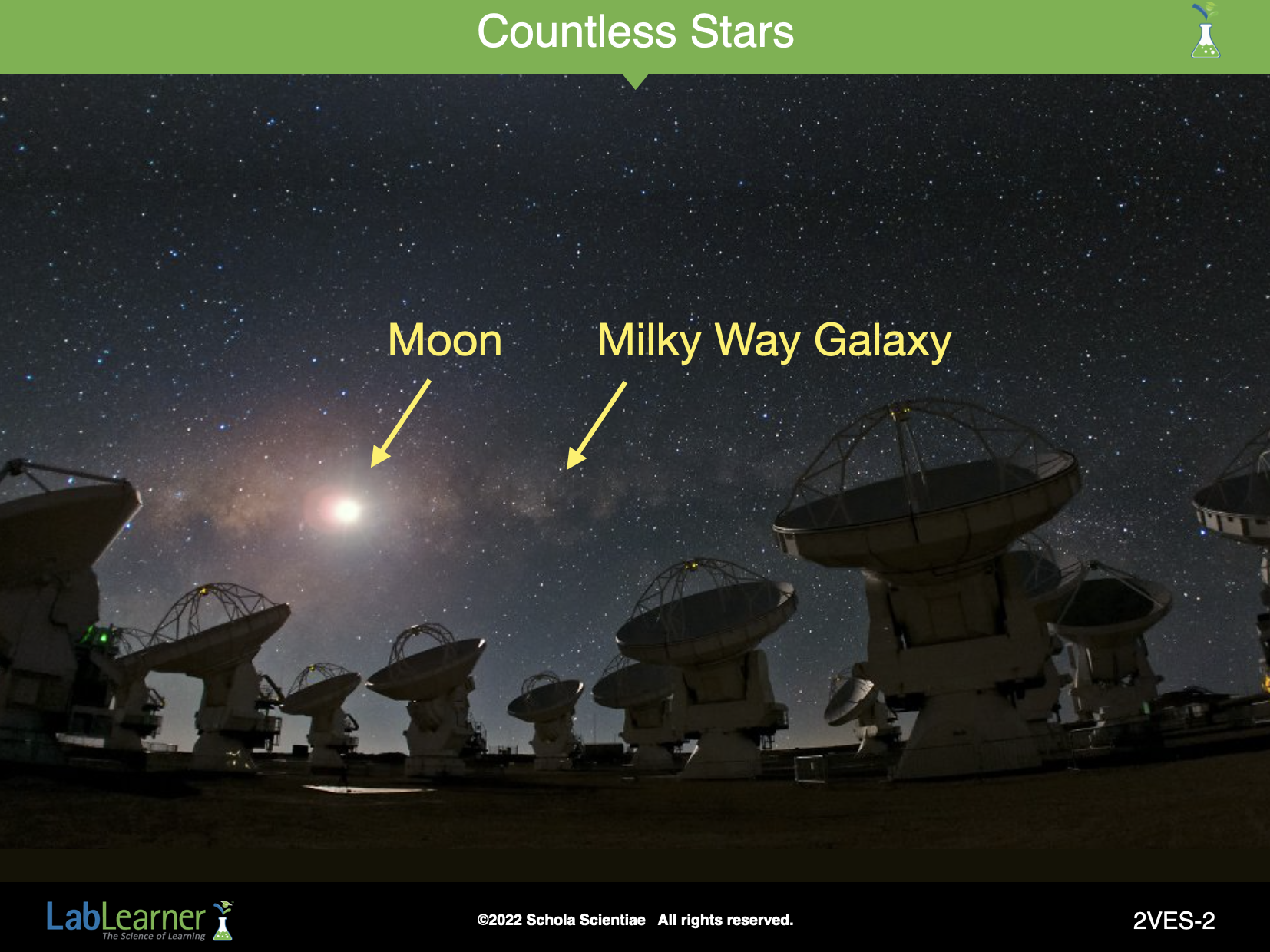
- Explain to students that we will briefly turn our focus to space to find the source of energy required to drive the cycling of matter. Most cycles, including the life cycle found in most food chains and food webs, gain this energy from a nearby star called the Sun. Like countless stars in this photograph, the Sun is a hot, bright ball of gases. Unlike other stars, however, the Sun provides heat and light to Earth, and as we will see, influences life and surface processes in many ways.
- The image shows the antennas of the Atacama Large Millimeter/submillimeter Array (ALMA) against a starry night sky. ALMA is the largest astronomical project in existence. It is a single telescope, composed of 66 high-precision antennas.
Note: ALMA is capturing never-before-seen details about the very first stars and galaxies in the Universe. It is also probing the heart of our Milky Way Galaxy and directly imaging the formation of planets. Scientists consider it to be the largest leap in telescope technology since Galileo first aimed a lens at the Universe.
- In addition to countless stars, two other familiar celestial objects also stand out in the image. First, the Moon glows to the left, reflecting light from the sun. Second, it is possible to distinguish the Milky Way Galaxy (our own Galaxy) as a hazy stripe across the sky.
- Ask students to guess how many stars are in the universe.
Note: The universe is defined as all existing matter and space.
Note: Accept all answers.
- Explain that it is easy to ask this question but difficult for scientists to give a fair answer. Stars are not scattered randomly through space, they are gathered together into vast groups known as galaxies. The Sun belongs to a galaxy called the Milky Way. Astronomers estimate there are about 100 thousand million stars in the Milky Way alone. Outside that, there are millions upon millions of other galaxies. That’s a lot of stars!
______________________________________________
SLIDE 2VES-3
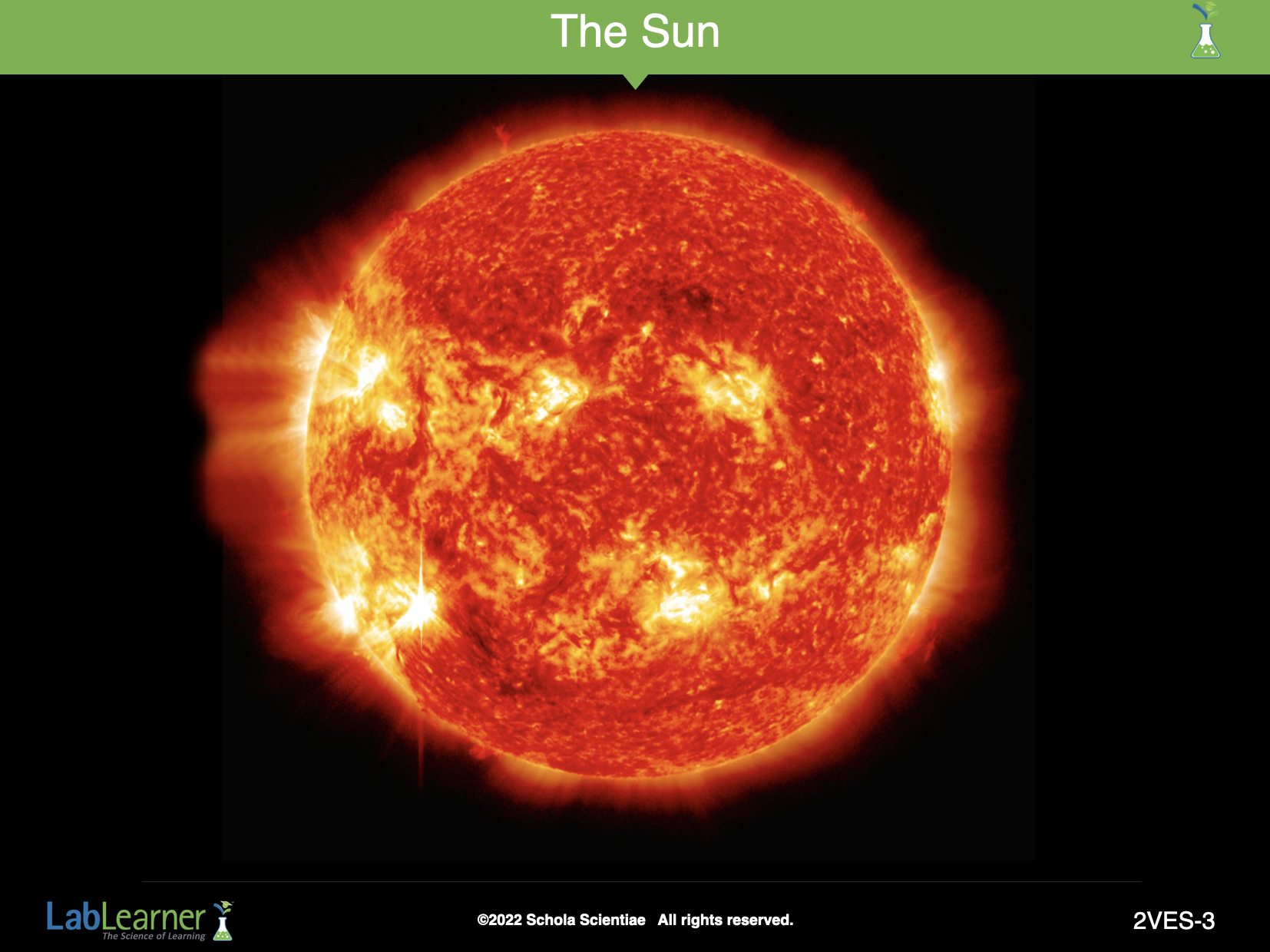
Like everything else in the Universe, the Sun is composed of matter. In the case of the Sun, it is mainly composed of two elements that are also common on Earth and throughout the Universe, hydrogen (H) and helium (He).
As hydrogen is converted into helium in the core of the Sun, a tremendous amount of energy is released, radiating out in all directions.
The energy released by the Sun is captured by plants on Earth and is passed throughout the food chain as animals eat plants and grow.
______________________________________________
SLIDE 2VES-4
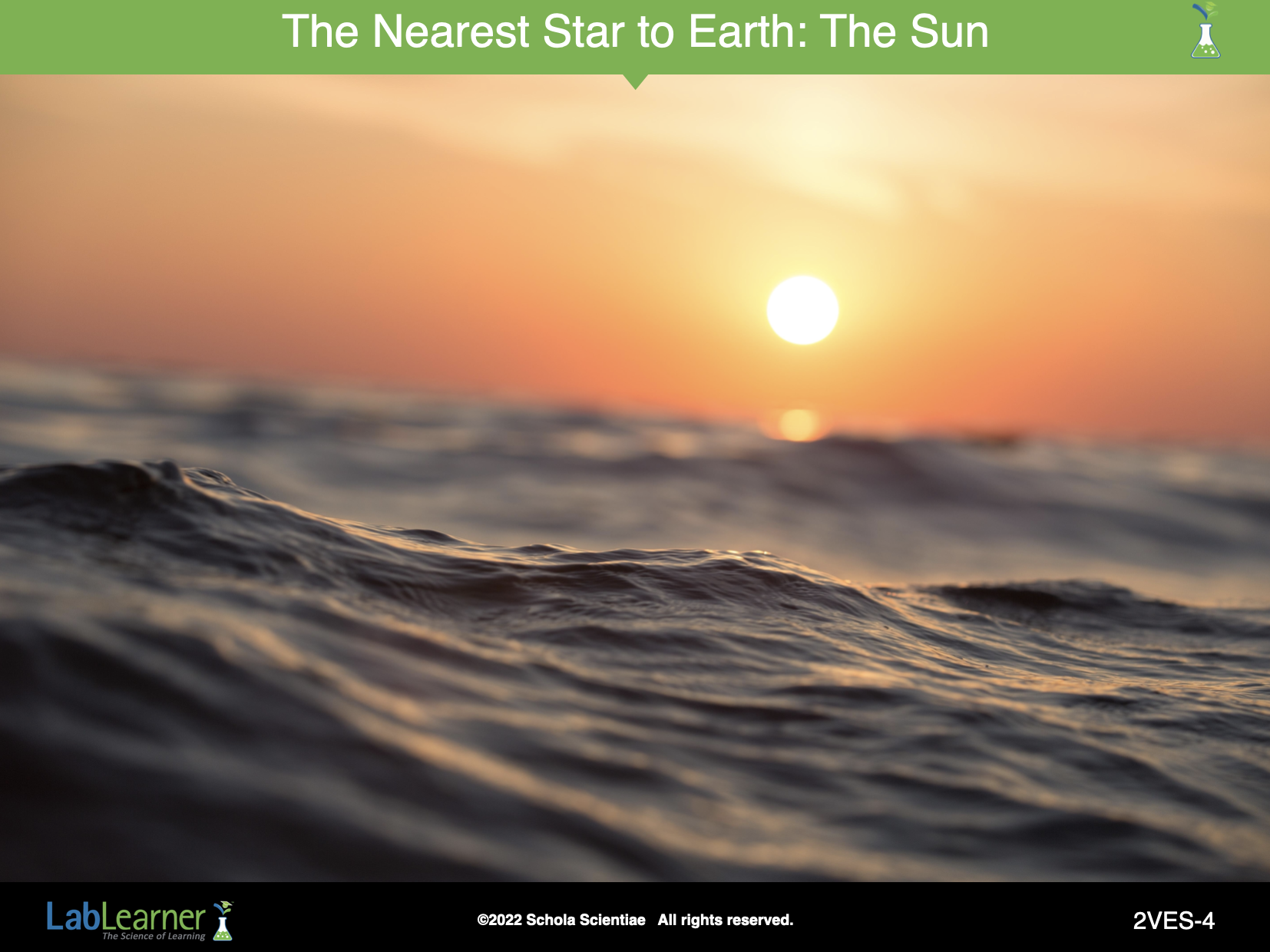
Explain to students that the image shows the Sun.
Ask students, “Why, if there are countless stars in the universe, does the Sun look so much brighter compared to other stars.” The answer to this question will be addressed on the next slide.
Note: Students may ask about the difference between a star and a Sun. A star is defined as a “Sun” if it has planets orbiting around it.
Note: Students may ask why other stars are not visible during the day. It is possible to see stars during the day. First, there’s the Sun, our nearest star, but observing it directly is dangerous without using the proper shields and equipment. Other individual, bright stars can be seen with a telescope. With the unassisted eye, they are not visible due to the bright glare of sunlight.
______________________________________________
SLIDE 2VES-5
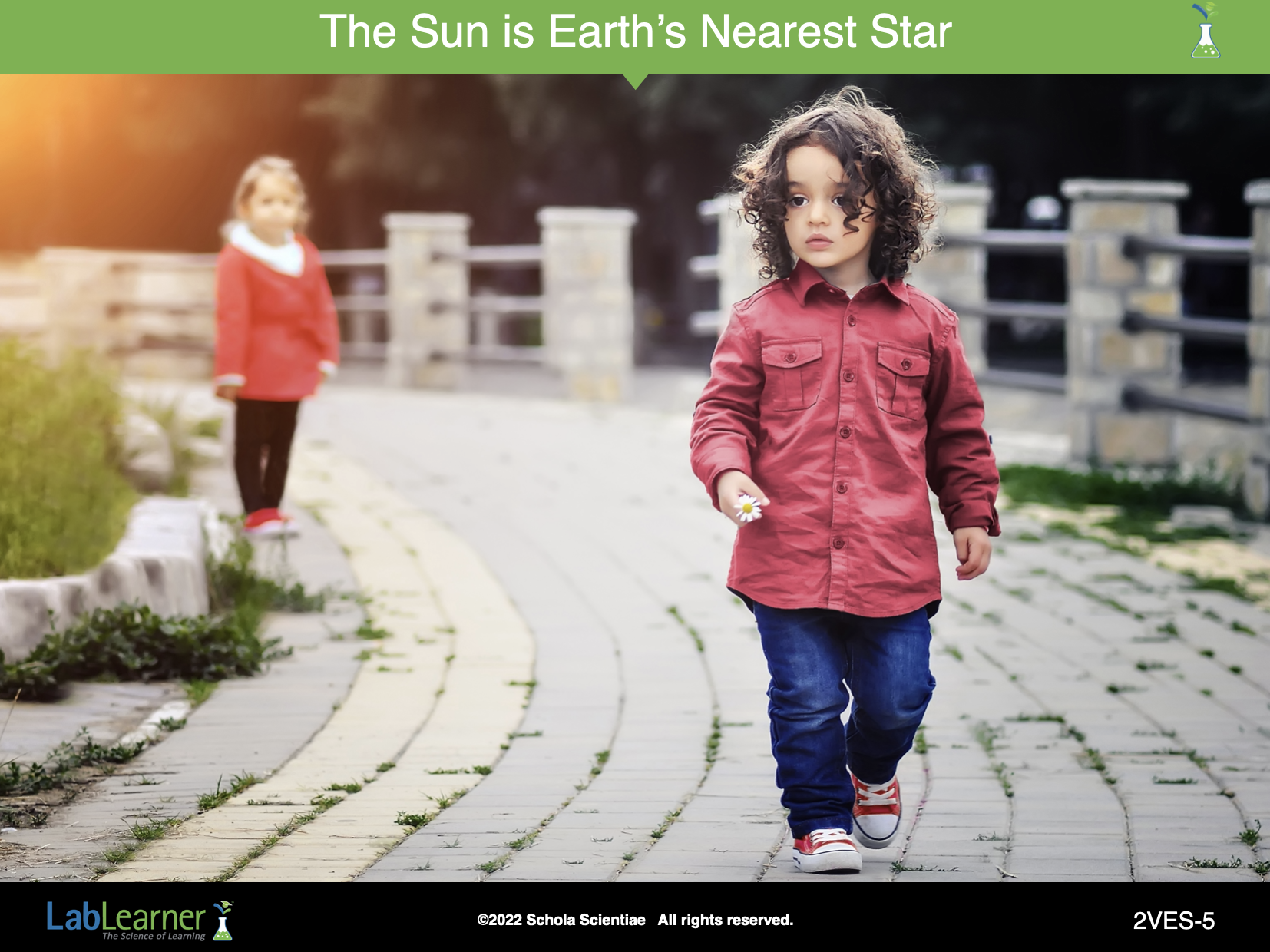
These two siblings are about the same height and size. Why does one look so much bigger than the other? Answer: One child is much closer to us.
For similar reasons, our Sun looks much bigger and brighter than any other star to us because it is so close compared to other stars.
______________________________________________
SLIDE 2VES-6
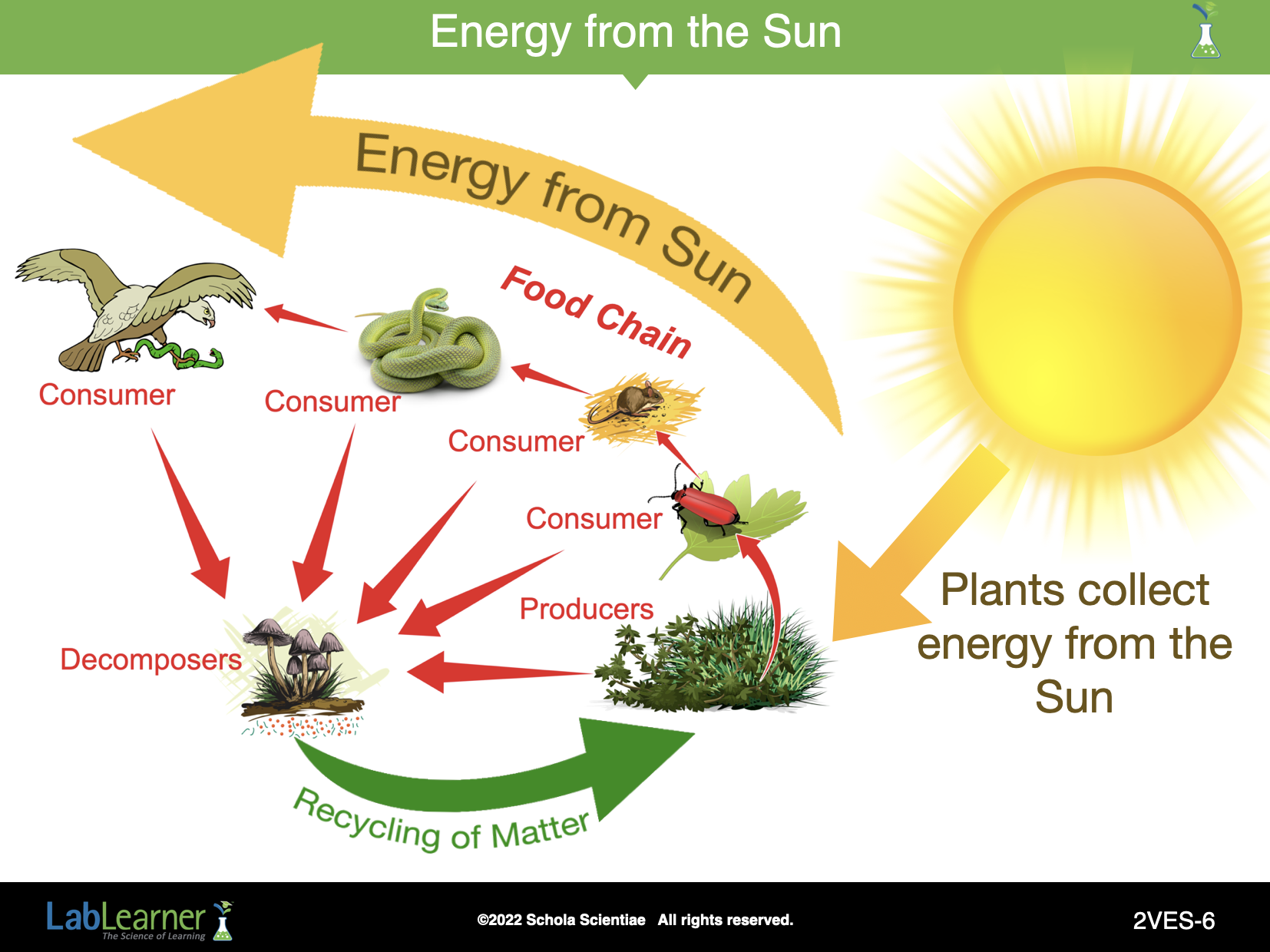
- Explain to students that the only energy available to most ecosystems on Earth comes from the nuclear fusion reactions that take place in the deep interior of the Sun. During this process, the Sun recycles hydrogen matter and, as it does, releases an incredible amount of energy in the form of light and heat, and Earth sits just the right distance from the Sun to benefit from this light and heat.
- Since the Sun is only a fraction of a light-year away from Earth (0.00001581 light-years), light energy leaving the surface of the Sun takes about eight minutes (8.3154276) to reach Earth’s surface. When it does, it is trapped by the photosynthetic machinery of plants and micro-algae. The energy then gets cycled through food webs and ecosystems. In addition to the cycling of energy, the cycling of matter through most ecosystems on Earth would not be possible without the light and heat energy from our closest star.
______________________________________________
SLIDE 2VES-7
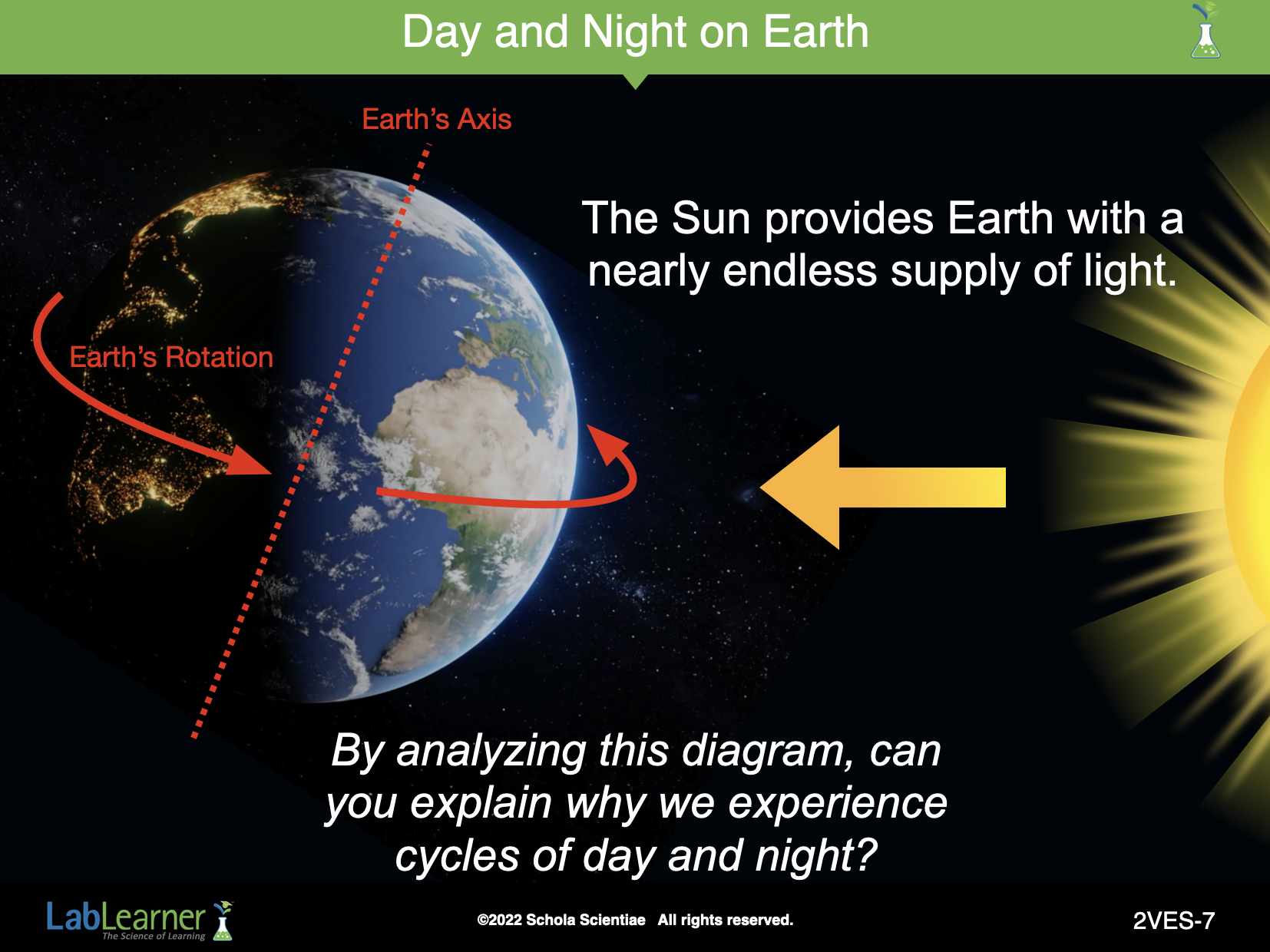
This is the first slide that focuses on the result of the Earth’s rotation on its axis in relation to day and night.
______________________________________________
SLIDE 2VES-8
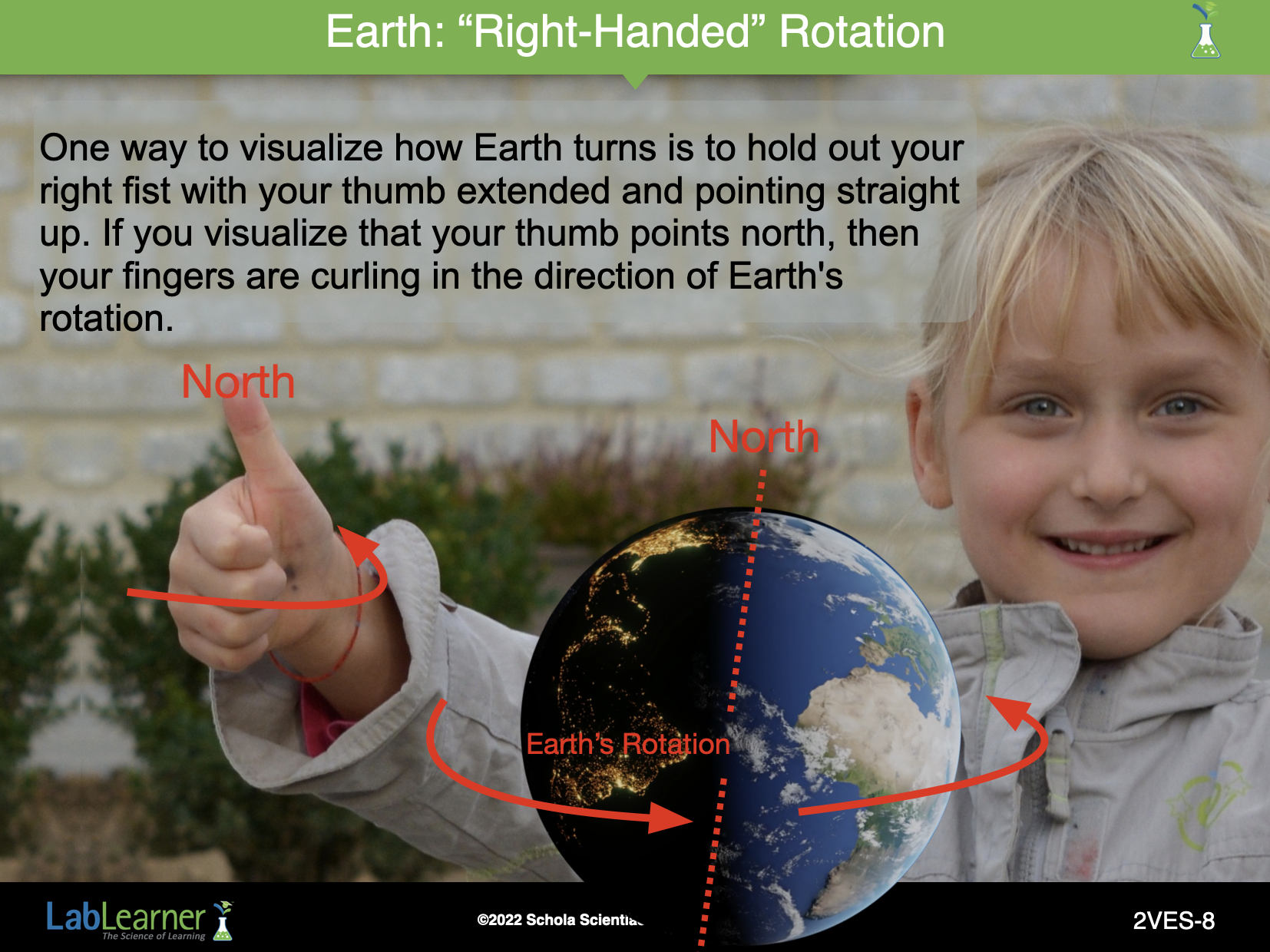
One way to visualize how Earth rotates is to hold out your right fist with your thumb extended and pointing straight up. If you visualize that your thumb points north, then your fingers are curling in the direction of Earth’s rotation. We can say that the earth rotates in a “right-handed” manner (because you are using your right hand as a model).
______________________________________________
SLIDE 2VES-9
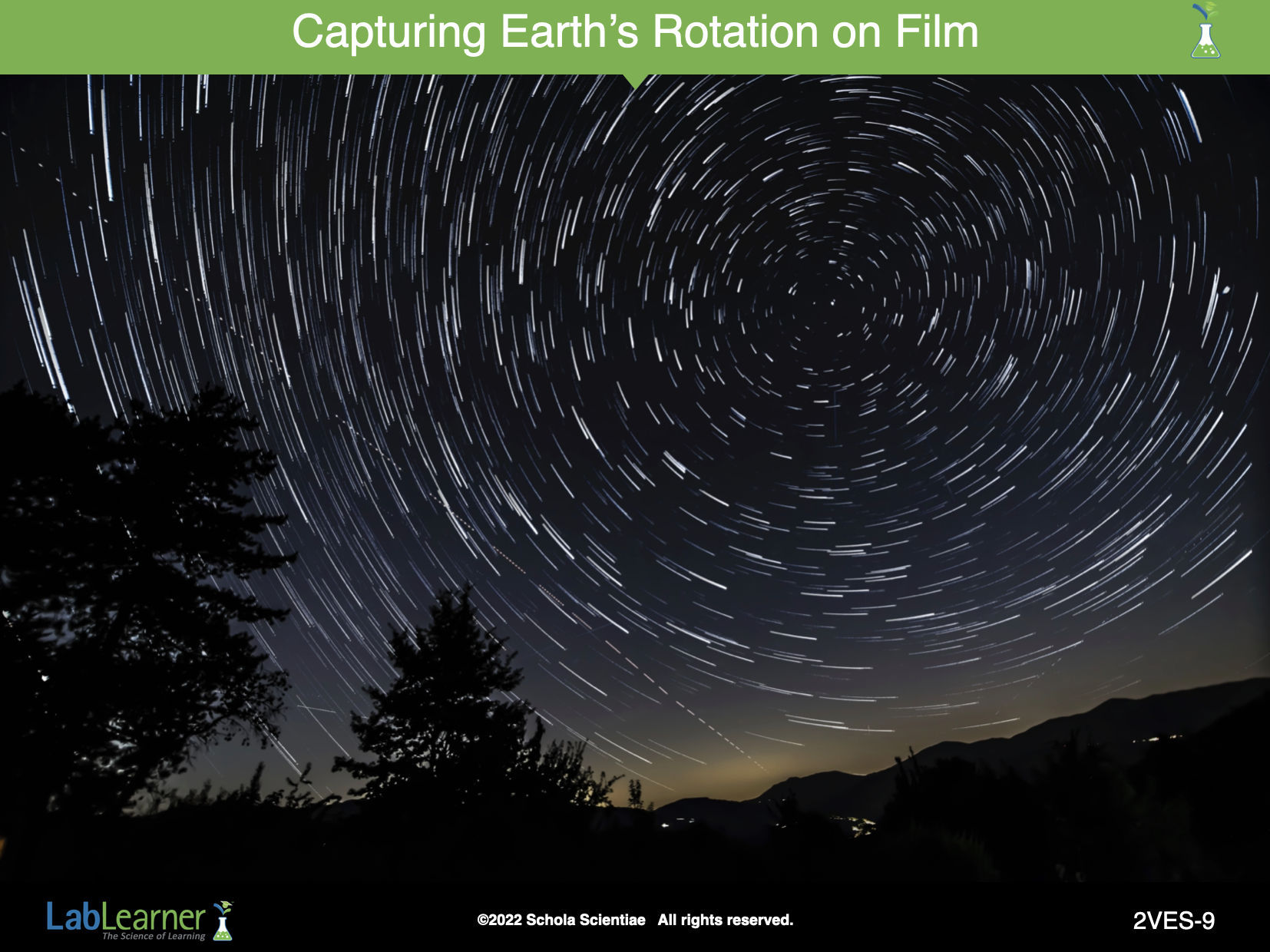
- Explain to students that the strange lines arcing across the night sky are called star trails and are captured by leaving a camera shutter open for an extended period of time. Each and every line is a star.
- The stars appear like curved lines instead of light dots due to Earth’s rotation. As Earth spins around its axis the stars seem to ‘move’. This is actually an apparent motion. Stars, including the Sun, are in fixed positions, therefore it is Earth’s motion that is captured in photographs like this.
______________________________________________
SLIDE 2VES-10
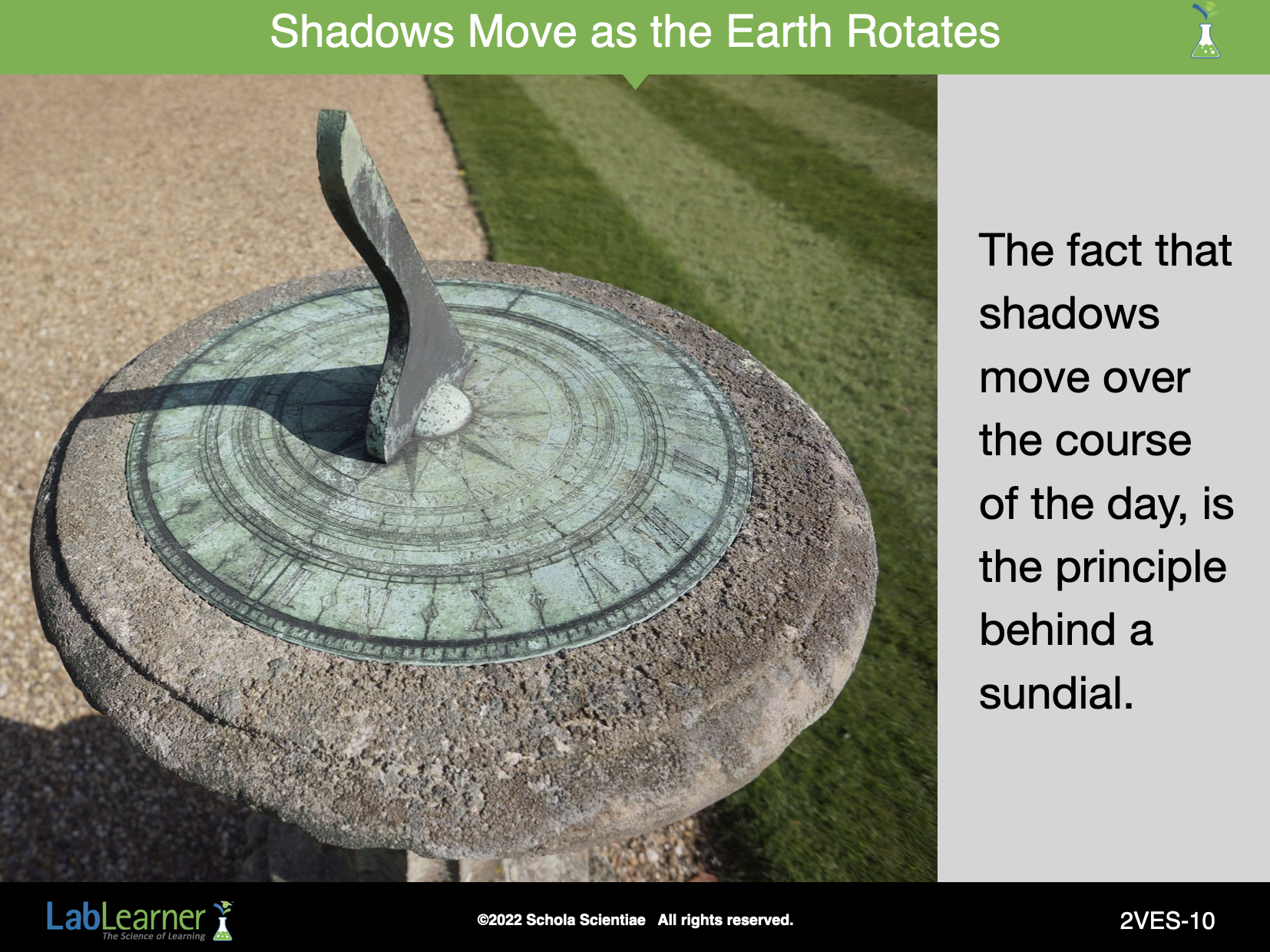
Shadows are produced when light hits an opaque object which prevents the light beams from passing through. When an object blocks the light’s path, then darkness appears on the other side. This darkness is called a shadow.
The fact that the sun’s position changes over the course of the day, thus causing a change in the shape of the shadows its light creates, is the principle behind a sundial. Sundials, like this one, use a central shadow-casting object to cast shadows in a circular pattern that changes throughout the day.
______________________________________________
SLIDE 2VES-11
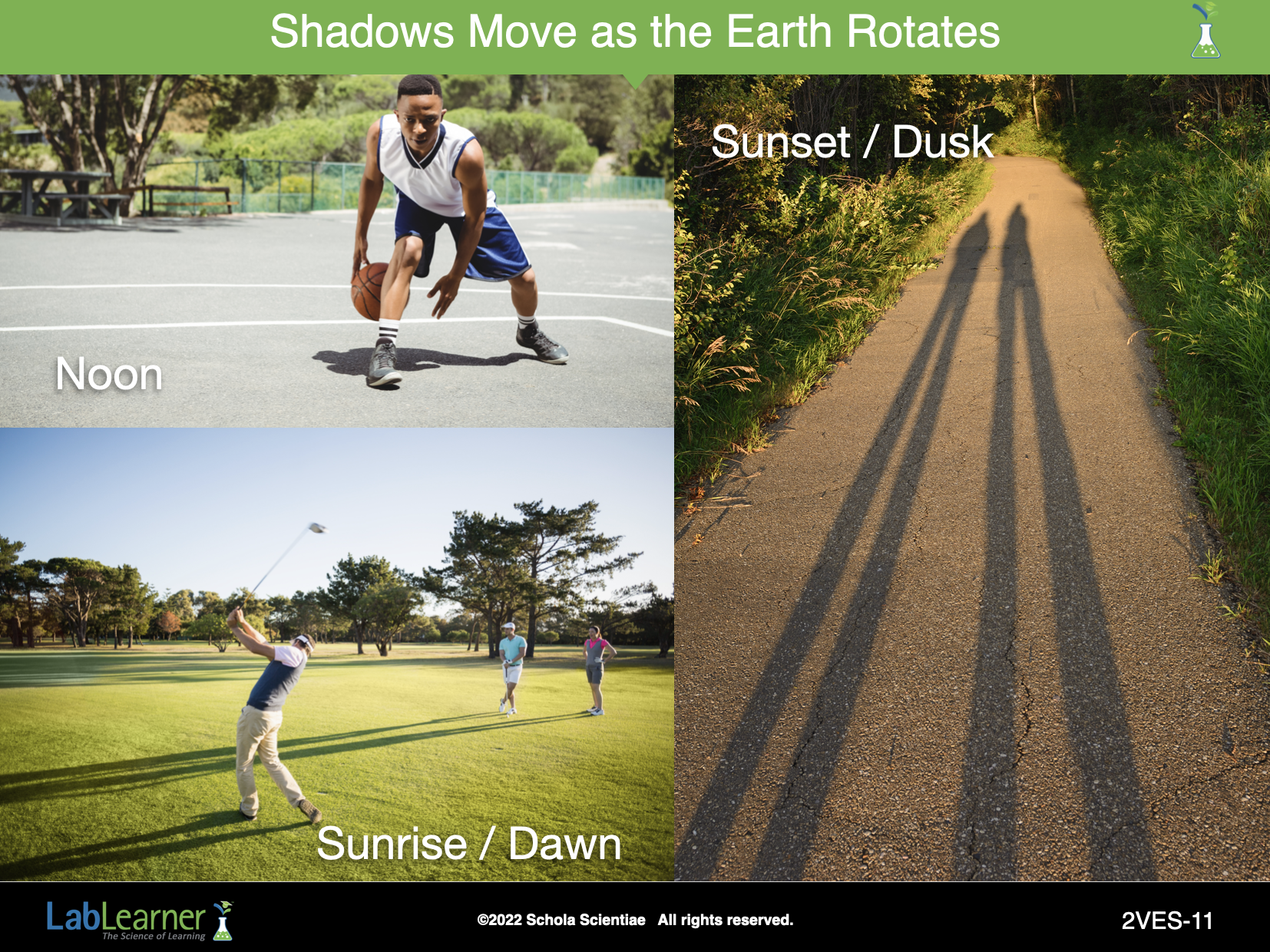
This slide simply shows how the length of shadows changes during the course of the day.
In the morning (the golfers) and evening (the walkers on the trail), the length of shadows is the longest of any time during the day. At around noon (the basketball player), the shadow is short and nearly directly beneath the player.
Below is a time-lapse series of shadows in a room as the day progresses:

______________________________________________
SLIDE 2VES-12
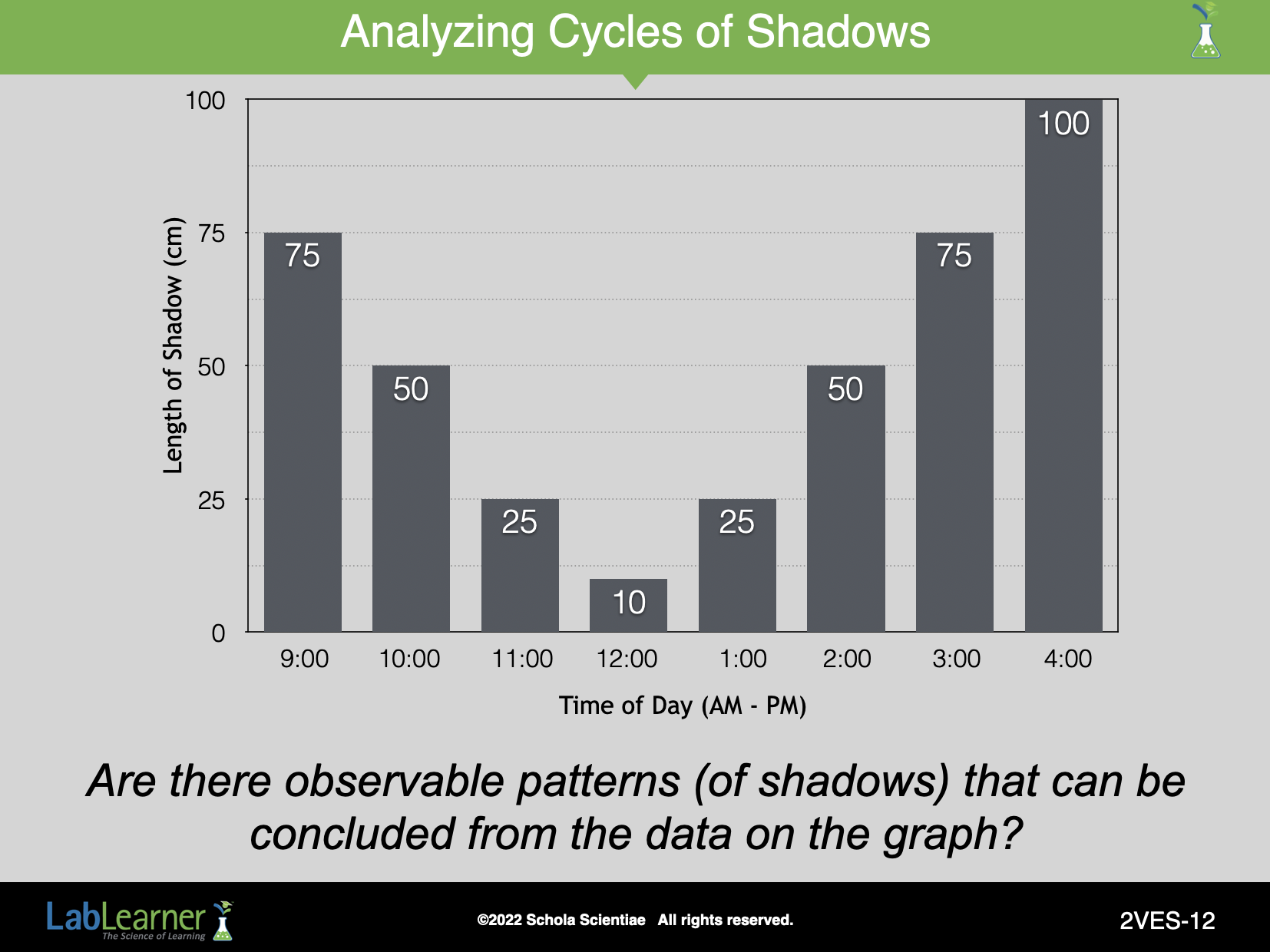
This slide provides data from a simple experiment in which the length of the shadow of an object is measured during the course of a day.
The pattern shown in the data is that shadows are the longest in the morning but decrease toward noon. At noon, the shadow is at its shortest. Finally, after noon, the shadow increases in length into the late afternoon and evening (dusk).
______________________________________________
SLIDE 2VES-13
Teacher’s Notes
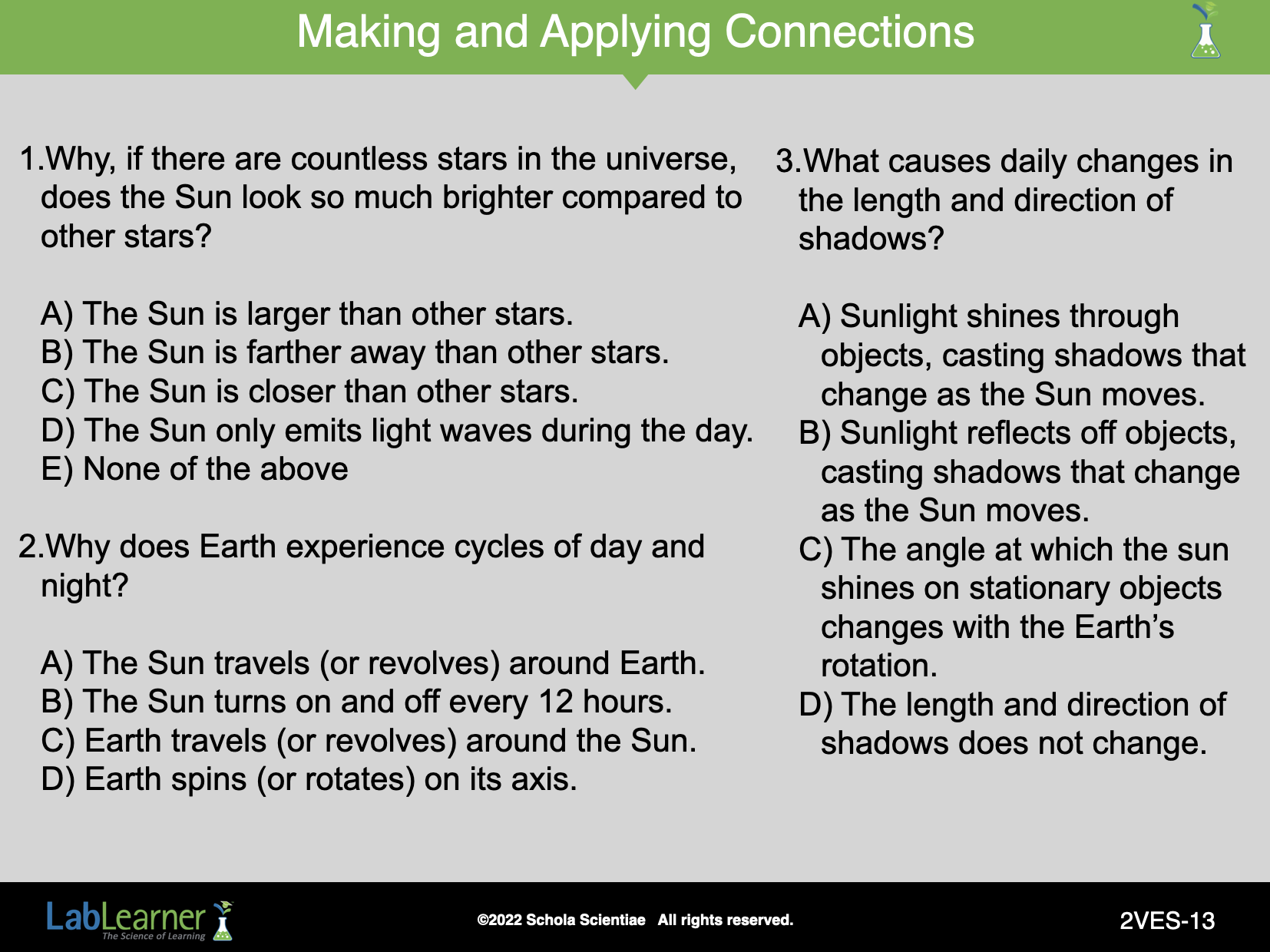
Question 1 – Answer C
The Sun is certainly not that large or bright of a star compared to other stars we can see in the night sky, it simply appears so large and powerful because we are so close to it.
“Close” in the interstellar realm, though, is a very relative term. If you were to model the Sun as a basketball, then our planet Earth would be about the size of an apple seed 30 yards away from it — and even the nearest other star, Alpha Centauri, would be 6,000 miles away.
Question 2 – Answer D
As Earth travels around the Sun, it rotates on its axis, which is an imaginary line running between the north and south poles. It takes one day or 24 hours for the Earth to make one complete rotation.
As Earth rotates on its axis, it constantly points new parts of its surface to the Sun. The side facing the Sun is bathed in light and heat energy. This side is day. The side facing away from the Sun is dark and cool. This side is experiencing night.
Because Earth is constantly rotating from west to east (counterclockwise when viewed from the North Pole) on its axis, the line between day and night is constantly moving around Earth creating perpetual cycles of day and night.
Question 3 – Answer C
The Sun is a source of light that when hits an object causes shadows. As Earth rotates each day, the Sun appears to change position in the sky, and the changing angles of sunlight affect the appearance of shadows.
Shadows change length throughout the day because the angle at which the sun shines on stationary objects changes with the Earth’s rotation. For example, at 9:00 AM, when the sun is near the horizon, it casts long shadows when an object blocks the light. Conversely, when the sun is high overhead during the middle of the day (12:00 PM), the shadows become shorter, as the angle of the sun has changed.