
Teacher Portal:
Earth and Space Journey
One: Ecosystems, Interactions, Energy, Dynamics
 PRINT IT
Use your browser to download a printable PDF as help during the slide presentation and to make additional notes. In your browser, go to File > Print and then choose to save as PDF.
NAVIGATE IT
Once the slide presentation is launched
- use your left and right arrows to advance or go back in the slide presentation, and
- hover your mouse over the left edge of the presentation to get a view of the thumbnails for all the slides so that you can quickly move anywhere in the presentation.
- Click HERE to launch the slide presentation for the CELL.
SHARE IT
SLIDE 1VES-1
______________________________________________
SLIDE 1VES-2
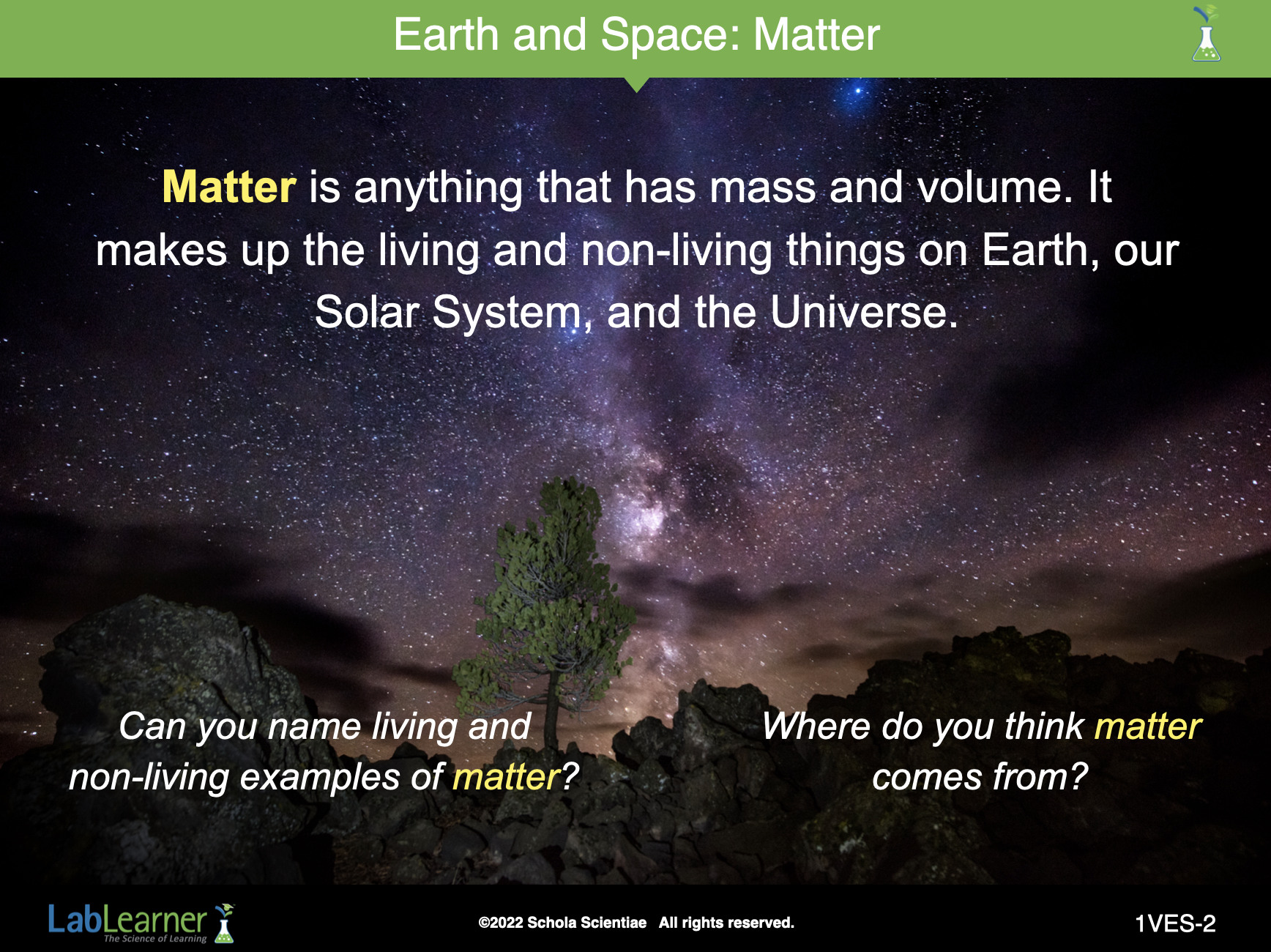
- Things that have mass and volume are composed of matter.
Mass: The quantity of matter in a body, object, or substance. Mass can be measured in the metric system in units of grams (g), kilograms, milligrams, etc.
Volume: The quantity of space an object or substance occupies. Volume can be measured in the metric system in units of liters (L), milliliters (ml) and cubic centimeters (cm3).
- As we move from the entire Earth into the solar system and then the entire Universe, the substances that we experience are composed of matter.
- Can you suggest other things made of matter? Think of both living and non-living examples.
Living = animals (including humans), plants
Non-living = water, carbon, nitrogen
- Where does all the matter in the Universe come from? A scientific theory on the origin of matter is shared on the next slide.
______________________________________________
SLIDE 1VES-3
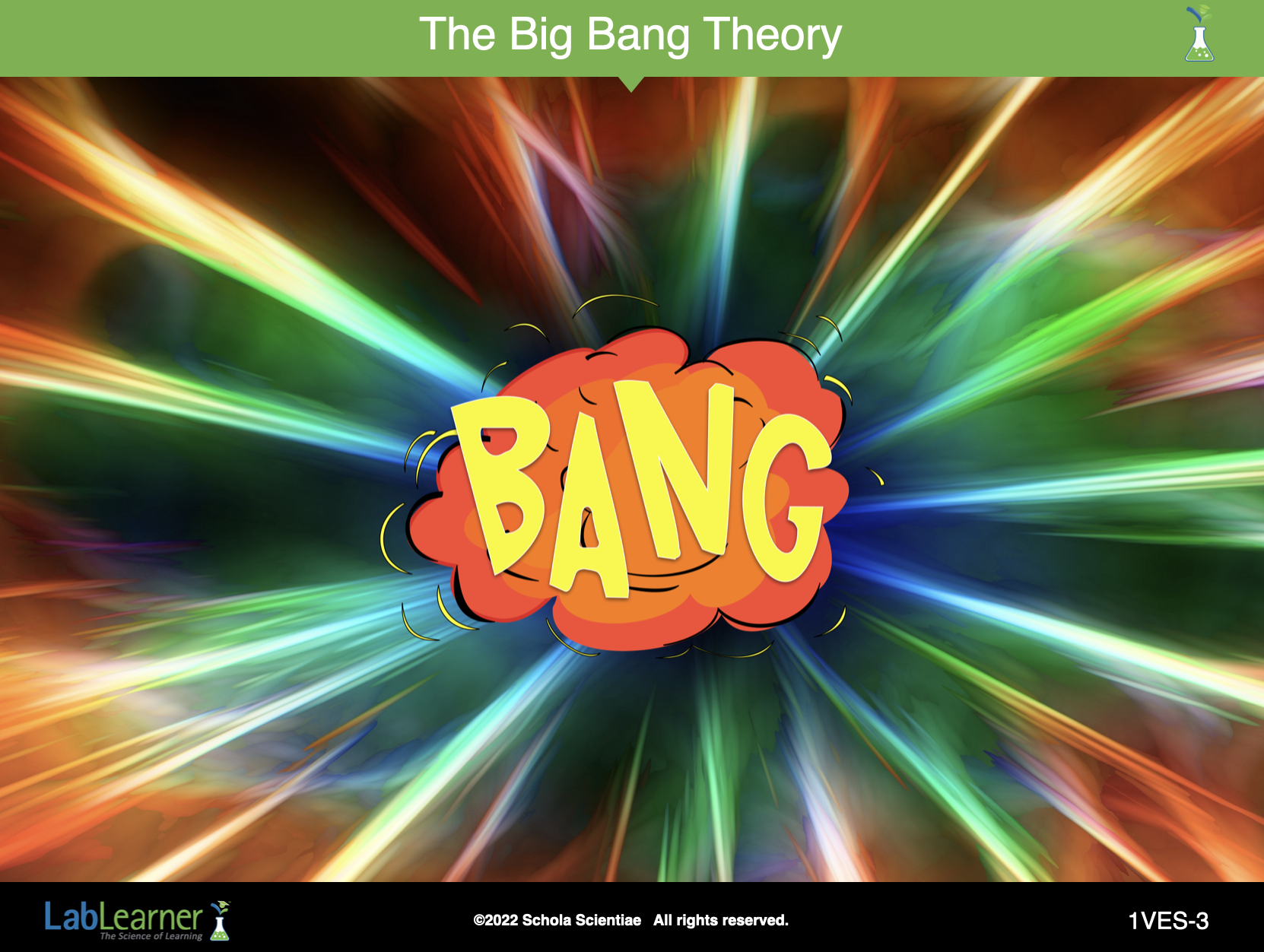
1. Scientists believe all matter and energy that exists today came into existence nearly 15 billion years ago in an immense explosion called the Big Bang.
2. Since all matter originated at the same time, all matter and energy in the Universe (including Earth) is composed of the same matter and is of the same age as matter everywhere else in the Universe.
3. That means that the matter and energy created in the Big Bang has simply been recycled for 15 billion years!
While the Big Bang is perhaps the most significant of all scientific topics, we necessarily leave this brief introduction superficial and move on. Students should nonetheless be stimulated by this brief discourse and may also bring up the popular television show The Big Bang Theory.
______________________________________________
SLIDE 1VES-4
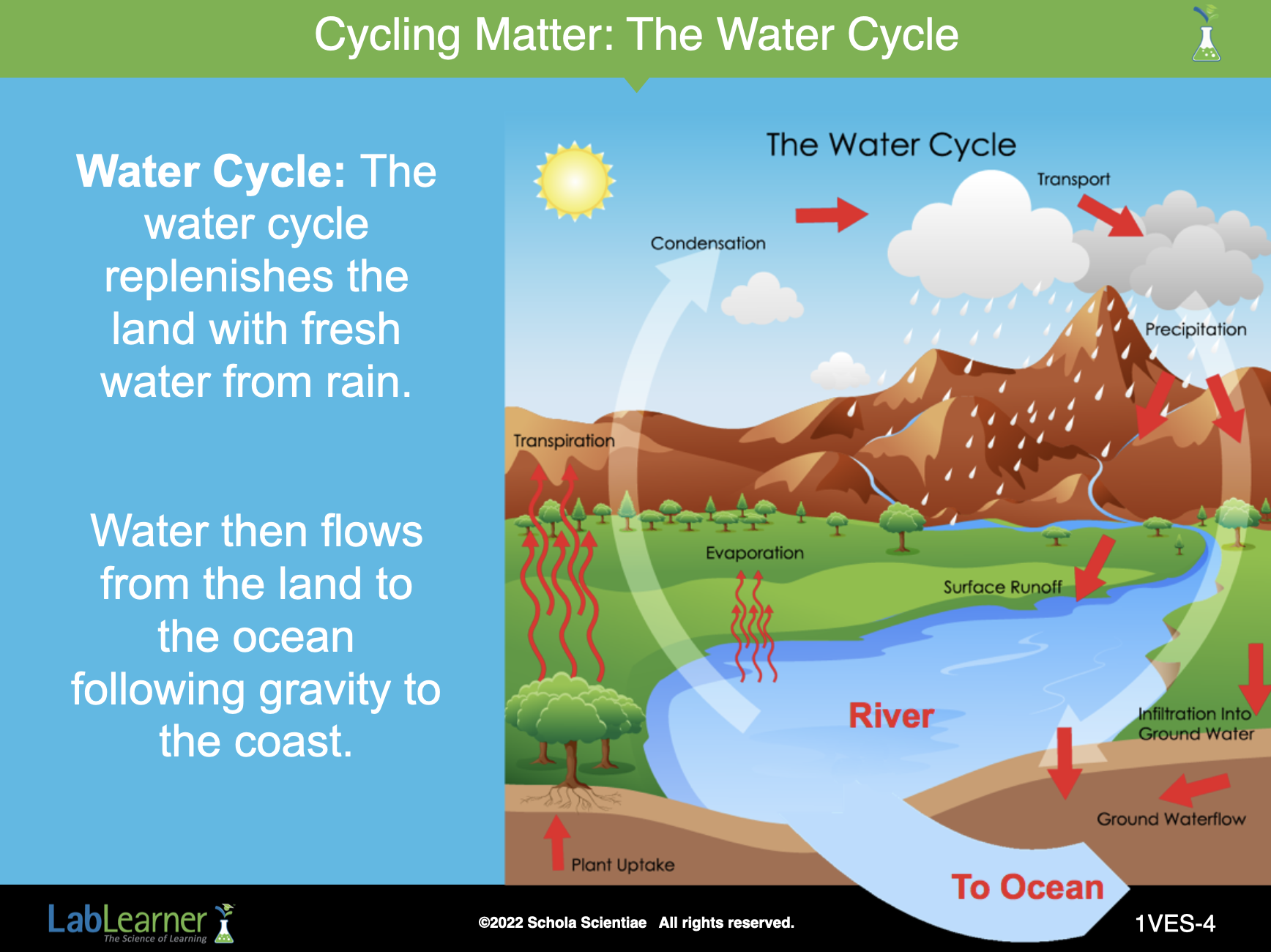
One way to easily understand how materials are recycled on Earth is to look at the Water Cycle.
 As with most cycles, you can enter the water cycle at any point. Let’s start with rainwater. Quite simply, rain falls on the Earth from the atmosphere (the sky).
The rainwater follows gravity and runs downhill. This “runoff” water may collect in lakes and rivers.
From there, it may continue to follow gravity down to the oceans. There, the water evaporates from the ocean’s surface and reenters the atmosphere. There, it condenses into clouds.
Finally, the clouds release the water they hold as rain and the cycle starts all over again. Over and over, the cycle repeats for millions and millions of years.
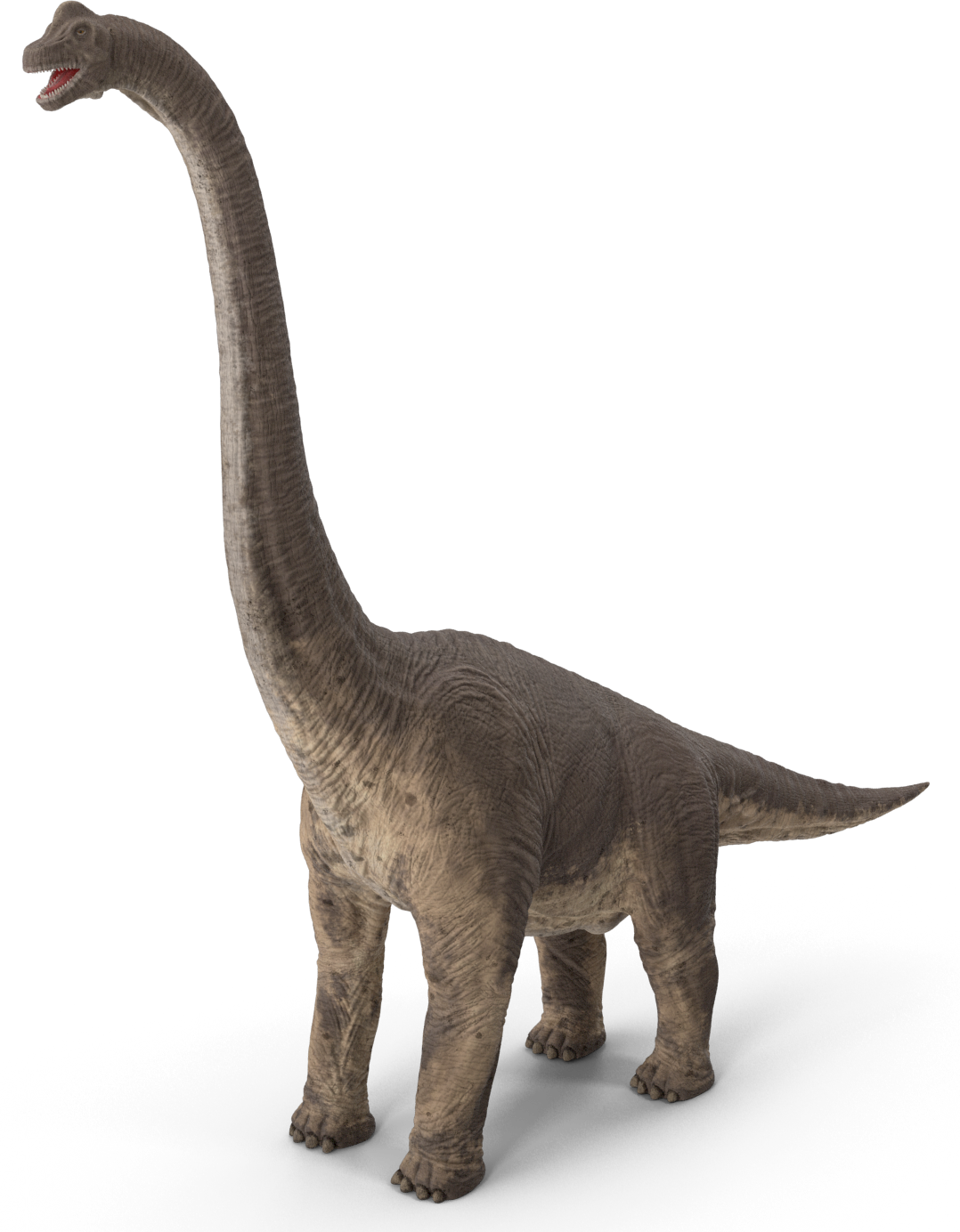
The most interesting thing about the water cycle is that no water on Earth is created or destroyed. The same amount of water we have on Earth today has been here for a billion years. The same water continually cycles as shown on this slide. So, the next time you are caught in a rain shower, just think, you are being drenched by the same water that once rolled off the back of a giant dinosaur!
______________________________________________
SLIDE 1VES-5
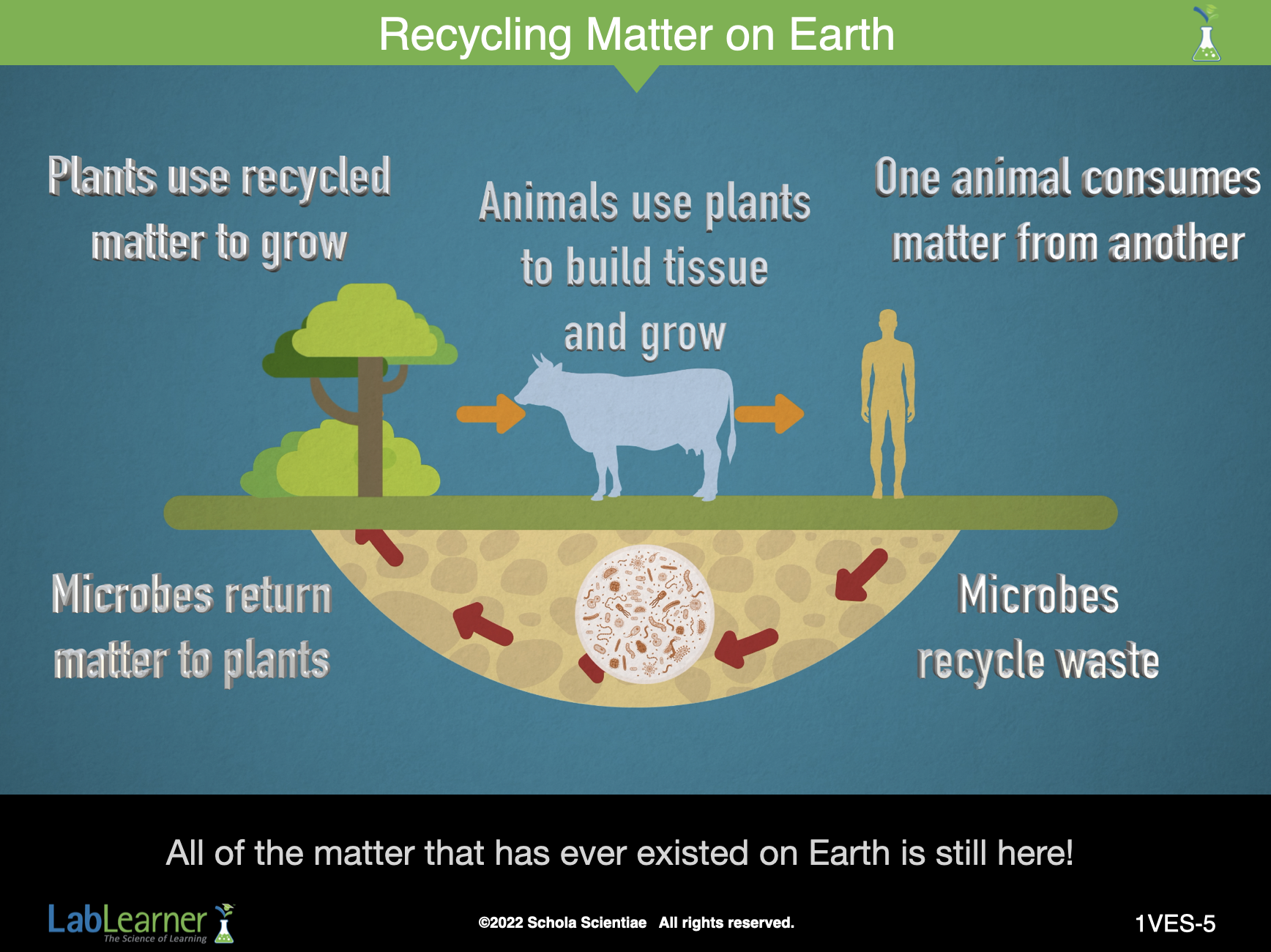
Just as all of the water on Earth today is composed of matter that was created at the time of the Big Bang, the same is true of all other forms of matter as well.
There are many different matter cycles on Earth. For example, there is a carbon and nitrogen cycle that continually recirculate carbon molecules and nitrogen molecule throughout both the physical and living systems on Earth.
While there are many specific chemical cycles on Earth, this slide and the animation below summarize the general idea.

At the bottom of the slide, is an interesting statement: “All matter that has ever existed on Earth is still here!” While this statement is nearly 100% true, there are a few examples that disagree with this statement… can you name one? (How about the satellites and telescopes we have sent up into orbit, the Mars rovers, and the spacecraft parts and flags left on the Moon?)
As humans move into the future of space exploration, they will take more and more of the matter that has always existed on Earth and send it into outer space and other planets. This marks the beginning of an entirely new chapter in Earth’s history.
Can you think of any way in which the Earth receives new matter from elsewhere in the solar system and outer space? (How about meteors and asteroids?)
______________________________________________
SLIDE 1VES-6
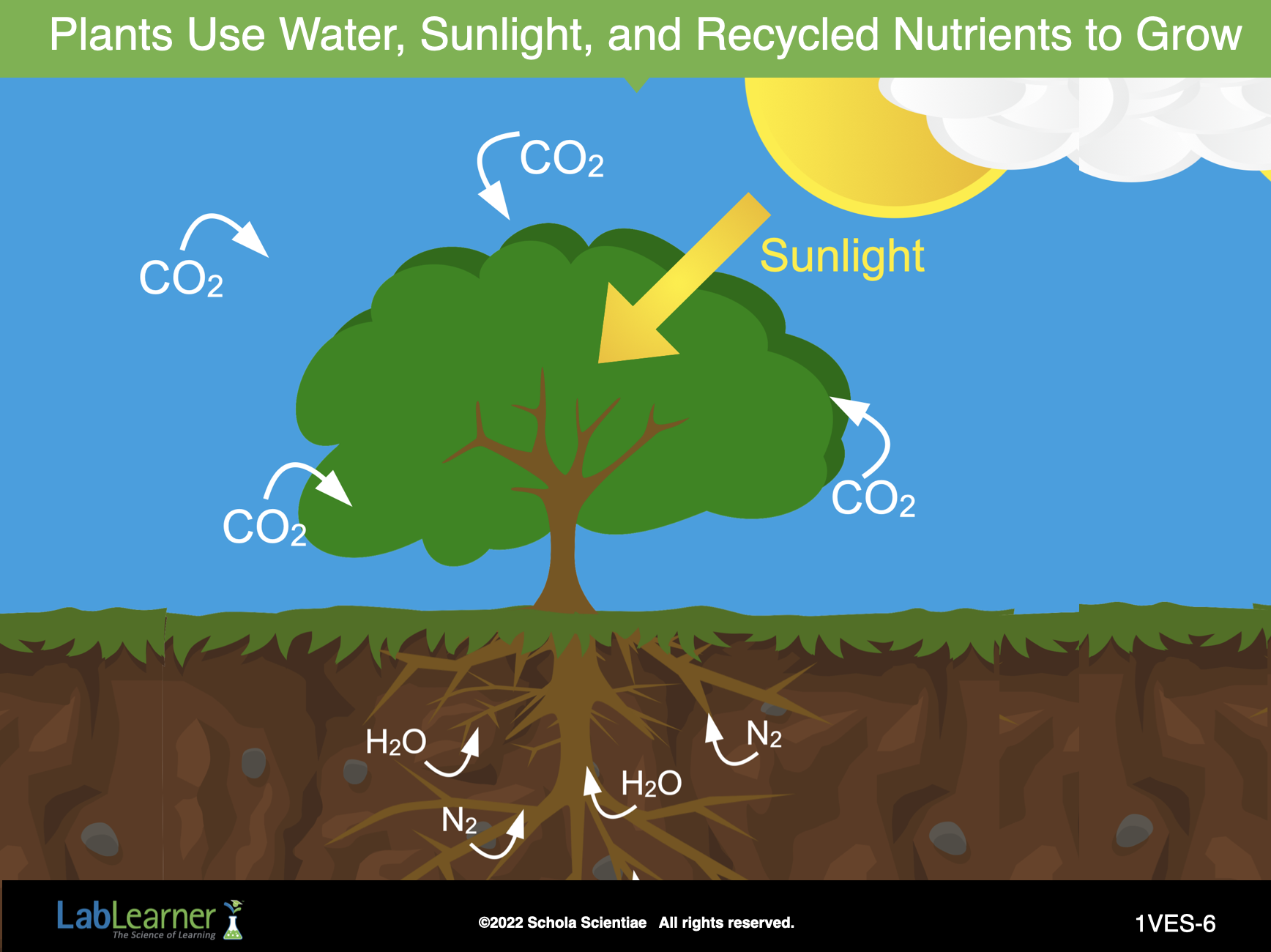
The cycling of non-living matter such as water, carbon, and nitrogen, is important to many Earth processes and to the survival of organisms.
Plants are one type of organism that depends on water (H2O from groundwater and rain), carbon (in CO2 gas in the air), and nitrogen (from N2 in the soil) for survival and also play a central role in the recycling of these types of matter.
Plants are considered producers since they are able to produce matter from non-living sources. They take in carbon dioxide from the atmosphere and water and nitrogen from their roots. These are combined to form sugars, starches, and protein, which are then used by the plant for growth and survival.
______________________________________________
SLIDE 1VES-7
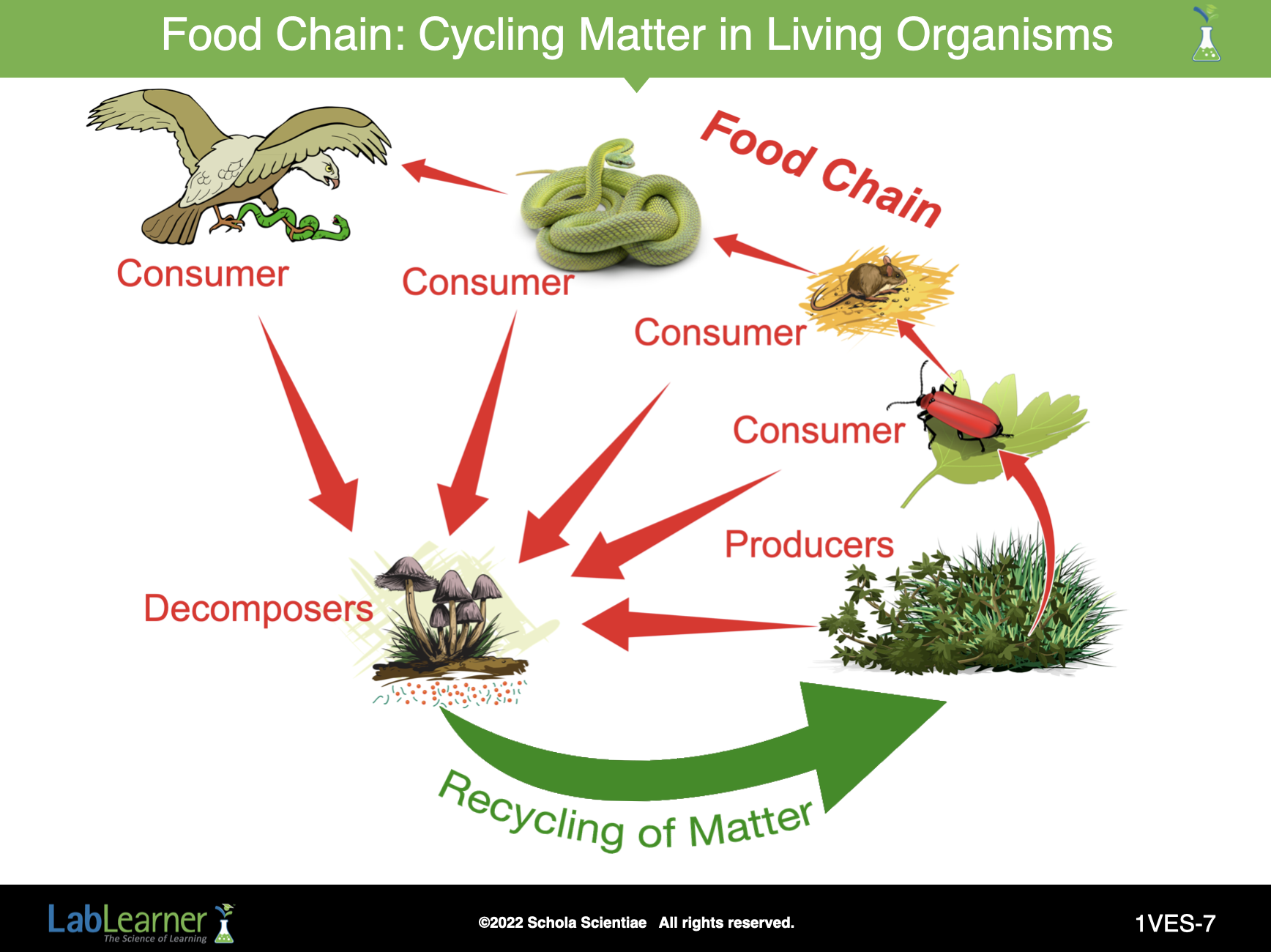
After plants convert non-living matter into useable forms, they become the source of food for many other organisms within an ecosystem.
Although matter can enter and exit an ecosystem at any point, the flow of matter through an ecosystem is often described as entering through plants, then moving through consumers in a food chain. The food chain model on this slide depicts this important flow of matter through an ecosystem.
Notice the arrows connecting each level of organisms in the food chain. The arrows essentially mean “is eaten by” except for the transfer of nutrient matter (Recycling of Matter) from the decomposers (fungi, bacteria, other microorganisms) back to plants.
______________________________________________
SLIDE 1VES-8
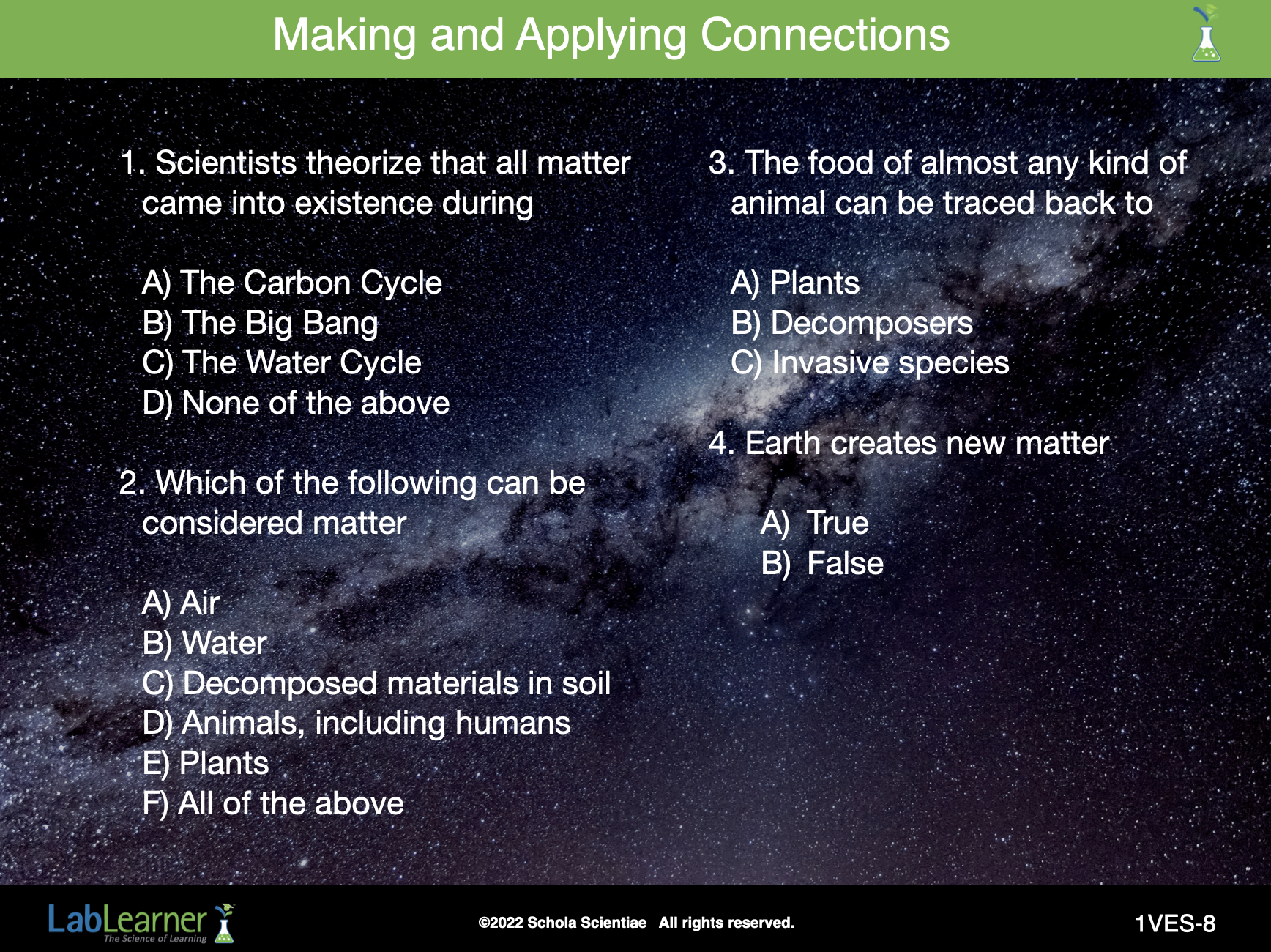
Question 1 – Answer B
Scientists believe all matter that exists today came into existence nearly 15 billion years ago in an immense explosion called the Big Bang. At the point of this event, all matter was contained at one point.
Question 2 – Answer F
Matter is anything that has mass and volume. It makes up the living and non-living things on Earth, in much of our solar system, and part of the universe. Air, water, decomposed materials in the soil, animals (including humans), and plants are all forms of matter, both living and non-living.
Question 3 – Answer A
Although matter can enter and exit an ecosystem at any point, the flow of matter through an ecosystem is often described as entering through plants and then moving through consumers in a food chain.
Question 4 – Answer B
According to the Law of Conservation of Matter, matter can neither be created nor destroyed, simply transformed. This means that Earth cannot create new matter, it simply recycles matter that already exists. Examples of Earth recycling matter include, but are not limited to, the water, carbon, and nitrogen cycles.