
Teacher Portal:
Earth’s Forces
Investigation 5
Work and Simple Machines Investigation-5: Force, Mass and Acceleration
 Investigation Five further explores Newton’s first two laws of motion. Sir Isaac Newton’s First Law of Motion states:
An object will remain stationary, or continue at the same speed in the same direction unless acted upon by an unbalanced force.
Hence, an unbalanced force on an object (which has a mass) will cause the object to accelerate (speed up, slow down, or change direction). This is captured by Newton’s Second Law of Motion which states the proportional relationship between force and acceleration, and the inversely proportional relationship between mass and acceleration:
An object’s acceleration is directly proportional to the unbalanced force applied and inversely proportional to the mass of the object.
This indicates that if the force (F) doubles, the acceleration (a) will also double. If the mass (m) of the object doubles in size, and the force remains the same, the acceleration will be half. Newton’s Second Law of Motion can be summarized mathematically by the equation:
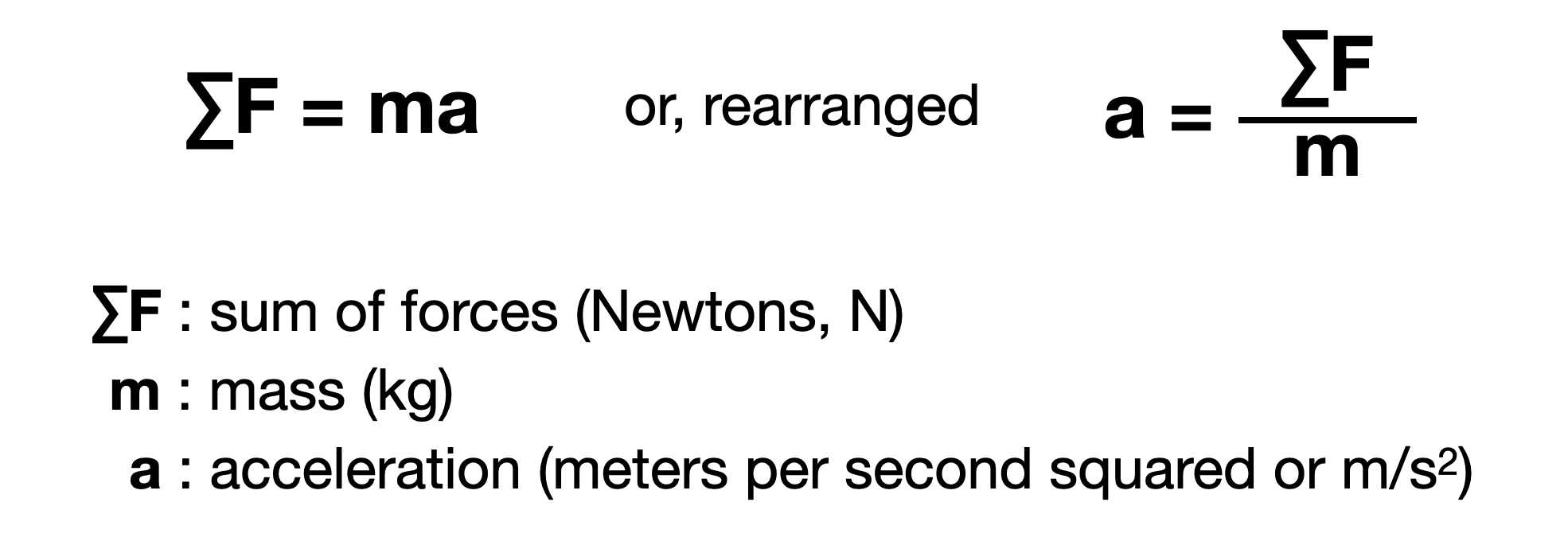
One quick way to simplify this equation is to not focus on the sigma (Σ) symbol, which simply means “sum”. For our purpose, we could simply call it force (F). Thus,

Investigation Five is designed to more fully examine the influence of balanced and unbalanced forces on vertical and horizontal acceleration and motion.
Vertical Acceleration
All objects on Earth are subject to the force of gravity. The force of gravity is the object’s weight. If an object is held stationary in the air by a spring scale, we know that the force of gravity acts downwards towards the Earth. As the object is not accelerating, the forces must be balanced on the object, therefore the force exerted by the spring scale is equal to the weight (force of gravity) on the object (see the illustration below).
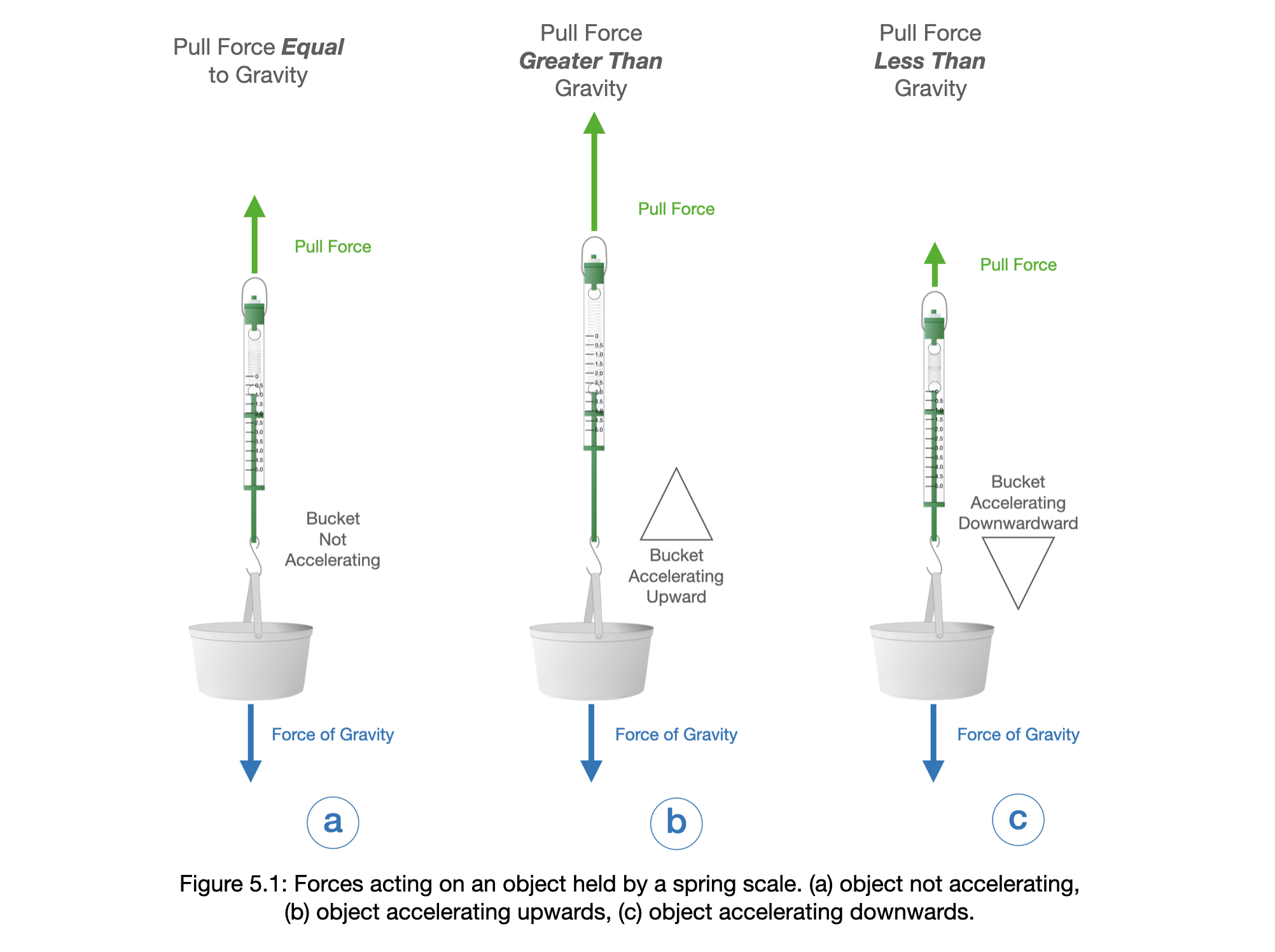
In order to start the stationary object moving upwards (to make it accelerate upwards), there must be an unbalanced force upwards. As the force of gravity is constant for the object on Earth, the pull force must be greater than the force of  gravity (see Figure 5.1b above). In order to get the stationary object to start moving downwards (to make it accelerate downwards), there must be an unbalanced force downwards. As the force of gravity is constant for the object on Earth, the pull force must be less than the force of gravity (see Figure 5.1c above). Once the object is moving upwards or downwards, if the forces become balanced again the object will stop accelerating but will continue moving at a constant speed in the same direction (See Figure 5.1a above).
In order to slow down an object that is moving downwards, there must be an unbalanced force acting upwards. This corresponds to a Pull Force greater than the force of gravity (see Figure 5.1b). If an object is moving upwards, to slow down the object it needs an unbalanced force acting downwards. This can be achieved by reducing the Pull Force to be less than the force of gravity (see Figure 5.1c). Students will examine the situations described above by holding an object with a spring scale and observing the Pull Force in Newtons under different conditions.
Horizontal Acceleration
 For an object resting on a desk, we know that the force of gravity is equal to the normal contact force, as the object is not accelerating in the vertical (up and down) direction. Therefore, the forces in the vertical direction are balanced.
If we pull on the object yet it remains stationary, we know that the horizontal forces are still balanced (see Figure 5.2a below). The Pull Force is equal to the Force of Friction. [Notice that since the force of gravity and the Normal Contact Force remain unchanged during vertical motion, they are not included in Figure 5.2. The Normal Contact Force would be in the upward direction with the same force as the Force of Gravity pulling downward, in the opposite direction.]
In order to start the object moving (to make it accelerate) to the left, there must be an unbalanced force in the left direction (see Figure 5.2b below). To achieve this unbalanced force, the Pull Force must be greater than the Force of Friction.
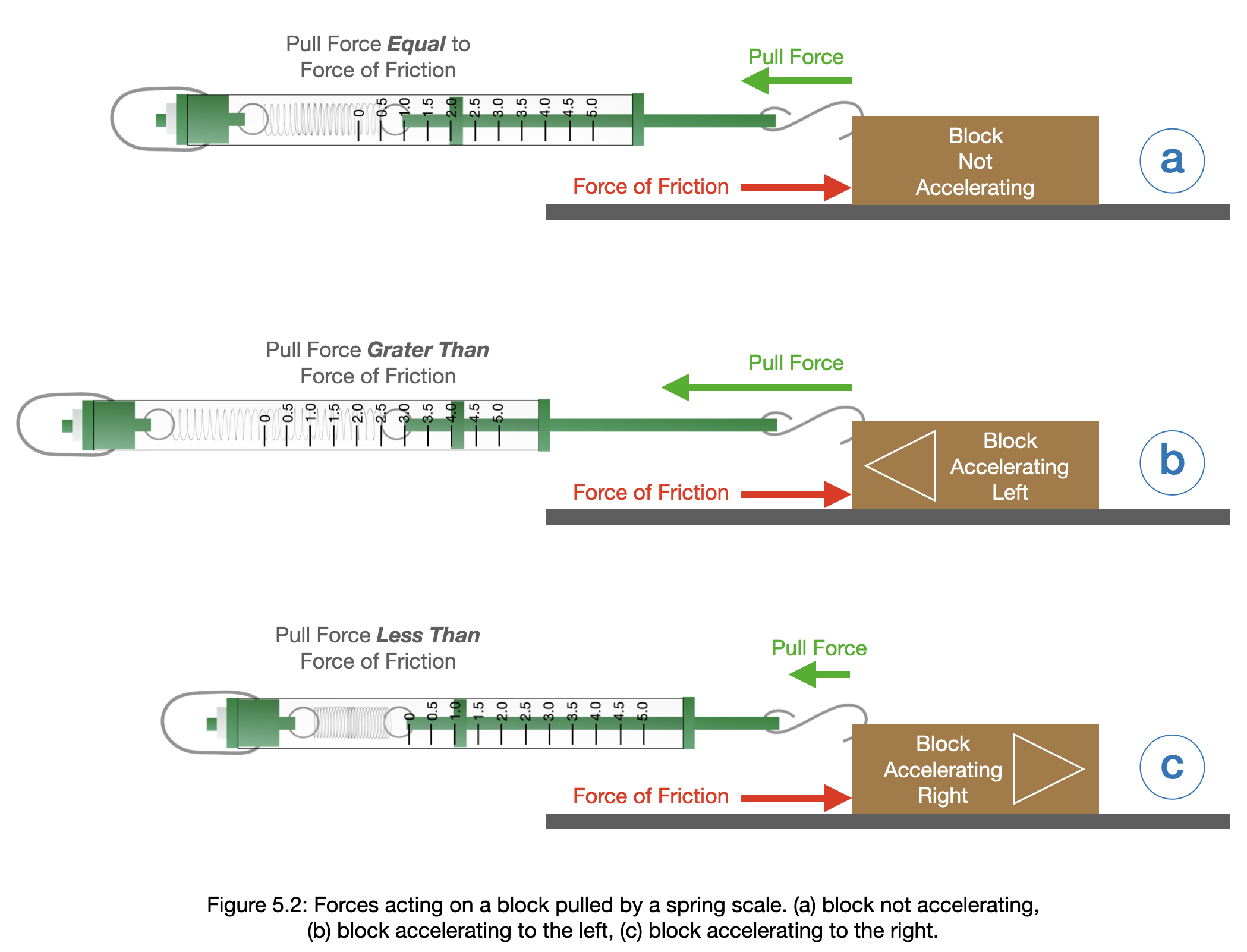
Once an object is moving, the Pull Force must be greater than the Force of Friction to make the object go faster (accelerate). Once the object is moving, it will continue moving at a constant speed in the same direction if the Pull Force equals the Force of Friction (see Figure 5.2a).
Once an object is moving, to slow the object down the Pull Force must be less than the Force of Friction (see Figure 5.2c). This unbalanced force will act in the direction opposite of motion causing the object to slow down. Students will examine these situations by holding an object with a spring scale, and observing the pull force in Newtons under the different conditions.
Understanding Force and Motion
These activities should further aid students in understanding that an unbalanced force causes an object to accelerate (speed up, slow down or change direction).  Students will again observe that when forces are balanced an object will remain stationary, or continue moving at the same speed and in the same direction.
These concepts also allow us to interpret what is occurring to a moving object. If an object is stationary or moving at a constant speed in one direction, then we know all the forces are balanced. If an object is speeding up, then an unbalanced force is acting in the direction of the speeding up. If an object is slowing down then an unbalanced force is acting in the opposite direction of motion. By understanding these concepts, and with a knowledge of the two key forces of gravity and friction, we can comprehend the relationship between force and motion in many different situations.
Earth's Forces: Investigation 5 - Mathematics Concepts
Prelab
- problem-solving
Lab
- mass in grams and kg
- addition
- weight/force in Newtons
- measuring mass using Triple Beam Balance
- metric conversion
- greater than/less than/equal to
- comparing values
Postlab
- data table
- data analysis
- weight/force in Newtons
- subtraction
- mass in kg
- division
- decimals to the nearest hundredth
- problem-solving
Earth's Forces: Investigation 5 - Procedural Tools

Earth's Forces: Investigation 5 - Cognitive Tools

Earth’s Forces:
Investigation 5 Quiz

