Teacher Portal:
Earth’s Forces
Investigation 4 – PreLab
 MINDSET
This Investigation is designed to:
- demonstrate that frictional force can be measured by pulling an object with a spring scale at a constant speed.
- show that if the forces on a moving object are balanced the object will continue moving at the same speed and direction.
- allow students to conclude that the greater the roughness of a surface the greater the friction force on an object as the two surfaces interact.
- allow students to conclude that the greater the weight of the object the greater the frictional force.
- allow students to discover that frictional force is typically less than the weight of an object.
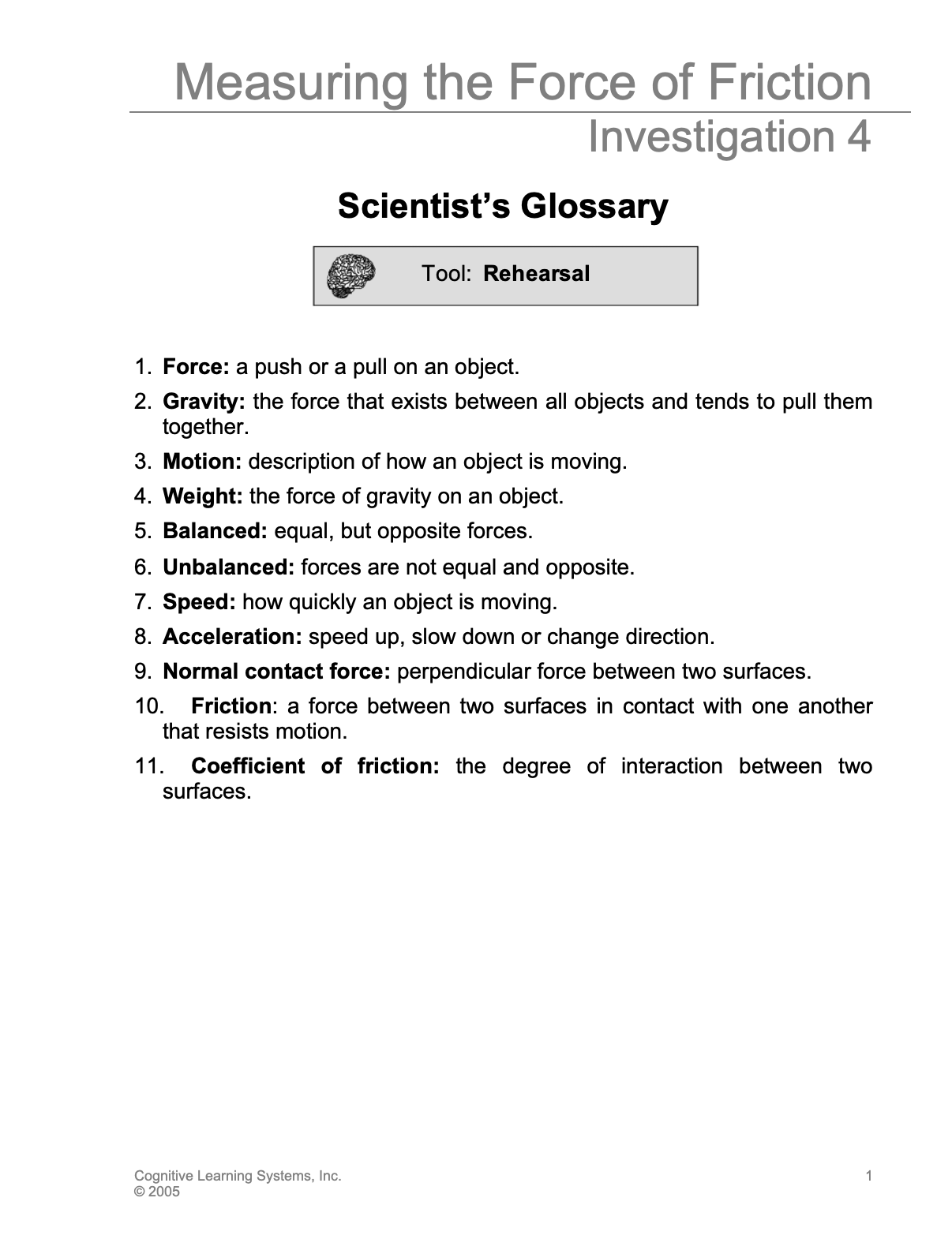
SCIENTIST’S GLOSSARY
1. Force: a push or a pull on an object.
2. Gravity: the force that exists between all objects and tends to pull them together.
3. Motion: how an object is moving.
4. Balanced forces: when forces are equal and act in opposite directions.
5. Unbalanced force: when a force does not have an equal force acting in the opposite direction on the same object.
6. Speed: how quickly an object is moving.
7. Acceleration: speeding up, slowing down, or changing direction.
8. Normal contact force: the force that occurs between two objects in contact, and is perpendicular to the surfaces.
9. Friction: the force that occurs between two objects in contact, and is perpendicular to the surfaces.
10. Coefficient of friction: the degree of interaction between two surfaces.
BE PREPARED
Watch the Investigation 4 Teacher Video (below) and Student Video (at end of PreLab SHARE IT) to prepare for the PreLab.
SET FOR SUCCESS
- Tell students that they will continue their study of the Earth’s Forces CELL.
- Tell students that they will focus on measuring the force of friction in this Investigation.
- Ask students to share the kinds of things they think they might learn in this Investigation.
Begin the PreLab Concept Slides to start students on their learning journey. Then watch the Pre-Lab Student Video as a class.
NAVIGATE IT
Once the slide presentation is launched
- use your left and right arrows to advance or go back in the slide presentation, and
- hover your mouse over the left edge of the presentation to get a view of the thumbnails for all the slides so that you can quickly move anywhere in the presentation.
- Click HERE to launch the slide presentation for the CELL.
SHARE IT

SLIDE VEFORCE4-pre-1
In Investigation Four, students will study the important force of friction. In the lab, they will learn how to measure frictional force with a spring scale and test the frictional force of several different surface types.
______________________________________________
SLIDE VEFORCE4-pre-2
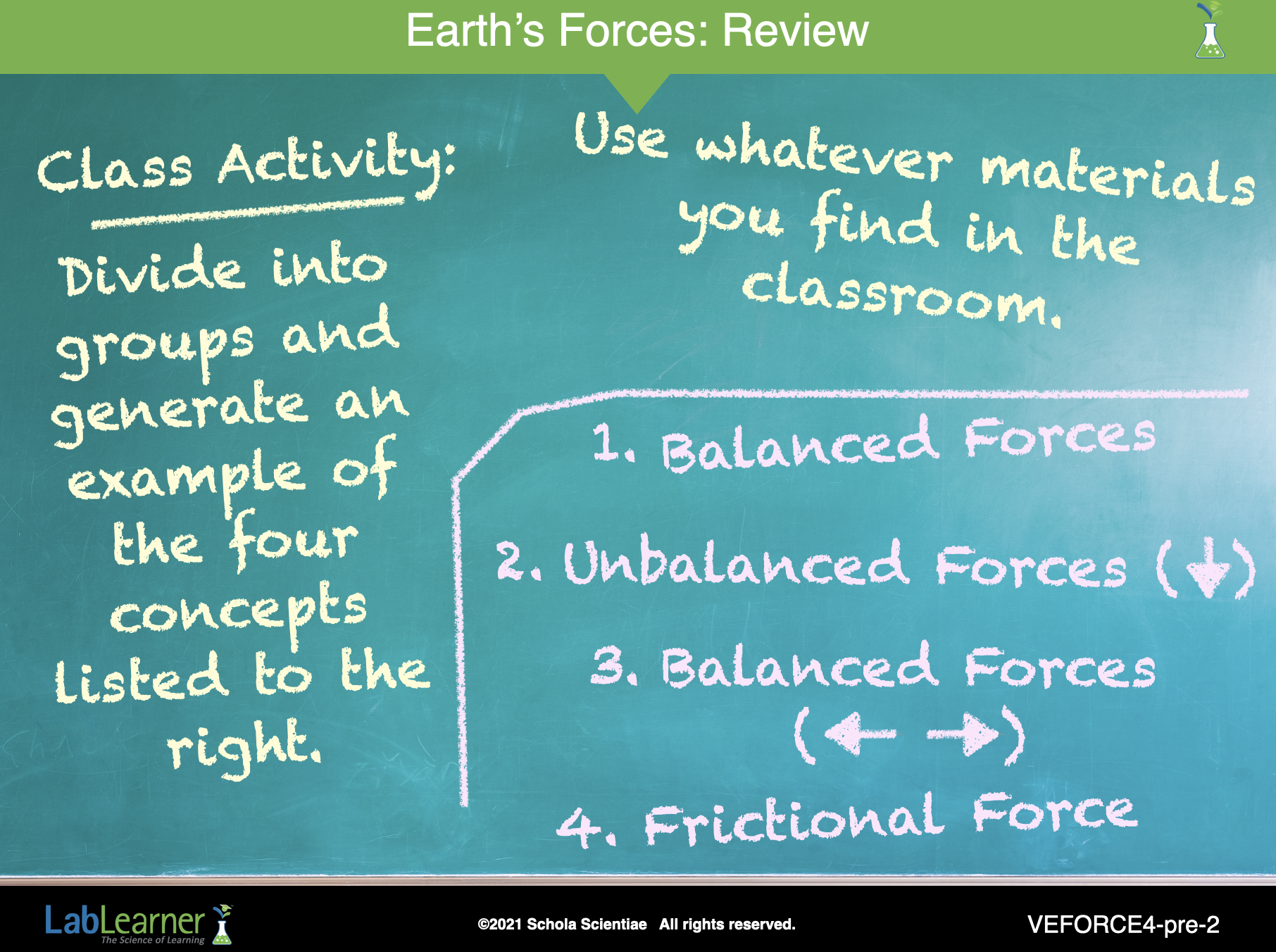
Begin the Investigation by conducting an activity to rehearse and establish student comprehension of major concepts discussed thus far in the CELL.
2. Divide the class into cooperative groups. Explain to students that as a group, they will generate an example of each of the scenarios shown on this slide. They can use themselves, or any small object in the classroom in order to demonstrate the scenario. Guide students to first of all discuss each scenario and generate examples, prior to locating objects.
3. Allow students approximately five to ten minutes to locate appropriate objects in the classroom with which they can demonstrate each scenario.
4. Allow groups to take turns demonstrating their examples to the rest of the class. As each group demonstrates their example, ask the class to describe why the example is correct or not. Some examples are listed below:
• Balanced forces: a stationary chair placed on a table or on the floor; a student standing or sitting on the floor; a pencil or eraser suspended from a string.
• Unbalanced forces (motion downward): dropping a book onto a table-top surface or onto the floor; rolling a coin down an improvised ramp.
• Balanced forces (motion sideways): pushing a book along a table-top surface or the floor; pulling a box along a table-top surface or the floor (object must move at a constant speed in one direction).
• Frictional force: sliding a foot or shoe along the floor; pushing a pencil and making it roll, then letting it come to a stop.
______________________________________________
SLIDE VEFORCE4-pre-3
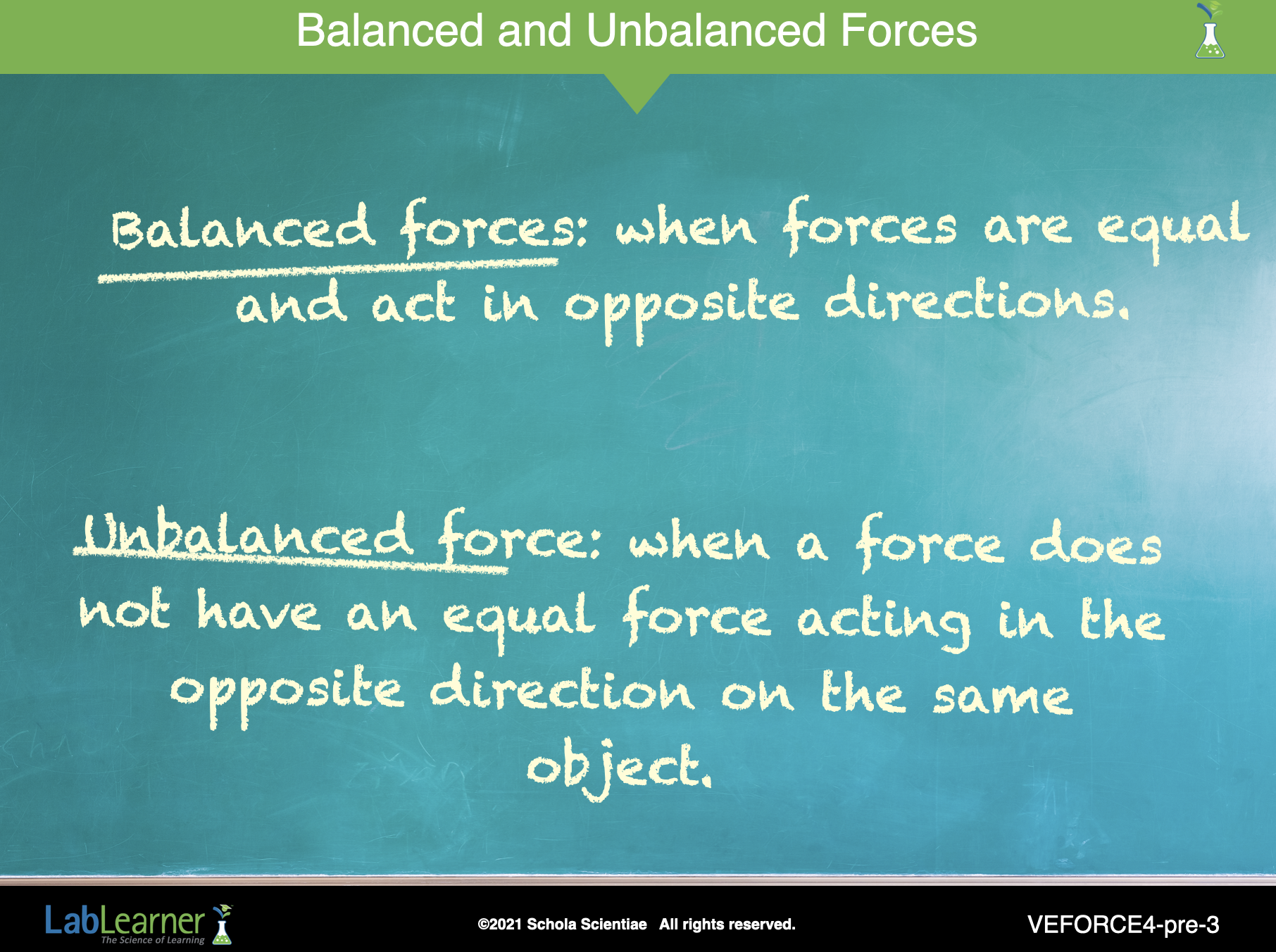
Continue the discussion by focusing on the effects of unbalanced and balanced forces. If necessary, refer students to their Scientist’s Glossary for the definition of balanced and unbalanced forces:
Balanced forces: when forces are equal and act in opposite directions.
Unbalanced force: when a force does not have an equal force acting in the opposite direction on the same object.
Ask students: What will happen to an object if there is an unbalanced force on it? It causes the object to accelerate (i.e., speed up, slow down or change direction).
Ask students: If an object is stationary, what will happen to the object if the forces on it are balanced? The object will remain stationary.
Ask students: If an object is moving at 2 m/s, what will happen to the object if the forces on it are balanced? The object will continue moving at the same speed (2 m/s) in the same direction.
Ask students: If an object is moving at 2 m/s, what will happen to the object if the forces on it are unbalanced? The object will accelerate and will either speed up or slow down, depending on the direction in which the forces are applied.
______________________________________________
SLIDE VEFORCE4-pre-4
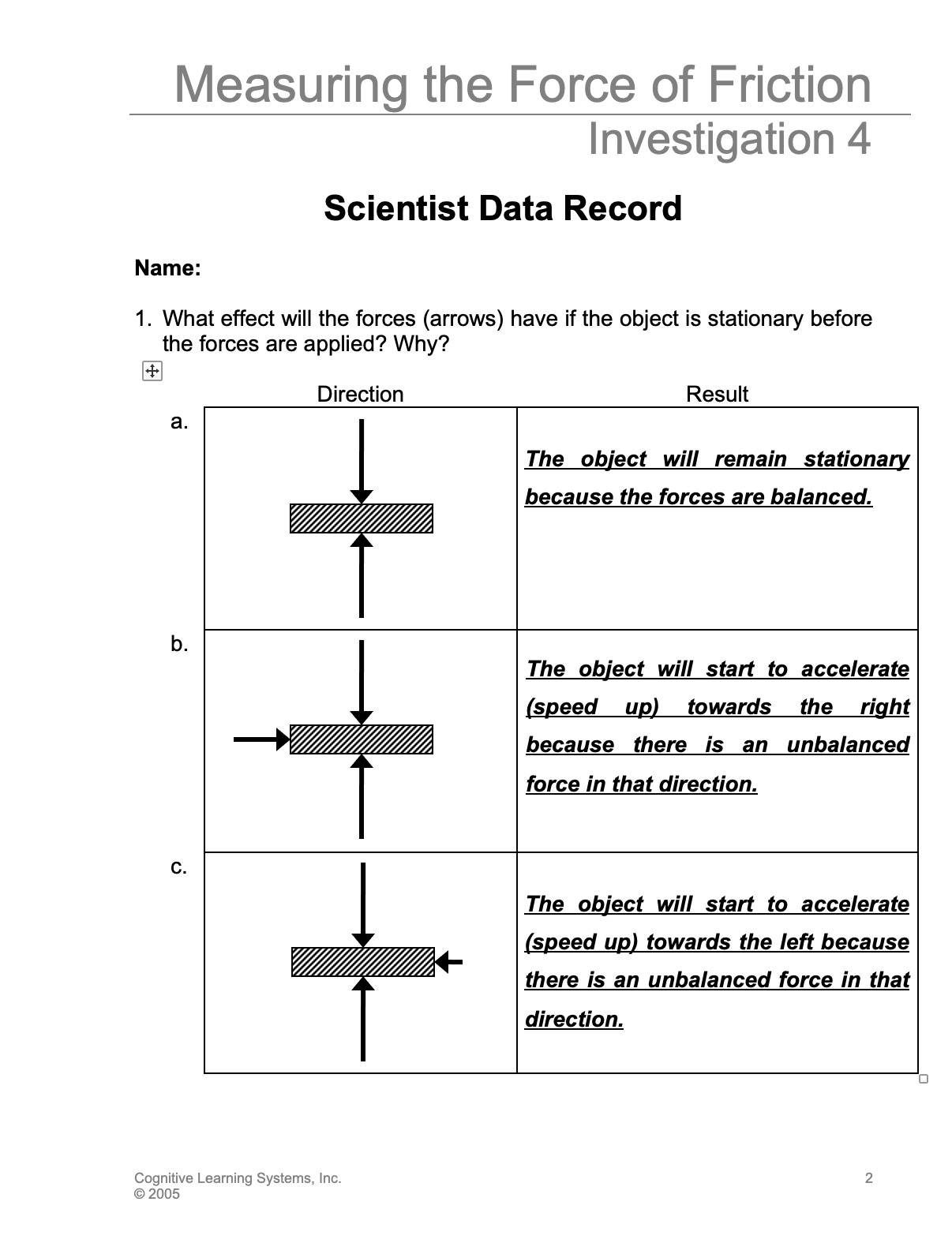
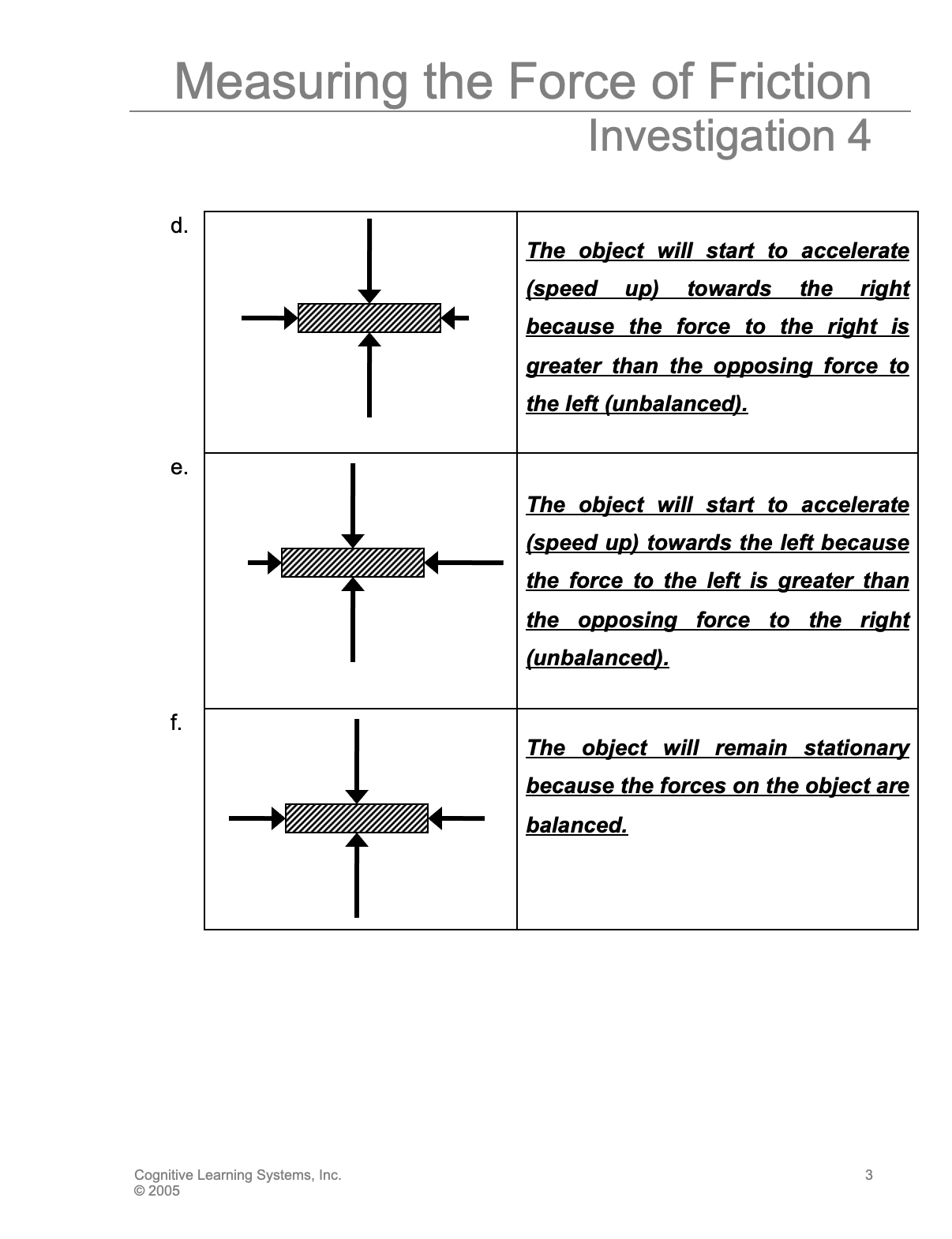
Continue the discussion of the effects of balanced and unbalanced forces by guiding students to complete written problems in their Student Data Record.
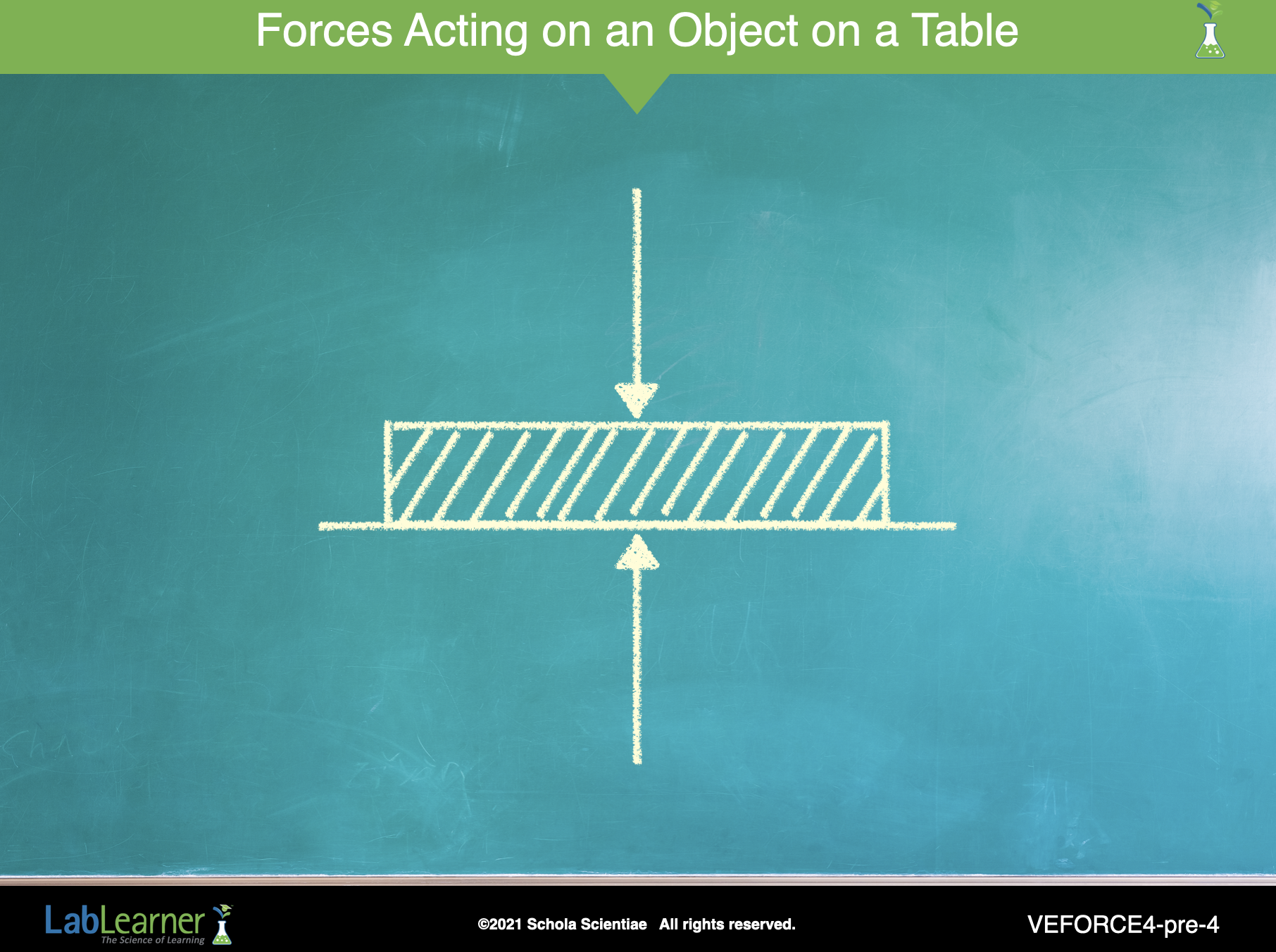
1. To remind students of the method of representing forces used in previous Investigations, refer to the figure on the slide.
Ask students: What does this rectangle represent? The rectangle represents an object.
Ask students: What do these arrows represent? The arrows represent forces.
Ask students: In this example, are these forces balanced or unbalanced? How do you know? The forces are balanced. This is evident from the equal length and opposing direction of the arrows.
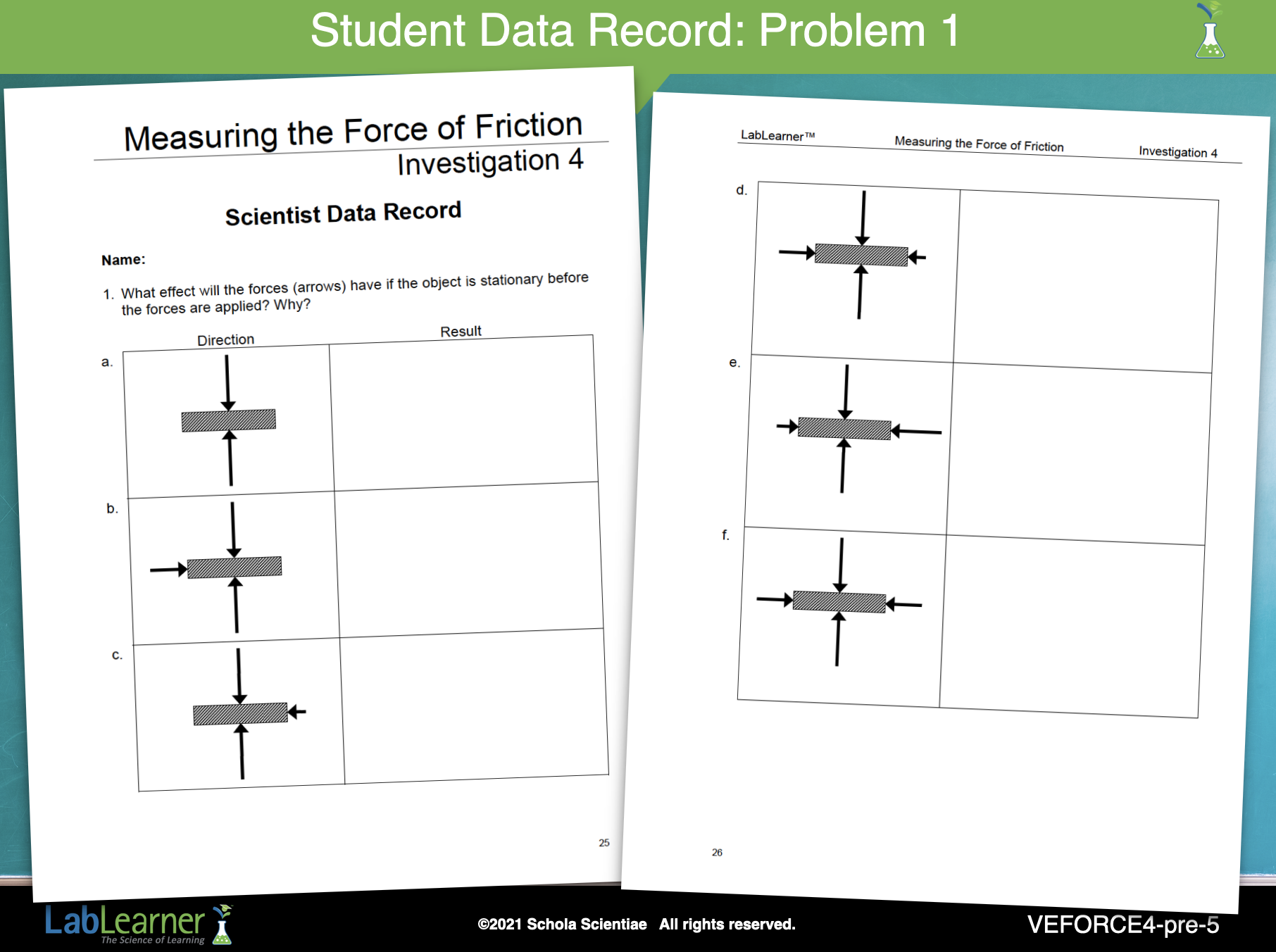
2. Direct students’ attention to Problems 1 and 2 in the Student Data Record. At the instructor’s discretion, allow students to work collaboratively in groups to answer Problem 1.
Continued on Next Slide ➡
______________________________________________
SLIDE VEFORCE4-pre-5
Continued from Previous Slide ➡
3. After a sufficient period, review each diagram in Problem 1 and discuss the answers as a class. Teachers, please see the Student Data Record KEYS below the SHARE IT section.
______________________________________________
SLIDE VEFORCE4-pre-6
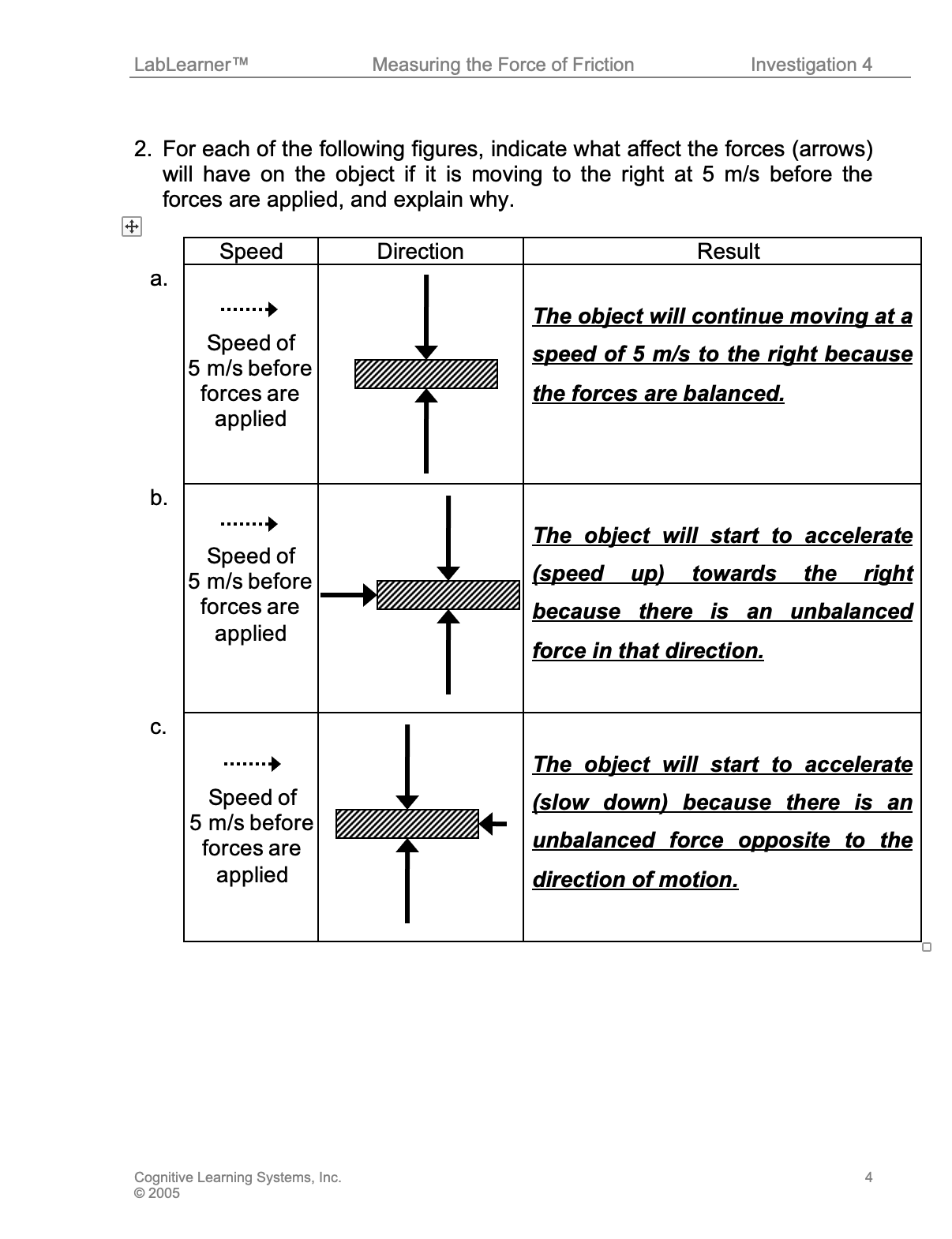
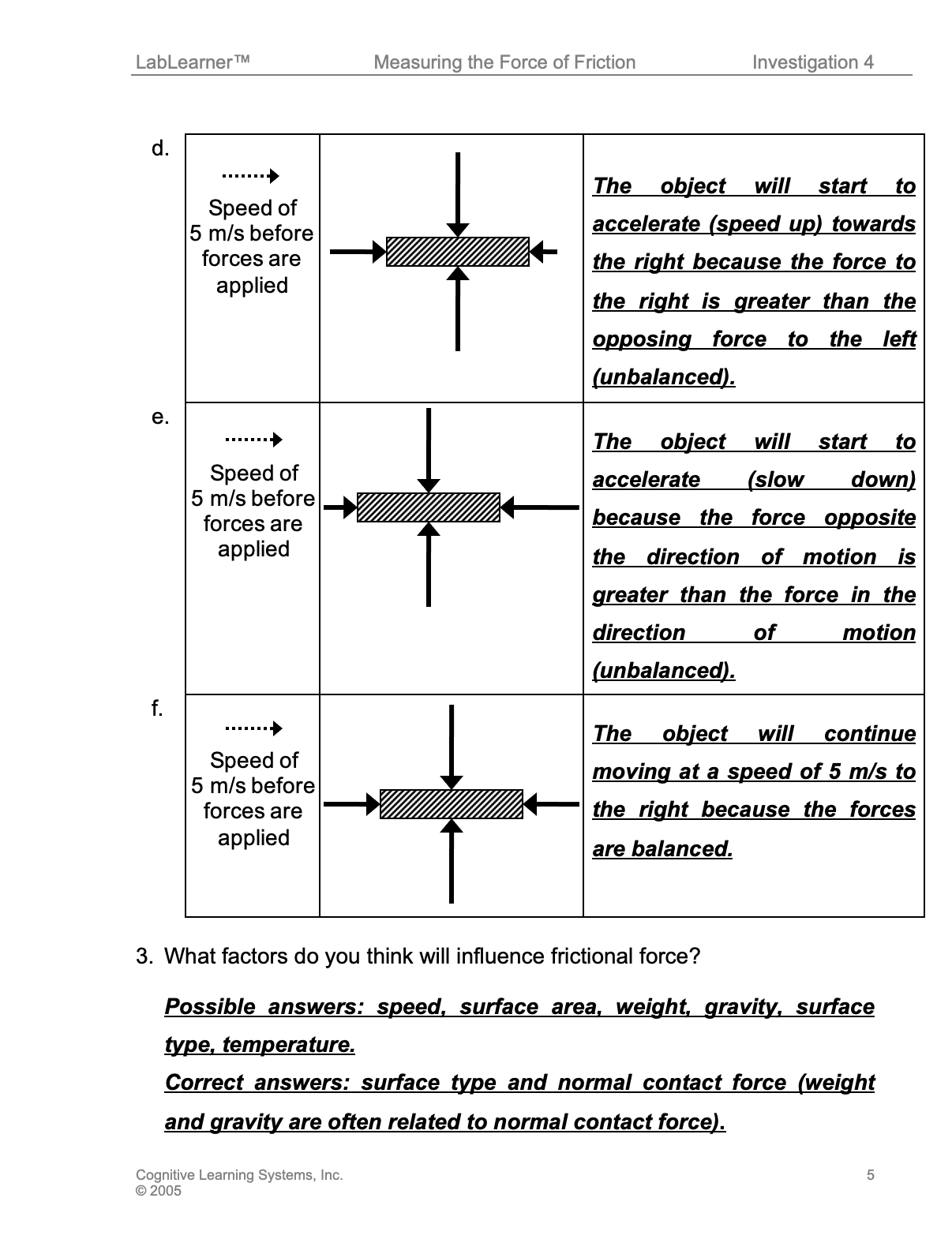
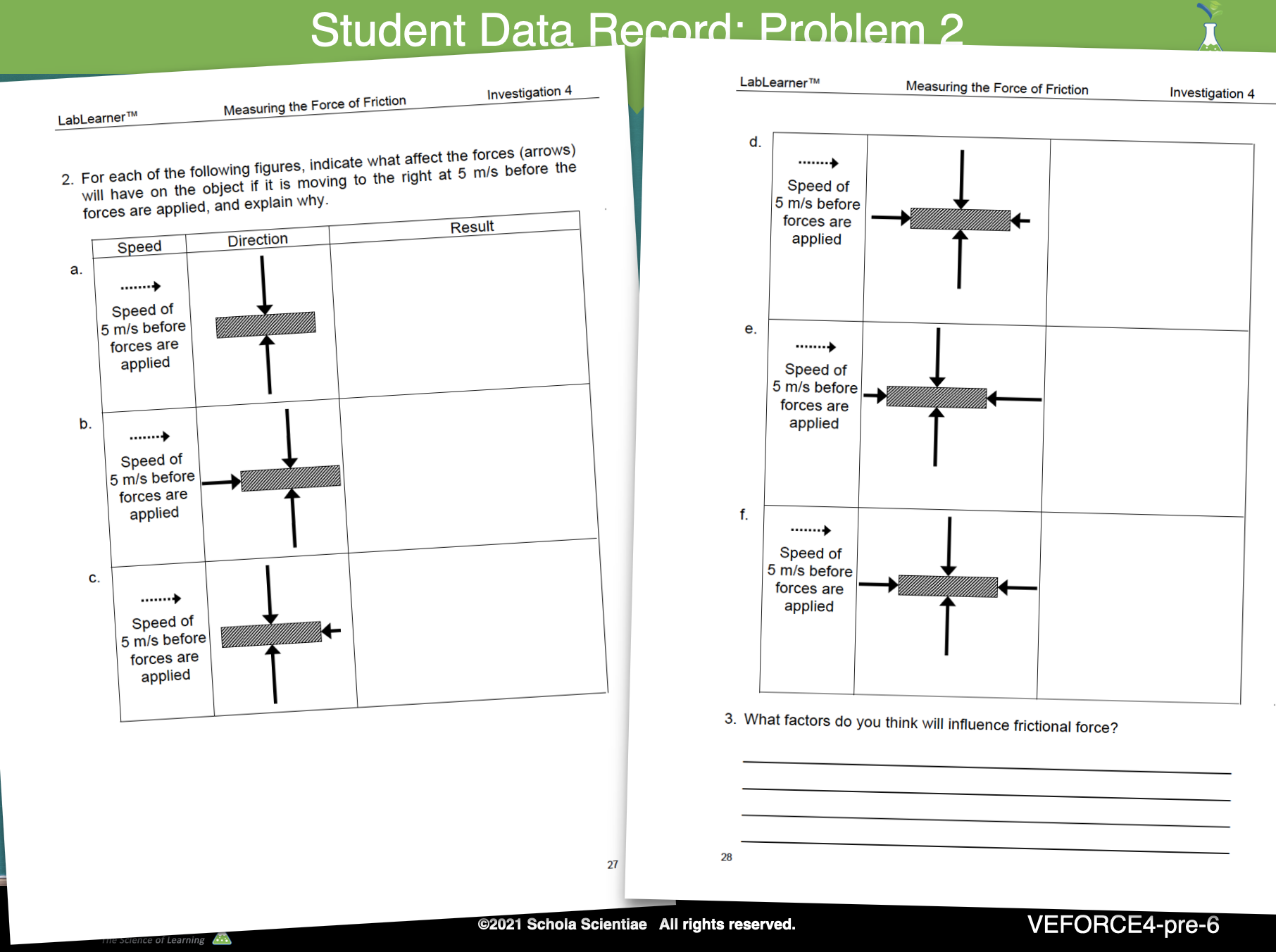
4. Direct students’ attention to Problem 2 in the Student Data Record. Remind students to pay attention to the fact that the diagrams now depict an object that is already moving. Ask students to think back to the previous Investigation, where the acrylic cylinder was in motion when the forces of friction and gravity acted upon it. If necessary, remind students that the force of friction acts in the opposite direction to the direction of motion.
5. At the instructor’s discretion, students may work collaboratively to answer Problems 2a through 2f. After a sufficient period, review each diagram in Problem 2 and discuss the answers as a class. Teachers, please see the Student Data Record KEYS below SHARE IT section.
______________________________________________
SLIDE VEFORCE4-pre-7
Conduct an interactive demonstration to introduce students to the equality that exists between pushing and pulling an object at a constant speed, with regard to the force of friction.
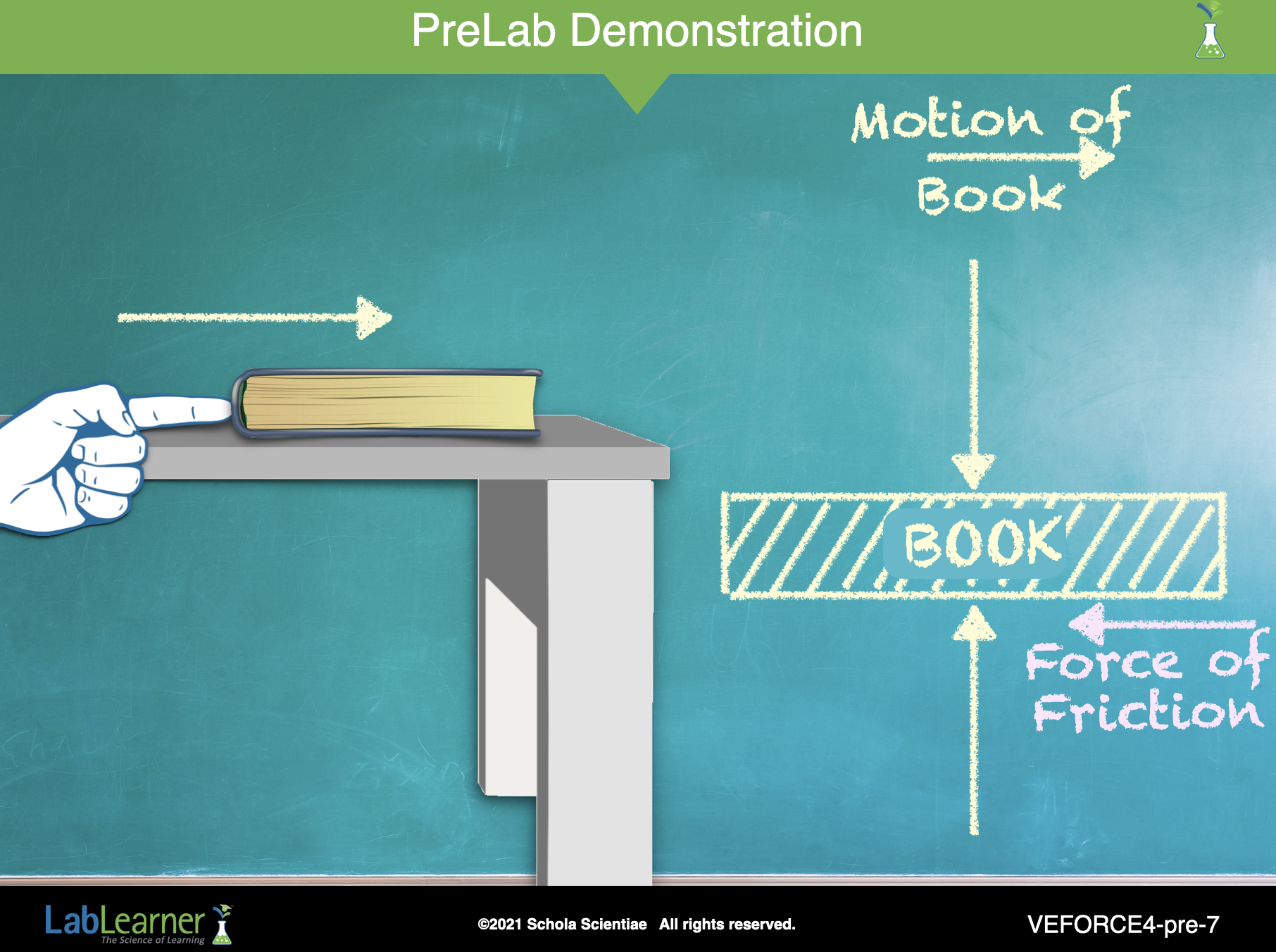
1. Place a book on a table and push it so that it slides from left to right, from a student’s perspective.
2. When the book stops, ask students: What forces were present on the book after I stopped pushing it?
Students should indicate the force of gravity acting downwards, the normal contact force acting upwards, and the frictional force acting opposite the direction of motion.
3. Ask: When I let the book go, was there a force acting in the same direction of motion? Students should realize that no, there was no force in the same direction of motion.
4. Ask: Were the forces balanced or unbalanced? How do you know? Students should realize that the forces were unbalanced since the book slowed down (accelerated).
5. Refer to the drawing on the slide that represents students’ answers to the previous question. Note that the vertical arrows are equal in length.
______________________________________________
SLIDE VEFORCE4-pre-8
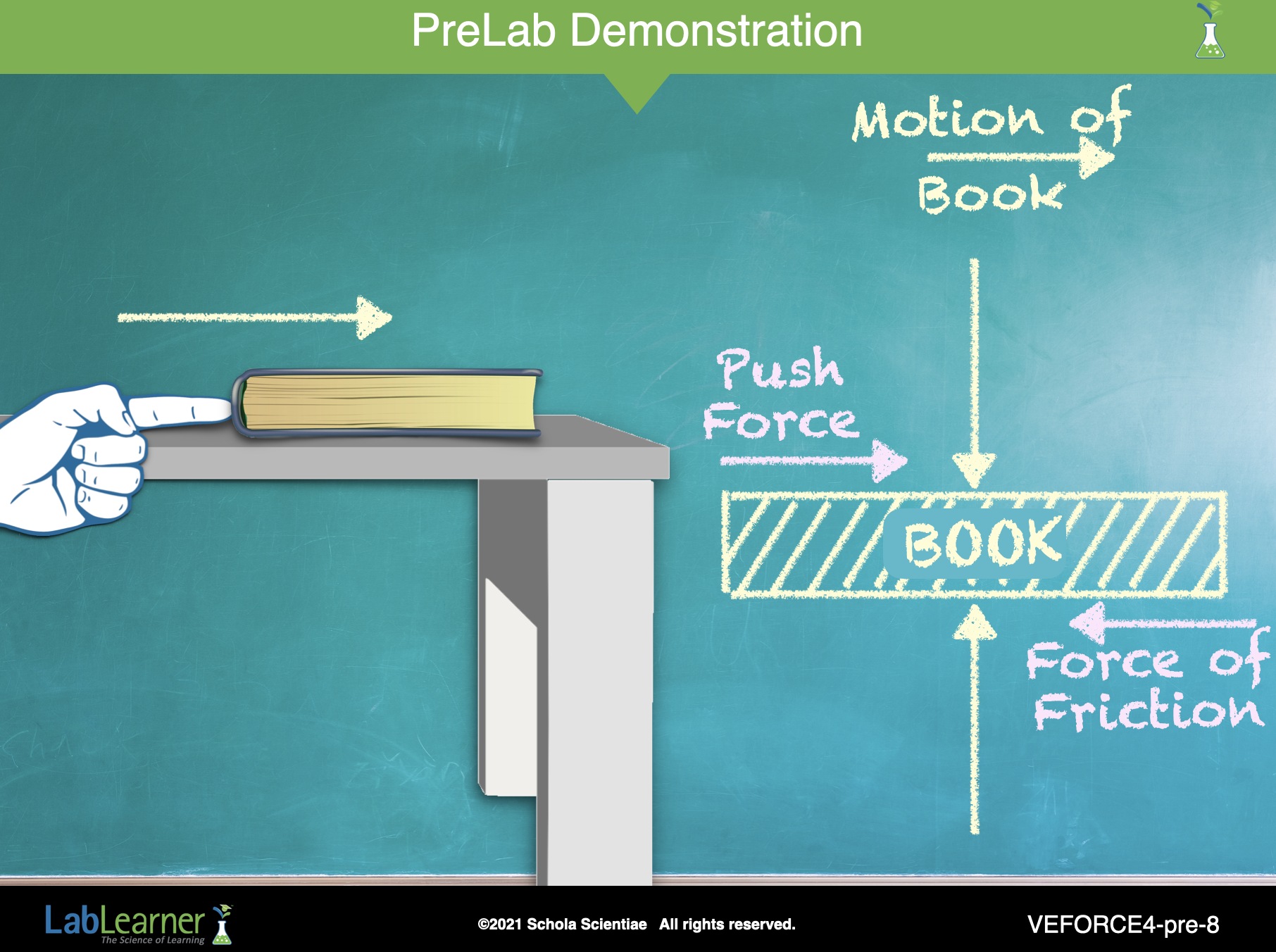
6. Move the book back to the starting position. This time continue to push the book so that it moves smoothly across the table at a constant speed.
7. Ask students: Was the force of friction still present while I was pushing the book? Yes, the force of friction was still present.
8. Ask students: If I pushed the book so that it moves at a constant speed so that the book is not accelerating, what can be said about the forces on the book? The forces are balanced.
9. Ask students: If the forces on the book are balanced, then what do we know about the push force relative to the frictional force? The push force and the frictional force are equal and opposite (balanced).
10. The push force is added to the figure drawn on the slide. It is important that the push and friction forces appear to be the same length.
______________________________________________
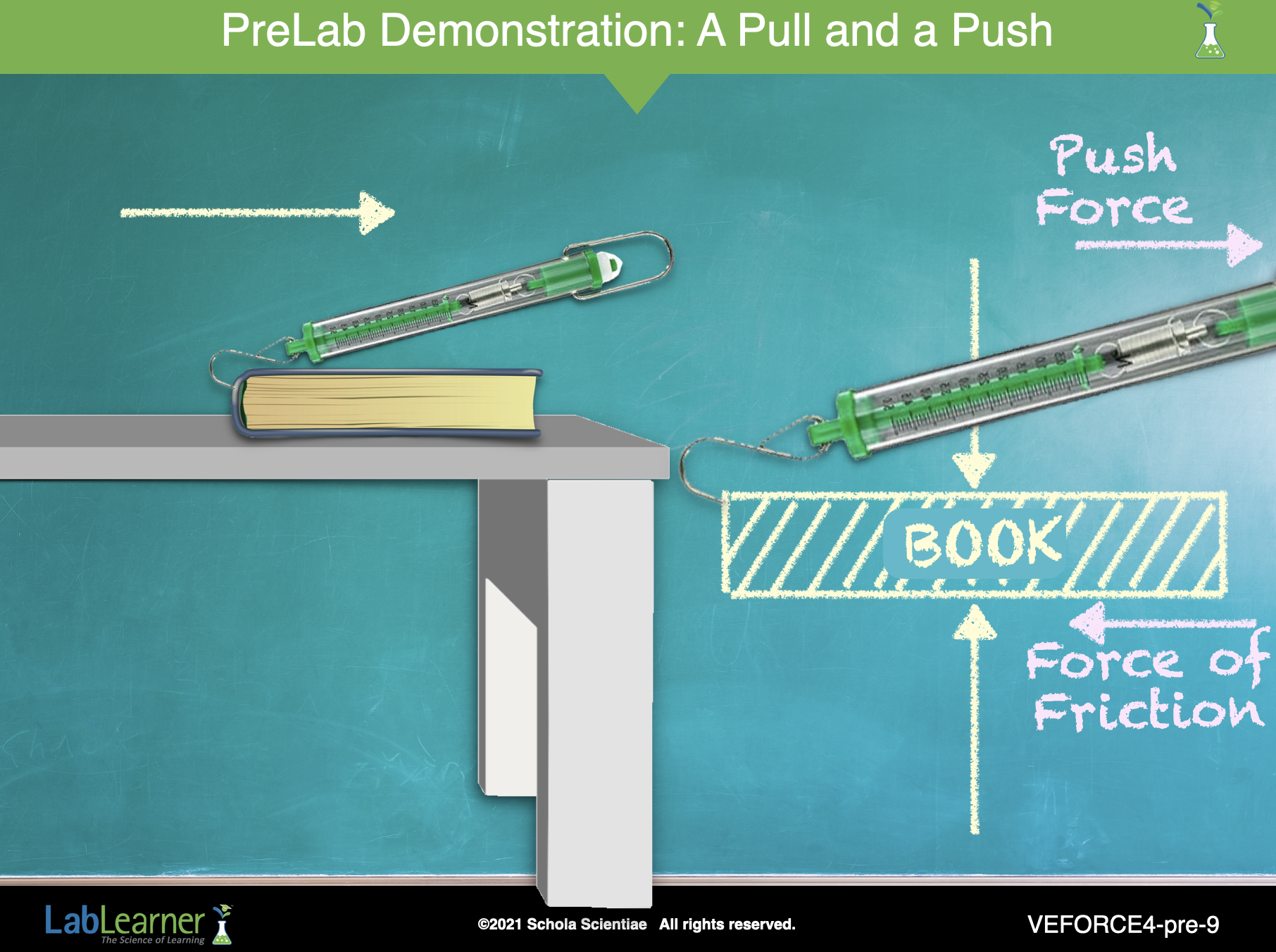
SLIDE VEFORCE4-pre-9
11. Repeat the demonstration, only this time pull on the book instead of pushing it. Explain to the students that, if the object is not accelerating we know that the pull force must be equal to the friction force but in the opposite direction.
12. Ask students: What does a spring scale measure? Students should identify that it measures force.
13. Ask students: Could we measure frictional force using a spring scale? Student answers may vary.
Close this portion of the investigation by explaining to students that in the Lab they will conduct experiments to measure the force of friction. As they do so, they should keep the following questions in mind:
• How can the force of friction be measured?
• How does the force of friction change as surface type changes?
• How does the force of friction change as weight changes?
WATCH IT
Play the following Student Video in preparation for the lab. Discuss as necessary to answer student questions.
KEYS: PRELAB EXERCISE