
Teacher Portal:
Earth’s Forces
Investigation 1
Earth's Forces: Investigation-1: Exploring Forces
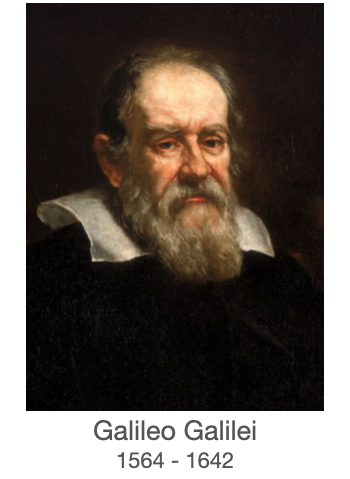 A central issue in physics is to understand the relationship between force and motion. A common misconception is that a force is necessary for an object to continue moving, as originally proposed by Aristotle (384-322 B.C.). This seems to match our experience with the world. However, the Italian scientist Galileo (1564-1642) turned this notion on its head by claiming that it is natural for an object to remain at rest, or to continue moving at a constant speed in a straight line.
Newton’s Three Laws of Motion
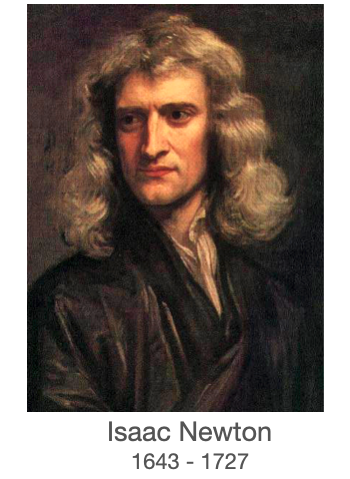
This breakthrough in thinking was further developed by the English scientist, Sir Isaac Newton (1643-1727), who developed three laws of motion (published in 1687). Newton’s 1st law states that:
Newton’s First Law of Motion:
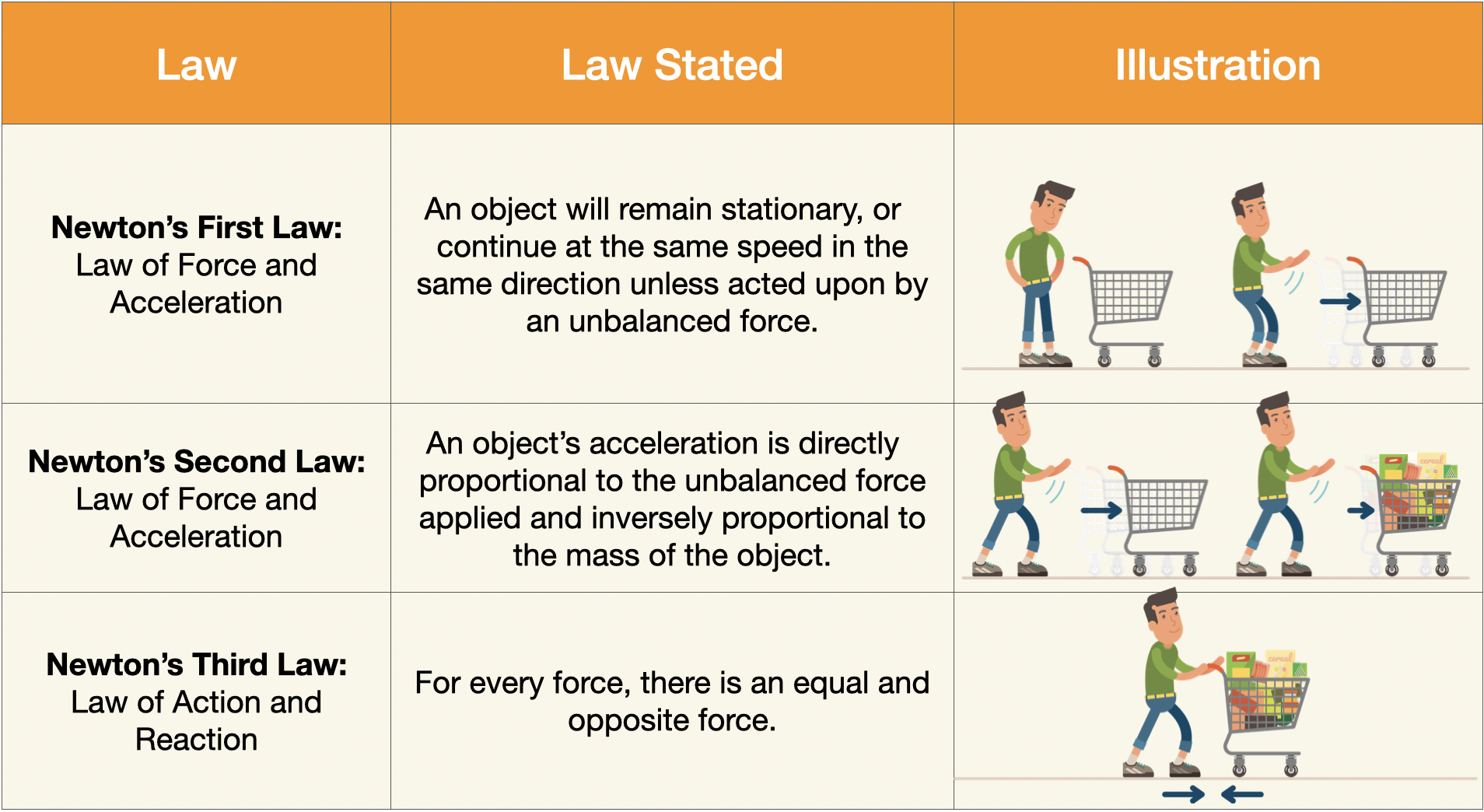
An object will remain stationary, or continue at the same speed in the same direction unless acted upon by an unbalanced force.
 The resistance to change in motion, that is acceleration, is due to the object’s inertia. Hence, this law is also sometimes referred to as the Law of Inertia. An unbalanced force is necessary to overcome an object’s inertia. An unbalanced force will cause the object to speed up, slow down, or change direction, all of which are forms of acceleration. It is important to use the term acceleration even for describing an object slowing down. While a term used in everyday language, deceleration is not a technically correct term in physics. Newton’s 2nd law goes further, by stating the influence of a force on the acceleration of an object:
Newton’s Second Law of Motion:
An object’s acceleration is directly proportional to the unbalanced force applied and inversely proportional to the mass of the object.
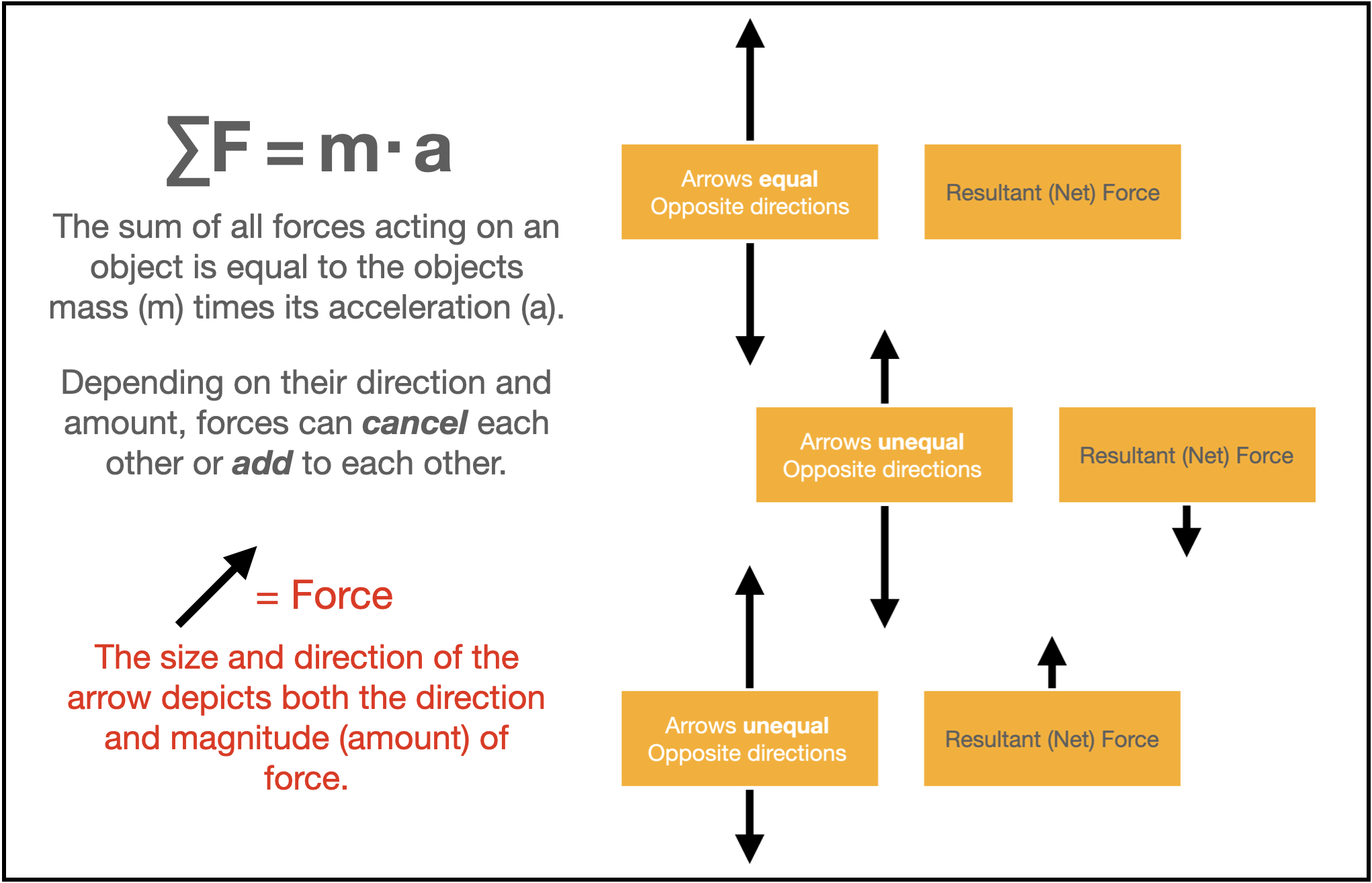
This indicates that if the mass is not changed, as the force (F) doubles, the acceleration (a) will also double. On the other hand, if the mass (m) of the object doubles in size, and the force remains the same, the acceleration will half. Newton’s 2nd law can be summarized by the equation:
∑F = ma ,
where the summation sign at the beginning indicates that it is the net or resultant force that dictates the acceleration of an object. The reason the net force is used is because if two equal forces act in opposite directions on the same object they will cancel out, and the object will not accelerate (situation A in the Figure below). If the forces are unequal and opposite, then the smaller force will be subtracted from the other larger force (situations B and C in the Figure below). It is the net (resultant) force that is important and hence the term unbalanced force is used in this Investigation.
We finally come to Newton’s Third Law of Motion, which states:
Newton’s Third Law of Motion:
For every force, there is an equal and opposite force.
For every force, there is an equal and opposite force. This makes it appear that every force will be canceled out by an equal and opposite force! However, this is not the case. Newton’s 3rd law refers to forces that act on two different objects. For example, if you (object 1) apply a force to press on a book (object 2), the book also applies an equal force on you which acts in the opposite direction. Because these forces act on two different objects (one on the book and one on you) they never cancel out. To understand what happens to the net or resultant force on the book, only the forces on the book should be considered. To understand what happens to you, only the forces on you should be considered.
Gravity
An ideal place to begin to understand Newton’s laws is to examine the force of gravity. All objects exert a force between all other objects, known as the force of gravity. This means, there is a force of gravity between you and all the objects in the room you are now sitting in! Why doesn’t this make all the objects in the room clump together? The reason you do not feel the force of gravity between yourself and the other objects in the room is because the force of gravity is a relatively weak force.
When thinking about the force of gravity, many people only think about the force of gravity between the Earth and 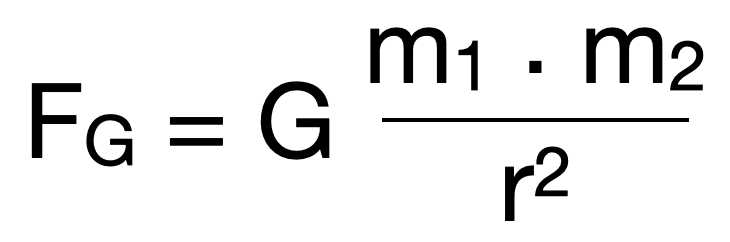 the objects on the Earth. This is the most obvious force of gravity in our everyday experience. The reason the force of gravity between the Earth and other objects is large is due to the very large mass of the Earth. The force of gravity (FG) is dependent on the mass of the two objects (m1 and m2) being considered, and the distance (often referred to as the radius, r) between the centers of the two objects.
The force equation shown here tells us that the force of gravity on the two objects considered is equal. This is an example of Newton’s 3rd law, but it is important to realize that the forces act on two different objects. As the mass of one or both of the objects get bigger, so too does the force of gravity.
The equation also tells us that the force of gravity gets smaller as the radius gets bigger, and, because the radius is squared in the equation (r2), as the radius is doubled the force of gravity becomes a quarter of the size.
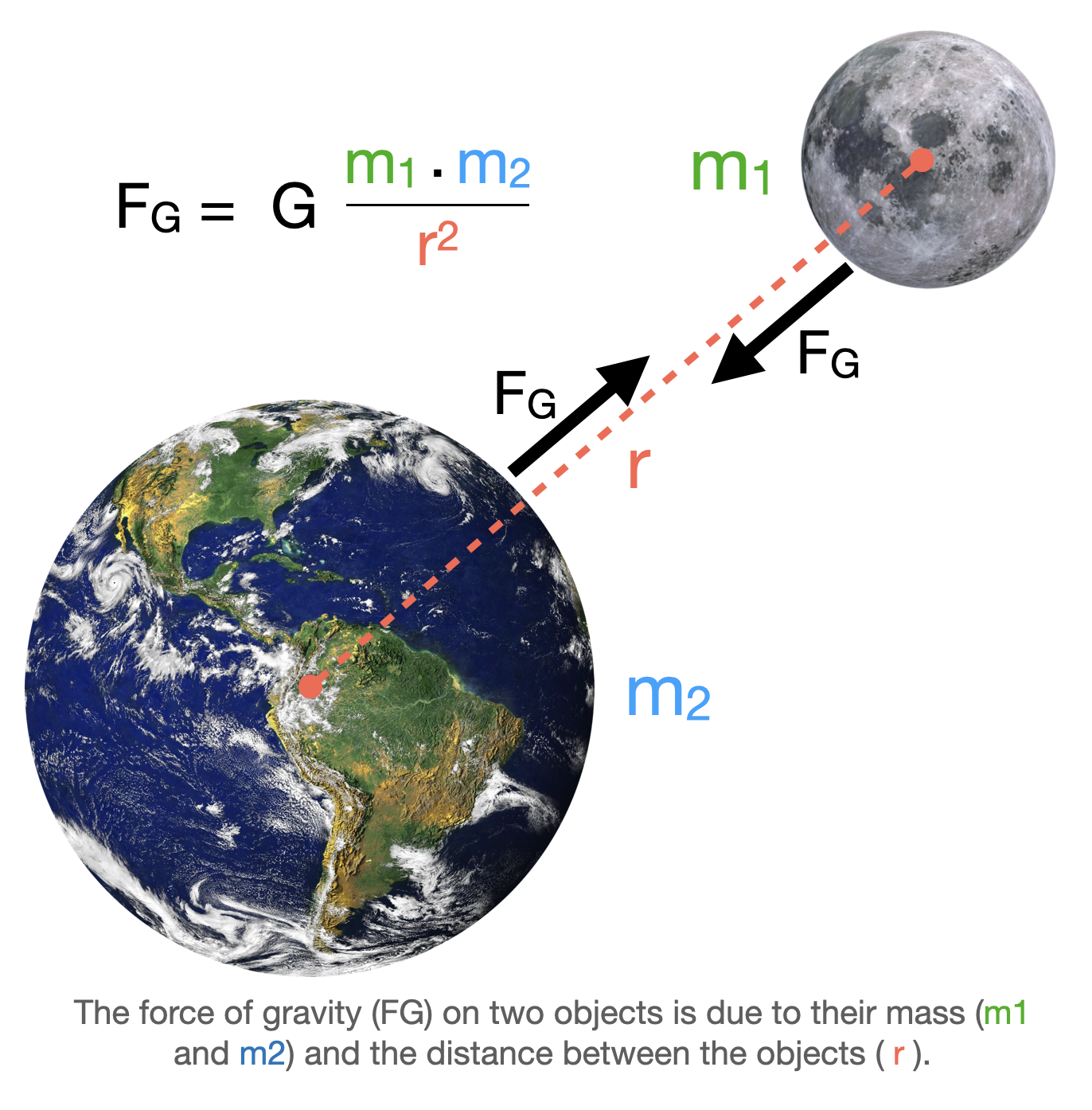 The other term in the equation, G, is the gravitational constant and equals 6.67 X 10⁻¹¹ (or 0.0000000000667) N m2/kg2. As the name indicates it is a constant value in the equation, and as you can see the number is extremely small. From the equation, we can now see that it takes one of the masses to be extremely large (e.g., the mass of the Earth which is 6 X 1024 kg), and for the objects to be close, in order for the force of gravity to be large.
Another term for the force of gravity is weight. We consider the weight of an object on Earth to be due to the force of gravity with the Earth. It is vital to realize that mass and weight are not the same thing. If we look back at the equation above, it reveals that the weight of an object (which is denoted as FG in the equation but can be represented by W) is not equal to its mass. Although, the equation does show that the mass of an object is related to its weight (force of gravity).
We define mass as the amount of matter an object consists of. The mass is therefore constant anywhere in the Universe, as long as the object does not change. In contrast, the weight of an object is the force of gravity on the object and depends on the other object with which it has a gravitational force. For example, the weight of an object on the surface of the Moon is approximately 1/6th the weight of the same object on the surface of the Earth. This is due to the difference in the radius (r) and the mass of the Moon relative to that of the Earth. One note of importance is that in the context of this CELL, students will work with a 100 g mass weight. That is, the mass of the object is 100 g. However, it is often referred to as a ‘weight’ when technically, the term weight refers to the force of gravity that acts on the object.
 A common misconception is that there is no gravity in space. Clearly, there is a force of gravity between the Earth and the Moon, and between the Earth and the Sun. Even though they are far away from each other (that is, a large radius r exists), they are very large masses. Artificial satellites that orbit the Earth have a force of gravity with the Earth. The force of gravity is less than on Earth because of the increase in the distance between them, but if they did not have this force of gravity these satellites would not orbit the Earth. Instead, the satellites would continue moving in a straight line at a constant speed according to Newton’s First Law. This is the same for astronauts on the Space Station orbiting the Earth. The reason for the apparent feeling of “weightlessness”, is because the Space Station and the astronaut are actually falling towards the Earth at the same speed.
As mass and weight are different, so too are their units. The S.I. units (International System of Units, from the French, Systeme Internationale) for mass are grams (g) or kilograms (kg). In contrast, weight is a force, with the S.I. units of Newtons (N), named for Sir Isaac Newton. Newtons actually represent a combination of units, more specifically 1 N = 1 kg⋅m/s2. These units arise from Newton’s 2nd law, where force (N) equals mass (kg) multiplied by acceleration (m/s2).
In Investigation One, you will investigate the difference between mass and weight. The mass and weight of various objects will be measured. Based on the measurements, you will discover that mass and weight are related, with weight directly proportional to mass. You will also begin to understand that an object will remain stationary, or continue moving in a straight line at a constant unless acted upon by an unbalanced force.
Earth's Forces: Investigation 1 - Mathematics Concepts
Prelab
- (in)direct relationships
- patterns/trends
Lab
- (in)direct relationships
- patterns/trends
- mass in grams and kg
- weight/force in Newtons
- decimals to the nearest tenth
- metric conversion
- comparing (non)measurable characteristics
Postlab
- line graph
- mass in kg
- force in Newtons
- skip counting by 0.4 and 0.04
- data analysis
- (in)direct relationships
- patterns/trends
- least to greatest
- problem-solving
Earth's Forces: Investigation 1 - Procedural Tools


Earth’s Forces:
Investigation 1 Quiz

