
Teacher Portal:
Rock Cycle Journey
Four: Metamorphic Rocks
 PRINT IT
Use your browser to download a printable PDF as help during the slide presentation and to make additional notes. In your browser, go to File > Print and then choose to save as PDF.
NAVIGATE IT
Once the slide presentation is launched
- use your left and right arrows to advance or go back in the slide presentation, and
- hover your mouse over the left edge of the presentation to get a view of the thumbnails for all the slides so that you can quickly move anywhere in the presentation.
- Click HERE to launch the slide presentation for the CELL.
SHARE IT
SLIDE VECS4-1
This is the fourth and final presentation in the Rock Cycle Journey. In it, students will learn about metamorphic rocks and, combined with their understanding of igneous and sedimentary rocks, come to understand the complete rock cycle.
______________________________________________
SLIDE VECS4-2
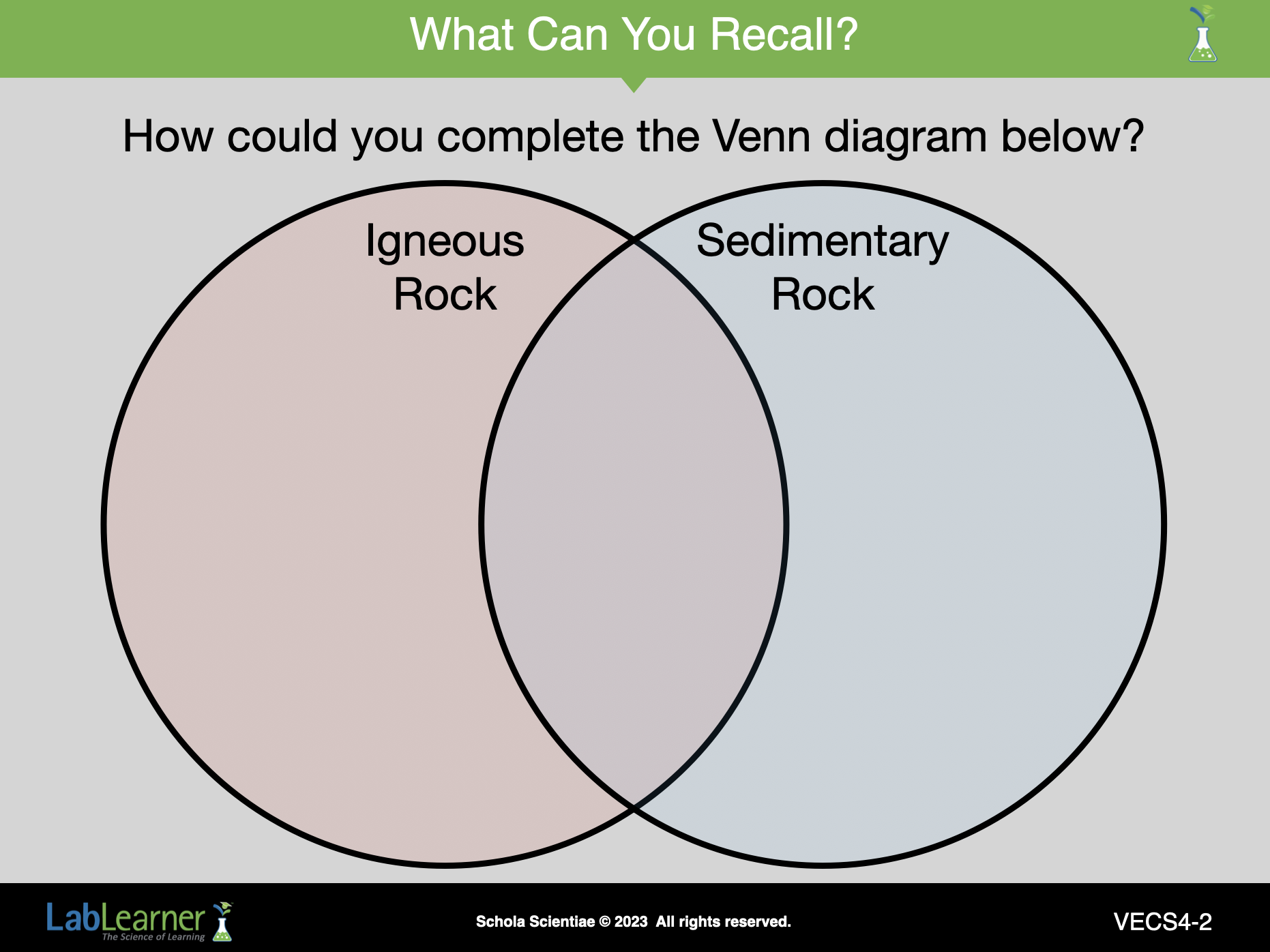
The What Can You Recall section has been provided as a way to help students rehearse and process the information learned previously during the previous sections of the Rock Cycle Journey. The question focuses on some major concepts or facts about igneous and sedimentary rocks.
This What Can You Recall section is designed to be the first activity at the beginning of the Metamorphic Rocks section of the Rock Cycle Journey.
Student answers may vary. Sample answers are provided:
Under Igneous Rocks
- Makes up the bottom of Earth’s crust
- Forms by magma or lava that cools
- Looks bubbly, glassy, or has large crystals
- Forms from and around volcanoes
Under Sedimentary Rocks
- Forms from weathering and erosion of other rocks
- Forms from layers of sediment
- Forms by the pressure of one layer on top of another layer
- Forms in areas at the bottom of rivers, lakes, and oceans
- Forms on TOP of Earth’s crust
Under the area of similarities (middle of Venn Diagram)
- Found on the surface of Earth
- Found on Earth’s crust
- Found on land and under the ocean
______________________________________________
SLIDE VECS4-3
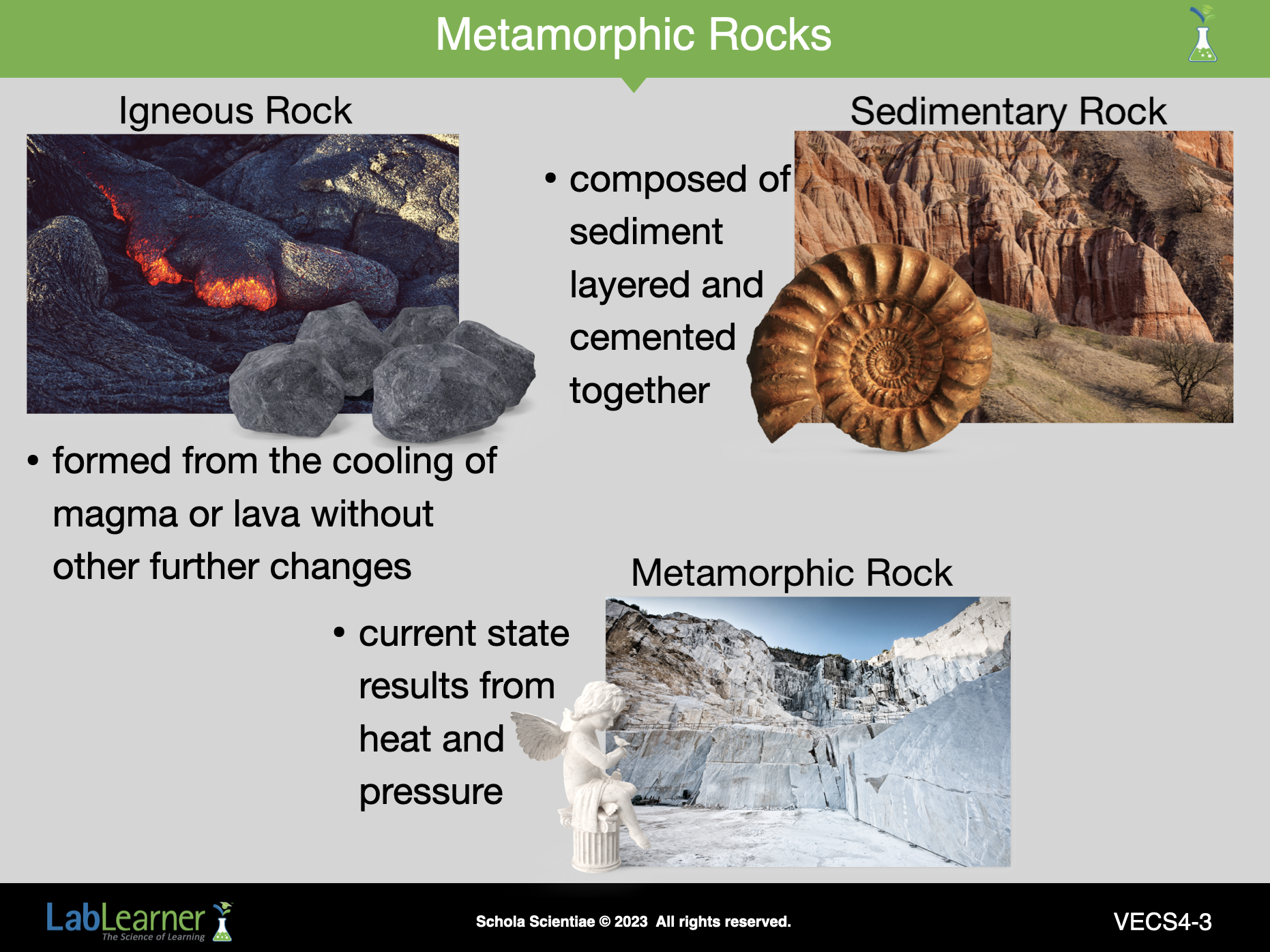
This and the following slides have been designed to introduce students to the third type of rock that composes the Earth’s crust: metamorphic rock. Compared to igneous and sedimentary rock, metamorphic rock makes up only a tiny part of the Earth’s crust (approximately 5%).
Metamorphic rocks are formed due to chemical changes induced by heat and pressure. Any rock that experiences chemical changes due to heat and pressure and becomes a different rock from which it first started is classified as a metamorphic rock and is said to have undergone metamorphosis. For example, when limestone (a sedimentary rock) is subjected to intense heat and pressure, it is chemically changed into marble. Therefore, marble is a metamorphic rock.
The key to understanding the difference between a sedimentary, igneous, or metamorphic rock is to understand what process formed the rock that is being observed:
- If it formed from the cooling of magma or lava without other further changes, it is an igneous rock.
- If it is composed of sediment layered and cemented together, it is a sedimentary rock.
- It is a metamorphic rock if its current state results from heat and pressure.
Thus, metamorphic rocks can begin as igneous, sedimentary, or metamorphic rocks.
When the starting rocks meet high temperatures or pressures, they change. They become pressed, smeared, or folded during the process, and their minerals are changed into minerals different from the original igneous, sedimentary, or metamorphic rocks.
______________________________________________
SLIDE VECS4-4
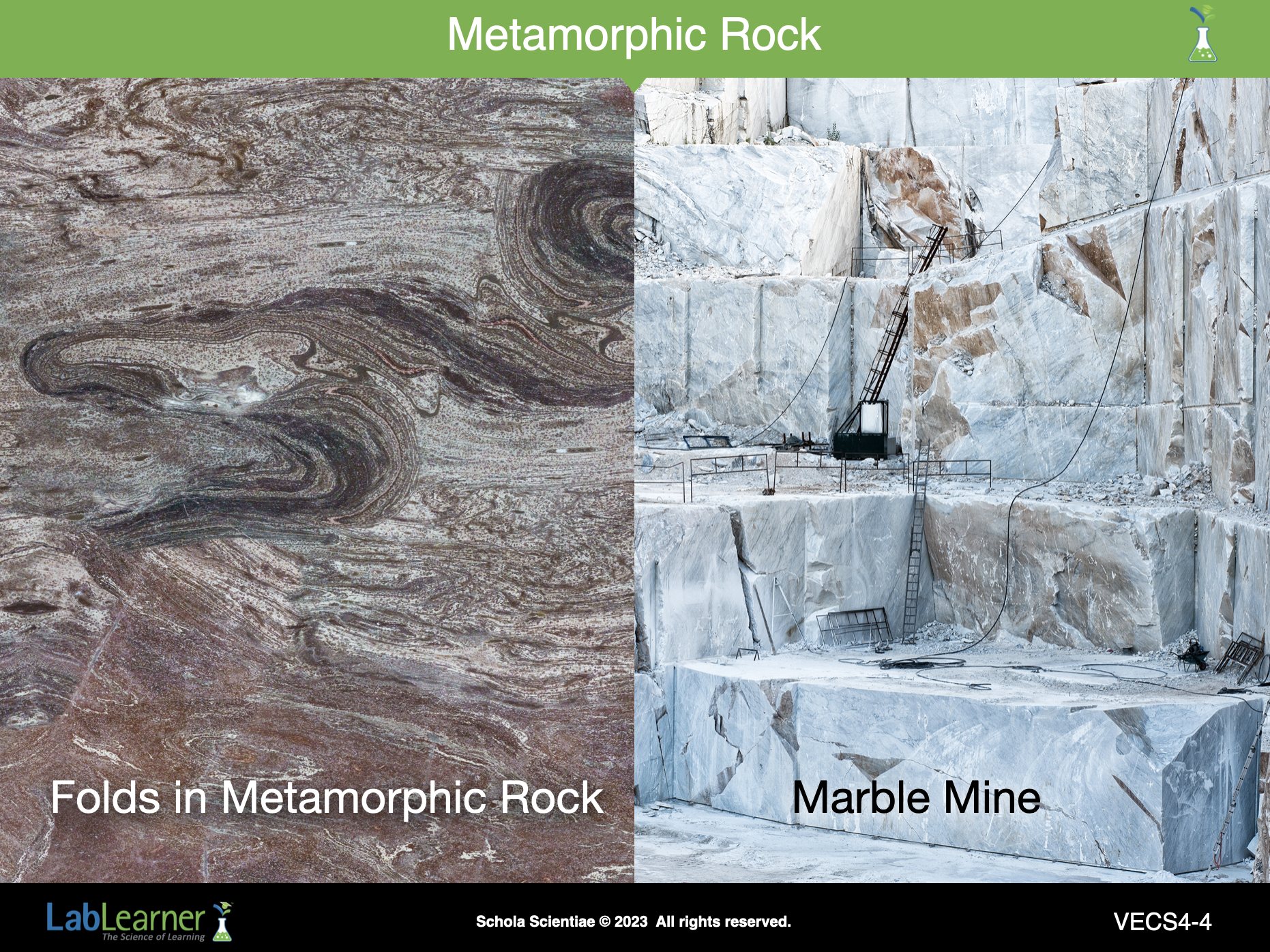
As rocks are forced downward and deeper into the crust, they become pressed, stretched, or folded during the process, and the minerals in them are changed into minerals different from the original rocks.
The forces acting on the rock may cause it to bend, fold, and become deformed. Sometimes, the folds in the metamorphic rock are visible (as shown in the example on the left). In other cases, the metamorphic process does not produce folds.
______________________________________________
SLIDE VECS4-5
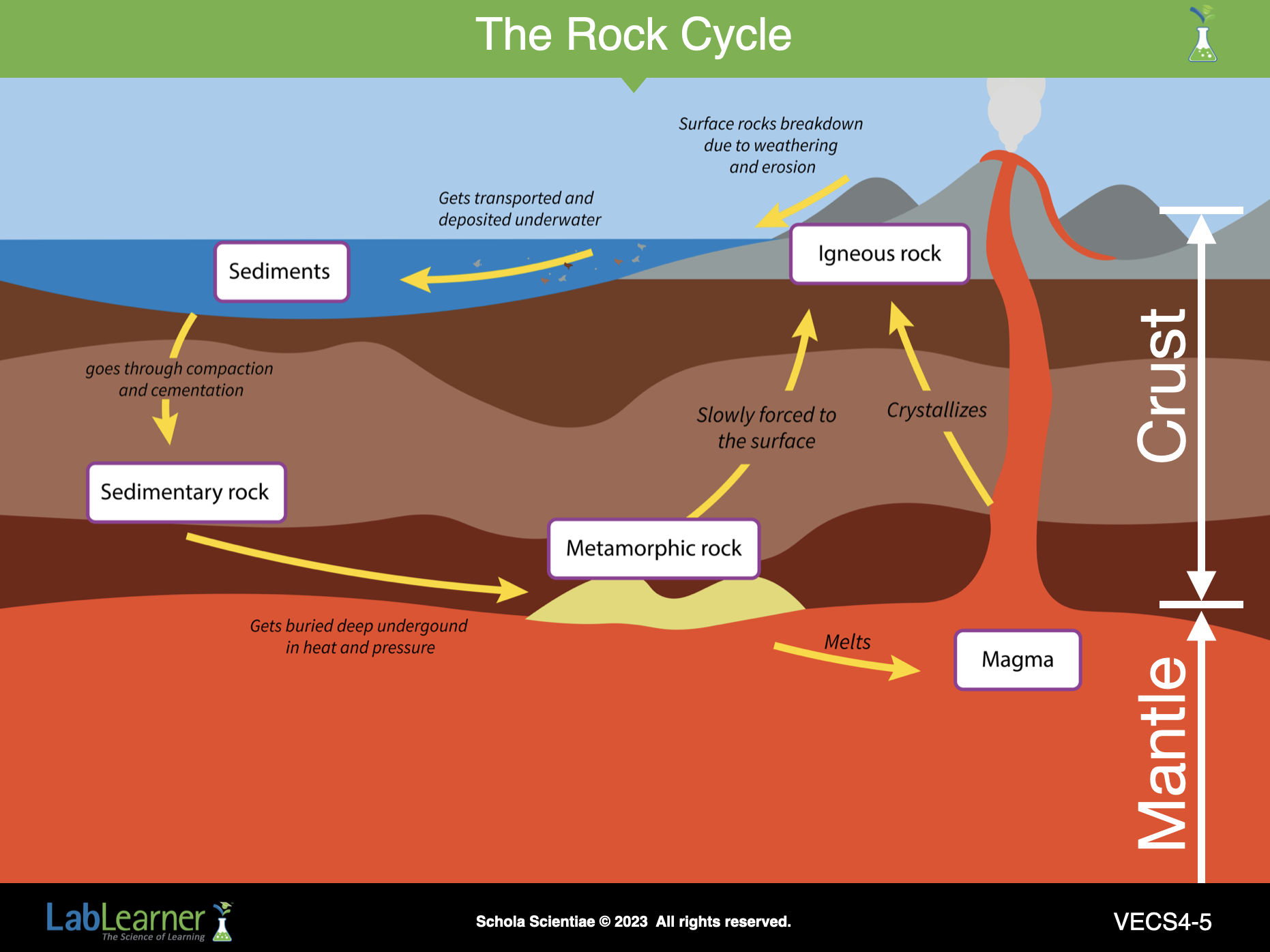
The high temperatures and pressure needed to produce metamorphic rocks are found deep within the Earth’s crust. As a result, metamorphic rock formation occurs below the Earth’s surface.
One of the events that can produce metamorphic rocks occurs when one section of the Earth’s crust slides over another. As this happens, there is a tremendous amount of friction, heat, and pressure on the part of the crust that slides under the top piece of the crust.
Metamorphic rock is formed during this process in some of the deeper areas under the two pieces of moving crust… this brings us to the rock cycle.
______________________________________________
SLIDE VECS4-6
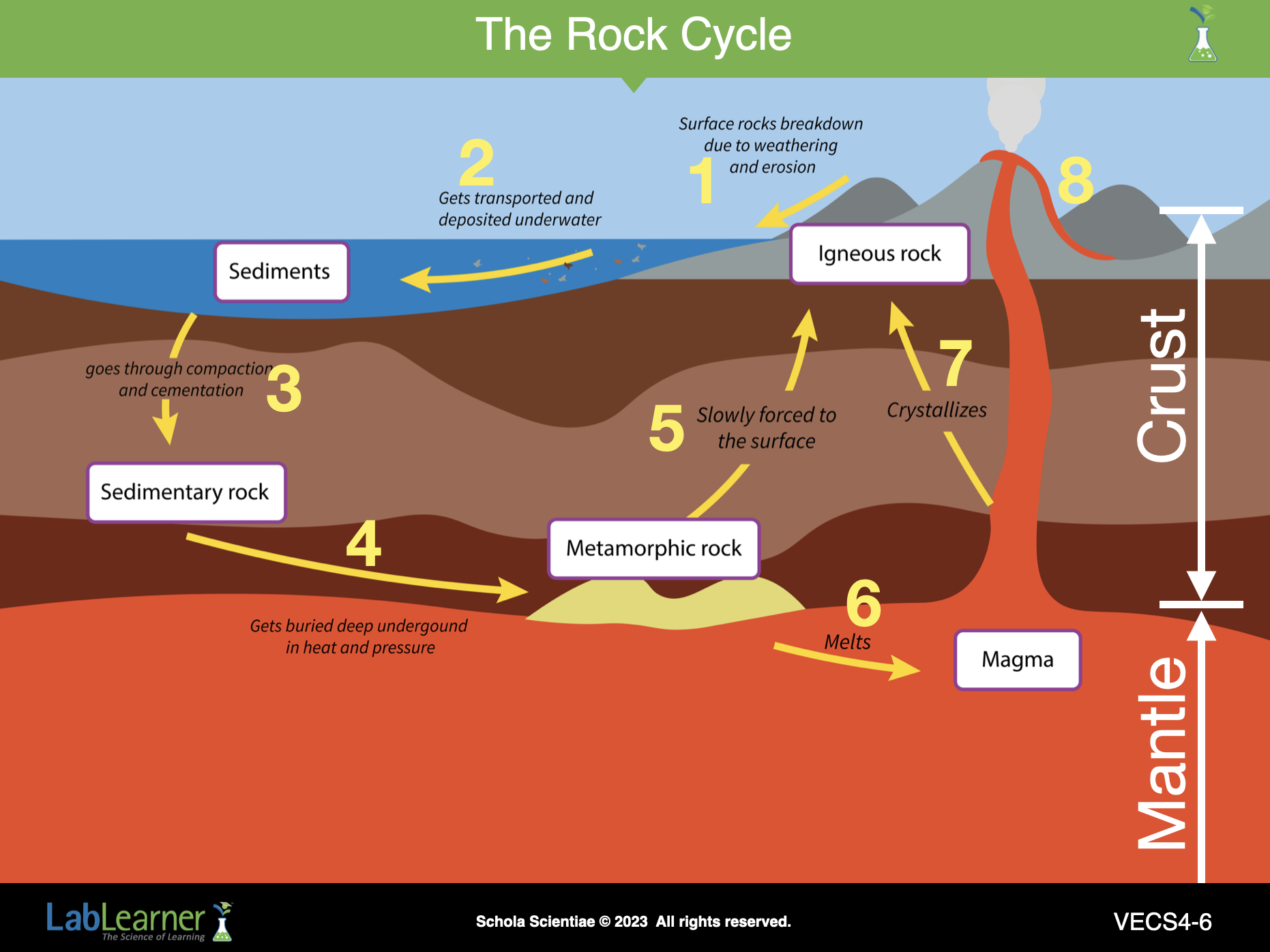
The Rock Cycle:
- Surface rocks are worn down by weathering and erosion (rain, wind, running water) and enter bodies of water as sediment.
- Sediment is transported and deposited underwater.
- As sediment is pressed deeper by increasing layers above, sedimentary rock is formed through compaction and cementation.
- As these rocks are forced deeper, and temperatures rise as they approach the mantle, physical and chemical changes occur in the rock, and they undergo metamorphosis and become metamorphic rock.
- At this point, huge rock movements such as earthquakes and crust shifting can force the metamorphic rock to the surface. These are the metamorphic rocks that we may see on the surface.
- Alternatively, metamorphic rocks may melt and enter the liquid magma of the mantle.
- From the mantle, the magma then rises into the crust. Pockets of magma that don’t reach the surface and slowly cool underground become intrusive igneous rock such as granite.
- Finally, magma that reaches the surface through a volcano, becoming lava, quickly cools and becomes extrusive igneous rock such as obsidian, pumice, and basalt.
Once the uplifted igneous rock, either intrusive or extrusive, arrives at the surface and is exposed to wind, rain, and perhaps cycles of freezing and thawing (all contributing factors in erosion), forming new sediment particles, the entire rock cycle is repeated.
In other words, rock constantly moves from new igneous rock to sedimentary rock, to metamorphic rock, and back to the surface as igneous rock.
This cycle can take millions of years to complete, and it never stops.
______________________________________________
SLIDE VECS4-7
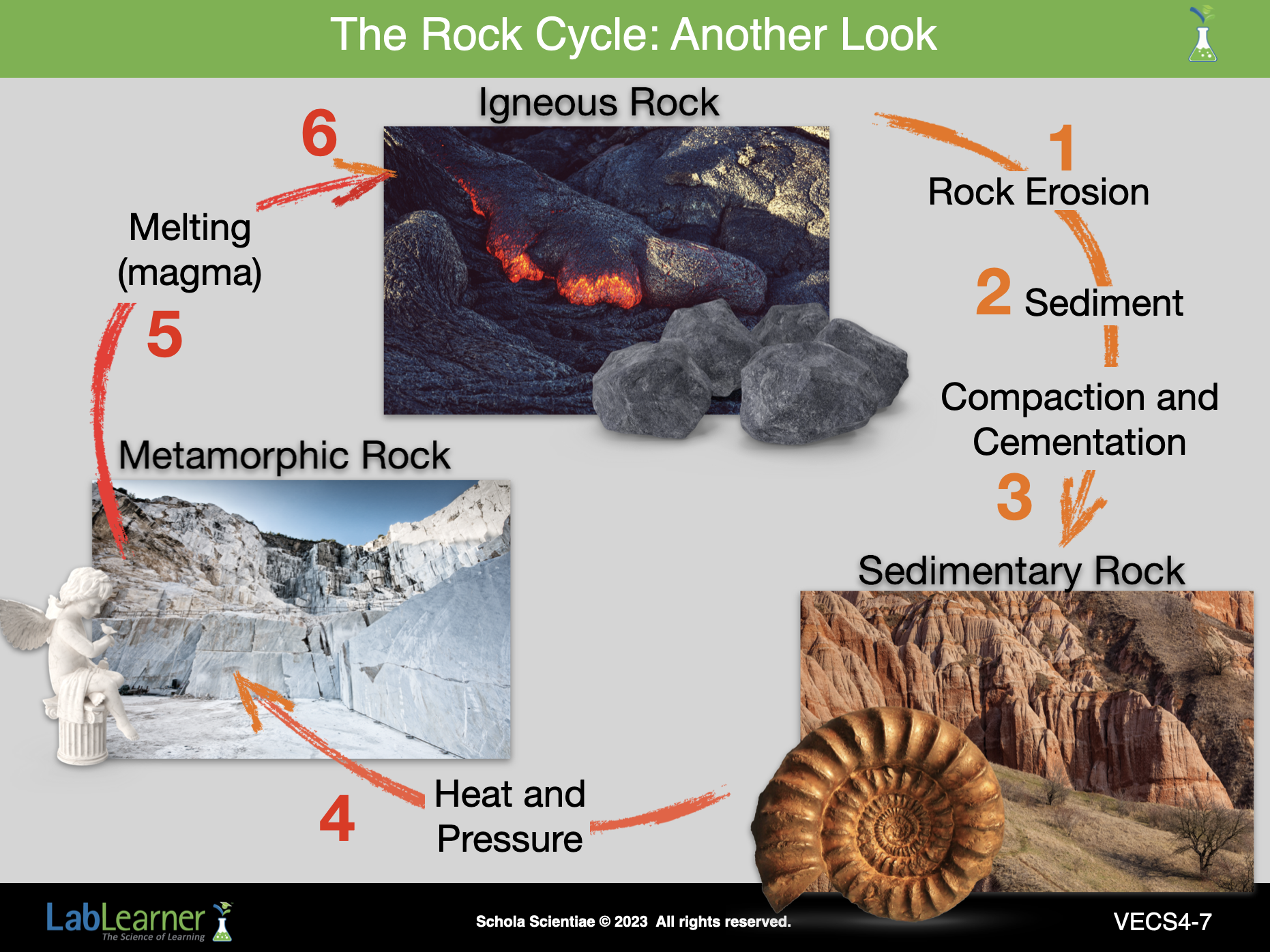
The Rock Cycle:
- Surface rocks are worn down by weathering and erosion (rain, wind, running water) and enter bodies of water as sediment.
- Sediment is transported and deposited underwater.
- As sediment is pressed deeper by increasing layers above, sedimentary rock is formed through compaction and cementation.
- As these rocks are forced deeper, and temperatures rise as they approach the mantle, physical and chemical changes occur in the rock, and they undergo metamorphosis and become metamorphic rock.
- From the mantle, the magma then rises into the crust. Pockets of magma that don’t reach the surface and slowly cools underground becomes intrusive igneous rock such as granite.
- Finally, magma that reaches the surface through a volcano, becoming lava, quickly cools and becomes extrusive igneous rock such as obsidian, pumice, and basalt.
Once the uplifted igneous rock arrives at the surface, it is immediately acted upon by wind and water erosion, forming new sediment particles, and the entire rock cycle is repeated.
______________________________________________
SLIDE VECS4-8
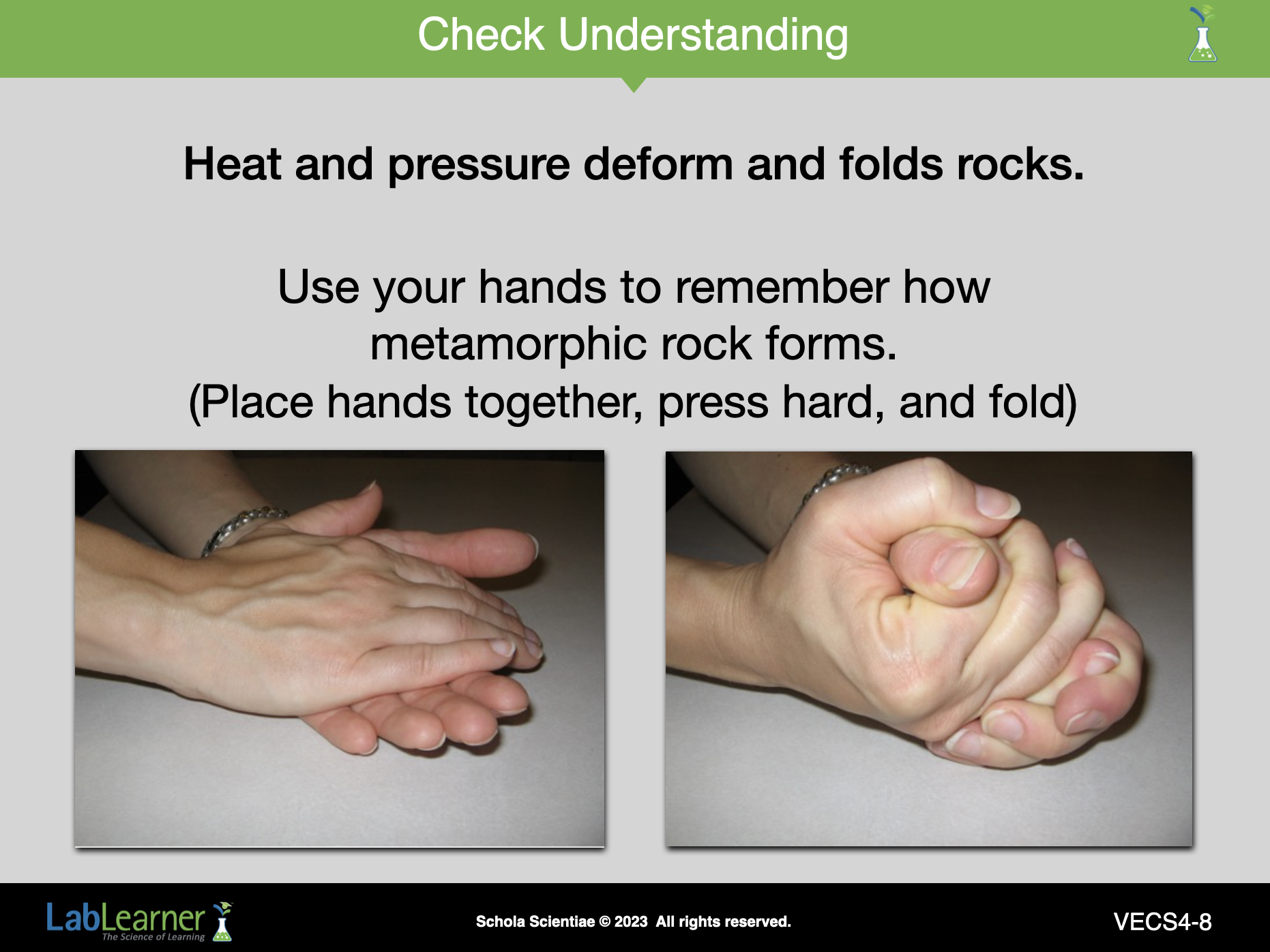
The Check Understanding section is provided to help students rehearse and review what they have learned about metamorphic rocks and their formation by linking information about heat and pressure with the pressing, smearing, and folding of rocks with hand movements.
______________________________________________
SLIDE VECS4-9
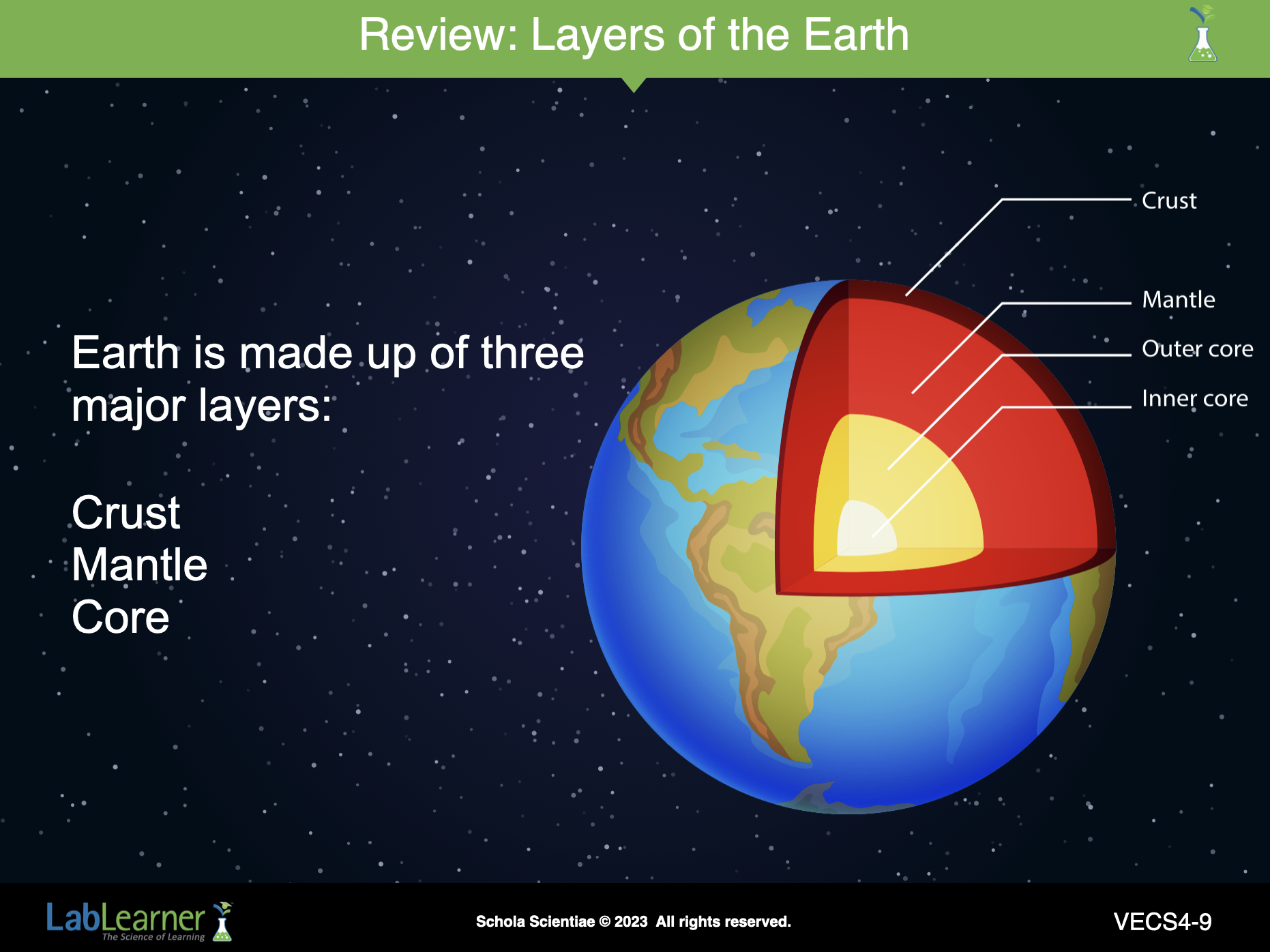
The following few slides are included for a quick review of key points of the Rock Cycle Journey.
The Earth is composed of layers:
- The crust is the outer, solid layer of rocks.
- The mantle is beneath and much thicker than the crust. It contains liquified, melted (molten) rock.
- The core is beneath the mantle and forms the center of the Earth. The extreme heat of the core keeps most of the mantle in a liquid state.
______________________________________________
SLIDE VECS4-11
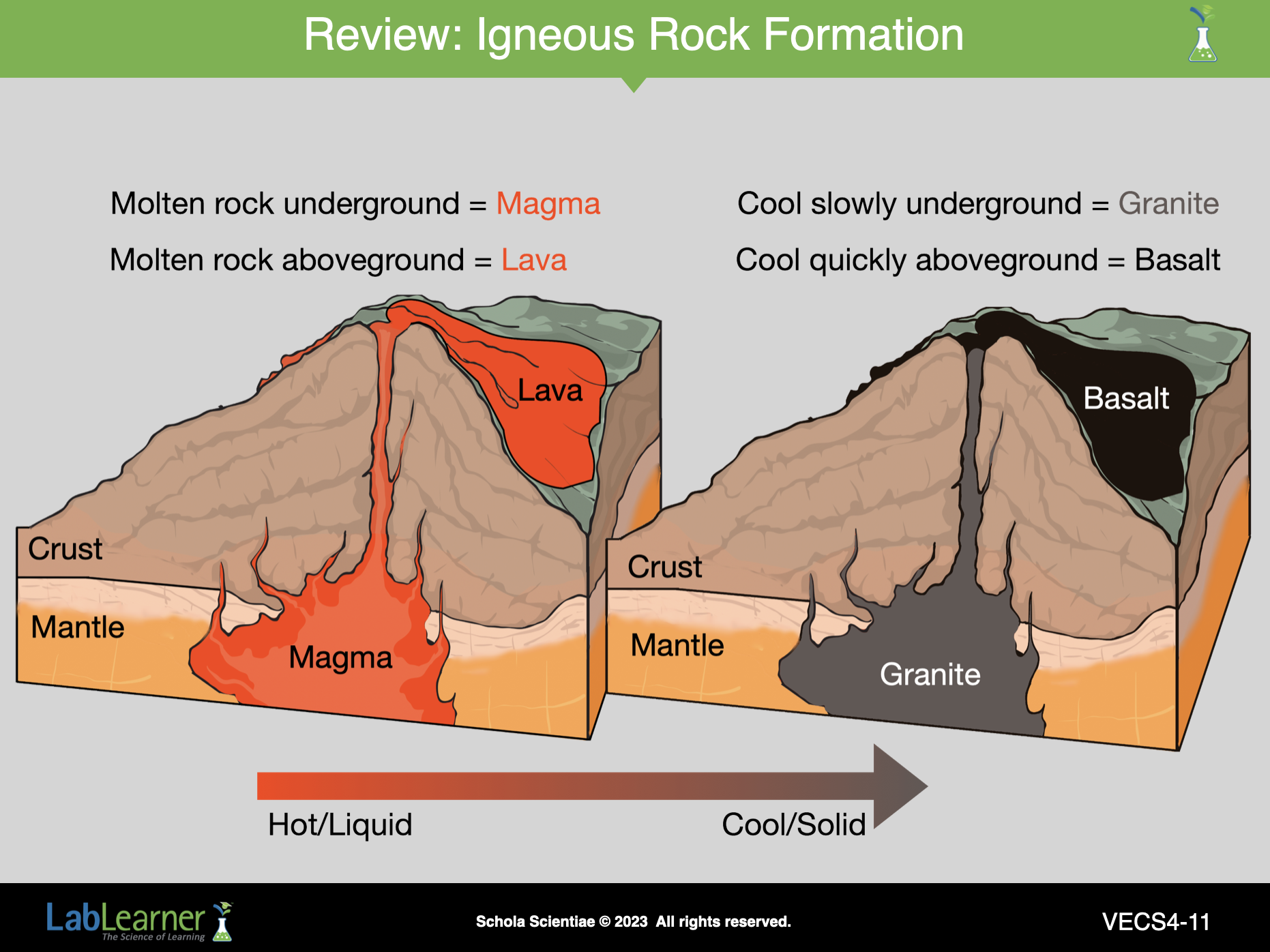
In simple terms, igneous rock is formed from the cooling of molten magma that comes up to the crust from the mantle.
As noted on the slide, underground molten rock is called magma. It is called lava once the magma reaches and spills onto the surface.
One significant difference between cooling underground and above ground is the speed at which the molted rock solidifies, becoming solid rock. Magma extruded above ground as lava cools faster than magma solidifies below ground.
______________________________________________
SLIDE VECS4-12
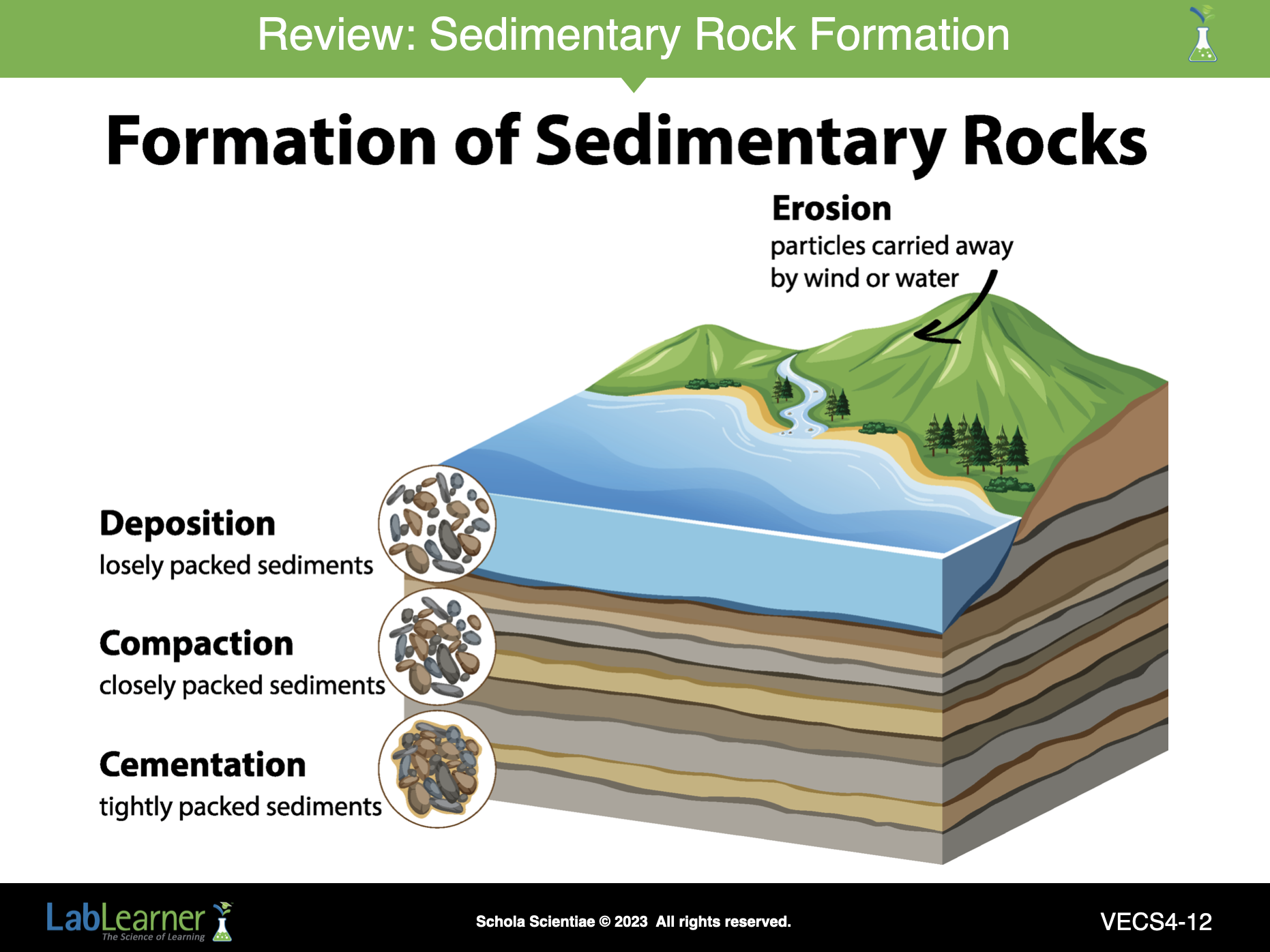
This illustration shows how sedimentary rock is formed.
Deposition occurs first as new material from the river and land mass. It forms the topmost layers of sediment. The round insert shows that the particles are only loosely packed at this stage, much like the mud on the bottom of a river or lake.
Compaction occurs as more weight is placed on lower sediment layers from the newer sediment layers and water above.
Finally, cementation occurs under tremendous pressure, and the sedimentary particles become hardened and stick together like cement.