
Teacher Portal:
Rock Cycle Journey
Three: Sedimentary Rocks
 PRINT IT
Use your browser to download a printable PDF as help during the slide presentation and to make additional notes. In your browser, go to File > Print and then choose to save as PDF.
NAVIGATE IT
Once the slide presentation is launched
- use your left and right arrows to advance or go back in the slide presentation, and
- hover your mouse over the left edge of the presentation to get a view of the thumbnails for all the slides so that you can quickly move anywhere in the presentation.
- Click HERE to launch the slide presentation for the CELL.
SHARE IT
SLIDE 3VRC-1
This is the third presentation in the Rock Cycle Journey. In it, students will learn about sedimentary rocks.
______________________________________________
SLIDE 3VRC-2
Students have previously learned that the Earth is composed of three main layers and that there are three types of rocks that make up the uppermost layer of the Earth, the crust. In the previous slides, students were given information about igneous rocks, their formation, and their location.
This Sedimentary Rock section of slides is provided to help students continue their investigation of the rocks that compose the Earth’s surface by focusing their attention on sedimentary rocks.
Sedimentary rocks compose almost 75% of the Earth’s surface. This information may contrast with what students learned about igneous rocks and their prevalence in the Earth’s crust. The difference is in understanding that igneous rock composes the foundation of the Earth’s crust both on land and under the ocean. In contrast, sedimentary rock composes most of the rock on the top of the crust’s surface.
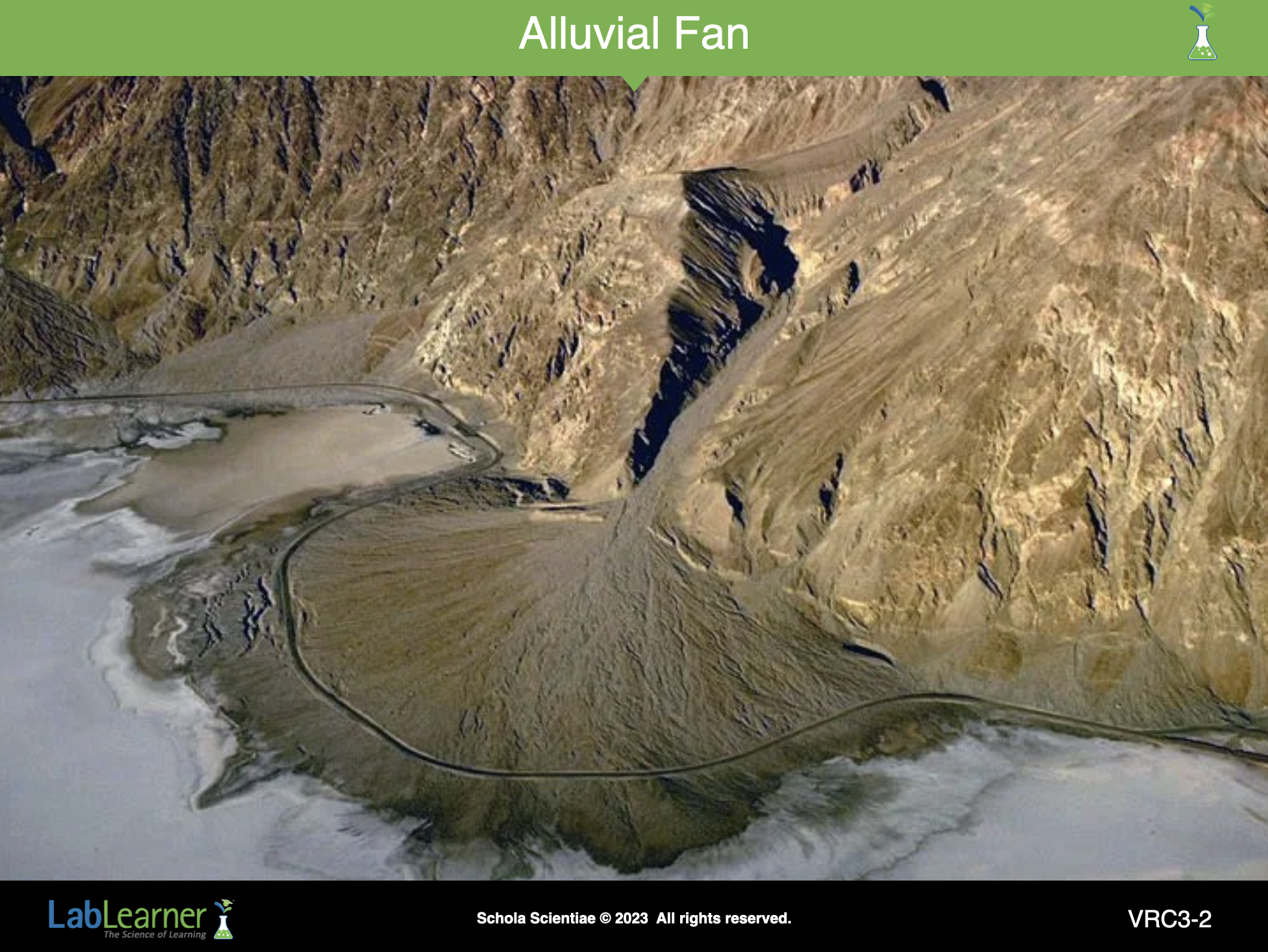
The pictures in this slide give students examples of sediment formation. This is a photograph of an alluvial fan. An alluvial fan is an area found at the end of a body of water where the sediment carried by the body of water is deposited. Alluvial fans are often found at the end of rivers. When layers of sediment pile on top of each other, the pressure from the upper layers increases, along with other chemical changes, the layers of sediment cement and become rock.
______________________________________________
SLIDE 3VRC-3
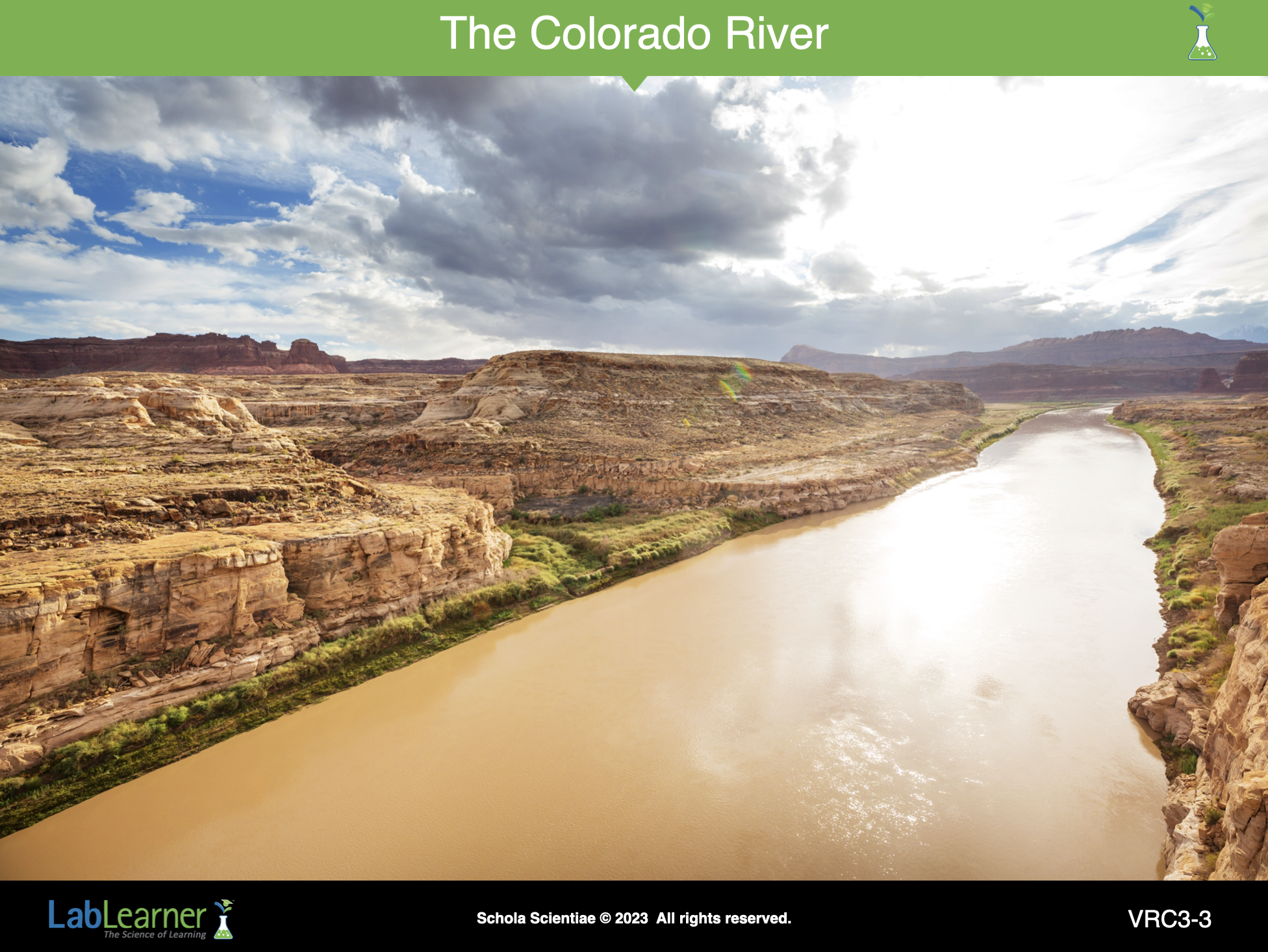
Moving water wears (erodes) away at the rocks it passes over. Little by little, this releases sand and other particles and minerals from the areas where the moving water flows.
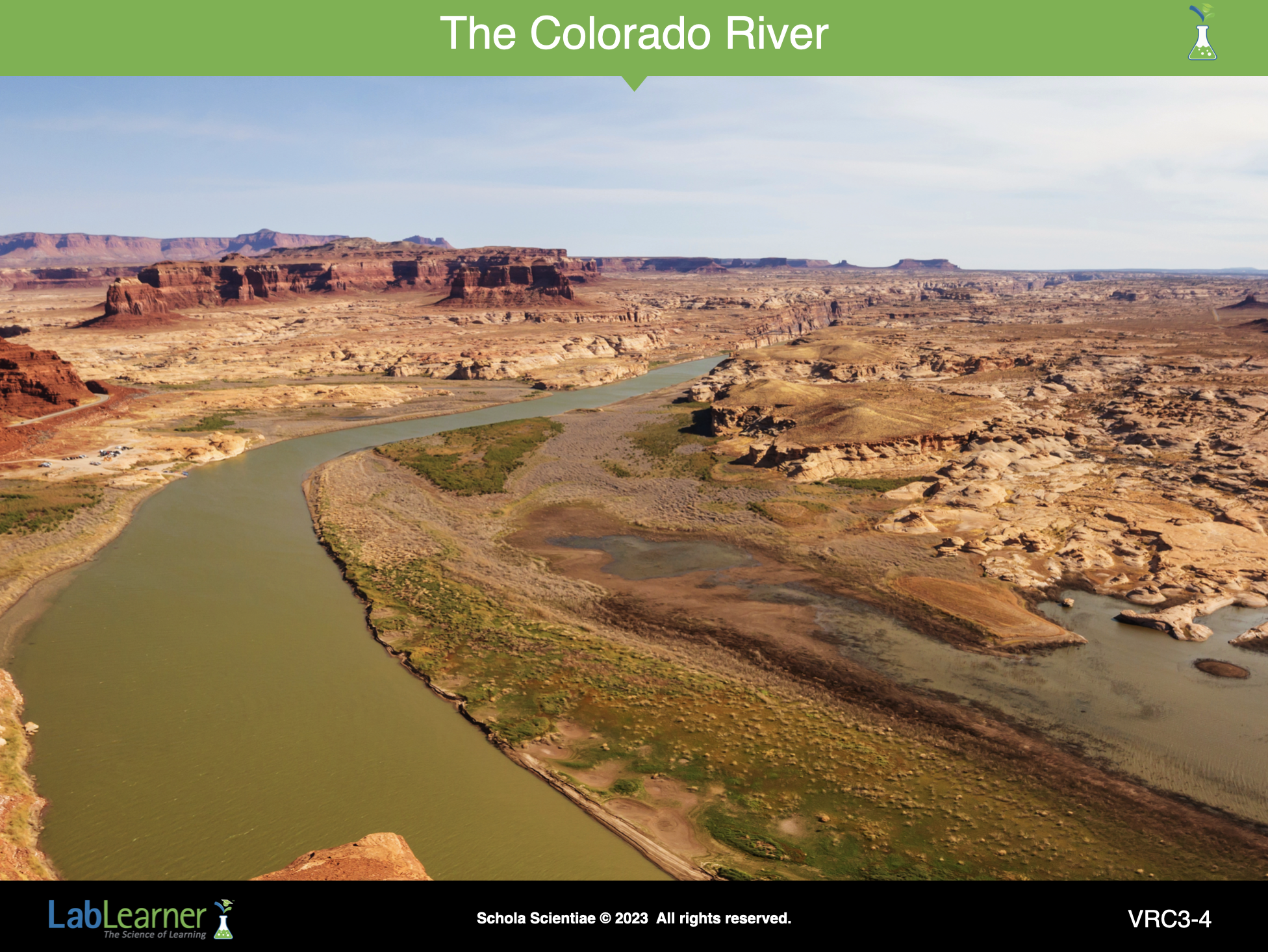
Look at the color of the Colorado River in this picture. You can easily see how much sediment is being carried by the flowing water.
In areas where the flow of water slows and at the mouths of rivers where they enter the ocean, the particles in the water sink to the bottom and remain as sediment. Year after year and century after century, layers and layers of this sediment build-up. An example of this was seen on the second slide, where an alluvial plain formed at the mouth of an ancient river. Eventually, the upper layers of newer sediment become so heavy that they force lower sedimentary layers to cement together and form sedimentary rocks.
______________________________________________
SLIDE 3VRC-4
Look at this section of the Colorado River. You can see that over many years, the river has moved its course and deposited sediment, forming a sediment-rich plain.
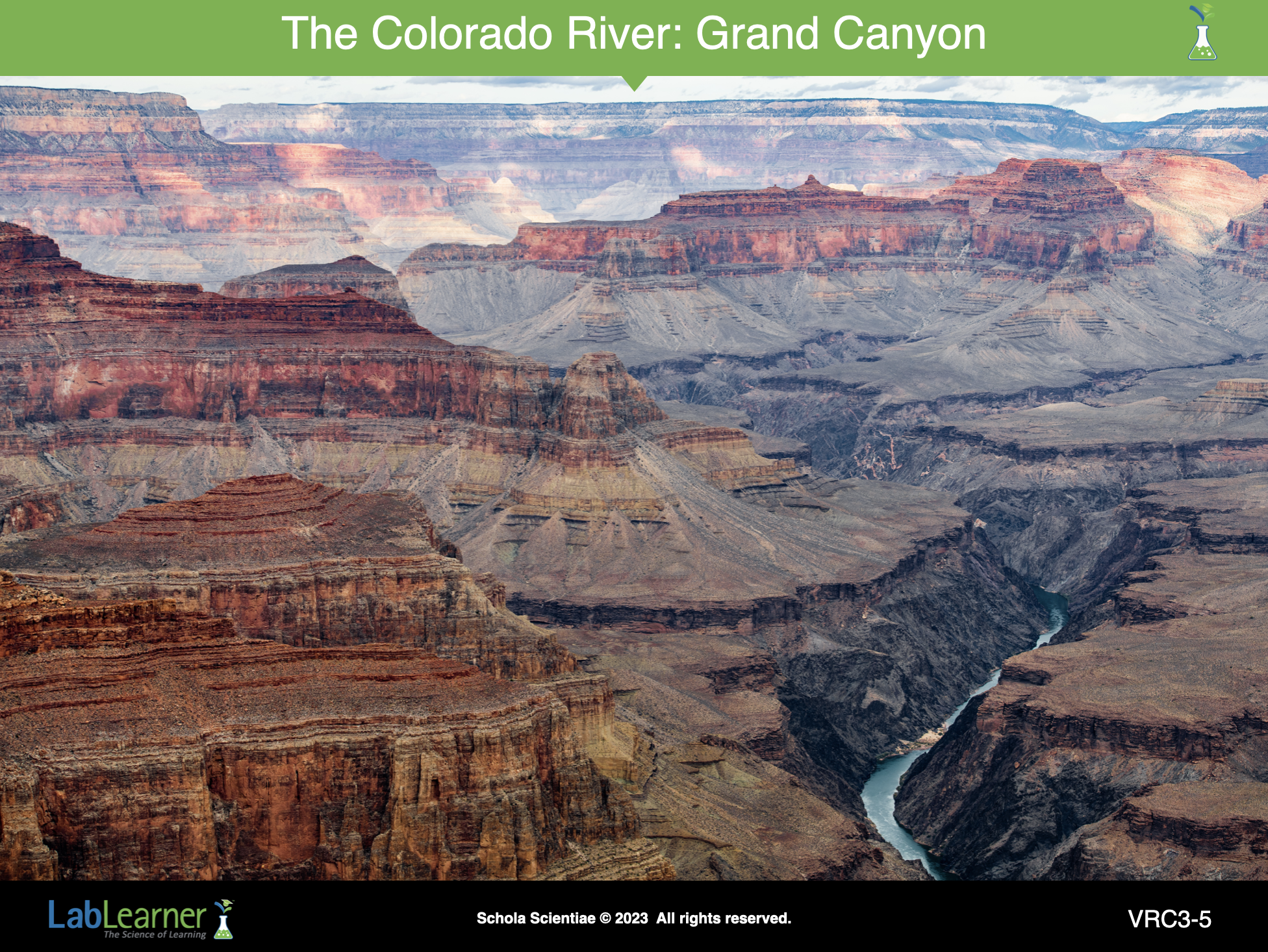
In the distance to the left, you can observe that, in the ancient past, the river cut through older sedimentary rocks. The exposed surface of these sedimentary rocks shows the many layers that were accumulated and transformed into rock. You can easily spot the sedimentary rock formations by the layers of rock that are clearly visible. The following slide will show an even more dramatic example of how flowing water not only takes part in the formation of sedimentary rocks but also in exposing deep layers as it scrapes its way across the countryside.
______________________________________________
SLIDE 3VRC-5
This slide shows another area of the Grand Canyon where the Colorado River has cut through the sedimentary rock layers. Notice how the rock layers are visible on the vertical faces of the canyon.
The scouring erosion action of the river has cut through the rock to an average depth of 1,219 meters (4,000 feet). The canyon is 1,828 meters (6,000 feet) at its deepest.
______________________________________________
SLIDE 3VRC-6
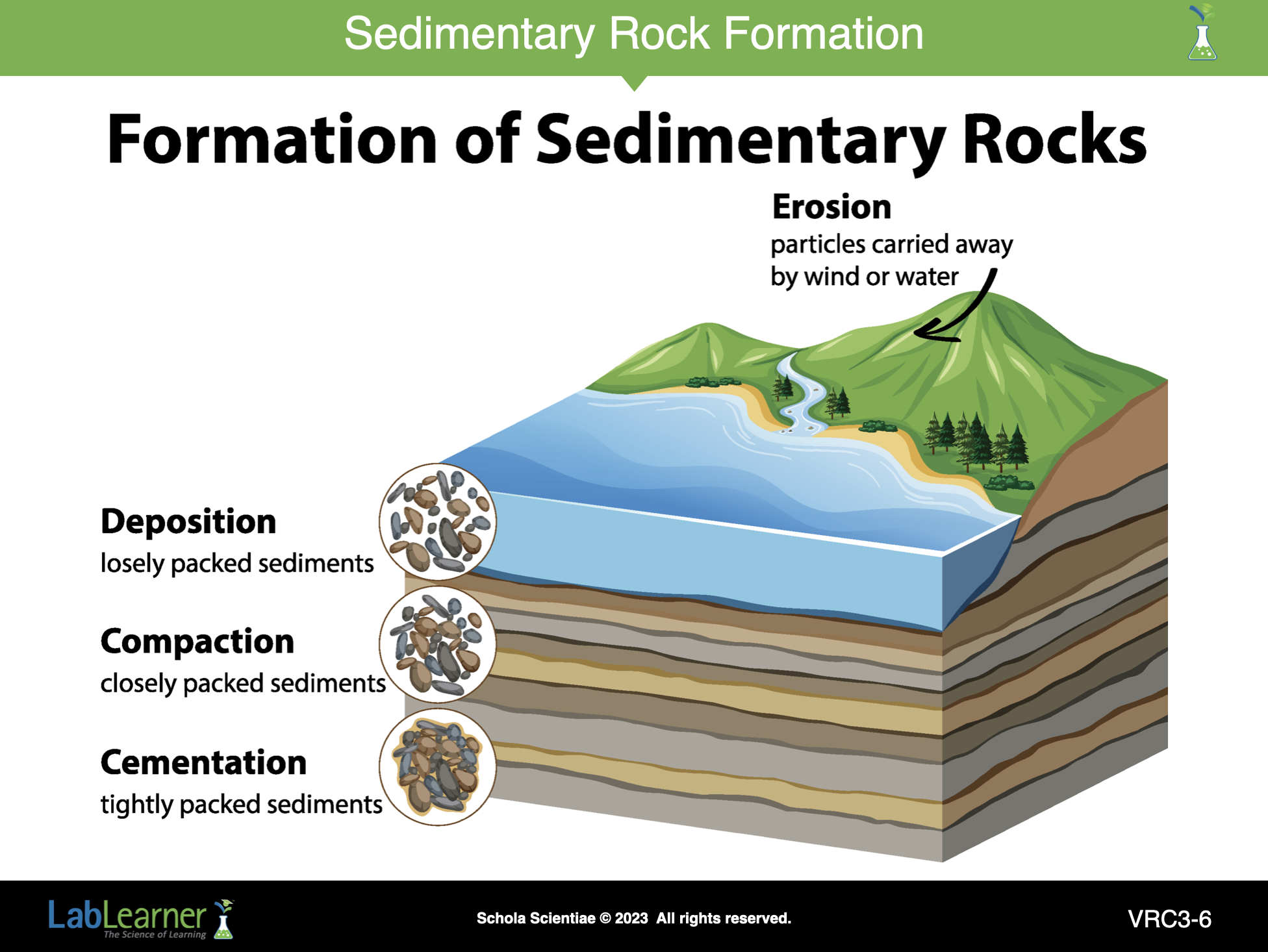
This illustration shows how sedimentary rock is formed.
Deposition occurs first as new material from the river and land mass. It forms the topmost layers of sediment. The round inserts show that the particles are only loosely packed, much like the mud on the bottom of a river or lake.
Compaction occurs as more weight is placed on lower sediment layers from the newer sediment layers and water above.
Finally, cementation occurs under tremendous pressure, and the sedimentary particles become hardened and stick together like cement.
______________________________________________
SLIDE 3VRC-7
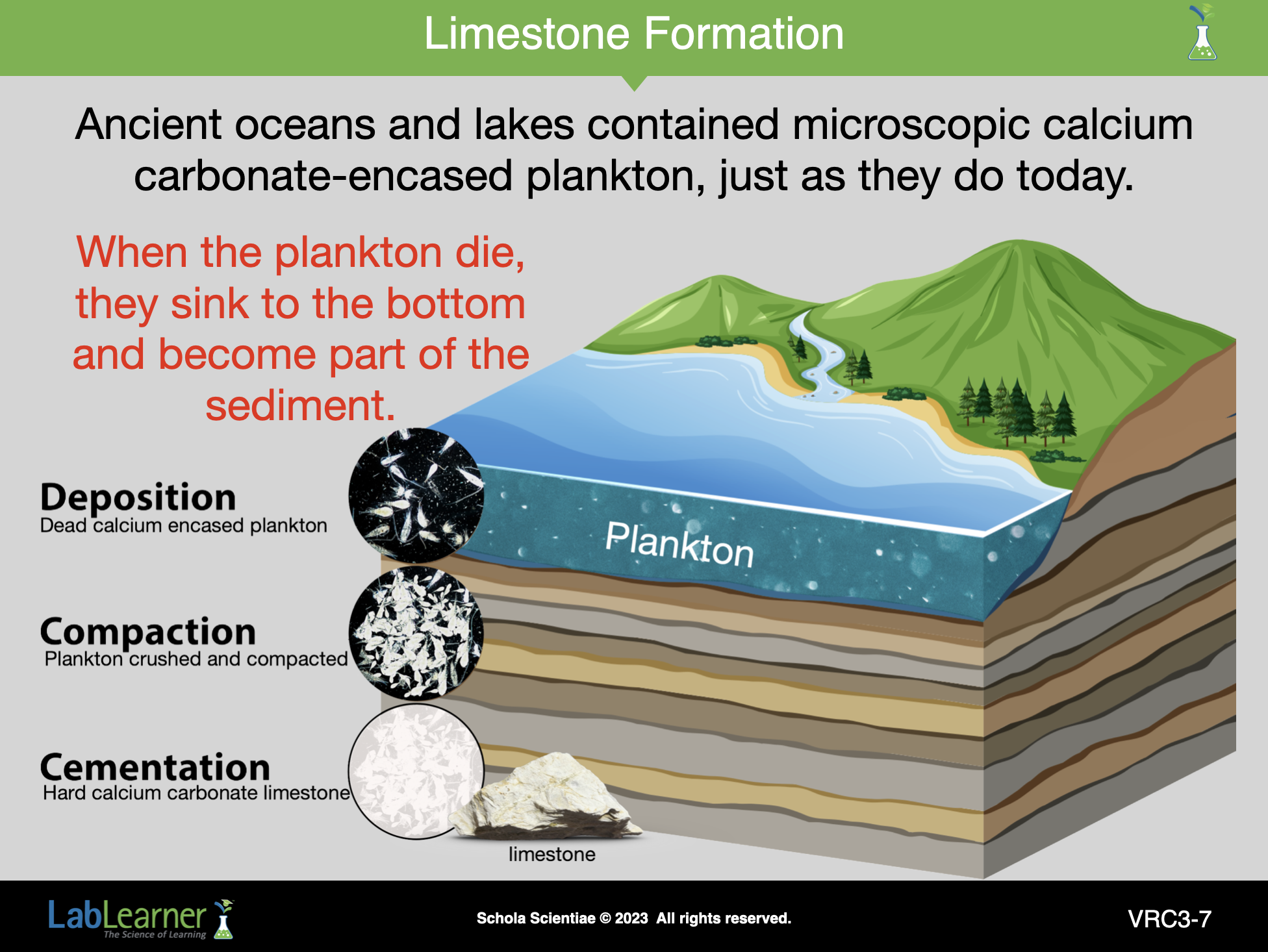
One of the most abundant sedimentary rocks on Earth is limestone. In the illustration above, the sediment particles are purposely not identified. The final type of sedimentary rock formed depends on the nature of the sedimentary particles.
Particles that makeup limestone in this process are derived mainly from microscopic animals that live in lakes and oceans called plankton. These tiny organisms are encased in an outer calcium carbonate (CaCO3) coating, also called calcite. This is the same compound that makes up the shells of clams.
After compaction and cementation, layers of limestone rock are formed. Over time, this process forms enormous limestone formations.
Students can easily prove that a stone is made of calcium-containing limestone by applying a drop of acid to a sample. Below is a video of a drop of weak hydrochloric acid to a limestone chip. Students can cause a similar reaction by applying full-strength vinegar (acetic acid).

______________________________________________
SLIDE 3VRC-8
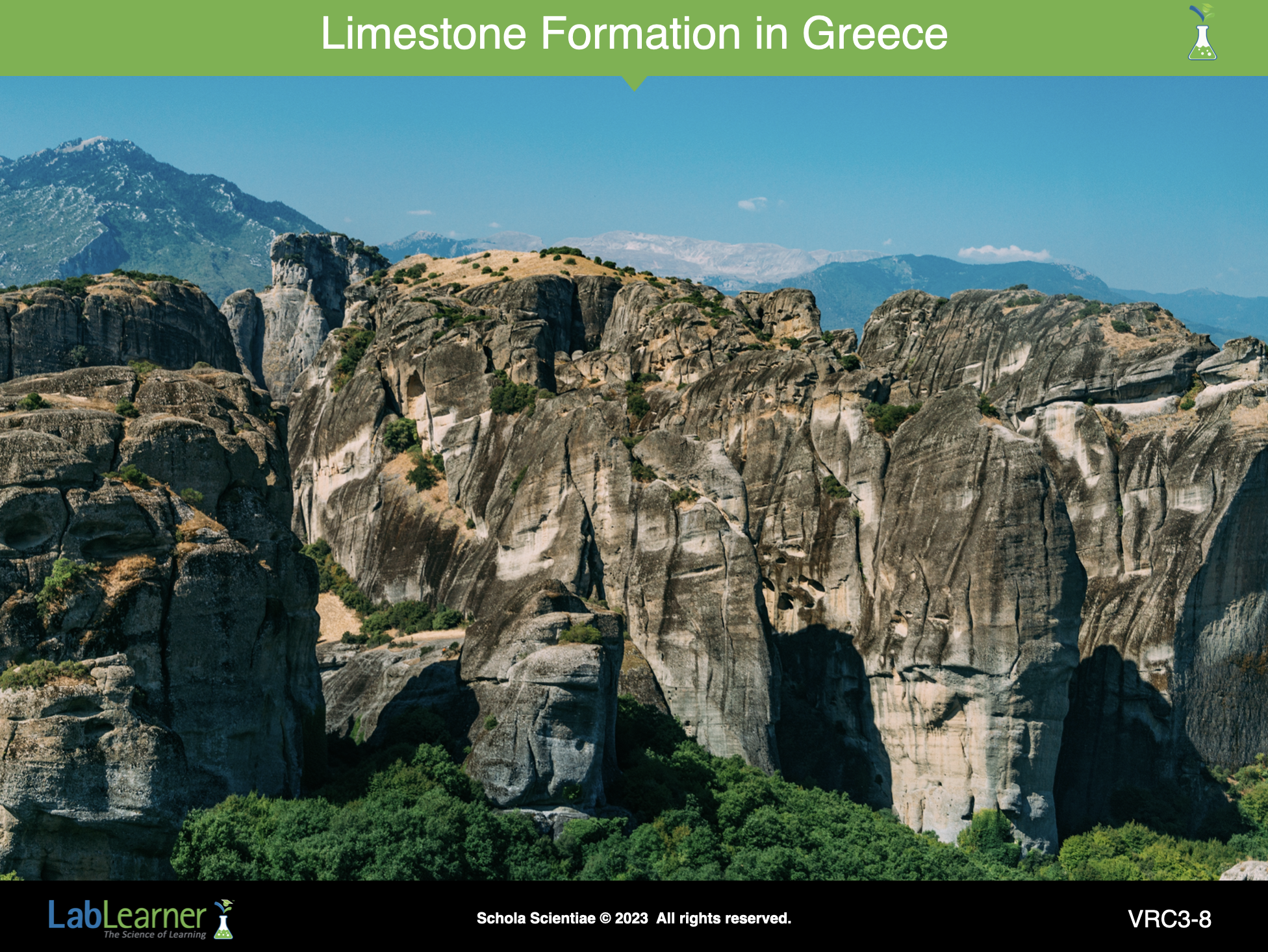
This photograph shows a large limestone formation in Greece. Notice the layers of bands of slightly different colored limestone. Such layering is a telltale sign of sedimentary rock formations.
______________________________________________
SLIDE 3VRC-9
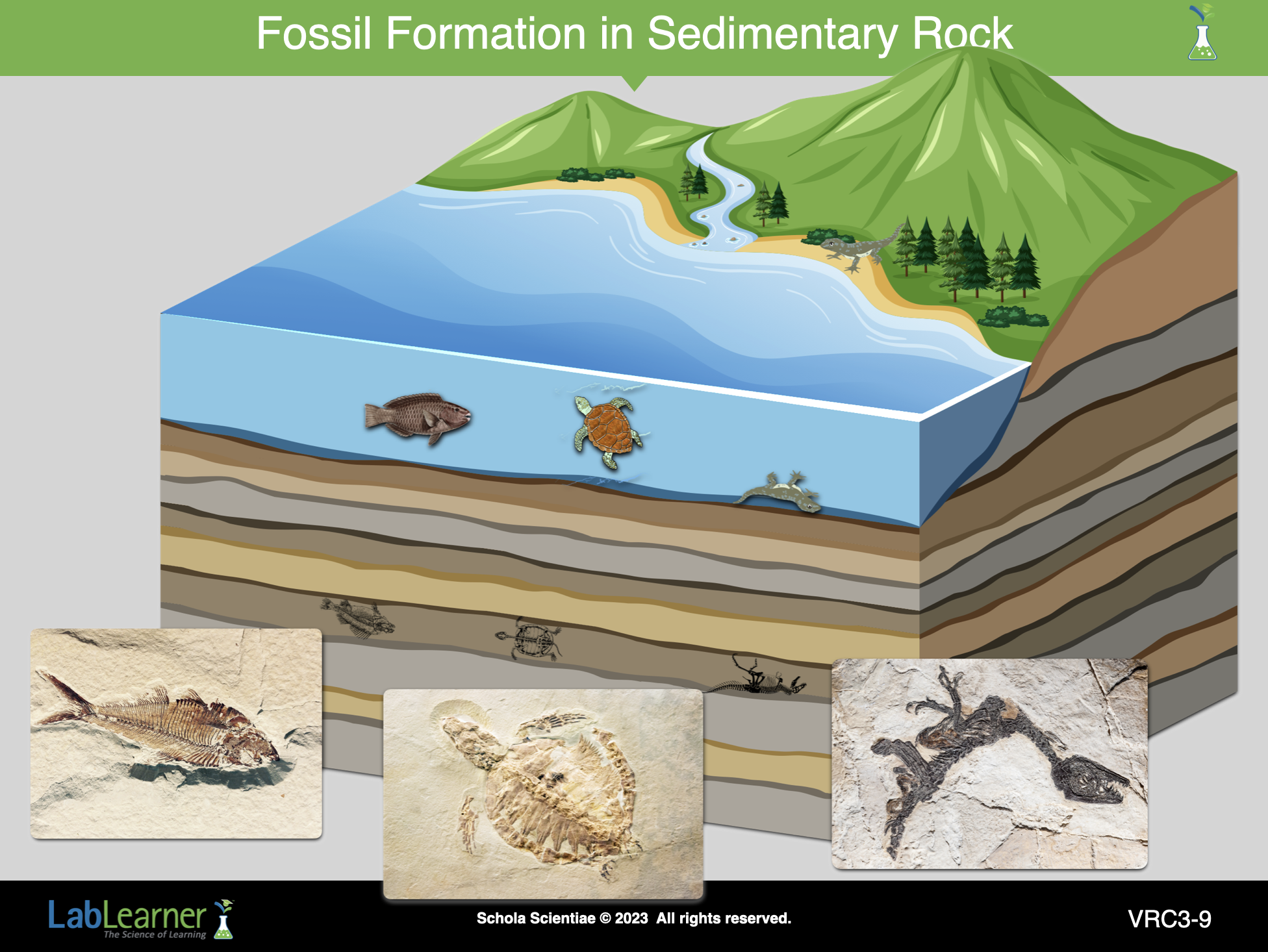
Animals and plants that live in and around water where sediments are deposited may become fossilized after they die.
When an organism dies, if it’s not eaten, it may become buried in the sediments at the bottom. As more sediments fall from above, the body becomes buried deeper and deeper. Eventually, when pressure is such that sedimentary particles begin to be cemented together, the entrapped animal may become encased in the formed sedimentary rock. These are common types of fossils.
Students may notice that the older a fossil is, the deeper it will be buried. This is true and can be used to piece together a time course of fossils in an area. The three inserts are actual fossils recovered from layers of sedimentary rock.
______________________________________________
SLIDE 3VRC-11
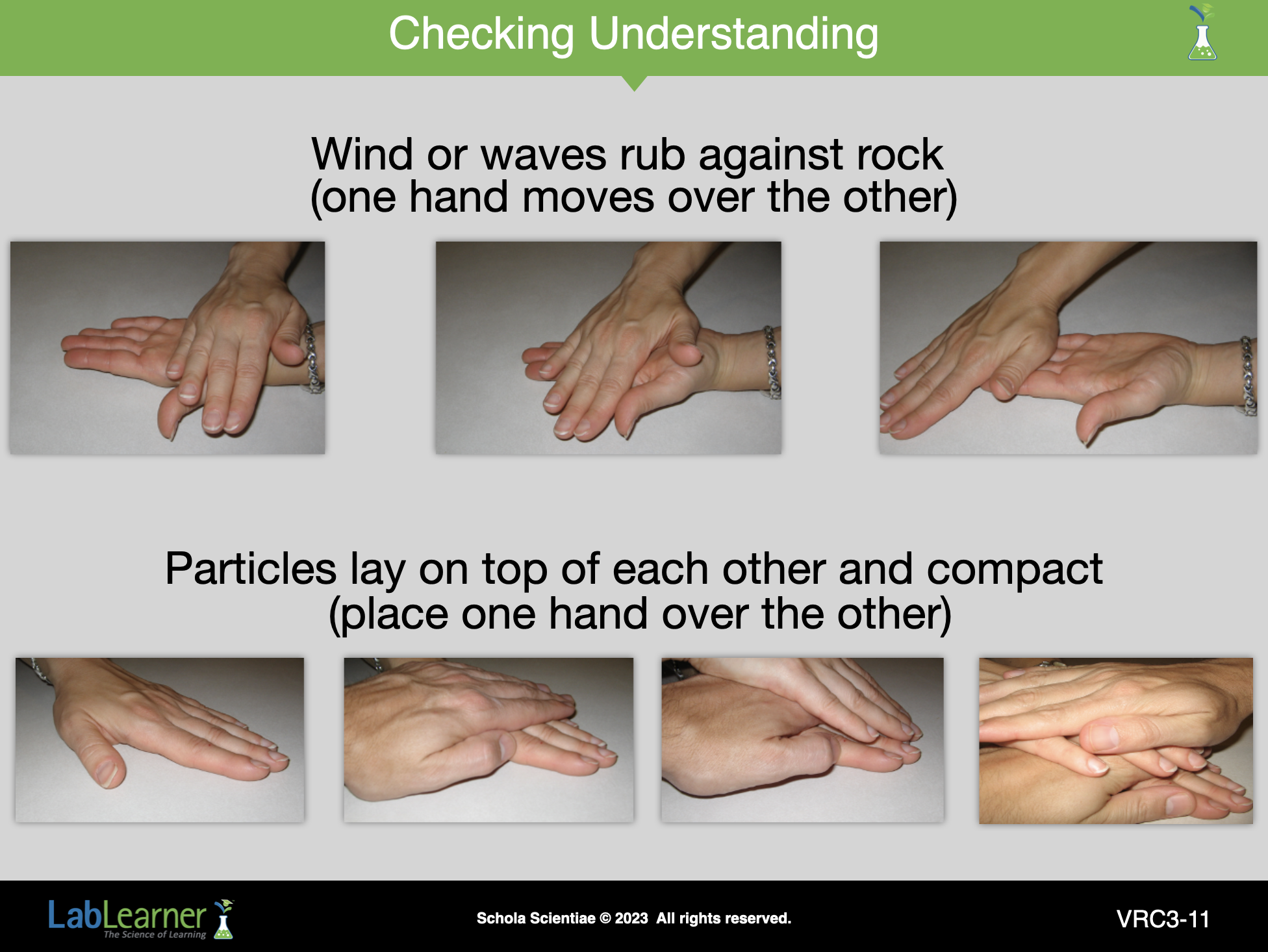
The Check Understanding section is provided to help students rehearse and review what they have learned about sedimentary rocks and their formation by linking information about the weathering and erosion of rock (sediment formations), formation of sediment layers, and cementation with hand movements.
The first set of hand movements is designed to represent the rubbing of rocks by wind or waves, producing sediment.
The second set of hand movements focuses on the layering and cementation of the sediment into sedimentary rock.
______________________________________________
SLIDE 3VRC-12
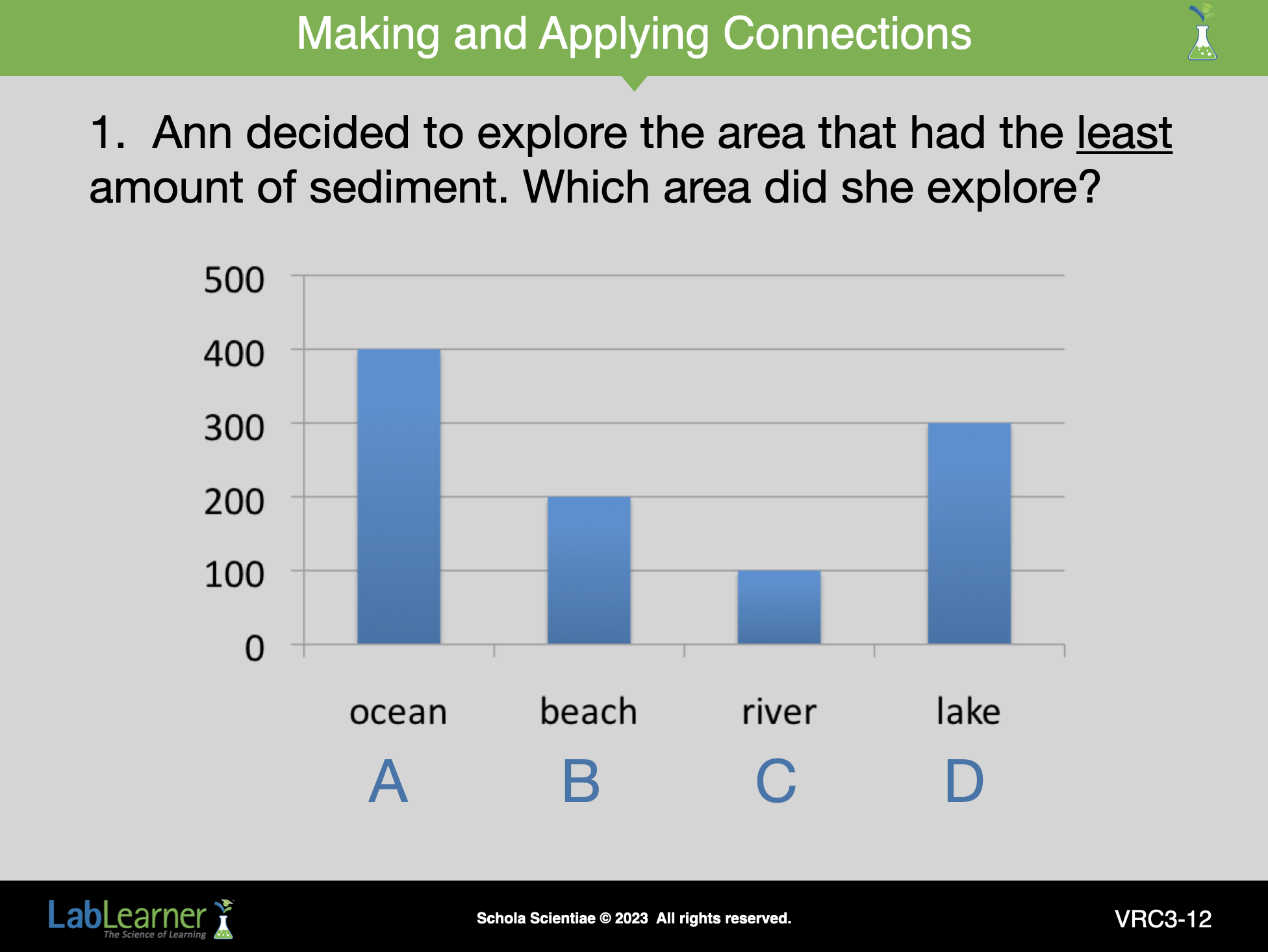
The Making and Applying Connections section of the Journeys has been provided to help students rehearse and process the information learned during the Rock Cycle Journey and become more familiar with test-taking strategies and various analysis questions.
Answer
Question 1: C (river)
______________________________________________

SLIDE 3VRC-13
This final slide is a photograph of the Taj Mahal in India. It is coated with a layer of bright white marble.
Marble is an example of the final type of rock we will discuss in the next presentation – metamorphic rock.
Metamorphic rock is formed from igneous and sedimentary rock when heated to high temperatures under tremendous pressure. Marble is a metamorphic rock formed from limestone. Thus, the acid test we discussed for limestone would also work with marble.