
Teacher Portal:
Rock Cycle Journey
Two: Igneous Rocks
 PRINT IT
Use your browser to download a printable PDF as help during the slide presentation and to make additional notes. In your browser, go to File > Print and then choose to save as PDF.
NAVIGATE IT
Once the slide presentation is launched
- use your left and right arrows to advance or go back in the slide presentation, and
- hover your mouse over the left edge of the presentation to get a view of the thumbnails for all the slides so that you can quickly move anywhere in the presentation.
- Click HERE to launch the slide presentation for the CELL.
SHARE IT

SLIDE 2VRC-1
This is the second of four presentations in the Earth’s Changing Surface Journey. In it, students will learn about igneous rocks.
______________________________________________
SLIDE 2VRC-2
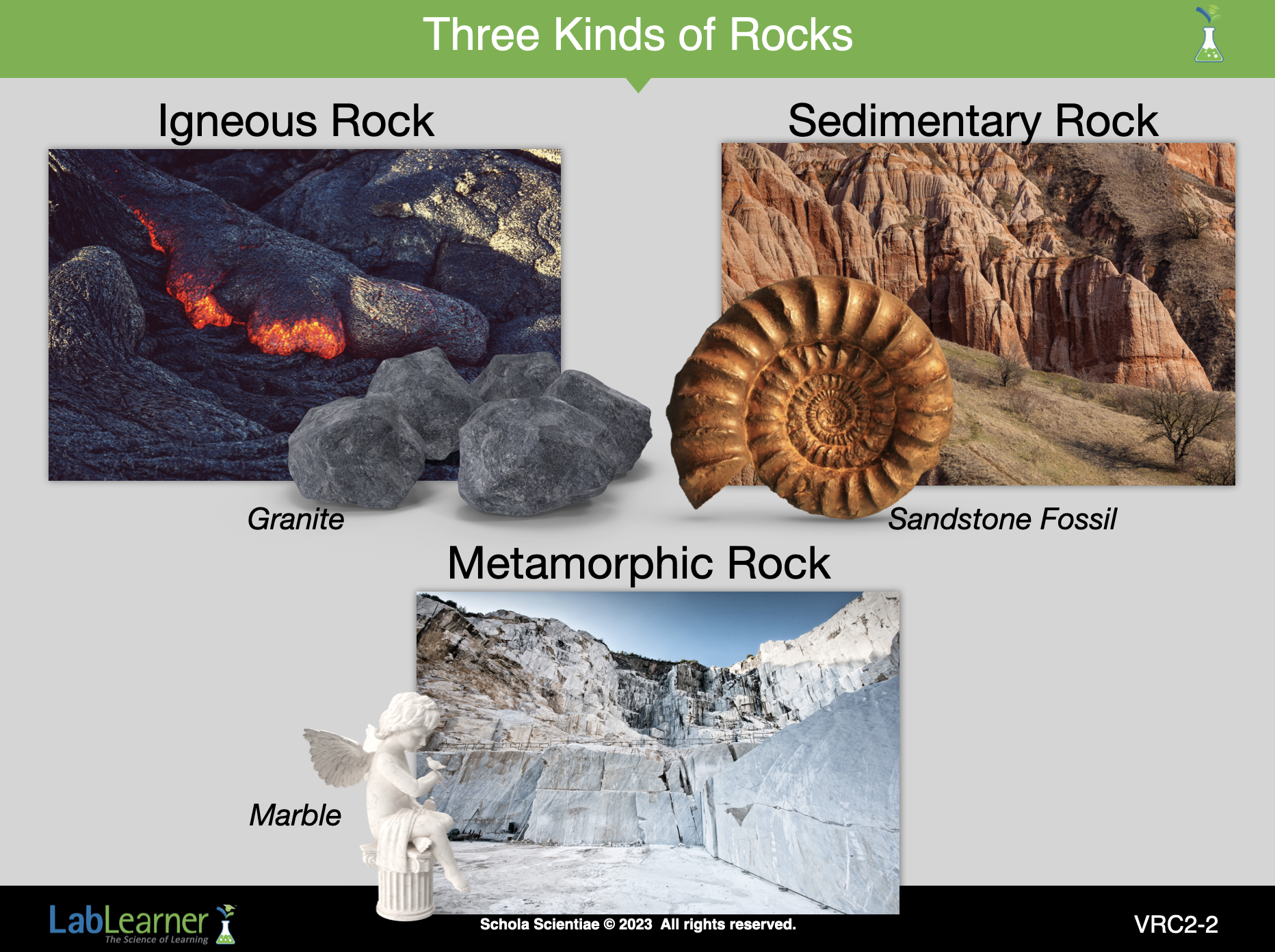
Introduce students to the concept that three different rock types compose the Earth’s crust: igneous, sedimentary, and metamorphic.
In this picture, we see the three major kinds of rocks. Sedimentary rock is made of layers and layers of sand or silt that pile up over many years. The top layers press down on the lower layers causing them to form sedimentary rocks. Because ancient plants and animals may be buried in the layers, they may be fossilized, and we can find them in sedimentary rocks today.
Metamorphic rocks are formed when igneous or sedimentary rocks are pressed deep into the Earth and encounter tremendous pressure and heat. For example, when limestone, a sedimentary rock, is exposed to tremendous pressure and heat, it forms a metamorphic rock called marble. As shown in the slide, artists commonly use marble to produce sculptures and statues.
We will discuss sedimentary and metamorphic rock in greater detail in the following two presentations of the Rock Cycle Journey. The remainder of this section will be about the other rock type shown on the slide, igneous rocks.
______________________________________________
SLIDE 2VRC-3
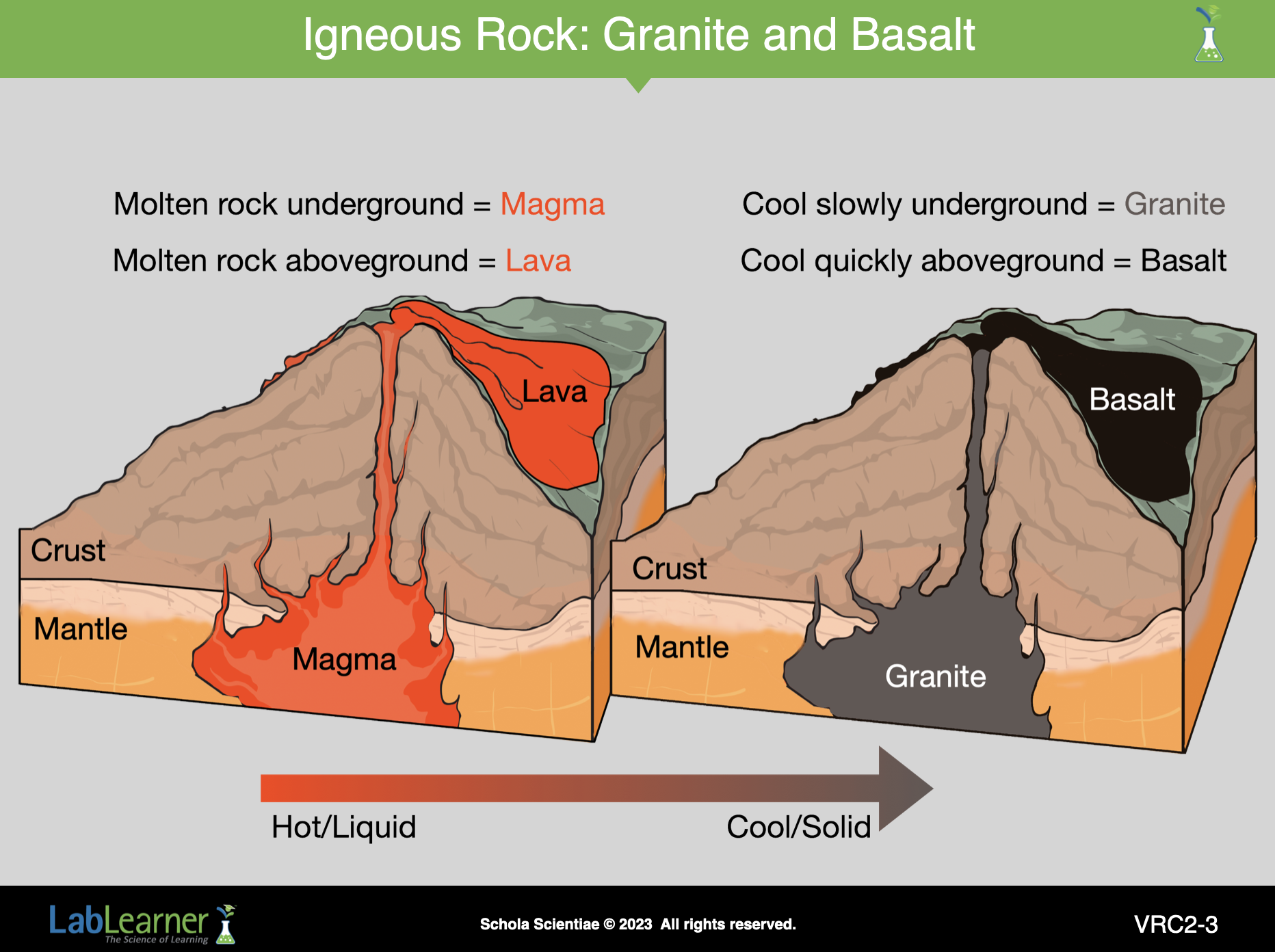
In simple terms, igneous rock is formed from the cooling of molten magma that comes up to the crust from the mantle.
As noted on the slide, underground molten rock is called magma. It is called lava once the magma reaches and spills onto the surface.
One significant difference between cooling underground and above ground is the speed at which the molted rock solidifies, becoming solid rock. Magma extruded above ground as lava cools faster than magma solidifies below ground. Later slides show that the cooling rate is a significant factor in the type and properties of rock formed above and below ground.
______________________________________________
SLIDE 2VRC-4
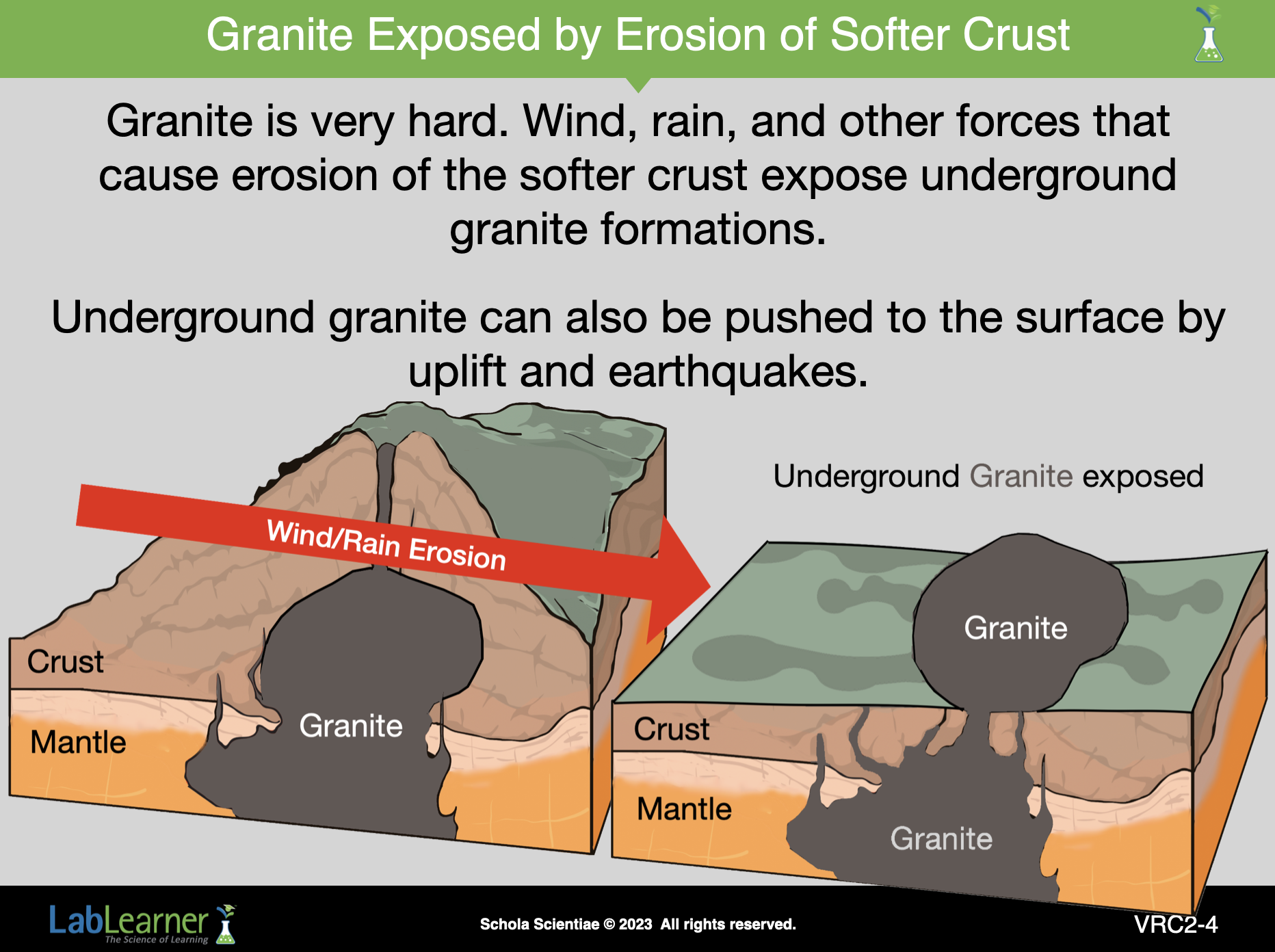
This slide shows that solid underground igneous rock (as in the granite example here) can eventually be exposed to the crust’s surface.
Earthquakes can cause enormous igneous rock formations to be pushed upward (uplifted) to the surface.
In addition, as highlighted on this slide, wind and rain erosion can remove softer rock and soil material from around the much harder igneous rock, thus exposing it to the surface. Uplifting and erosion often work together to expose subsurface igneous rock formations.
The following slide demonstrates how large and magnificent such exposed igneous rock formations can be.
______________________________________________
SLIDE 2VRC-5
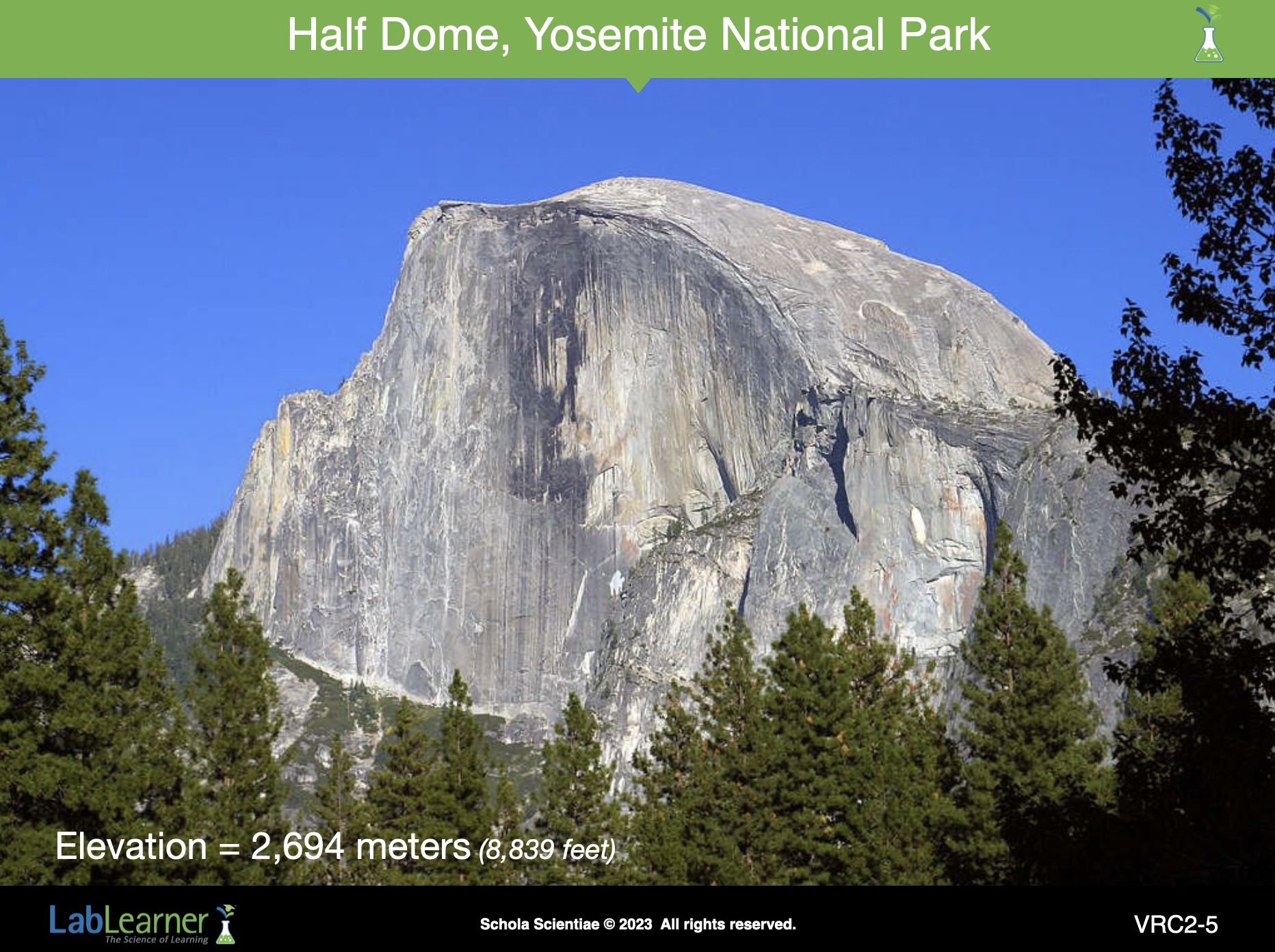
This slide shows the Half Dome at Yosemite National Park in California. Some students may have visited this rather famous formation on vacation.
As depicted on the previous slide, the giant rock protrusion resulted from the uplifting of hardened underground granite followed by erosion of softer crust material surrounding it. The abrasive action of glaciers formed the shear vertical exposed surface (popular with rock climbers).
Students may be surprised that glaciers (rivers of ice formed during the ice age) have such enormous power to scrape away half of this massive dome-shaped granite formation.
______________________________________________
SLIDE 2VRC-6
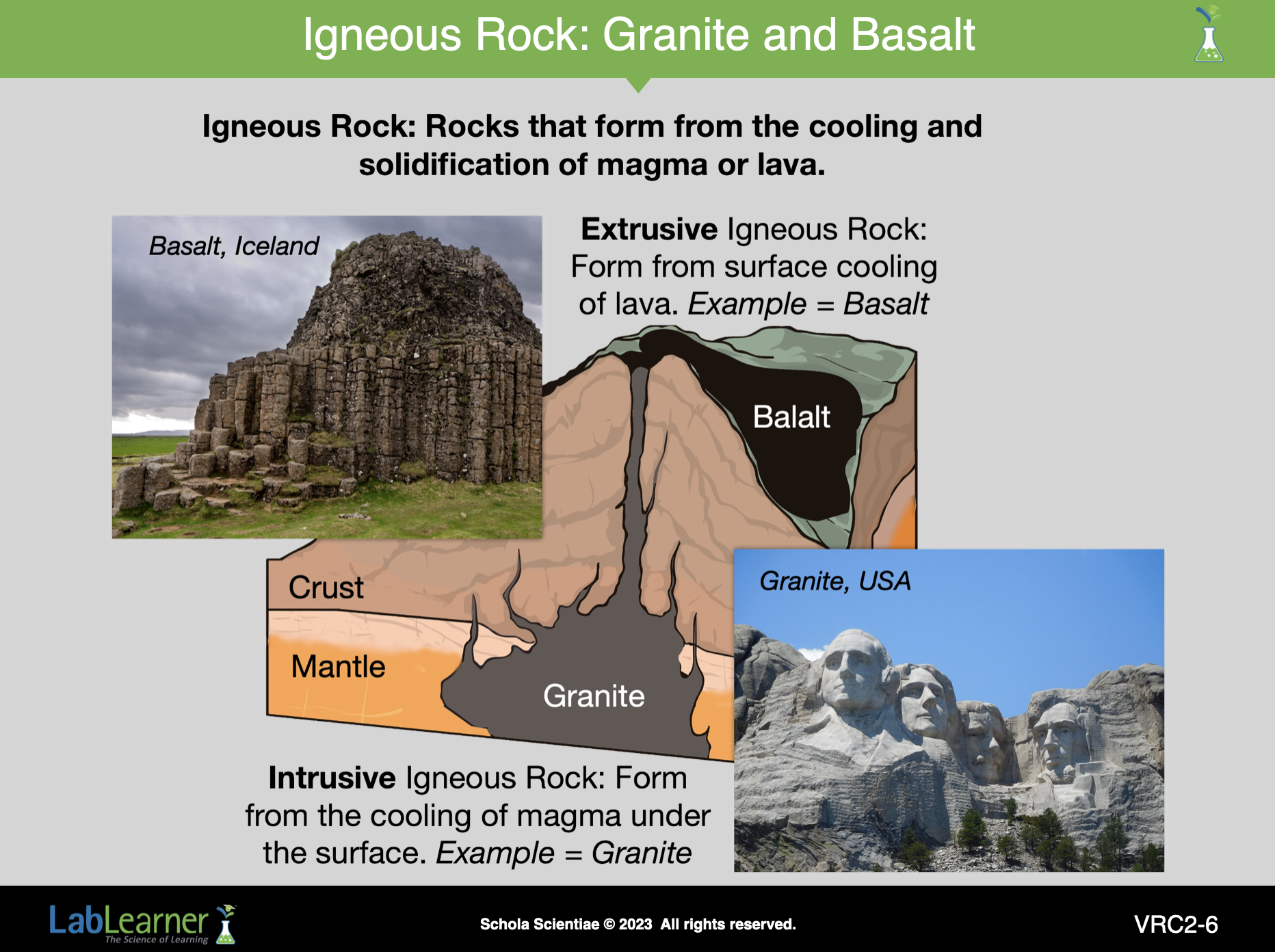
This slide shows the location of intrusive and extrusive igneous rock and a common example of each type.
______________________________________________
SLIDE 2VRC-7
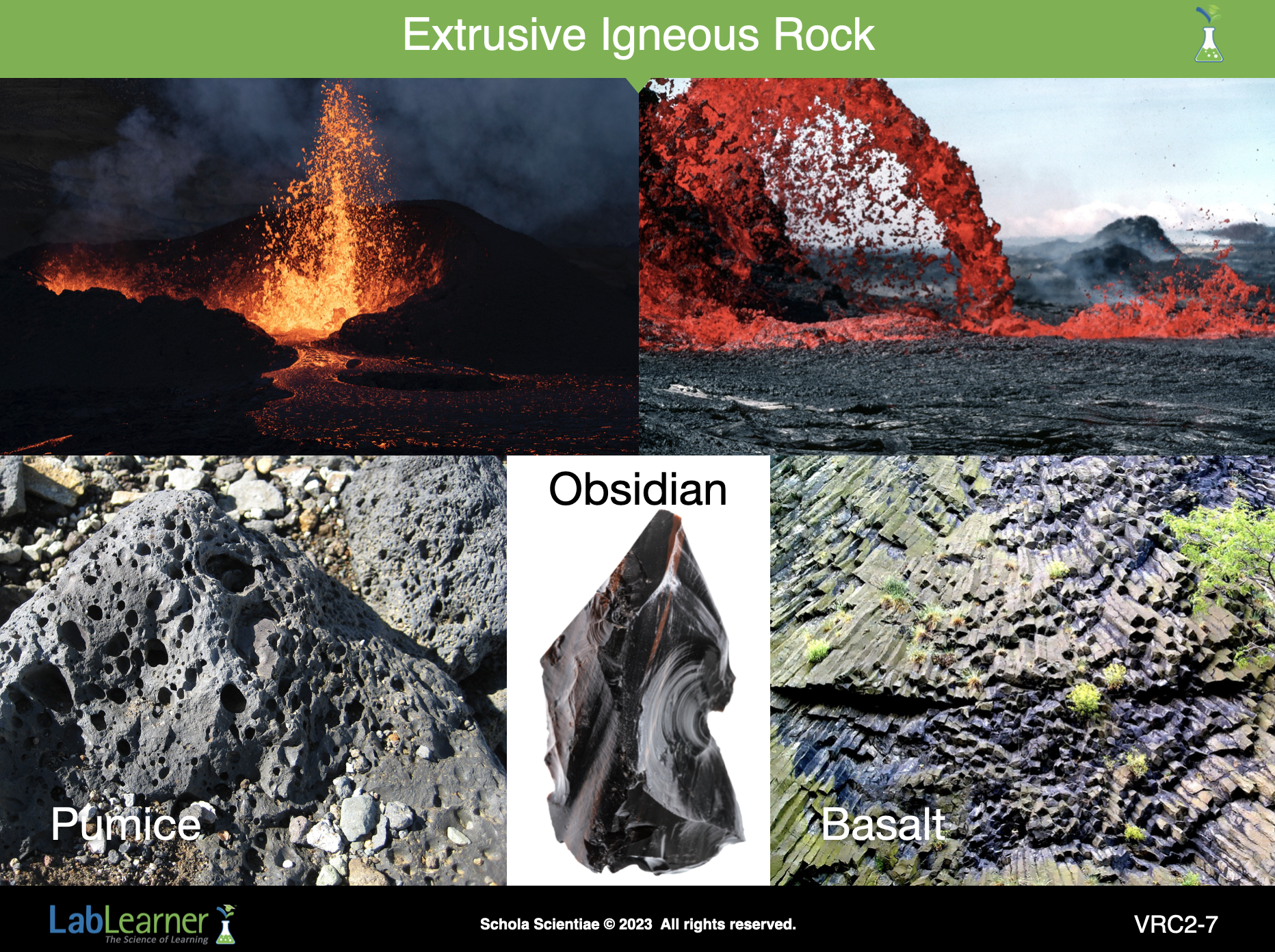
Extrusive igneous rock is formed from lava deposited above ground and therefore cools rather rapidly. Consequently, the mineral crystals in these rocks are very small and might not be seen by the naked eye.
Obsidian (center bottom) is an extrusive volcanic rock formed by very rapidly cooling lava. Its glassy texture makes it incredibly smooth, and the broken edges can be as sharp as broken glass…be careful.
On the lower left of this slide is a large piece of pumice stone. Pumice cools so rapidly that many gas bubbles are trapped in the rock. Some pumice rocks contain so much trapped air that they actually float on water! Students might have seen pumice stones at home as they are used for smoothing calluses on the skin.
______________________________________________
SLIDE 2VRC-8
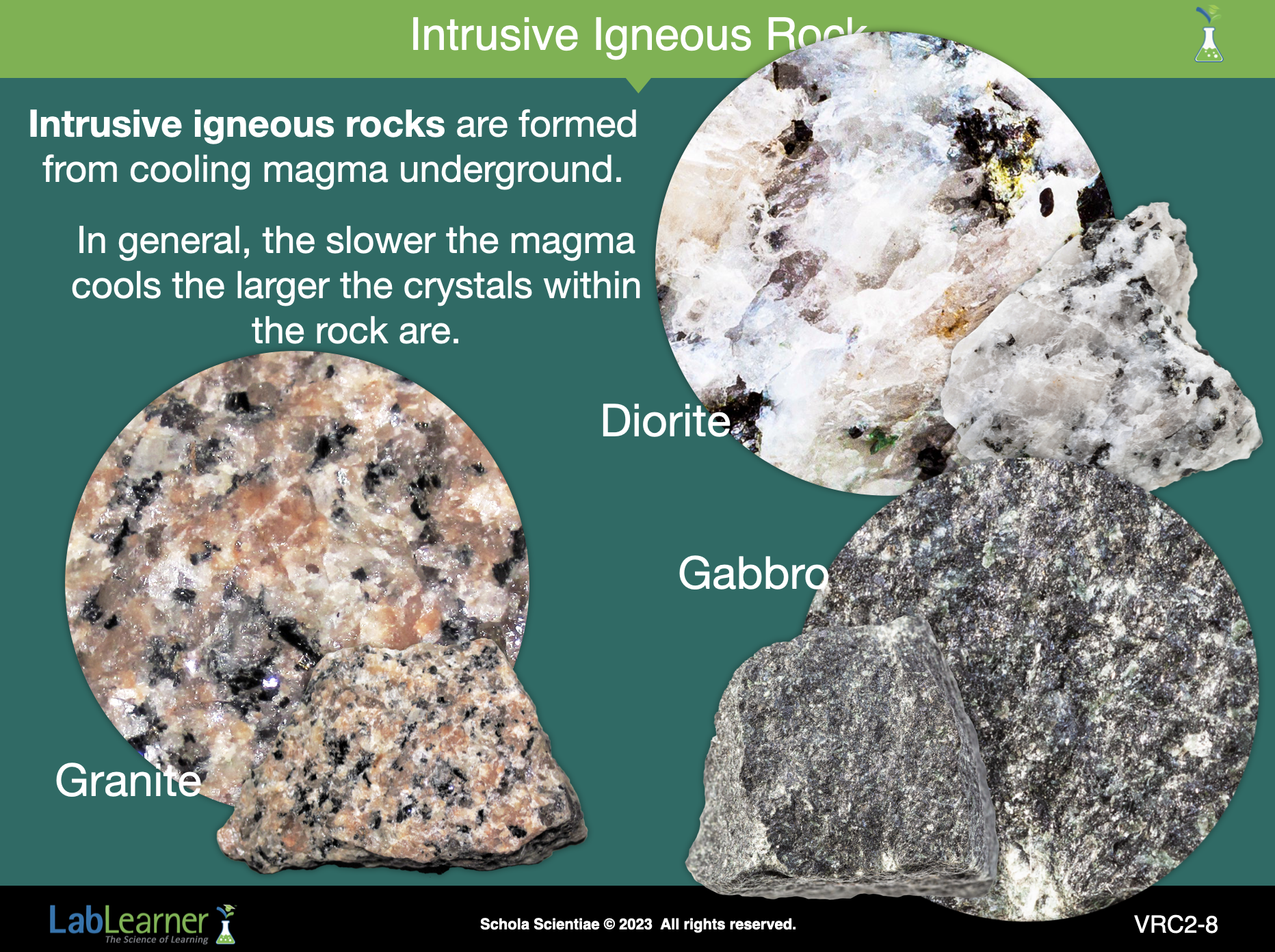
Intrusive igneous rocks are formed from cooling magma underground.
When magma cools, crystals form because the solution (molten rock) is super-saturated with respect to some minerals. If the magma cools quickly, the crystals have little time to form, so they are very small. If the magma cools slowly, the crystals have enough time to grow and become large.
Igneous rocks are characterized by having crystals large enough to be seen with the naked eye.
Ask students if they can find a piece of granite or other intrusive igneous rock in their backyard or elsewhere (or the class might find one on the playground) and bring it to class. Then use a hand lens to study the crystals even closer.
______________________________________________
SLIDE 2VRC-9
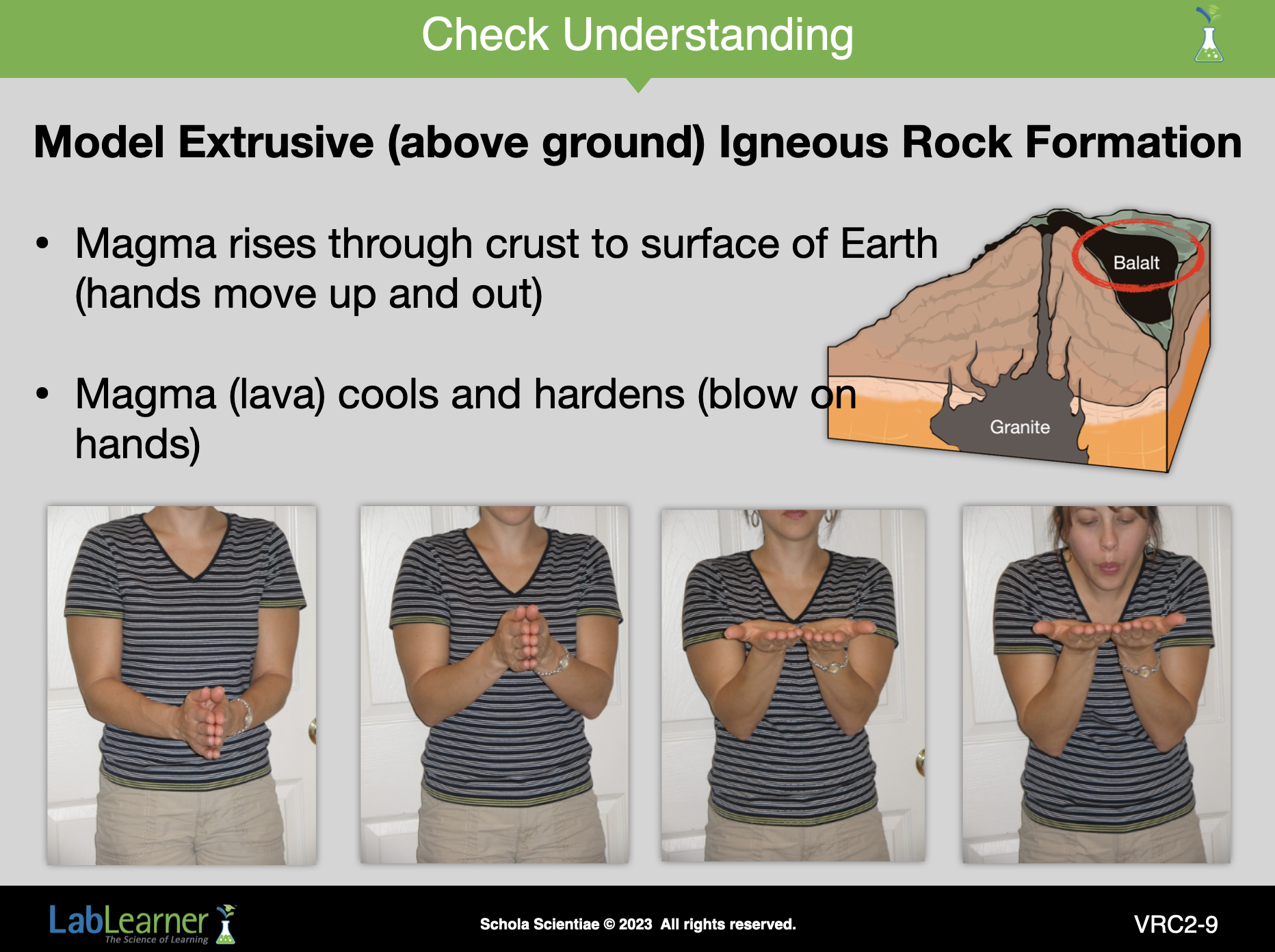
The Check Understanding section is provided to help students rehearse and review what they have learned about igneous rocks and their formation by linking information about the movement of magma and cooling events above and below the surface of the Earth with hand movements.
The hand movements for igneous rock formation above the surface of the Earth (extrusive igneous rock) are similar to those for igneous rock formation below the surface of the Earth (intrusive igneous rock). However, one important difference in the movements is designed to draw students’ attention to the location in which the magma cools and, therefore, where the igneous rock is formed.
______________________________________________
SLIDE 2VRC-10
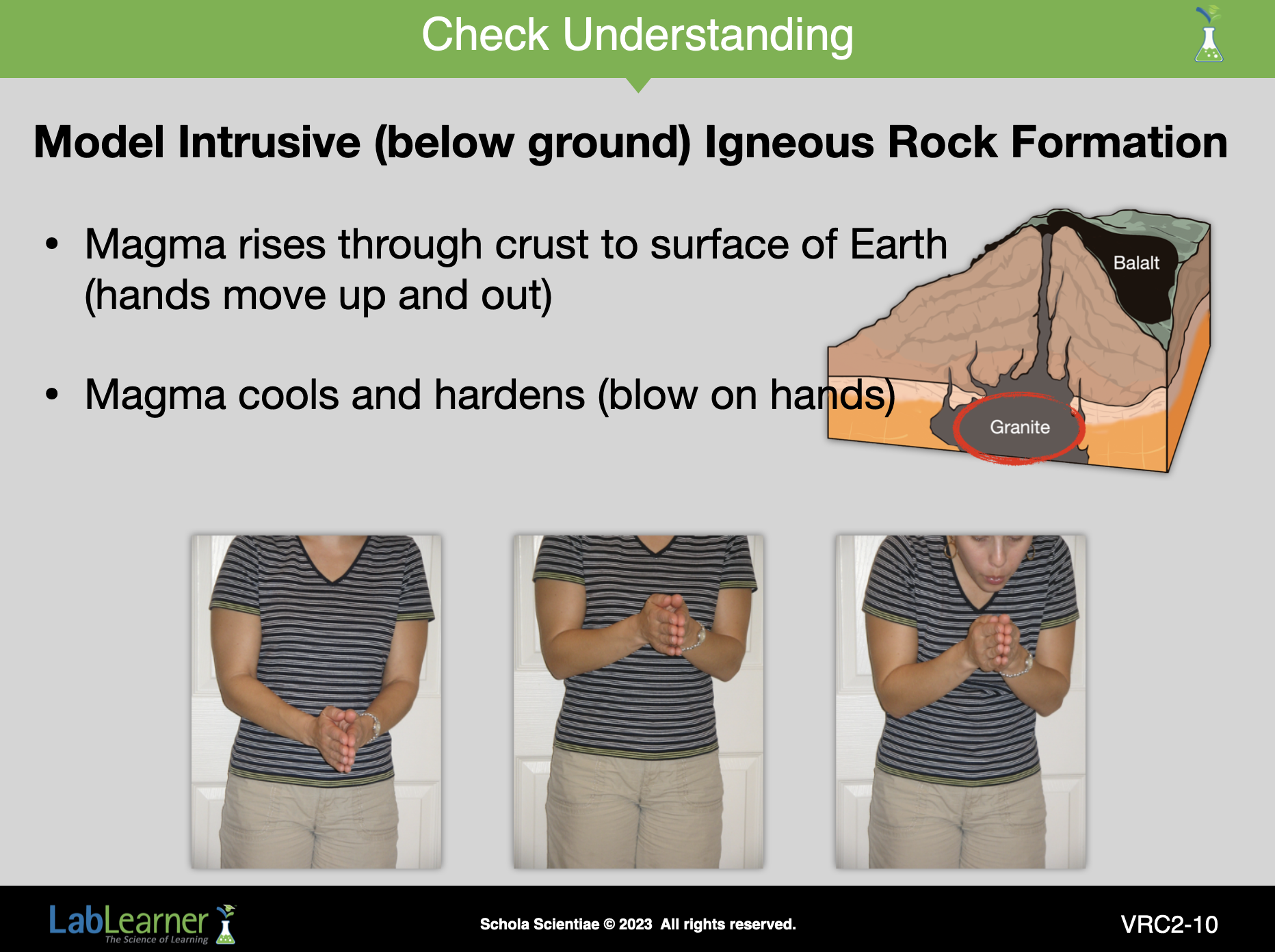
In the second set of hand movements on this slide, the hands do not show the movement of magma “out” onto the surface of the Earth.
This type of review is the first for the Rock Cycle Journey. As students continue to investigate sedimentary and metamorphic rocks and their formation, there will be opportunities to review both formations through hand movements.
______________________________________________
SLIDE 2VRC-11
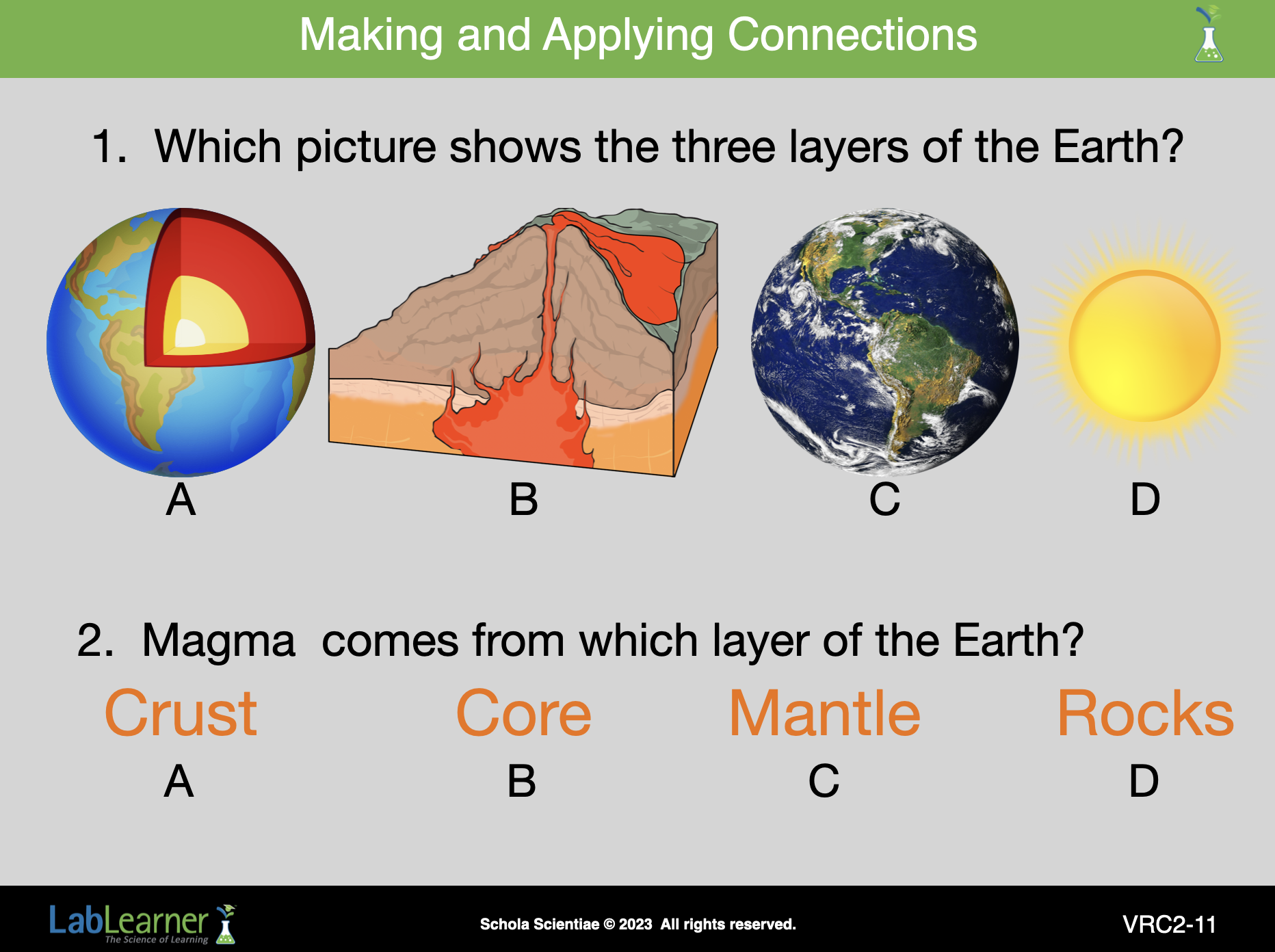
The Making and Applying section has been provided to help students rehearse and process the information learned during the Rock Cycle Journey and become more familiar with test-taking strategies and various analysis questions.
Answers
Question 1: A
Question 2: C
______________________________________________
SLIDE 2VRC-12
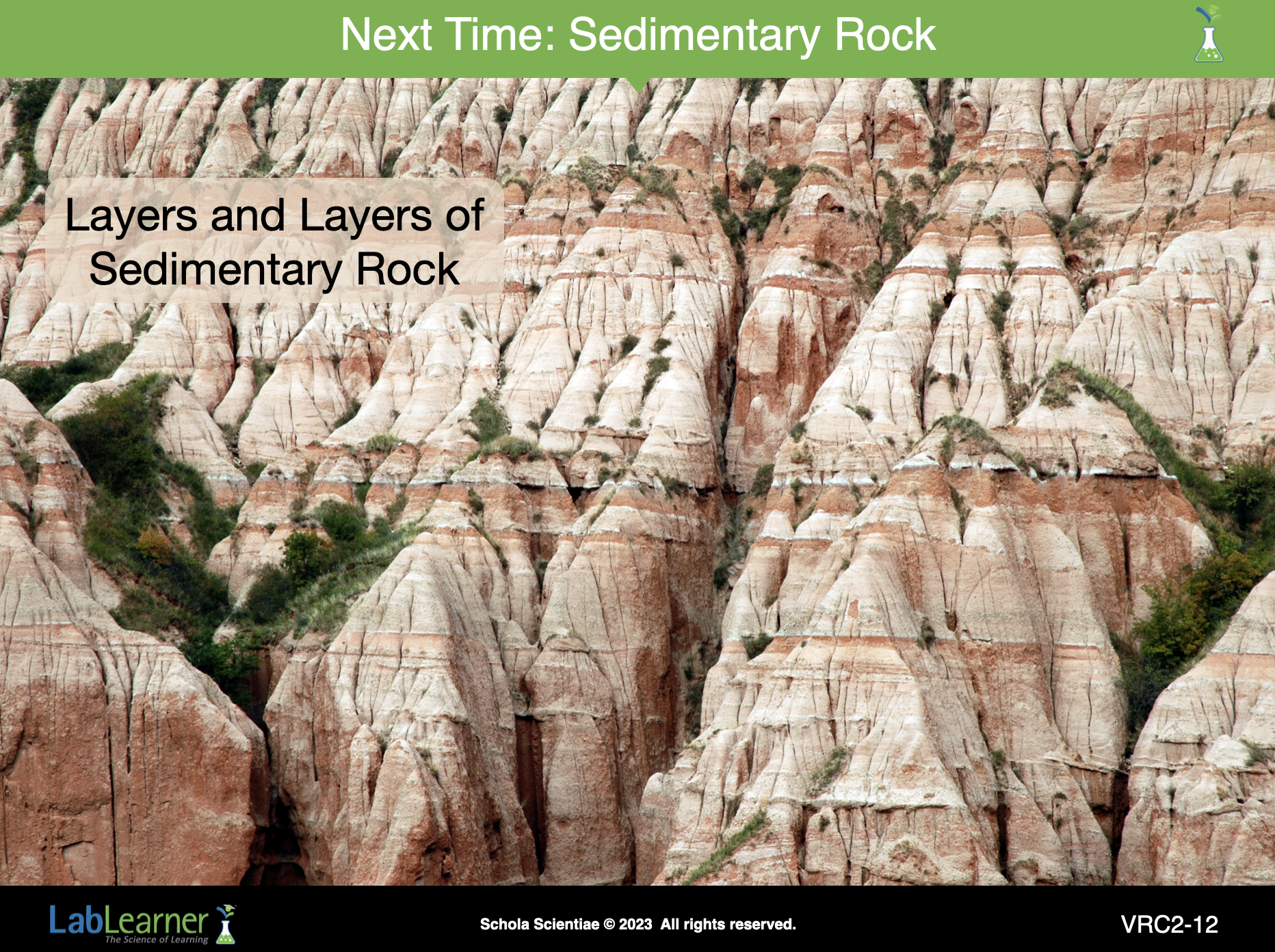
Tell students that in the following presentation in the Rock Cycle Journey, they will learn about the second of the three rock types – sedimentary rocks.