
Teacher Portal:
Rock Cycle Journey
One: The Earth’s Layers
 PRINT IT
Use your browser to download a printable PDF as help during the slide presentation and to make additional notes. In your browser, go to File > Print and then choose to save as PDF.
NAVIGATE IT
Once the slide presentation is launched
- use your left and right arrows to advance or go back in the slide presentation, and
- hover your mouse over the left edge of the presentation to get a view of the thumbnails for all the slides so that you can quickly move anywhere in the presentation.
- Click HERE to launch the slide presentation for the CELL.
SHARE IT
SLIDE 1VECS-1
This is the first of four Rock Cycle Journey presentations. In it, students will learn about the layers of the Earth, the crust, mantle, and core, and some of their essential properties.
______________________________________________
SLIDE 1VECS-2
Begin the lesson by introducing the Earth’s Changing Surface Journey to the class. This Journey focuses on the surface of the Earth, the types of rocks that compose the Earth’s surface, and some of the changes that affect the surface of the Earth. The questions below may be used to introduce the topic to the students.
Ask students: How does the surface of the Earth look? Student answers will vary.
Ask students: Are all parts of the Earth’s surface the same? Student answers will vary. No, the Earth’s surface looks different at different locations.
Ask students: What types of materials make up the surface of the Earth? Student answers will vary. The surface has rocks, soil, and water.
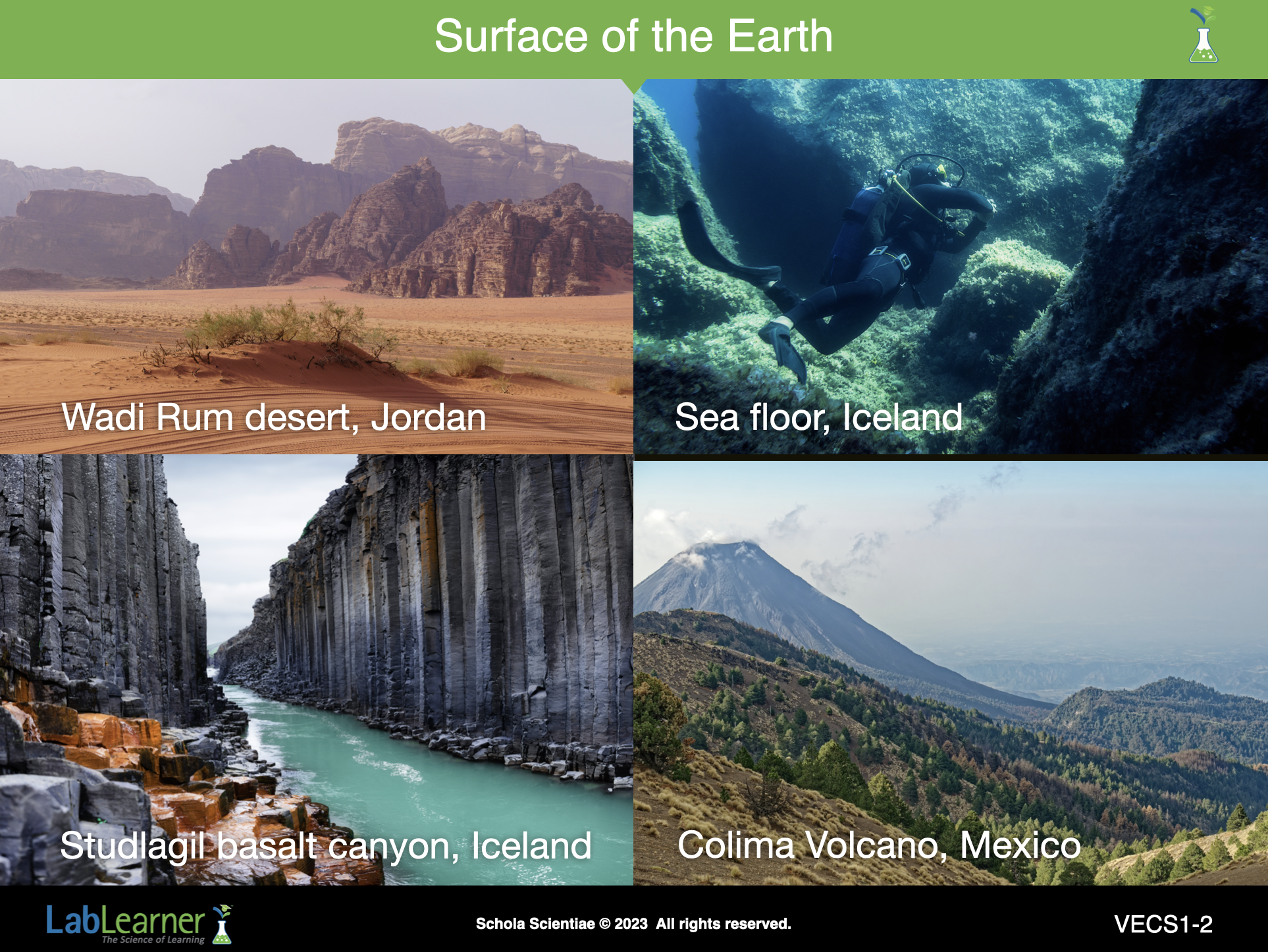
Show students the four pictures that show different areas of the Earth. Ask them to describe what the pictures have in common and how they differ.
Point out that the picture in the upper right-hand corner is a picture of one area of the ocean floor. The other three pictures are areas on land.
Discuss that the surface of the Earth is not the same everywhere. We see deserts, mountains, volcanoes, rivers, and oceans on the surface. Even under the oceans, the surface changes from sandy to rocky terrain.
______________________________________________
SLIDE 1VECS-3
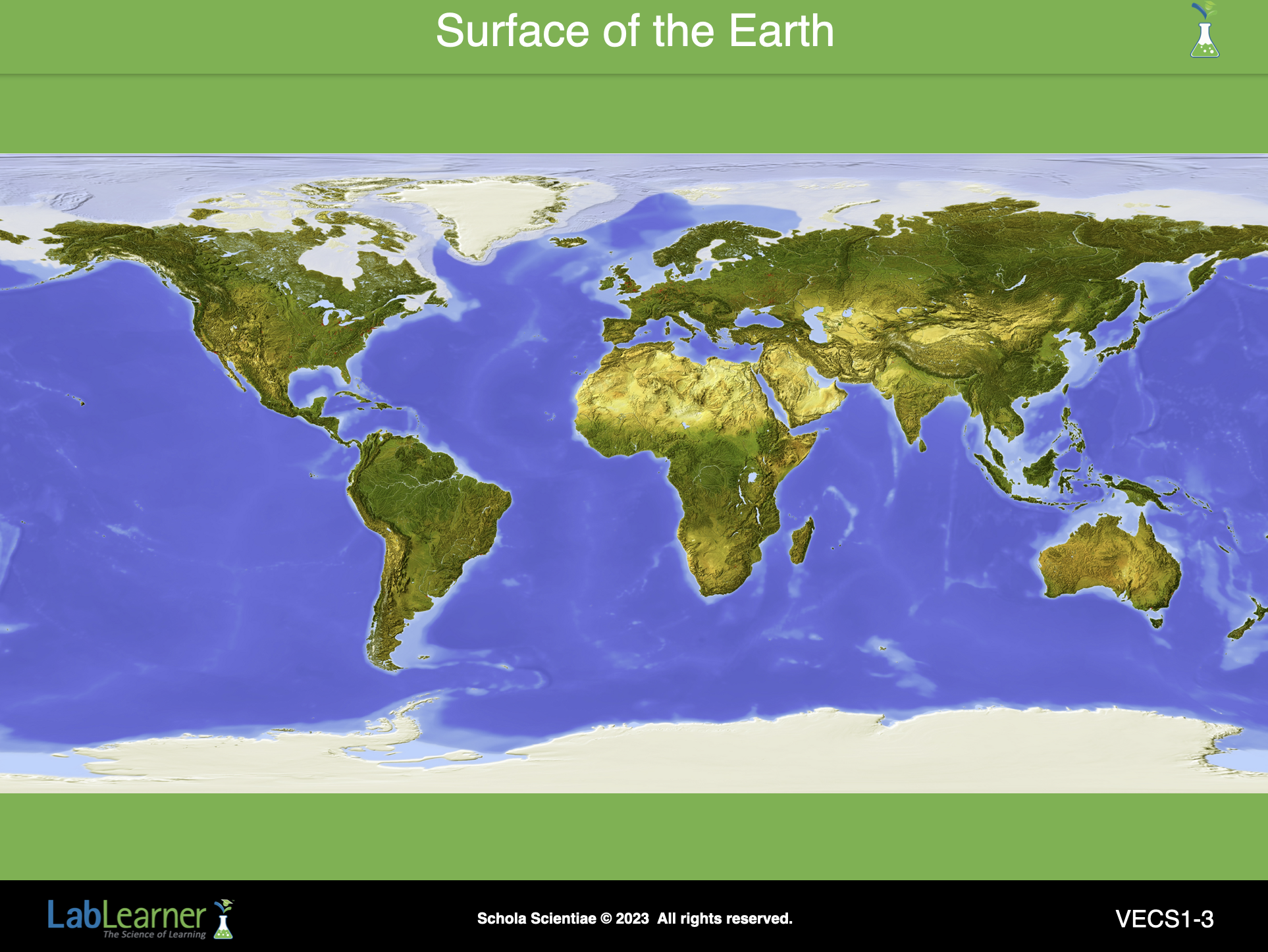
Direct students’ attention to the large map of the world. Ask students the following questions:
Ask students: Think of the pictures you saw on the last slide of the Earth’s surface. Think of different places that you have been and seen. Could you think of a way to classify areas of the Earth that are the same and different? Student answers will vary. Allow students time to come up with their own categories.
Ask students: Could you divide the surface of the Earth into only two categories? Student answers will vary. Discuss various answers proposed by students.
Ask students: What about the categories of land and oceans? Student answers may vary.
Ask students: If you divided the surface of the Earth into two categories: land and ocean, how might they be different? How might they be the same? Students may suggest that these two categories are vastly different. One difference is that the land is above the water, and the ocean encompasses life and areas under water. Students may suggest that a similarity is that living things are present on land and in the ocean. Some students may suggest that there is dirt/sand/some type of Earth surface both on land and under the ocean.
Use this discussion as a way of leading into a discovery of the layers of the Earth. The layers of the Earth will be the focus of the remainder of the slides in this short first presentation.
______________________________________________
SLIDE 1VECS-4
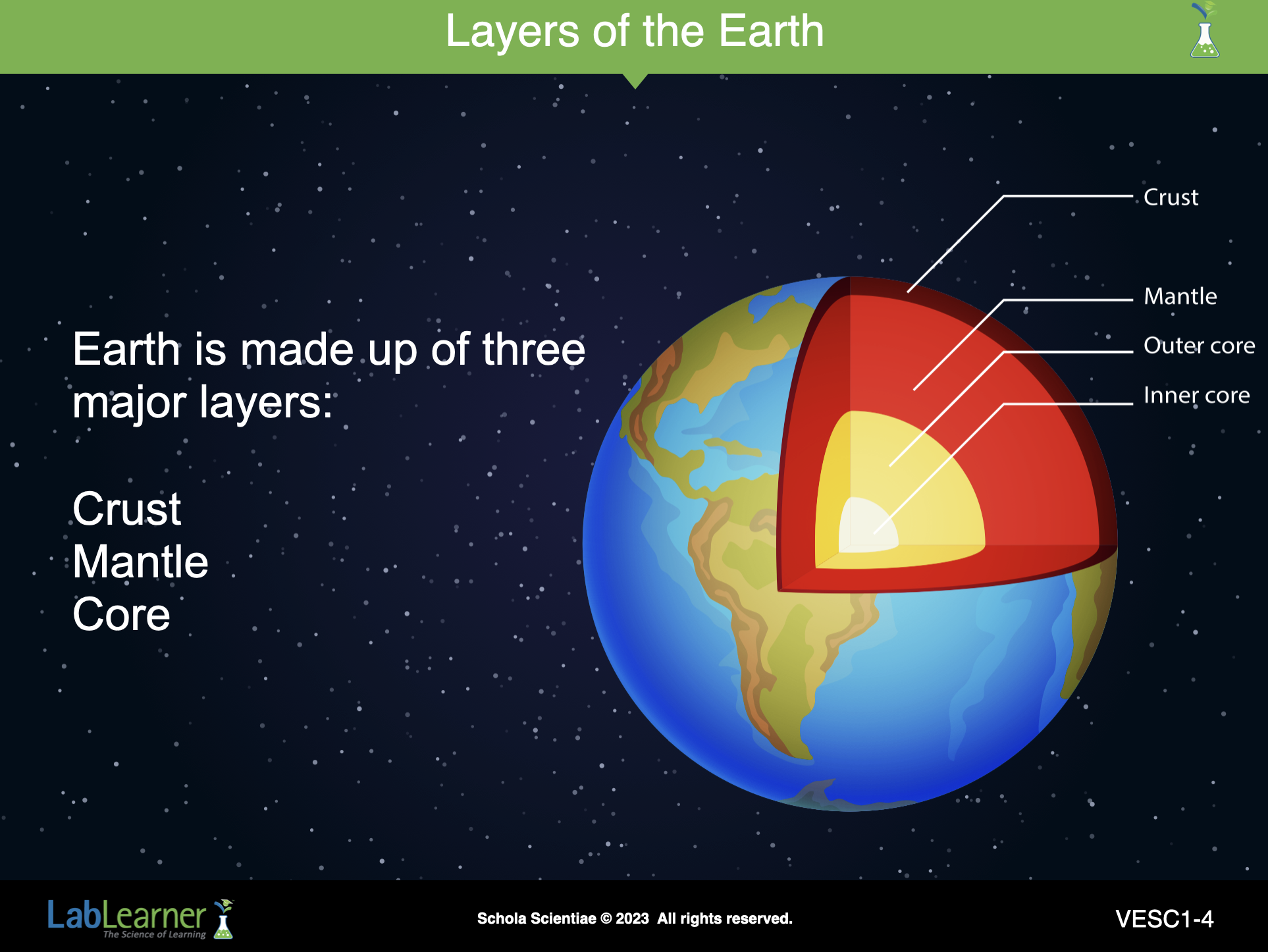
Students have previously looked at pictures and a map of the surface of the Earth. They have been asked to consider how two different areas: the land and the ocean, are similar, and different.
The next series of slides is designed to help students understand that one similarity the land and the area under the ocean have in common is that they are all part of the top layer of the Earth, the crust.
In this slide set, students should discover that the Earth is composed of layers.
______________________________________________
SLIDE 1VECS-5
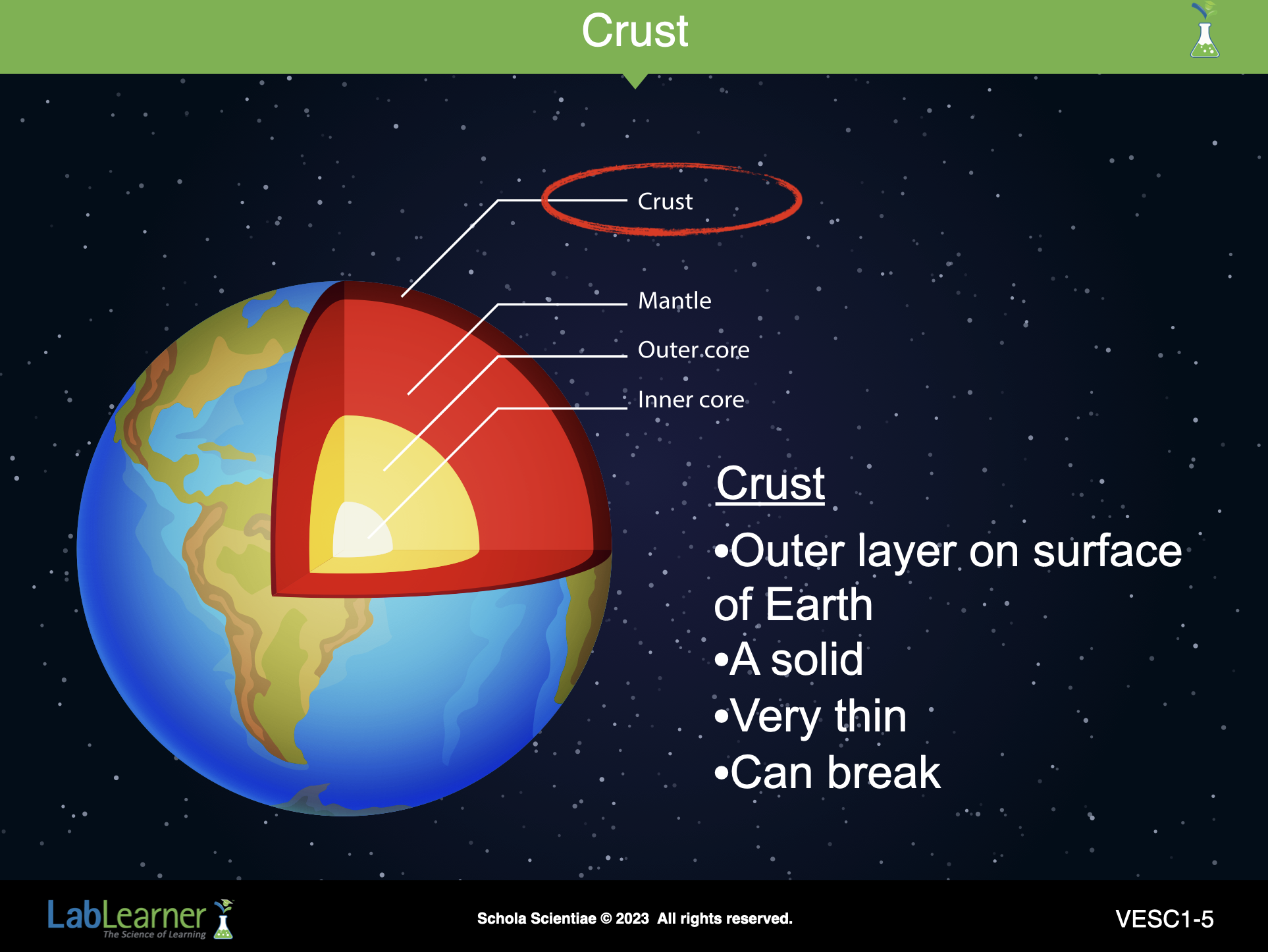
The crust is its outermost layer. Students may better understand this by explaining that the crust is the layer they walk on. The properties of the crust include that it is solid, relatively thin compared to the other layers, and can break.
Ask students: Compare the crust of the Earth to the crust of an apple pie. Student answers will vary. Both are solid and form a covering for what is underneath.
______________________________________________
SLIDE 1VECS-6
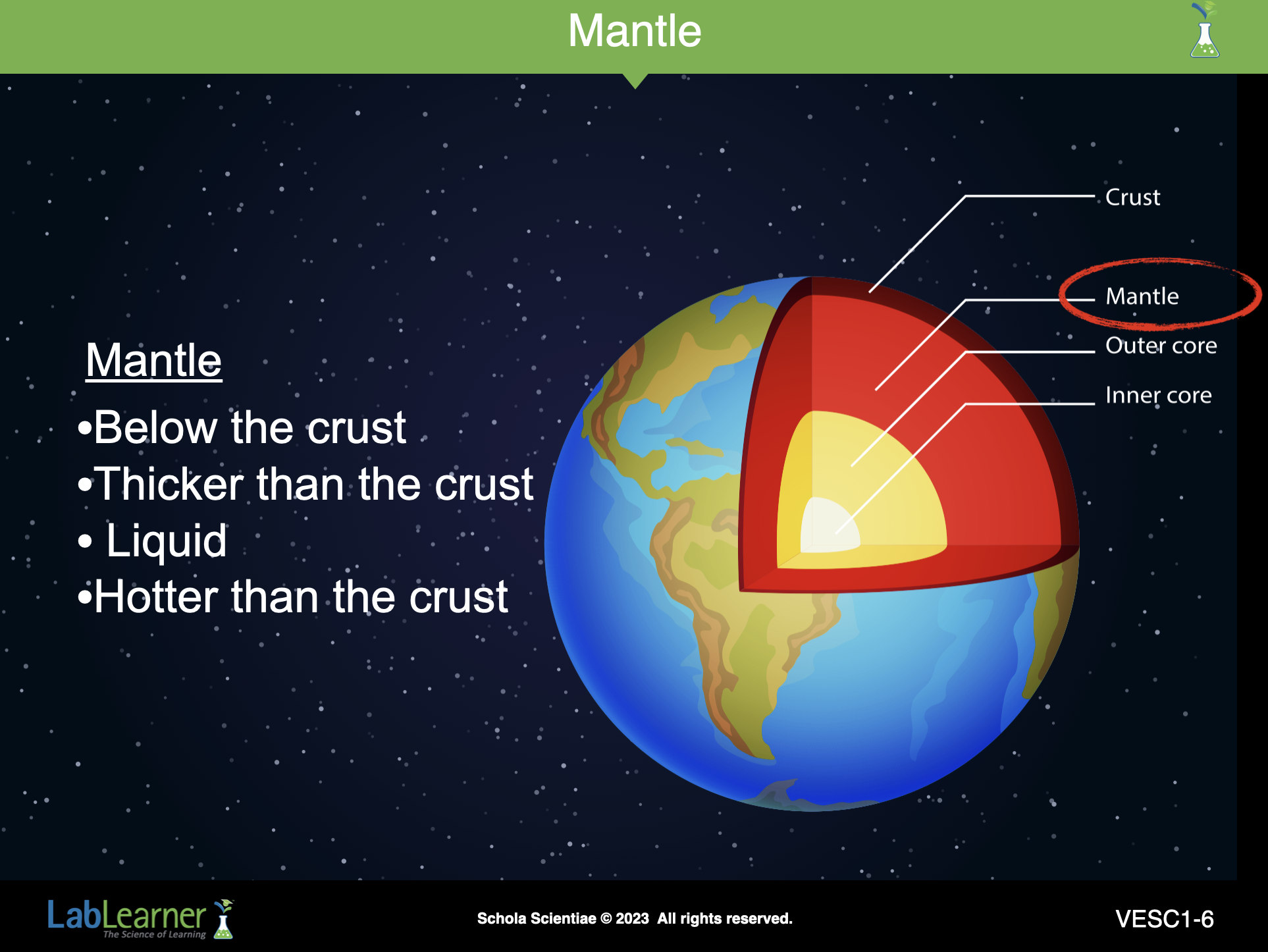
Beneath the crust is the mantle, a liquid that is thicker and hotter than the crust. Although the mantle does not represent the surface of the Earth, students must recognize this layer. They will later learn that the magma in the mantle is the source of some of the rocks on the Earth’s surface.
Students may be interested to learn that scientists think the Earth’s surface once resembled the mantle: a hot liquid when the Earth first formed billions of years ago. But the molten rock eventually cooled, giving us the solid, cool crust that we live on.
______________________________________________
SLIDE 1VECS-7
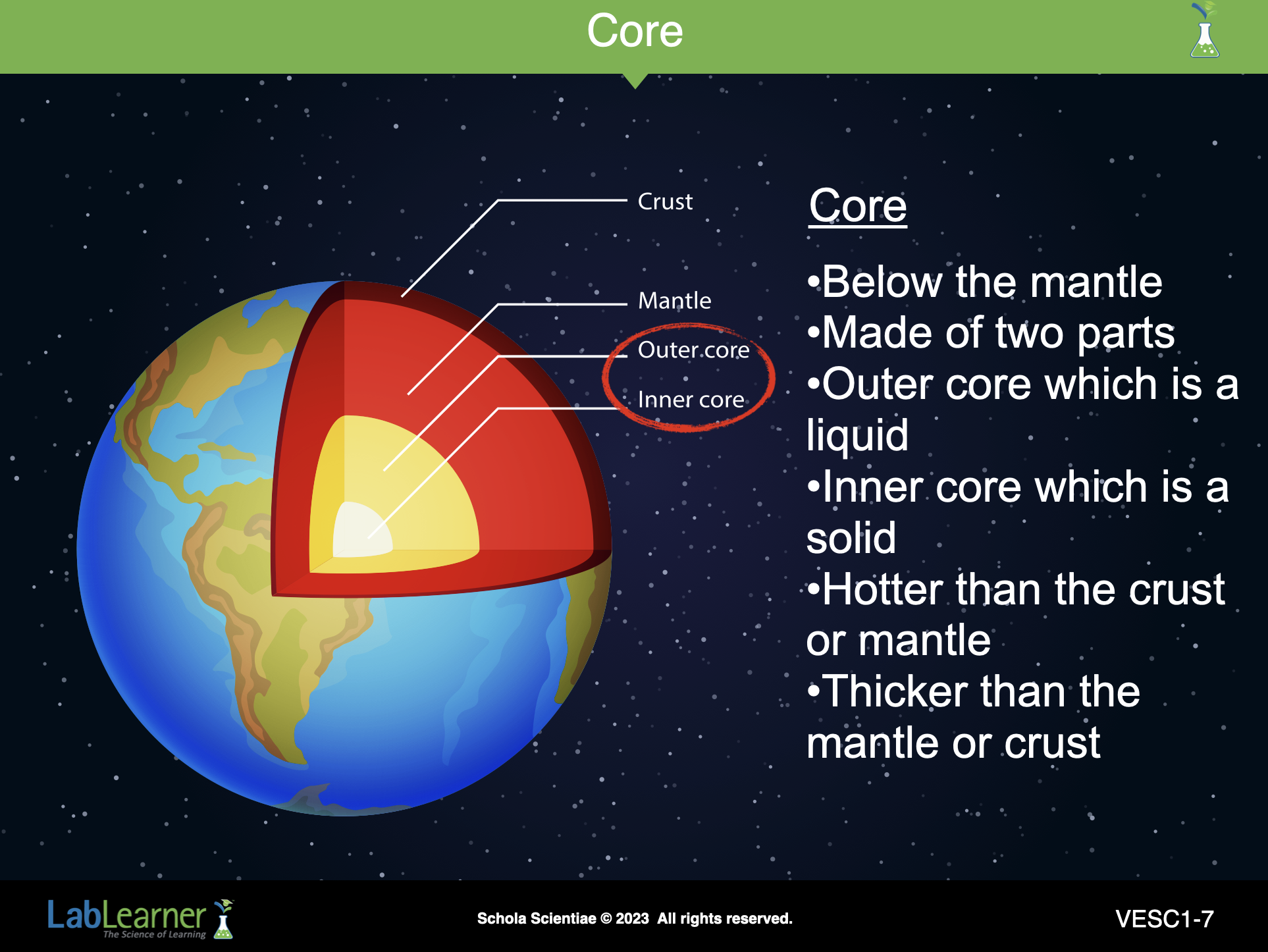
Beneath the mantle is the Earth’s core. Information about the core is provided for students to understand the composition of the Earth. The composition of the core is essential in understanding concepts such as the Earth’s magnetic field and the source of heat for the mantle. This information is not included for students at this level, but their introduction to this layer should help to serve as a foundation for later years of their science education.
______________________________________________
SLIDE 1VECS-8
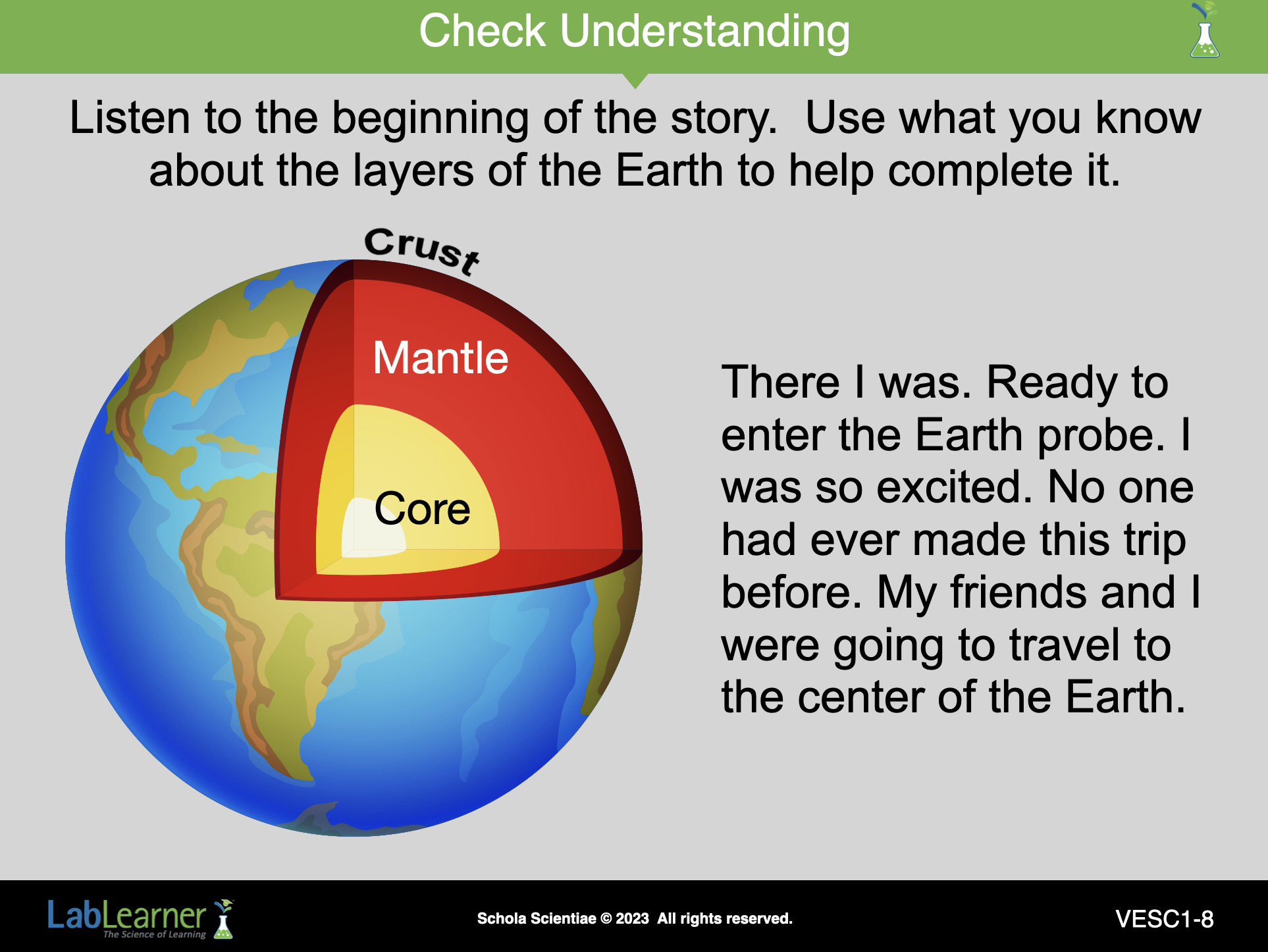
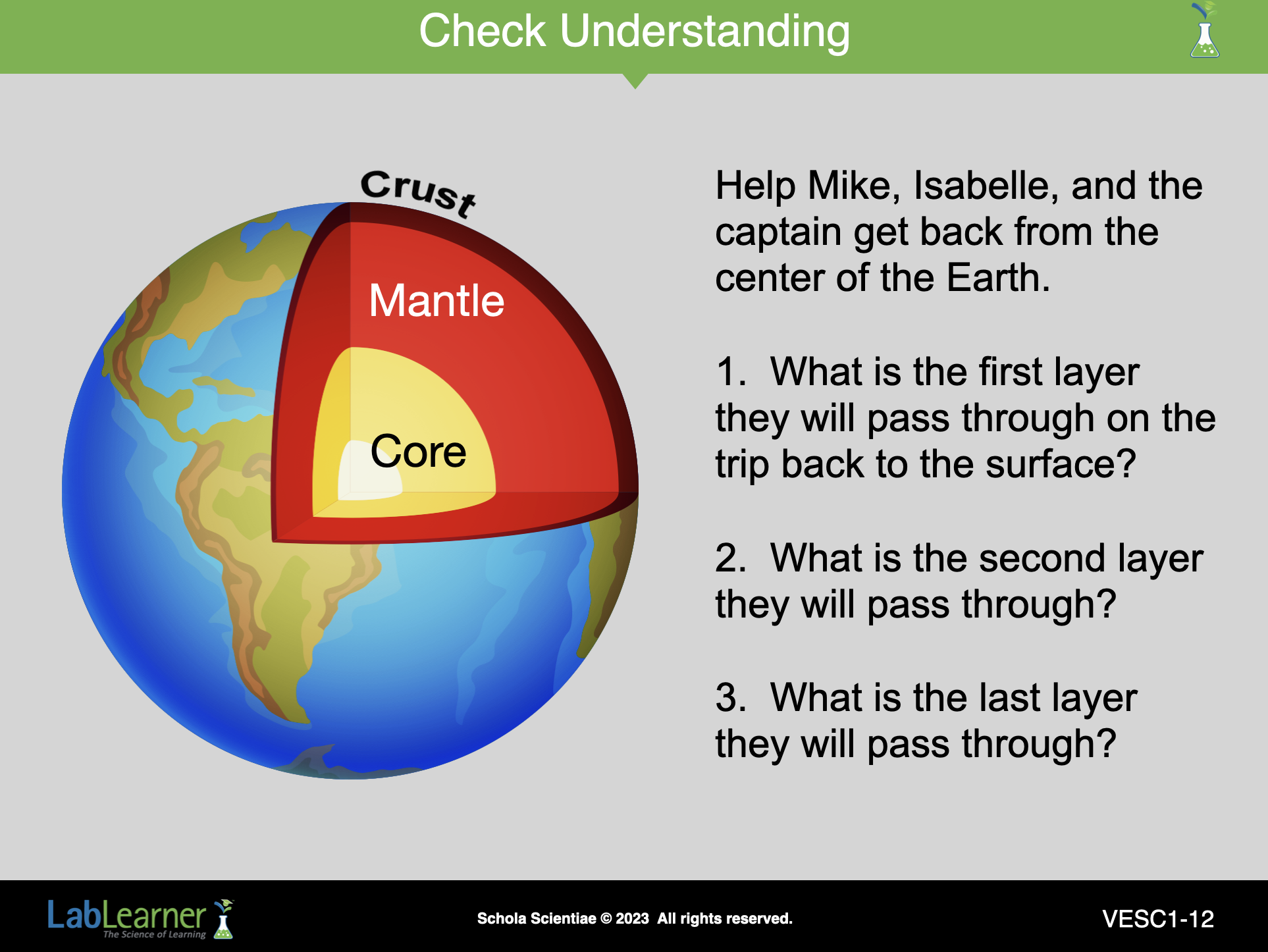
Students have now been introduced to the layers of the Earth and some of their properties. The Check Understanding section is provided to help students rehearse and review what they have learned.
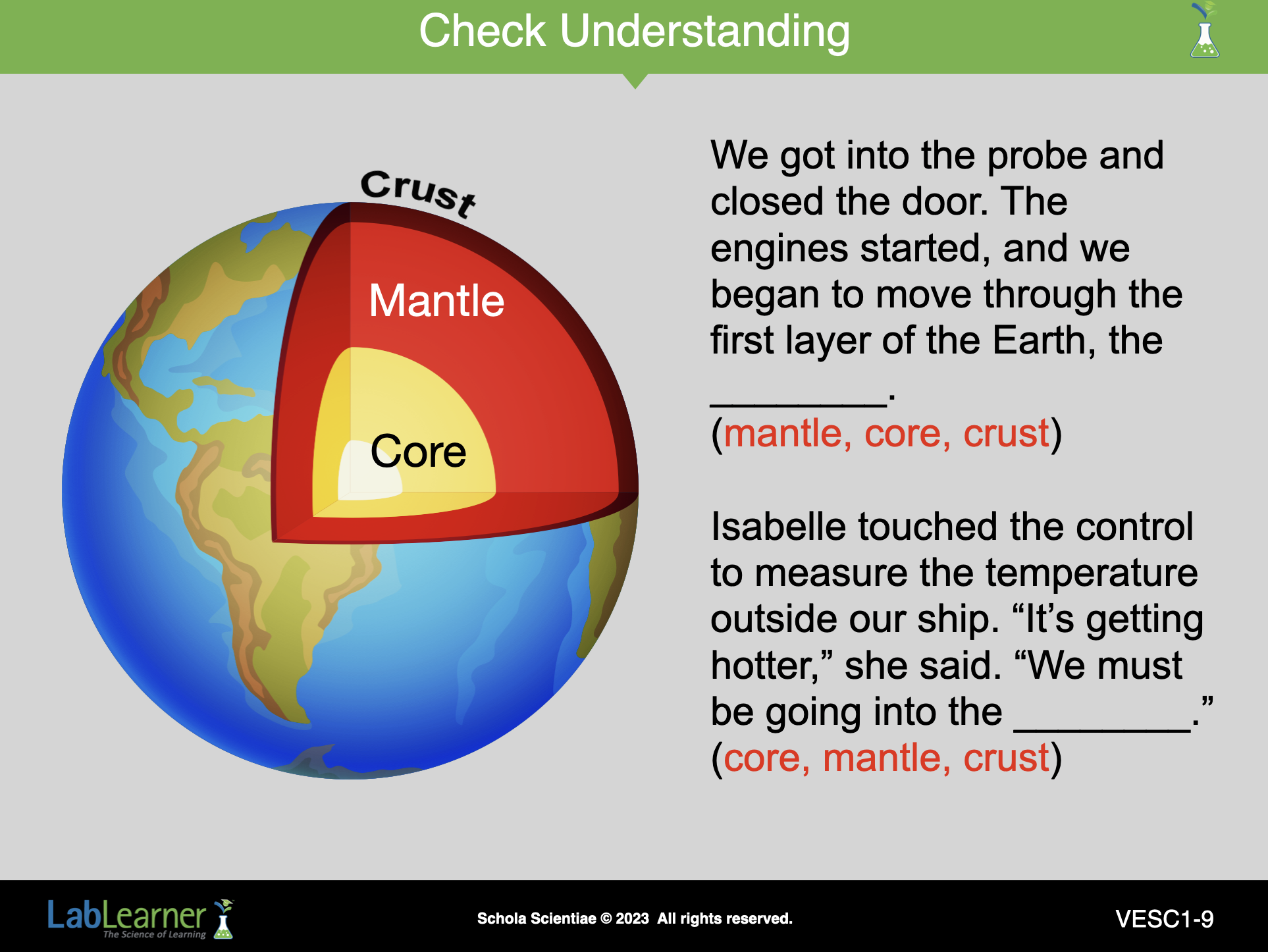
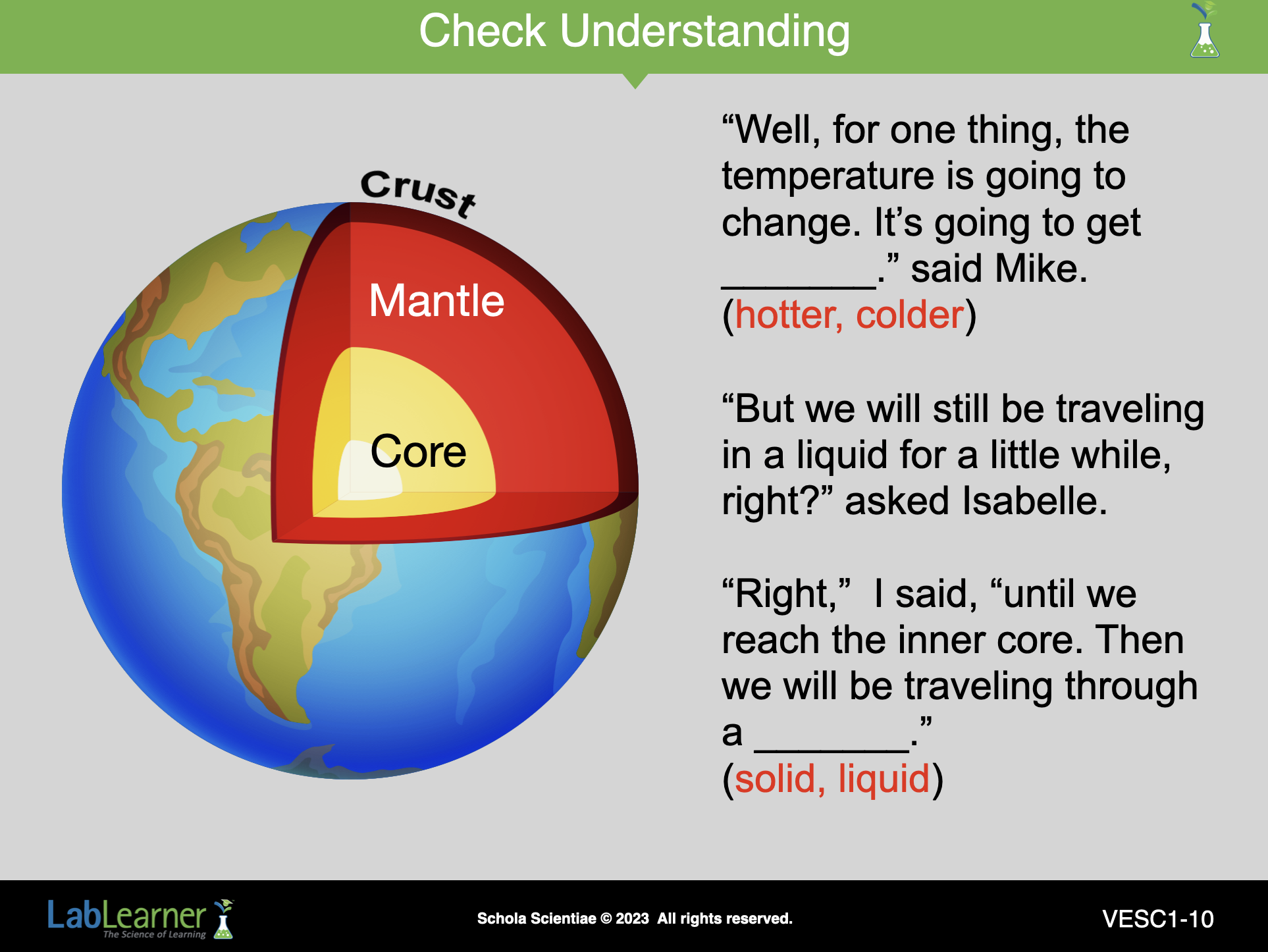
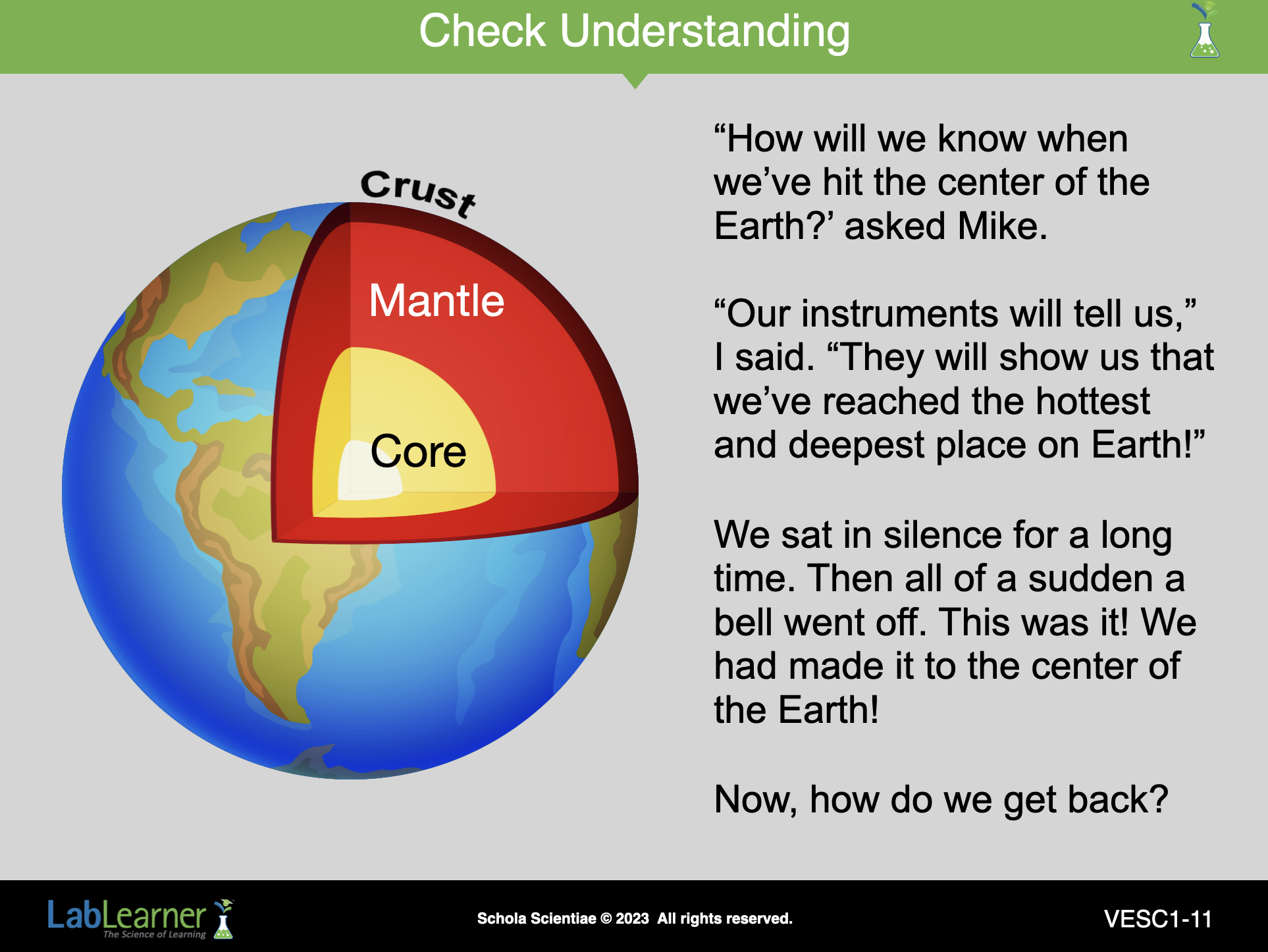
Tell students that they will read a fictional story that contains some factual information about the layers of the Earth. As they listen, they will be prompted to suggest an answer that helps to complete the story. A blank line denotes where students are expected to provide an answer. Below the line is a series of words from which students can choose. In addition, students can refer to the diagram of the Earth to help them follow the location of the Earth probe as they read the story.
______________________________________________
SLIDE 1VECS-9
Answer 1: crust
Answer 2: mantle
______________________________________________
SLIDE 1VECS-10
Answer 1: hotter
Answer 2: solid
______________________________________________
SLIDE 1VECS-11
______________________________________________
SLIDE 1VECS-12
Answers to questions:
Question 1: Core
Question 2: Mantle
Question 3: Crust
______________________________________________
SLIDE 1VECS-13
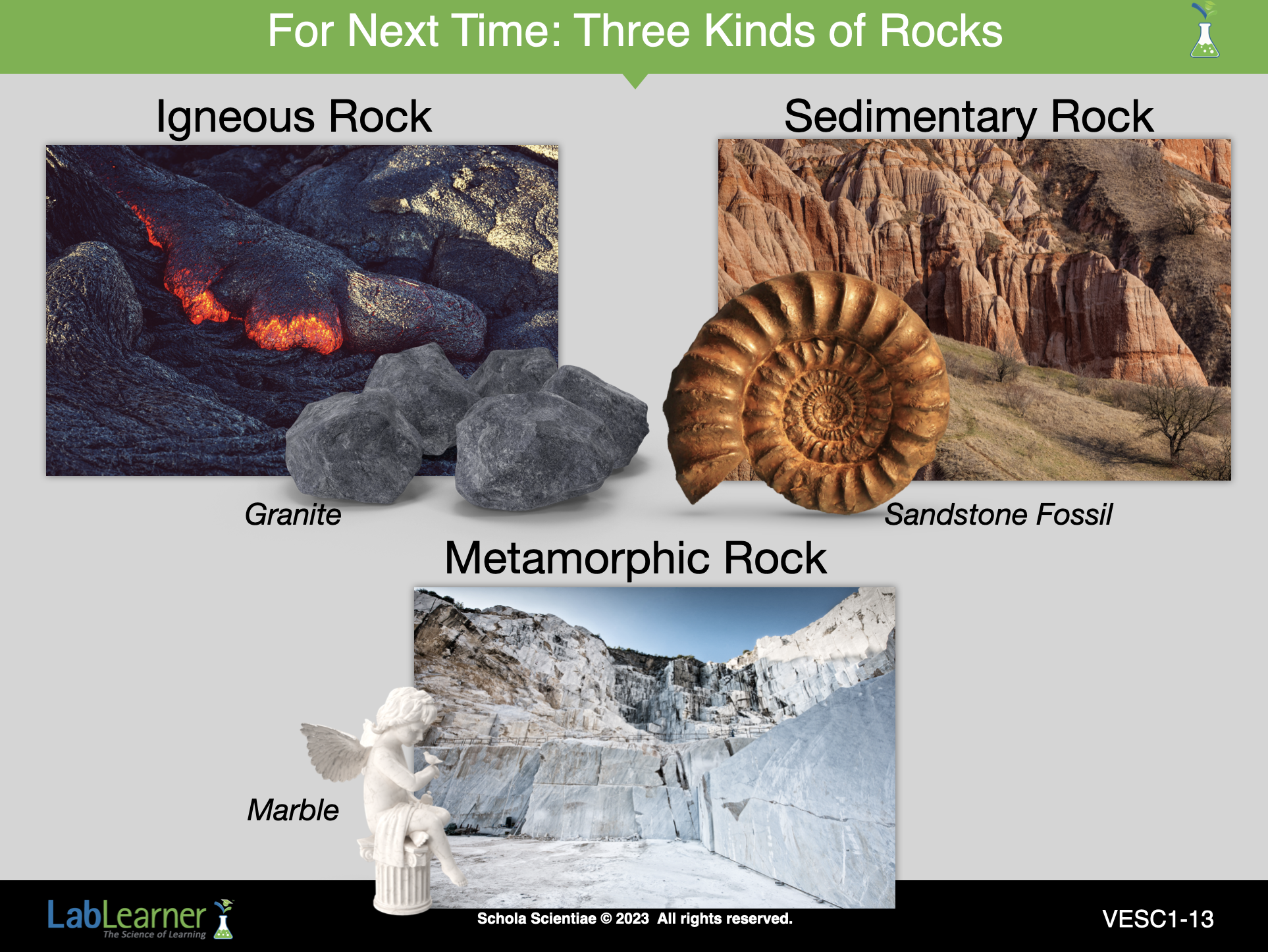
Introduce students to the concept that three different rock types compose the Earth’s crust/surface: igneous, sedimentary, and metamorphic rock.
Tell students that over the following three presentations, they will learn more about each type of rock, how it is formed, where it can be found, and how it relates to the other types of rocks.
______________________________________________