Teacher Portal:
Exploring Ecosystems
Investigation 5 – PreLab
 PRINT IT
Use your browser to download a printable PDF as help during the slide presentation and to make additional notes. In your browser, go to File > Print and then choose to save as PDF.
MINDSET
This Investigation is designed to:
- further students’ understanding of how pollution can spread through an ecosystem.
- demonstrate through experimentation, that organisms in an ecosystem must compete with each other for resources and survival.
- encourage students to compare experimental results between groups.
- increase students’ understanding of how pollution can negatively affect the ecosystem.
- foster practice in communicating and interpreting experimental results.
SCIENTIST’S GLOSSARY
1. Competition: a situation that exists in nature when two or more different species require the same environmental resource, such as food or shelter, to survive.
2. Ecosystem: a community of living things in its non-living environment.
3. Environment: the world around us and all of its parts, including physical surroundings, weather, plants, and animals.
4. Food chain: a straight-line diagram that represents which organisms are eaten by others in an ecosystem.
5. Food web: a complex interaction between organisms caused in an ecosystem when food chains overlap.
6. Natural Selection: the process in nature by which organisms that are best adapted to their environment tend to survive and reproduce while those less adapted tend to die off; also called “survival of the fittest”
7. Organism: a living thing.
8. Pollutant: any harmful material released into the environment. Some pollutants may be compounds that are naturally found in the environment (e.g. carbon dioxide gas), but are released in excess amounts.
9. Pollution: when harmful compounds or materials are added into the environment; types of pollution include air, land, and water pollution.
BE PREPARED
Watch the Investigation 5 Teacher Video and Student Video below to prepare for the PreLab.
SET FOR SUCCESS
- Tell students that they are continuing their study of the Exploring Ecosystems CELL.
- Ask students to share the kinds of things they might learn in these Investigations.
Begin the PreLab Concept Slides to start students on their learning journey. Then watch the Pre-Lab Student Video afterward as a class.
NAVIGATE IT
Once the slide presentation is launched
- use your left and right arrows to advance or go back in the slide presentation, and
- hover your mouse over the left edge of the presentation to get a view of the thumbnails for all the slides so that you can quickly move anywhere in the presentation.
- Click HERE to launch the slide presentation for the CELL.
SHARE IT
SLIDE VECO5-pre-1
This is the fifth and final regular Investigation of the LabLearner CELL Exploring Ecosystems. In it, students will further explore the impact of environmental pollutants on plants and animals in an ecosystem.
______________________________________________
SLIDE VECO5-pre-2
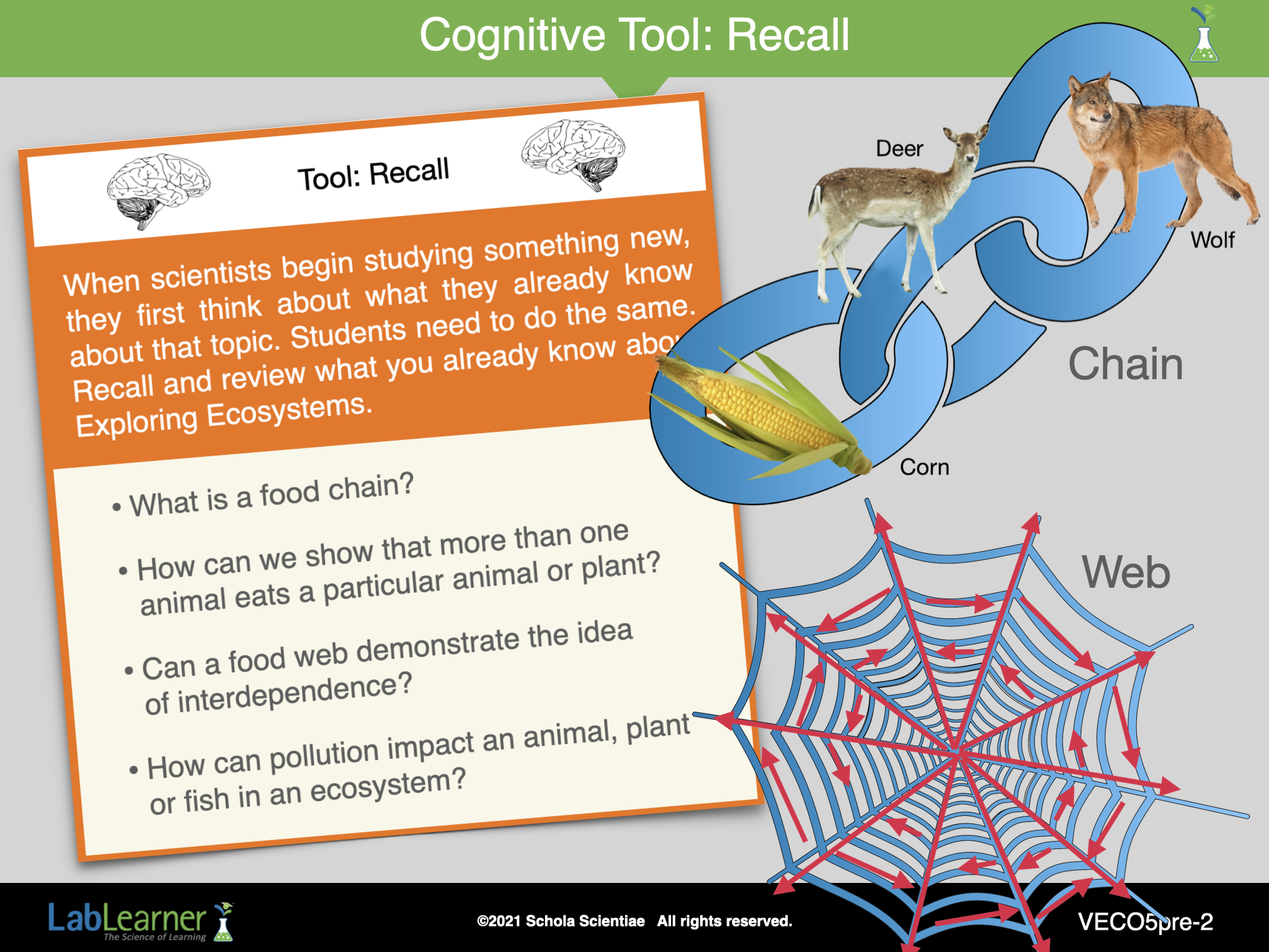
A. Begin the investigation by helping students remember important terms that will support new learning. Students may find it helpful to refer to the Scientist’s Glossary from previous Investigations during this introductory discussion.
1. Ask students: What is a food chain? Students should recall that a food chain is a diagram that shows which living things are eaten by others.
2. Ask students: How can we show that more than one animal eats a particular animal or plant? Students should recall that a food web is a diagram that overlaps many different food chains to show all of the feeding patterns of living things in an ecosystem.
3. Ask students: Can a food web demonstrate the idea of interdependence? Student answers may vary. The food web can be used to demonstrate interdependence since the amount of biomass available in part of a food web will impact the number of animals that can exist at subsequent levels.
Students may recall activities from previous Investigations in which changes in the number of herbivores or first-level carnivores impacted the amount of biomass and hence the number of animals that were present at higher levels of the food webs.
4. Ask students: How can pollution impact an animal, plant or fish in an ecosystem? Student answers may vary. Students may recall the previous investigation in which a fish could no longer survive because its environment and access to food were negatively impacted by water pollution.
______________________________________________
SLIDE VECO5-pre-3
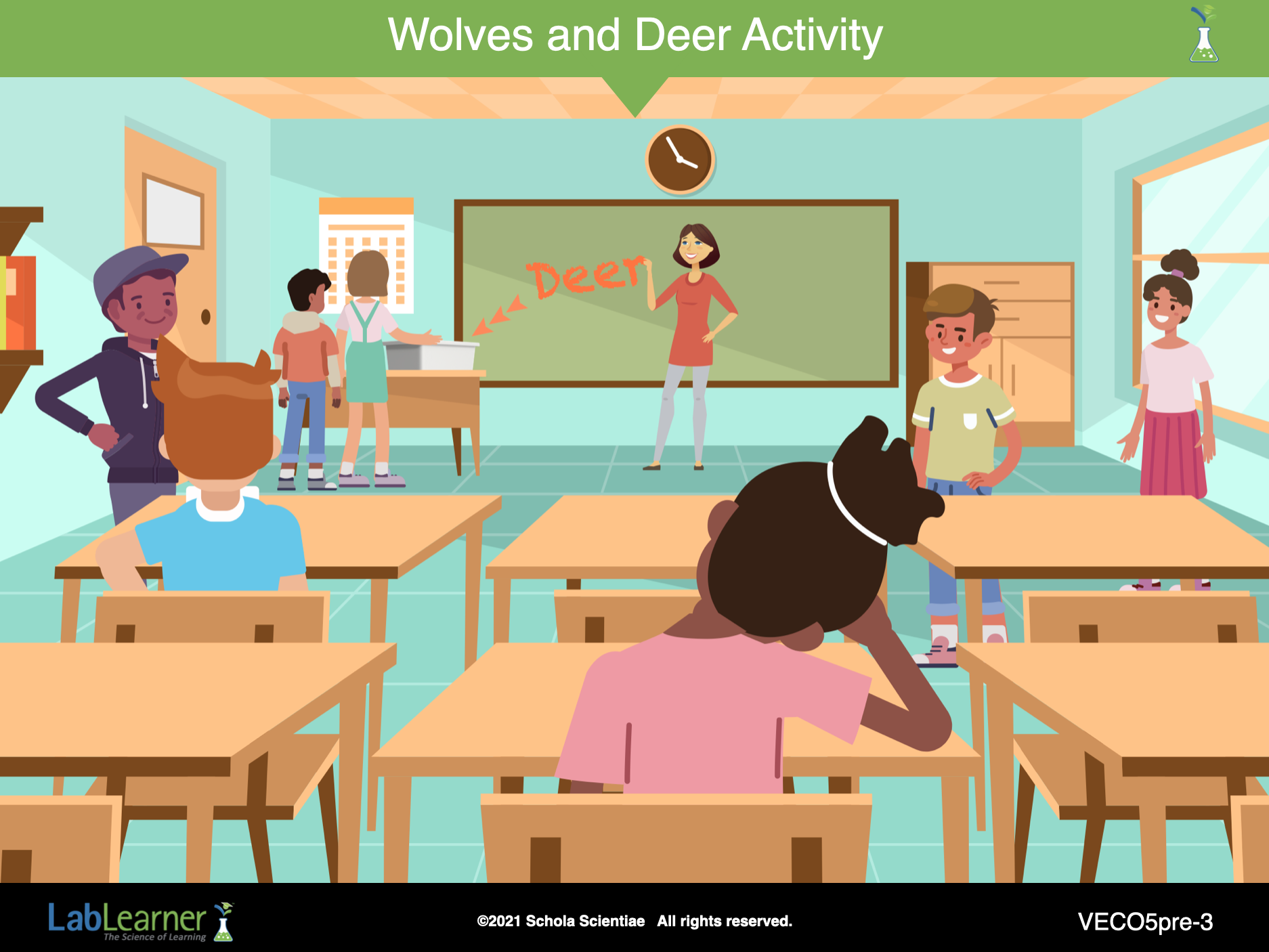
B. Conduct an activity to demonstrate the concepts included in the review.
1. Place 50 paper clips or marbles, pencils, etc., into a container such as a small box, bag, or hat. Place the container either at the front or side of the classroom. Do not place the container in the middle of the classroom.
a. Introduce the class to the fact that there is a container of items that represent deer and that there are wolves that need to eat the deer to survive.
b. Place the container of “deer” on the teacher’s desk or a side counter (anywhere but in the middle of the classroom).
c. Without providing specific instructions regarding how or which students should proceed, tell students (the “wolves”) to pick up one (1) paper clip (“deer”) from the container and return to their seats.
d. Once all students are seated, again tell the class (“wolves”) to pick up one (1) paper clip from the container and return to their seats. Depending on the size of the class, there may not be enough “deer” for some students. Tell the students that those who were unable to obtain food did not survive. Students (wolves) who did not collect a paperclip should observe but not participate in the remaining portion of the experiment.
e. Have one or two students collect all the paper clips from the class while you place a total of ten (10) paper clips into the container. Do not move the container from its starting location.
2. Tell students that a herd of deer is now available for the surviving wolves to eat.
a. Direct the surviving wolves to pick up one paper clip (“deer”) from the container and return to their seats. Students (‘wolves”) who did not get a paper clip (“Deer”) did not survive and should remain quietly in their seats observing the rest of the experiment.
b. Ask one student to collect the ten paper clips from the ten (10) survivors. Place a total of five (5) paper clips into the container.
c. Tell the remaining “survivors” to pick up one paper clip from the container and return to their seats. At this point, only five (5) wolf survivors will remain.
d. Have a student collect all the paper clips from the class.
3. Tell students that a herd of deer is now available for the surviving wolves.
a. Place a total of two (2) paper clips into the container.
b. Tell the remaining “survivors” to pick up one paper clip from the container and return to their seats. Only two (2) wolves will survive this experiment.
______________________________________________
SLIDE VECO5-pre-4
C. Analyze the concepts that the activity demonstrated. The following questions are intended as a guide for class discussion.
1. Discuss the results of the experiment as a class:
a. Ask students: What was the situation the first time the wolves “fed” at the beginning of the experiment? At the beginning of the experiment there were enough deer (paper clips) for all the “wolves” to survive.
b. Ask students: What happened to the number of wolves as the number of paper clips (“deer”) declined? There was less and less food so fewer wolves were able to survive. The number of wolves decreased as their food supply decreased.
c. Ask students: What factors contributed to determining which “wolves” in the class survived? Student answers will vary, but may include:
- Wolves that sat (“lived”) closest to the container (food source) were more likely to retrieve a “deer” (paperclip) and hence survive.
- Wolves that quickly figured out that there wasn’t enough food for everyone and realized they needed to compete, were more likely to act in a way that led to survival.
- Wolves that were the fastest were more likely to retrieve a “deer” (paperclip).
- Wolves that were biggest and pushed other wolves out of the way were more likely to retrieve a “deer” (paperclip) and survive.
d. Explain to students that through the ways just described, any advantage that a wolf had, made them better competitors for food. Explain that another way to say this is that they had a better “fit” with the environment. They were more “fit” to survive.
______________________________________________

SLIDE VECO5-pre-5
2. Help students recognize the concept of survival of the fittest in the context of the activity.
a. Ask students: Can you think of a word that describes having a quality or characteristic that means that you win, or are successful compared to others? Student answers may vary. Guide students to recall the word “advantage.”
b. Ask students: How does the phrase “Survival of the fittest” apply to what happened in the deer and wolf activity? Only the “fittest” wolves in the class were able to obtain food when the supply dropped. They had an advantage. Only these “fit” wolves would survive.
c. With wolf survival, the next herd of deer that was available was smaller in number.
Ask students: What are some ways that the supply of deer may have been reduced? Student answers will vary but may include:
-
- Other predators ate the deer so there were fewer available for the wolves.
- The winters were cold and many deer did not survive.
- Over-hunting by humans reduced the deer population.
- Deer might have migrated out of the area.
- There may have been a decrease in the amount of food available for the deer to eat.
d. Ask students: What could cause a herd of deer’s food supply to decrease? Student answers will vary but may include:
-
- Forests were destroyed for lumber or clearing space for new homes.
- Other herbivore populations increased and ate the deer’s food.
- Pollution partially destroyed the deer’s food.
- A tree or plant disease reduced the amount of food available for deer.
______________________________________________
SLIDE VECO5-pre-6
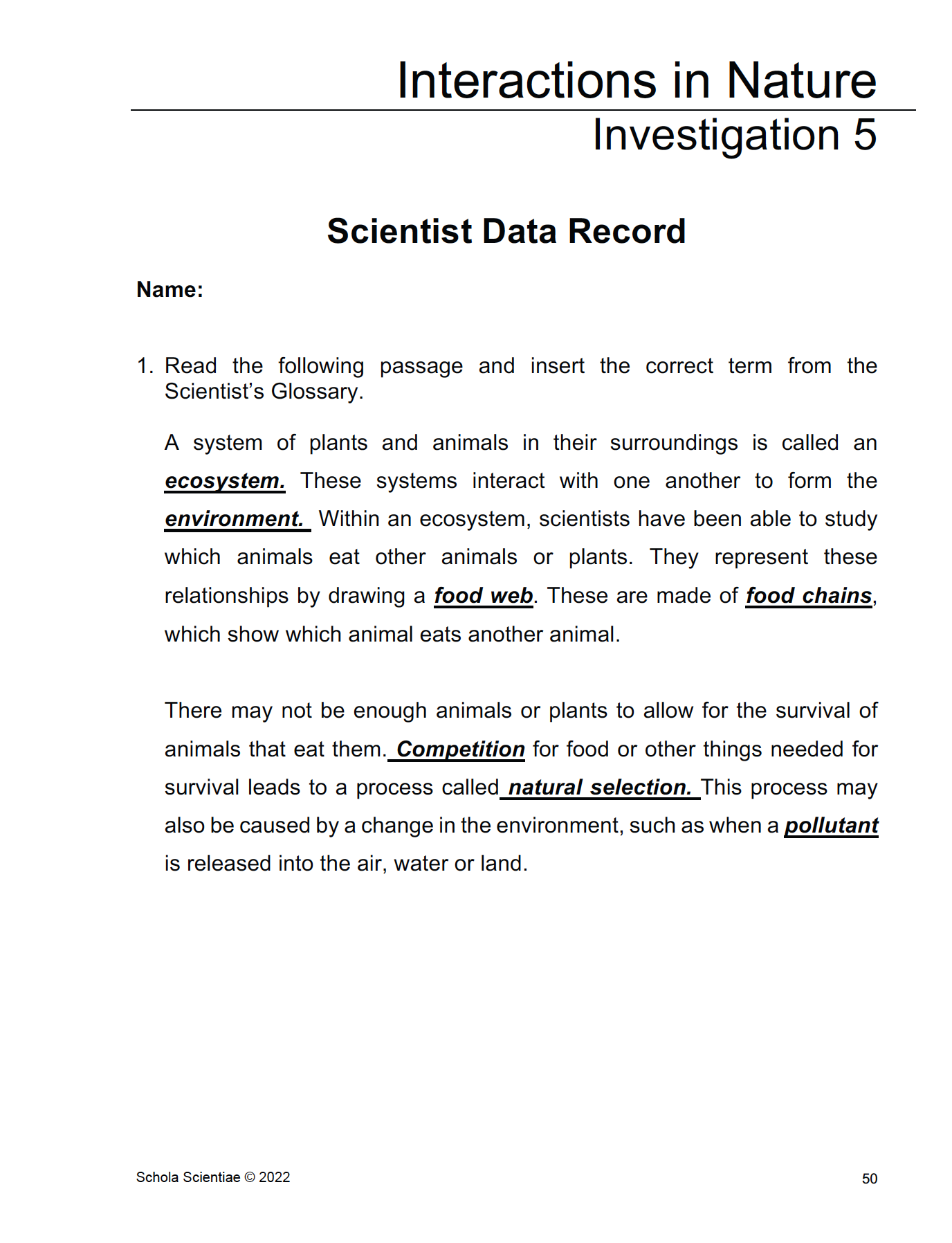
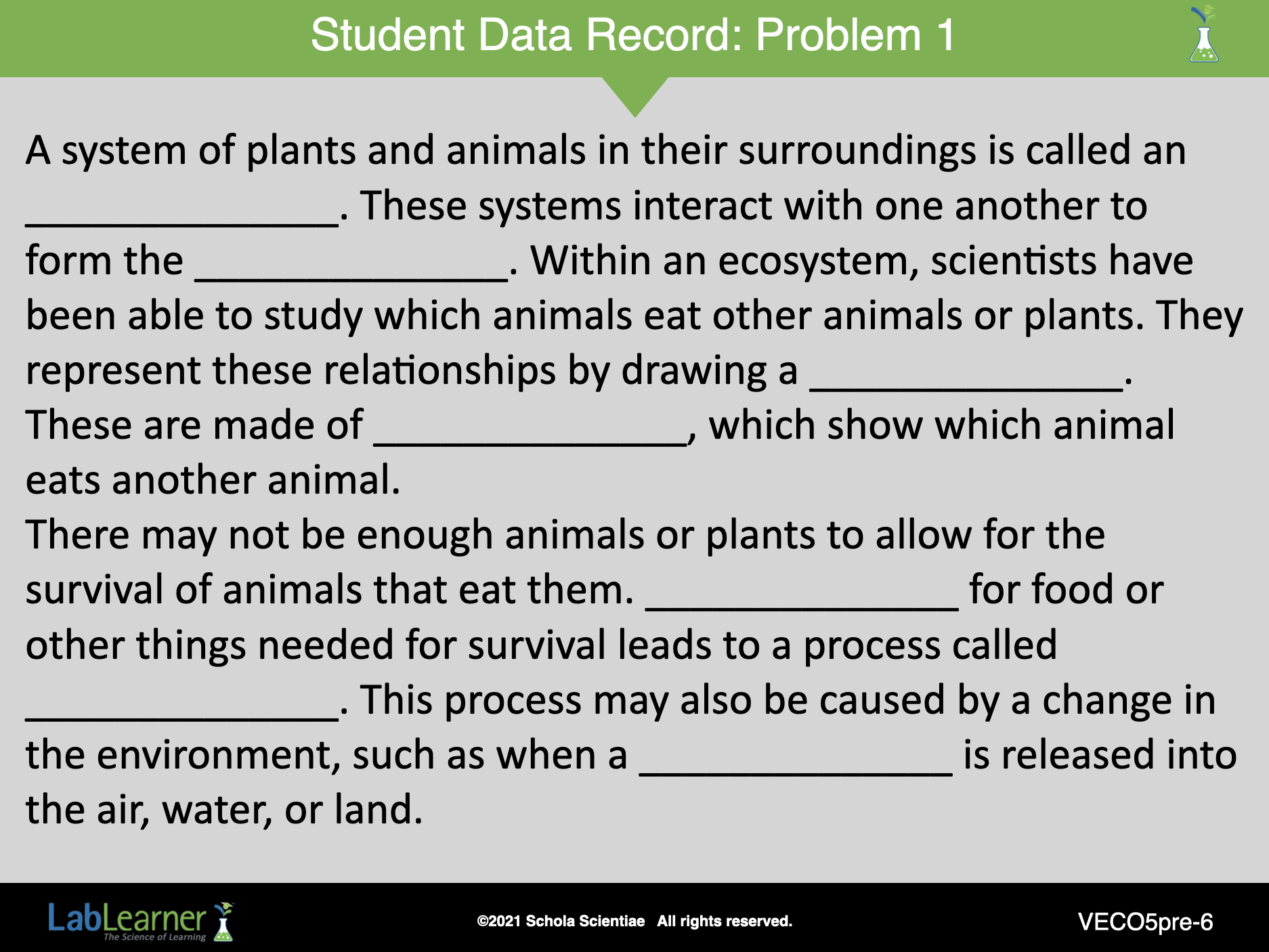
D. Complete a comprehension activity in which students read a passage indirectly describing key vocabulary terms and identify their correct placement within the passage.
1. Direct students to read the passage in Problem 1 of their Student Data Record. Students should refer to the Scientist’s Glossary to help them choose the correct word to insert in the blank space.
2. Ask for a student volunteer to read each sentence of the passage, including the word he or she selected as their answer.
______________________________________________
SLIDE VECO5-pre-7
E. Bring this portion of the Investigation to a close by introducing students to the following questions, which will be investigated in detail in Lab:
- How do changes in the environment affect the producers and consumers in that environment?
- What effects can pollution have on producers and consumers?
Student Video
Watch the Investigation 5 Student Video after the Share It presentation to prepare for the Lab.
KEYS