Teacher Portal:
Dynamic Earth Journey
Five: Convergent and Transform Boundaries
 PRINT IT
Use your browser to download a printable PDF as help during the slide presentation and to make additional notes. In your browser, go to File > Print and then choose to save as PDF.
NAVIGATE IT
Once the slide presentation is launched
- use your left and right arrows to advance or go back in the slide presentation, and
- hover your mouse over the left edge of the presentation to get a view of the thumbnails for all the slides so that you can quickly move anywhere in the presentation.
- Click HERE to launch the slide presentation for the CELL.
SHARE IT
SLIDE 5VDE-1
______________________________________________
SLIDE 5VDE-2
______________________________________________
SLIDE 5VDE-3
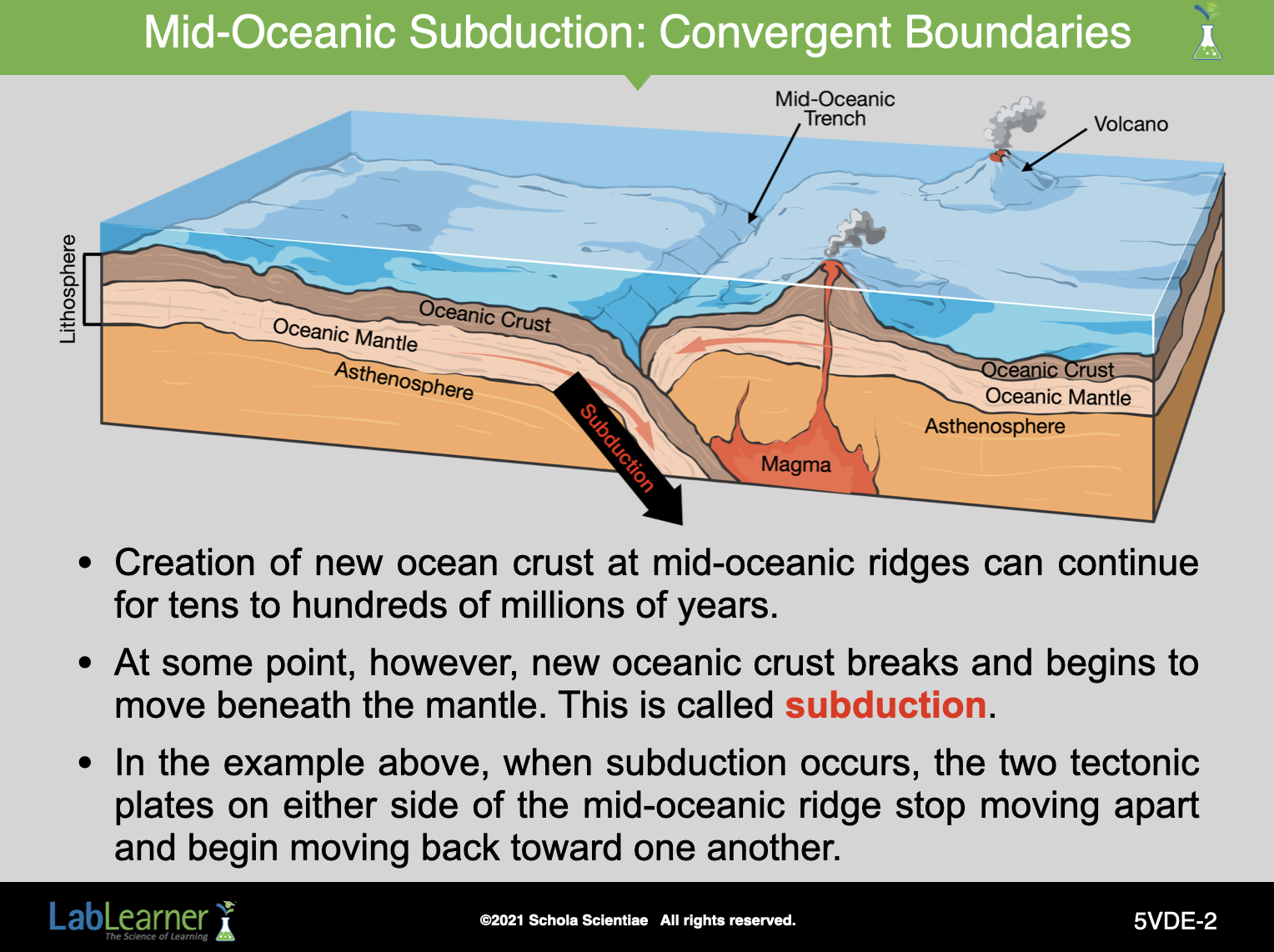
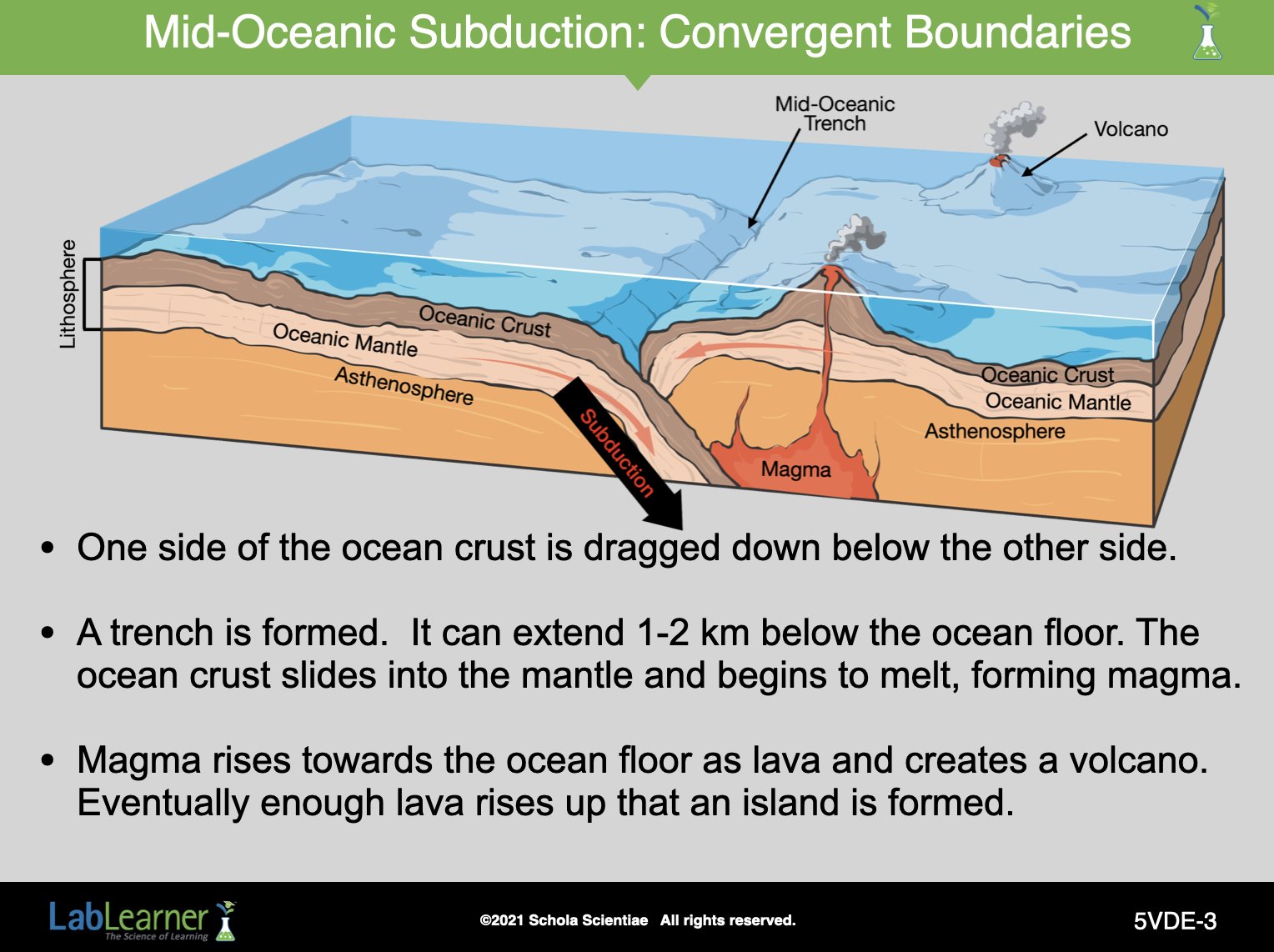
Subduction zones are where oceanic crust moves under the mantle.
Subduction zones can occur anywhere in the ocean basin.
Generally see two types of locations:
- inside an ocean basin
- along the edge of the continents
Subduction zones cause volcanic mountain building.
During subduction, one side of the ocean crust is dragged down below the other side and into the mantle. As the crust thrusts into the mantle, it begins to melt forming magma.
This magma rises up toward the ocean floor, breaks through the ocean lithosphere, and creates a volcano and ultimately an island. (Examples: Japan, Aleutian Island, Java, Borneo, Sumatra)
As soon as the island is formed, weathering and erosion processes begin. Sediment slides down the island to the edge of the ocean. Some are subducted along the trench of the two ocean plates.
Ask students: Subduction occurs only with oceanic crust, not continental crust. Why? Because oceanic crust (lithosphere) is more dense than continental lithosphere. The density of the continental lithosphere is such that it does not sink into the mantle.
______________________________________________
SLIDE 5VDE-4
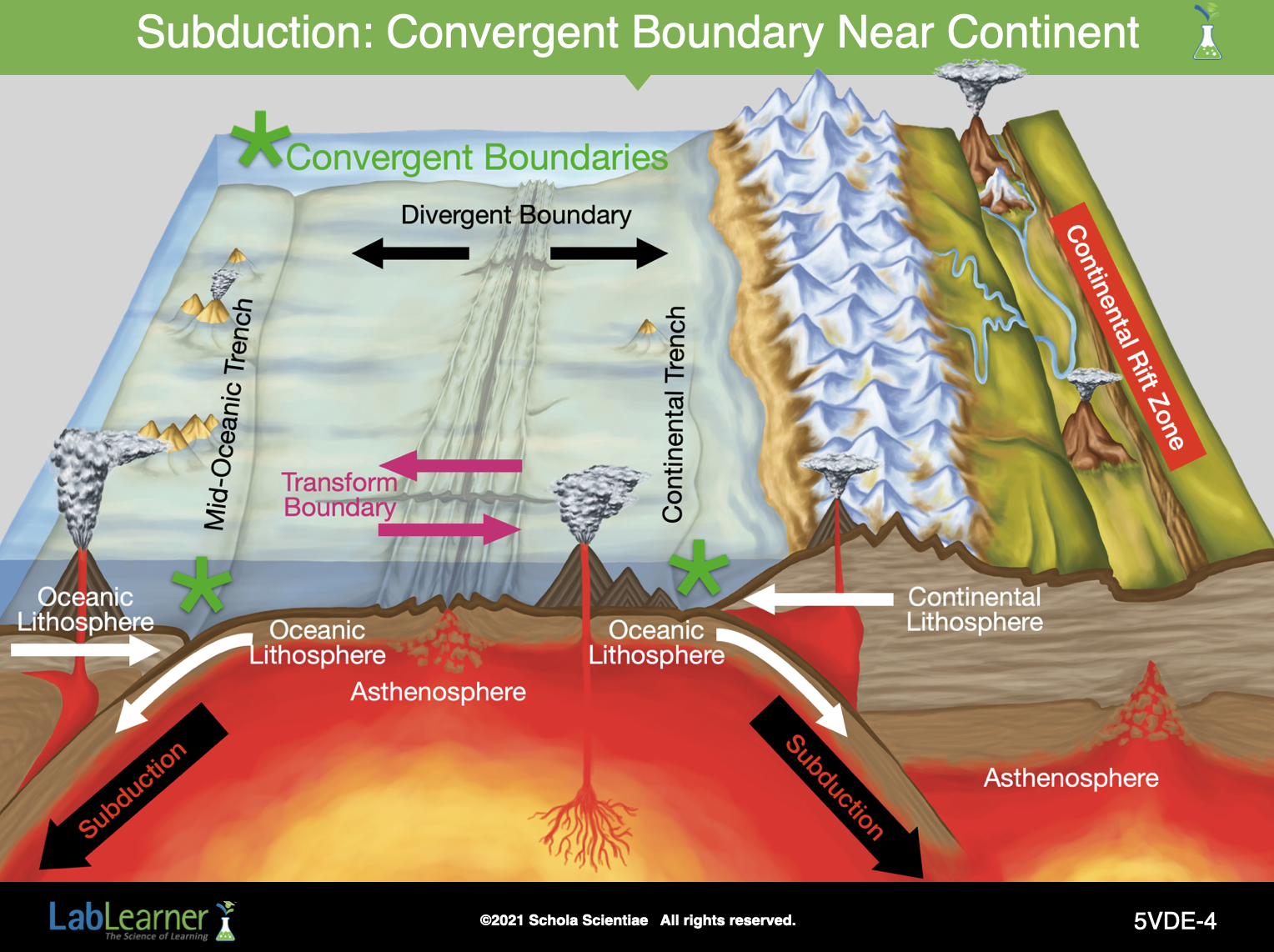
Similar processes occur when the subduction zone is near the edge of a continent. Volcanoes appear under the crust that is above sea level. Mountains are higher than the ones created by island-building. This is called oceanic-continental convergence.
Like divergent boundaries, volcanoes and earthquakes can occur at convergent boundaries.
_________________________________________
The graphic on this slide consolidates much of the information we have discussed about plate tectonics.
Convergent boundaries are marked with a green *. There are two on this slide. The one on the left occurs mid-ocean (as discussed in the last two slides) while the one on the right occurs near a continent (oceanic-continental convergence).
In both cases, the oceanic lithosphere is subducted under the lithosphere as it approaches. In the case of a mid-oceanic convergent boundary, either one of the opposing plate lithospheres may be subducted beneath the other.
In the case of continental/oceanic convergent boundaries, it is always the oceanic lithosphere that subducts under the continental lithosphere. This is because the oceanic lithosphere has a greater density than the continental lithosphere. It is composed of denser rocks (typically basalt rather than granite or limestone).
Notice that a trench is formed with either a mid-oceanic or continental convergent boundary. These trenches are among the deepest oceanic locations on Earth.
______________________________________________
SLIDE 5VDE-5
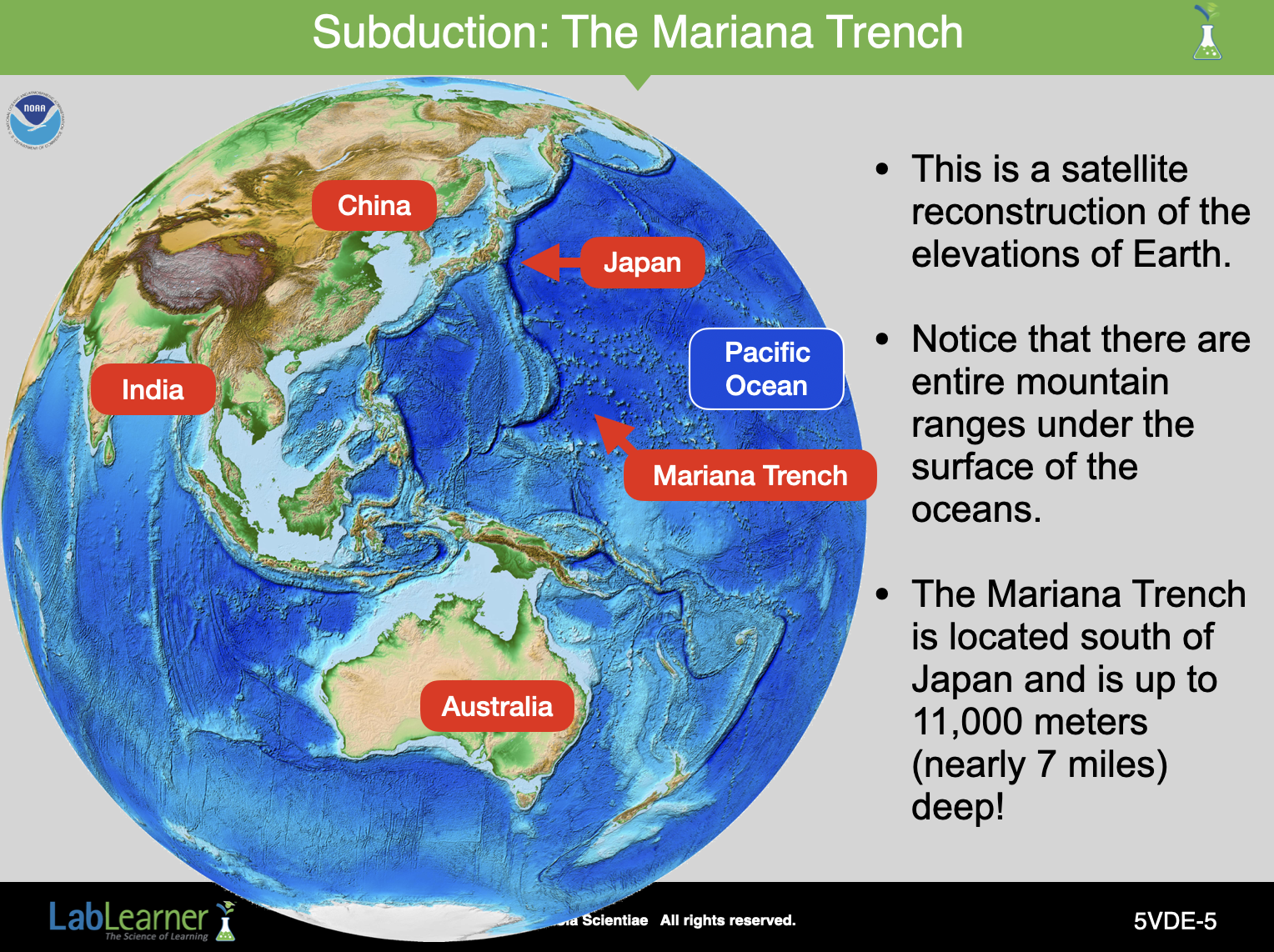
Graphic thanks to the National Oceanic and Atmospheric Administration (NOAA).
______________________________________________
SLIDE 5VDE-6
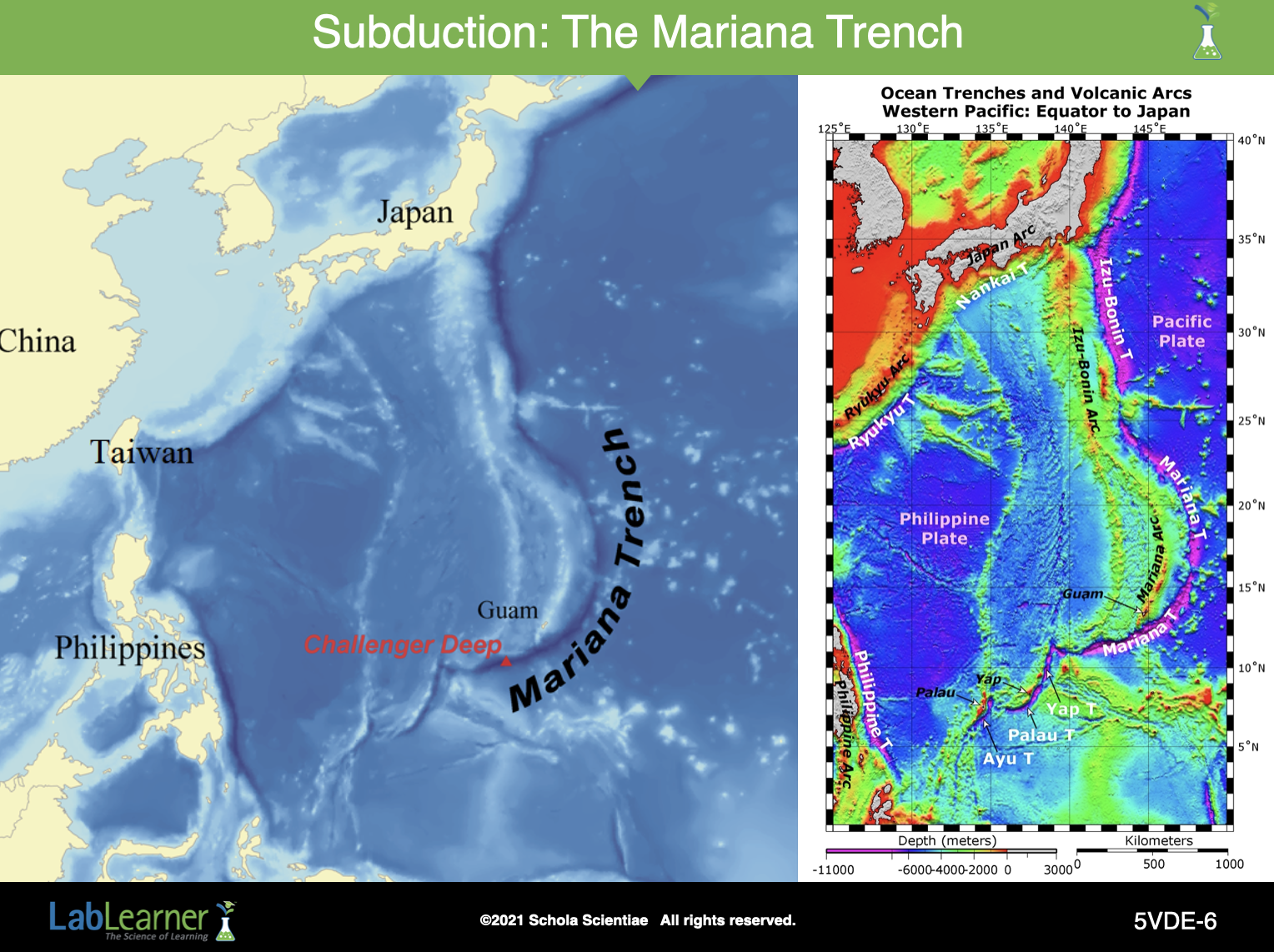
This is a close-up of the Mariana Trench region of the Pacific Ocean. The Mariana Trench is approximately 11,000 meters (almost 7 miles) below sea level. The trench is the result of the subduction of the massive Pacific Plate and the smaller Philippine Plate.
Mountains and volcanic islands have formed as the Pacific Plate subducts under the Philippine Plate.
______________________________________________
SLIDE 5VDE-7
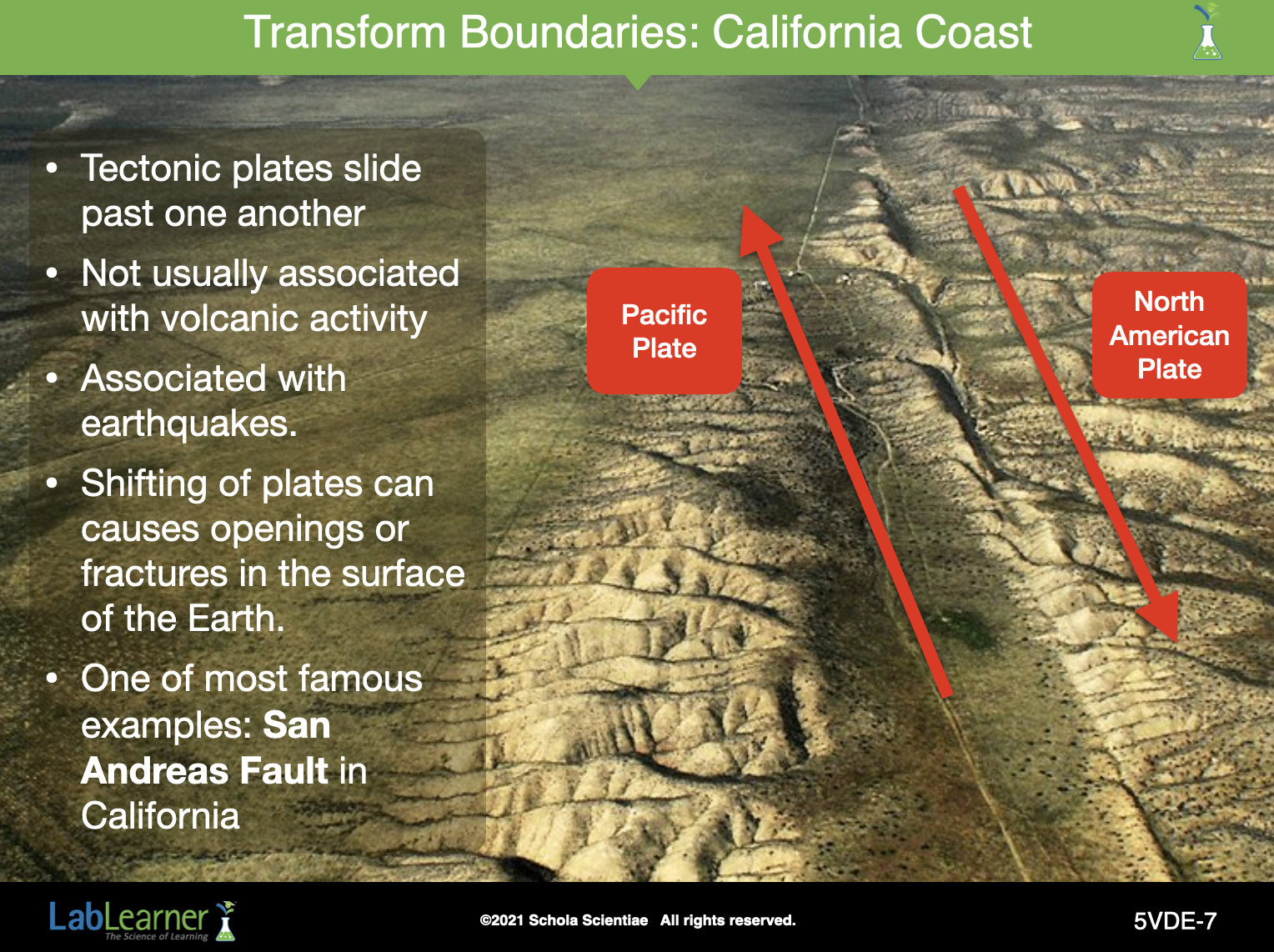
Transform boundary on the coast of California, the San Andreas Fault.
______________________________________________
SLIDE 5VDE-8
Answer
Question 1:
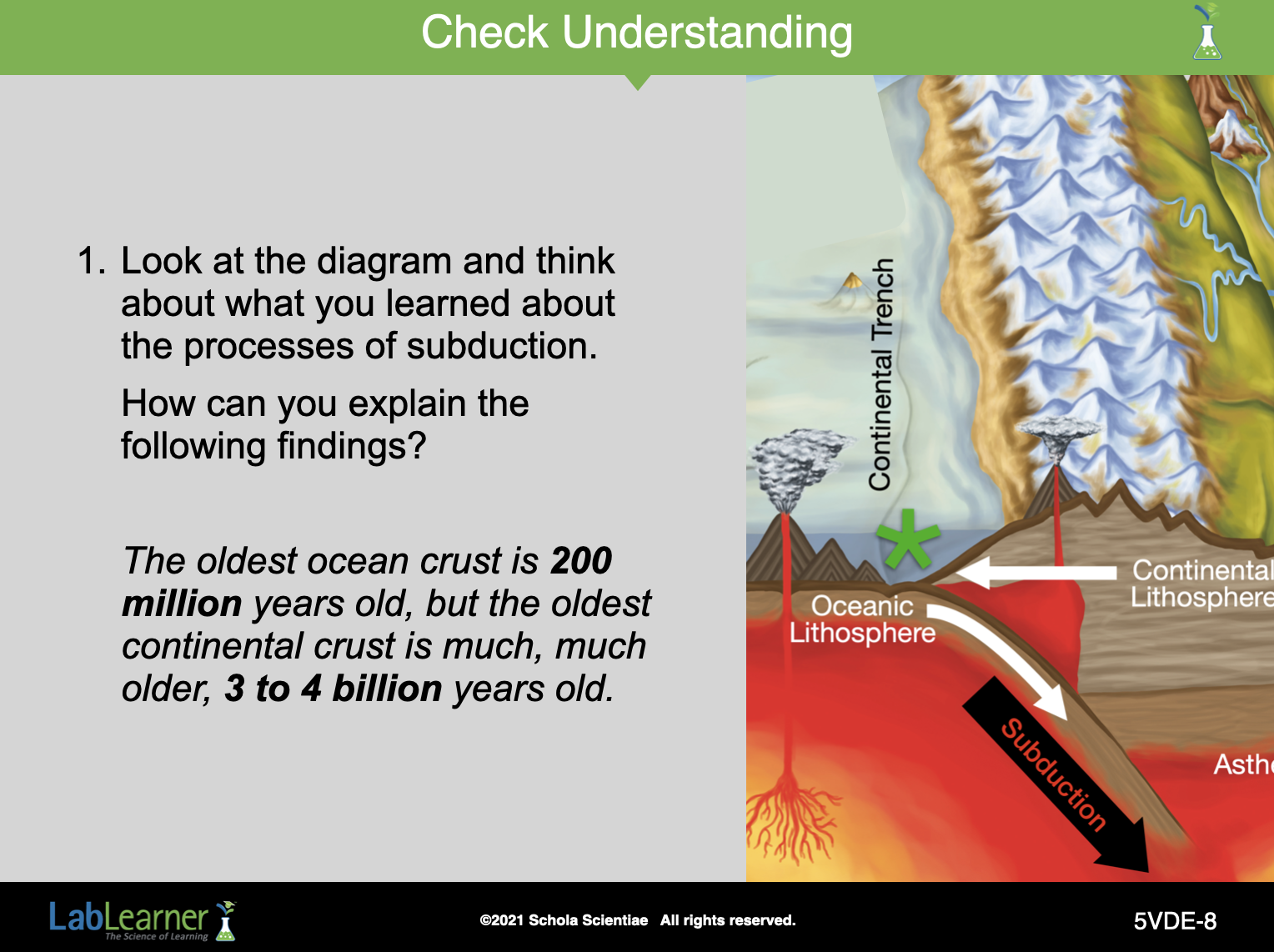
The process of subduction explains the differences in the ages of the ocean and continental crust. Because the ocean lithosphere is subducted it is moved from the surface of the Earth to the mantle as two tectonic plates move together. Because continental lithosphere is not dense enough to be subducted, it remains on the surface of the Earth. As more and more ocean floor is subducted, the ocean basin and floor decrease in size. Eventually, these oceans and ocean floor disappear.
______________________________________________
SLIDE 5VDE-10
_________________________________________
SLIDE 5VDE-11
Answers
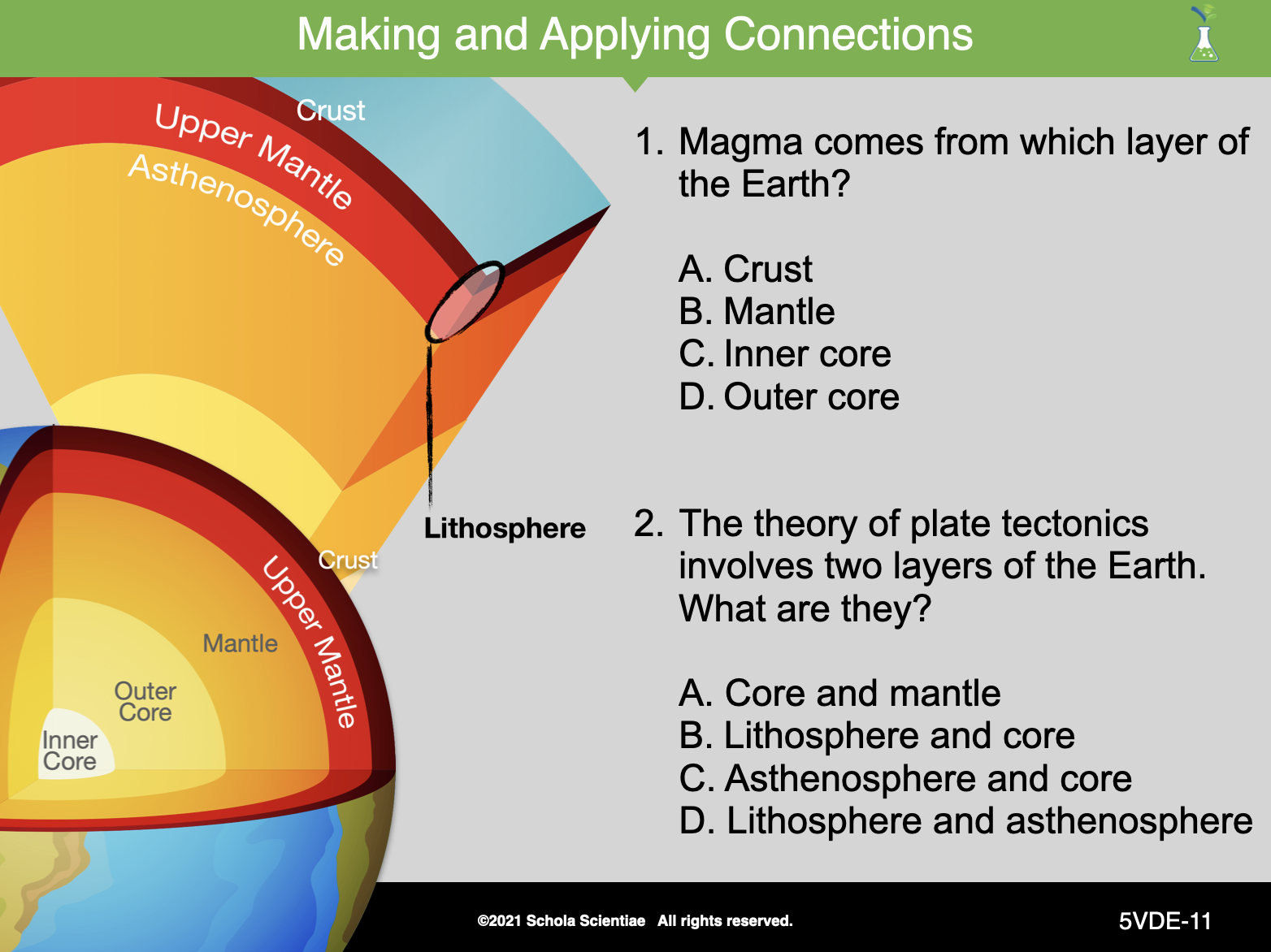
Question 1: B
Question 2: D
_________________________________________
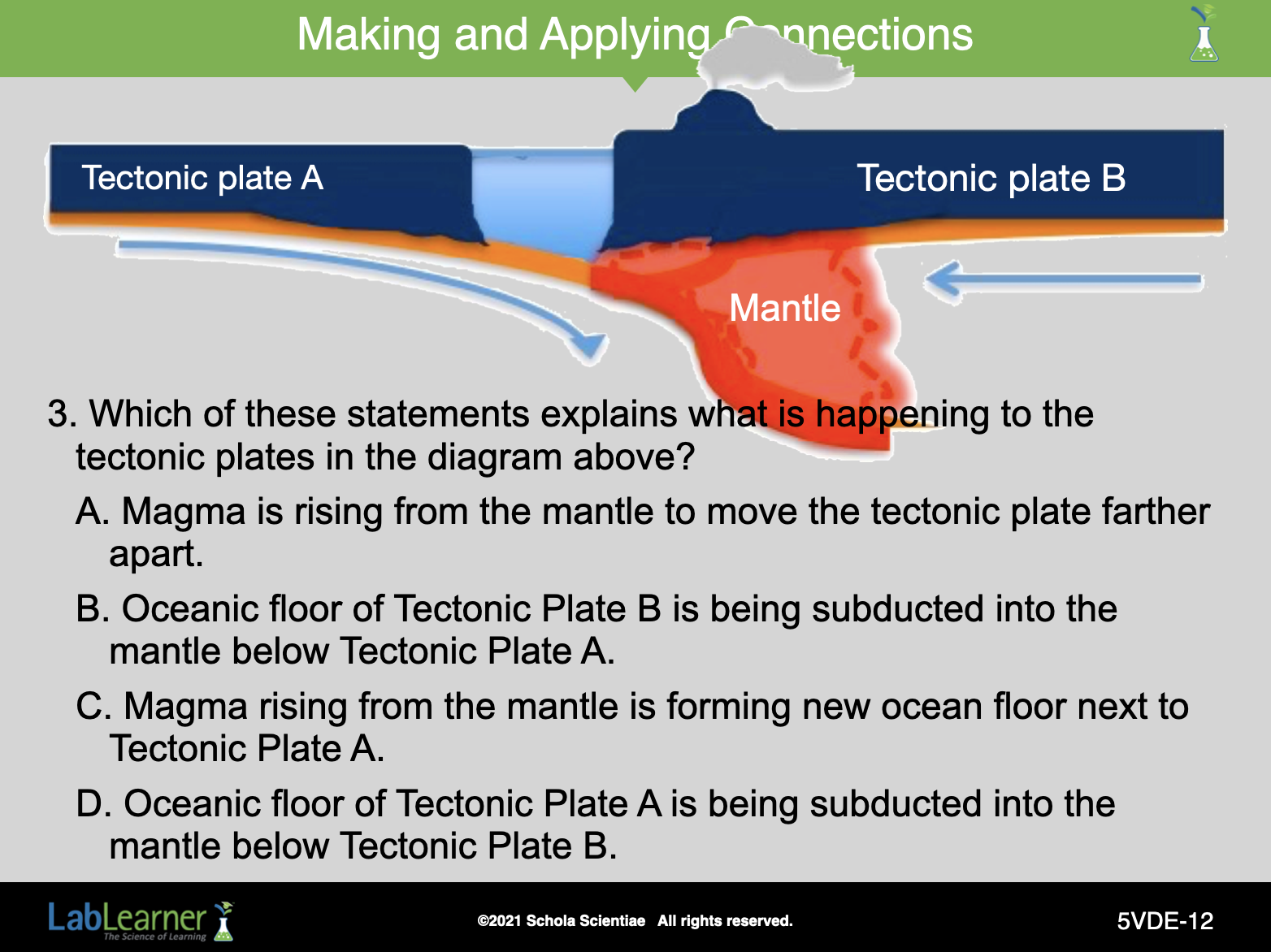
SLIDE 5VDE-12
Answer
Question 3: D
_________________________________________
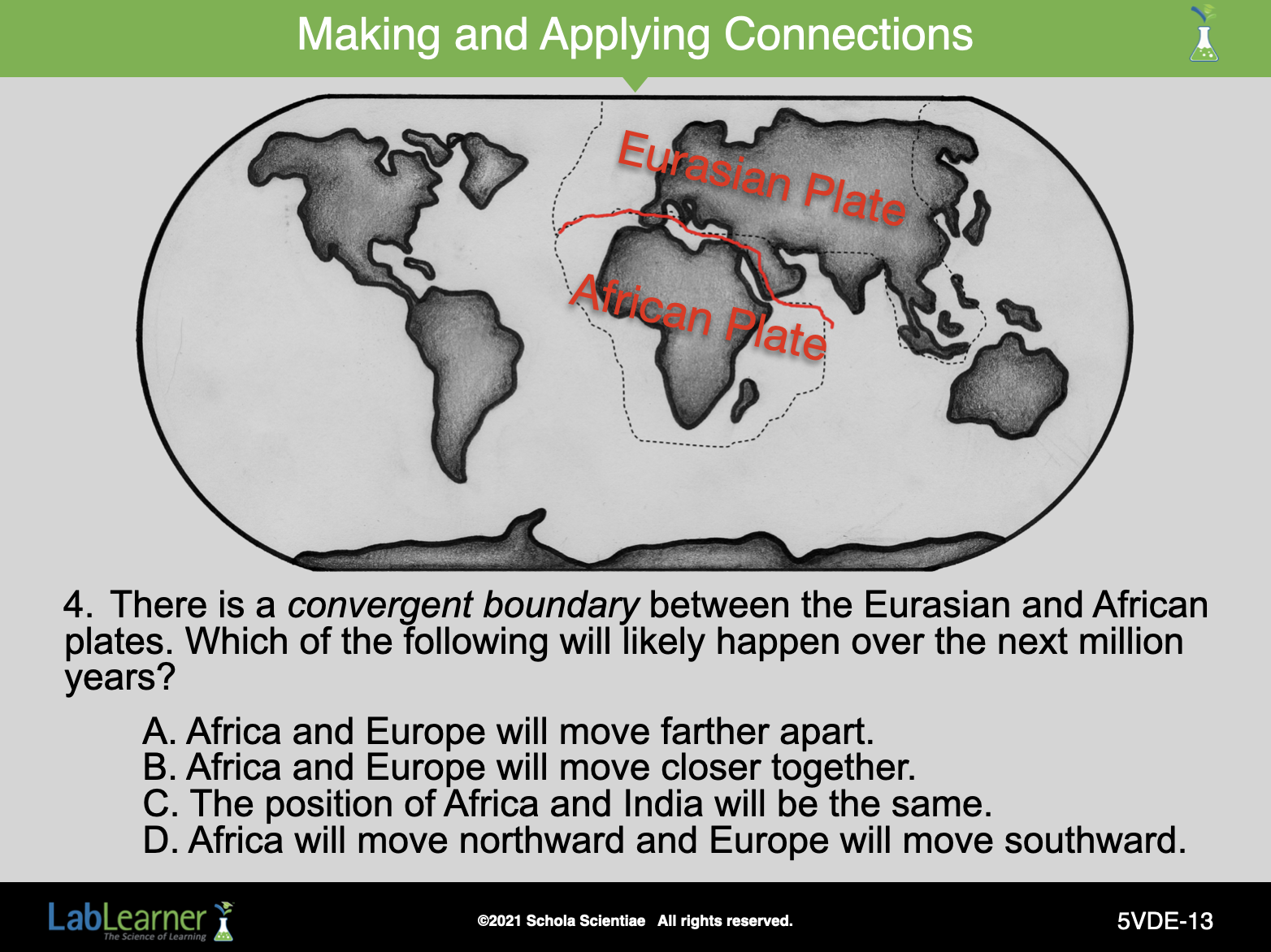
SLIDE 5VDE-13
Answers
Question 4: B
_________________________________________
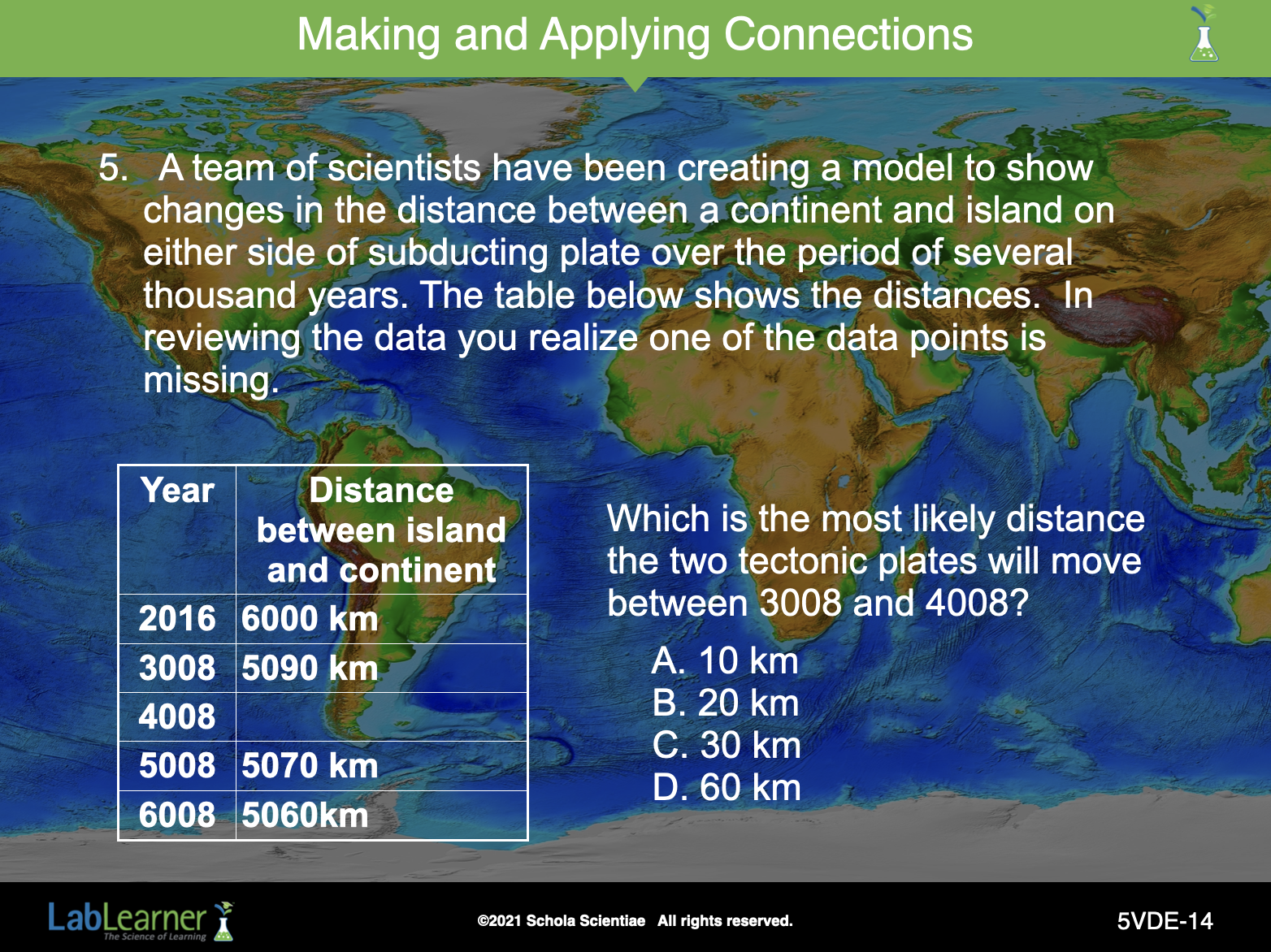
SLIDE 5VDE-14
Answers
Question 5: A
_________________________________________
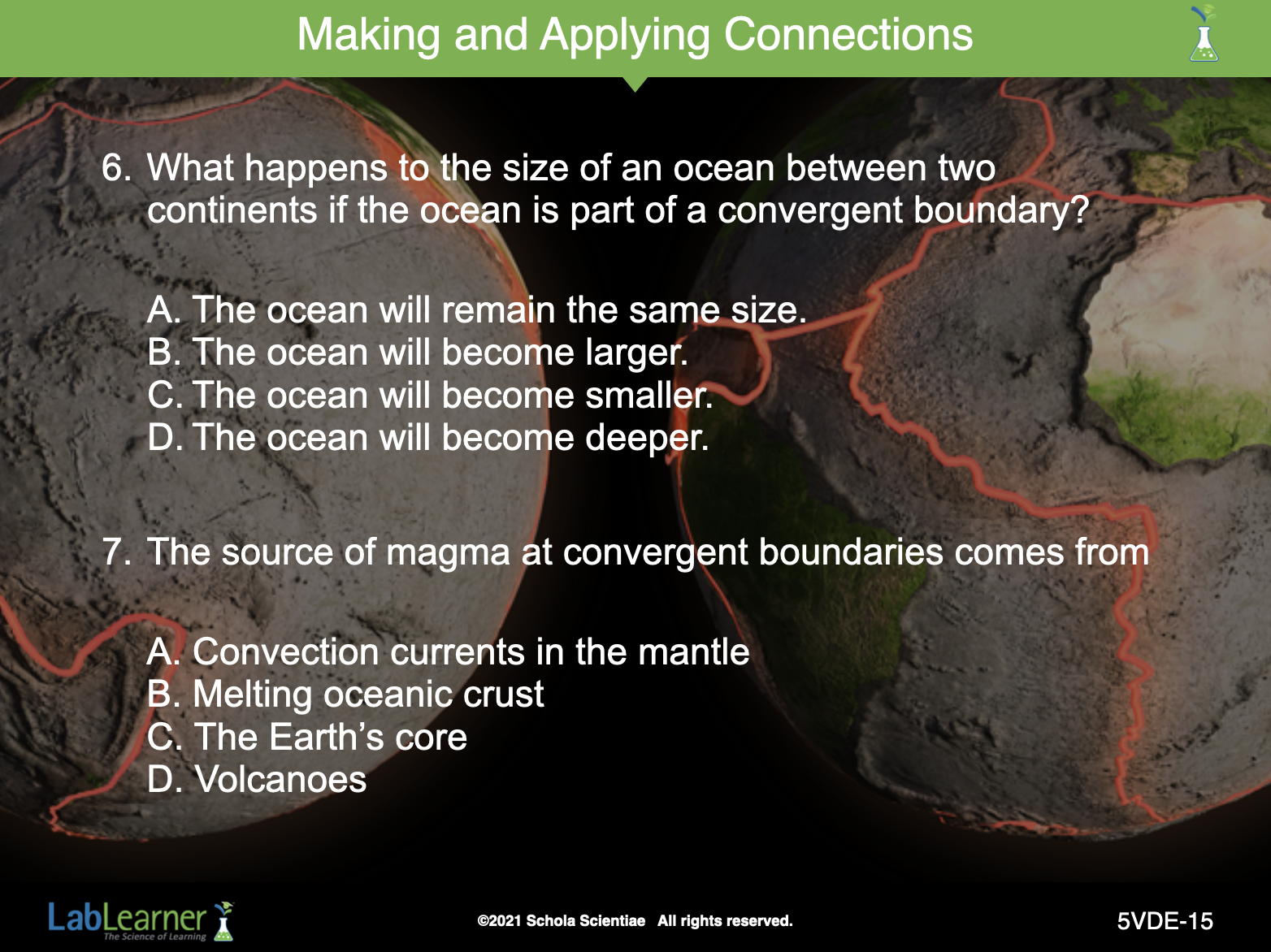
SLIDE 5VDE-15
Answers
Question 6: C
Question 7: B
_________________________________________
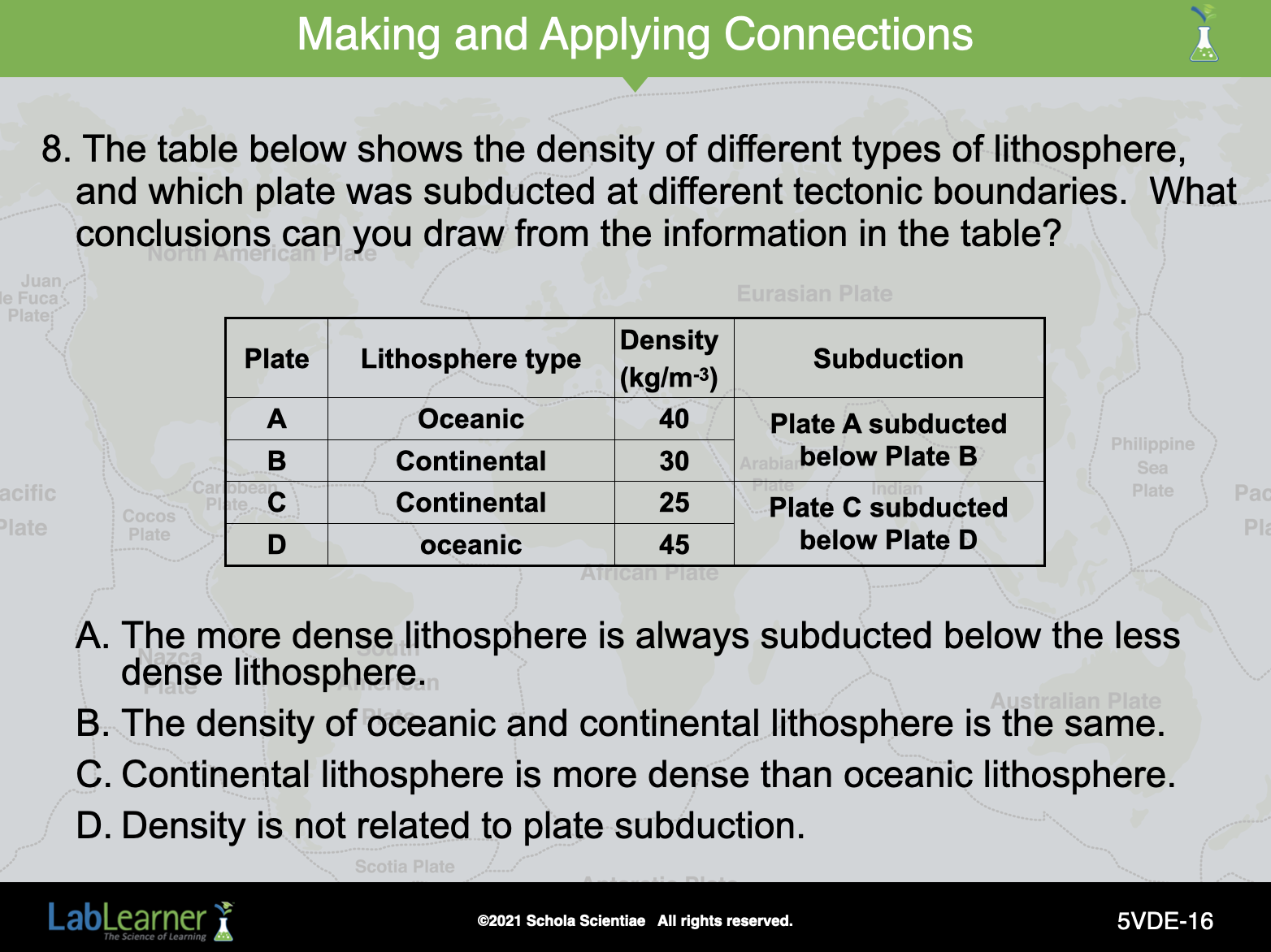
SLIDE 5VDE-16
Answers
Question 8: A