Teacher Portal:
Dynamic Earth Journey
Three: The Lithosphere, Asthenosphere, and Tectonic Plates
 PRINT IT
Use your browser to download a printable PDF as help during the slide presentation and to make additional notes. In your browser, go to File > Print and then choose to save as PDF.
NAVIGATE IT
Once the slide presentation is launched
- use your left and right arrows to advance or go back in the slide presentation, and
- hover your mouse over the left edge of the presentation to get a view of the thumbnails for all the slides so that you can quickly move anywhere in the presentation.
- Click HERE to launch the slide presentation for the CELL.
SHARE IT
SLIDE 3VDE-1
______________________________________________
SLIDE 3VDE-2
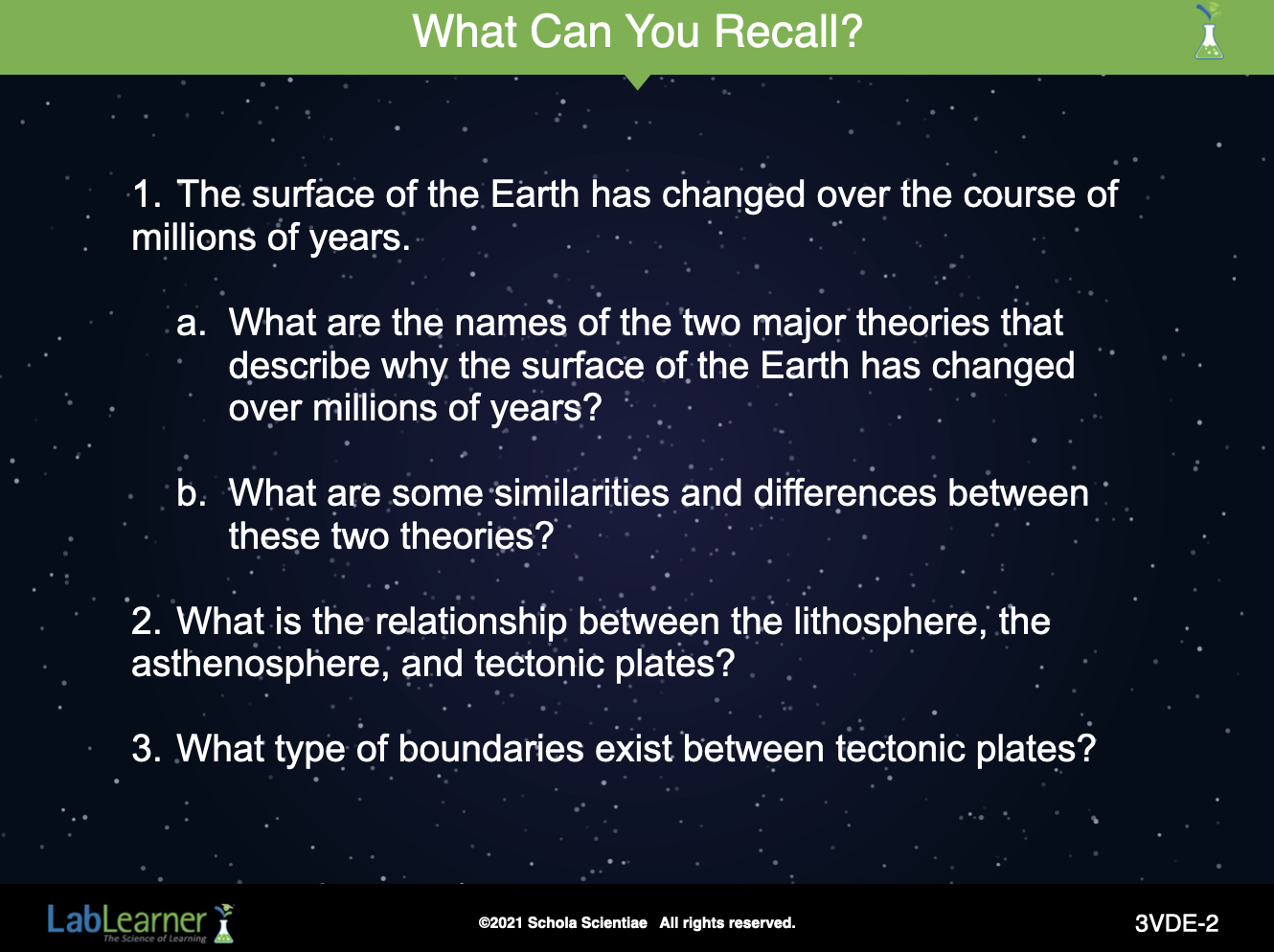
Present questions to students. Provide time for students to work in groups and then share answers as a class.
Answers to questions:
1a. Continental Drift and Plate Tectonics were the names of two of the theories that explain why the surface of the Earth has changed over millions of years.
1b. Continental Drift and Plate Tectonics both describe the movement of the continents over the history of the Earth. They both propose that the Earth looks different today than it has in the past. Continental drift asserts that the continents moved over the oceans but does not provide information about the force that moves the continents. Plate tectonics suggests that there are plates or sections of the lithosphere that float on top of the asthenosphere. The plate can contain oceans and continents. Plate tectonics suggests that currents in the asthenosphere provide the force that moves the tectonic plates.
2. The lithosphere is the solid portion of the crust and mantle that floats on top of the asthenosphere, one of the liquid parts of the mantle. Tectonic plates are slabs or sections of the lithosphere that float on the asthenosphere.
3. There are convergent, divergent, and transform boundaries between tectonic plates. At convergent boundaries, plates are moving together. At divergent boundaries, plates are moving apart. At transform boundaries, plates are sliding past one another.
______________________________________________
SLIDE 3VDE-3
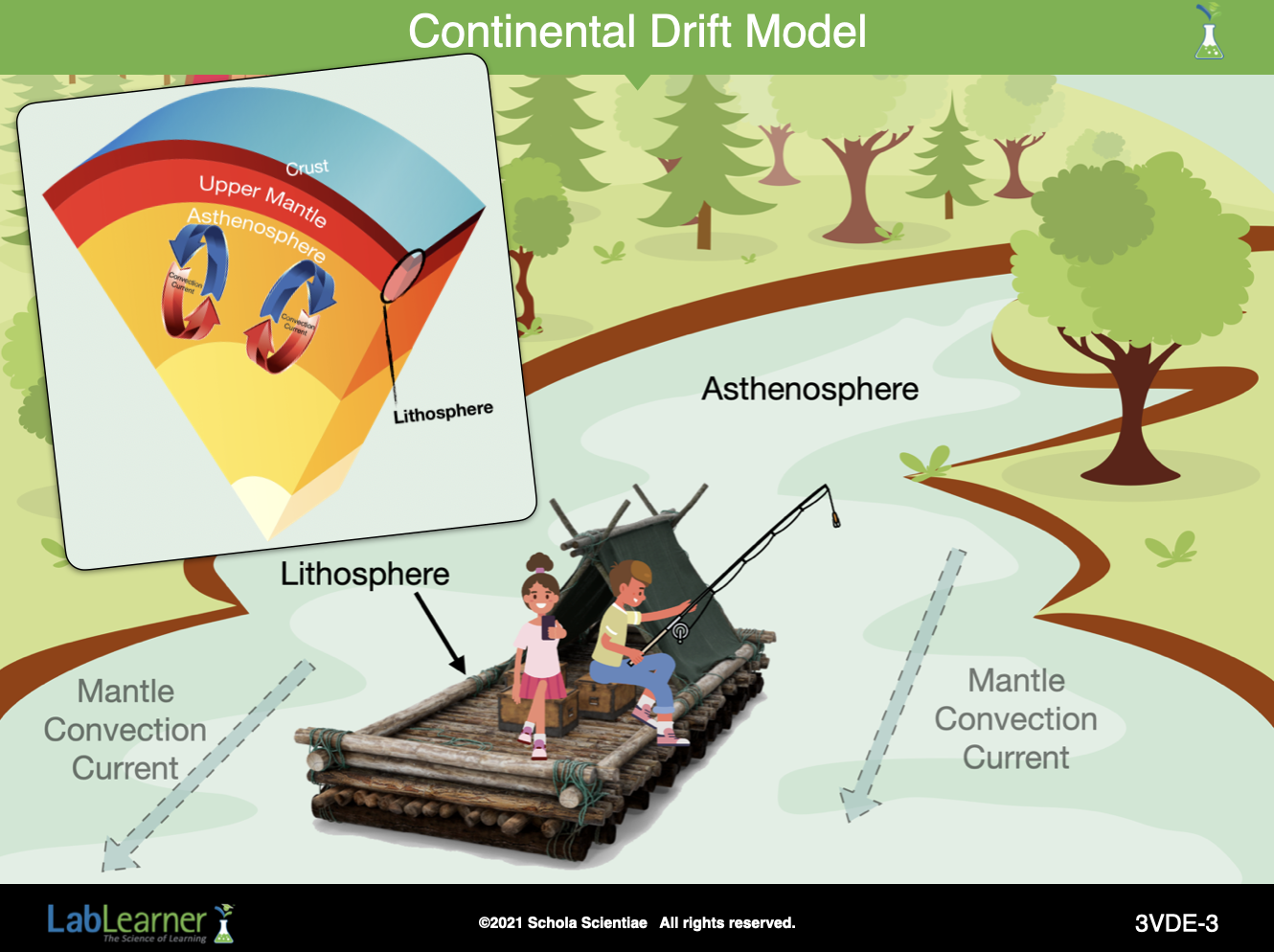
This cartoon slide presents a simple model of how the lithosphere (the raft) floats atop the asthenosphere (the surface of the river).
The Lithosphere moves along with the current caused by convection currents deeper beneath the asthenosphere in the liquid portion of the mantle.
In terms of Continental Drift, the raft represents a continent slowing moving along in the direction of the underlying mantle convection current.
______________________________________________
SLIDE 3VDE-4
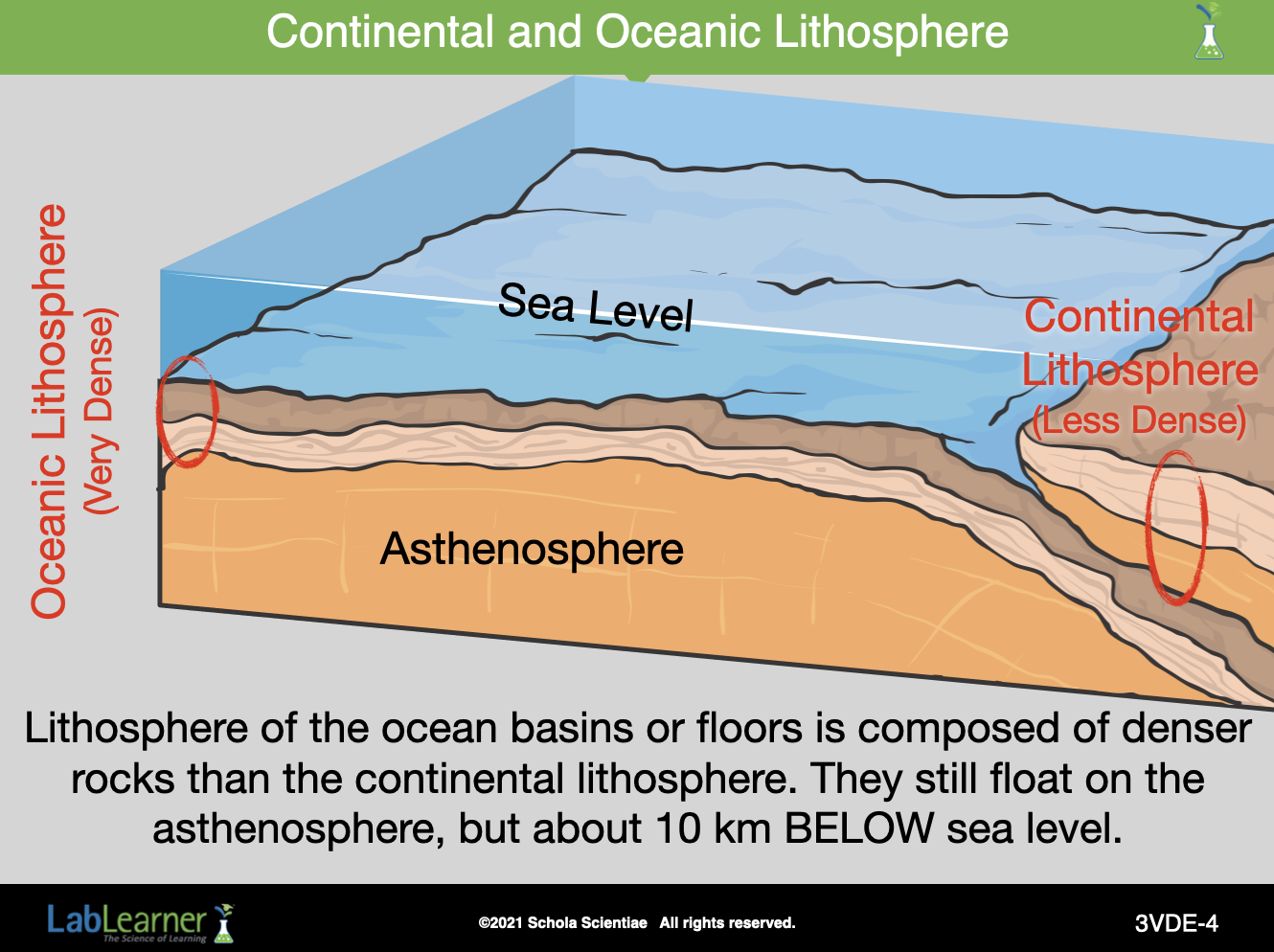
The theory of Plate Tectonics suggests that the surface of the Earth is made up of plates or slabs of lithosphere that float on the asthenosphere, a molten, semi-solid portion of the Earth’s mantle.
Plate Tectonics suggests that convection currents in the asthenosphere drive the movement of the tectonic plates. But, exactly how does this happen?
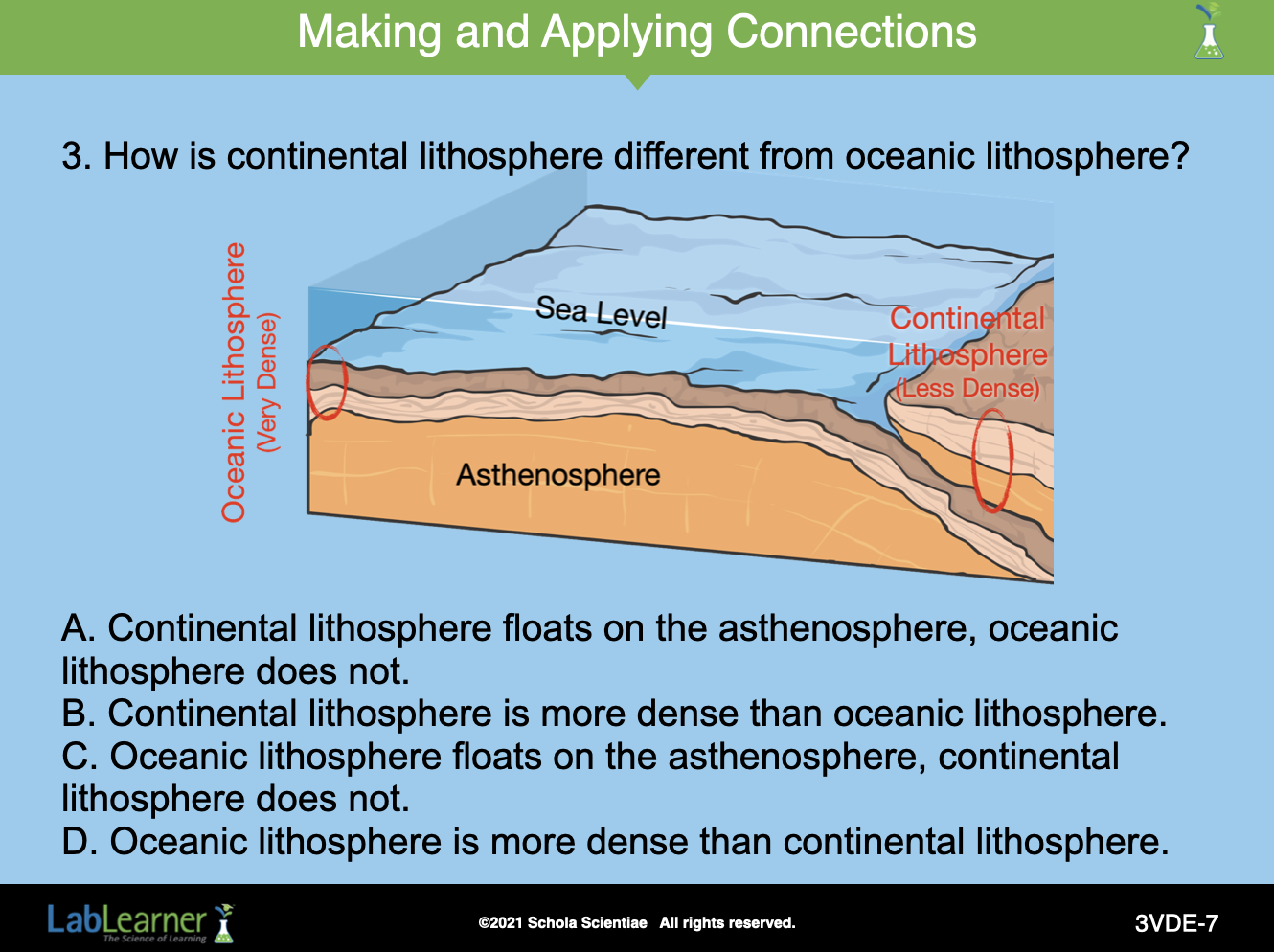
A tectonic plate generally consists of both continental lithosphere which floats just above sea level and oceanic lithosphere which floats below sea level.
Ask students: Why do you think continental lithosphere floats above sea level and oceanic lithosphere floats below sea level? (Allow students times to suggest reasons for differences.)
The answer lies in the composition of continental and oceanic lithosphere. Both are composed of a high percentage of igneous rock. However, they are composed of different types of igneous rock.
The continental lithosphere is composed of granite which is less dense than basalt, the igneous rock that composes the oceanic lithosphere.
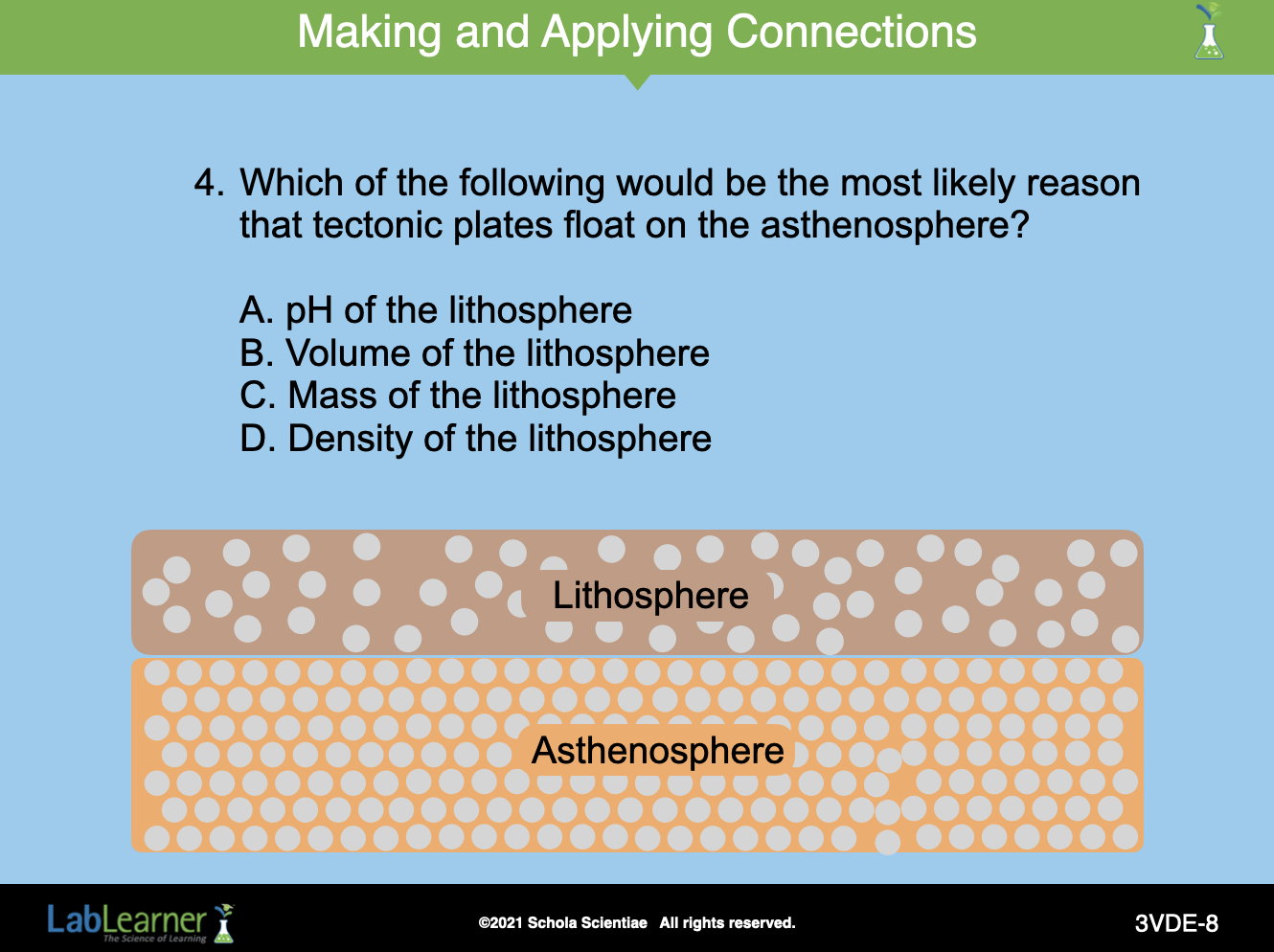
Both continental and oceanic lithosphere is less dense than the asthenosphere. Therefore they both float on the asthenosphere rather than sinking below it into the mantle.
However, basalt and therefore oceanic lithosphere is more dense than granite (continental lithosphere). Therefore, the oceanic lithosphere (ocean floor) floats below sea level but the continental lithosphere tends to stay above sea level.
______________________________________________
SLIDE 3VDE-5
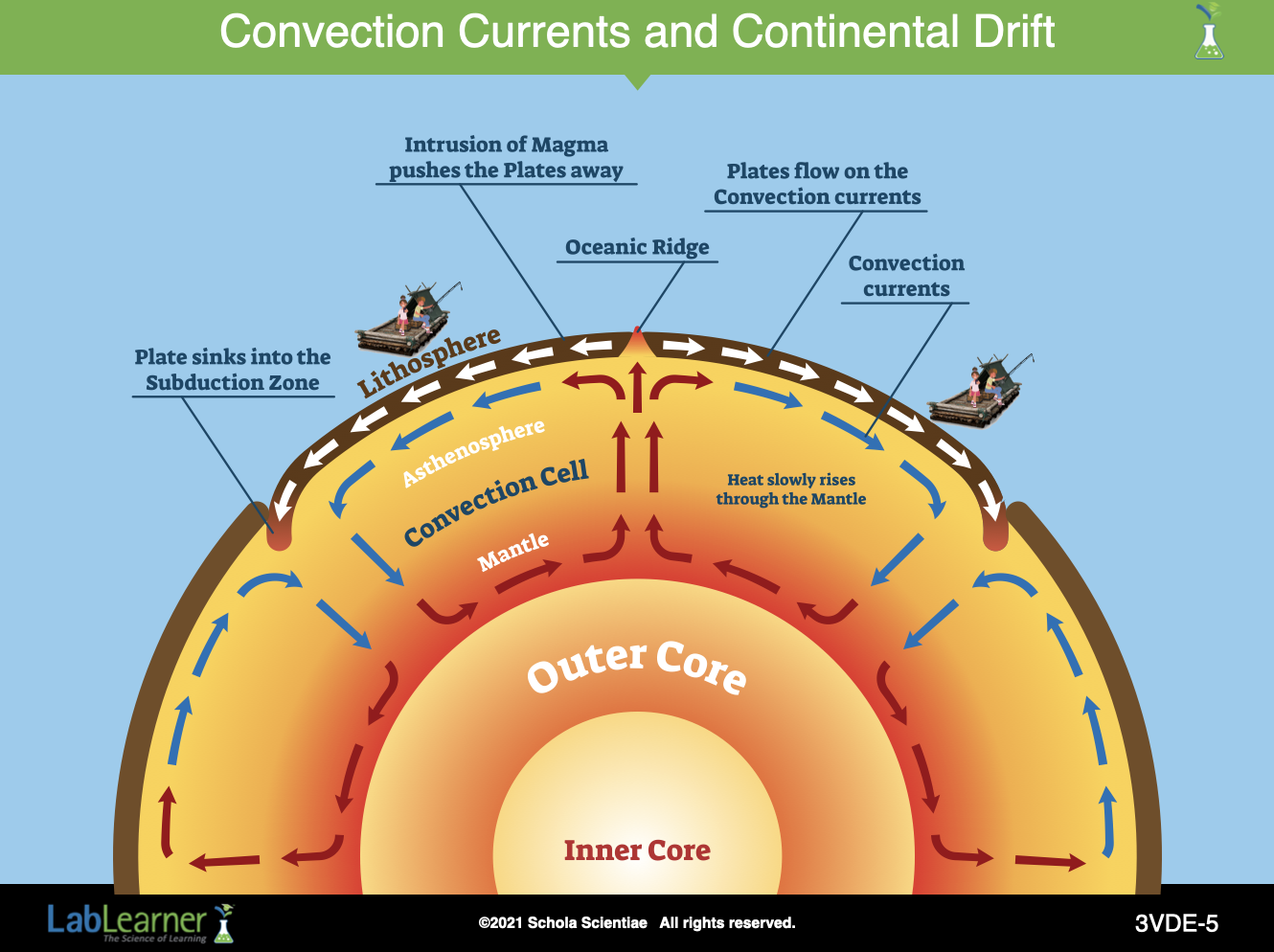
This slide demonstrates how/why contestants drift because of the convection currents in the liquid mantle:
- The heat from the Earth’s core is transferred to the asthenosphere, heating it.
- The warmer molten rock rises to the top layer which is cooled by contact with the lithosphere.
- This cooler, but still liquid, rock sinks back down into deeper sections of the asthenosphere and the cycle begins again.
- This cycle of heating and cooling creates convection currents in the asthenosphere.
- Notice we have added the raft in reference to the model river analogy from slide #3. It is moving along with the convection current along with the rest of the lithosphere.
______________________________________________
SLIDE 3VDE-6
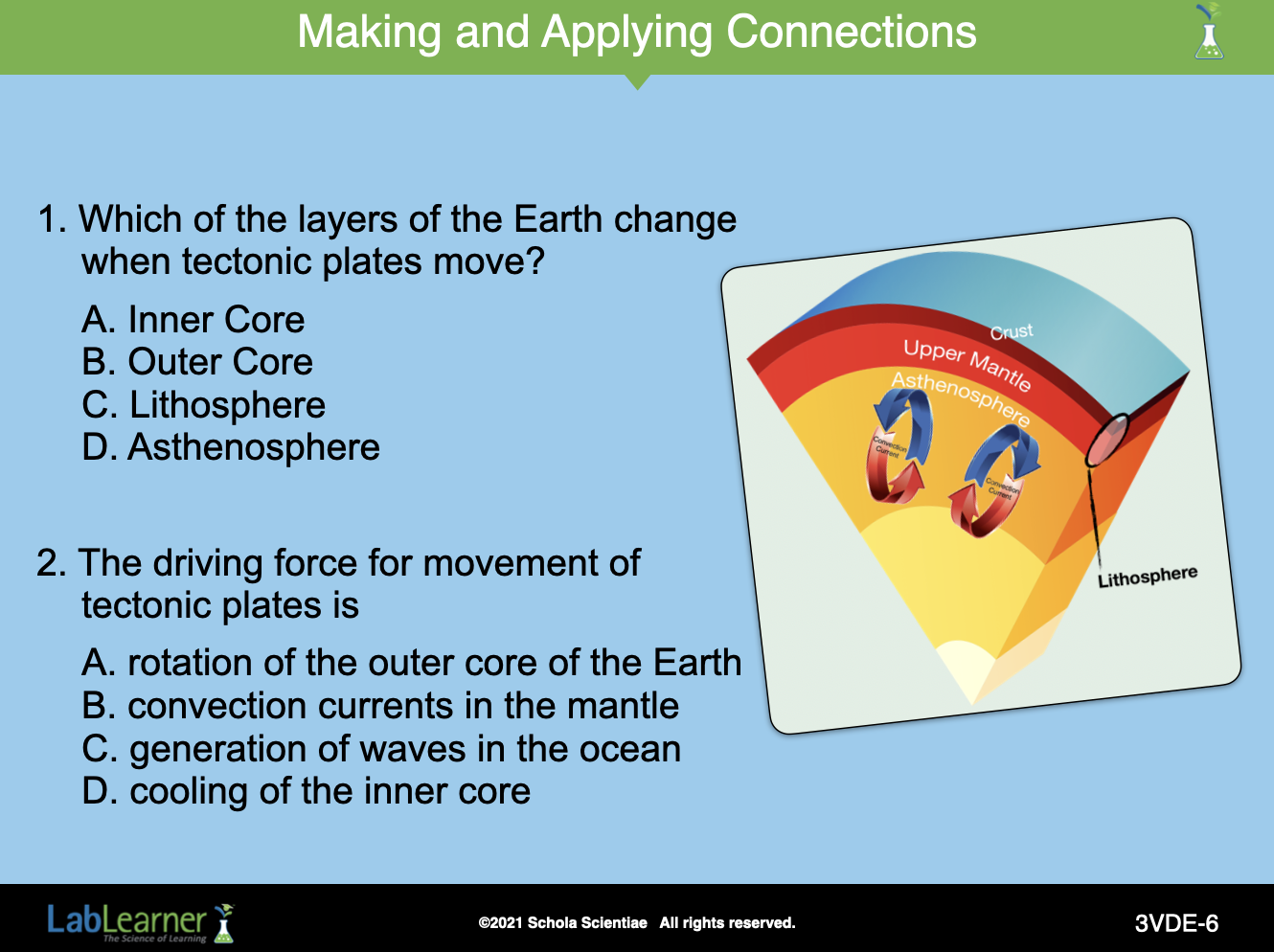
Answers
Question 1: C
Question 2: B
______________________________________________
SLIDE 3VDE-7
Answer
Question 3: D
______________________________________________
SLIDE 3VDE-8
Answers
Question 4: D