
Teacher Portal:
Dynamic Earth Journey
Two: Plate Tectonics Theory
 PRINT IT
Use your browser to download a printable PDF as help during the slide presentation and to make additional notes. In your browser, go to File > Print and then choose to save as PDF.
NAVIGATE IT
Once the slide presentation is launched
- use your left and right arrows to advance or go back in the slide presentation, and
- hover your mouse over the left edge of the presentation to get a view of the thumbnails for all the slides so that you can quickly move anywhere in the presentation.
- Click HERE to launch the slide presentation for the CELL.
SHARE IT
SLIDE 2VDE-1
______________________________________________
SLIDE 2VDE-2
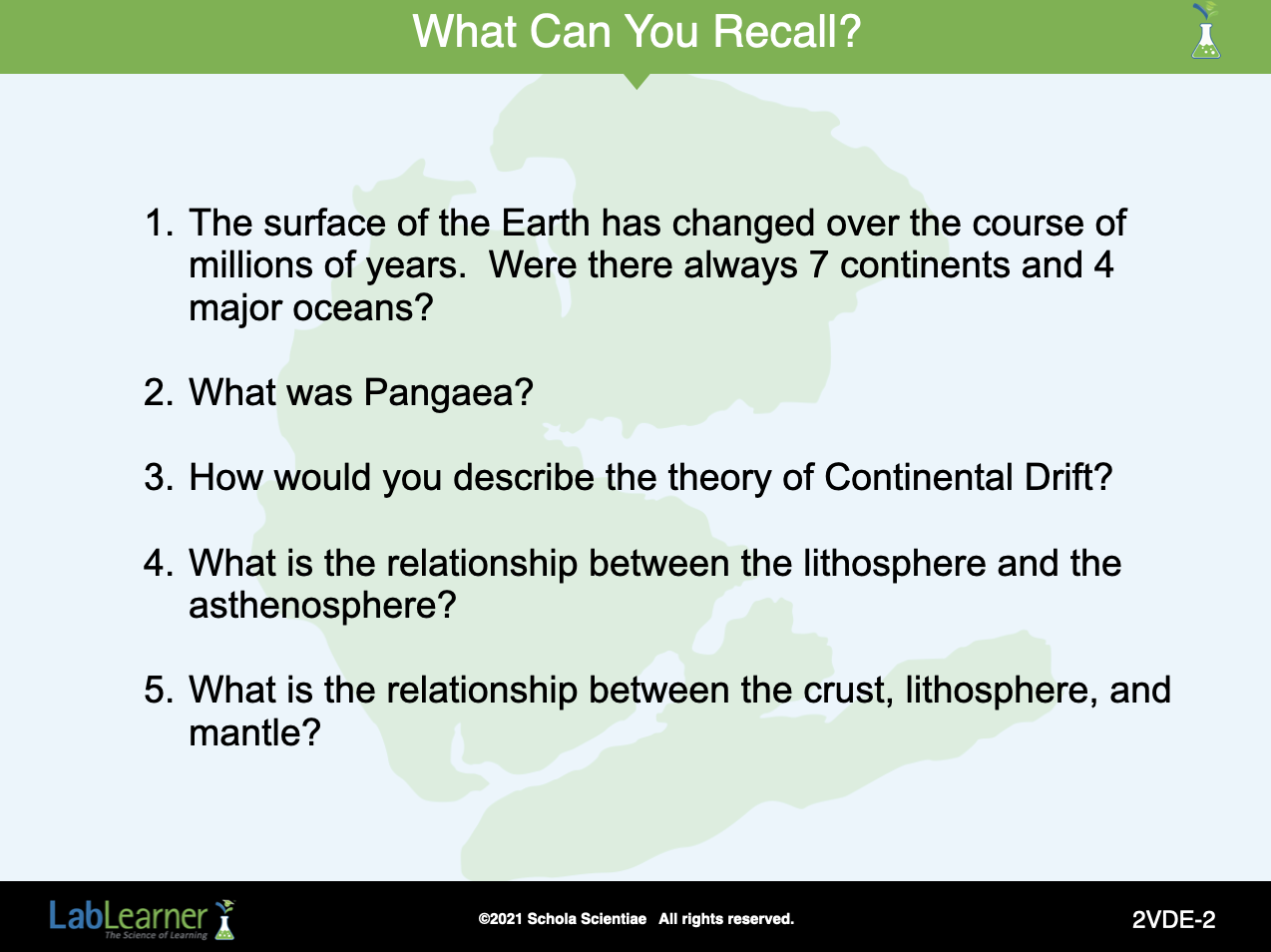
Present questions to students. Provide time for students to work in groups and then share answers as a class.
Answers to questions:
1. Seven continents and four major oceans did not always exist on the surface of the planet. Over the course of the Earth’s billion-year history, the surface of the Earth changed. At some points in time, there was only one or several continents and oceans. The seven major continents and four oceans have occurred during the “modern” history of the Earth.
2. Pangaea was super-continent that existed about 237 million years ago. Scientist believe that the break-up of Pangaea ultimately resulted in the 7 continents on the current surface of the Earth.
3. The theory of Continental Drift stated that the continents floated on the surface of the Earth and were not always in their current position. Over the history of the Earth, the continents moved or drifted over the surface of the Earth to their current position.
4. The lithosphere is the layer of solid mantle and crust that lies on top of the asthenosphere. The asthenosphere is the layer of molten (liquid) rock that lies below the lithosphere.
5. The lithosphere is composed of the crust and the solid layer of the mantle.
______________________________________________
SLIDE 2VDE-3
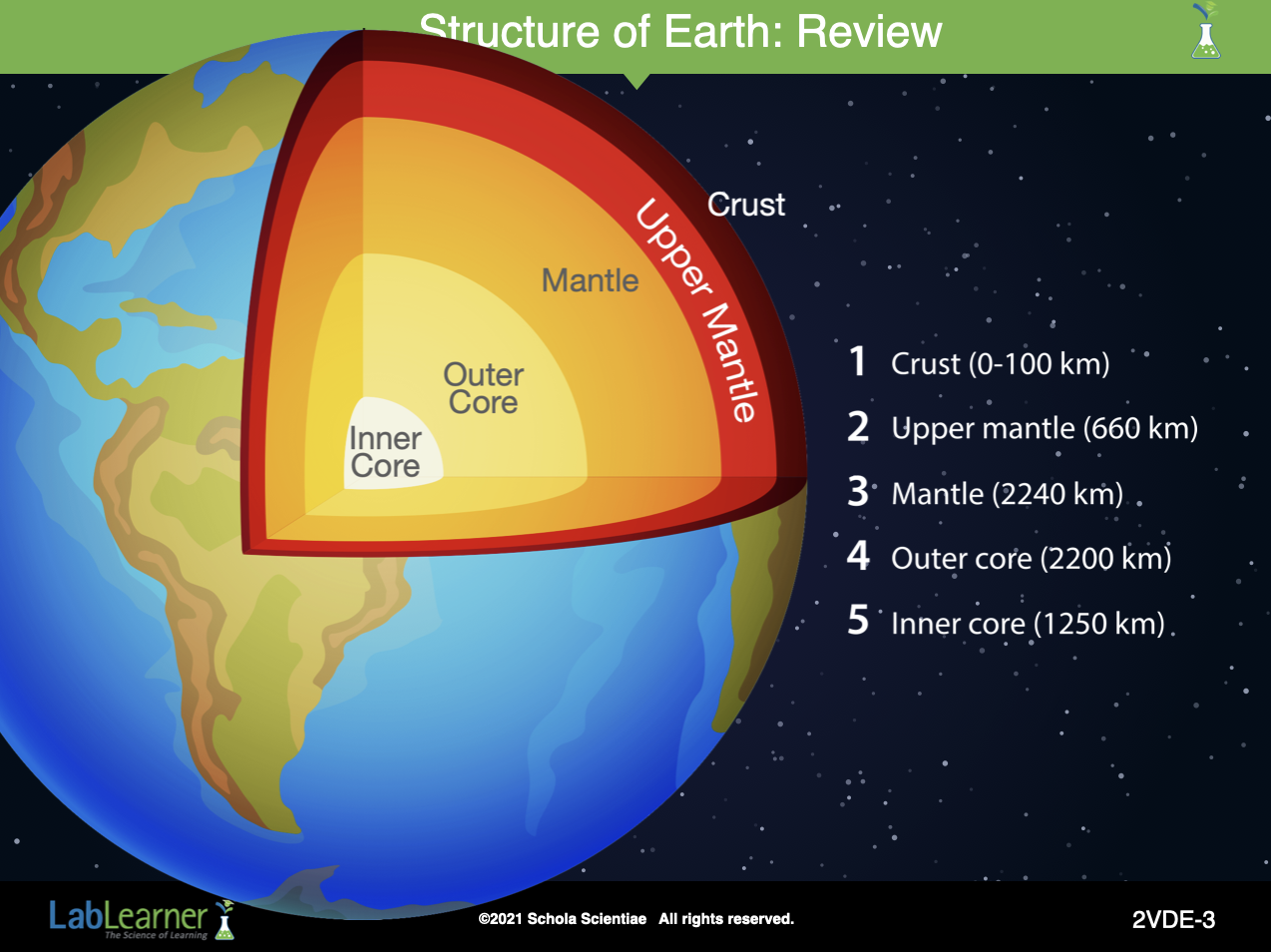
This slide is for a quick review of the layers in the interior of Earth.
______________________________________________
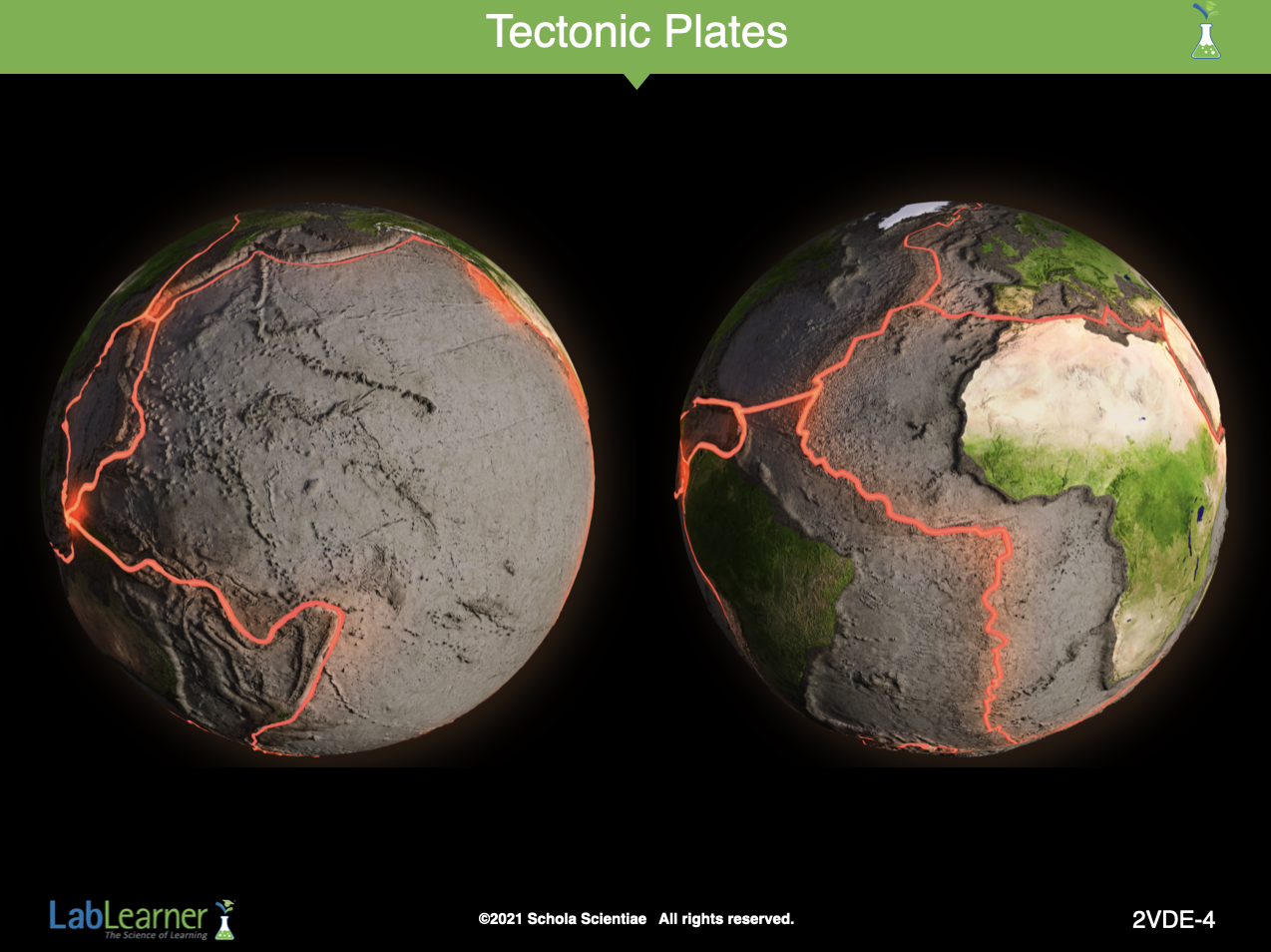
SLIDE 2VDE-4
This slide simply shows the tectonic plates in three dimensions on the globe.
The red lines hint at the intense volcanic activity, both on land and under the oceans, at the plate bounties (where the plates meet).
______________________________________________
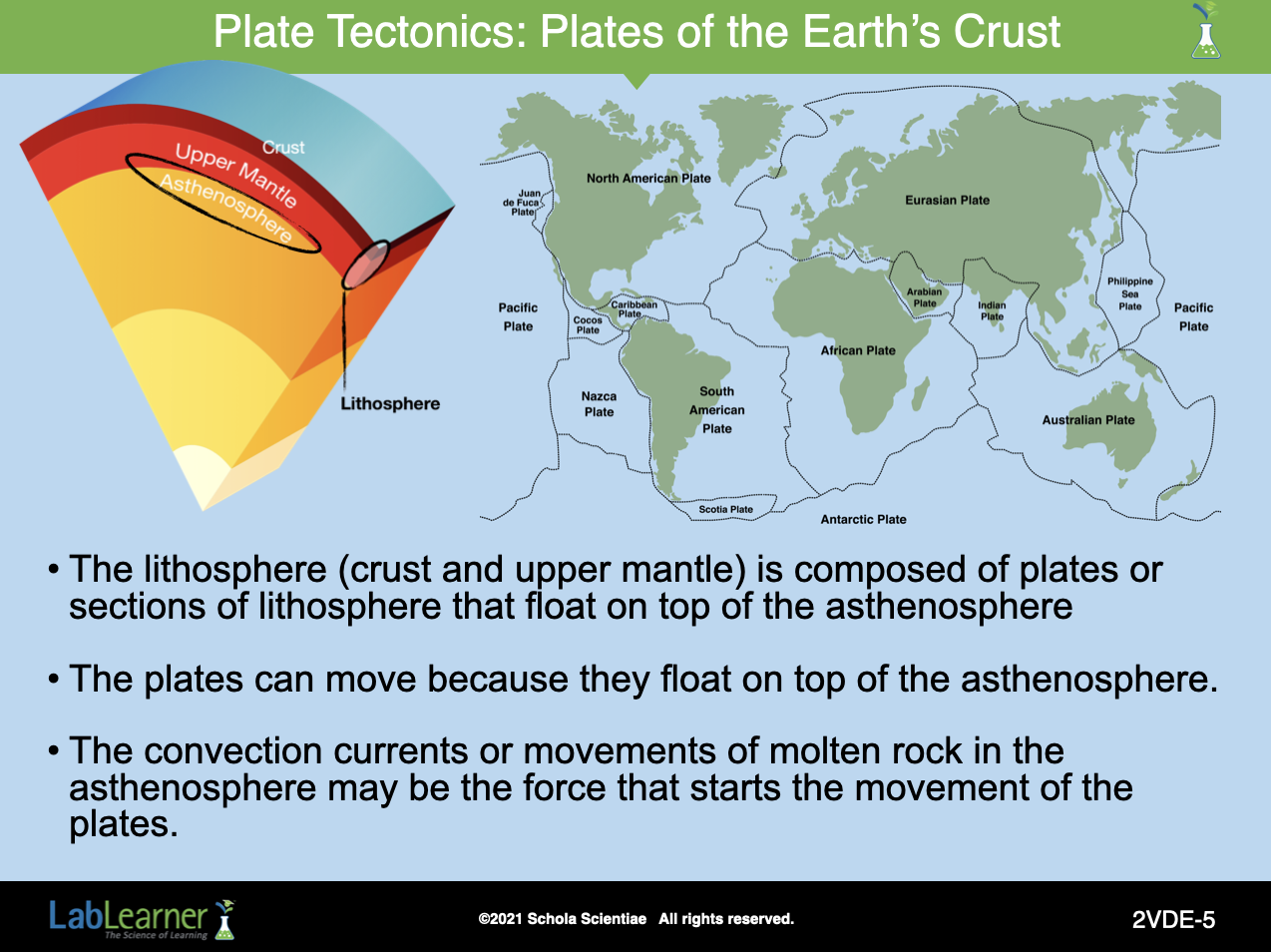
SLIDE 2VDE-5
Note to Teacher:
In the 1960’s several scientists re-visited Alfred Wegener’s theory of Continental Drift. Two of these scientist were Harry Hess and R. Deitz.
Hess and Deitz used sonar readings of the ocean floor, magnetic readings of the ocean floor and observation of where ocean trenches and islands were as evidence for their theory.
The one thing that their theory did that Alfred Wegener’s did not was provide a source of the force that was able to “move” the continents. They suggested that the source of force was convection currents of molten rock in the asthenosphere.
Note: Currently in the field of plate tectonics there is debate as to whether the convection current in the asthenosphere is the sole driving force or whether other forces are at work. This continues to be an area of research.
Their theory became known as Plate Tectonics.
- The term plate was used to describe a slab of rocks.
- The term tectonics comes from the Greek root “to build”.
Plate tectonics, therefore, refers to how the Earth’s surface is built on plates.
The map on this slide shows the different tectonic plates that exist today. Note that the plates do not correspond exactly to continents. Rather they may include both continents and oceans and in some cases their boundaries may cut across continents.
Scientists have identified 7 major plates: the African, North American, South American, Eurasian, Australian, Antarctic, and Pacific plates. Several minor plates also exist, including the Arabian, Nazca, and Philippines plates.
______________________________________________
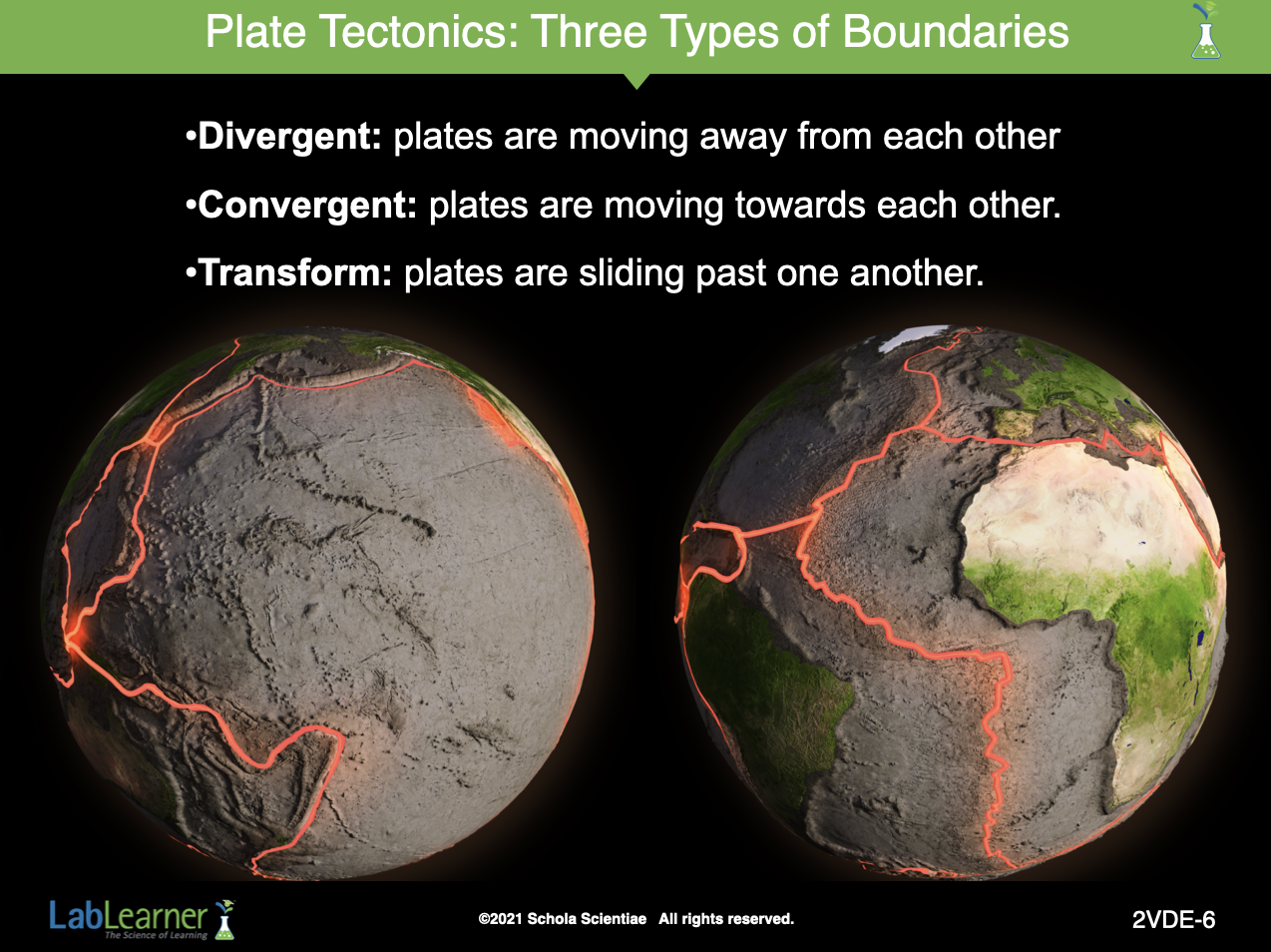
SLIDE 2VDE-6
This slide shows a map of the World with the tectonic plates indicated. The terms Divergent, Convergent, and Transform describe how two tectonic plates move in relation to each other.
There are three basic types of movements:
Divergent: This is a boundary where the plates are being pulled away from each other. We will look at a good example of a divergent boundary that runs across Iceland shortly.
Convergent: This is a boundary where two tectonic plates are moving towards each other. In an earlier slide, we saw how India moved north and ran into the Eurasian plate, forming the Himalayan mountains. This is an example of a convergent boundary.
Transform: This is a tectonic boundary where two plates slide past one another. A good example of this type of boundary is the San Andreas Fault in California.
We will discuss the three types of tectonic boundaries in much more detail in future slides in the Dynamic Earth Journey.
______________________________________________
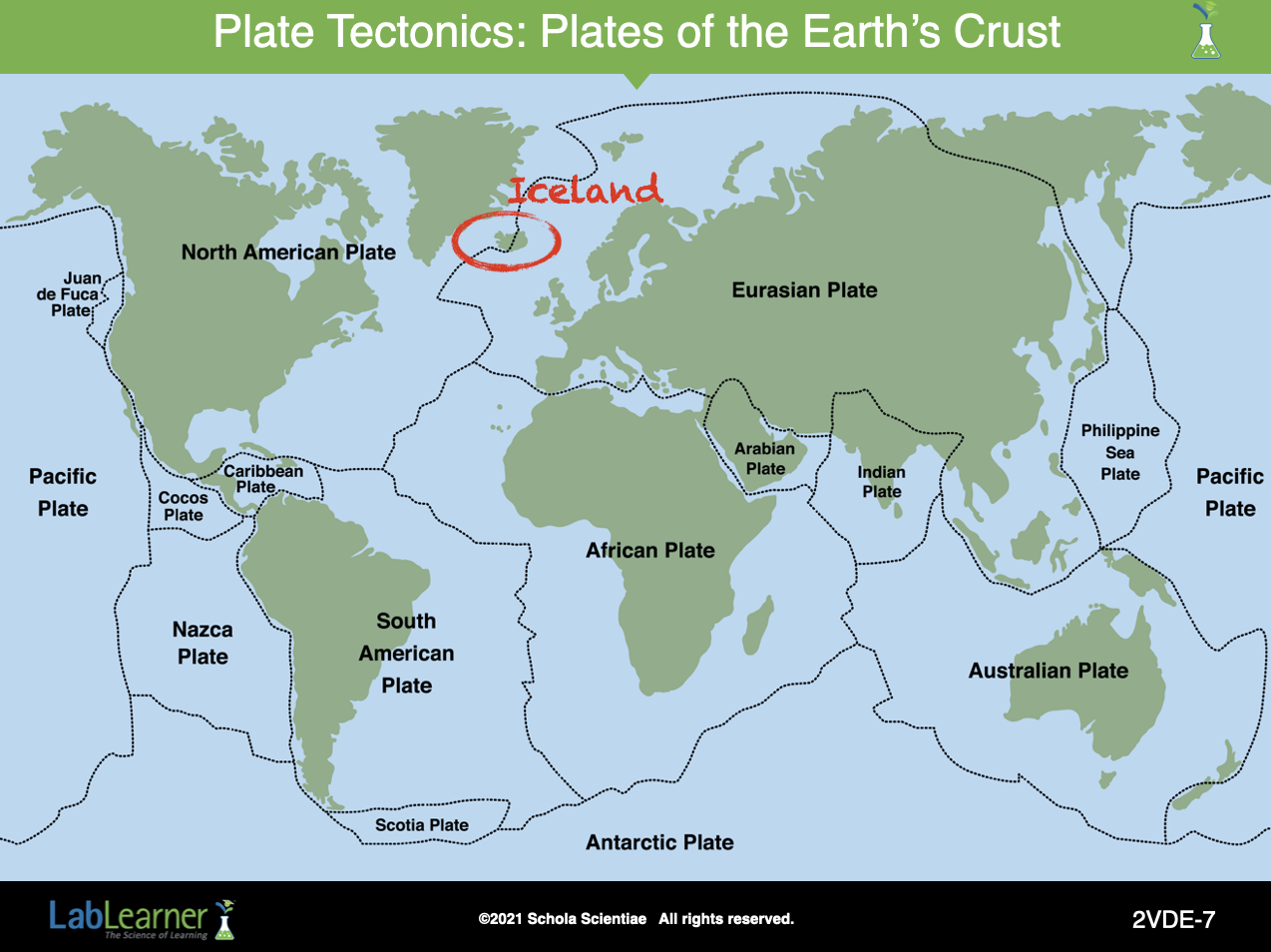
SLIDE 2VDE-7
This slide shows an enlarged map of the World with the tectonic plates indicated. Notice that Iceland is identified on the map. Also, notice that one of the tectonic boundaries (the one where the North American and Eurasian plates meet) runs right through Iceland. This is a divergent boundary.
We will look at this boundary much more closely on the next two slides.
______________________________________________
SLIDE 2VDE-8
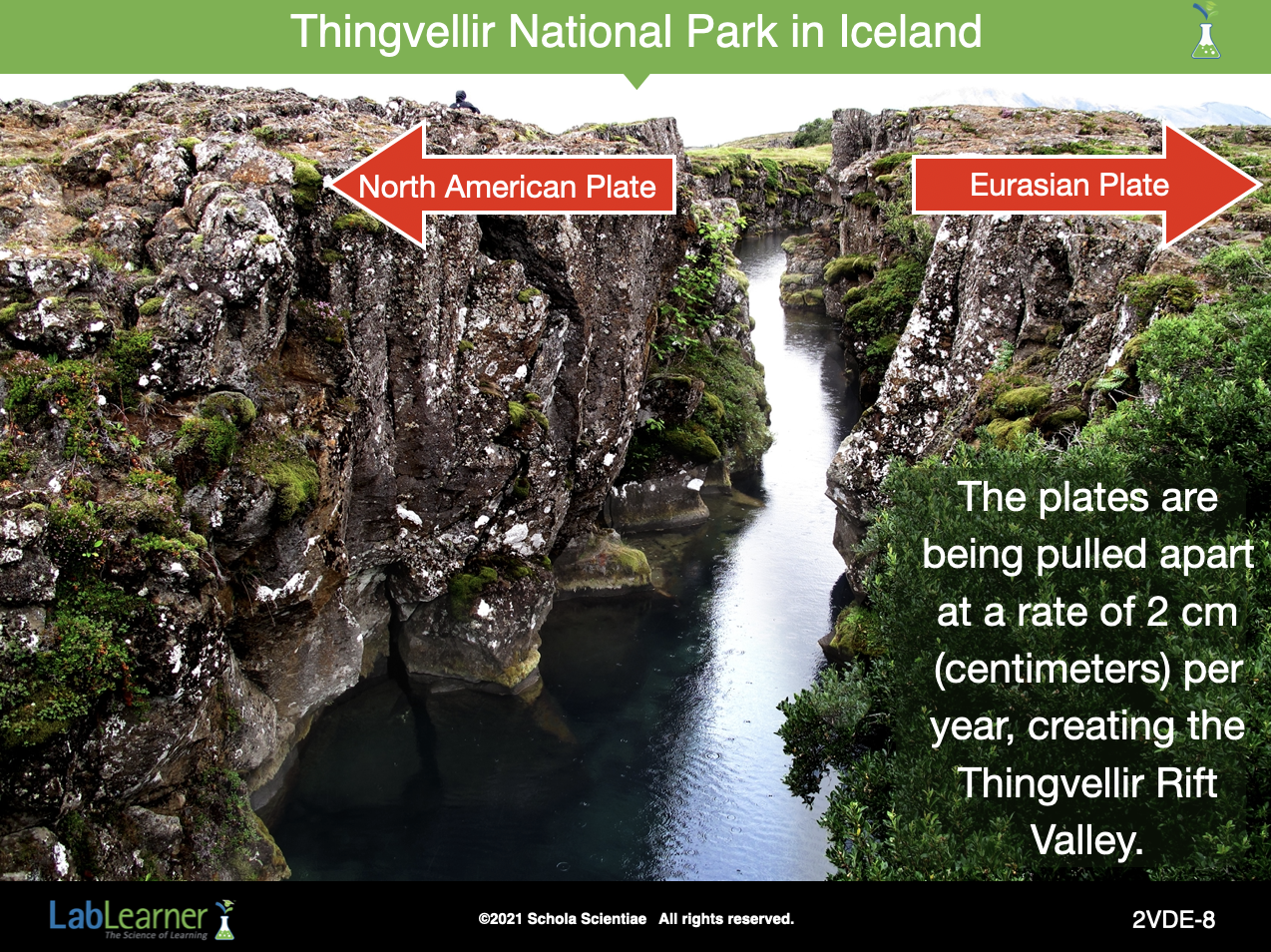
This is a photograph of the precise spot in Iceland where the North American and the Eurasian Plates meet.
This is an example of a divergent boundary. A divergent boundary is where two tectonic plates are pulling away from each other.
______________________________________________
SLIDE 2VDE-9
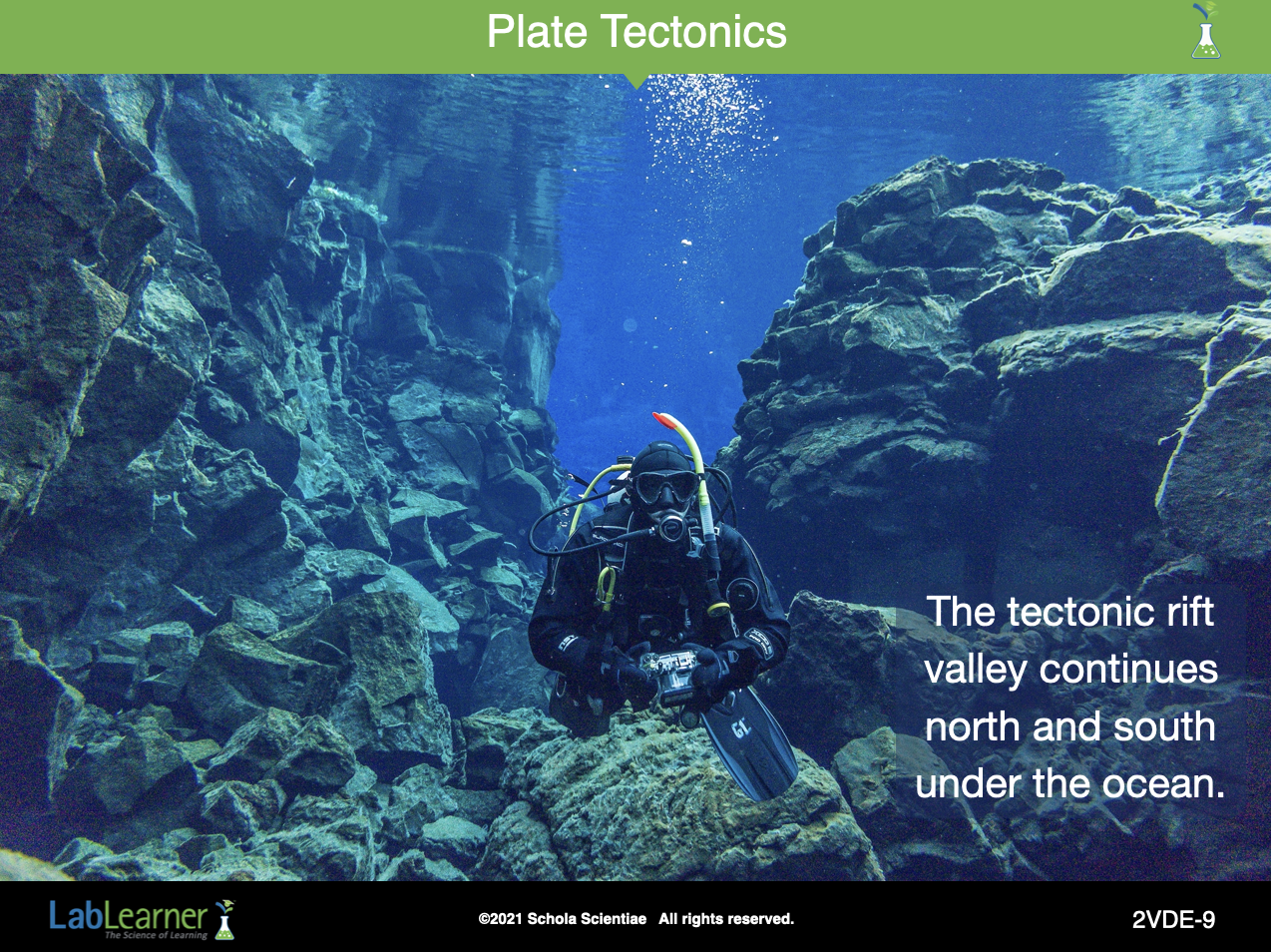
This photograph was taken just off the Icelandic coast. It shows how the rift valley between the North American and Eurasian tectonic plates extends under the ocean’s surface.
In fact, this boundary extends many thousands of kilometers down the center of the Atlantic Ocean.
______________________________________________
SLIDE 2VDE-10
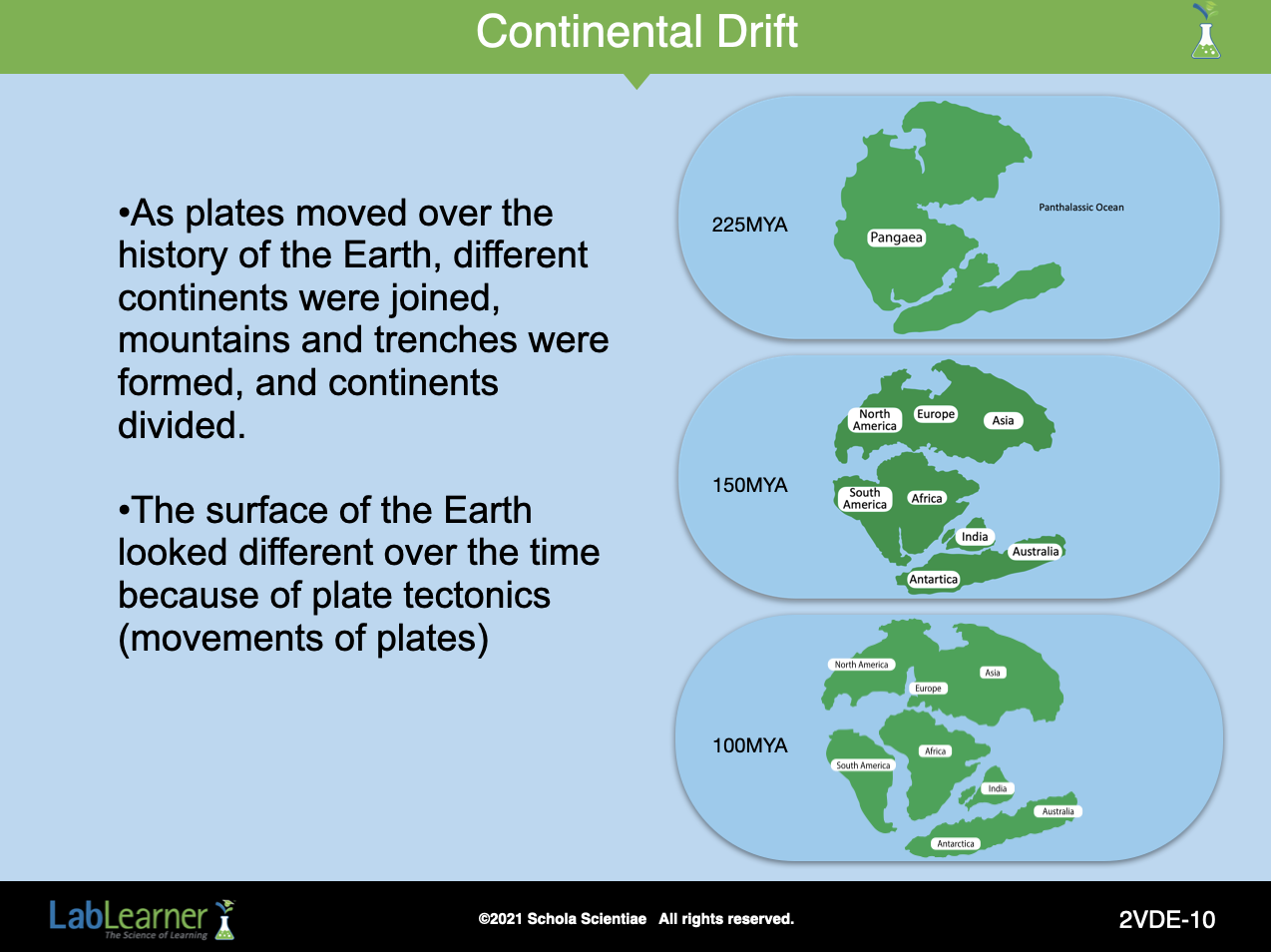
Explain that the movement of tectonic plates is thought to be involved in the movement and rearrangement of the continents and oceans discussed earlier.
Thus, Plate Tectonics provides a mechanism for the idea of Continental Drift.
______________________________________________
SLIDE 2VDE-11
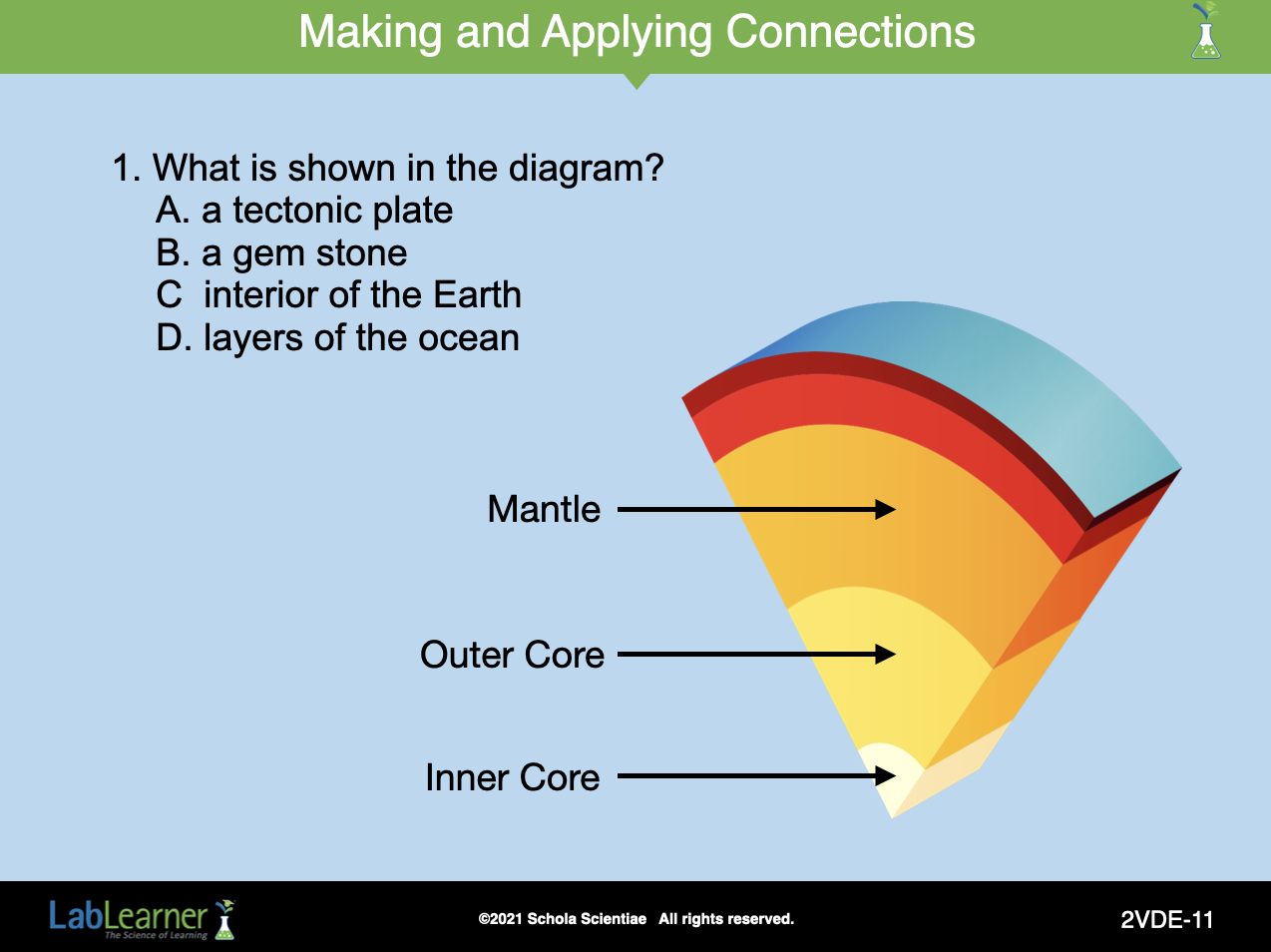
Answer
Question 1: C
______________________________________________
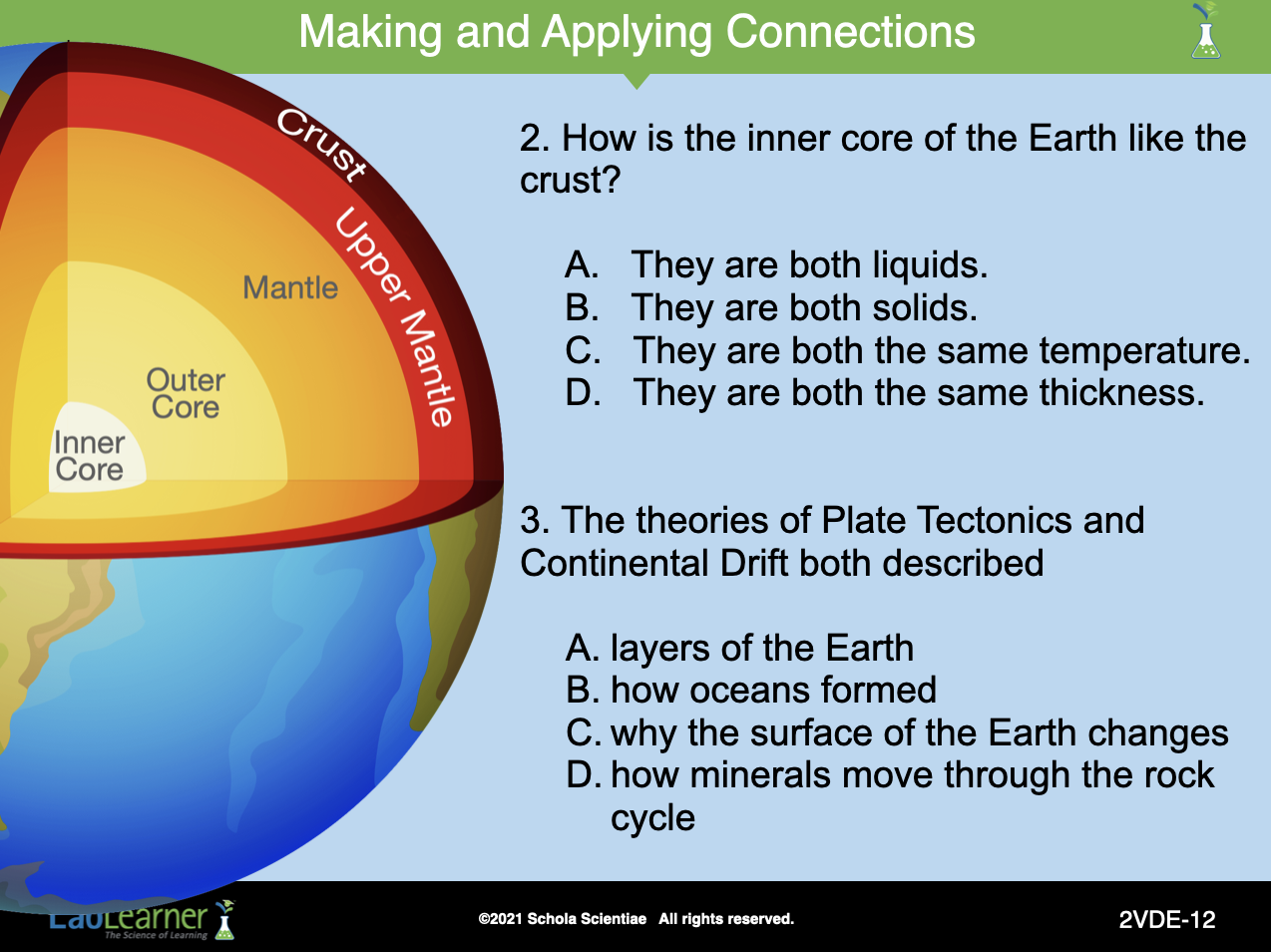
SLIDE 2VDE-12
Answers
Question 2: B
Question 3: C
______________________________________________
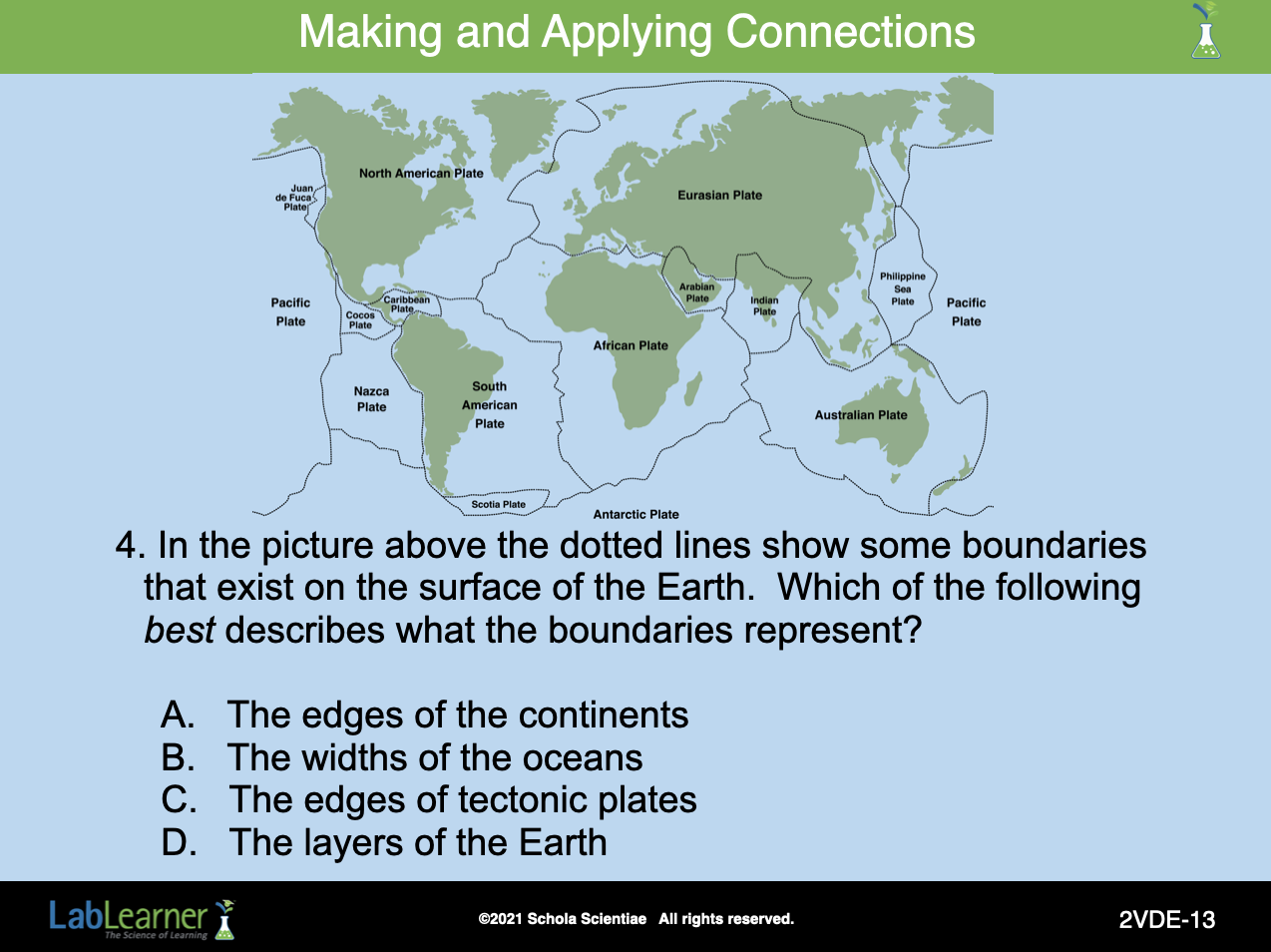
SLIDE 2VDE-13
Answer
Question 4: C
______________________________________________
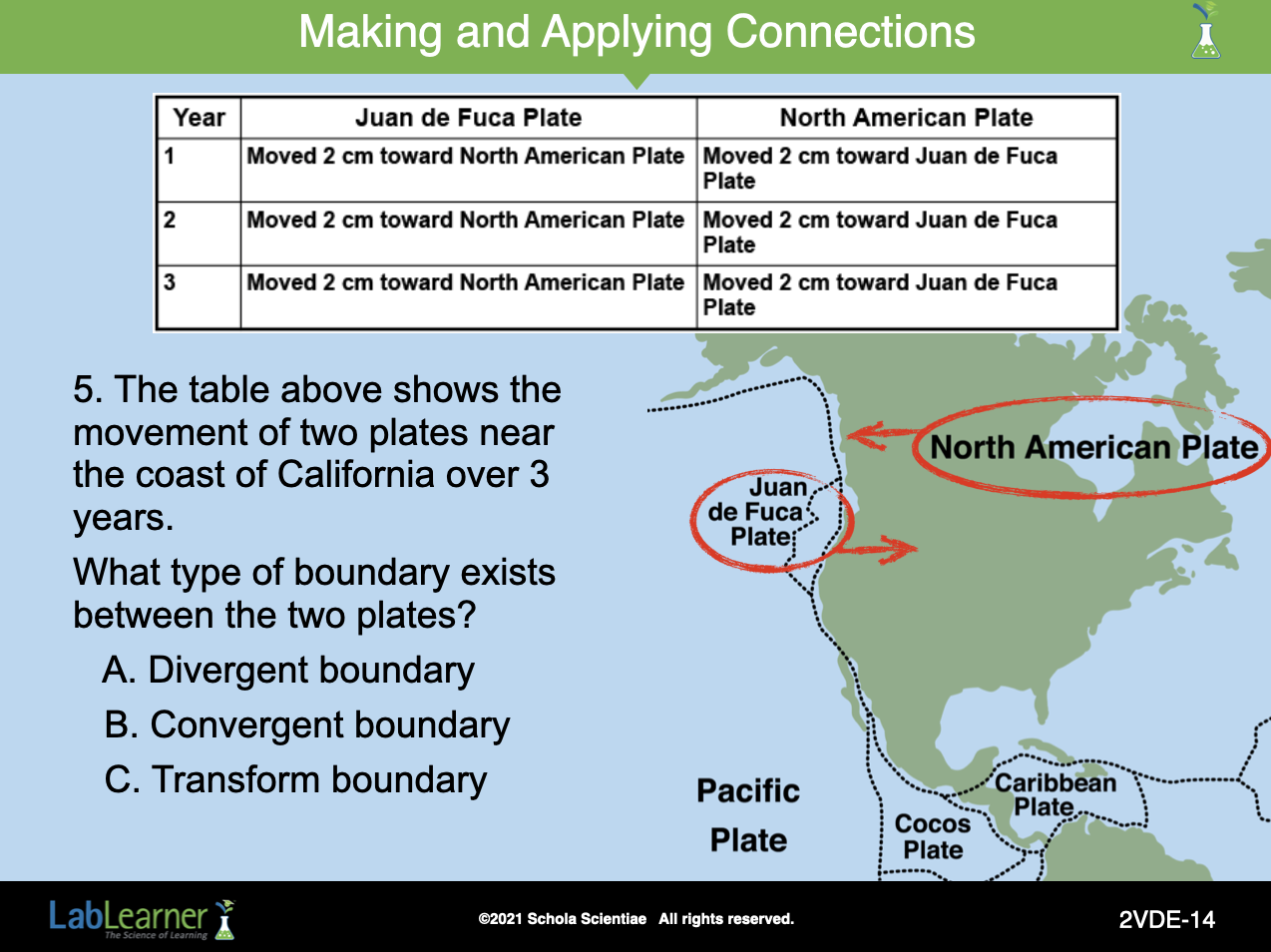
SLIDE 2VDE-14
Answer
Question 5: B