
Teacher Portal:
Dynamic Earth Journey
One: Surface and Interior of Earth
 PRINT IT
Use your browser to download a printable PDF as help during the slide presentation and to make additional notes. In your browser, go to File > Print and then choose to save as PDF.
NAVIGATE IT
Once the slide presentation is launched
- use your left and right arrows to advance or go back in the slide presentation, and
- hover your mouse over the left edge of the presentation to get a view of the thumbnails for all the slides so that you can quickly move anywhere in the presentation.
- Click HERE to launch the slide presentation for the CELL.
SHARE IT
SLIDE 1VDE-1
______________________________________________
SLIDE 1VDE-2
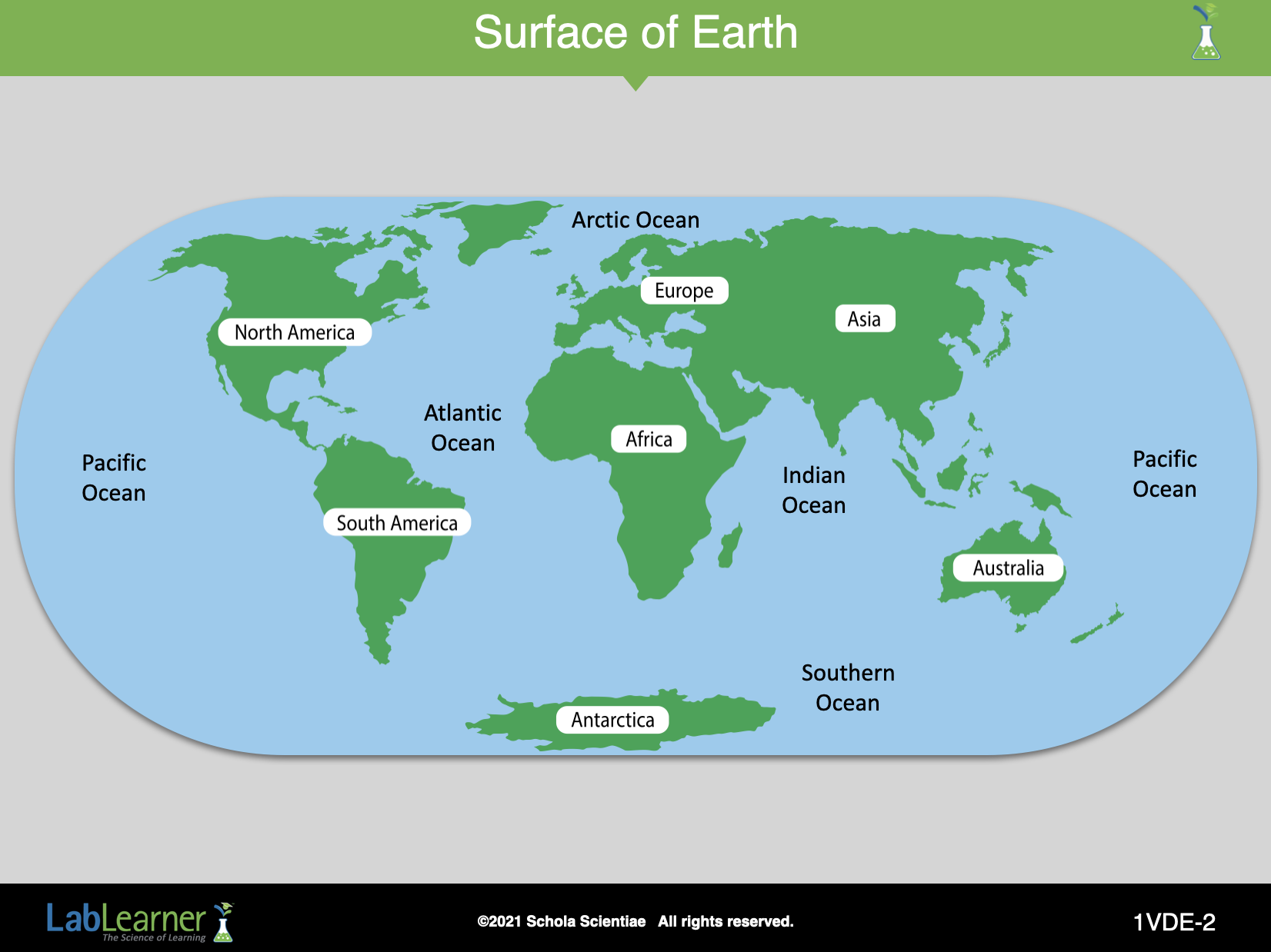
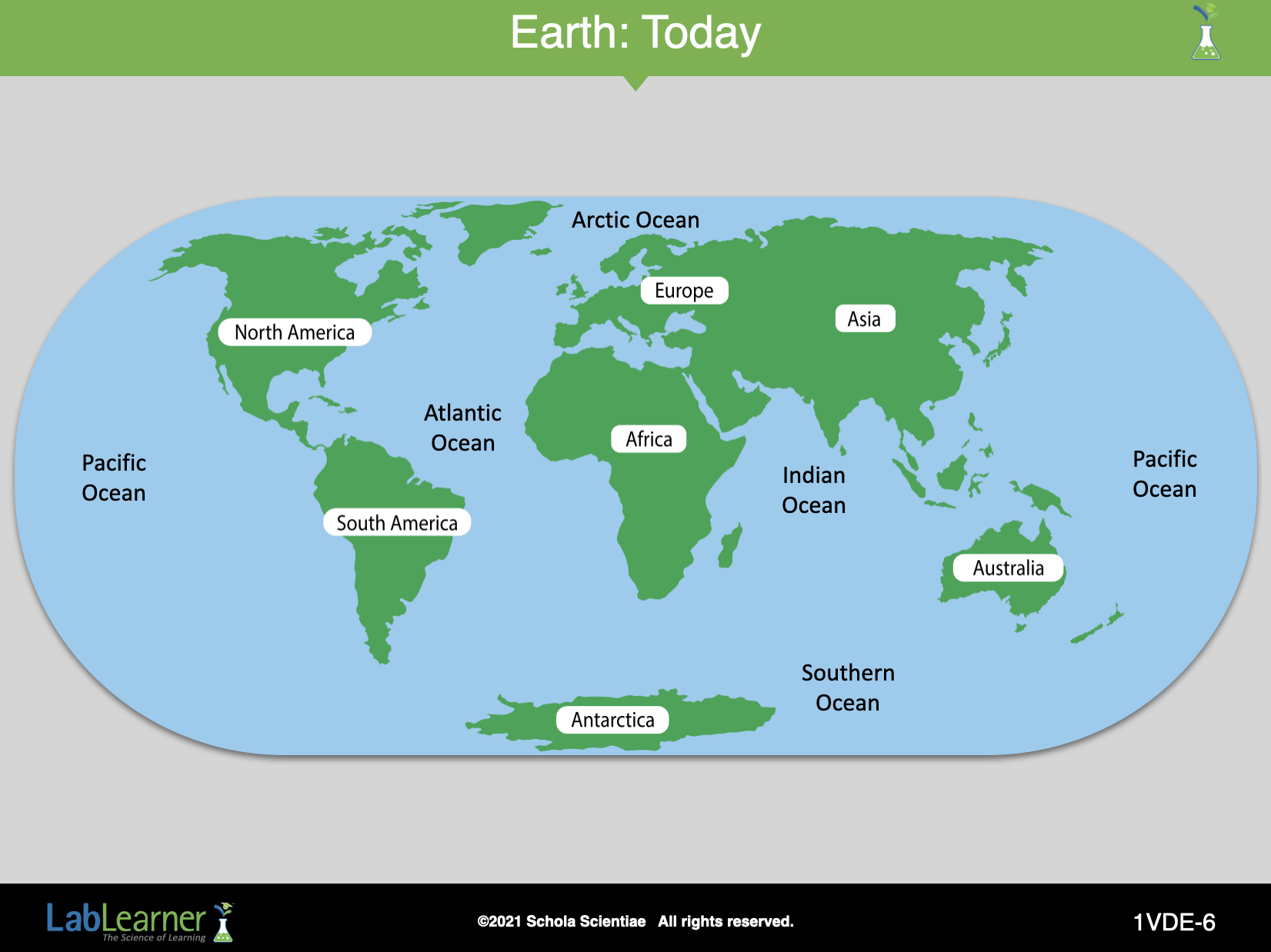
- This is what Earth looks like today.
- It has 7 continents: North America, South America, Africa, Europe, Australia, Asia, and Antarctica.
- and 5 major oceans: Atlantic, Pacific, Indian, Arctic, and Southern.
______________________________________________
SLIDE 1VDE-3
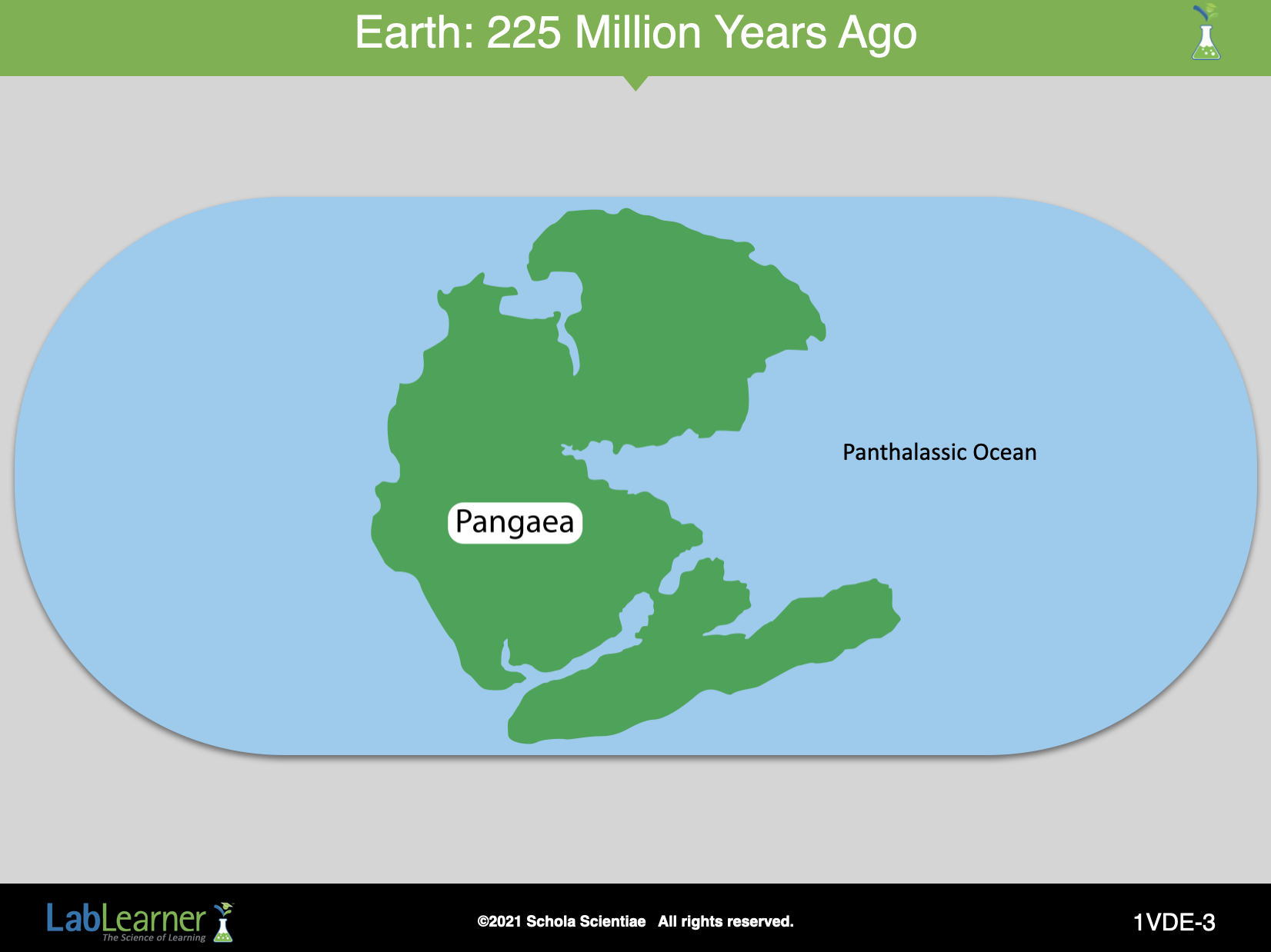
- This is what scientists believe the Earth looked like 225 million years ago (225 MYA).
- At this time, all of the land masses on Earth fused together to form the supercontinent Pangaea (pronounced “Pan-gee-ah”). At this point, Pangaea has begun to separate into multiple continents.
- Early dinosaurs already populated the Earth at this time. They could have walked from the North to the South Pole without crossing an ocean!
______________________________________________
SLIDE 1VDE-4
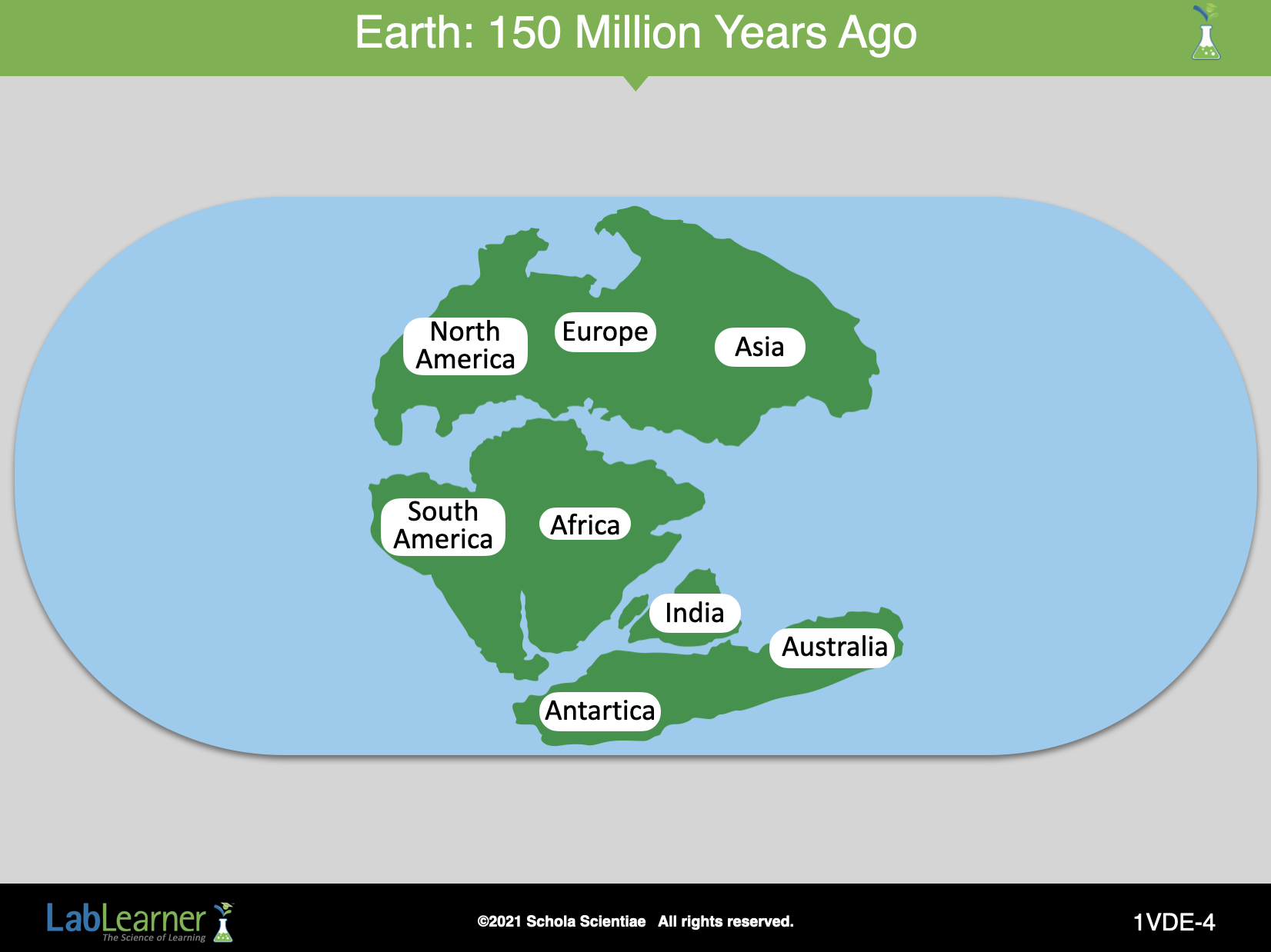
- This is what scientists believe the Earth looked like 150 million years ago.
- As can be seen, the large supercontinent Pangea is breaking apart. You can start to see North and South America and Africa. Antarctica and Australia are still attached and the land mass that will become India has broken free and begins moving north. North America, Europe, and Asia are still connected.
______________________________________________
SLIDE 1VDE-5
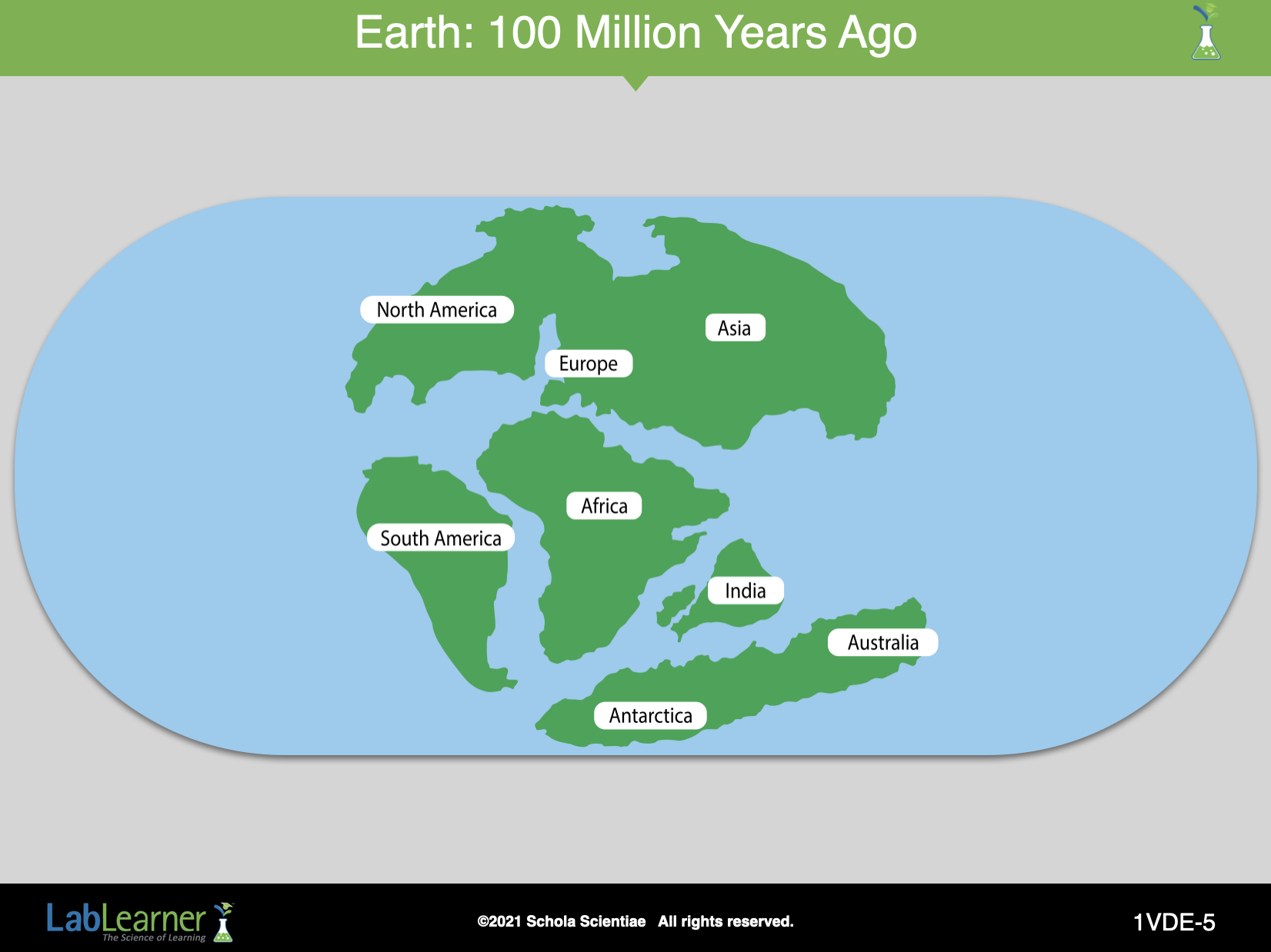
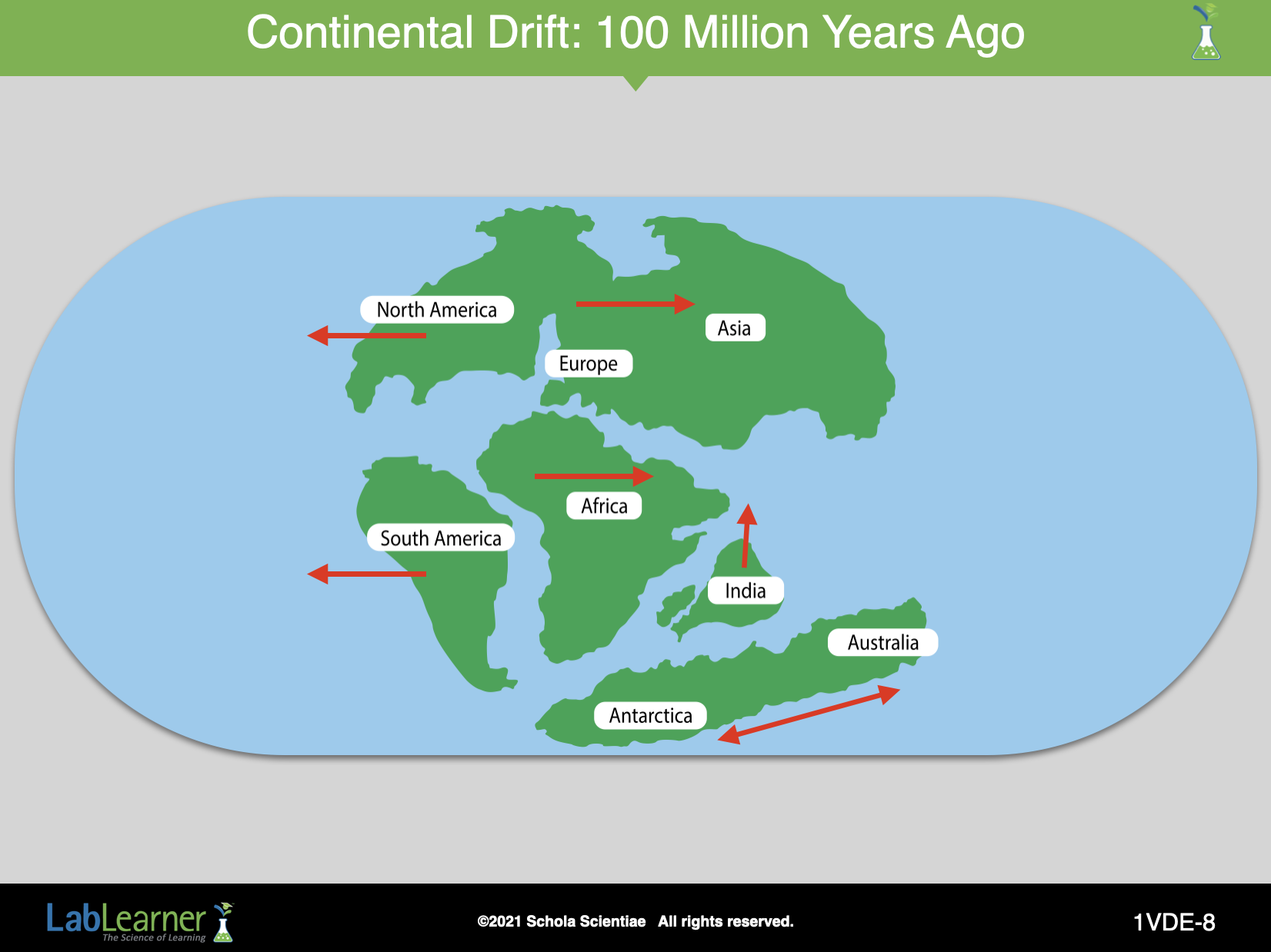
- This is what scientists believe the Earth looked like 100 million years ago.
- It is more similar to the layout of Earth as we know it —however, some differences exist.
- North and South America are not yet attached, while Antarctica and Australia are still attached. India continues to move north.
______________________________________________
SLIDE 1VDE-6
Why does our world look so much different than it did 225 million years ago, 150 million years ago, or even 100 million years ago?
______________________________________________
SLIDE 1VDE-7
- The idea that Earth today was dissimilar to the Earth of the past is not a new idea. As far back as 1596, mapmakers noticed how the edges of continents seemed to fit together like pieces of a puzzle.
- From the 1600’s to almost the present day, people believed the continents were immovable and that floods, earthquakes, and volcanoes caused the changes in the Earth.
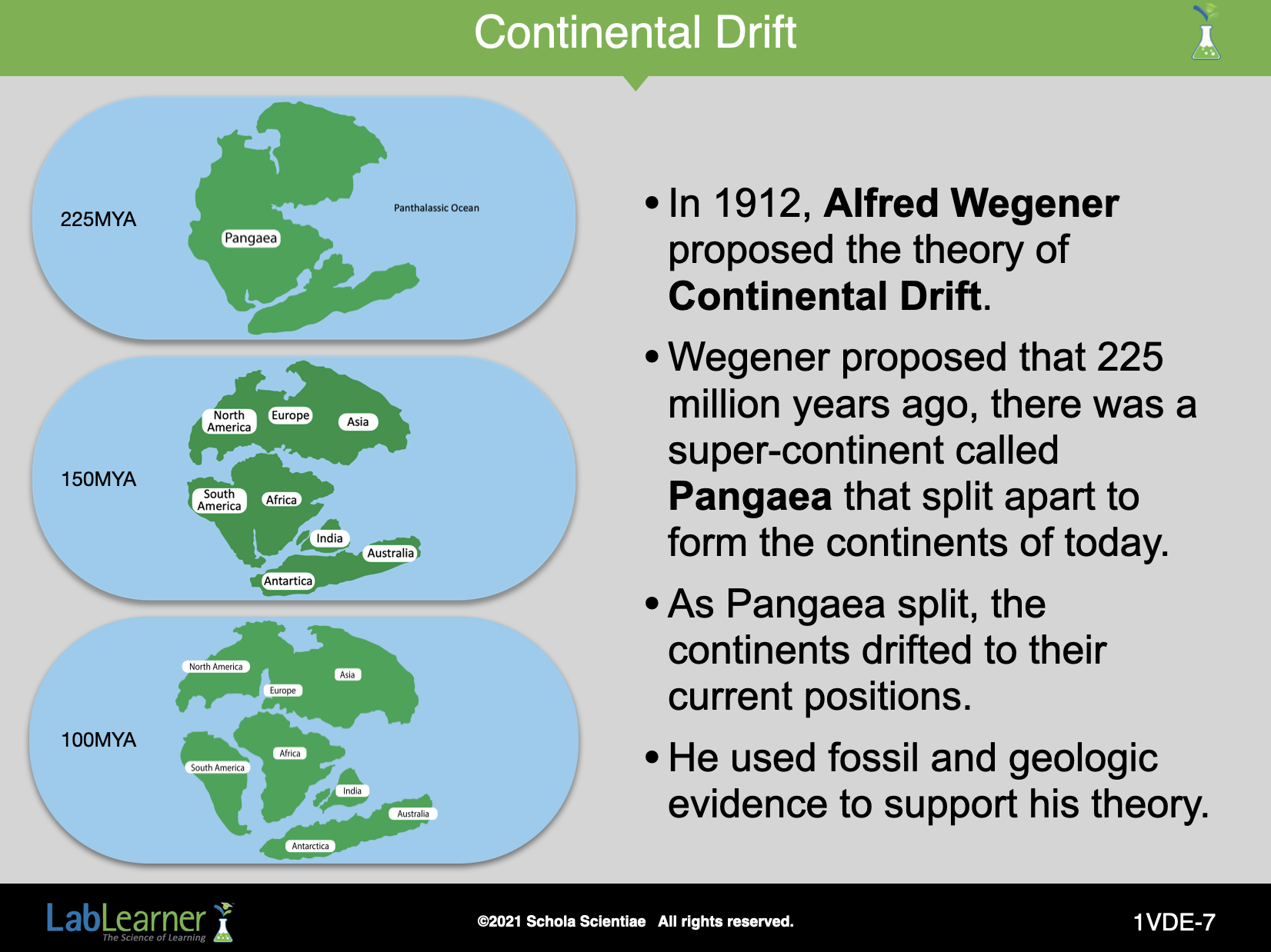
- In 1912, Alfred Wegener proposed something different: the continents were able to move.
His theory was called Continental Drift. He proposed that the continents were once locked together and over time drifted apart.
He cited the fact that the same fossils and rocks were found in different parts of the world, that was no longer physically connected as evidence for his theory.
But his theory was dismissed because he couldn’t explain what type of force could move continents.
______________________________________________
SLIDE 1VDE-8
- The red arrows show the directions the continents were “drifting” 100 million years ago. Look at how far India still must travel north to arrive at its present position.
- Eventually (about 40 to 50 MYA) India collided with the Eurasian continent. As a result of that collision, the Himalayan Mountains began to form. These mountains are the highest on Earth today and continue to get higher because India is still moving further north! We will discuss mountain formation of this type in more detail later.
______________________________________________
SLIDE 1VDE-9
Alfred Wegener was on the right track when he proposed his theory of Continental Drift.
However, it would take almost another 50 years and greater knowledge of Earth in order to understand why the surface of Earth changed and is still changing.
Ultimately, the answer to understanding the changes in Earth lies in understanding both the Earth’s composition and its mechanical properties.
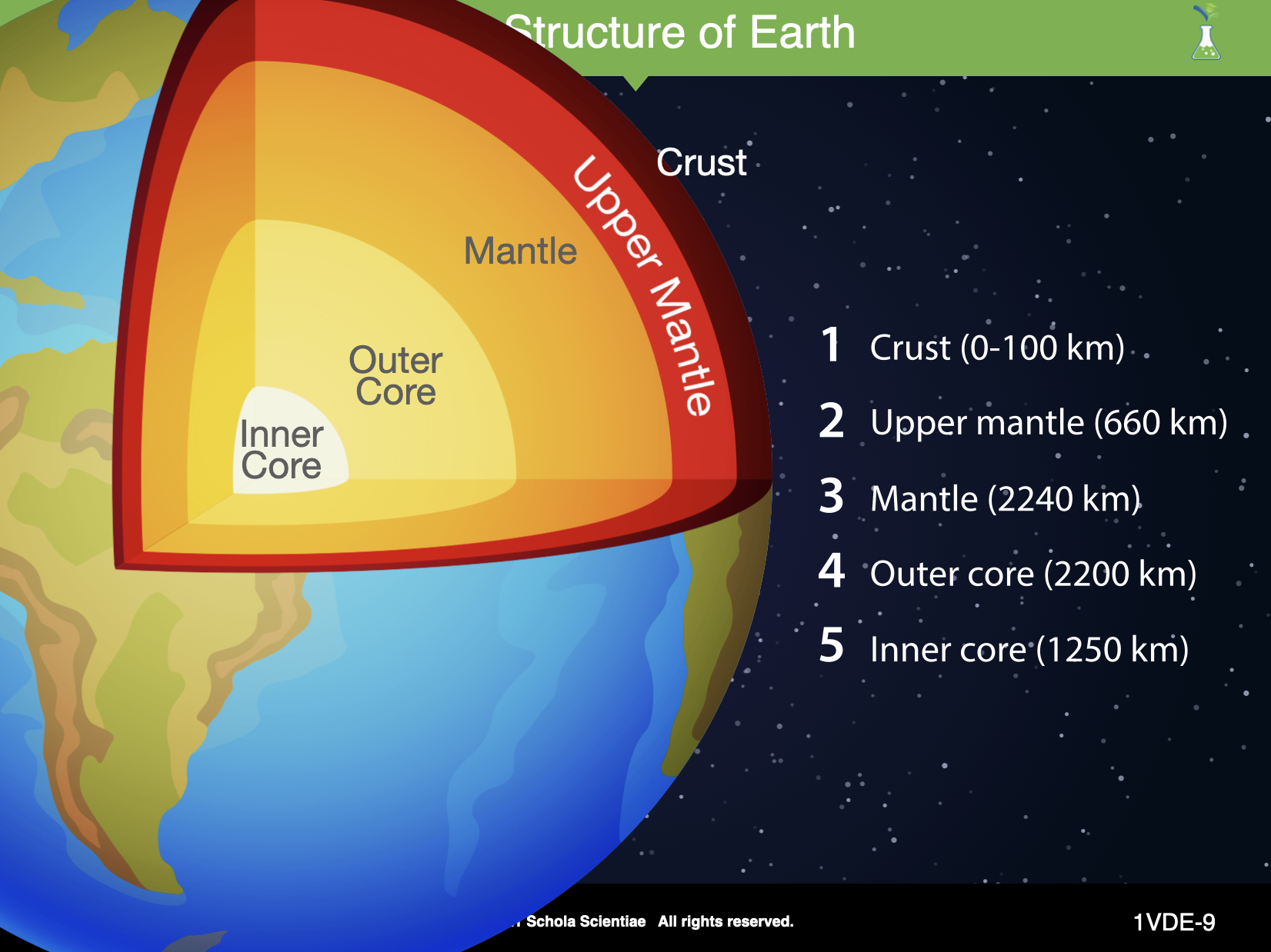
Scientists can divide the Earth into 3 different layers based solely on its composition:
- The layers are not all in the same states of matter.
- Some are solid, some are liquid.
- The three major layers are the core (Inner Core and Outer Core), mantle (Mantle and Upper Mantle), and crust.
______________________________________________
SLIDE 1VDE-10
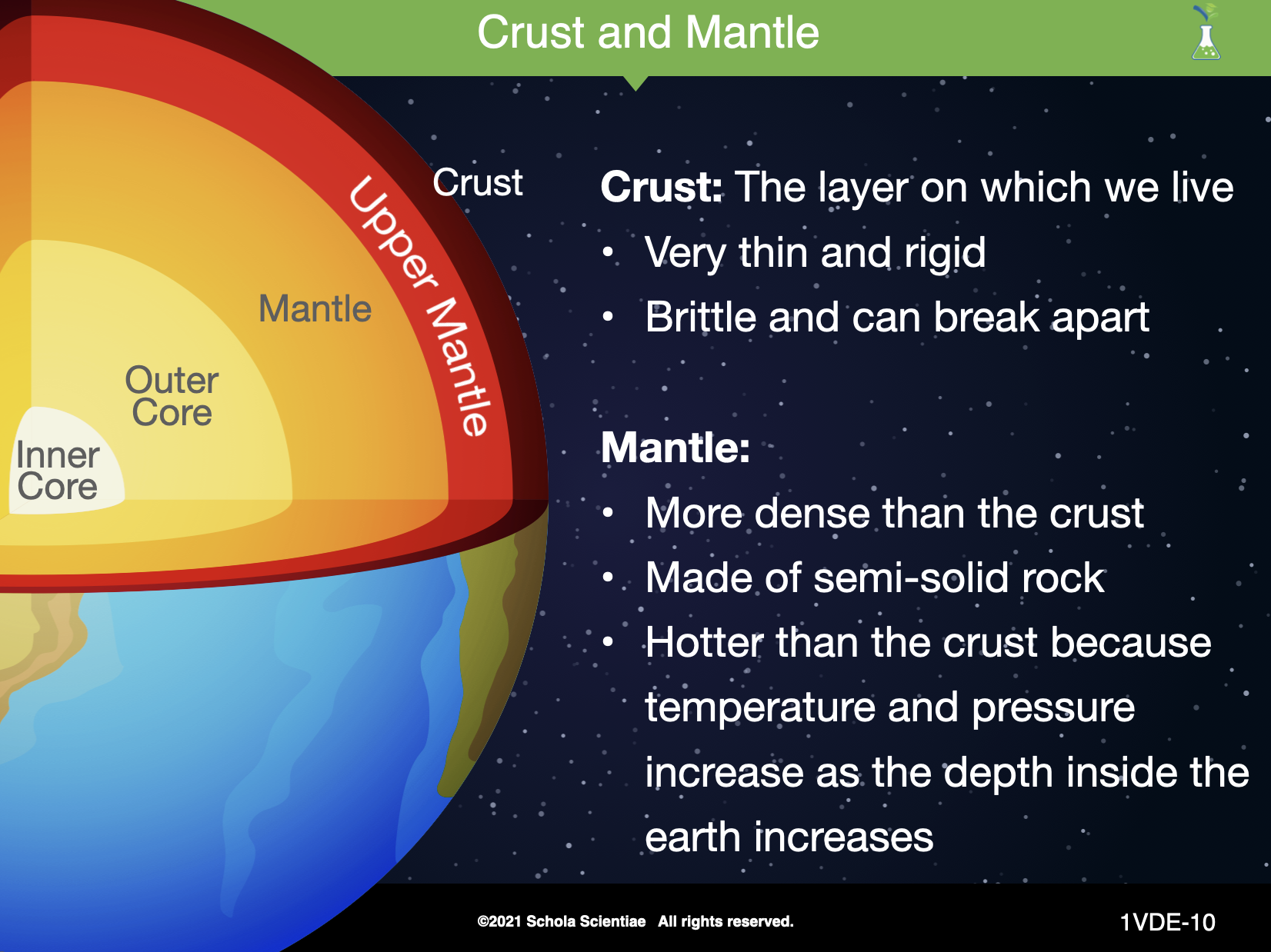
- Each layer of Earth has different properties.
- The difference in these properties helps to explain changes that occur both above and under Earth’s surface.
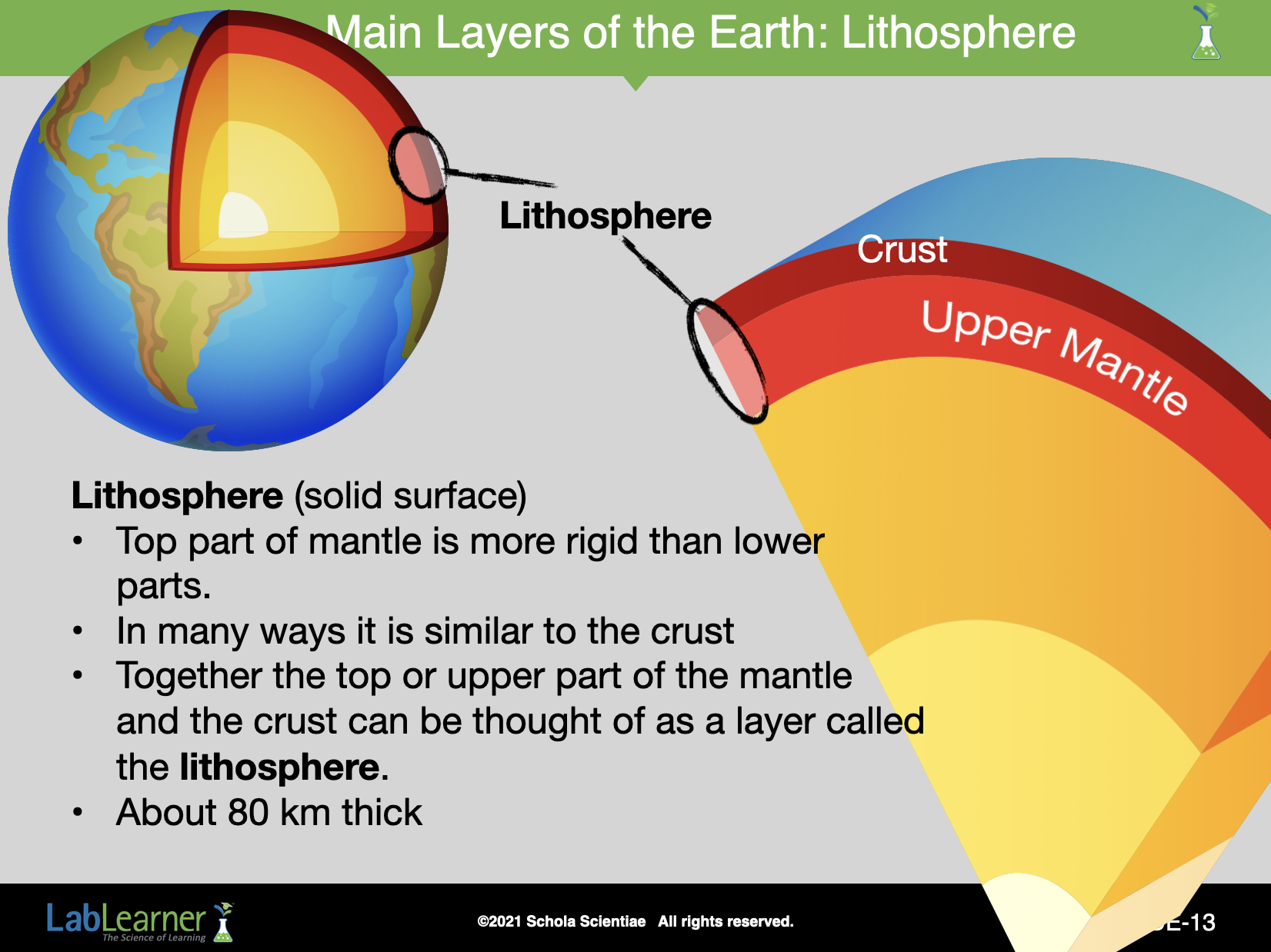
The crust and upper mantle are extremely important players in the mechanism of Continental Drift. We will see shortly, that the crust and upper mantle are functionally referred to as the lithosphere.
______________________________________________
SLIDE 1VDE-11
-
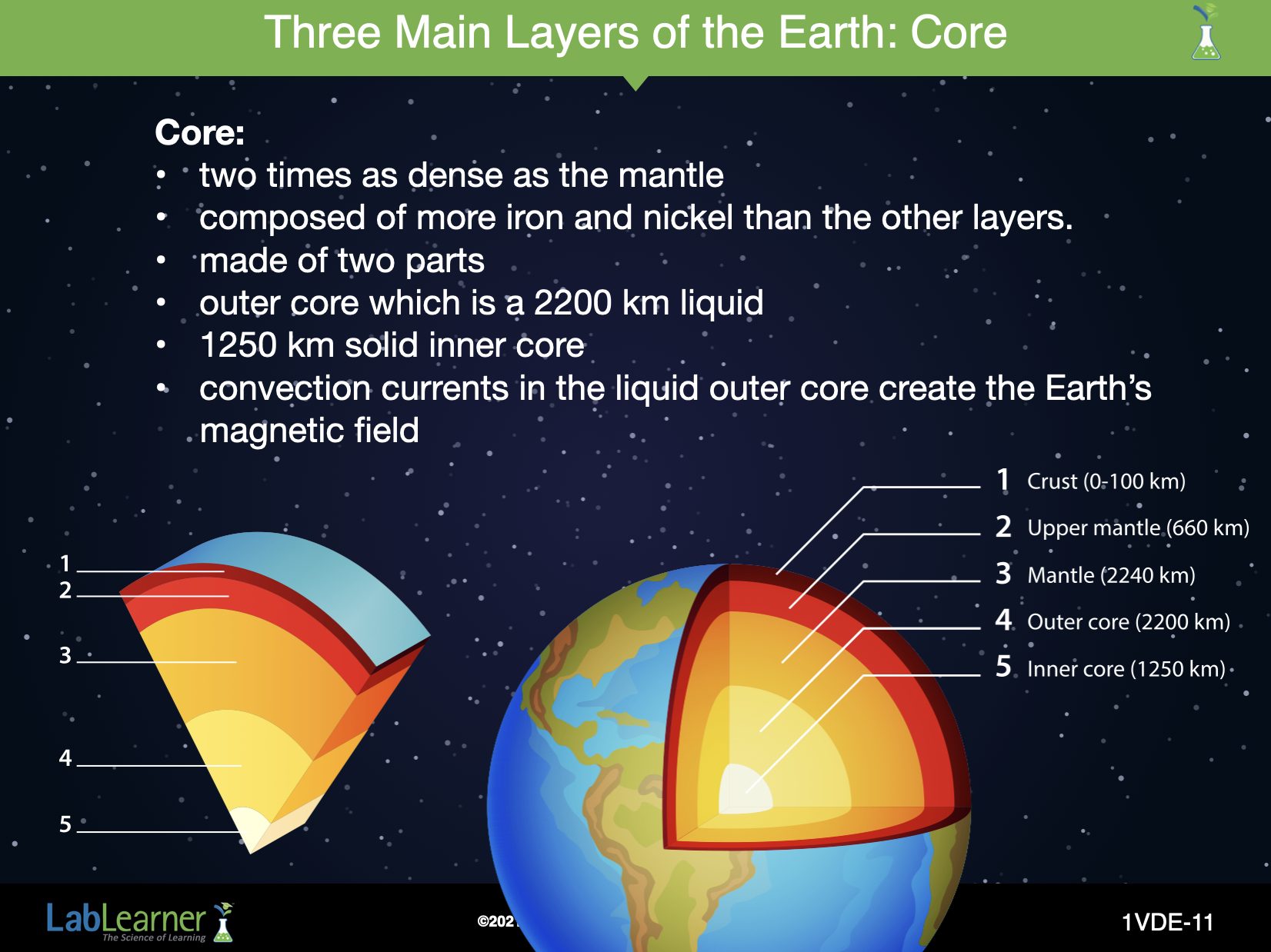
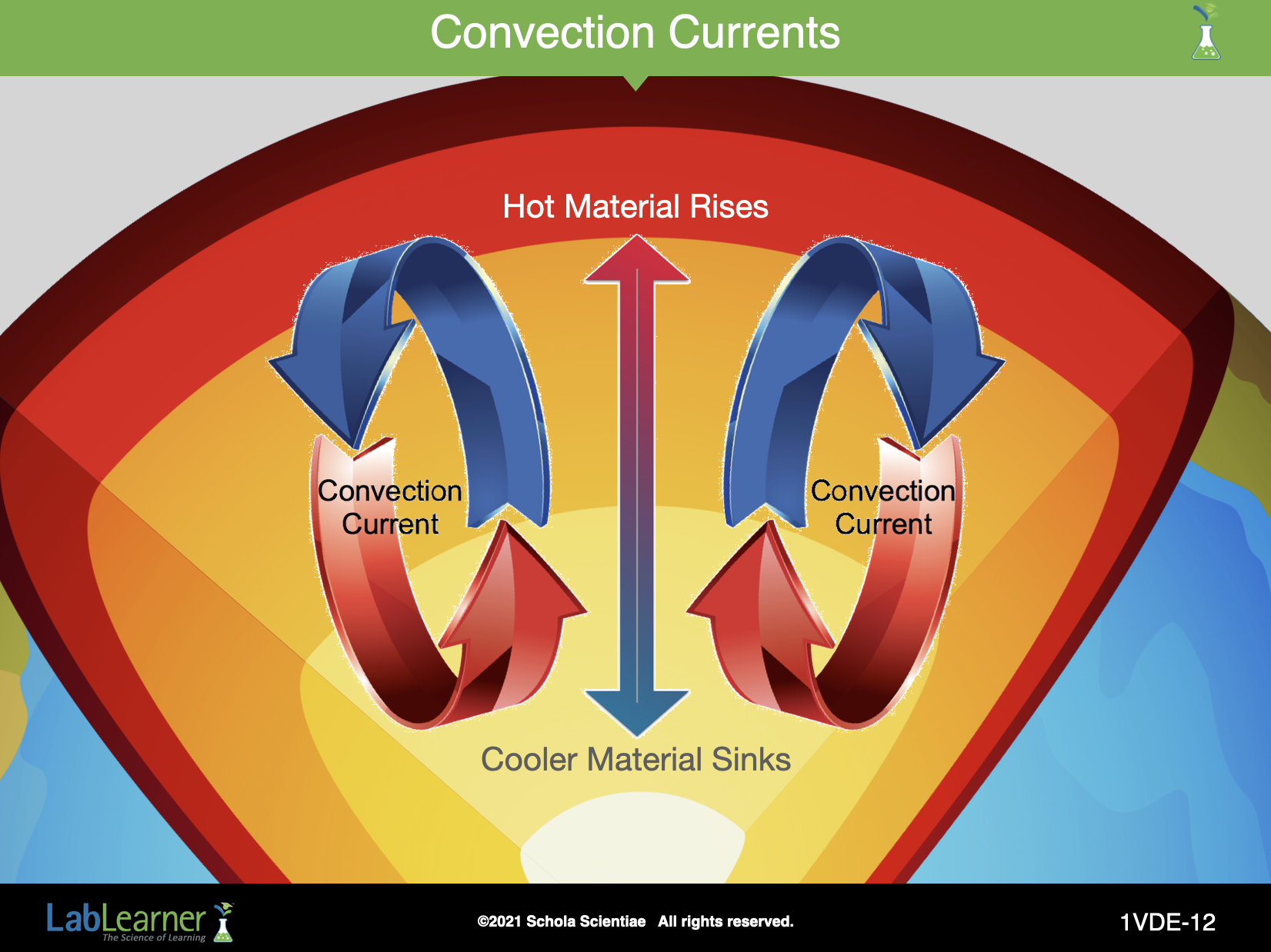
Four factors are responsible for the convection currents in the outer core:
- Differences in composition: The core is made up of several metals, each with different physical properties.
- Differences in temperature: the inner core heats the liquid outer core, causing it to become less dense and rise toward the mantle. The liquid cools as it rises, so it becomes more dense and sinks back toward the inner core.
- Differences in pressure: Pressure increases due to the effect of gravity as the center of Earth is approached.
- The Coriolis effect causes swirling in the outer core.
The magnetic field is generated by electric currents in the outer core. These currents are caused by the movement of iron atoms by the convection in the molten metal.
______________________________________________
SLIDE 1VDE-12
-
Convection currents are important in many areas of science. For example, the same principle that causes the upward movement of core and mantle material also is responsible for the upward movement of warm air and the downward movement of cool air that drives weather patterns.
In both cases of convection noted above, the density of warmer air or mantle is lower than the density of cool air or mantle. Thus, cool material (air or mantle) is more dense and sinks. Hot material (air or mantle) is less dense and rises. This is the reason why hot air balloons rise – the air inside the balloon is warmer than the air outside.
The constant turning and churning of core and mantle material make Earth a very dynamic planet. It not only is involved in volcanic activity and other surface occurrences but also is involved in continental drift.
______________________________________________
SLIDE 1VDE-13
We’ve just discussed that scientists can describe the composition of Earth in three major layers.
Another way to describe the composition of Earth comes as a result of studying its mechanical properties.
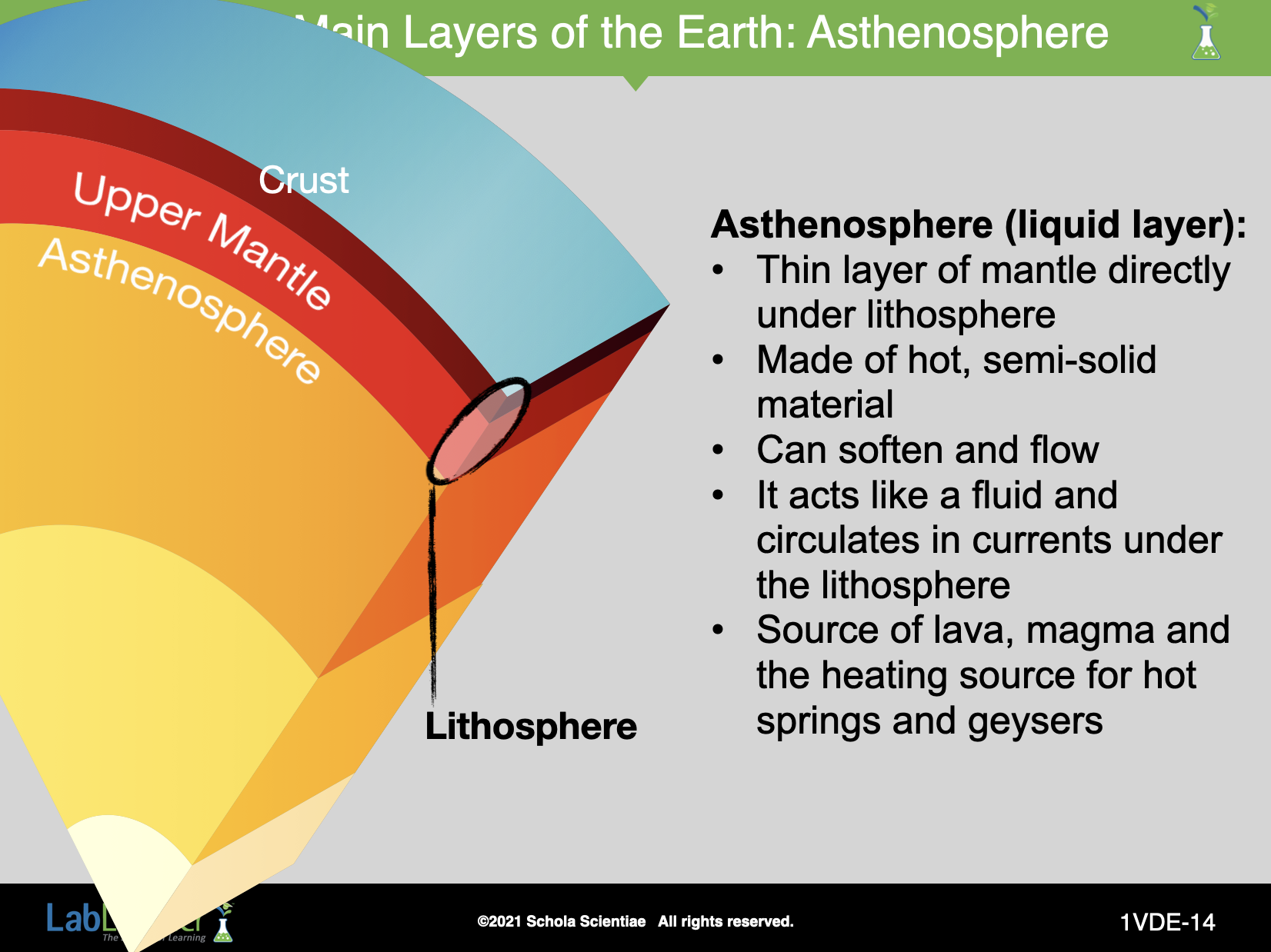
Based on mechanical properties, the topmost layer is the lithosphere.
Underneath the lithosphere is the asthenosphere.
______________________________________________
SLIDE 1VDE-14
Just underneath the lithosphere is the asthenosphere.
______________________________________________
SLIDE 1VDE-15
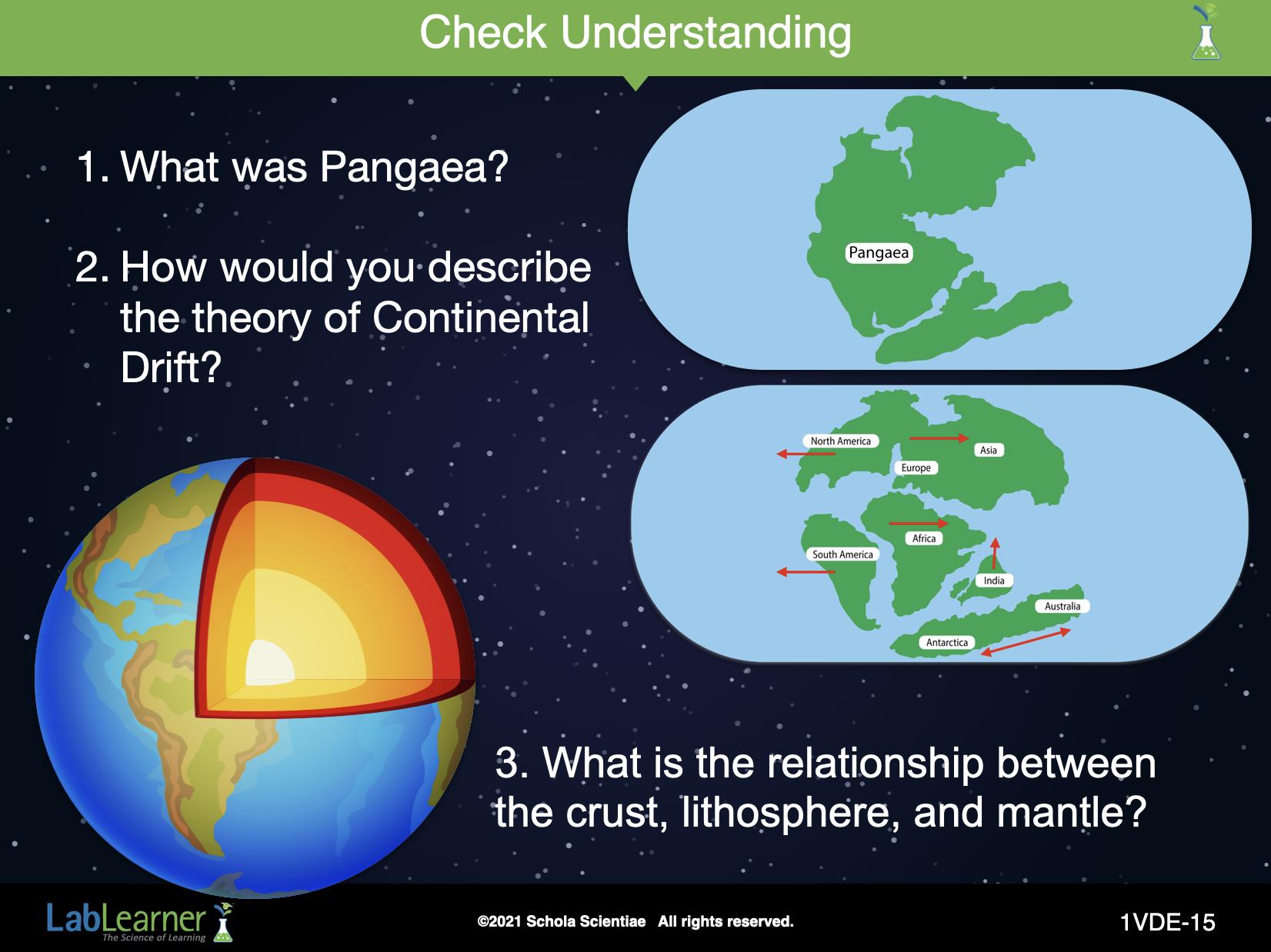
Present questions to students. Provide time for students to work in groups and then share answers as a class.
Answers to questions:
- Pangaea was a super-continent that existed about 237 million years ago. Scientists believe that the break-up of Pangaea ultimately resulted in the 7 continents on the current surface of the Earth.
- The theory of Continental Drift stated that the continents floated on the surface of the Earth and were not always in their current position. Over the history of the Earth, the continents moved or drifted over the surface of the Earth to their current position.
- The lithosphere is composed of the crust and the solid layer of the mantle.
______________________________________________