
Teacher Portal:
Chemistry, Matter and Interactions
Investigation 5 – PreLab
 ASK WHY
There are five major branches of chemistry today – organic chemistry, analytical chemistry, physical chemistry, inorganic chemistry, and biochemistry. Biochemistry is a branch of chemistry that deals with cells and living systems. Biochemistry studies inheritance (DNA and RNA molecules), metabolism, interactions between cells, and cell growth and repair.
BRANCH OUT
According to the American Chemical Society, “Biochemistry” explores chemical processes related to living organisms. It is a laboratory-based science combining biology and chemistry.
“Biochemists study the structure, composition, and chemical reactions of substances in living systems and, in turn, their functions and ways to control them.
PRINT IT
Use your browser to download a printable PDF as help during the slide presentation and to make additional notes. In your browser, go to File > Print and then choose to save as PDF.
MINDSET
This Investigation is designed to:
- introduce students to the concept of pH, a chemical property of substances.
- engage students in the investigation of the pH of substances in a solution with water.
- provide students with an opportunity to review the use of the triple beam balance.
- allow students to create solutions.
- aid students in review of the terms solute, solvent, and solution.
SCIENTIST’S GLOSSARY
1. Acidic: A property of matter which depends on the chemical make-up of a substance. A substance that is an acid has a pH between 0 and 6 and is neither a base nor a neutral substance.
2. Basic: A property of matter which depends on the chemical make-up of a substance. A substance that is a base has a pH between 8 and 14 and is neither an acid nor a neutral substance.
3. Neutral: A property of matter which depends on the chemical make-up of a substance. A substance that is neutral has a pH of 7 and is neither an acid nor a base.
4. pH: A property of matter that defines whether a substance is an acid, a base, or a neutral substance.
5. pH scale: A scale of numbers from 0 to 14. The scale describes the strength of an acid or a base.
6. Properties: Characteristics of a substance.
7. Solute: The substance that changes phase when creating a solution or is present in the smaller amount in a solution.
8. Solution: A mixture of two or more substances that is uniform in composition and appearance.
9. Solvent: The substance in a solution that did not change phase when creating the solution or is present in the larger amount.
BE PREPARED
Watch the Investigation 5 Teacher Videos to prepare for the PreLab and Lab
SET FOR SUCCESS
- Tell students that they will continue the Chemistry, Matter and Interactions CELL.
- Ask students to share the kinds of things they might learn in this Investigation.
Begin the PreLab Concept Slides to start students on their learning journey. Then watch the Pre-Lab Student Video afterward as a class.
NAVIGATE IT
Once the slide presentation is launched
- use your left and right arrows to advance or go back in the slide presentation, and
- hover your mouse over the left edge of the presentation to get a view of the thumbnails for all the slides so that you can quickly move anywhere in the presentation.
- Click HERE to launch the slide presentation for the CELL.
SHARE IT
SLIDE VCHEM5-pre-1
In this fifth and final Investigation in the LabLearner CELL Chemistry, Matter and Interactions, students will learn about one more important property of matter, pH. The term pH stands for the “potential of hydrogen”. pH tells us a great deal about matter, particularly solutions. First off, it tells us how safe a product is. Students will learn how pH is a measure of the concentration of hydrogen and hydroxide ions in a solution. By the end of this Investigation, students should not be surprised that materials we commonly deem to be dangerous are often at the very extremes of the pH scale – the strong acids and the strong bases.
______________________________________________
SLIDE VCHEM5-pre-2
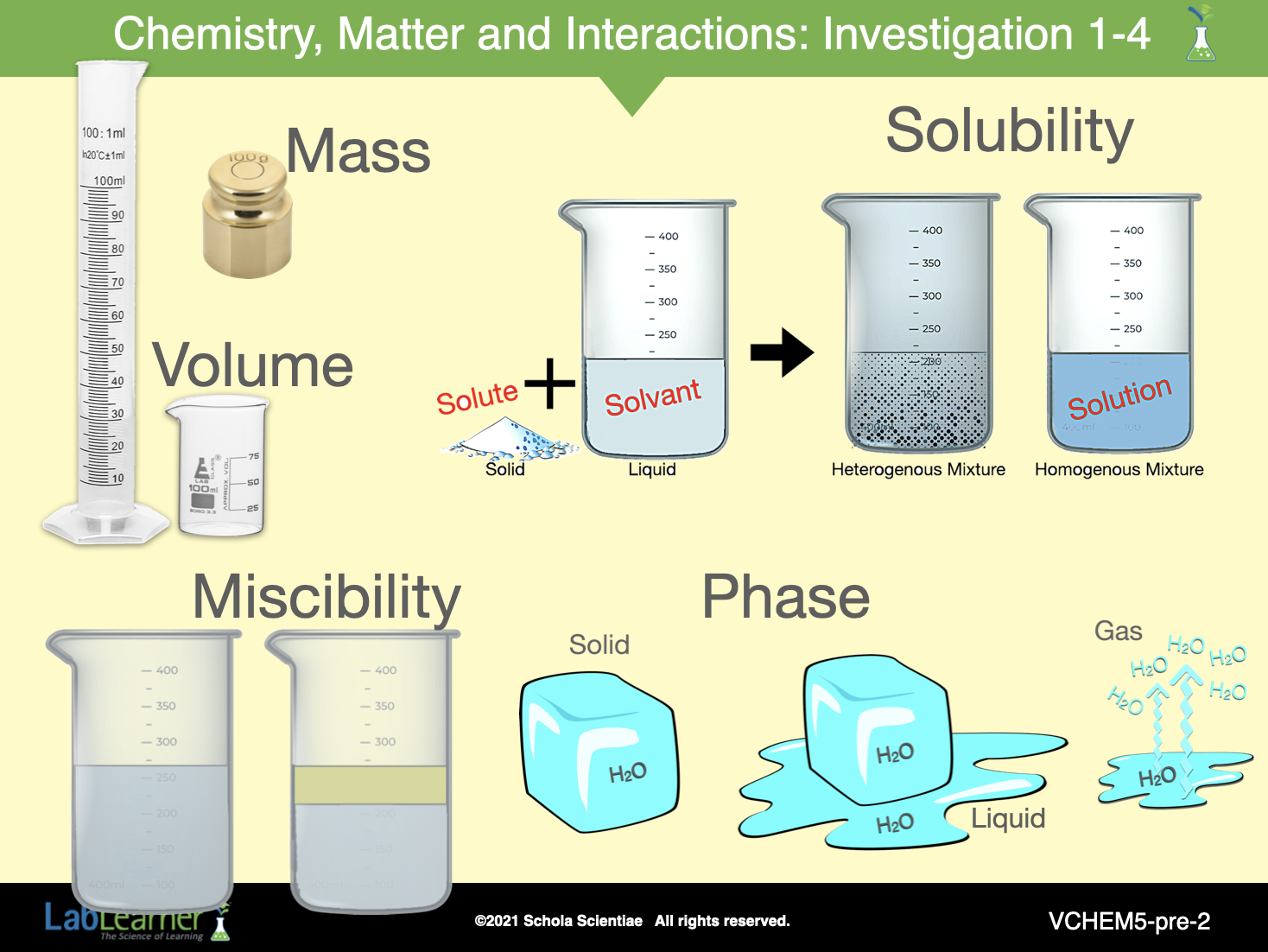
As a class, review the properties of substances that students have investigated thus far in this CELL. Sample answers may include qualitative properties such as solubility, miscibility, color, texture, and luster as well as quantitative properties such as size, mass, and volume.
Ask students to list a property, ask: What tool do you use to enable you to observe the properties of substances? Color, texture, and luster—visual observation, size—metric ruler or meter stick, mass—triple beam balance, volume—centrifuge (Falcon) tube or graduated cylinder.
Think about what you have learned about how properties can identify matter? You may be surprised how much you have already learned:
- For example, both qualitative and quantitative properties are necessary to identify matter. Mass, a quantitative property, is often a very descriptive property to observe. However, sample size determines the mass of a substance. Therefore qualitative properties such as color, texture, and luster, which remain constant regardless of sample size, should be included in a description of a substance along with its mass.
- Solubility and miscibility, quantitative properties, are other properties that students have observed. Some substances are soluble or miscible in one type of solvent but not in another. The differences in the solubility and miscibility of substances in different solvents may help to identify different substances.
- Properties such as mass and solubility can be used to describe the interaction of substances. When some substances interact, a chemical change occurs and a new substance is formed. The properties of the new substance may vary from the properties of the original substances. For example, the resulting substance may be of a different color. Looking for a change in properties such as color can help identify a change. When a physical change occurs, a change in some properties, such as the form of a substance (a change from a solid to a liquid), may occur. Describing the change by describing the properties of a substance may help identify a physical change.
______________________________________________
SLIDE VCHEM5-pre-3
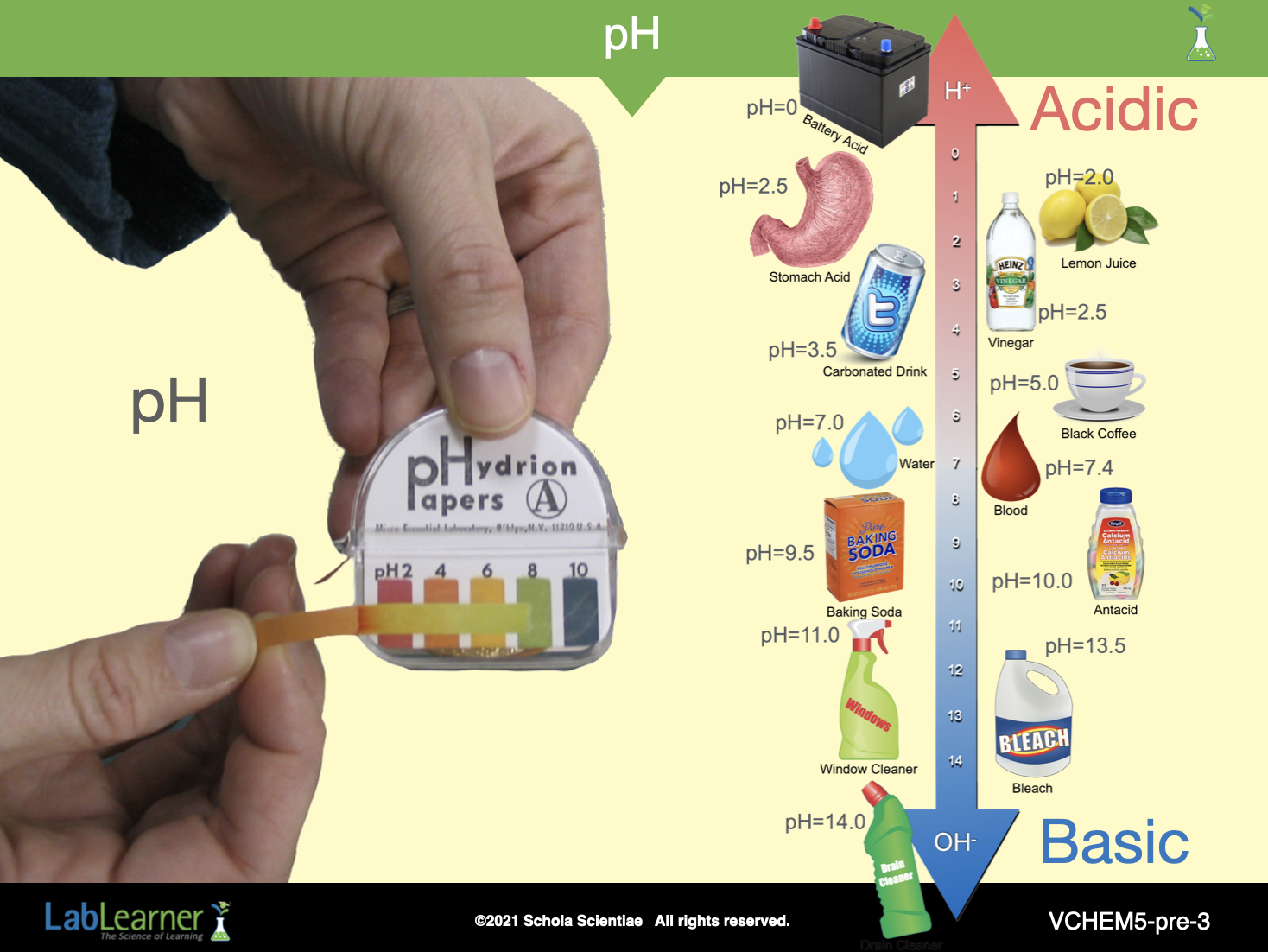
Tell students that during this Investigation, they will explore a new property of matter: pH
a. Instruct students to refer to their Scientist’s Glossary. Ask a student volunteer to read aloud the definition of pH.
“pH: A property of matter that defines whether a substance is an acid, a base, or a neutral substance.”
b. Ask students whether they have ever heard of the terms acid (or acidic), base (or basic), or neutral. Allow students to recall possible exposure to these terms. Tell students that in science, these words describe one aspect of the chemical composition, or make-up, of a substance.
______________________________________________
SLIDE VCHEM5-pre-4
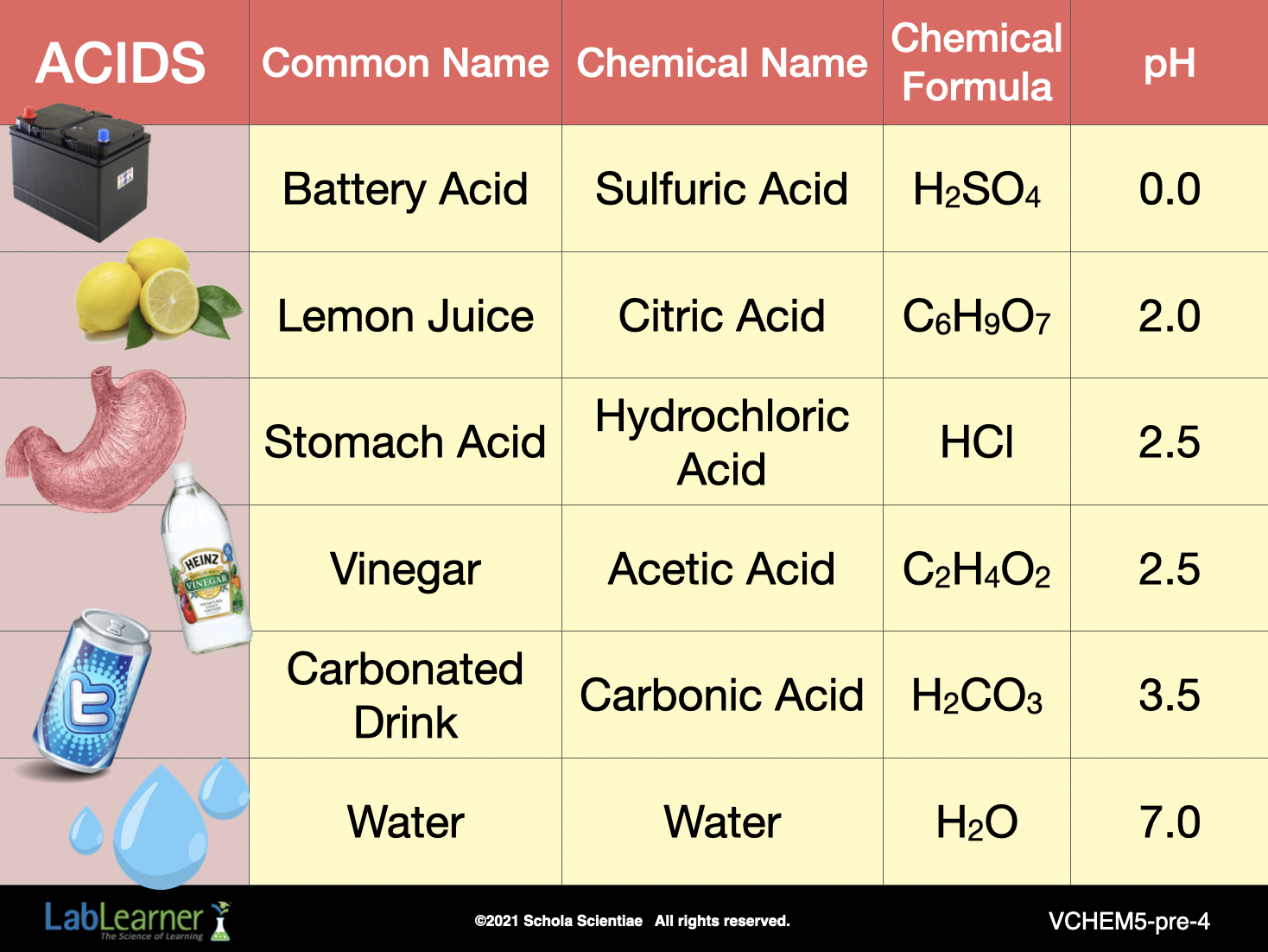
pH scale: A scale of numbers from 0 to 14. The scale describes the strength of an acid or a base.
Acids:
The pH scale on the right side of this slide is labeled from 0 through 14. The “acid” end of the pH scale is at the top and labeled in red. At the other end of the double-sided arrow is the “basic” end of the pH scale. Notice the following about the pH scale as presented in this slide:
The acid point of the arrow is labeled both “Acidic” and a H+ is also included. This represents hydrogen ions. The presence of extra H+ is what makes for an acidic solution. H+ (hydrogen ions) are very reactive with other compounds so that the greater concentration of hydrogen ions makes a solution more acidic.
The numbers on the pH scale range from 0 through 14. A pH of 0 is the most acidic solution, while a pH of 14 is the least acidic. That is, a solution with a pH of 14 would have very little extra H+. Therefore, such a solution can not be an acid.
This slide arranges a few common solutions on it with their actual pH given as a number between 0 and 7. The closer to 7, the less acidic the solution.
The most acidic solution shown on this pH scale is battery acid with a pH value of pH=0. The next several acidic examples (stomach acid, lemon juice, vinegar, and carbonated soda are all acidic. In fact, any solution with a pH under 7 is considered an acid even though we may not commonly call them acids. However, in this example, the chemical names of the acid solutions are given. Thus, battery acid is actually H2SO4 (sulfuric acid) and lemon juice is C6H9O7(citric acid).
Finally, at a pH of 7, there is an equal number of H+ and OH– ions and we call a solution with a pH of 7.0 neither acid nor base, instead it is said to be neutral. Water is the best example of a liquid with a neutral pH although there are many other solutions with neutral pH. Blood, for example, is neutral or mildly basic (see SLIDE VCHEM5Pre-3).
______________________________________________
SLIDE VCHEM5-pre-5
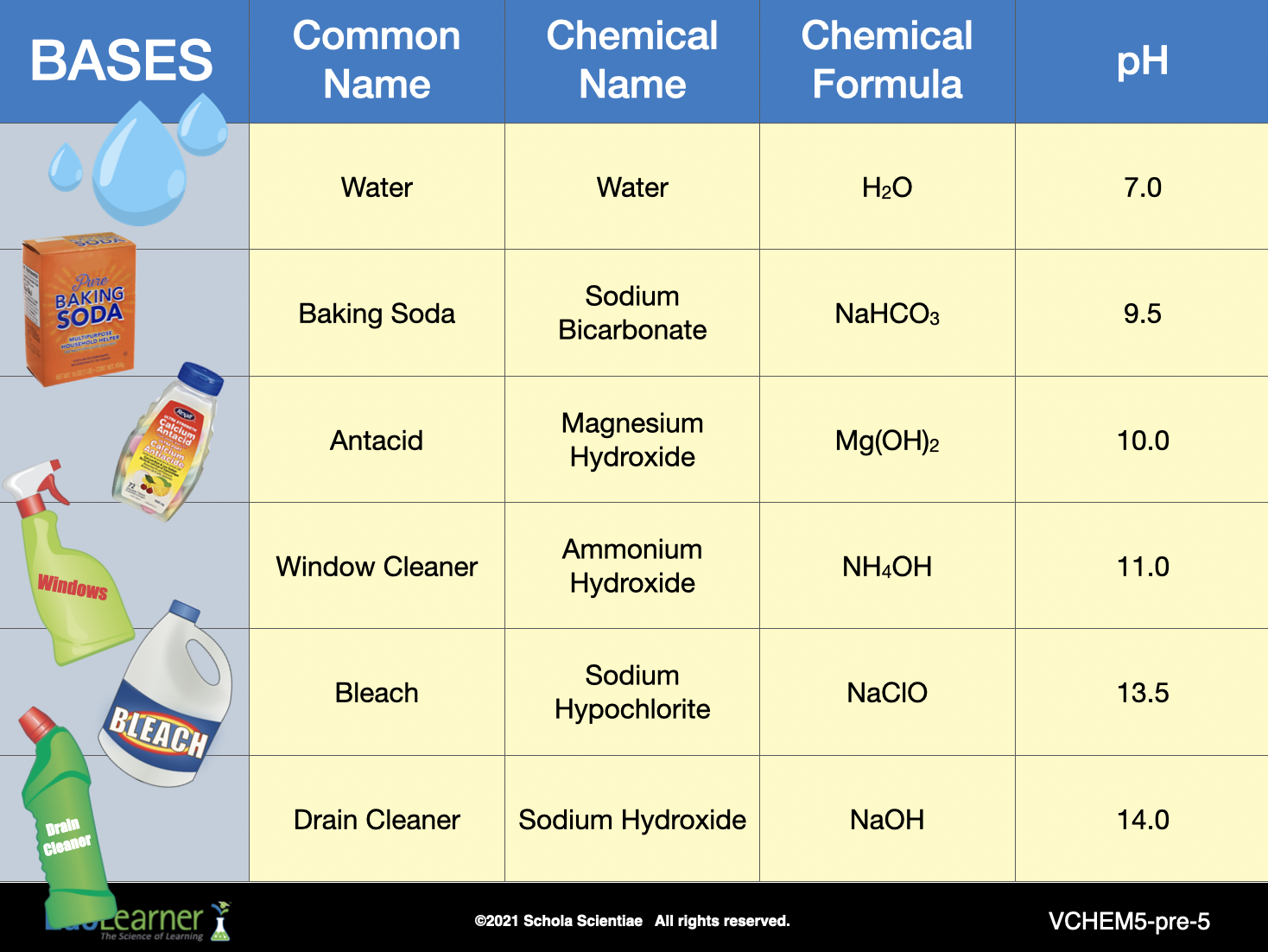
pH scale: A scale of numbers from 0 to 14. The scale describes the strength of an acid or a base.
Bases:
- The other end of the pH scale was shown in blue in SLIDE VCHEM5Pre-3. Notice that is not labeled with an H+ (hydrogen ion) like the acidic end of the arrow (the red end in this case) but rather with an OH– symbol. The OH– represents the hydroxide ion. The hydroxide ion is also very reactive. Solutions that contain extra OH– ions are called bases and we say the solution is “basic”.
______________________________________________
SLIDE VCHEM5-pre-6
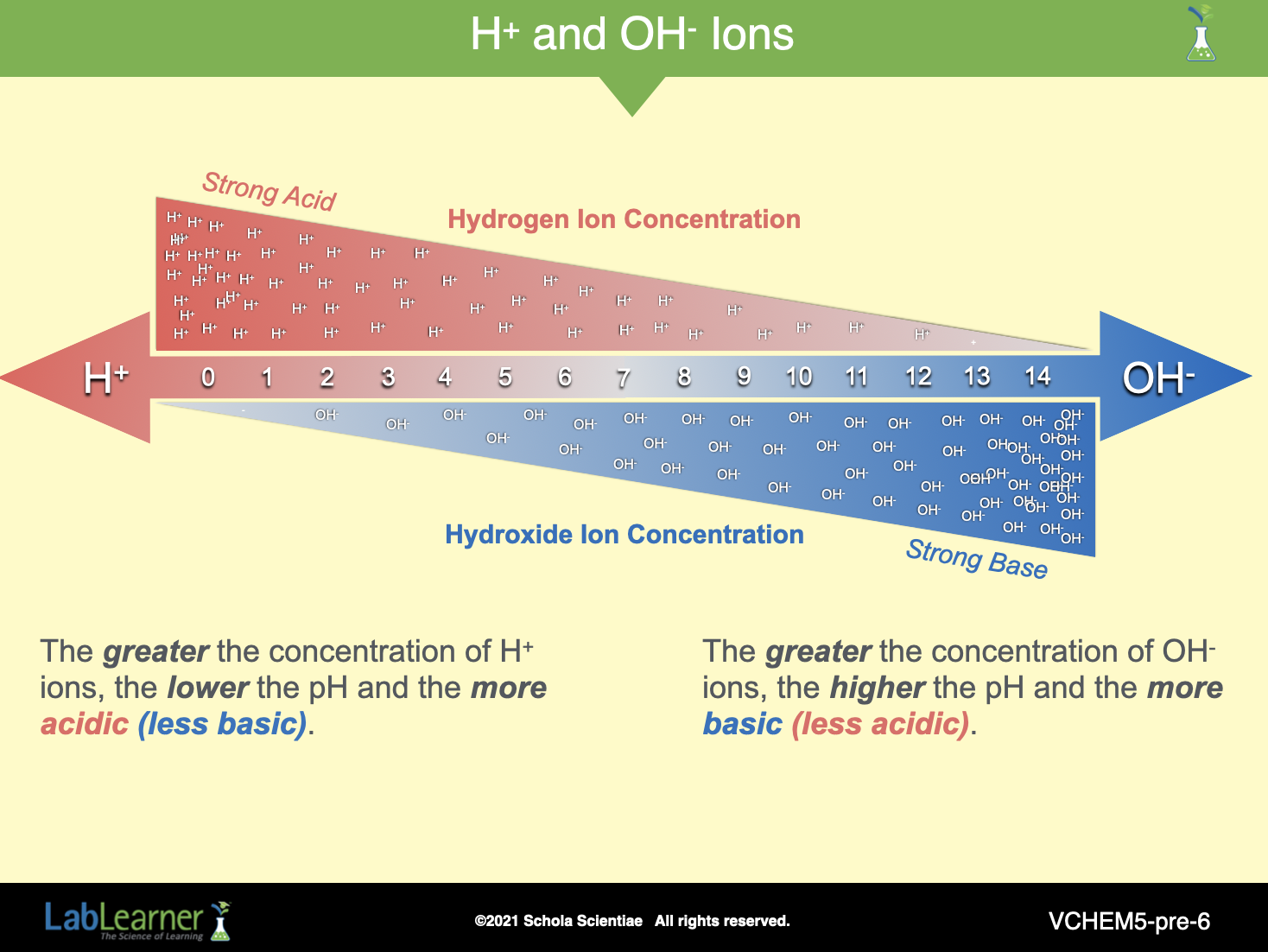
This review slide simply shows the relationship between the relative amount of H+ and OH– ions along the pH scale. Simply stated, acids have excess H+ ions and bases have excess OH– ions.
Explain to students that the pH scale tells us how acidic or how basic a substance is. A weak acid is almost neutral. It has a pH close to 7, such as 6 or even 5. However, a strong acid has a pH closer to zero.
A weak base, on the other hand, is almost neutral. In other words, it has a pH close to that of 7, such as 8 or even 9. A strong base is far from being neutral. In other words, it has a pH close to that of 14.
______________________________________________
SLIDE VCHEM5-pre-7
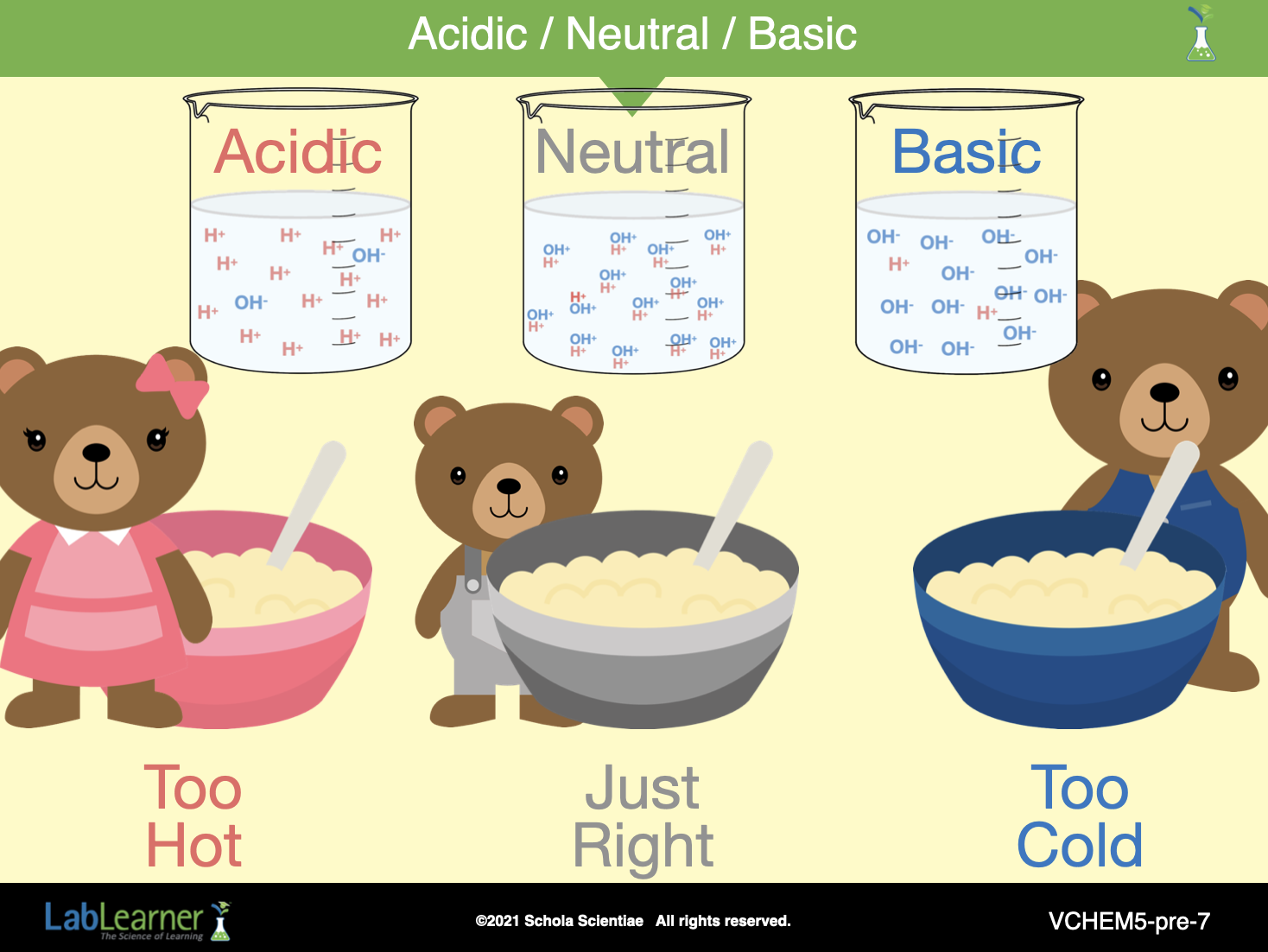
Drawing on the Three Bears fairy tale, this slide shows an analogy for the concept of a neutral pH being “just right” when compared to acids (too low ph) and bases (too high pH). A pH of around 7.0 is considered neutral and includes such fluids as human blood, milk, saliva, and water.
______________________________________________
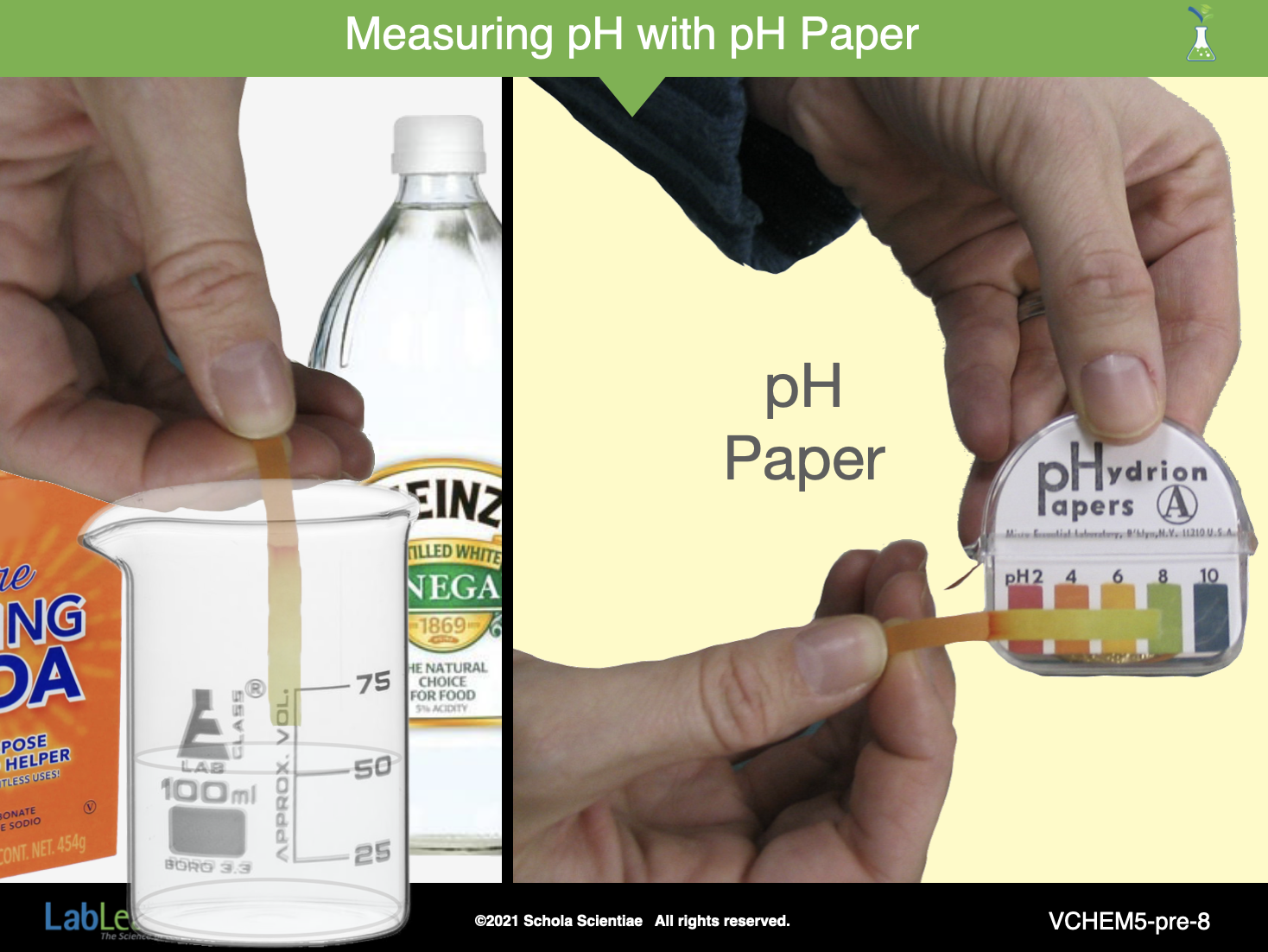
SLIDE VCHEM5-pre-8
Tell students that they will be testing various substances to find if they are strong or weak acids and bases during their laboratory experiments.
Remind students that just as height, mass, temperature, and volume are measured using tools, pH is also measured using a science tool. pH can be measured in a variety of ways, such as using pH paper, a pH meter, or chemicals called pH indicators that change color when placed in a base or an acid. The science tool that students will be using in this Investigation is called pH paper.
Student Video
Watch the Investigation 5 Student Videos after the Share It presentation to prepare for the PreLab. There are two student videos for this Investigation. The first covers Trials 1-5 and the second Trials 6 and 7.