
Teacher Portal:
Chemistry, Matter and Interactions
Investigation 5 – Lab
 ASK WHY
There are five major branches of chemistry today – organic chemistry, analytical chemistry, physical chemistry, inorganic chemistry, and biochemistry. Biochemistry is a branch of chemistry that deals with cells and living systems. Biochemistry studies inheritance (DNA and RNA molecules), metabolism, interactions between cells, and cell growth and repair.
BRANCH OUT
According to the American Chemical Society, “Biochemistry” explores chemical processes related to living organisms. It is a laboratory-based science combining biology and chemistry.
“Biochemists study the structure, composition, and chemical reactions of substances in living systems and, in turn, their functions and ways to control them.”
BE PREPARED
Supplies and Equipment:
Class Materials:
- 60 ml vinegar
- 60 ml laundry detergent
- 60 ml lemon juice
- 60 g baking soda
- 3 L water
- 1 roll of masking tape, for labeling
- 1 set of Investigation Supplement Pages (located at the end of Investigation 5 Lesson Plans)
Station Materials:
Trials 1-5:
- 6 100 ml graduated cylinders*
- 6 100 ml beakers
- 18 400 ml beakers
- 18 15 ml falcon tubes
- 6 glass stir rods*
- 6 pH paper dispensers with pH strips*
- 3 triple beam balances*
- 3 liter pitchers*
- 3 weigh dishes
* If desired, this Investigation may be divided into two lab experiences. Students may perform Trials 1 through 5 one day and perform Trials 6 and 7 the following day. The materials listed for Trial 6 and Trial 7 are the additional materials needed to perform these two trials. If you choose to divide this lab into two experiences, note the materials marked with an asterisk in the above list. These materials are needed for both days of investigations.
Trial 6:
- 6 lab scoops
- 6 falcon tubes, 15 ml
- 6 400 ml beakers
- 6 weigh dishes
Optional Extension (Trial 7) materials:
- 14 ml vinegar
- 6 15 ml falcon tubes
Individual Materials:
- 1 Student Data Record
- 1 pair of safety goggles
Teacher Preparation
1. Prepare the materials needed for Trials 1 through 5.
a. Fill two 100 ml beakers with approximately 30 ml of vinegar.
b. Fill two 100 ml beakers with approximately 30 ml of laundry detergent.
c. Fill two 100 ml beakers with approximately 30 ml of lemon juice.
d. Fill six 15 ml falcon tubes with 8 g of baking soda. To do this, fill the tube to just
above the 7 ml mark.
e. Fill three-liter pitchers with approximately 1000 ml of water.
2. Create three stations in the class. Each station will be equipped to handle two student groups simultaneously. It may be helpful to use masking tape to visually divide each station in half.
3. Place the materials for Trials 1 through 5 at each station according to the following table. The materials needed for each half of the station are listed, followed by the materials that are to be shared by the two student groups. Note that if a material is listed on the Each Half list, the number supplied for the entire station should be twice what is listed. For example, if 1 glass stir rod should be placed on each half of the table, a total of 2 glass stir rods should be provided at the station.
Note: Although the class could be divided into three groups rather than six, six stations are suggested so that student groups are smaller and students are better able to investigate during each trial. Students will rotate through stations when investigating vinegar, laundry detergent, and lemon juice. Each station is equipped with baking soda for Trial 5.
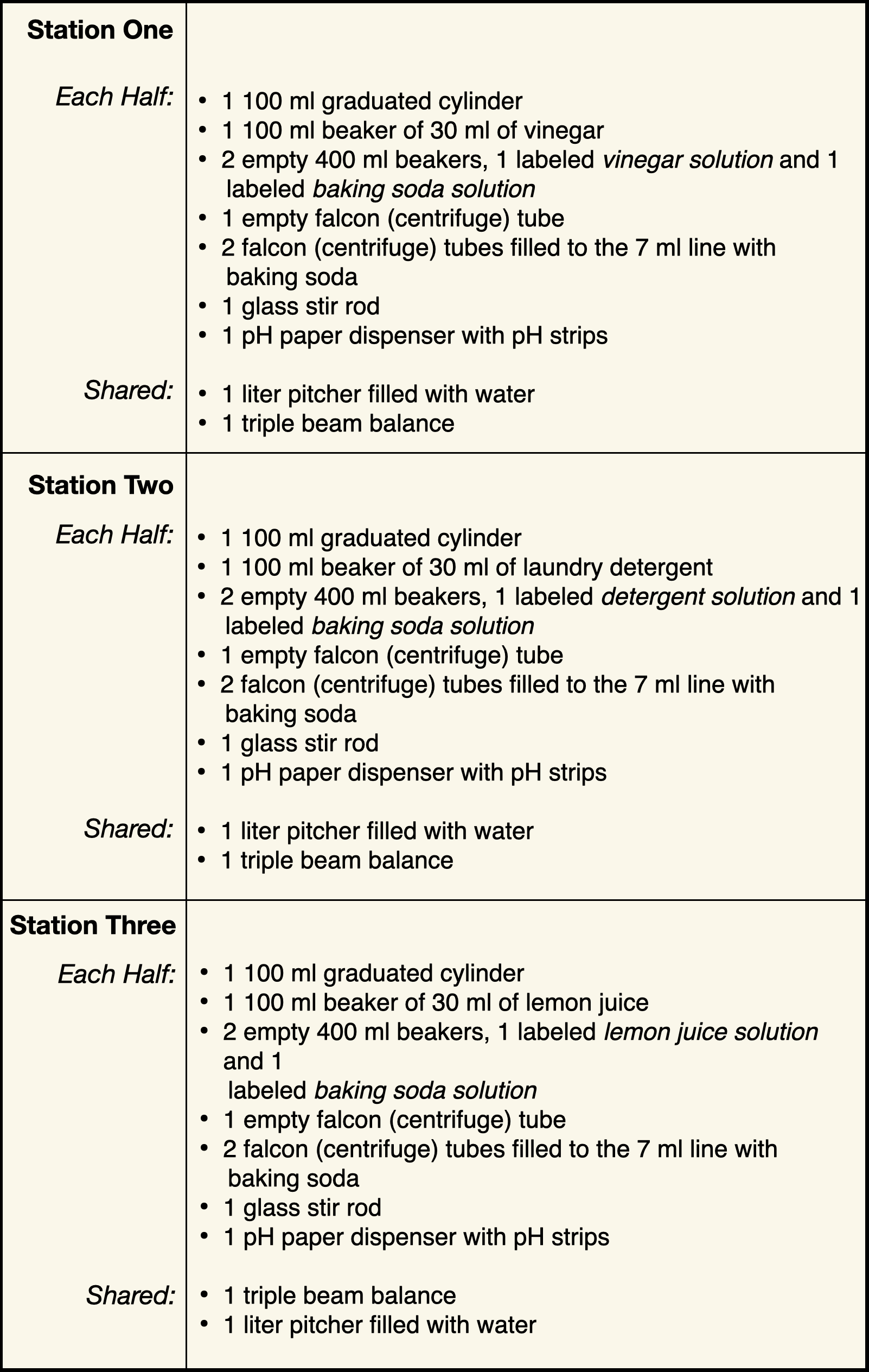
Note: If desired, this Investigation may be divided into two lab experiences. Students may perform through Trials 1 through 5 one day and perform Trials 6 and 7 the following day. If this is the chosen method of implementation, conclude the preparation for Trials 1 through 5 by separating the class into six groups and then begin the experiment. When ready to perform Trials 6 and 7, follow the directions described in steps 4 through 7.
4. Copy the two Investigation Supplement Pages (shown below) located at the end of Investigation 5 Lesson Plans. Cut each sheet into sections so that each group has one piece of paper outlining the directions for their trial.
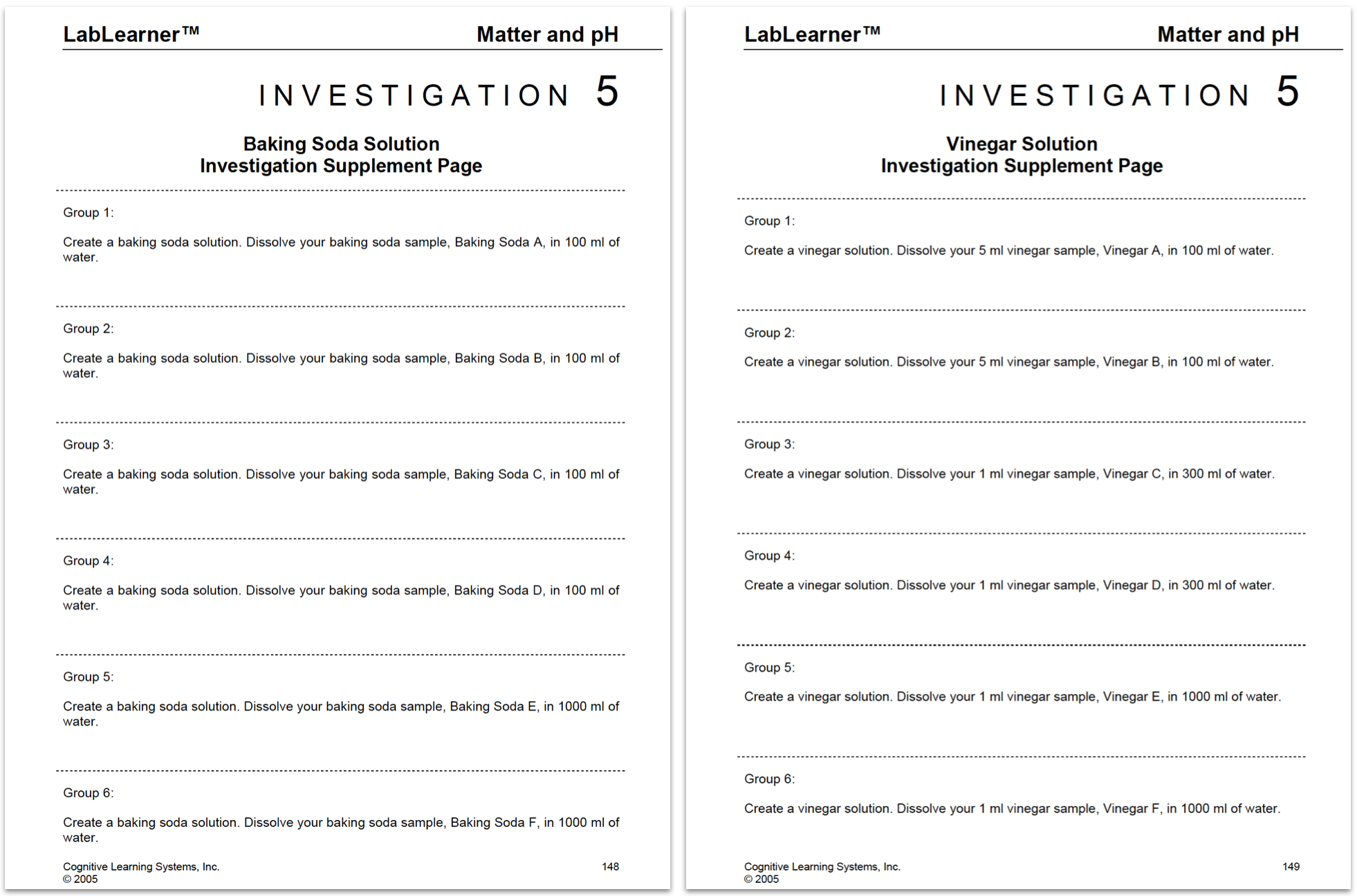
5. Prepare the materials needed for Trial 6 and, if desired, Trial 7 (Optional Extension). For each of these trials, student groups will create solutions of specific concentrations according to the directions on the Investigation Supplement Pages.
a. Fill two 15 ml falcon tubes with 4 g of baking soda by filling them just below the 4 ml line (Trial 6). Label one tube Baking Soda A and another Baking Soda B.
b. Fill four 15 ml falcon tubes with 1 g of baking soda by filling them to the 1 ml line (Trial 6). Label the tubes Baking Soda C, Baking Soda D, Baking Soda E, and Baking Soda F.
c. Fill two 15 ml falcon tubes with 5 ml of vinegar (Trial 7). Label the tubes Vinegar A and Vinegar B.
d. Fill four 15 ml falcon tubes with 1 ml vinegar (Trial 7). Label the tubes Vinegar C, Vinegar D, Vinegar E, and Vinegar F.
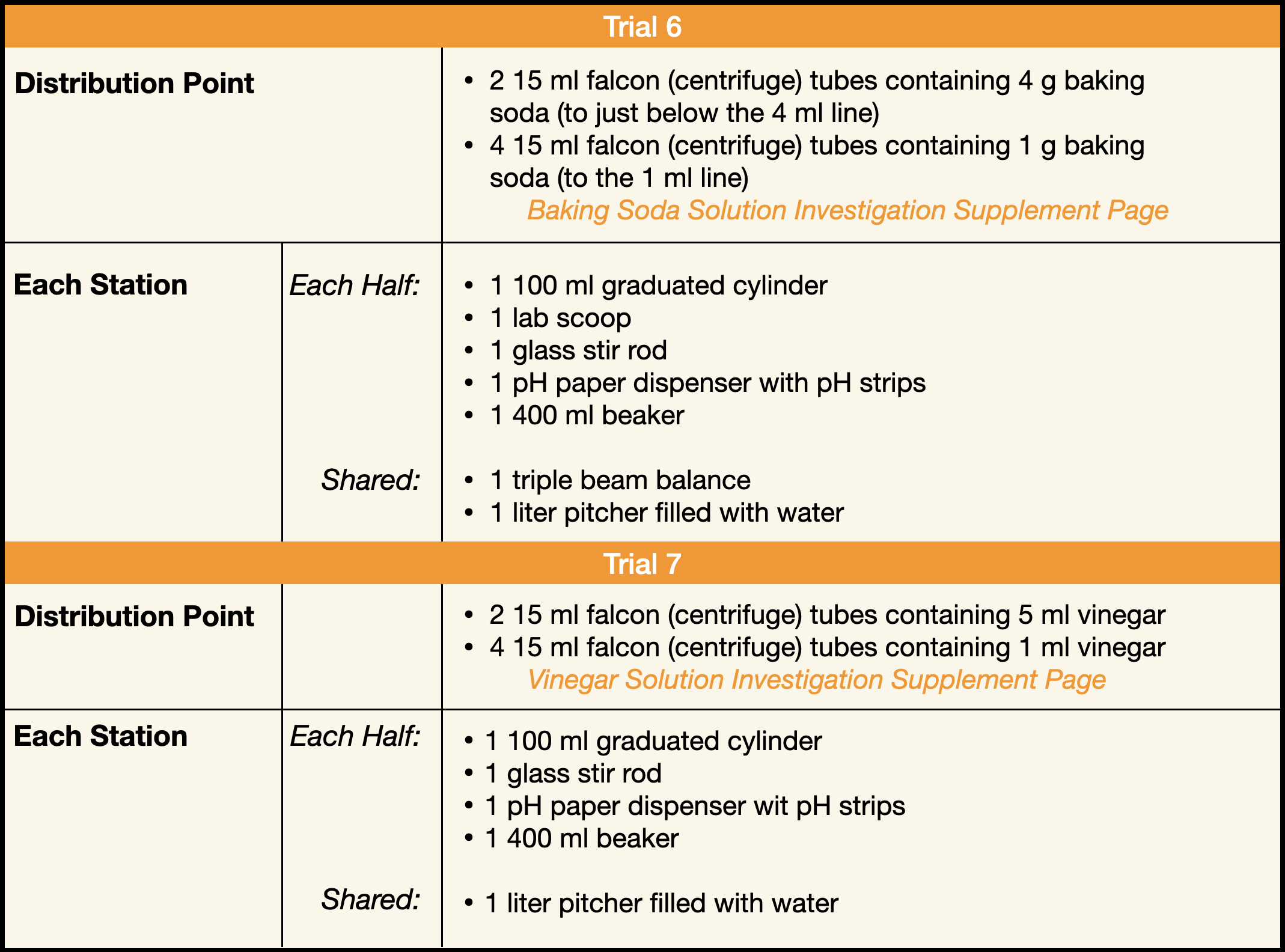
6. Place the materials for Trial 6 and Trial 7 (optional), including the filled falcon tubes and the cut-up Investigation Supplement Pages, at the distribution point. The following table lists all of the materials need for Trials 6 and 7.
Instruction
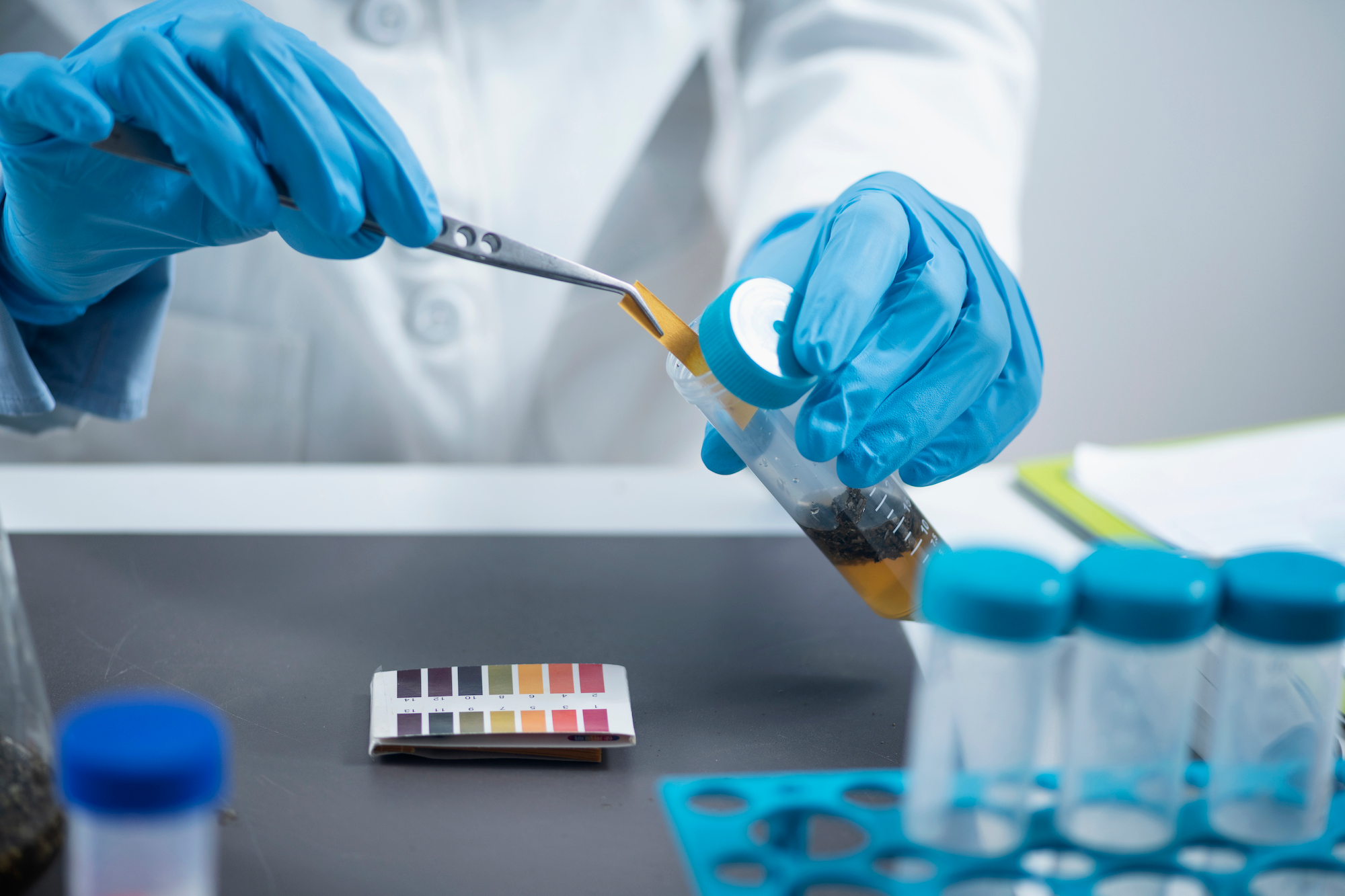
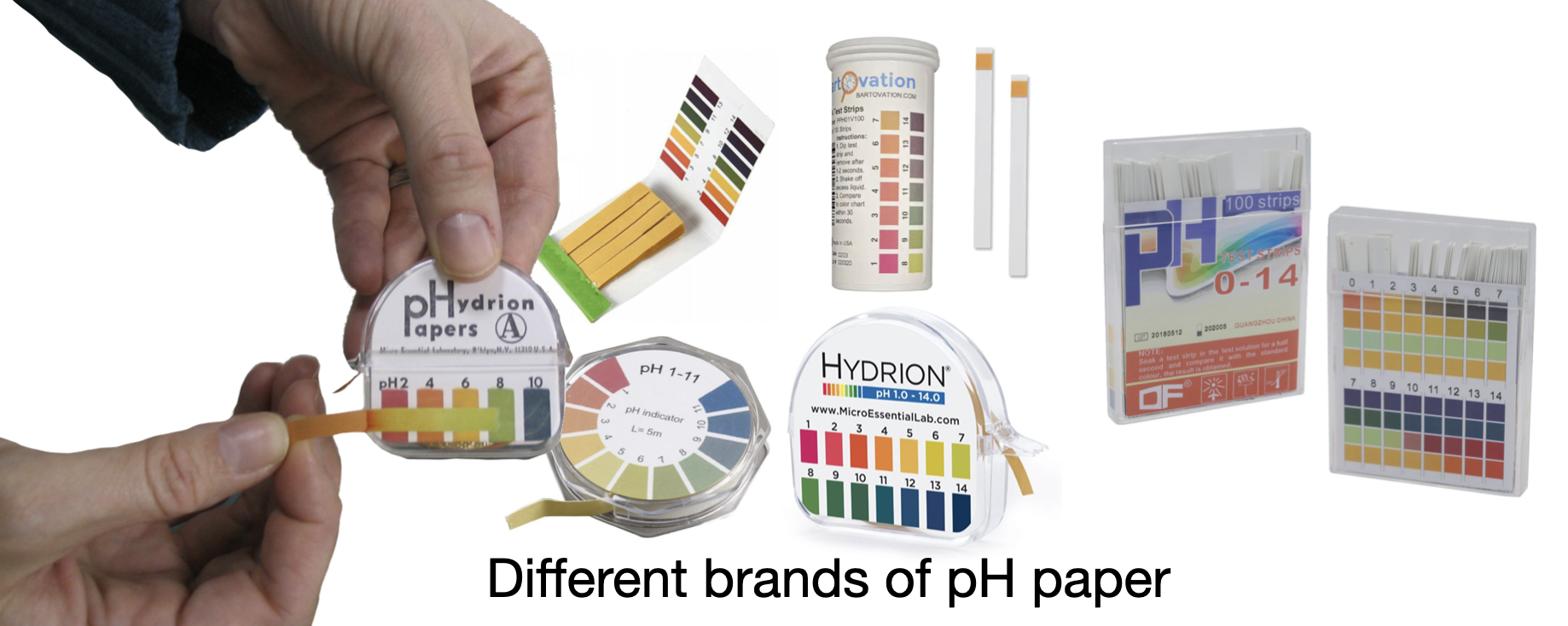
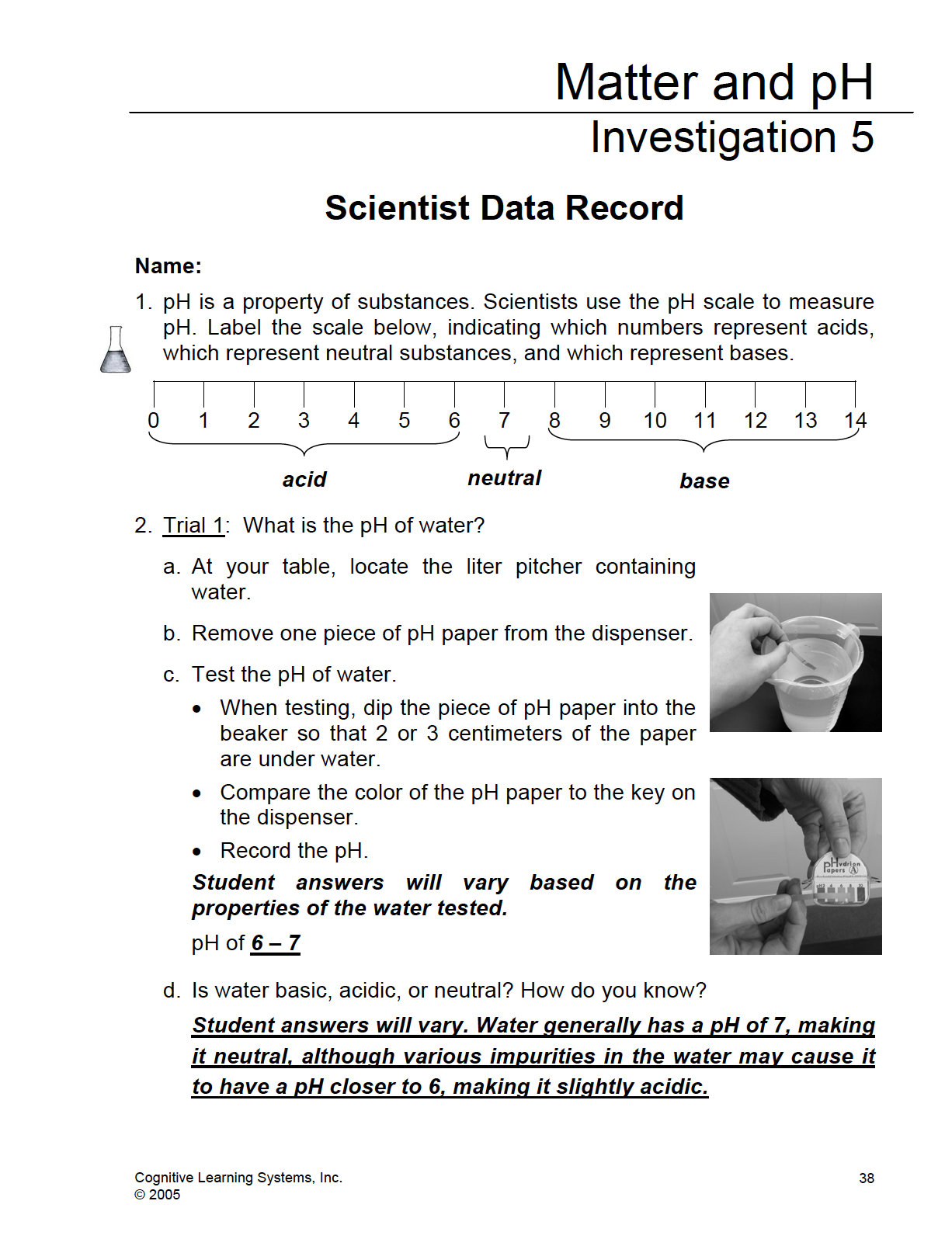
 As a class, review pH. Show students their pH paper in its dispenser. Allow students to observe the color key on the dispenser, noting the 0 to 14 scale. Instruct students to refer to Problem 1 in their Student Data Record. Students should label the numbers on the scale provided as indicative of an acid, a base, or a neutral substance. Students may draw brackets around groups of numbers if desired.
GET FOCUSED
-
Tell students that they will be testing various substances to find if they are strong or weak acids and bases during their laboratory experiments. Tell students that just as height, mass, temperature, and volume are measured using tools, pH is also measured using a science tool.
-
pH can be measured in a variety of ways, such as using pH paper, a pH meter, or chemicals called pH indicators that change color when placed in a basic or an acid. The science tool that students will be using in this investigation is called pH paper.
INVESTIGATE
Trial 1
In Trial 1, students will use pH paper to measure the pH of water. This trial has been designed to help students draw the correlation between the pH of a substance and the terms we use to describe it. As students conduct the trial, they will answer the question:
What is the pH of water?
a. For this experiment, each group of students will remove one piece of pH paper from the dispenser. Students will then dip the paper into the liter pitcher containing water and observe the color change. When dipping, 2 or 3 cm of the paper should be submerged.
b. After dipping the paper into the water, students should compare the color of the paper to the color key on the dispenser and record the pH of the water in problem 2c of the Scientist Data Record.
c. After recording the pH of water, students will determine whether water is acidic, basic, or neutral.
Trial 2-4
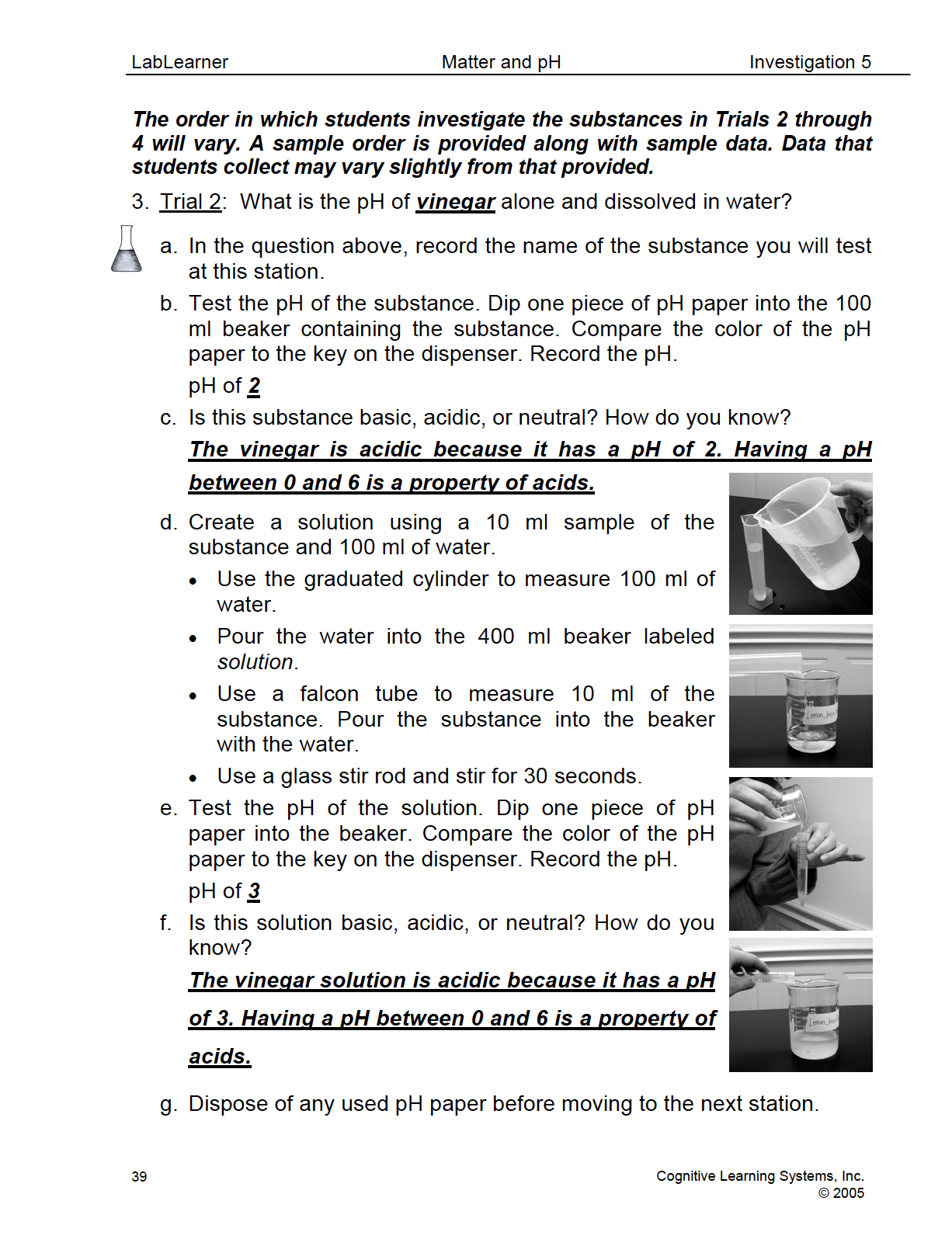
 Trials 2 through 4 guide students in investigating the pH of three different substances: vinegar, laundry detergent, and lemon juice. In addition, students will create a solution of each substance in water and test the pH of the solution. Through these Investigations, students will draw conclusions about whether each substance and each solution is basic, acidic, or neutral. These trials are designed to aid students in answering the question: What is the pH of vinegar, laundry detergent, and lemon juice alone and when dissolved in water?
a. In Trial 2, students will test the pH of the substance at their station. The two groups of students at Station One will test vinegar, those at Station Two will test laundry detergent, and those at Station Three will test lemon juice.
b. Before students begin their Trials, review the process each group will perform at their first station.
- Students should first dip a strip of pH paper into the 100 ml beaker containing the substance.
- They should compare the color of the strip to the color key, and will determine the pH. After recording the pH, they should determine whether the substance is an acid, a base, or a neutral substance.
- After testing the substance, students should create a solution by dissolving 10 ml of the substance in 100 ml of water. They should use the graduated cylinder to measure 100 ml of water and pour the water into the 400 ml beaker labeled with the name of the solution they are creating.
- Students should then use the empty falcon tube to measure 10 ml of the substance. They should pour this sample into the beaker with the water and stir for 30 seconds or until dissolved using the stir rod.
- After creating the solution, students should measure the pH of the solution and determine whether it is basic, acidic, or neutral. The goal of this part of the investigation is to determine how water affects the pH of a substance. During analysis in the Post-Lab lesson, students will conclude that the effect of water on the pH of a substance depends on the properties of the specific solute.
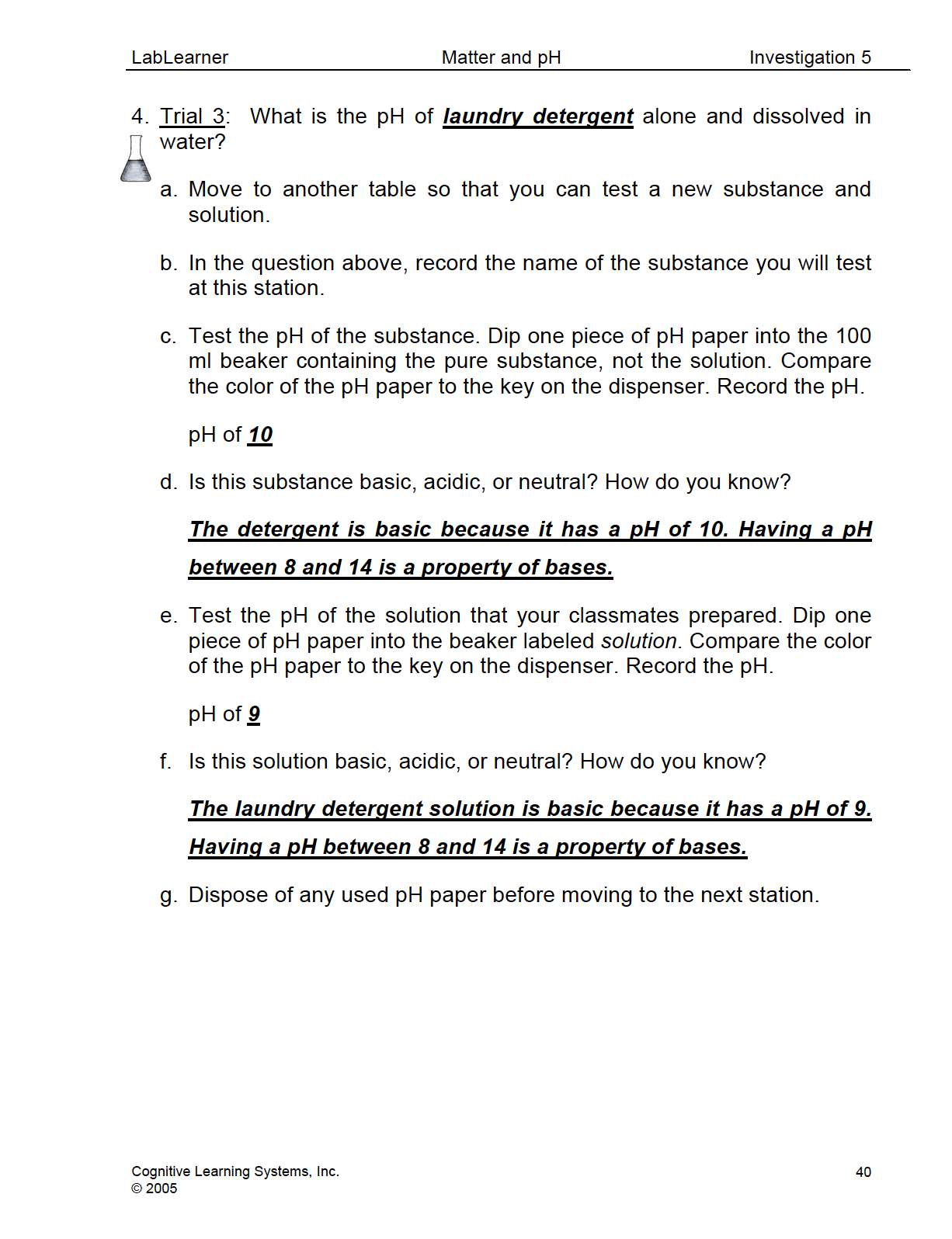
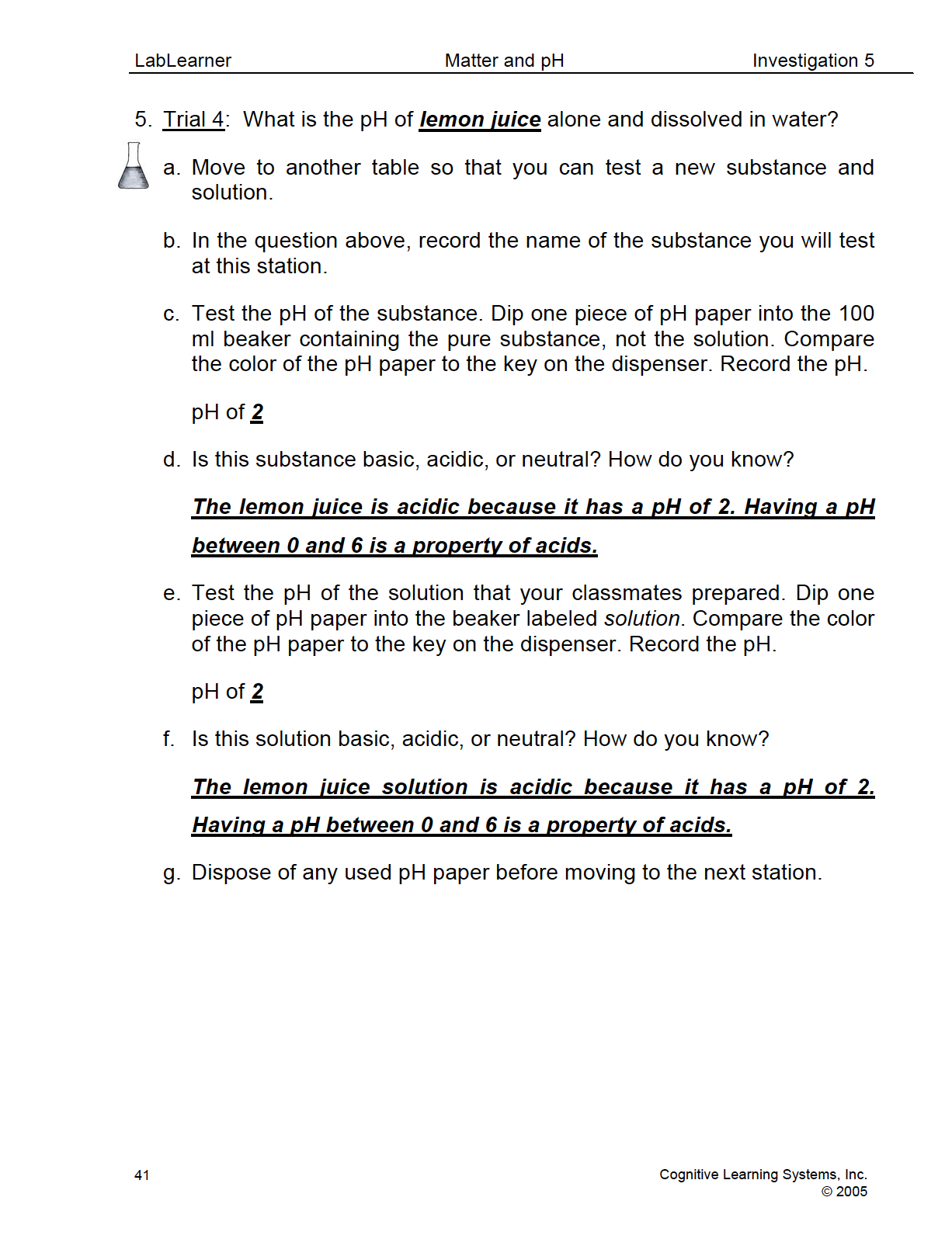
c. After completing Trial 2, each group will move to a different station for Trial 3. Students will rotate again after Trial 3 so that each group has the opportunity to measure and record the pH of vinegar, laundry detergent, and lemon juice.
d. Trials 3 and 4 will be conducted similarly to Trial 2. After students have completed Trial 2, conduct a brief overview of the procedure they will perform during Trials 3 and 4.
- Each group will first measure and record the pH of the substance at their station. It is important that students first test the pH of the pure substance in the 100 ml beaker.
- Instead of creating a solution, students will test the pH of the solution created by their classmates. Students will use this solution to determine whether the solution is acidic, basic, or neutral.
Trial 5
Note: For Trial 5, students will not rotate to a new station. Rather, they will remain at their current station and use the materials provided at that station.
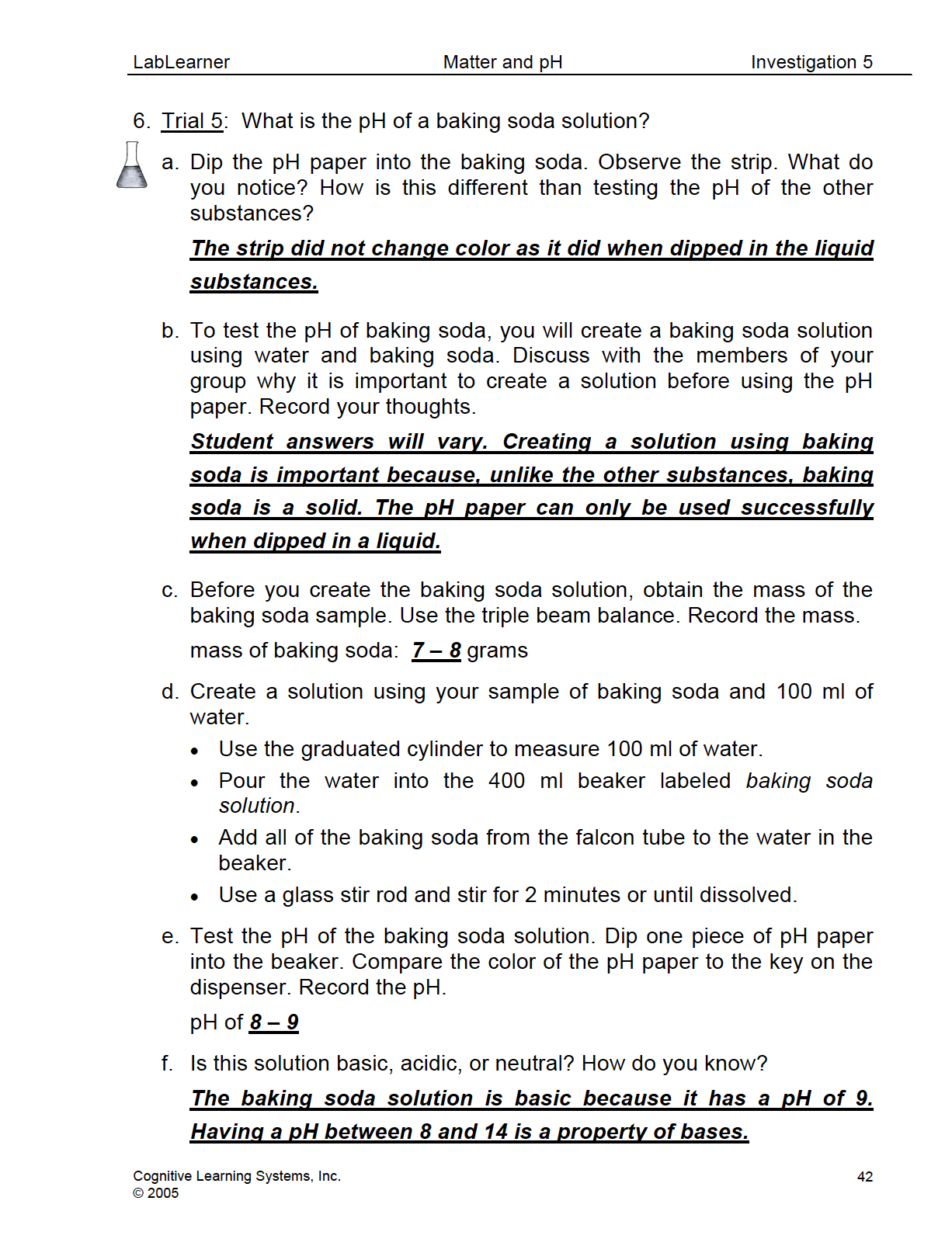
During Trial 5, students will attempt to obtain the pH of baking soda, a solid. In Trials 1 through 4, students were able to obtain the pH of water, vinegar, laundry detergent, and lemon juice using the pH paper. Students will find during this trial that a specific property of these substances enabled their pH to be measured—they were all liquids.
When posed with the problem of finding the pH of baking soda, students will be asked to attempt to obtain the pH of the baking soda in its solid form. During this exploration, students will find that the pH of baking soda cannot be measured as long as the baking soda is a solid.
Students will then create a baking soda solution using approximately 8 g of baking soda in 100 ml of water. After creating the solution, students will measure the pH and determine whether the baking soda solution is acidic, basic, or neutral and will discuss why creating a solution is important for the determination of the pH of baking soda. During this Trial, students will focus on the question: What is the pH of a baking soda solution?
Note: If desired, this Investigation may be divided into two lab experiences. Students may perform Trials 1 through 5 one day and perform Trials 6 and 7 the following day. If this is the chosen method of implementation, end the lab experiments at this point and allow students to clean up the lab and return the materials and equipment to their assigned locations. If desired, the following materials may be left on the lab tables for the completion of Trials 6 and 7: two (2) graduated cylinders, two (2) glass stir rods, two (2) pH dispensers, one (1) triple beam balance, and one (1) liter pitcher filled with water.
Trial 6
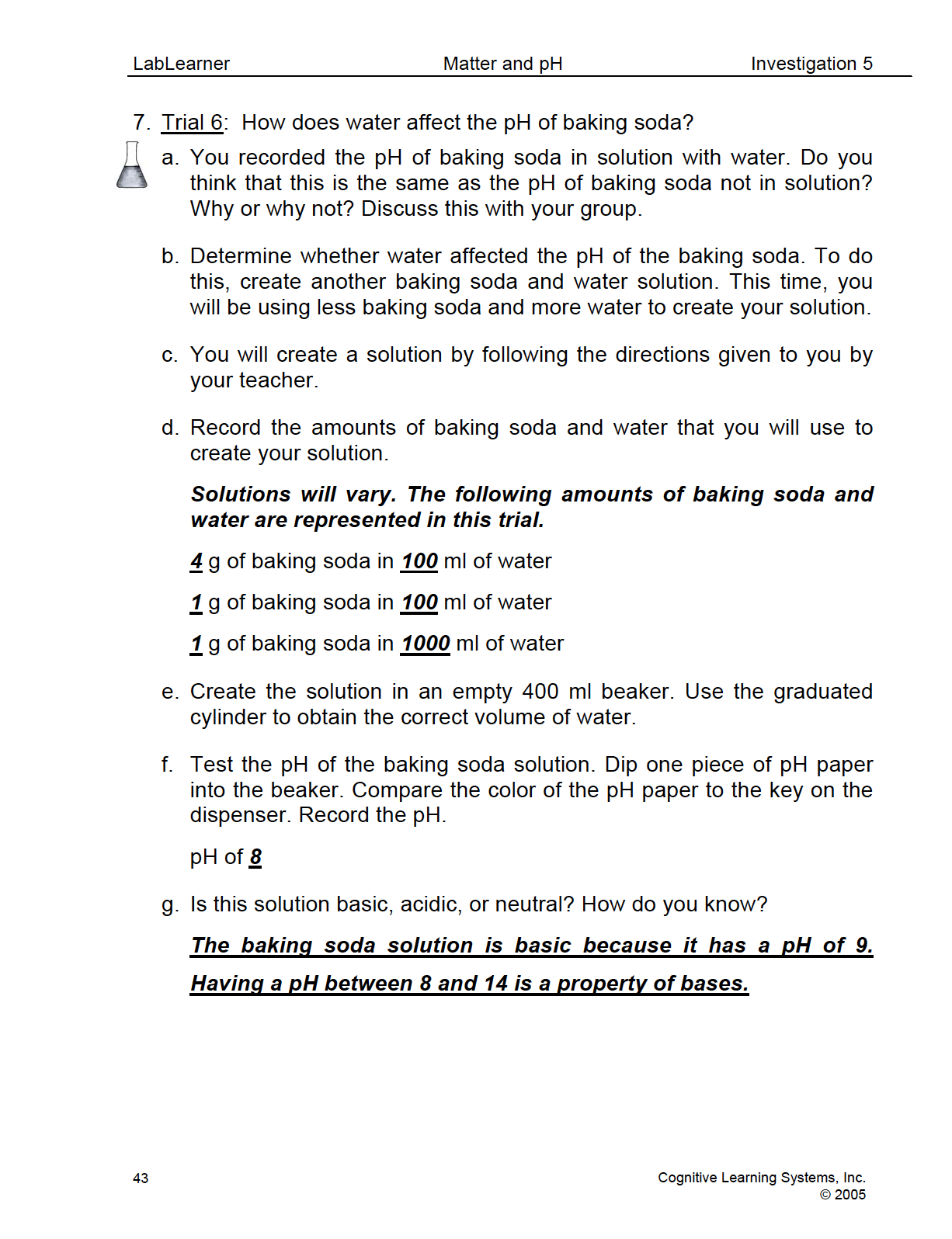
Students will further investigate baking soda by determining the effects of increasing water and decreasing baking soda when creating a baking soda solution. This Trial is designed to illustrate to students the effect that the addition of water has on the pH of baking soda, as many students may wonder whether the pH of the baking soda solution from Trial 5 represented the pH of the baking soda or the water. Students will find that the pH of a baking soda solution remains at or around 8 even when a very small amount of baking soda is added to a large amount of water, indicating that the pH of the baking soda solution is representative of the pH of the baking soda. Students will use this Trial to answer the question: How does water affect the pH of baking soda?
a. Before students begin this Trial, distribute the Investigation Supplement Pages strips so that each group has instructions to create a specific concentration of baking soda solution. As you distribute the Investigation Supplement Pages, also give each group one falcon (centrifuge) tube containing the appropriate baking soda sample. Groups 1 and 2 each receive one (1) falcon tube containing 4 g baking soda (filled to just below the 4 ml line, labeled baking soda A and B). Groups 3, 4, 5, and 6 receive one (1) falcon tube containing 1 g baking soda (filled to the 1 ml line, labeled baking soda C, D, E, and F).
b. Instruct students to use the triple beam balance to obtain the mass of the baking soda sample contained in the falcon tube.
c. Next instruct students to read and follow the directions on the Investigation Supplement Page slip to create their baking soda solution.
___________________________________________
Trial 7 (Optional Extension)
This investigation follows directly from students’ conclusions from Trial 6. In Trial 6, students found that the pH of a baking soda solution remains constant, even when a very great amount of water is added. This led students to conclude that the addition of water does not greatly affect the pH of baking soda.
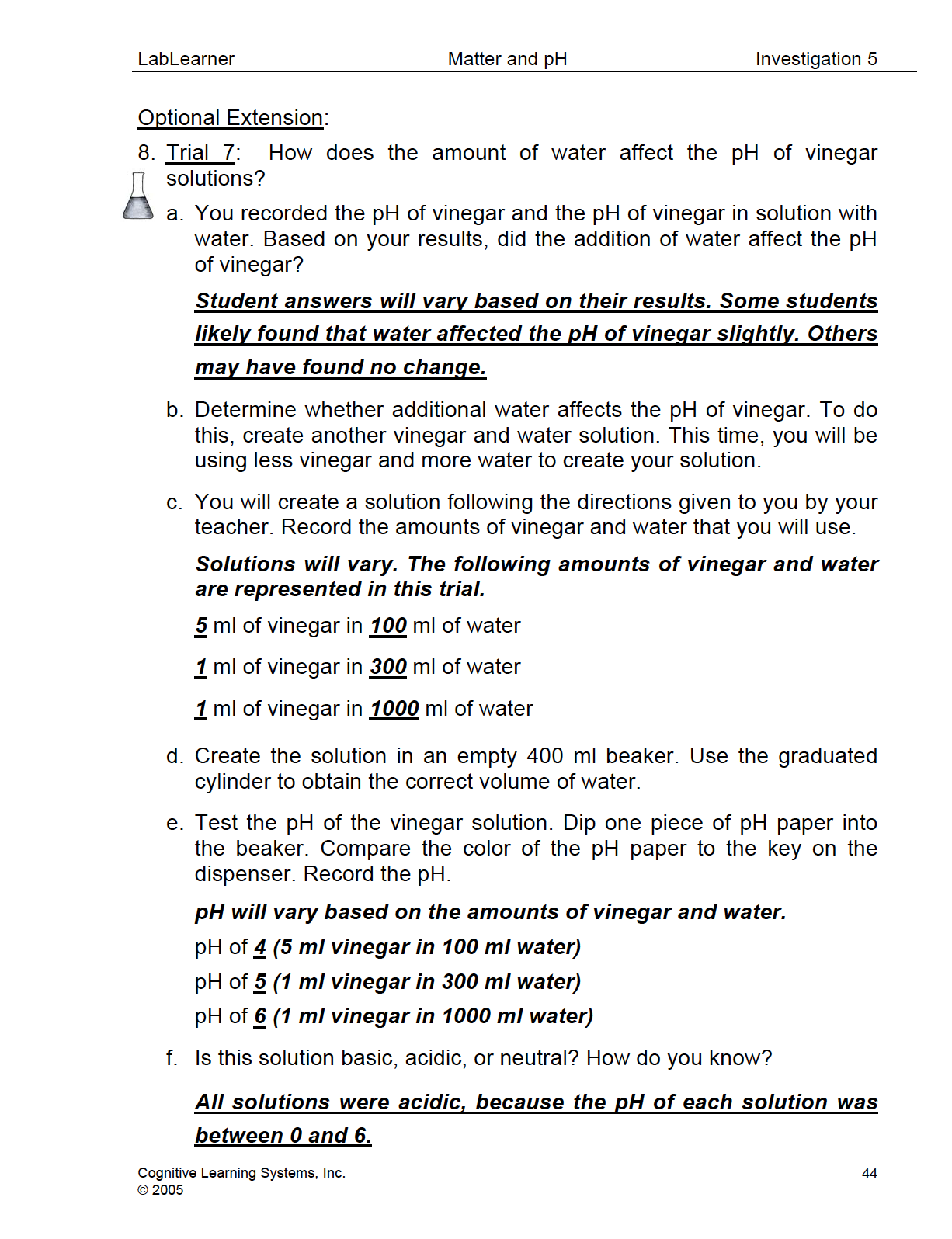
During this activity, students will create vinegar and water solutions of various concentrations. By doing this, students will find that vinegar is more greatly affected by the addition of water than is baking soda. The pH of the vinegar solution moves more toward the pH of water as additional water is used to create the solution. However, students will also find that adding water to vinegar yields a solution with a pH between that of water and vinegar, but never a solution with a basic pH. Thus, students should begin to understand that dilution of some pure substances produces more noticeable changes in pH than others. Dilution with water can change the strength of the acid or base but does not convert an acid into a base or vice versa.
By performing this Trial, students will answer the question: How does the amount of water affect the pH of vinegar solutions?
a. Before students begin this Trial, distribute the Investigation Supplement Pages strips so that each group has instructions to create a specific concentration of vinegar solution. As you distribute the Investigation Supplement Page strips, also give each group one falcon tube containing the appropriate vinegar sample. Groups 1 and 2 each receive one (1) falcon tube containing 5 ml vinegar. Groups 3, 4, 5, and 6 receive one (1) falcon tube containing 1 ml vinegar.
b. Instruct students to read and follow the directions on the Investigation Supplement Page to create their vinegar solution.

How Does Alka Seltzer Work?
Antacids like Alka Seltzer contain both citric acid (like in lemon juice) and sodium bicarbonate (baking soda). Try mixing baking soda and lemon juice together and you will get a million bubbles of carbon dioxide gas!
KEYS
CLEAN UP
Let students know your expectations for clean-up. Ask them to clean up.