
Teacher Portal:
Chemistry, Matter and Interactions
Investigation 4 – PreLab
 ASK WHY
There are five major branches of chemistry today – organic chemistry, analytic chemistry, physical chemistry, inorganic chemistry, and biochemistry. Organic chemistry is a brank of chemistry that focuses upon molecules and compounds that contain the carbon atom. Since living organisms contain many thousands of types of carbon-containing molecules, organic chemistry is sometimes associated with compounds derived from living organisms.
BRANCH OUT
According to the American Chemical Society, “inorganic chemistry is concerned with the properties and behavior of inorganic compounds, which include metals and minerals.
“While organic chemistry is defined as the study of carbon-containing compounds, inorganic chemistry is the study of the remaining (i.e., not carbon-containing) subset of compounds.
“Many inorganic chemists work in industry, but they also work in academic institutions and government labs. Inorganic chemists who work in government say their time is increasingly spent writing grant proposals and competing for research money”.
PRINT IT
Use your browser to download a printable PDF as help during the slide presentation and to make additional notes. In your browser, go to File > Print and then choose to save as PDF.
MINDSET
This Investigation is designed to:
- promote understanding that interactions of matter may result in either physical or chemical changes.
- introduce students to the ten common signs of chemical change.
- demonstrate that chemical changes result in the formation of new substances.
- promote understanding that some of the ten common signs of chemical change may also be present during physical changes.
- introduce students to the process scientists use to determine whether interactions of matter are physical or chemical changes.
SCIENTIST’S GLOSSARY
1. Chemical change: A change in which a new substance or substances are produced.
2. Physical change: A change in which no new substance is produced but the original substance changes form.
3. Solute: The substance that changes its state when a solution is created or that is in the smallest amount in a solution.
4. Solution: A mixture of two or more substances that is the same throughout the mixture.
5. Solvent: The substance in a solution that does not change its state when a solution is created or that is present in the largest amount.
BE PREPARED
Watch the Investigation 4 Teacher Video to prepare for the PreLab.
SET FOR SUCCESS
- Tell students that they will continue the Chemistry, Matter and Interactions CELL.
- Ask students to share the kinds of things they might learn in this Investigation.
Begin the PreLab Concept Slides to start students on their learning journey. Then watch the Pre-Lab Student Video afterward as a class.
NAVIGATE IT
Once the slide presentation is launched
- use your left and right arrows to advance or go back in the slide presentation, and
- hover your mouse over the left edge of the presentation to get a view of the thumbnails for all the slides so that you can quickly move anywhere in the presentation.
- Click HERE to launch the slide presentation for the CELL.
SHARE IT
SLIDE VCHEM4-pre-1
Investigation Four continues students’ exploration of the interactions of matter by demonstrating how chemical changes can occur when different types of matter interact.
Begin this part of the investigation with a brief review of what was learned about how matter interacts in Investigation Three.
- Remind students that in Investigation Three they learned that different types of matter interact to form mixtures. Ask students: What do we call a mixture that is the same throughout? Students should indicate that a mixture that is the same throughout is called a solution.
- Ask students: Do all mixtures form solutions? Students should indicate that all mixtures do not form solutions.
______________________________________________
SLIDE VCHEM4-pre-2
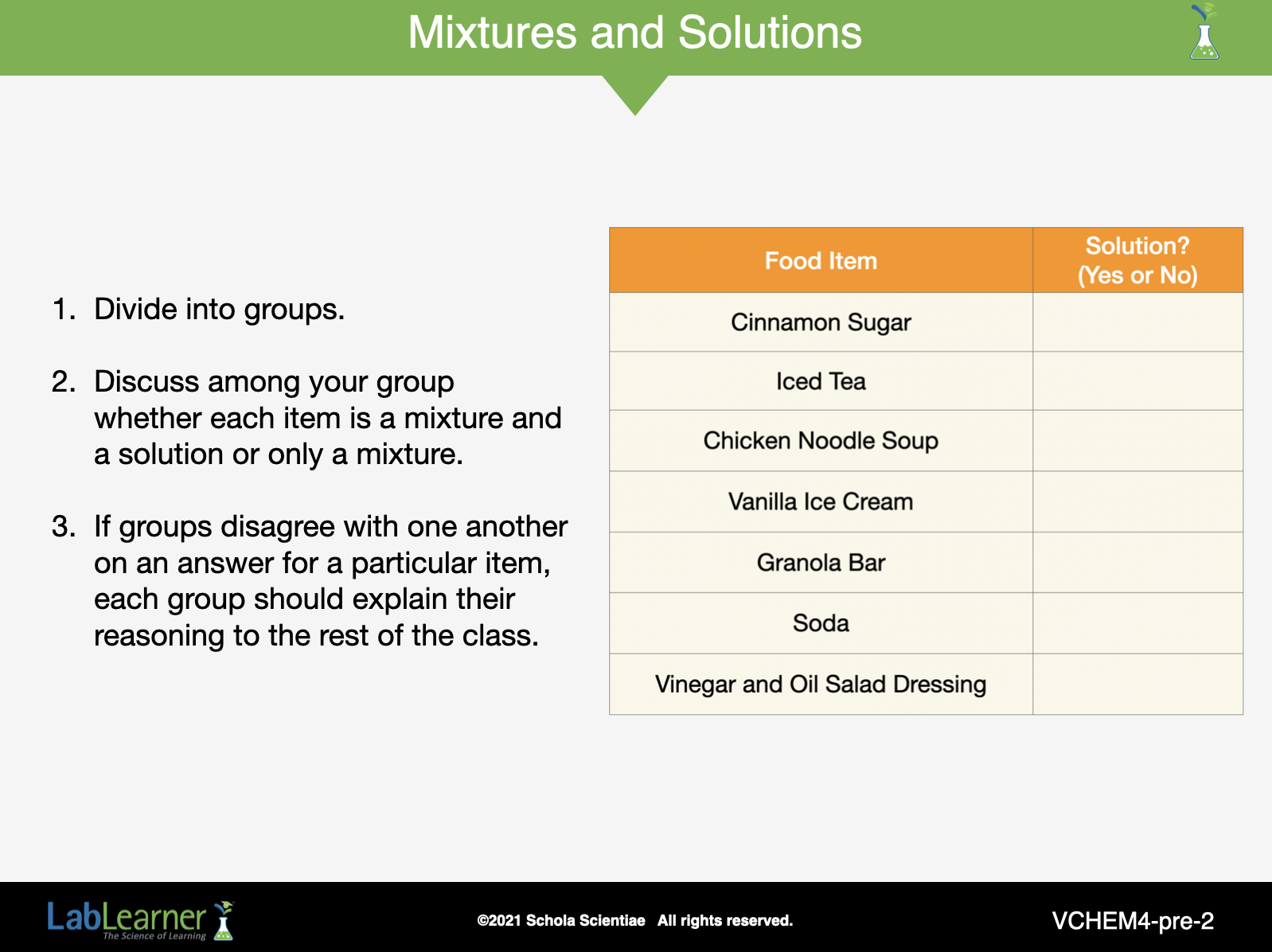
Divide students into groups.
- Direct students to discuss among their groups whether each item is a mixture and a solution or only a mixture.
- After allowing time for discussion, ask students to indicate which items qualify as solutions.
- If groups disagree with one another on an answer for a particular item, encourage each group to explain their reasoning to the rest of the class.
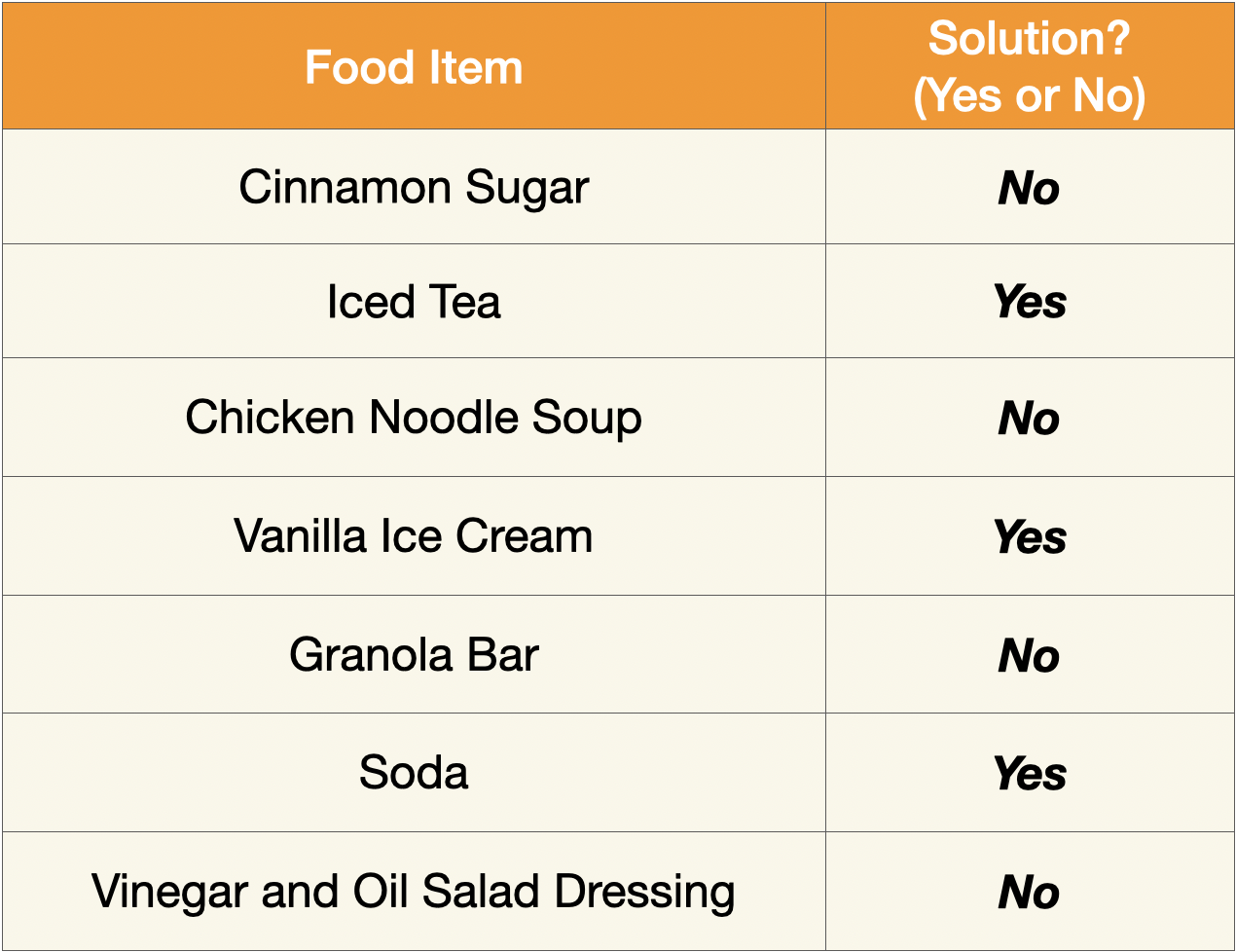
- Cinnamon sugar is a mixture of solids. Cinnamon may coat the sugar crystals but both solids are still clearly visible.
- Iced tea is a solution because the tea (and sugar if sweetened) has been dissolved into the water, leaving a uniform mixture.
- Chicken noodle soup is a mixture because the noodles and chicken are clearly visible in the broth.
- Vanilla ice cream is a solution because the sugar has been dissolved into the liquid ingredients, which are all miscible with one another.
- The oats and other solids are clearly definable in a granola bar, and therefore it is a mixture.
- All the ingredients of a soda have dissolved into a uniform solution.
- Vinegar and oil salad dressing is a mixture, as vinegar and oil are not miscible, although they may briefly appear blended after vigorous shaking.
______________________________________________
SLIDE VCHEM4-pre-3
Explain to students that they will continue their study of matter, solutions, and interactions of matter by exploring the differences between physical and chemical changes in matter.
Direct students’ attention to the terms physical change and chemical change in their Scientist’s Glossary.
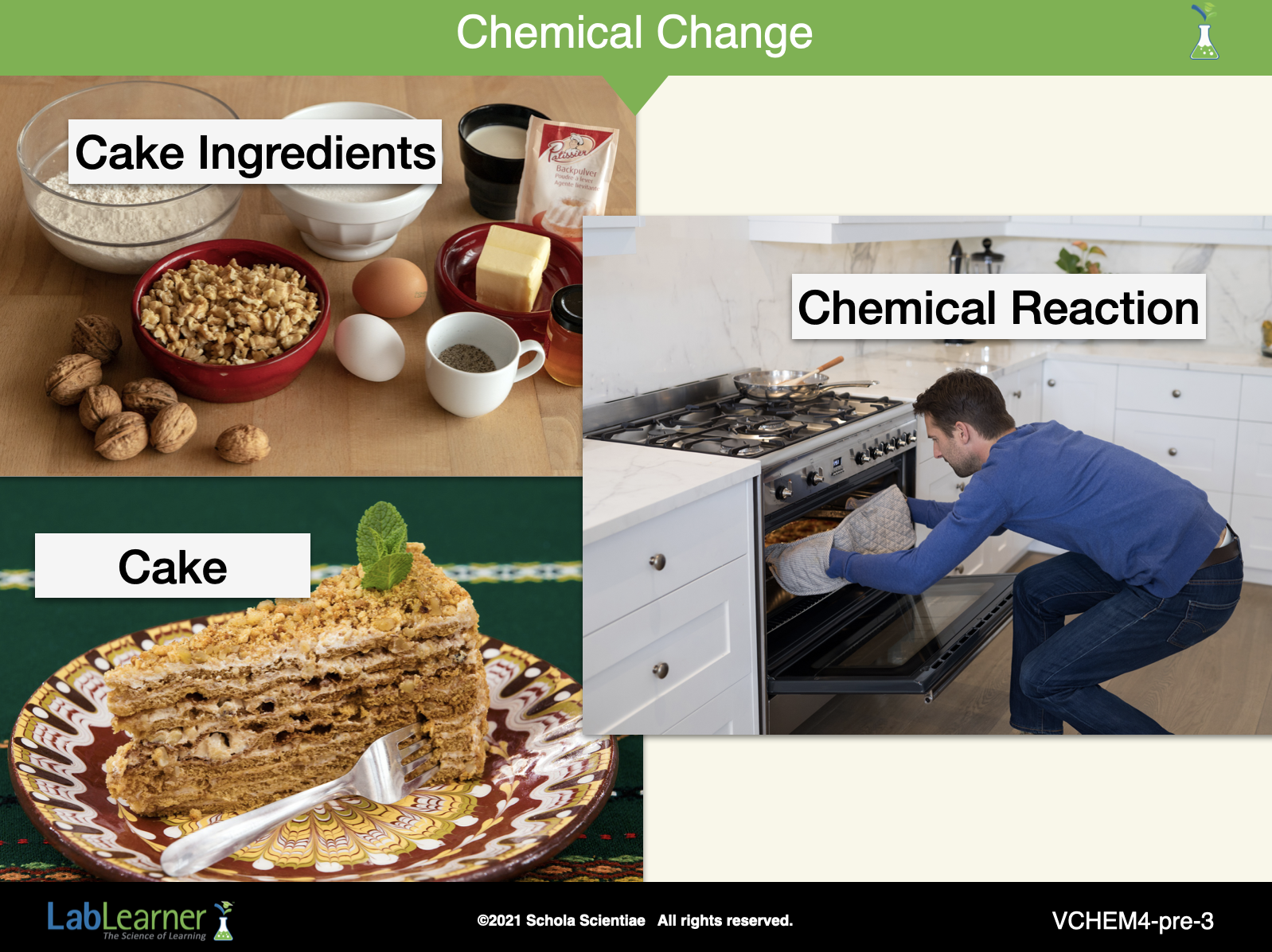
Explain that when a physical change occurs the substance or substances involved do not change chemically, only their state of matter or form changes. For example, when sugar is dissolved in water it simply changes from a solid to a liquid state and can be recovered if the water is evaporated away. When paper is cut, its form changes but its chemical composition remains the same. In contrast, when a chemical change occurs new substances are created.
Ask students: How can you tell if a new substance has been created? Student answers will vary. Students may suggest a change in the substance occurs, or a change in color.
Suggest the following examples to help students understand chemical change in terms of previous knowledge: Milk turning sour or cake ingredients becoming a cake after baking.
Explain to students that each example mentioned was the result of a chemical change and that a characteristic of a chemical change occurring is that the original substances cannot be recovered.
______________________________________________
SLIDE VCHEM4-pre-4
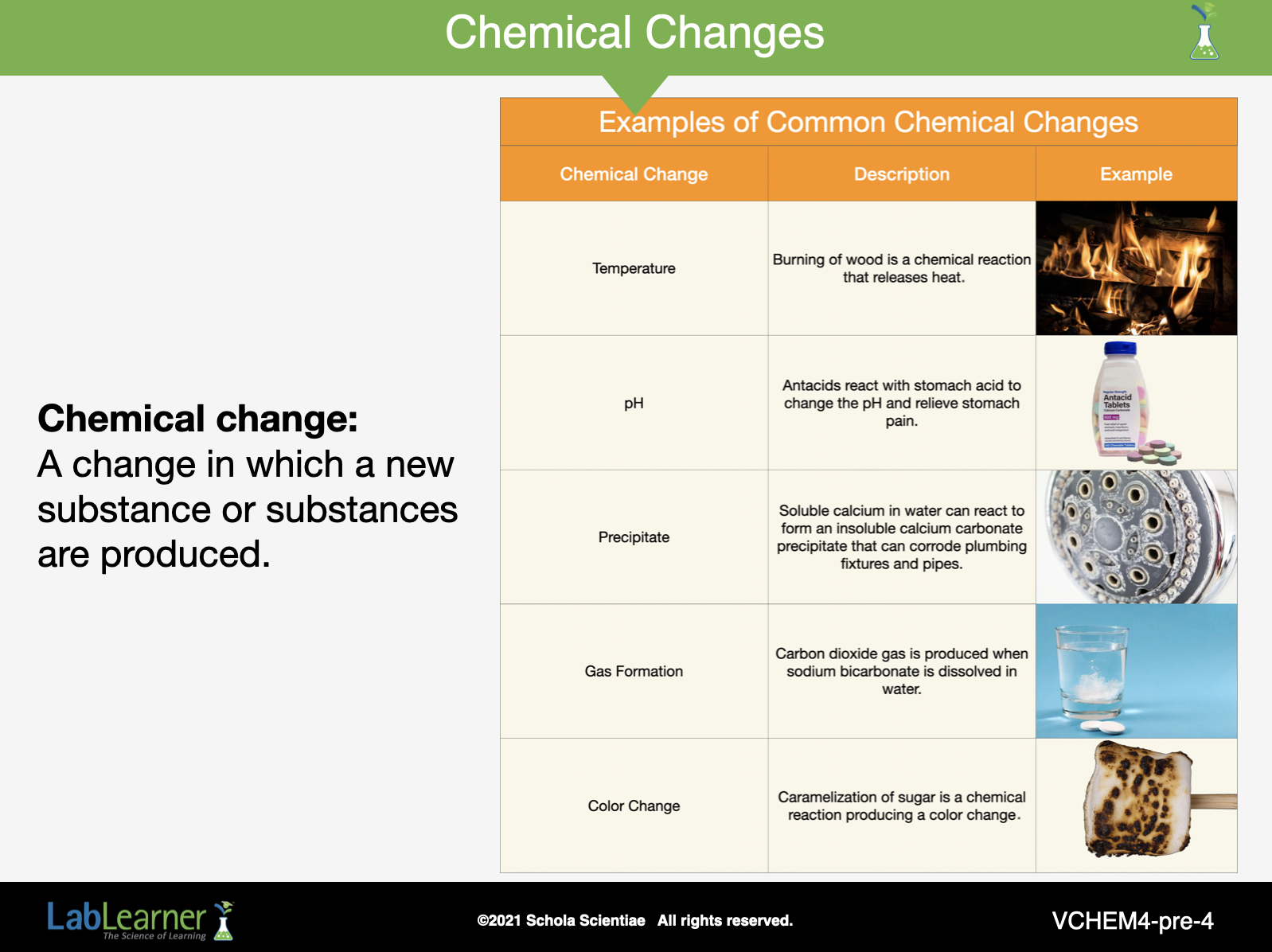
Tell students that a chemical change can be detected when the combination of two or more substances creates a new substance by focusing on the properties of the substance. Explain to students that chemists look for at least one of ten common signs when deciding if a chemical change has occurred:
- A change in volume.
- A change in temperature.
- A change in color.
- A change in electrical conductivity.
- A precipitate forms (a chemical falls out of solution as a solid or a liquid).
- A gas is produced.
- A change in pH.
- A change in chemical or physical properties occurs.
- A change in odor.
- A change in melting or boiling point.
______________________________________________
SLIDE VCHEM4-pre-5
Explain to students that sometimes more than one of these common signs occurs when a chemical change takes place. For example, a change in volume might occur when a gas is produced or a precipitate forms.
Ask students: Which do you think you observed in Investigation Three, physical or chemical changes? Student answers will vary.
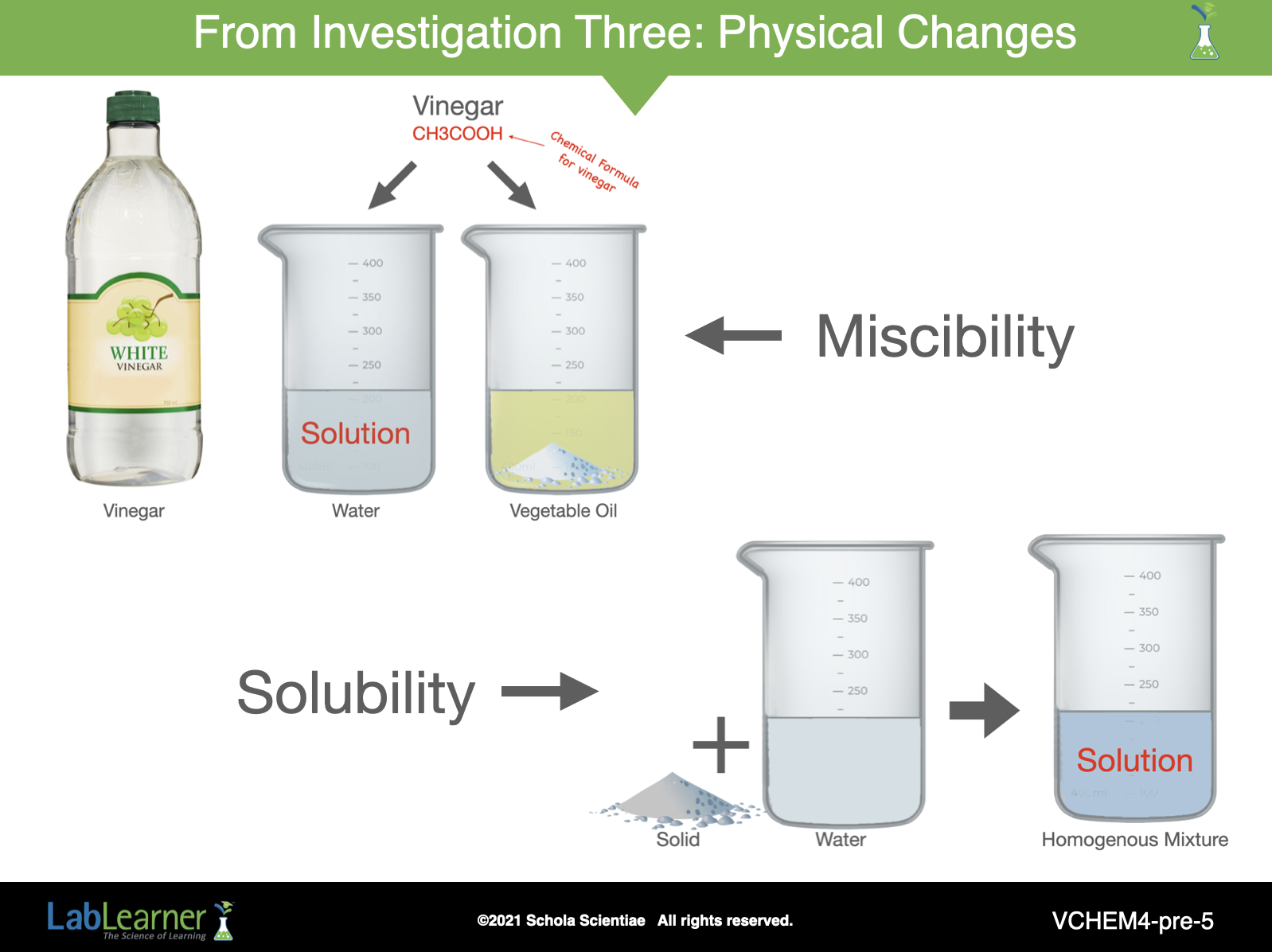
Explain that they observed a physical change in salt when salt dissolved in water because only its form changed. Salt was a solid and when dissolved became a liquid. As in the sugar example earlier, if the water was evaporated, the salt would remain behind as a solid.
Tell students that in Investigation Three they did not create any new substances when they mixed their solutions. Remind students that two solutions were created during Investigation Three: saltwater and vinegar water. The salt dissolved into the water but did not create a new substance in doing so. Vinegar was miscible in water, creating a weaker solution of vinegar. However, no new substance was created even though the vinegar was no longer visible.
Ask students: Is it possible to create new substances when you mix solutes and solvents? Student answers may vary. Tell students this is one of the questions they will investigate in the lab.
______________________________________________
SLIDE VCHEM4-pre-6
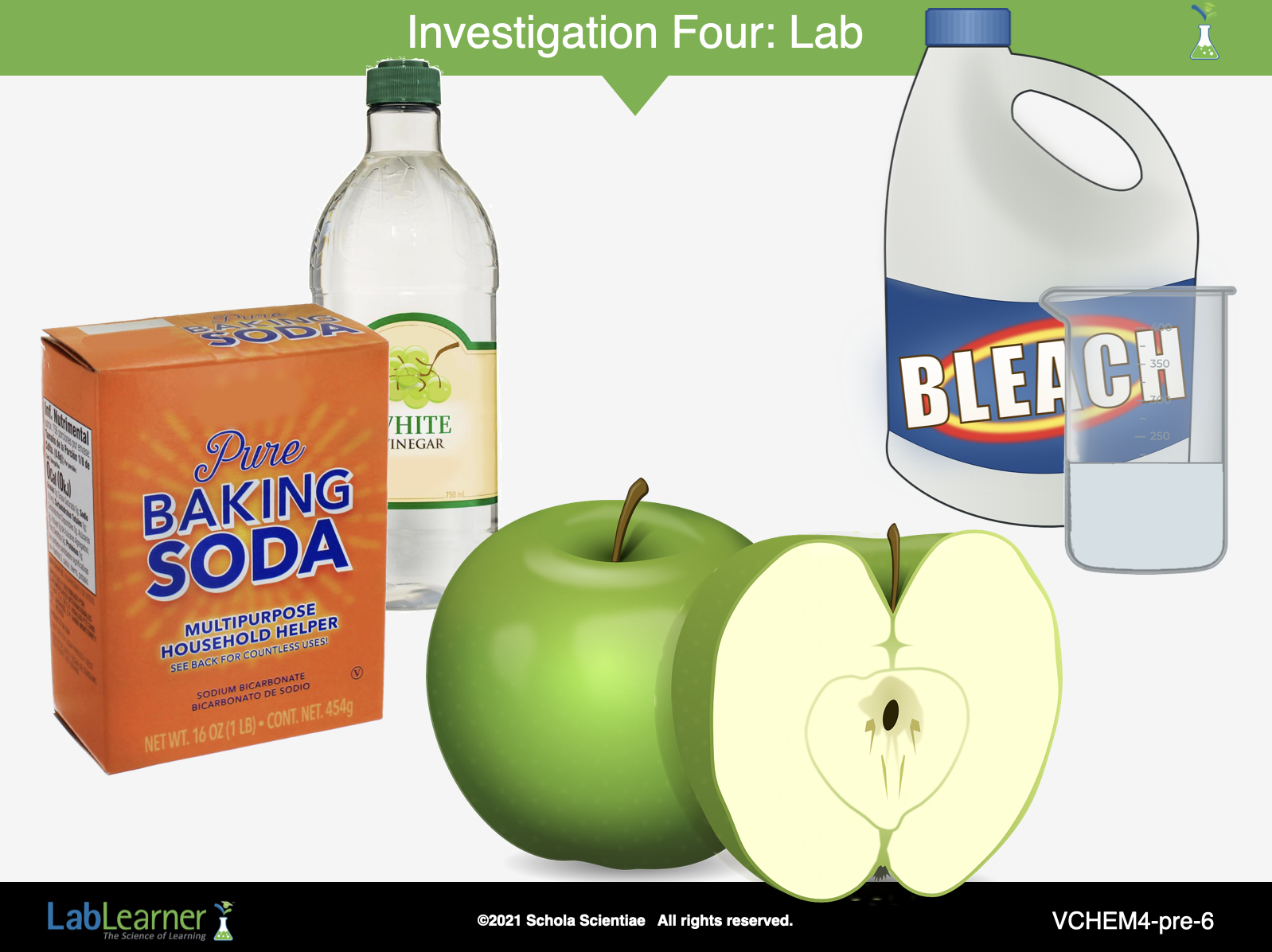
Explain to students that one way they can help answer the question is to focus on three signs of a chemical change: an unexpected change in color, a change in temperature, and the production of a gas.
Tell students that in order to better understand these changes they will conduct several trials that show these changes. These include:
-
- Browning of an apple slice
- Production of gas by combining baking soda and vinegar
- A change in temperature caused by adding bleach to water
______________________________________________
SLIDE VCHEM4-pre-7
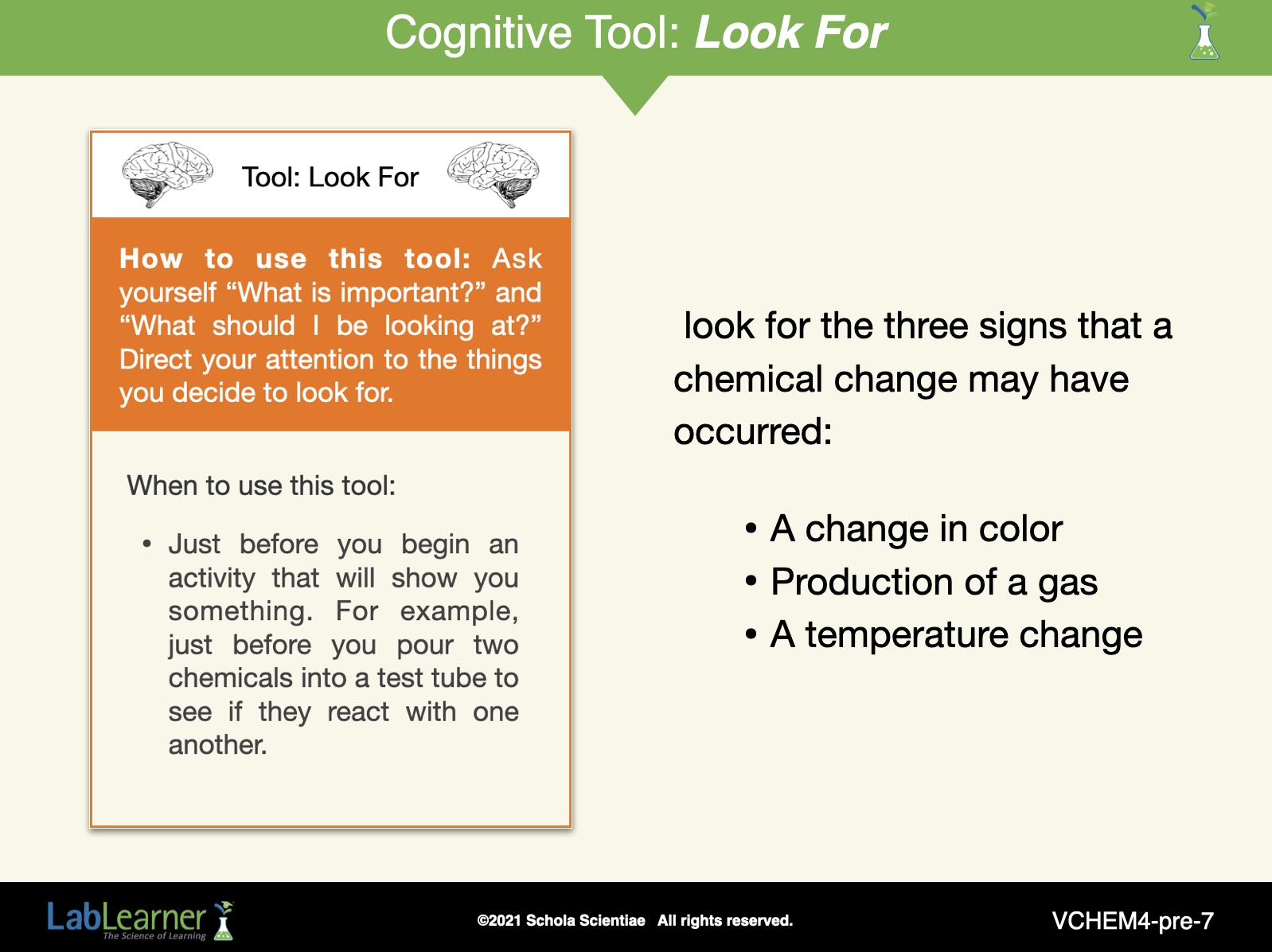
Tell students that as they prepare for their laboratory experiments you would like them to use the Cognitive Tool, Look For.
Look For should be used before students begin activity that will demonstrate something. Students should ask themselves, “What is important?” and “What should I be looking at?” to help direct their attention toward important experimental outcomes.
In their lab experiments, students should remember to look for the three signs that a chemical change may have occurred:
- A change in color
- Production of a gas
- A temperature change
Ask students: Why do you think it will be important to look for the signs of a chemical change? Students should indicate that knowing what to look for will help them be more aware of their observations and will help them to remember the results of their experiments.
Student Video
Watch the Investigation 4 Student Video after Share It presentation to prepare for the PreLab.