Teacher Portal:
Chemistry, Matter and Interactions
Investigation 4 – PostLab
 ASK WHY
There are five major branches of chemistry today – organic chemistry, analytic chemistry, physical chemistry, inorganic chemistry, and biochemistry. Organic chemistry is a brank of chemistry that focuses upon molecules and compounds that contain the carbon atom. Since living organisms contain many thousands of types of carbon-containing molecules, organic chemistry is sometimes associated with compounds derived from living organisms.
BRANCH OUT
According to the American Chemical Society, “inorganic chemistry is concerned with the properties and behavior of inorganic compounds, which include metals and minerals.
“While organic chemistry is defined as the study of carbon-containing compounds, inorganic chemistry is the study of the remaining (i.e., not carbon-containing) subset of compounds.
“Many inorganic chemists work in industry, but they also work in academic institutions and government labs. Inorganic chemists who work in government say their time is increasingly spent writing grant proposals and competing for research money”.
PRINT IT
Use your browser to download a printable PDF as help during the slide presentation and to make additional notes. In your browser, go to File > Print and then choose to save as PDF.
NAVIGATE IT
Once the slide presentation is launched
- use your left and right arrows to advance or go back in the slide presentation, and
- hover your mouse over the left edge of the presentation to get a view of the thumbnails for all the slides so that you can quickly move anywhere in the presentation.
- Click HERE to launch the slide presentation for the CELL.
SHARE IT
SLIDE VCHEM4-post-1
Begin this part of the investigation by asking students several questions about the experiments they conducted in the lab:
What did you do in the lab? Student answers will vary. Students should indicate that they observed ice melt, water boil, water, and apple slices change color, gas production when they mixed baking soda and vinegar, and increases in the temperature of the water when adding bleach. Accept all answers.
Why do you think you conducted each experiment? The experiments were conducted to better understand physical versus chemical changes and the signs that signify chemical change.
Can you summarize what you learned about the three common signs of chemical changes, chemical changes, and physical changes? Student answers may vary.
______________________________________________
SLIDE VCHEM4-post-2
Ask students: What did you do in the lab? Student answers will vary. Students should indicate that they observed ice melt, water boil, water, and apple slices change color, gas production when they mixed baking soda and vinegar, and increases in the temperature of the water when adding bleach.
Ask students: What were the three signs of chemical change you focused on in the lab? The three signs of chemical change that were focused on in the lab were gas production, color change, and temperature change.
- Explain that in order to summarize their results, students will need to organize their data.
- Divide students into six cooperative groups and assign each group one Trial from the lab.
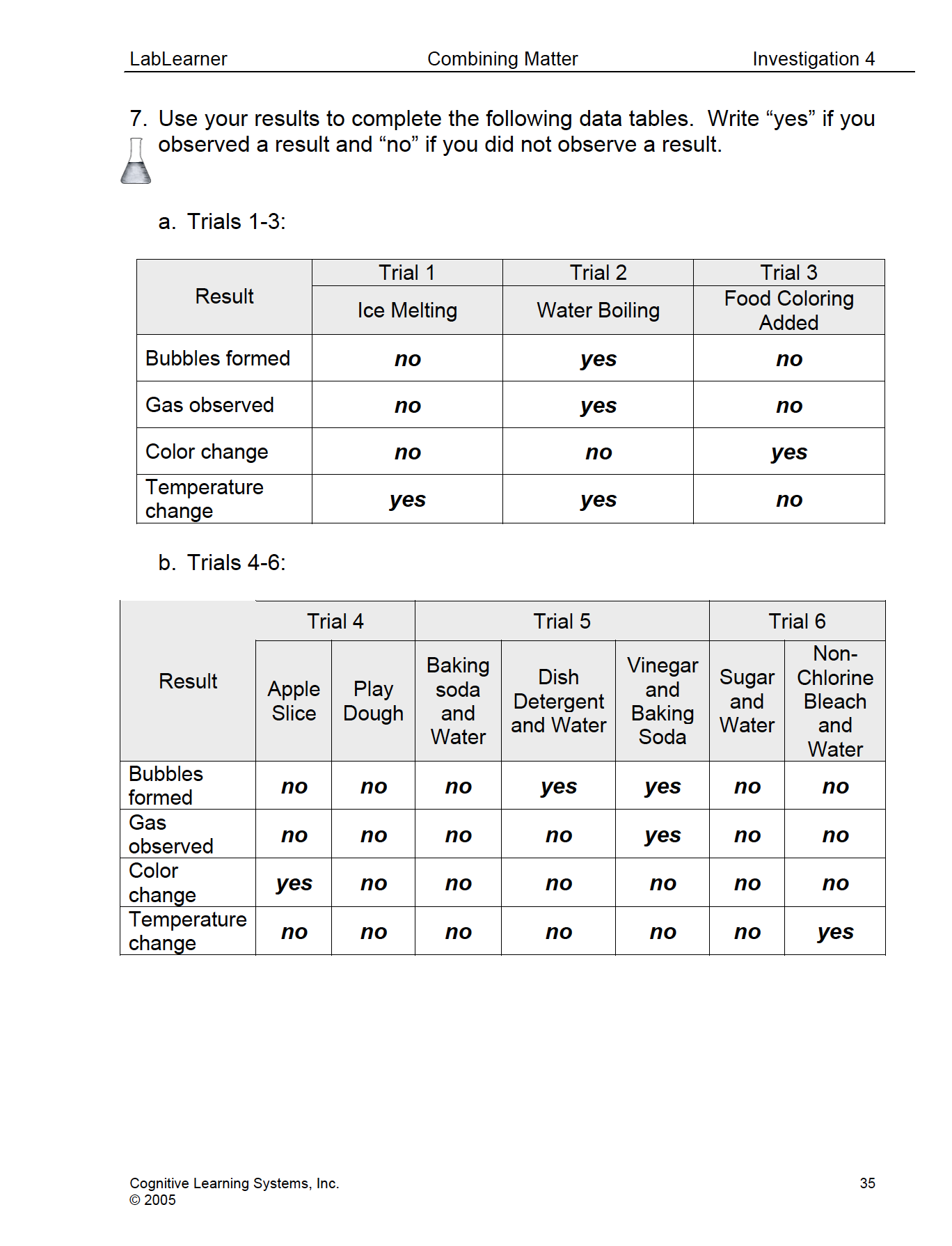
a. Explain that each group will be responsible for reviewing a trial and determining whether they observed the three signs of chemical change during that trial that were discussed during the investigation: gas production, unexpected color change, and change in temperature.
b. After students review their observations, they should record their answers in Problem 7 of their Student Data Record. Tell students that they will have approximately 10-15 minutes to complete their review of the Trial. Explain that they will use the class reviews to write their Summary.
______________________________________________
SLIDE VCHEM4-post-3
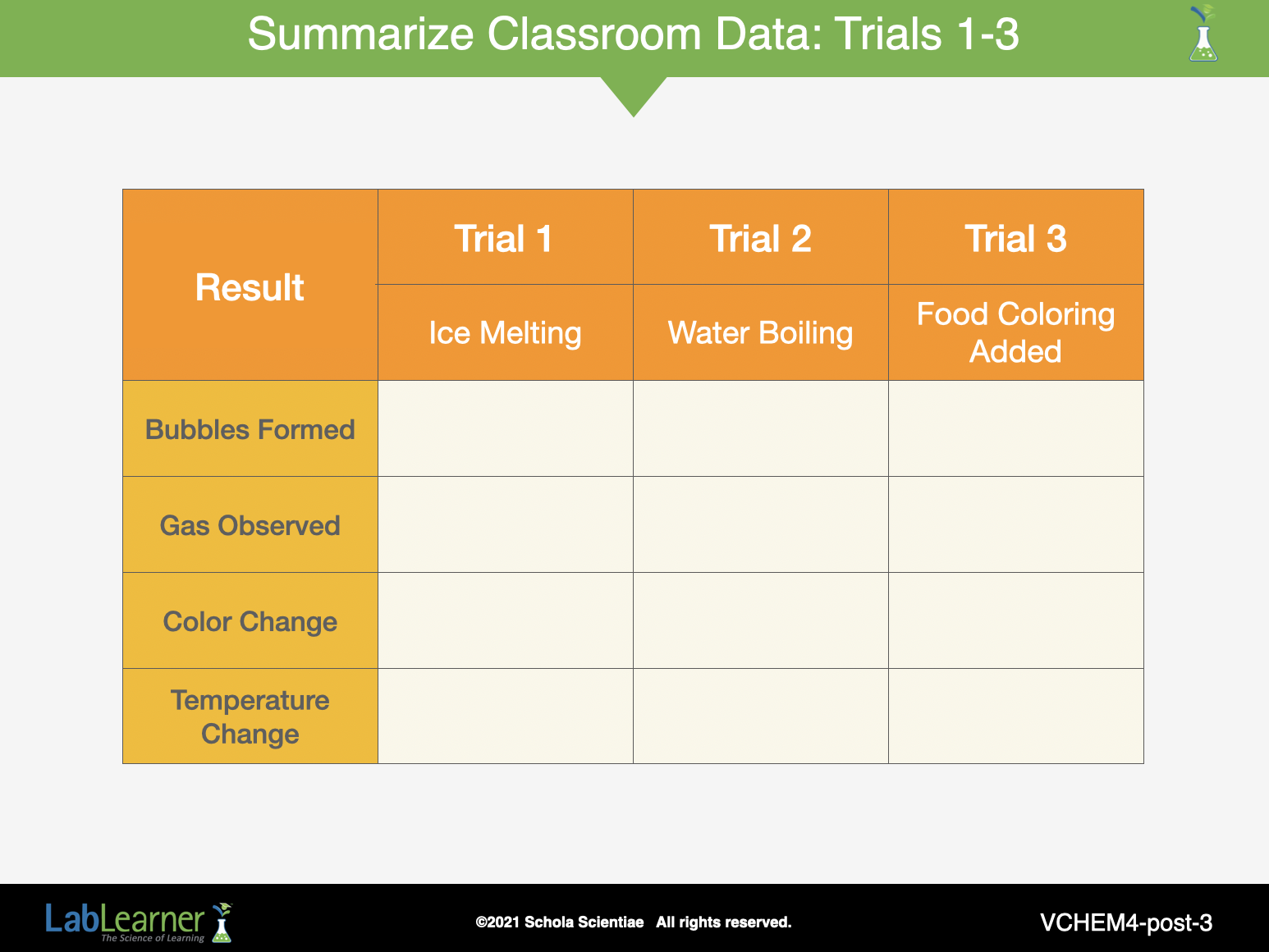
After students have had an opportunity to complete their group discussions, review the results of each Trial as a class.
Encourage students to record the results of the other groups’ Trials as the discussion progresses so that all students have a complete summary of the results. Use the completed Tables and Summaries to assist students in reaching a consensus during the discussion.
Below are likely student observations and summaries for Trials 1 through 3:
- Bubbles were easily observed forming as the water boiled, as was the gas (steam) being produced.
- The addition of food coloring caused the water to change color.
- Students should have been able to measure a temperature change in the melting ice and should indicate a temperature change occurred when the water boiled even though the change was not measured, based on previous knowledge of how water responds to the addition of heat.
______________________________________________
SLIDE VCHEM4-post-4
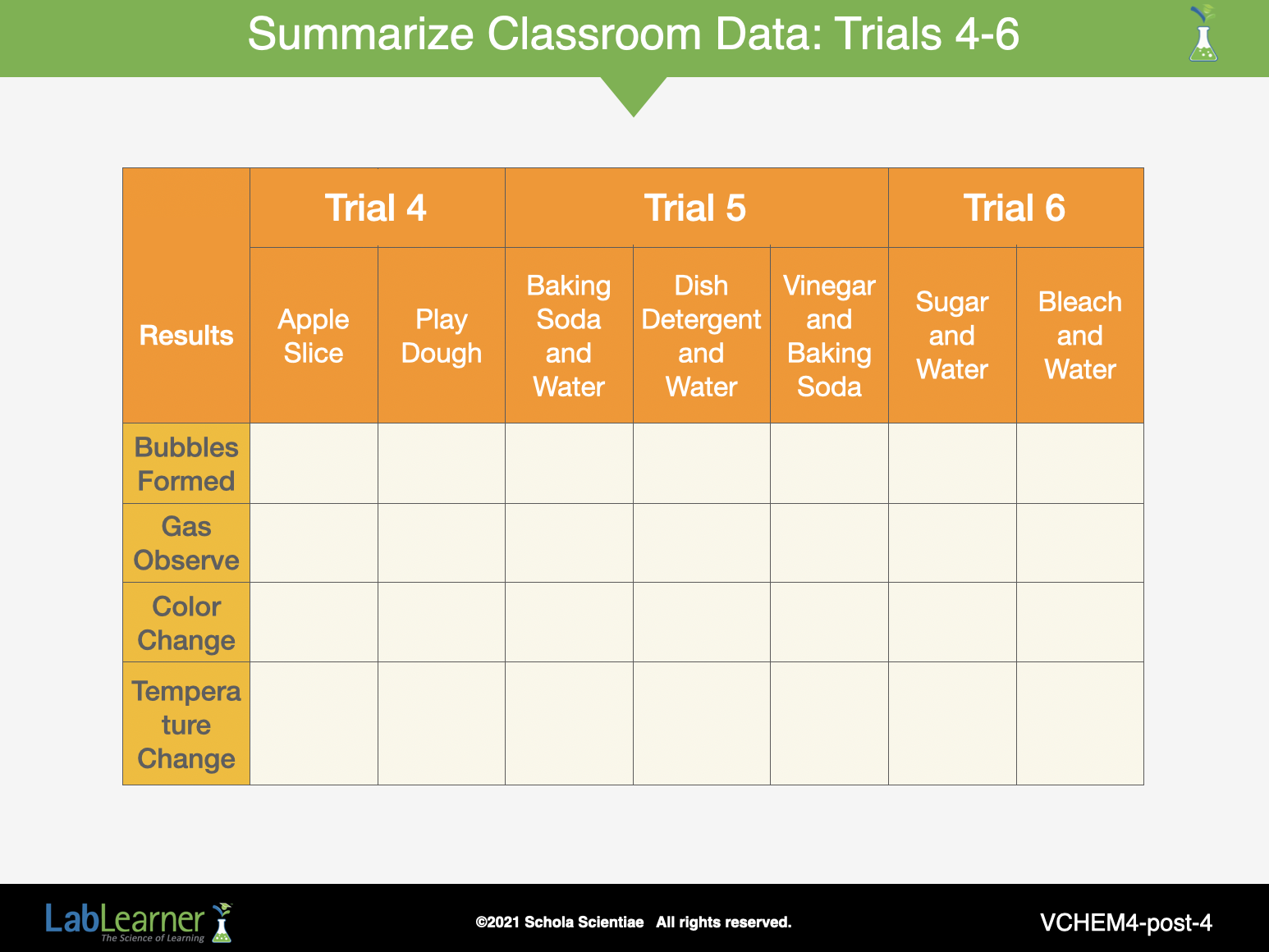
Below are likely student observations and summaries for Trials 4 through 6:
- Students should indicate that neither bubbles nor gas formed when water was added to baking soda.
- Bubbles formed but no gas was produced when water was added to dish detergent.
- Bubbles formed and gas was produced in the baking soda and vinegar solution.
- A color change occurred on the apple slice when the apple browned during Trial 4, but no color change occurred on the play dough slice.
- There should have been a definite temperature change when non-chlorine bleach was added to the water, but no temperature change should have been observed when sugar was added to the water.
______________________________________________
SLIDE VCHEM4-post-5
Remind students that the trials they conducted included both physical and chemical changes.
1. Ask students: Were there any Trials you conducted that were not accompanied by one of the three signs of a chemical change? There were no trials conducted that were not accompanied by one of the three signs of a chemical change.
2. Ask students: If all of the trials you performed had either a change in temperature, production of bubbles or a color change, how could you determine which was a physical change and which was a chemical change? How do you think scientists answer this question? Student answers may vary.
3. Explain that scientists are often able to determine whether a chemical or physical change occurred because they are familiar with examples of physical changes. When they see a common sign of a chemical change, they first ask themselves, “Is this an example of a physical change I already know?” If it is not, they then inspect the reaction more closely for additional signs of chemical change.
4. Students may need assistance in understanding this approach. In order to help students with this new approach tell them that they will try this approach with the three signs they observed in the lab.
______________________________________________________
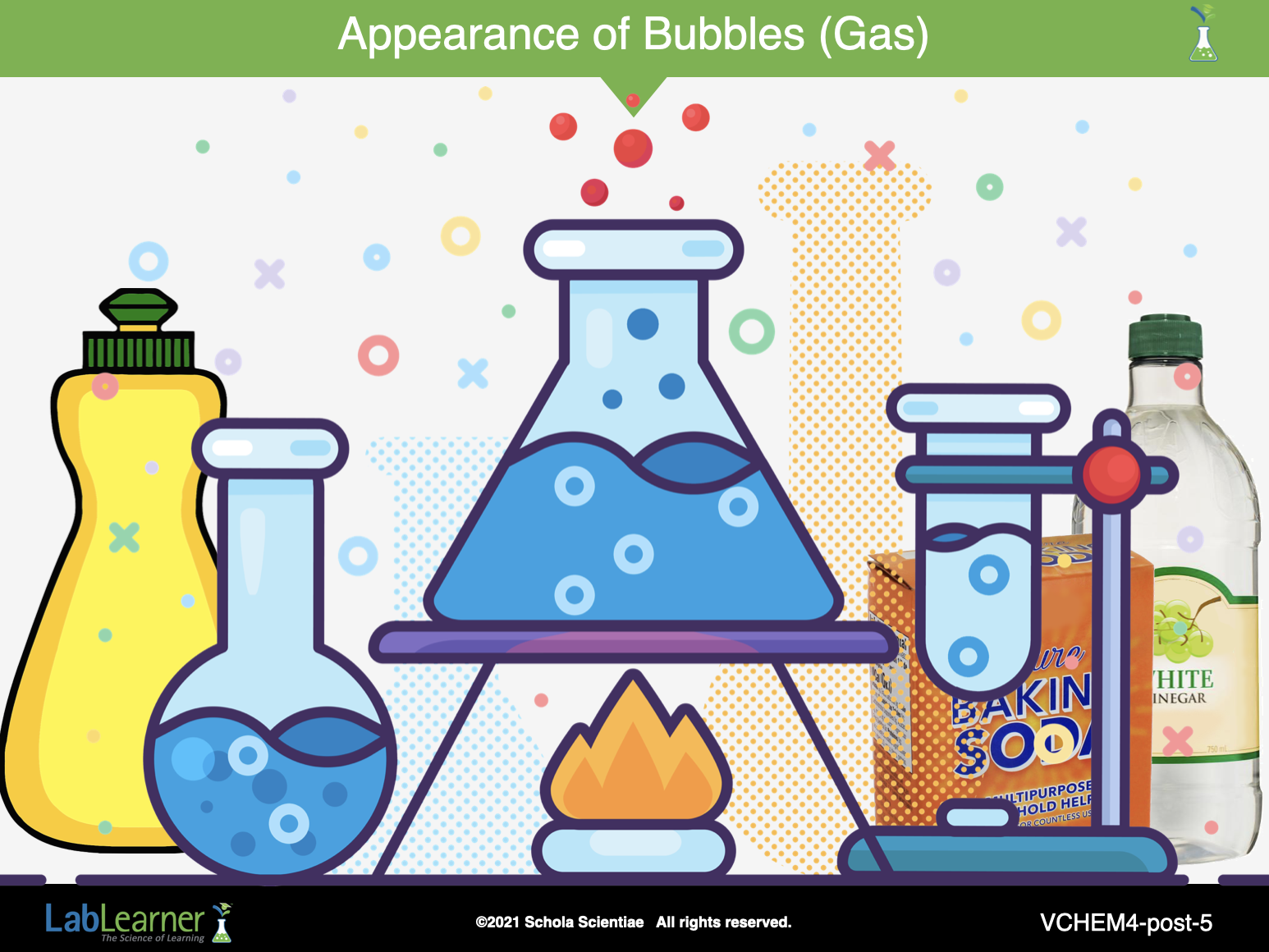
5. Begin with the sign of a chemical change: appearance of bubbles. Remind students that bubble formation is often considered a sign of gas production. However, bubbles can also be produced by physical changes.
a. Ask students: In which trials were bubbles produced? Students should indicate that bubbles were formed in the boiling water, when water was added to dish detergent, and when vinegar was added to baking soda.
b. Ask students: Was gas produced in each case? How do you know? Students should indicate that gas was produced by the boiling water because they could see steam rising from the beaker as the water boiled. Gas was not produced by water and dish detergent because the balloon did not expand. Gas was produced with baking soda and vinegar because the balloon expanded.
c. Explain that scientists know that:
- The production of steam from boiling water is a physical change because they have proven that steam and water are the same substance in different forms. Steam is an expected result of exposing water to heat. Explain that since nothing was added to the water that could have interacted with the water to produce a new substance, the resulting steam was water and therefore the change observed was physical.
- The formation of bubbles when air is added to soap is a property of soap, and adding water does not change that property or cause the formation of a new substance. Explain that since the only thing added to the dish detergent was water and no new substance was formed, it is reasonable to conclude that the bubbles were formed because air was trapped in the detergent. Therefore, the bubbles were the result of a physical change.
d. When scientists would observe the baking soda and vinegar reaction, they would first think: Is this an example of boiling? Was any detergent added? Neither occurred, therefore it is most likely a chemical reaction. In addition, they would test baking soda in another solvent such as water. As the students’ own experiments showed, baking soda and water do not produce bubbles or gas. Therefore, scientists would state that the bubbles and gas produced by combining vinegar with baking soda are most likely the result of a chemical change that produced a new substance, the gas (the gas is carbon dioxide, CO2).
e. Reaffirm that the baking soda and vinegar reaction was a chemical change, by telling students that scientists know that the gas produced by the reaction of baking soda and vinegar, carbon dioxide, is the result of a chemical change. The chemical that remains behind is sodium acetate. Students may know carbon dioxide as the gas that is released when they exhale.
______________________________________________
SLIDE VCHEM4-post-6
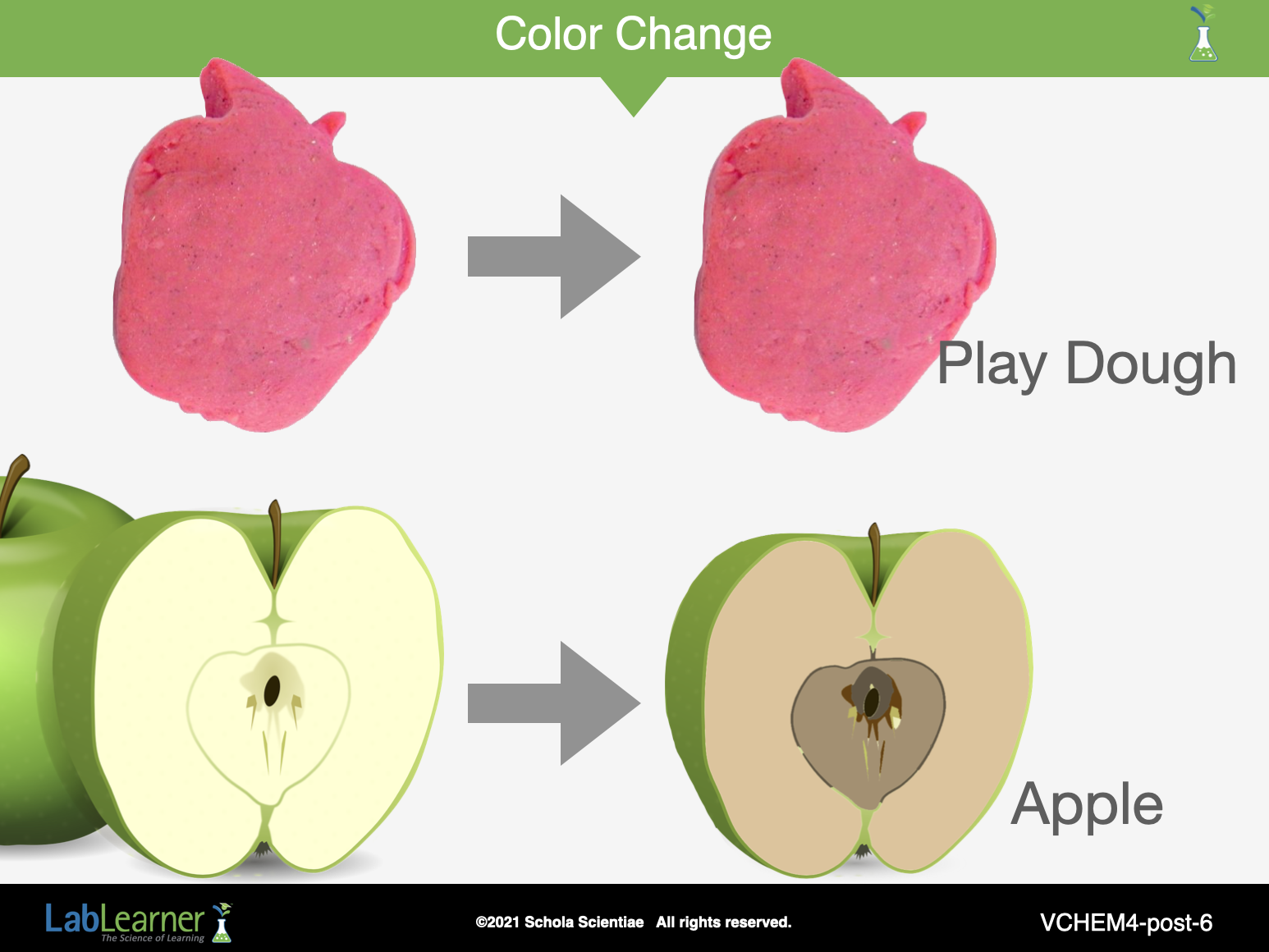
6. Remind students that an unexpected color change is another sign that a chemical change may have occurred. However, it can also be the sign of a physical change.
a. Ask students: In which trials did a color change occur? Students should indicate that water turned blue when food coloring was added to it, and the apple slice turned brown after it was cut from the apple.
b. Explain that scientists know that the color change to the water after the addition of food coloring was a physical change because it is expected that water will turn blue if blue food coloring is added.
c. When scientists are first approached with the unexpected color change, they would first think: Is this the result of food coloring or some other colored substance being applied to the apple slice? They would then recall the steps which had occurred from the time the apple was cut until the slice turned brown. They would remember that all that happened to the slice was that it was removed from the apple and placed on the paper towel and that nothing had been added to the slice.
They would also perform the same steps on another substance, such as the play dough, to see if it demonstrates a similar unexpected color change. If no color change occurs with the second substance, then the color change on the apple slice would be considered to be the result of a chemical change.
The brown color that developed on the apple slice is an unexpected color change. Most substances keep their original color when exposed to air. The apple slice, however, turned brown instead of remaining its original color. As nothing brown was added to the surface of the slice, and the air contained nothing brown that could have settled on its surface, the color change is most likely the result of a chemical change.
d. Reaffirm that the browning of the apple was a chemical change by telling students that scientists know that the browning of an apple is a chemical change, resulting from the reaction of air with a chemical on the surface of the apple to create a new chemical with a brown color.
______________________________________________
SLIDE VCHEM4-post-7
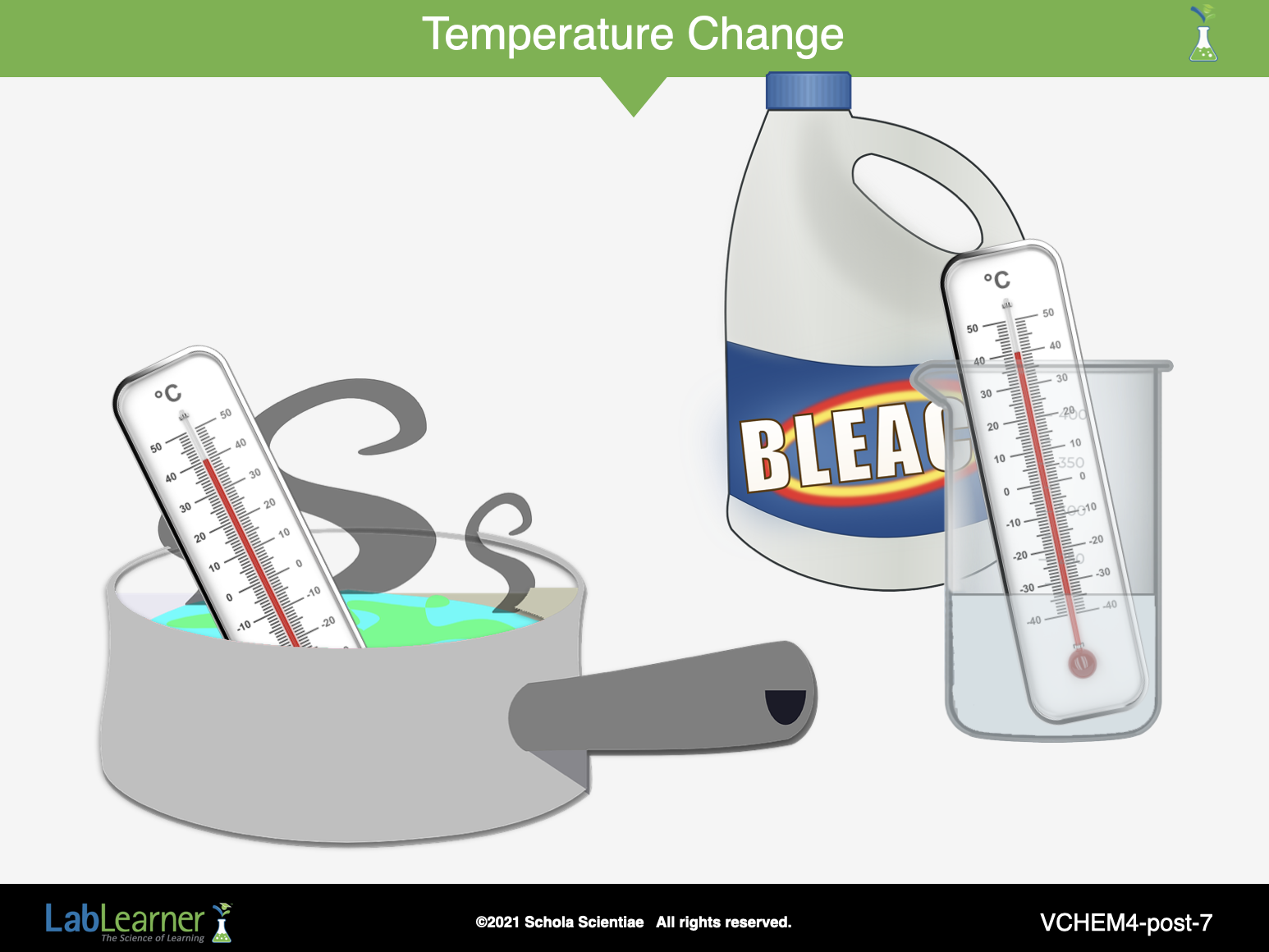
7. Remind students that a temperature change is a third sign that a chemical change may have occurred. However, a temperature change is also a sign of physical change.
a. Ask students: In which trials did a temperature change occur? Students should indicate that they observed a temperature change when the ice melted when the water boiled, and when the bleach was added to the water.
b. Explain that scientists know that:
- Water boils because the water absorbs heat from the heat source, and therefore the temperature of the water increases. Scientists know that a property of water is that it boils at 100oC. As a result, even though students did not measure the temperature change, they can conclude that a temperature increase occurred because they observed the water boiling and steam rising from the beaker. Scientists consider the rise in temperature when water boils to be a physical change because it is not accompanied by any other change, and is not a response to adding any other substance to the water.
- Ice melts because it absorbs heat from its surroundings. Scientists know that this is a property of ice, and consider melting to be a physical change because it occurs without being accompanied by any other change and can occur without any other substance being added to the ice.
c. When scientists observe a temperature change in water, they would first think: Is this the result of heat or cold being applied to the water and bleach solution? Was something added that was hot or cold that could have caused the temperature of the water to change? If the answer to these questions is no, then scientists would test the results of adding another solute to water, such as sugar to see if a temperature change occurs. If a temperature change in the comparison solution (sugar and water) does not occur, then it is likely that the change originally observed was the result of a chemical change.
d. Reaffirm that the dissolution of sugar in water was a physical change by explaining that when the sugar was added to the water, no chemical change occurred. A temperature change occurred when non-chlorine bleach was added to water. The dissolution of sugar in water is simply a change in state from solid to liquid and is a physical change that does not involve a chemical reaction. Therefore, no energy is involved in the reaction and no heat is generated or absorbed.
e. Reaffirm that the temperature change caused by the addition of bleach to water was a chemical change by explaining that scientists know that a chemical change resulted from the reaction of the active ingredient in the bleach powder with water and caused a release of a chemical called hydrogen peroxide. This reaction is known to release energy which is detected as heat and an increase in temperature.
Conclude the analysis of students’ experiments by discussing the overall results of this Investigation, as time permits.
______________________________________________
SLIDE VCHEM4-post-8
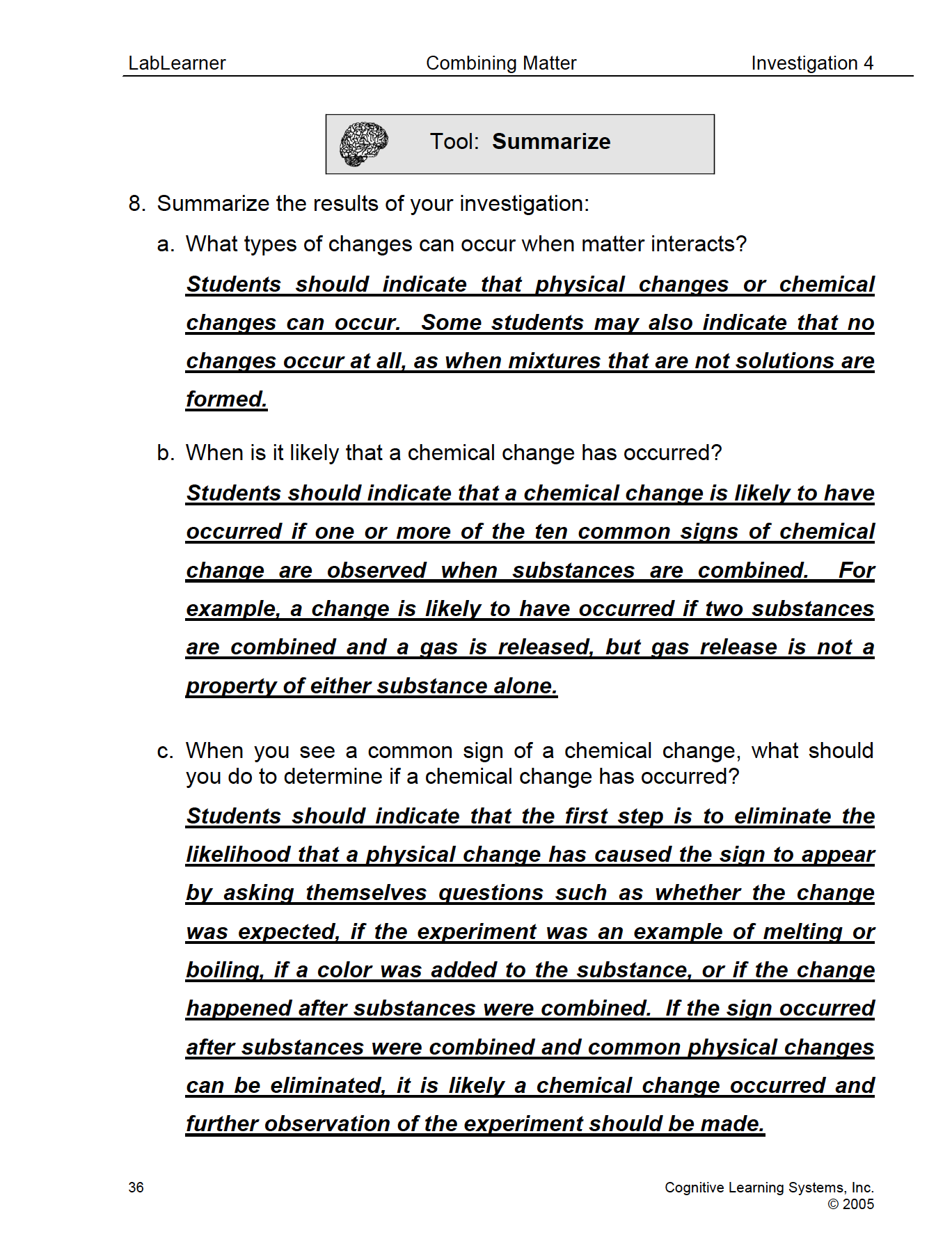
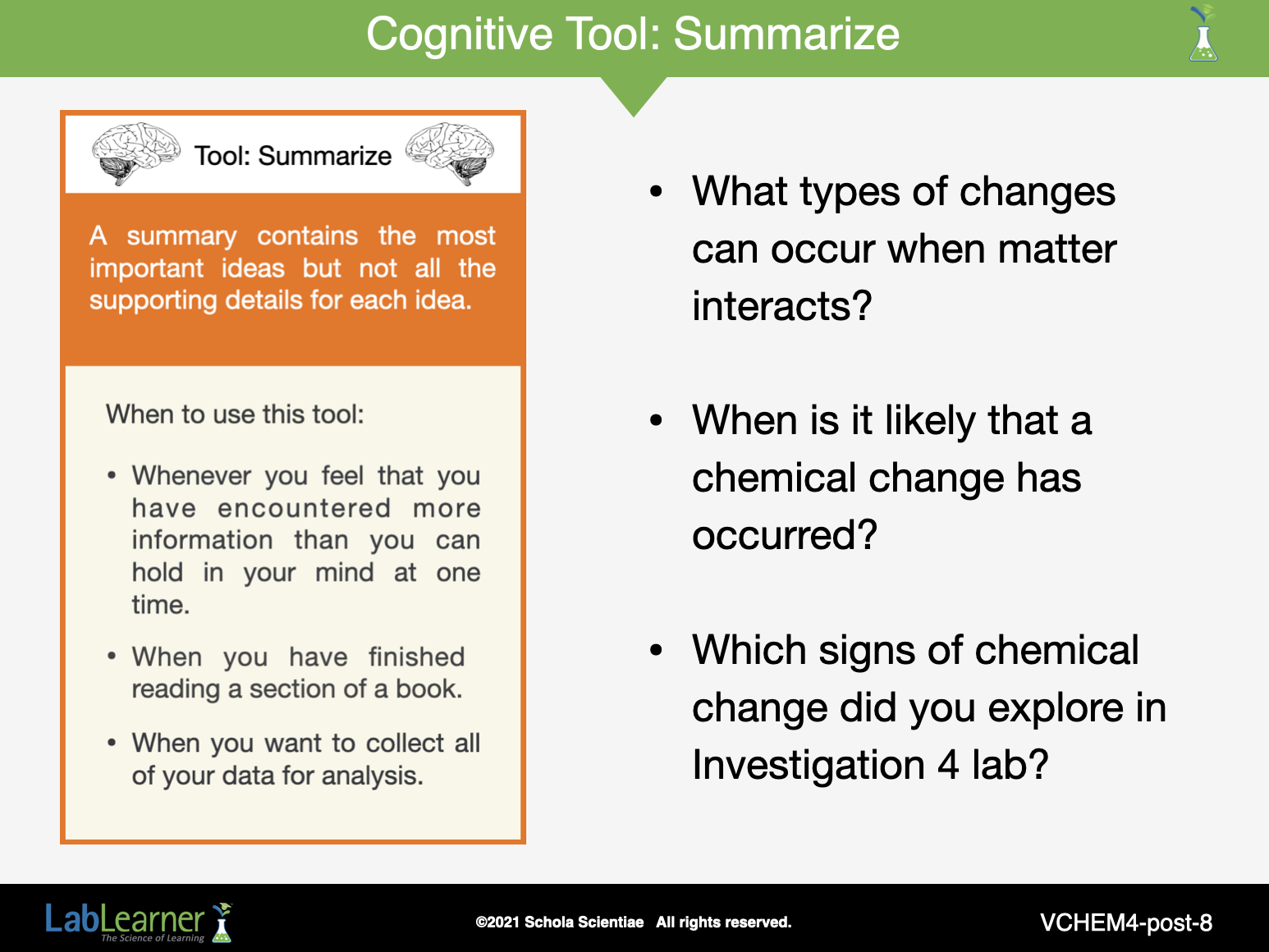
Help students Summarize the results by posing the following three questions:
1. What types of changes can occur when matter interacts? Student answers will vary. Students should indicate that physical changes or chemical changes can occur. Some students may also indicate that no changes occur at all, as when mixtures that are not solutions are formed. An example would be the salt and pepper mixture formed in Investigation Three.
2. When is it likely that a chemical change has occurred? Student answers may vary. Students should indicate that a chemical change is likely to have occurred if they see one or more of the ten common signs of chemical change. Students may opt to list the ten common signs:
- A change in volume.
- A change in temperature.
- A change in color.
- A change in electrical conductivity.
- A precipitate forms.
- A gas is produced.
- A change in pH.
- A change in chemical or physical properties occurs.
- A change in odor.
- A change in melting or boiling point.
3. NOTE: The analysis involved in this part (#3) of the discussion will be a challenge for 4th-graders. It may be used as an enrichment challenge or as a means for the teacher to model the thought process as a demonstration of focused, critical thinking for the students.
Ask students: When you see a common sign of a chemical change, what should you do to determine if a chemical change really has occurred? Students should indicate that the first step is to eliminate the likelihood that a physical change has caused the sign to appear by asking themselves one or more of the following questions based on the change they observe:
a. Was the change expected?
b. Was the substance exposed to a source of heat or cold? Is this an example of melting or boiling?
c. Was a color added to the substance, and if so, was it the color observed the same as the color added?
d. Is more than one sign observable?
e. Did the change happen after substances were combined?
If the answer to questions a-c is “yes”, then it is likely that a chemical change has not occurred and the change observed is the result of a physical change. However, if the answer to one or more of those questions is “no” and the answer to questions d and e is “yes”, then it is likely that the change observed is the result of a chemical change, and further observation may be required.
4. Encourage students to record their answers to the questions in Problem 8 of their Student Data Record. The answers will form a summary of their Trials.
______________________________________________
KEYS: POSTLAB