Teacher Portal:
Chemistry, Matter and Interactions
Investigation 3 – PreLab
 ASK WHY
There are five major branches of chemistry today – organic chemistry, analytic chemistry, physical chemistry, inorganic chemistry, and biochemistry. Organic chemistry is a brank of chemistry that focuses upon molecules and compounds that contain the carbon atom. Since living organisms contain many thousands of types of carbon-containing molecules, organic chemistry is sometimes associated with compounds derived from living organisms.
BRANCH OUT
According to the American Chemical Society, physical chemistry deals with the principles of physics involved in chemical interactions. It examines:
- How matter behaves on a molecular and atomic level
- How chemical reactions occur
Physical chemists are focused on understanding the physical properties of atoms and molecules, the way chemical reactions work, and what these properties reveal. Their discoveries are based on understanding chemical properties and describing their behavior using theories of physics and mathematical computations.
Physical chemistry is a good area for chemists who have a strong curiosity about how things work at the atomic level and enjoy working with lab instrumentation and machines.
PRINT IT
Use your browser to download a printable PDF as help during the slide presentation and to make additional notes. In your browser, go to File > Print and then choose to save as PDF.
MINDSET
This Investigation is designed to:
- introduce students to the use of the graduated cylinder as an appropriate tool for measuring volume.
- demonstrate how solids and liquids interact with other solids and liquids.
- promote understanding of solutes and solvents and their roles in solutions.
- introduce the concepts of solubility and miscibility and demonstrate the difference between the two concepts.
SCIENTIST’S GLOSSARY
1. Dissolve: Term used to describe the process by which particles of one substance disperse and spread evenly in another substance.
2. Miscible: Liquids that can mix without separating.
3. Mixture: A combination of two or more substances.
4. Soluble: The ability of a solid or gas to dissolve in a liquid.
5. Solute: The substance or substances that change phase when creating a solution or that are present in the smaller amounts in a solution.
6. Solution: A mixture of two or more substances that is uniform in composition and appearance.
7. Solvent: The substance in a solution that did not change phase when creating the solution or is present in the larger amount.
BE PREPARED
Watch the Investigation 3 Teacher Video to prepare for the PreLab.
SET FOR SUCCESS
- Tell students that they will continue the Chemistry, Matter and Interactions CELL.
- Ask students to share the kinds of things they might learn in this Investigation.
- Tell students to think about all of the different things around them, that they come in contact with every day that is made of chemicals.
Begin the PreLab Concept Slides to start students on their learning journey. Then watch the Pre-Lab Student Video afterward as a class.
NAVIGATE IT
Once the slide presentation is launched
- use your left and right arrows to advance or go back in the slide presentation, and
- hover your mouse over the left edge of the presentation to get a view of the thumbnails for all the slides so that you can quickly move anywhere in the presentation.
- Click HERE to launch the slide presentation for the CELL.
SHARE IT
SLIDE VCHEM3-pre-1
Begin this part of Investigation Three by reviewing Investigations One and Two with students.
Ask students: What did you learn about the properties of matter from the first two investigations?
______________________________________________
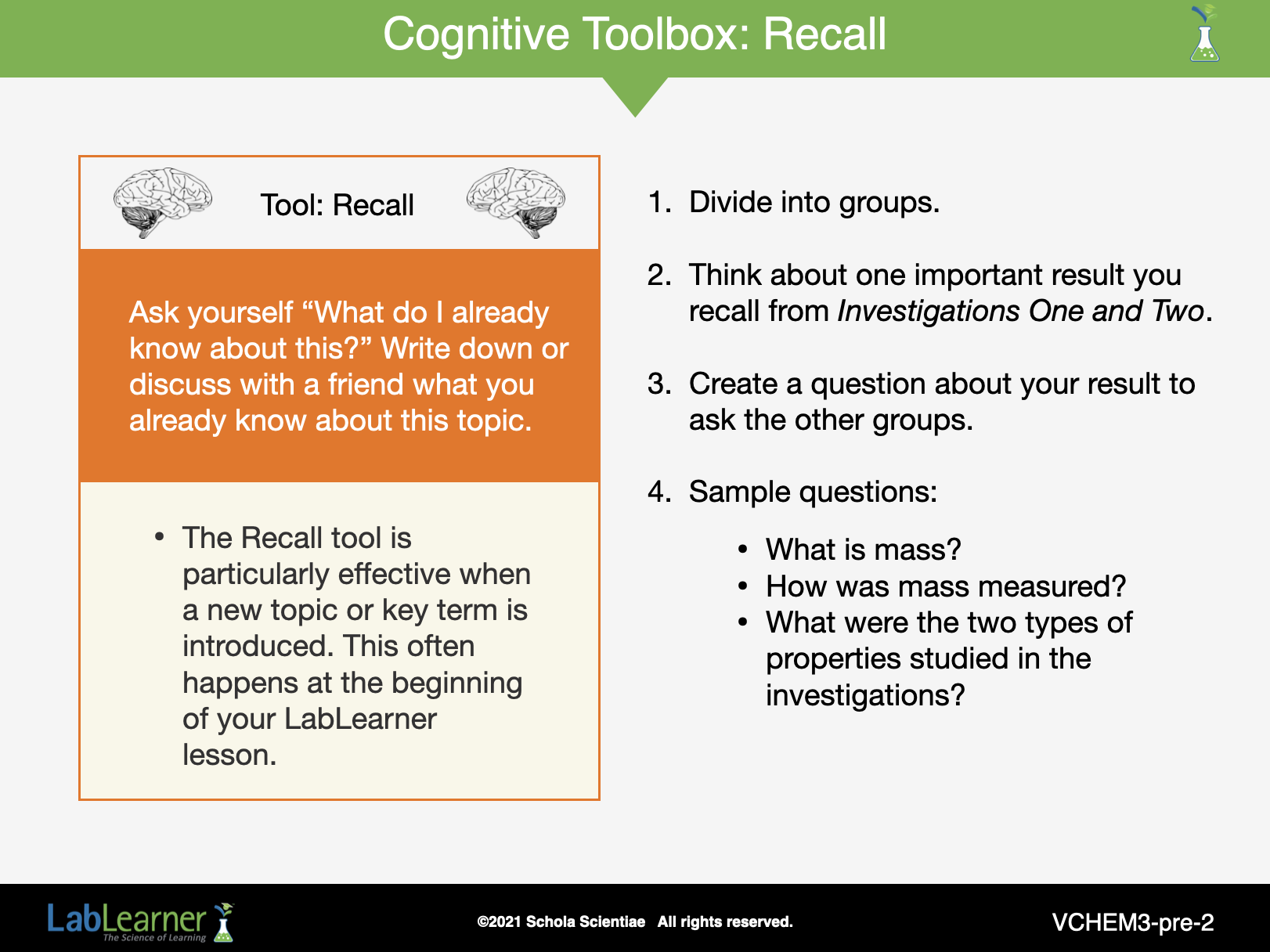
SLIDE VCHEM3-pre-2
The activity described on this slide will help students consolidate what they have learned in Investigations One and Two. Students should use this time to discuss their investigations and conclusions about chemistry, matter, and interactions.
______________________________________________
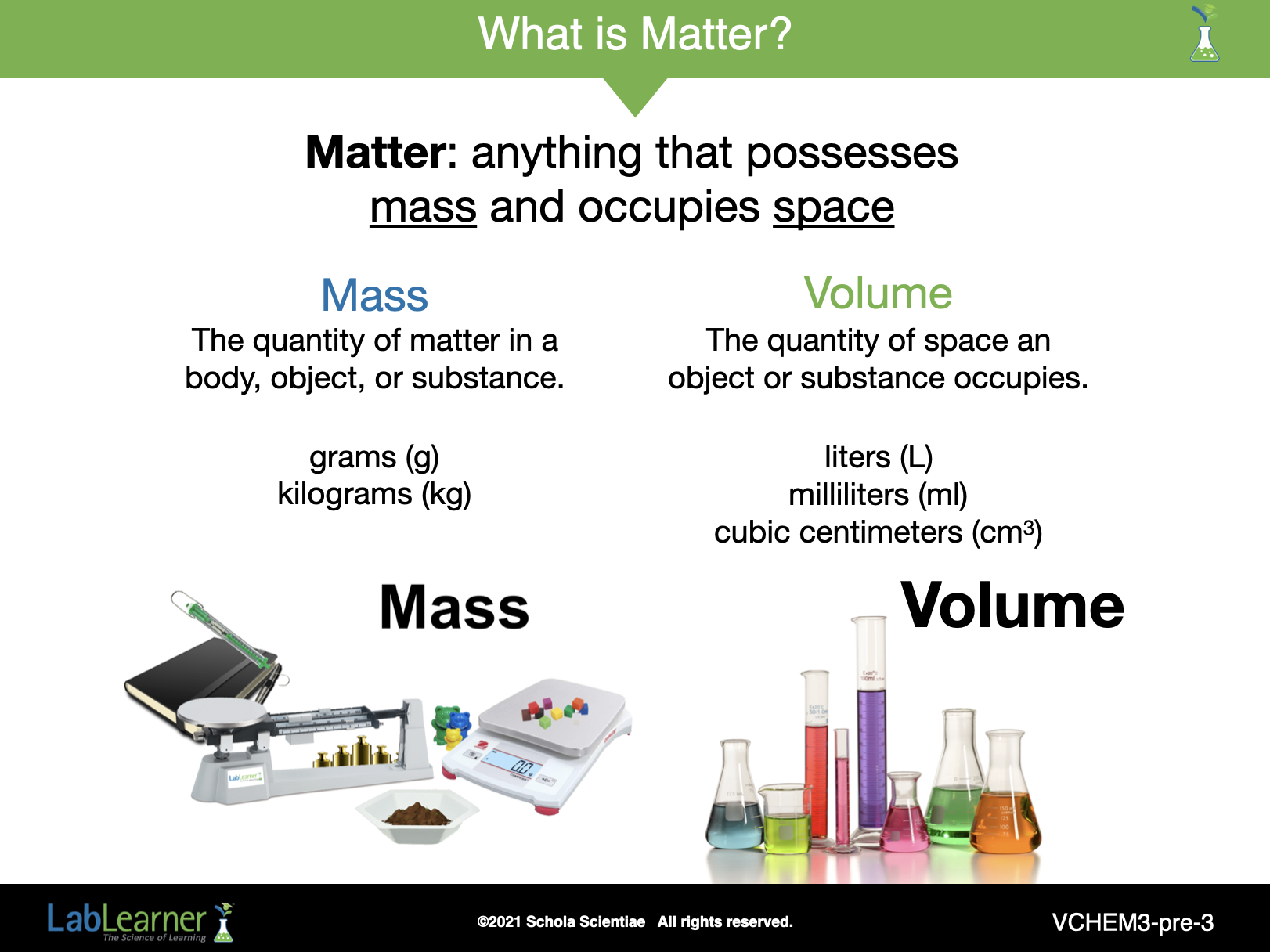
SLIDE VCHEM3-pre-3
This is a review slide from Investigation One. It focuses on the two important attributes (properties) of matter. Matter is anything that possesses mass and occupies space, that is, matter has volume. You will explore the interactions between mass and volume further in Investigation Three.
______________________________________________
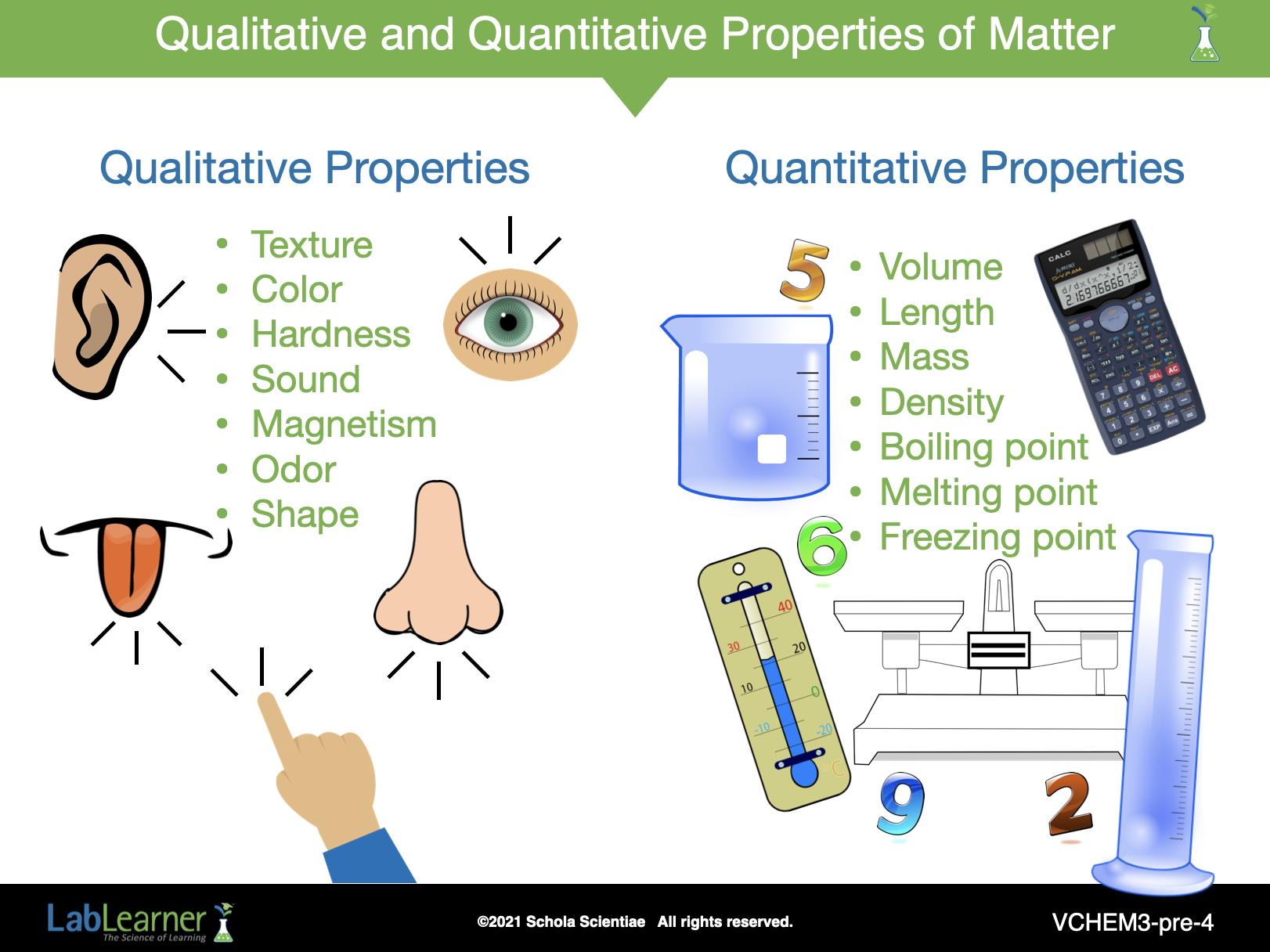
SLIDE VCHEM3-pre-4
From Investigation Two, this slide focuses on the two major divisions of the properties of matter, qualitative and quantitative properties. Recall that, in general, qualitative properties can be experienced directly with our five senses and can be described in words (smooth, loud, salty, stinky). Quantitative properties, on the other hand, typically require some kind of an instrument and are reported as numbers with units (12 g, 1.5 meters, 3 liters, 27.4 cm). In Investigation Three you will learn to use the graduated cylinder to accurately quantify the volume of matter.
______________________________________________
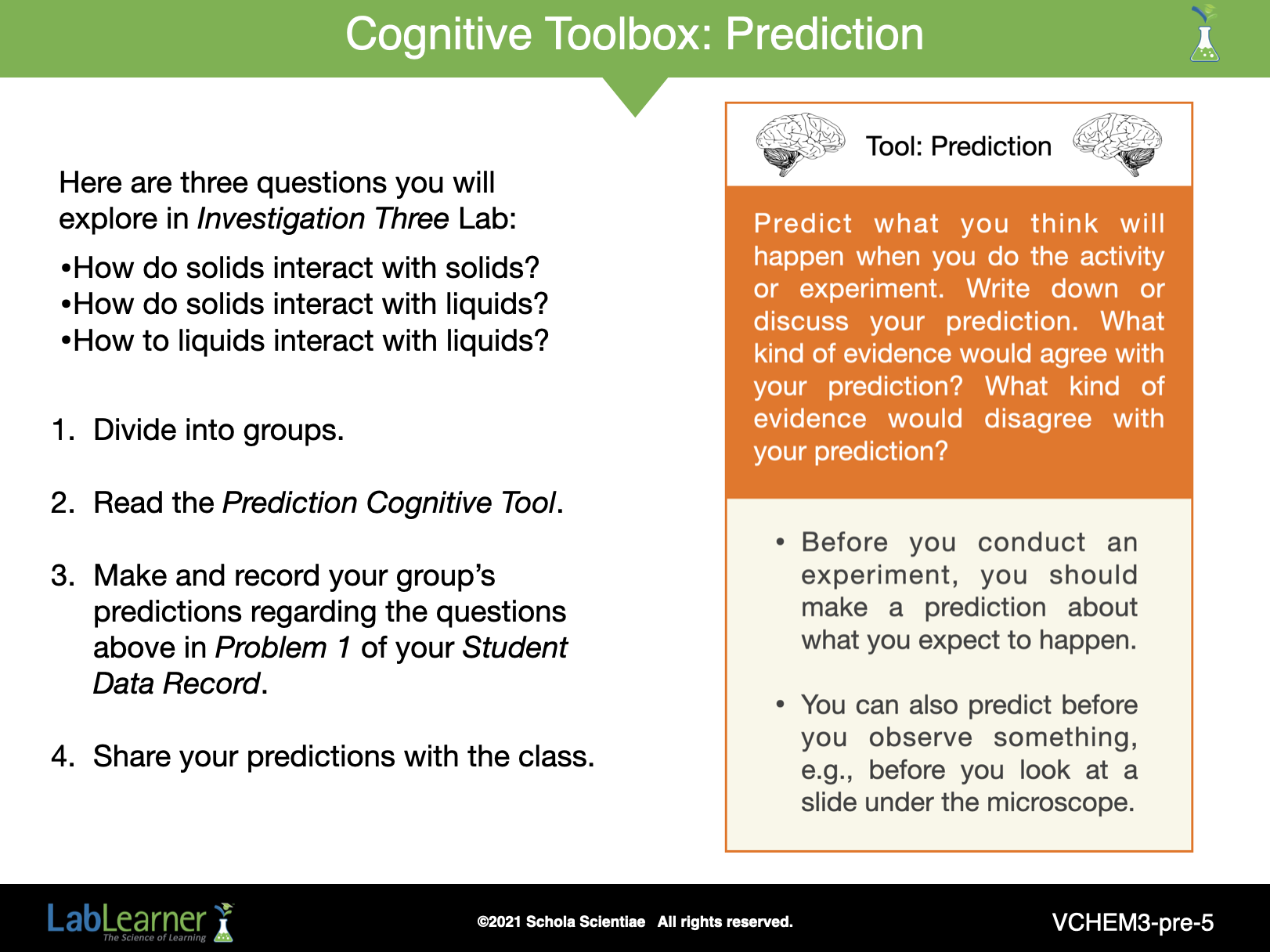
SLIDE VCHEM3-pre-5
Explain to students that in this investigation they will use their knowledge of quantitative and qualitative properties to investigate how substances interact with each other.
Ask students: What do you think is meant by the term interact?
After listening to students’ answers, discuss that when two or more substances come in contact with each other they may or may not combine and they may or may not change. Scientists refer to the result as the interaction of the substances. When some substances interact no change or combination occurs. Other times a change or combination does occur.
Ask students: Why might we want substances to interact? Student answers will vary.
New mixtures or even new substances can be created by the interaction of matter. Explain that in this lab, the student will not be forming new substances, although different forms of matter will interact.
______________________________________________
Student Video
Watch the Investigation 3 Student Video after Share It presentation to prepare for the PreLab.
KEYS: PRELAB EXERCISE