Teacher Portal:
Chemistry, Matter and Interactions
Investigation 3 – PostLab
 ASK WHY
There are five major branches of chemistry today – organic chemistry, analytic chemistry, physical chemistry, inorganic chemistry, and biochemistry. Organic chemistry is a brank of chemistry that focuses upon molecules and compounds that contain the carbon atom. Since living organisms contain many thousands of types of carbon-containing molecules, organic chemistry is sometimes associated with compounds derived from living organisms.
BRANCH OUT
According to the American Chemical Society, physical chemistry deals with the principles of physics involved in chemical interactions. It examines:
- How matter behaves on a molecular and atomic level
- How chemical reactions occur
Physical chemists are focused on understanding the physical properties of atoms and molecules, the way chemical reactions work, and what these properties reveal. Their discoveries are based on understanding chemical properties and describing their behavior using theories of physics and mathematical computations.
Physical chemistry is a good area for chemists who have a strong curiosity about how things work at the atomic level and enjoy working with lab instrumentation and machines.
PRINT IT
Use your browser to download a printable PDF as help during the slide presentation and to make additional notes. In your browser, go to File > Print and then choose to save as PDF.
NAVIGATE IT
Once the slide presentation is launched
- use your left and right arrows to advance or go back in the slide presentation, and
- hover your mouse over the left edge of the presentation to get a view of the thumbnails for all the slides so that you can quickly move anywhere in the presentation.
- Click HERE to launch the slide presentation for the CELL.
SHARE IT
SLIDE VCHEM3-post-1
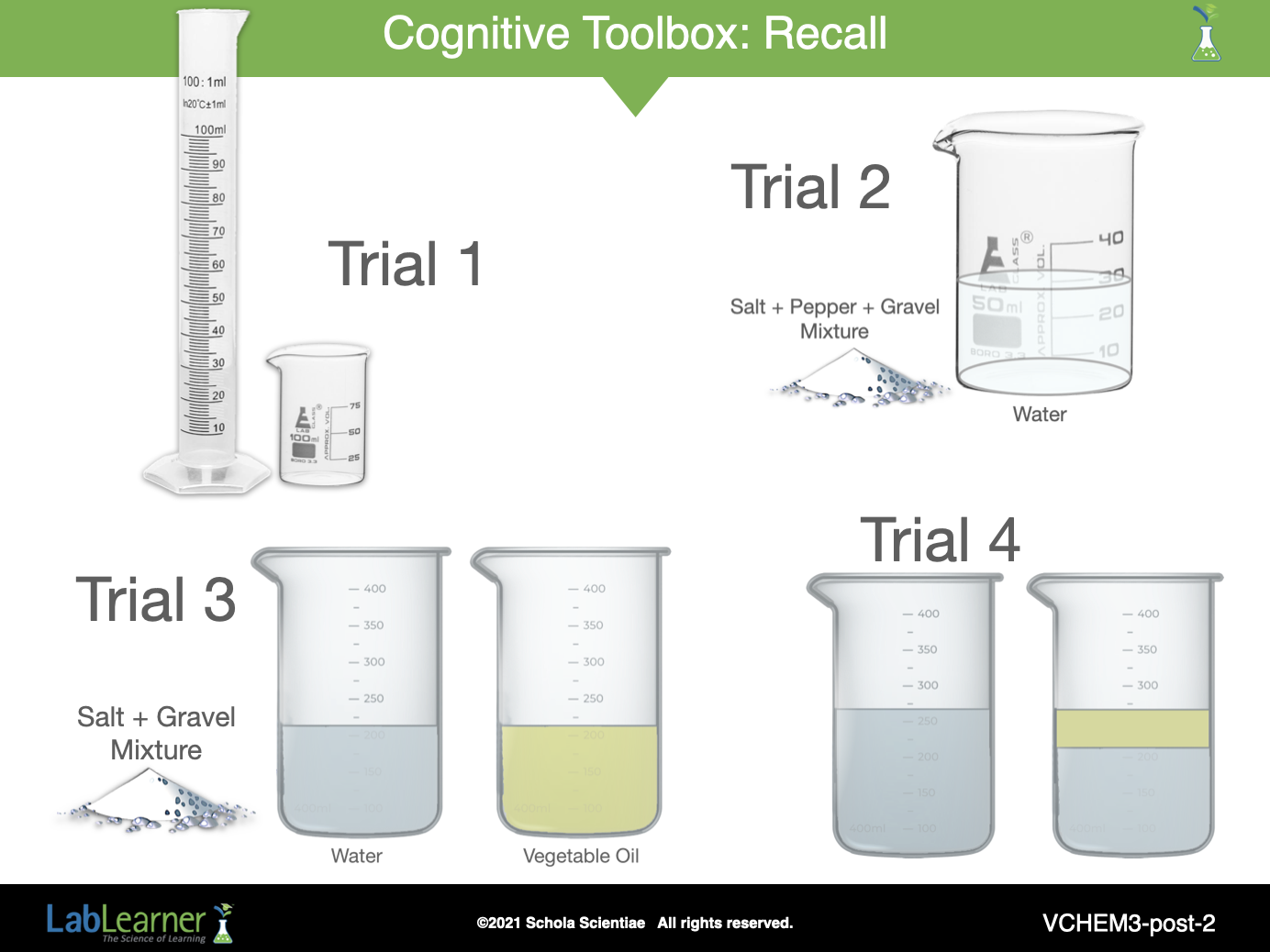
Begin this part of the Investigation by asking students to describe the experiments they performed in the lab. Student answers will vary.
- Students should indicate that they compared the accuracy of a beaker with a graduated cylinder by using both to measure specific amounts of water.
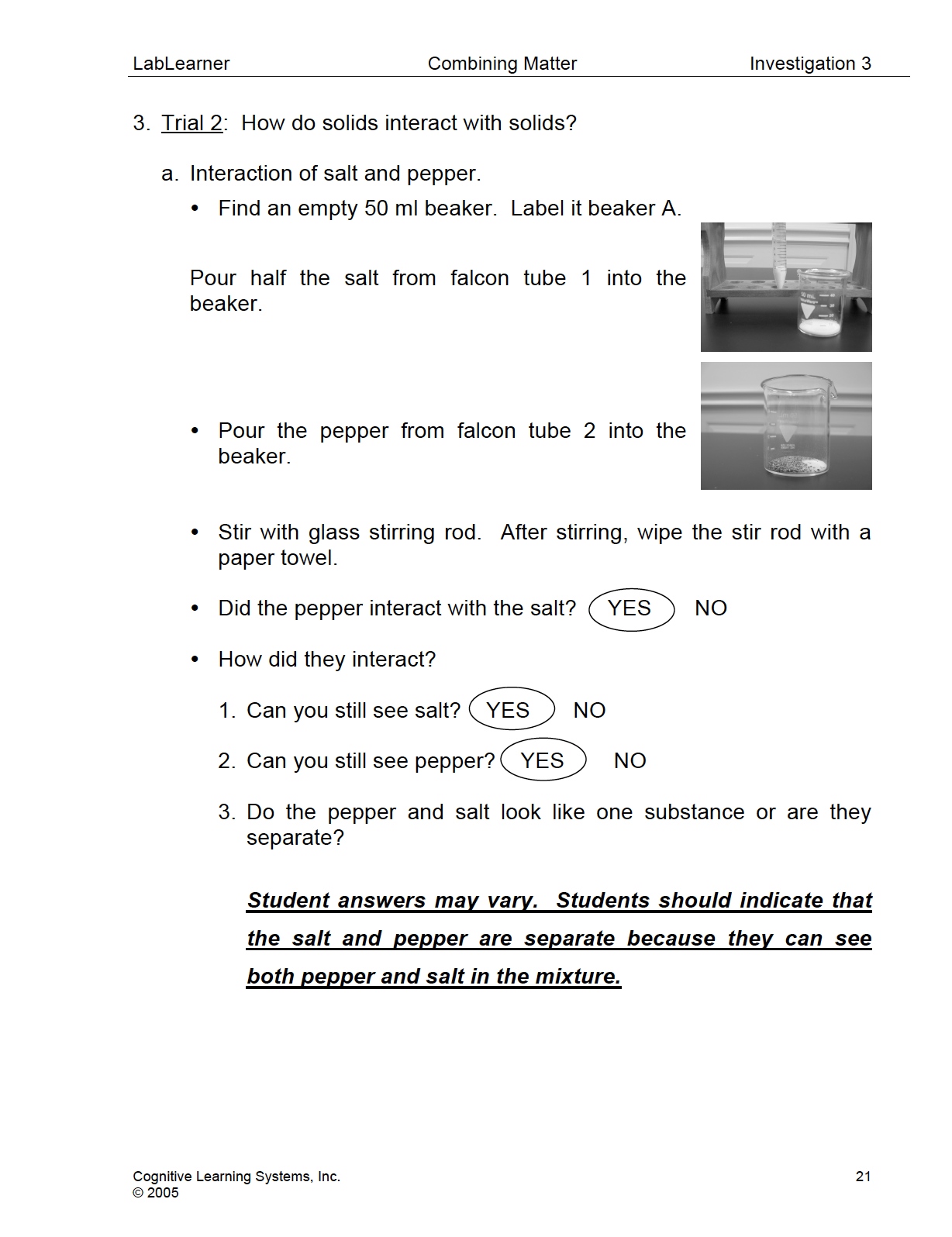
- Students should also indicate that they studied how solids interact with solids by creating mixtures of salt, pepper, and gravel.
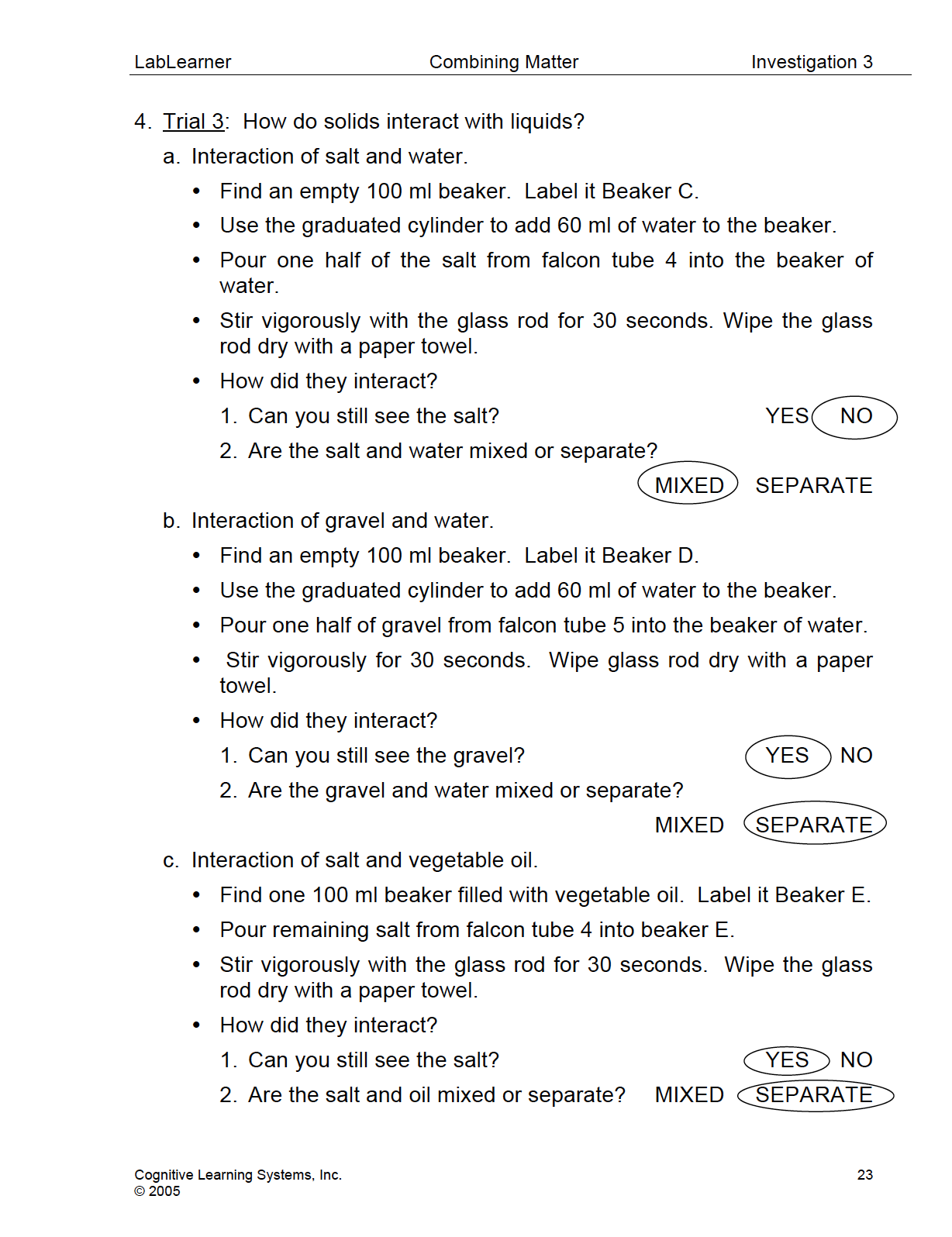
- They explored how liquids and solids interact by combining water with salt and gravel and oil with salt and gravel.
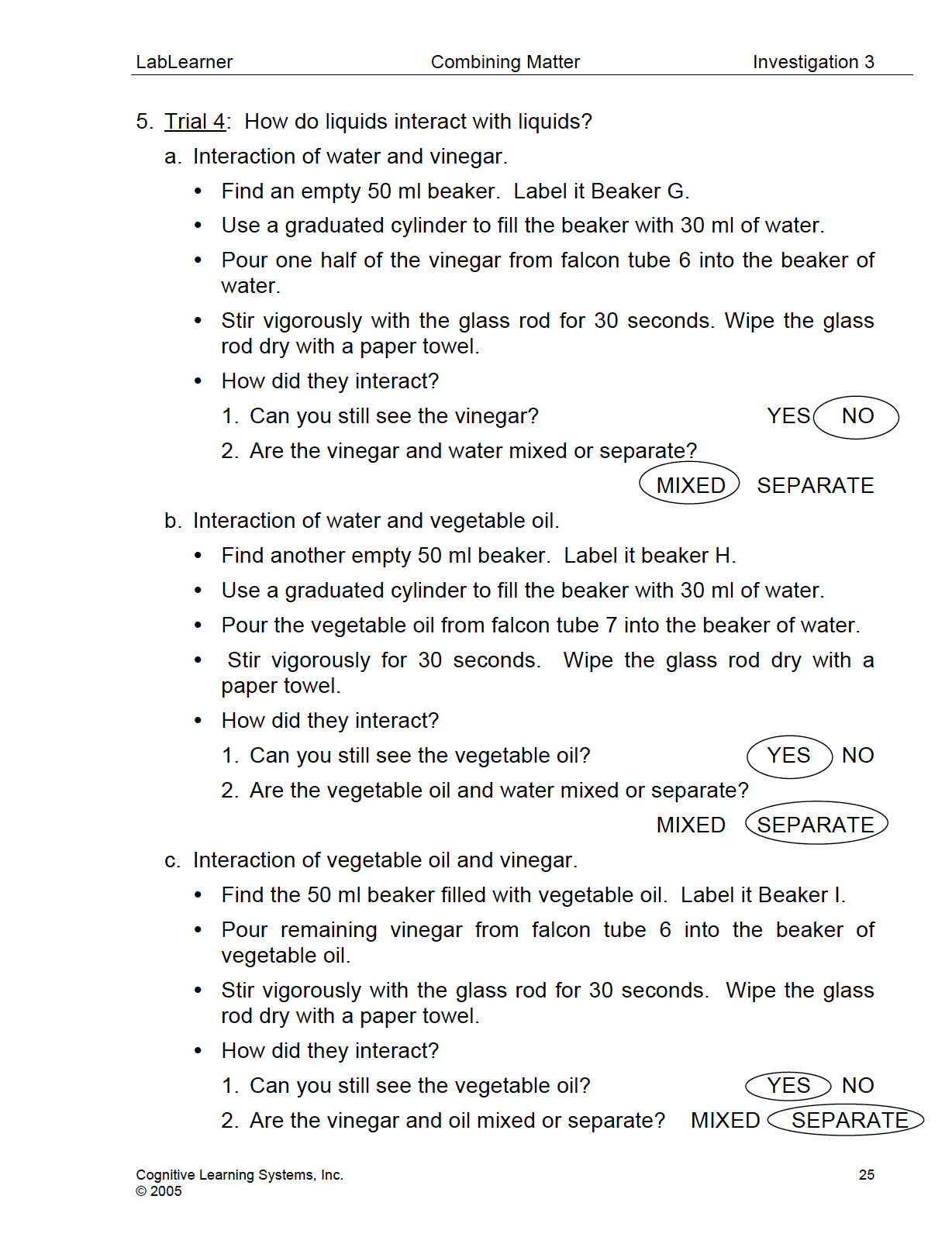
- They should further indicate that they combined water with vinegar and oil and vinegar with oil as they observed how liquids interact with liquids.
______________________________________________
SLIDE VCHEM3-post-2
Pose the following question to students: What do you think was the purpose of each experiment? What did you learn as a result of each experiment?
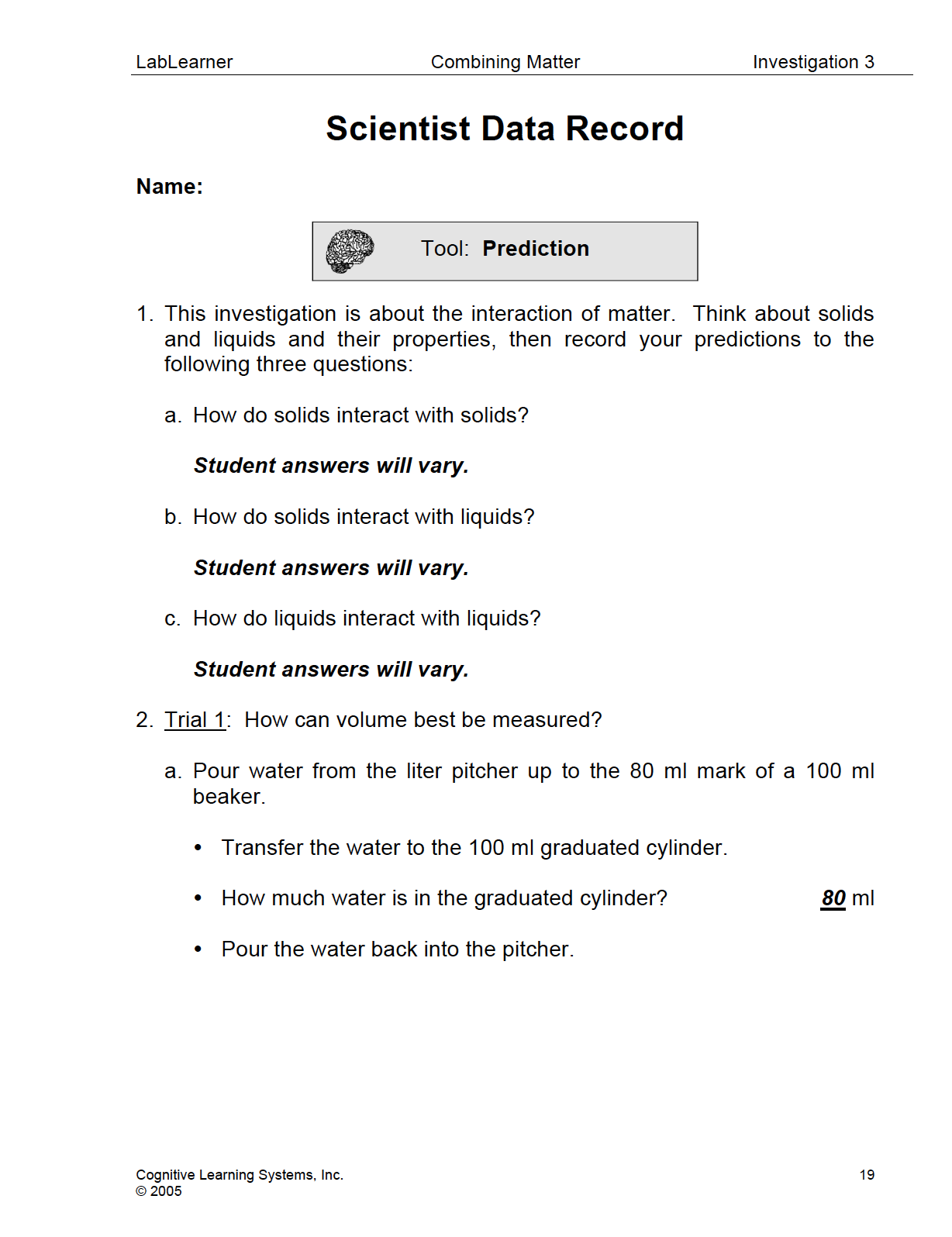
To help students answer this question, encourage them to refer to their Scientist Data Record and focus on Trial 1.
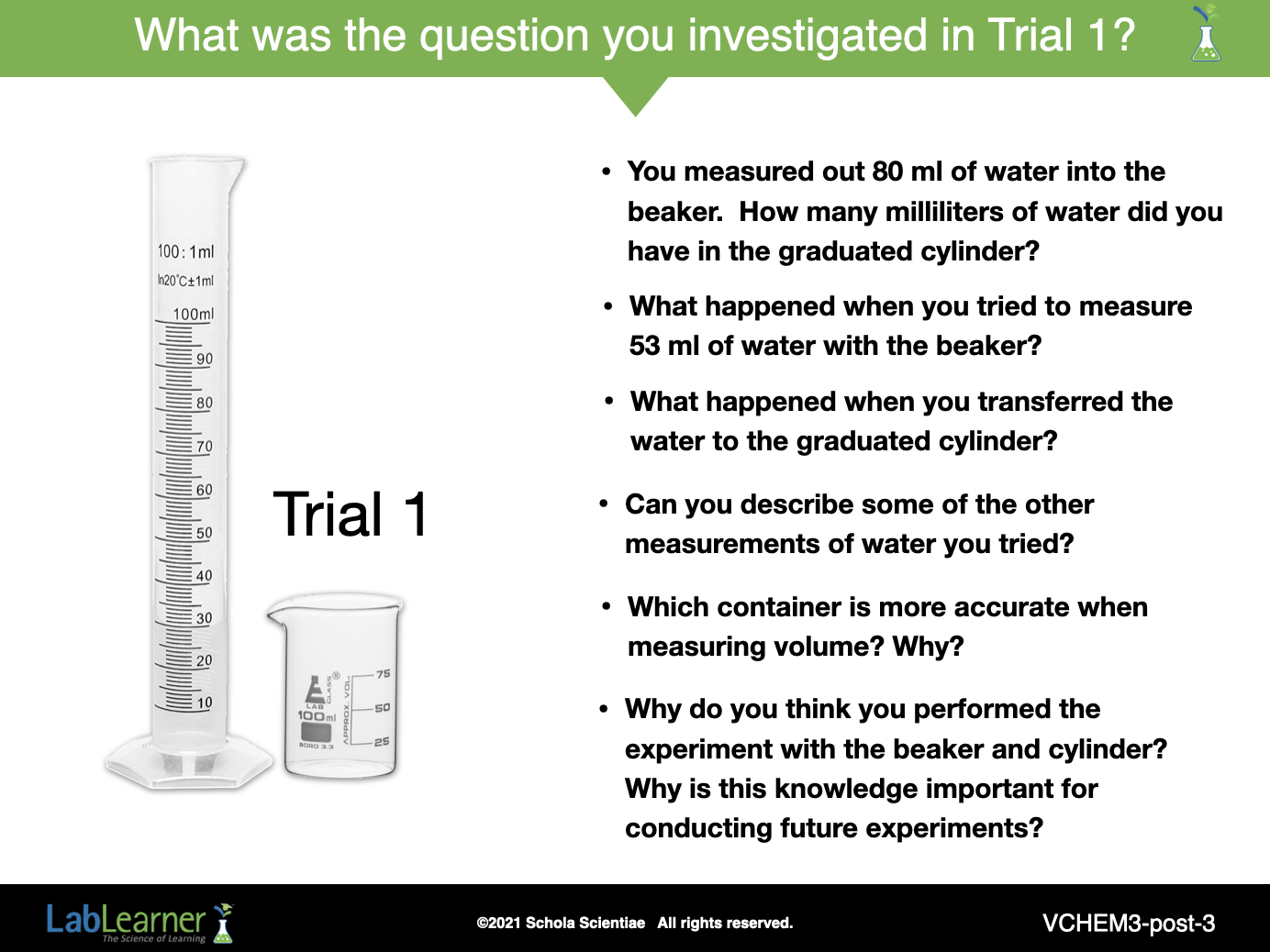
a. Direct students to study the results of Trial 1. Ask students: You measured out 80 ml of water into the beaker. How many milliliters of water did you have in the graduated cylinder?
Students should indicate that they had 80 ml of water, plus or minus a milliliter.
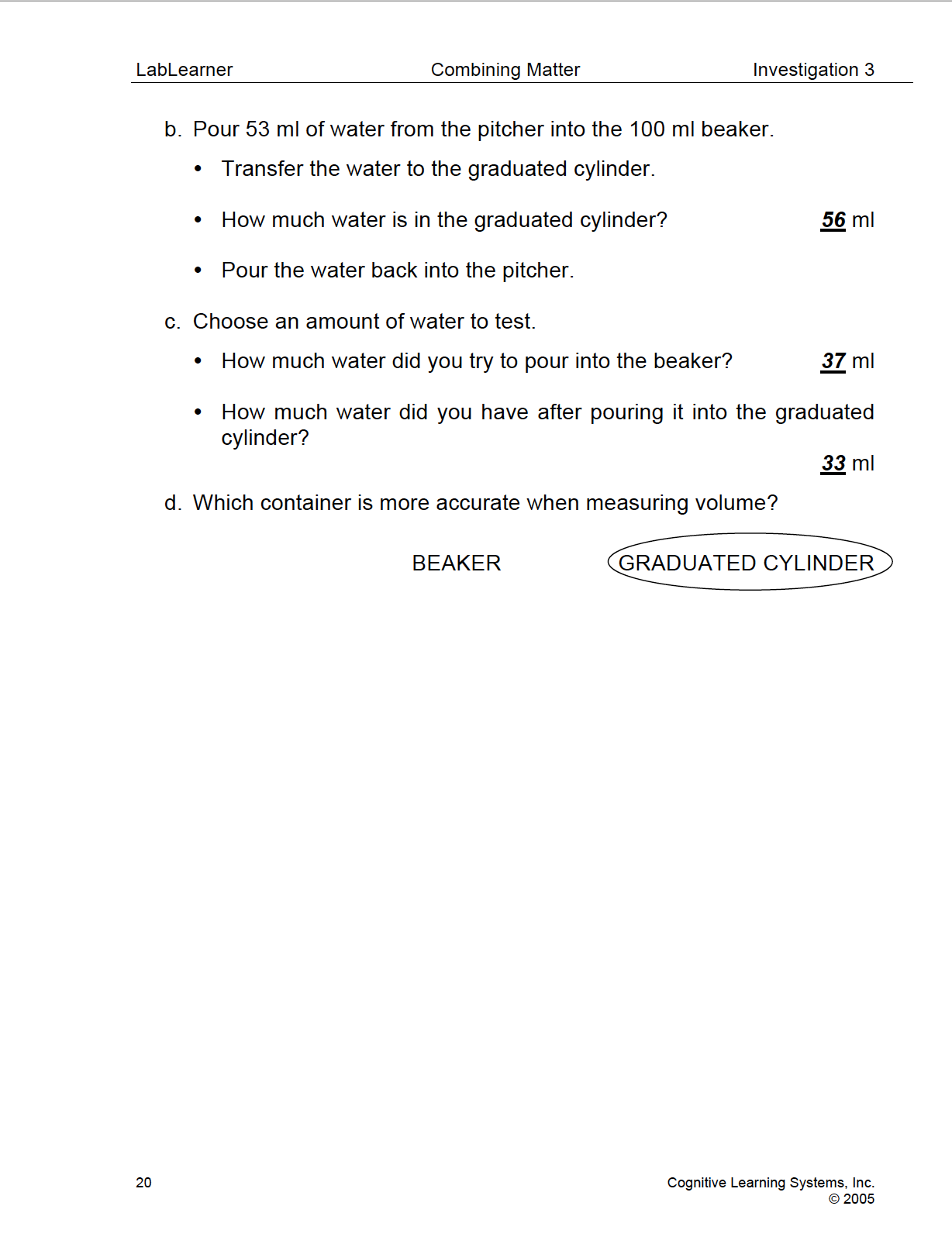
b. Ask students: What happened when you tried to measure 53 ml of water with the beaker?
Students should indicate that they had difficulty measuring 53 ml of water with the beaker because there was no graduation mark on the beaker representing 53 ml.
c. Ask students: What happened when you transferred the water to the graduated cylinder?
Student answers will vary. Students likely encountered a wide range of volumes resulting from their approximations of 53 ml on the scale of the beaker.
d. Ask students: Can you describe some of the other measurements of water you tried? What did you observe when comparing the volume with both the beaker and the graduated cylinder?
Student answers will vary. Students likely will have observed that volumes based on the beaker’s graduation marks were reasonably close when the volume water was transferred to the graduated cylinder, while chosen volumes between the beaker’s graduation marks varied widely from the intended amount when the water was transferred to the graduated cylinder.
______________________________________________
SLIDE VCHEM3-post-3
Pose the following question to students: What do you think was the purpose of each experiment? What did you learn as a result of each experiment?
To help students answer this question, encourage them to refer to their Student Data Record and focus on Trial 1.
a. Direct students to study the results of Trial 1. Ask students: You measured out 80 ml of water into the beaker. How many milliliters of water did you have in the graduated cylinder?
Students should indicate that they had 80 ml of water, plus or minus a milliliter.
b. Ask students: What happened when you tried to measure 53 ml of water with the beaker?
Students should indicate that they had difficulty measuring 53 ml of water with the beaker because there was no graduation mark on the beaker representing 53 ml.
c. Ask students: What happened when you transferred the water to the graduated cylinder?
Student answers will vary. Students likely encountered a wide range of volumes resulting from their approximations of 53 ml on the scale of the beaker.
d. Ask students: Can you describe some of the other measurements of water you tried? What did you observe when comparing the volume with both the beaker and the graduated cylinder?
Student answers will vary. Students likely will have observed that volumes based on the beaker’s graduation marks were reasonably close when the volume water was transferred to the graduated cylinder, while chosen volumes between the beaker’s graduation marks varied widely from the intended amount when the water was transferred to the graduated cylinder.
e. Ask students: Which container is more accurate when measuring volume? Why? Students should conclude that the graduated cylinder was better for measuring volume than the beaker because the graduated cylinder had more accurate graduations and smaller graduations. In addition, students learned that graduated cylinders, but not beakers, are calibrated during manufacture.
f. Ask students: Why do you think you performed the experiment with the beaker and cylinder? Why is this knowledge important for conducting future experiments? Student answers will vary. Students should indicate that the experiment with the beaker and the graduated cylinder was performed to demonstrate the appropriate tool for determining volume. Students should further indicate an understanding that accurate measurement of volume is important for the successful completion of experiments as they continue to work with solutions and mixtures.
______________________________________________
SLIDE VCHEM3-post-4
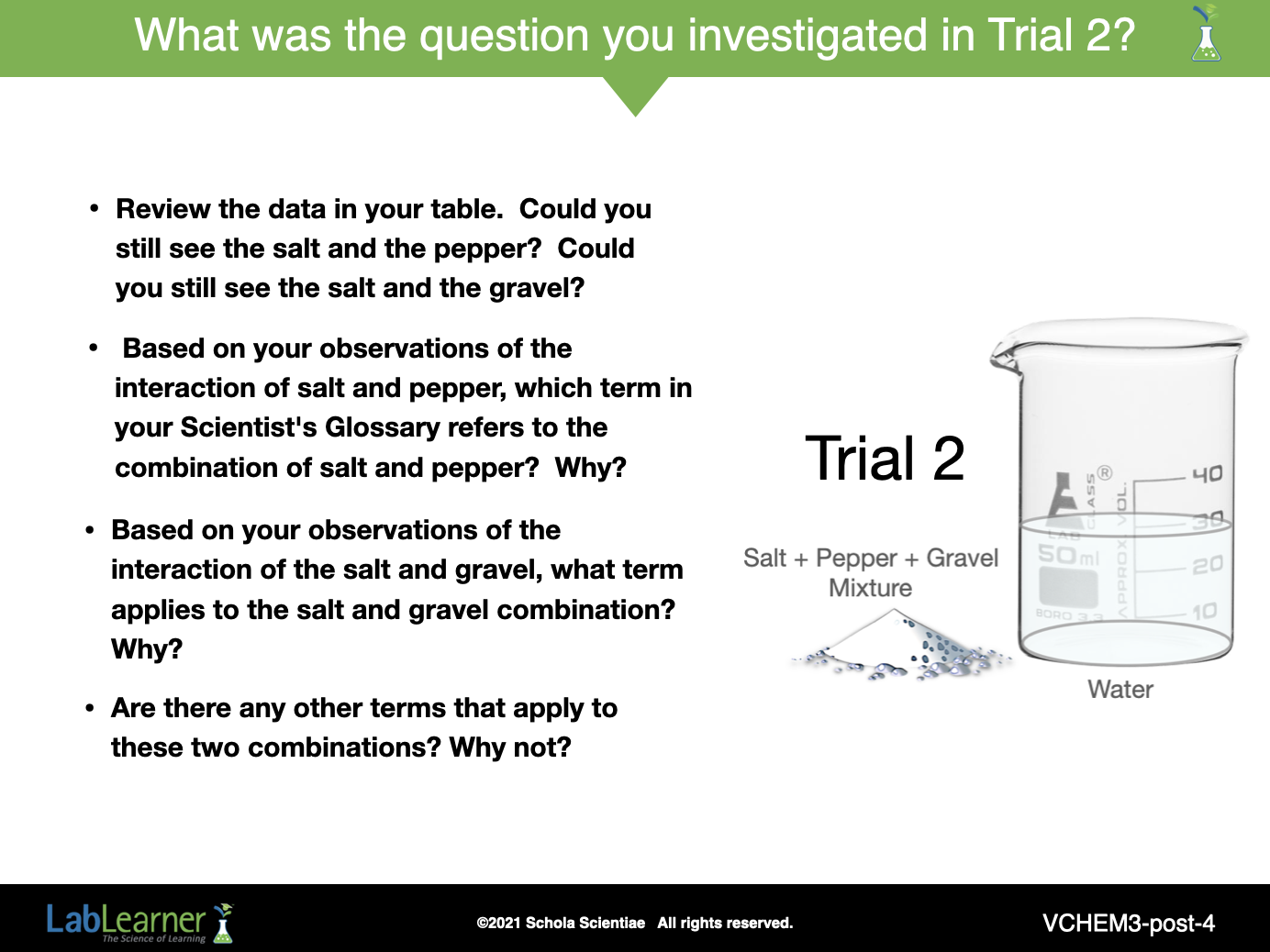
Ask students: What was the question you investigated in this Trial? The question students investigated was: How do solids interact with solids?
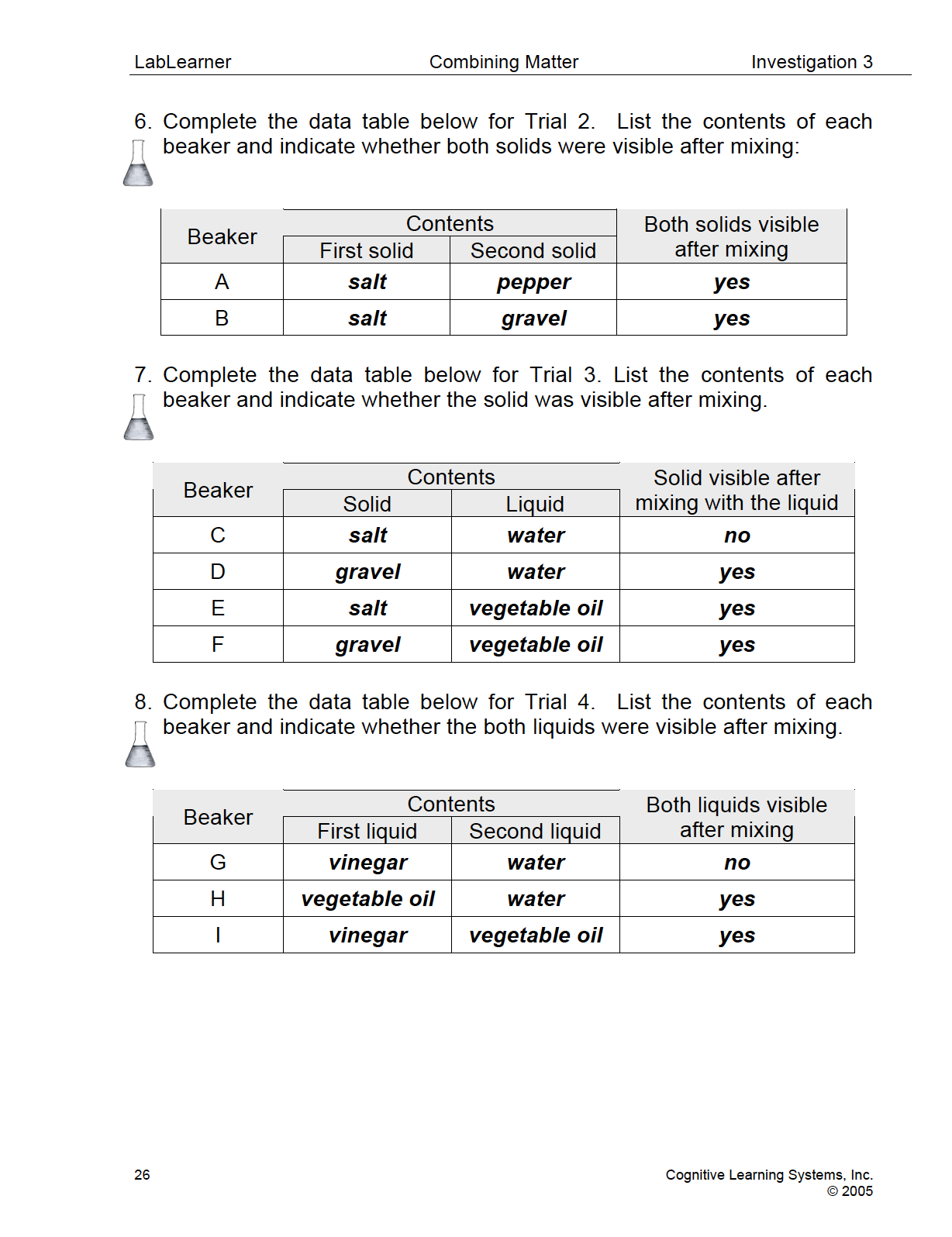
- Direct students to complete the data table in Problem 6 of their Student Data Record.
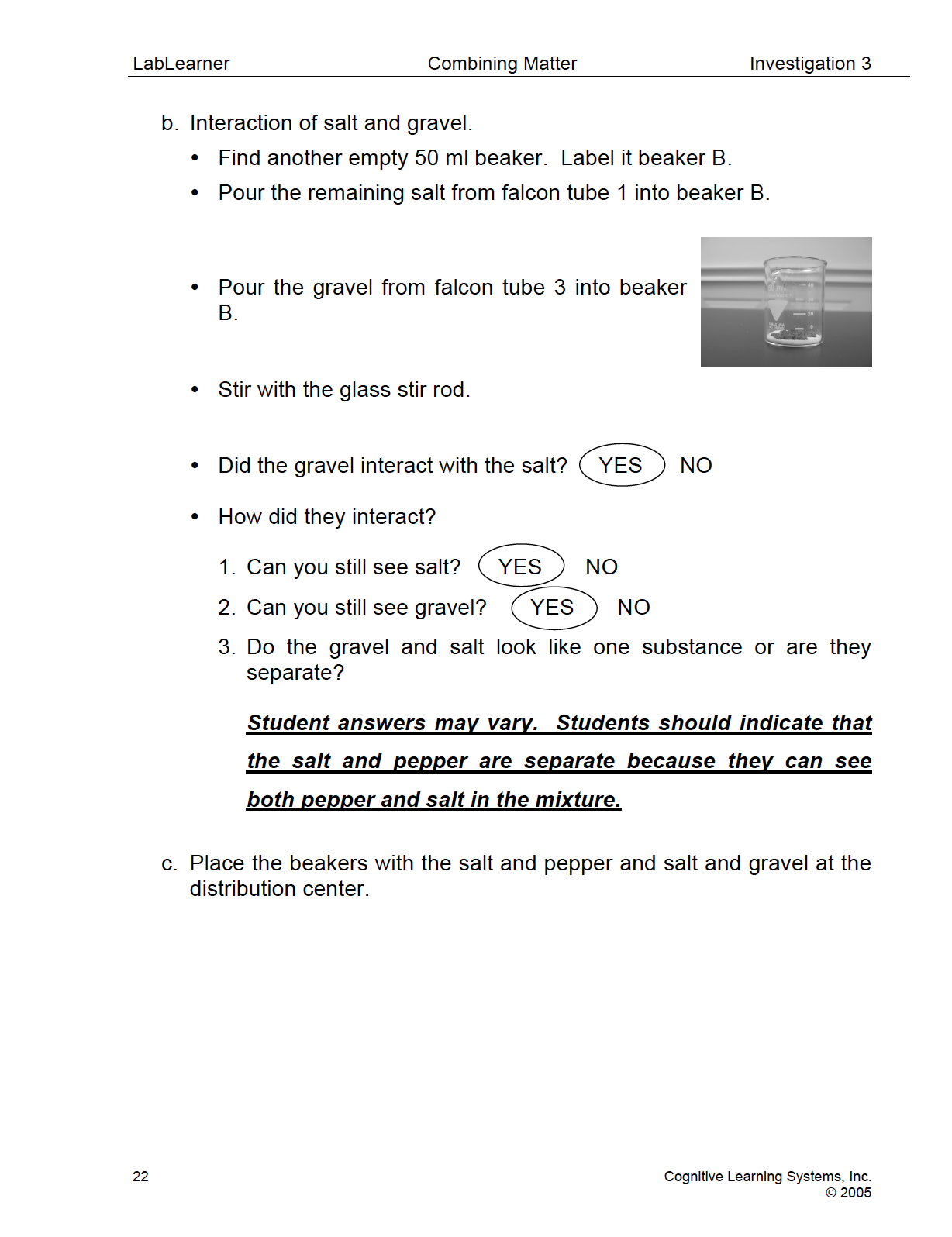
Ask students: Review the data in your table. Could you still see the salt and the pepper? Could you still see the salt and the gravel? Students should indicate that the salt, pepper, and gravel all remained visible after mixing.
Direct students’ attention to their Scientist’s Glossary. Ask students: Based on your observations of the interaction of salt and pepper, which term in your Scientist’s Glossary refers to the combination of salt and pepper? Why? Students should indicate that the term “mixture” applies to the salt and pepper combination because, while pepper was dispersed throughout the salt, both salt and pepper could still be seen in the mixture and some areas of the mixture had more salt than others.
Ask students: Based on your observations of the interaction of the salt and gravel, what term applies to the salt and gravel combination? Why? Students should indicate that the term “mixture” also applies to the salt and gravel combination because gravel could clearly be seen in the salt and the salt and gravel were not evenly dispersed.
Ask students: Are there any other terms that apply to these two combinations? Why not? Students should indicate that no other terms apply because the other terms either involve liquids and no liquid was present in either mixture or refer to a solution that has a uniform distribution of substances when combined. Uniform distribution did not occur in either the salt and pepper mixture or the salt and gravel mixture.
______________________________________________
SLIDE VCHEM3-post-5
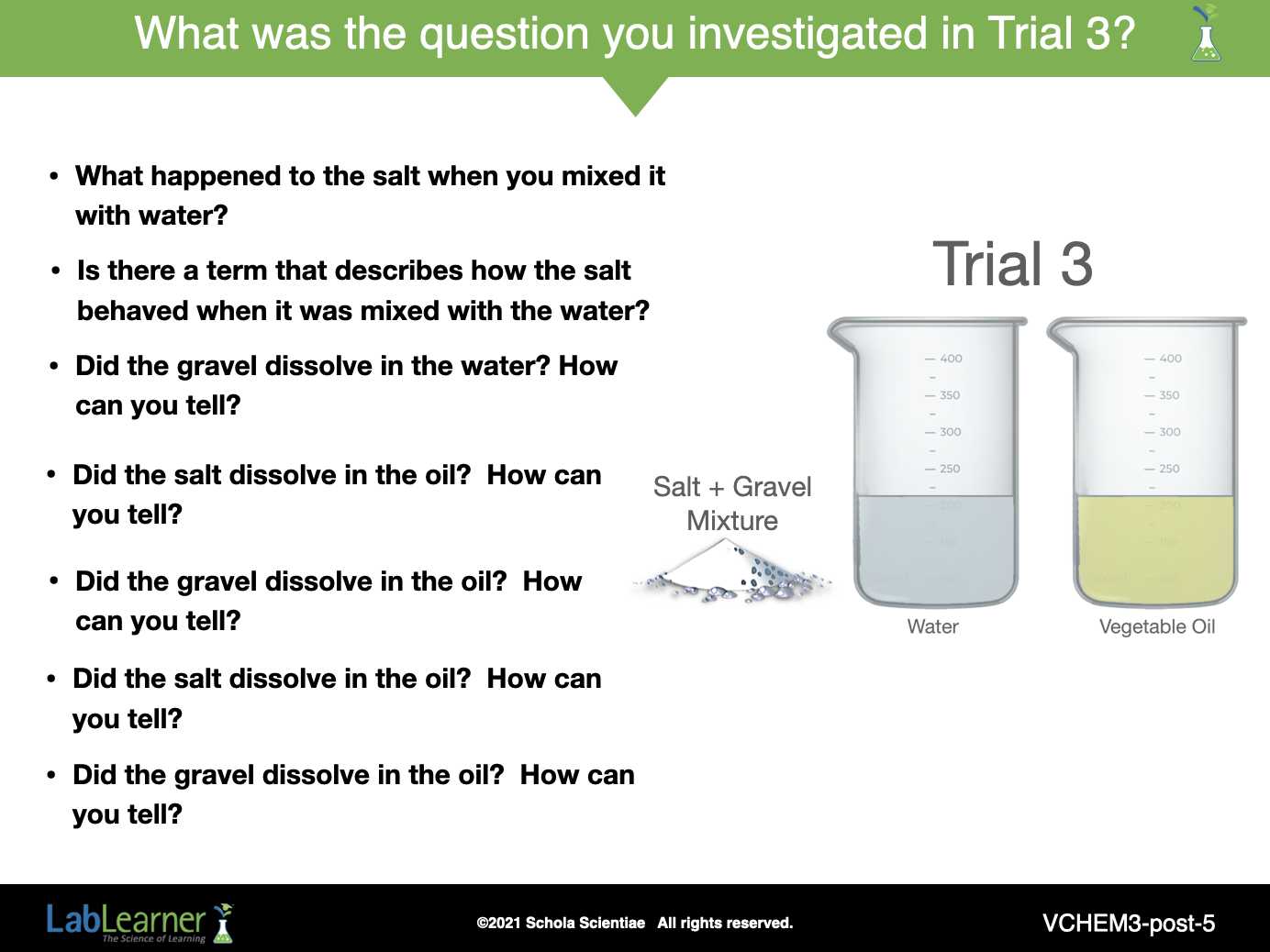
Ask students: What was the question you investigated in this trial? The students investigated the question: How do solids interact with liquids?
- Direct students to complete Problem 7 in their Student Data Record.
Ask students: What happened to the salt when you mixed it with water? Students should indicate that the salt seemed to change phase (changed from a solid to a liquid) when it was combined with the water. The resulting mixture appeared uniform throughout.
Direct students’ attention to their Scientist’s Glossary. Ask students: Is there a term that describes how the salt behaved when it was mixed with the water? Students should indicate that the term “dissolve” describes the behavior of salt when mixed in water.
Ask students: Did the gravel dissolve in the water? How can you tell? Students should indicate that gravel did not dissolve in the water because they could still see gravel and water after stirring.
Ask students: Did the salt dissolve in the oil? How can you tell? Students should indicate that the salt did not dissolve in the oil because they could still see salt and oil in the beaker after stirring.
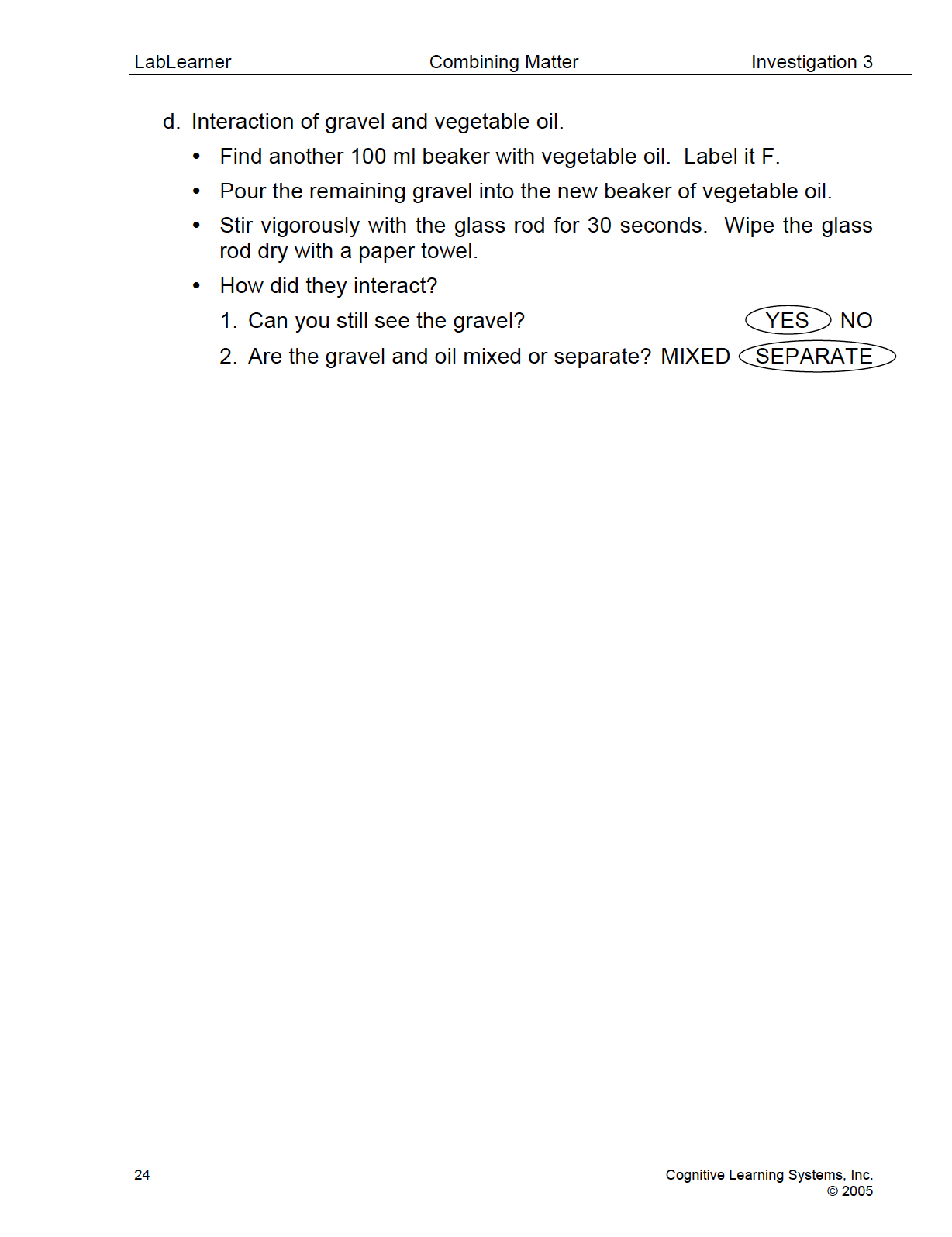
Ask students: Did the gravel dissolve in the oil? How can you tell? Students should indicate that the gravel did not dissolve in the oil because they could see both gravel and oil in the beaker after stirring.
Ask students: Did the salt dissolve in the oil? How can you tell? Students should indicate that the salt did not dissolve in the oil because they could still see salt and oil in the beaker after stirring.
Ask students: Did the gravel dissolve in the oil? How can you tell? Students should indicate that the gravel did not dissolve in the oil because they could see both gravel and oil in the beaker after stirring.
______________________________________________
SLIDE VCHEM3-post-6
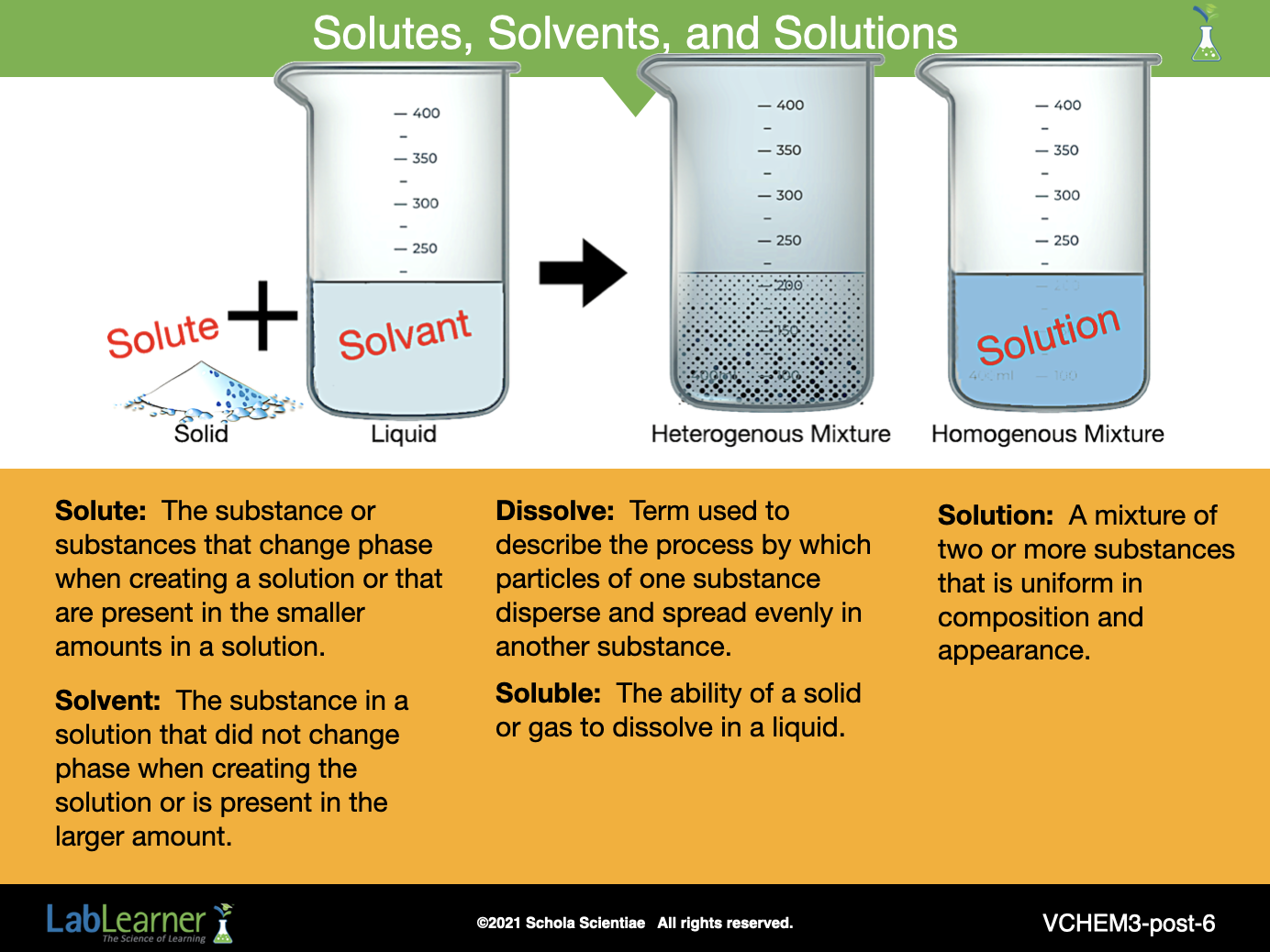
Direct students’ attention to their Scientist’s Glossary. Explain to students that there is a special term scientists use when a mixture behaves like salt and water.
Ask students: Which terms in your Scientist’s Glossary refers to the type of mixture formed by salt and water? Students should indicate that the salt and water mixture was a solution.
- Explain to students that chemicals in solution have special terms relating to how they interact with each other in that solution.
Ask students: Which term refers to salt in this solution? Why? Students should indicate that salt is the solute because it changed its state from solid to liquid.
Ask students: Which term refers to water in this solution? Why? Students should indicate that water is the solvent because it did not change its state.
- Explain to students that not all solids and liquids can form solutions when they are mixed.
Ask students: Do you see a term in your Scientist’s Glossary that describes whether solids and liquids can form solutions? Students should identify the term “soluble” as describing whether solids and liquids are able to form solutions.
Ask students: Was salt soluble in water or oil? Why? Students should indicate that salt was soluble in water but not in oil because salt dissolved in the water but not in the oil.
Ask students: Was gravel soluble in water or oil? Why? Students should indicate that gravel was not soluble in either water or oil because it did not dissolve in either liquid.
______________________________________________
SLIDE VCHEM3-post-7
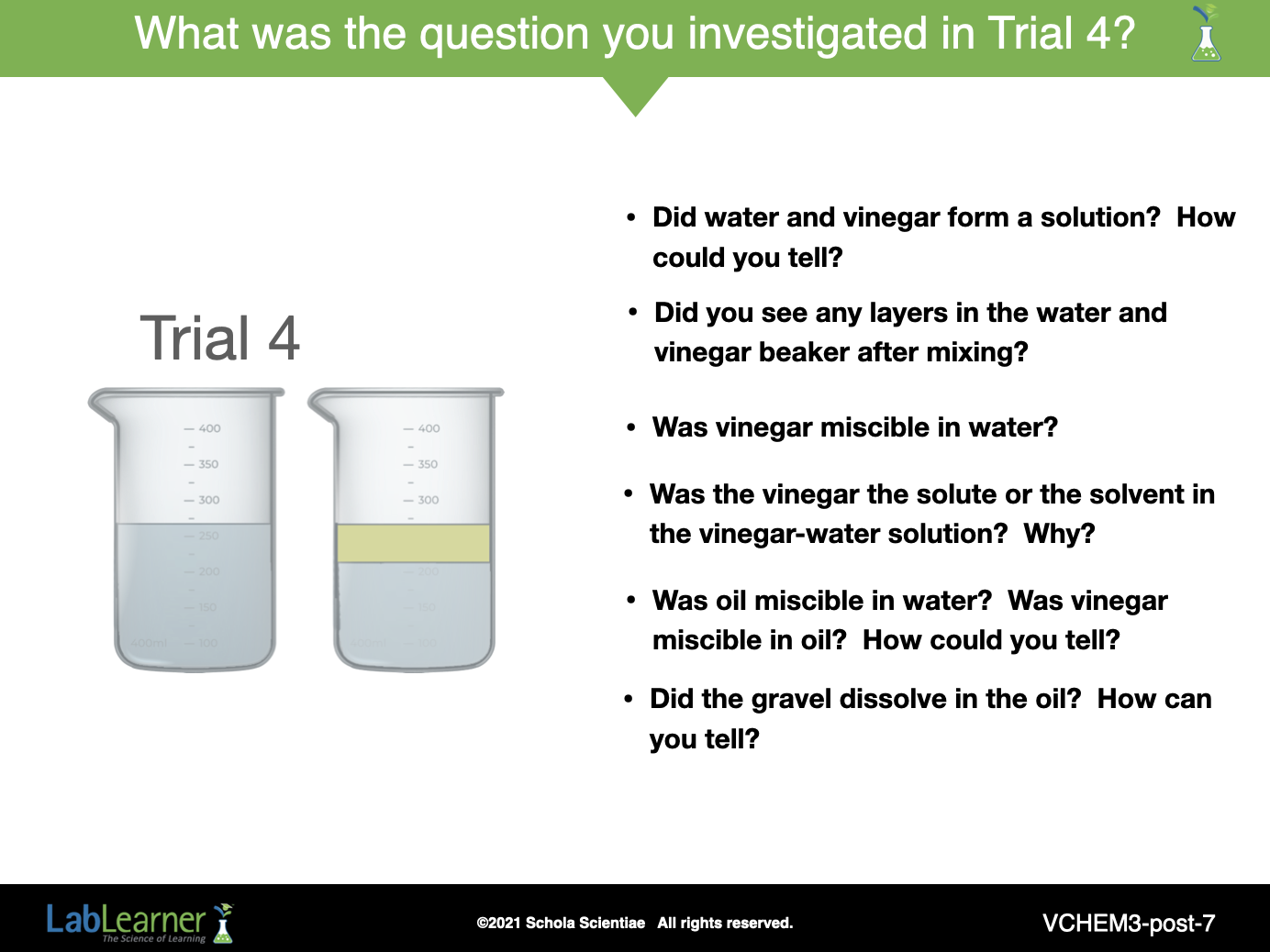
Ask students: What was the question you investigated in this trial? The students investigated the question: How do solids interact with liquids?
- Direct students to complete Problem 8 in their Student Data Record.
Ask students: Did water and vinegar form a solution? How could you tell? Students may have difficulty answering this question, as water and white vinegar were similar in appearance to each other and to the mixture after their interaction.
Ask students: Did you see any layers in the water and vinegar beaker after mixing? Students should indicate that they did not see any layers in the water and vinegar beaker. Layers would indicate that two liquids in a mixture did not form a solution.
Ask students: Was vinegar miscible in water? Students should answer that yes, vinegar was miscible in water.
- Explain that scientists use the term miscible when referring to liquids that mix with other liquids, and that liquid-liquid mixtures form solutions just as solids and liquids do. Miscible is similar to the concept of soluble. Soluble refers to the dissolution of solids and gases. Miscible refers to the dissolution of liquids with liquids. Explain that components in a liquid-liquid solution are referred to as solute and solvent just as in a solid-liquid solution. However, when dealing with a solute and solvent in the same state, the second part of the definition of solute and solvent are used: the solute is the substance present in the smaller amount in the solution and the solvent is the substance present in the larger amount.
Ask students: Was the vinegar the solute or the solvent in the vinegar-water solution? Why? Students should indicate that the vinegar was the solute because it was present in the smaller amount.
Ask students: Was oil miscible in water? Was vinegar miscible in oil? How could you tell? Students should indicate that oil was not miscible in water and vinegar was not miscible in oil because both the oil and water and vinegar and oil formed two separate layers after stirring.
______________________________________________
SLIDE VCHEM3-post-8
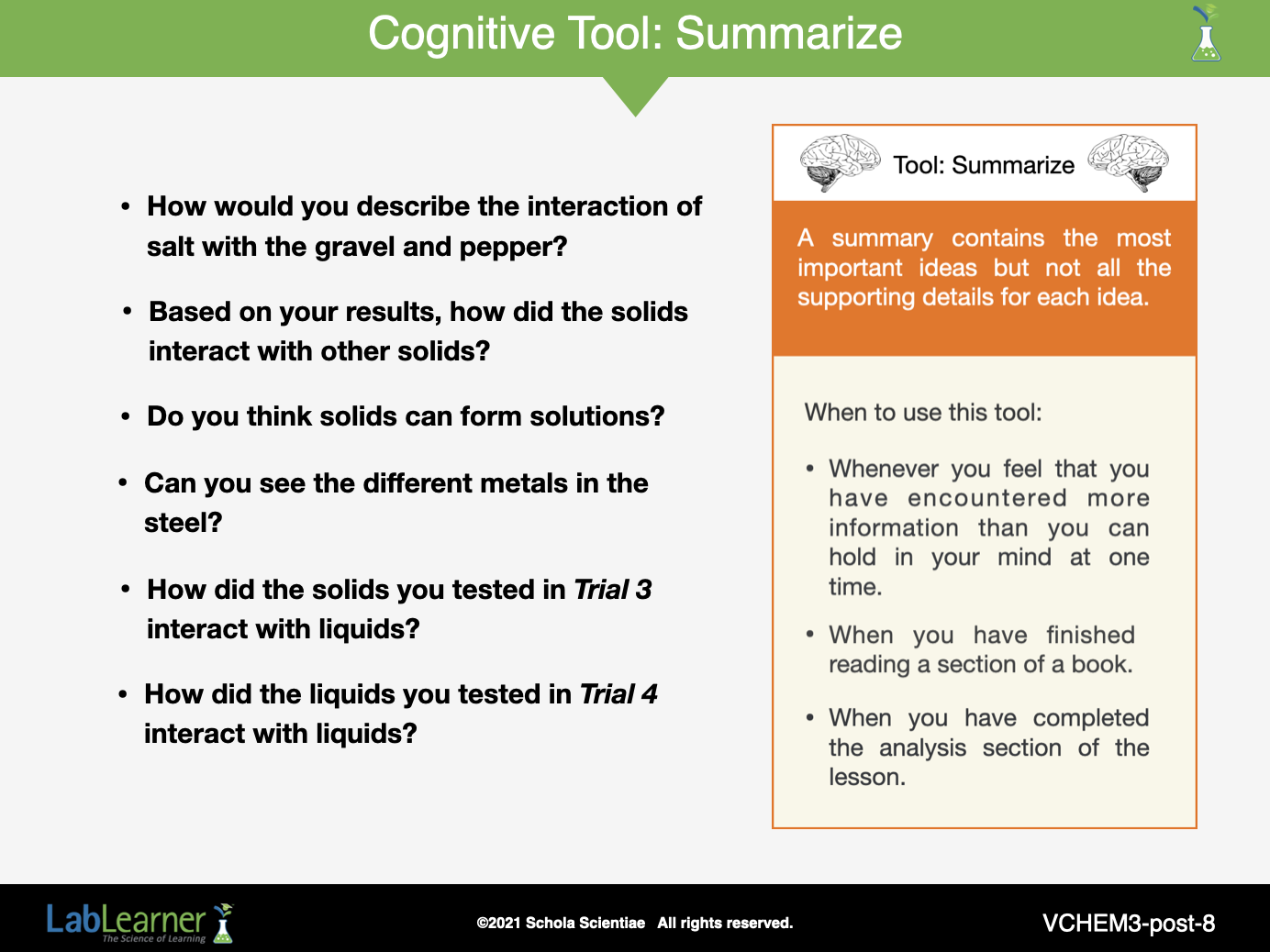
Ask students: How would you describe the interaction of salt with the gravel and pepper? Students should indicate that salt formed a mixture with pepper and with gravel but not a solution because they were still able to see the different solids after mixing.
Ask students: Based on your results, how did the solids interact with other solids? Students should conclude that the solids interacted with other solids to form mixtures. In the mixtures, all components in solid mixtures remained visible after mixing.
- Direct students to record their answers in Problem 9 of their Student Data Record.
Ask students: Do you think solids can form solutions? Student answers may vary. Students will likely indicate that they do not think solids can form solutions based on the results of Trial 2.
- Explain to students that solids can form solutions with other solids if they are mixed together while melted. Explain that steel is an example of a solid solution. Locate an item made of steel in the classroom such as a chair leg or door handle and use it as an example, being sure that it is not painted so that the students can see metal.
Ask students: Can you see the different metals in the steel? Students should indicate that they cannot see different metals and that the metal in the object all looks the same.
Ask students: How did the solids you tested in Trial 3 interact with liquids? Student answers may vary. Students should conclude that some solids interacted with liquids to form mixtures and that some solids dissolved in liquids to form special mixtures called solutions. Students should also indicate that not all solids were soluble in all of the liquids. Students should demonstrate an understanding that the solids that dissolved in liquids were referred to as solutes because they changed phase, while the liquids in which the solids dissolved were referred to as solvents.
- Direct students to record their answers in problem 9 of their Scientist Data Record.
Ask students: How did the liquids you tested in Trial 4 interact with liquids? Students should conclude that some liquids interacted with each other to form solutions and that the liquids that formed solutions with each other were miscible. Students should conclude that liquids were solutes just as solids were. Students should further conclude that not all the liquids were miscible with one another.
- Direct students to record their answers in Problem 9 of their Student Data Record.
______________________________________________
KEYS: POSTLAB