
Teacher Portal:
Chemistry, Matter and Interactions
Investigation 3 – Lab
 ASK WHY
There are five major branches of chemistry today – organic chemistry, analytical chemistry, physical chemistry, inorganic chemistry, and biochemistry. Organic chemistry is a brank of chemistry that focuses upon molecules and compounds that contain the carbon atom. Since living organisms contain many thousands of types of carbon-containing molecules, organic chemistry is sometimes associated with compounds derived from living organisms.
BRANCH OUT
According to the American Chemical Society, “inorganic chemistry is concerned with the properties and behavior of inorganic compounds, which include metals and minerals.
“While organic chemistry is defined as the study of carbon-containing compounds, inorganic chemistry is the study of the remaining (i.e., not carbon-containing) subset of compounds.
“Many inorganic chemists work in industry, but they also work in academic institutions and government labs. Inorganic chemists who work in government say their time is increasingly spent writing grant proposals and competing for research money”.
BE PREPARED
Supplies and Equipment:
Class Materials:
- 45 g salt
- 50 ml white vinegar
- 900 ml water
- 12 g gravel
- 3.5 g pepper
- 775 ml vegetable oil
- masking tape
- 1 100 ml graduated cylinder
Group Materials:
- 5 50 ml beakers
- 5 100 ml beakers
- 7 falcon tubes
- 1 100 ml graduated cylinder
- 1 liter pitcher
- 1 glass stirring rod
- 1 test tube rack
- 1 stopwatch
Individual Materials:
- 1 Student Data Record
- 1 pair of safety goggles
Teacher Preparation
1. Label five (5) 50 ml beakers “oil” and ten (10) 100 ml beakers “oil”.
2. Label five (5) falcon tubes “1”, five (5) falcon tubes “2”, five (5) falcon tubes “3”, five (5) falcon tubes “4”, and five (5) falcon tubes “5”, five (5) falcon tubes “6” and five (5) falcon tubes “7”.
3. Fill the beakers as follows using a 100 ml graduated cylinder:

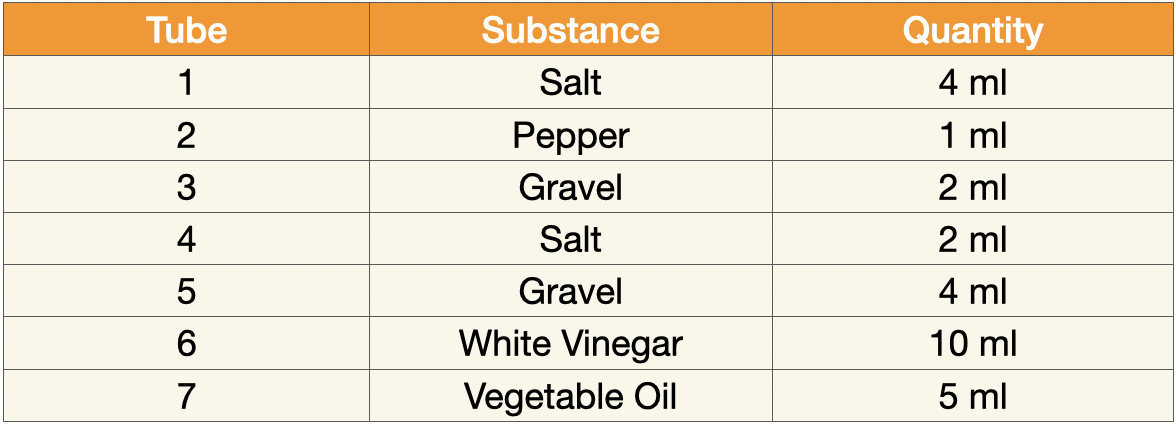
4. Fill the falcon (centrifuge) tubes as follows using a funnel if necessary:
5. Fill five (5) liter pitchers with 200 ml of water.
Instruction
Direct each student group to obtain the following necessary materials from the distribution point: four (4) empty 50 ml beakers, three (3) empty 100 ml beakers, one (1) 100 ml graduated cylinder, two (2) 50 ml beakers of water, one (1) 50 ml beaker of oil, two (2) 100 ml beakers of oil, one (1) glass stirring rod, one (1) one liter pitcher, one (1) test tube rack containing one (1) each of falcon tubes 1-7, and one (1) stopwatch.
GET FOCUSED
- In the previous investigations, students compared two scientific tools used to evaluate differences in the mass of objects: the pan balance and triple beam balance. As part of their investigations they found that while the pan balance allowed for a comparison of mass between two substances, the triple beam balance was a more appropriate tool for determining the exact mass of a substance.
- As students begin the laboratory portion of Investigation Three, they will be presented with a similar opportunity to compare two tools used to measure volume: the beaker and the graduated cylinder. This experiment has been placed at this point in the Core Experience as students will need to be more accurate in their measurement of volume during the experiments in this investigation and those that follow.
INVESTIGATE
- Remind students that safety goggles are to be worn while handling chemicals.
Trial 1
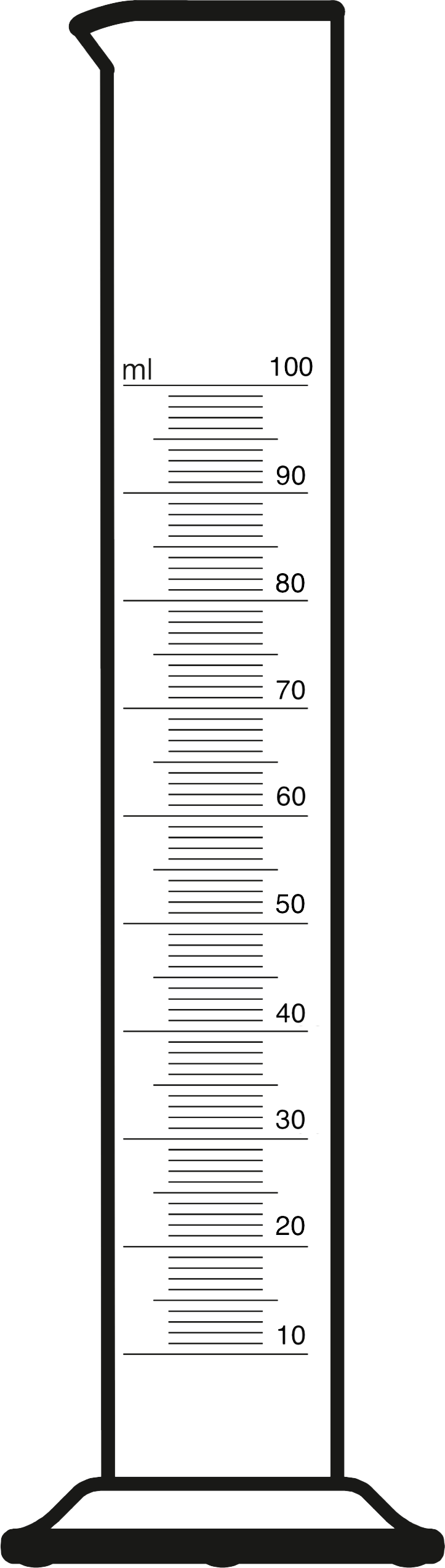
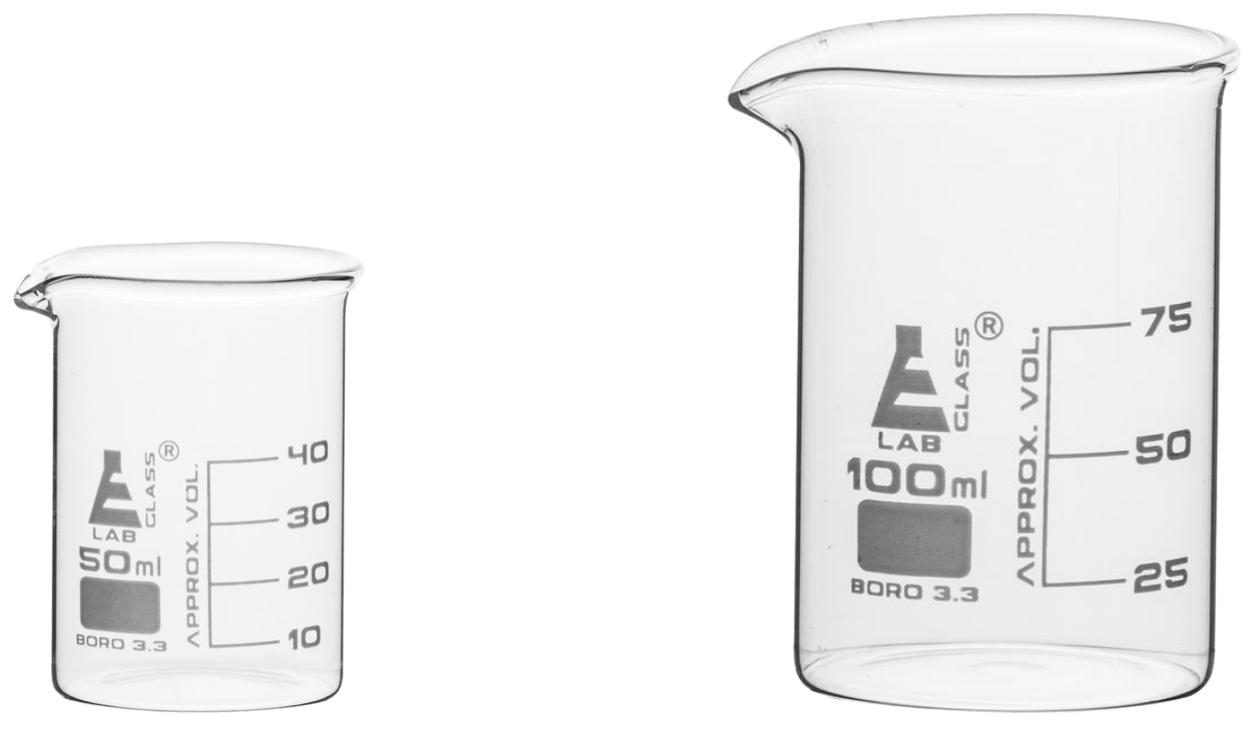
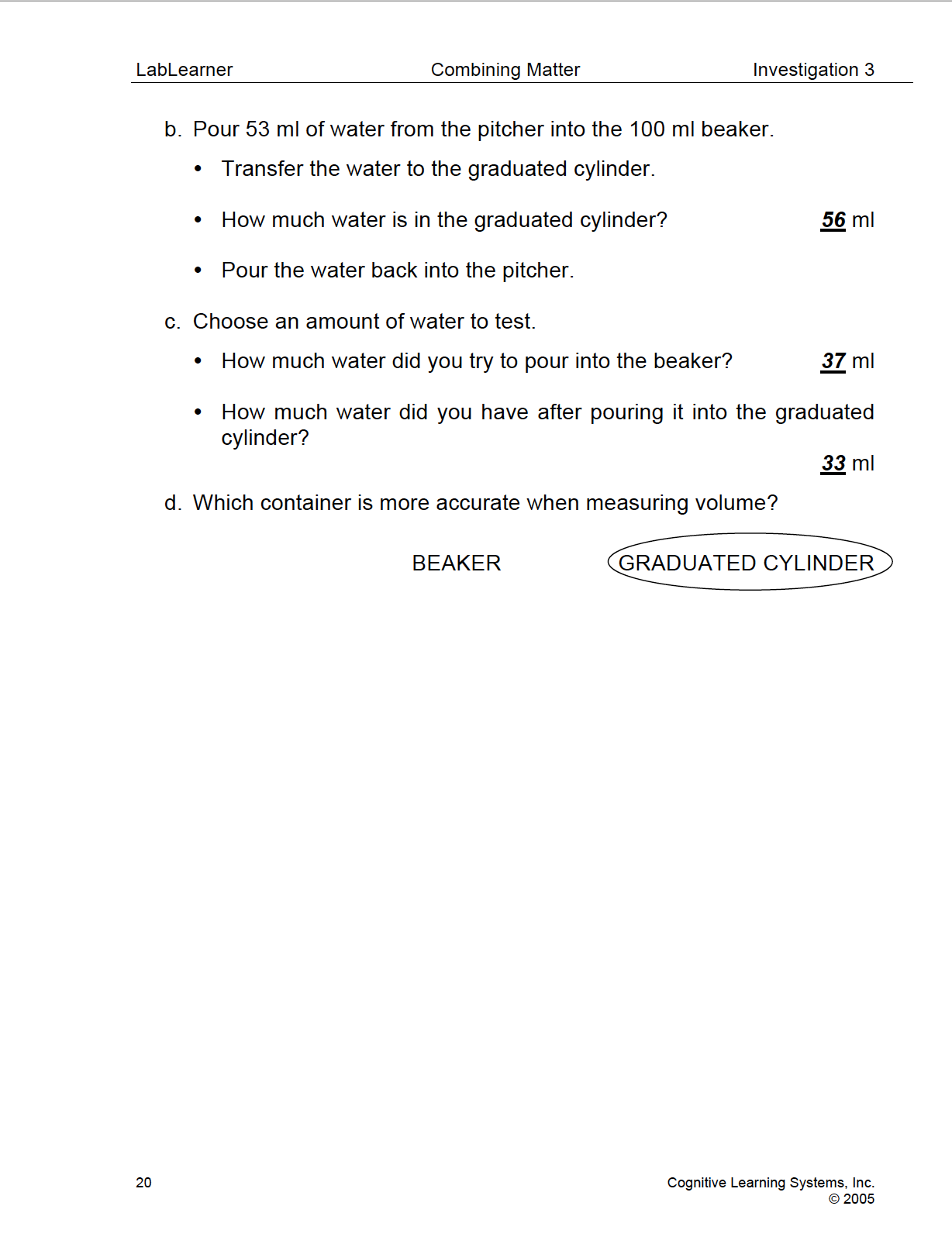
During this trial, students will compare the accuracy of a beaker and a graduated cylinder in measuring the volume of liquids. Graduated cylinders are more accurate for measuring volume because they are calibrated at the manufacture and have more increments, thus providing a more exact measurement. Students will discover during the course of this trial that using a beaker to accurately measure a volume that is not represented on the beaker scale is not easily achieved, but that measuring the same volume is easily achieved with a graduated cylinder due to its greater accuracy.
a. Explain to students that they have spent the last two Investigations focusing on several properties of substances, including mass. In this Investigation, they will focus on interactions of matter but will need to be very accurate in measuring the volume of liquids they will test. For this reason, you would like them to begin their experiments by comparing the accuracy of a beaker to a graduated cylinder for measuring the volume of liquids.
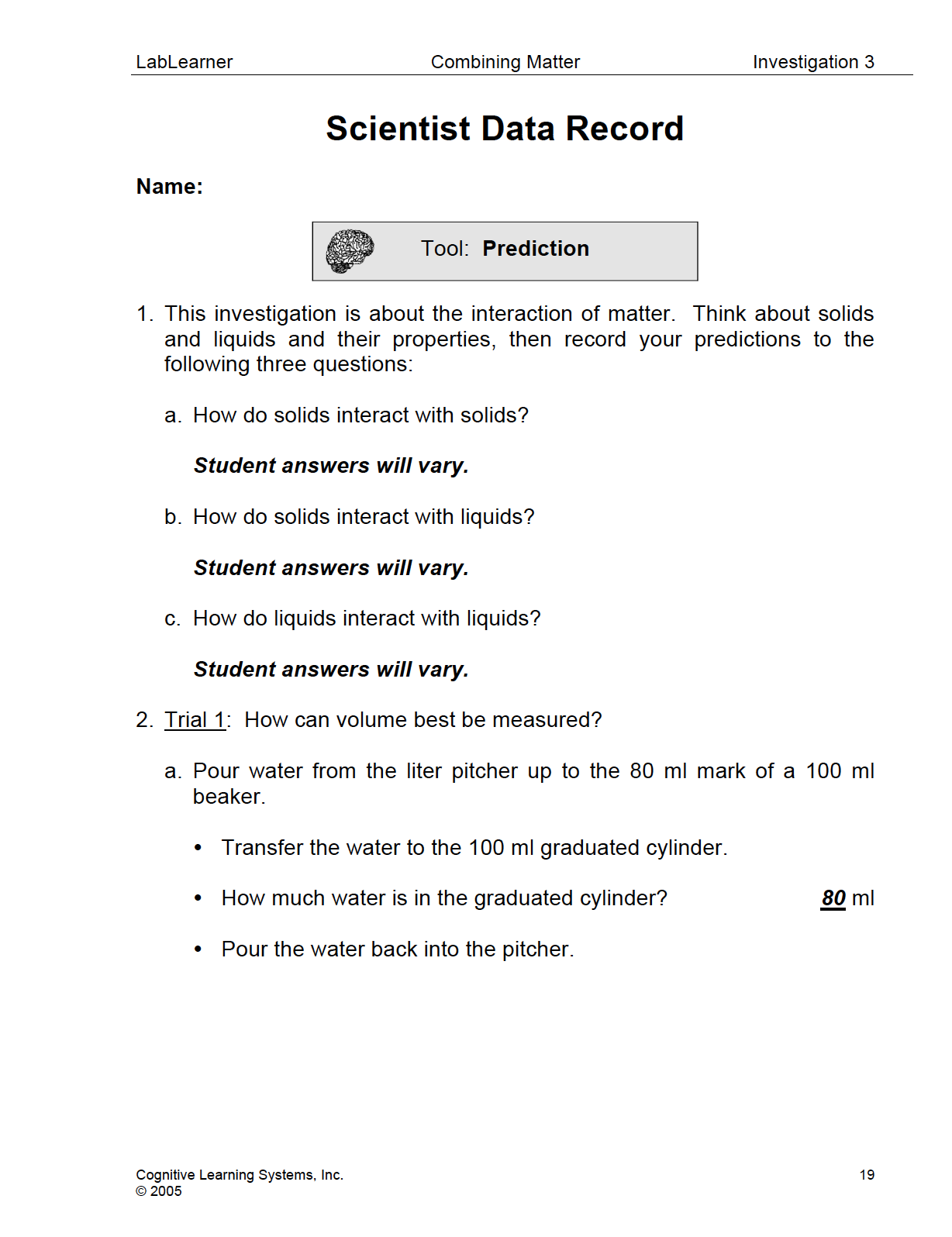
 b. Direct students to follow the steps described in problem 2a in their Student Data Record to conduct their experiment.
c. Ask students: What did you observe? Was there a difference between the volume of water as measured with the beaker as compared to the graduated cylinder? It is likely that the volume measured by both volumetric pieces is the same. However, some students may notice differences such as a measurement of 81 ml or 79 ml with the graduated cylinder.
d. Direct students to pour the water back into the pitcher.
e. Encourage students to continue the experiment by completing the steps in 2b of their Student Data Record.
f. Ask students: What did you observe? Was there a difference between the volume of water as measured with the beaker as compared to the graduated cylinder? It is likely that students will have had difficulty in measuring exactly 53 ml of water using the beaker because of the absence of smaller graduations on the beaker. In addition, students should have observed that the volume as measured by the graduated cylinder and beaker was different. The graduated cylinder provided a more accurate measure of volume.
g. Direct students to pour the water back into the pitcher.
h. Encourage students to measure out a volume of their choice using the beaker, compare it with the graduated cylinder and record their observations in problem 2c.
i. Once all student groups have had an opportunity to complete the last portion of the trial, evaluate the results of Trial 1 as a class. Discuss the differences students observed when measuring the volume of water with both the beaker and graduated cylinder. Emphasize how more graduations on the graduated cylinder provide greater accuracy and less error in the estimation of volume. Include in the discussion that graduated cylinders are calibrated at manufacture while beakers are not.
j. The concept of calibration may be new to students. Calibration is the standardization of measurement by marking the graduations, or correcting for deviation from a standard. Explain to students that when they equilibrate a triple beam balance, they are calibrating it to zero so that when they determine the mass of substance, that mass is exactly the amount indicated by the poises. As long as scientists use properly calibrated balances, the mass of a particular sample will be the same regardless of who determines its mass. The same holds true with a graduated cylinder. The cylinder is calibrated when it is manufactured so that scientists can accurately duplicate the volume of substances from one experiment or laboratory to another.
k. Encourage students to record their conclusion in problem 2d of their Student DataRecord.
Trial 2
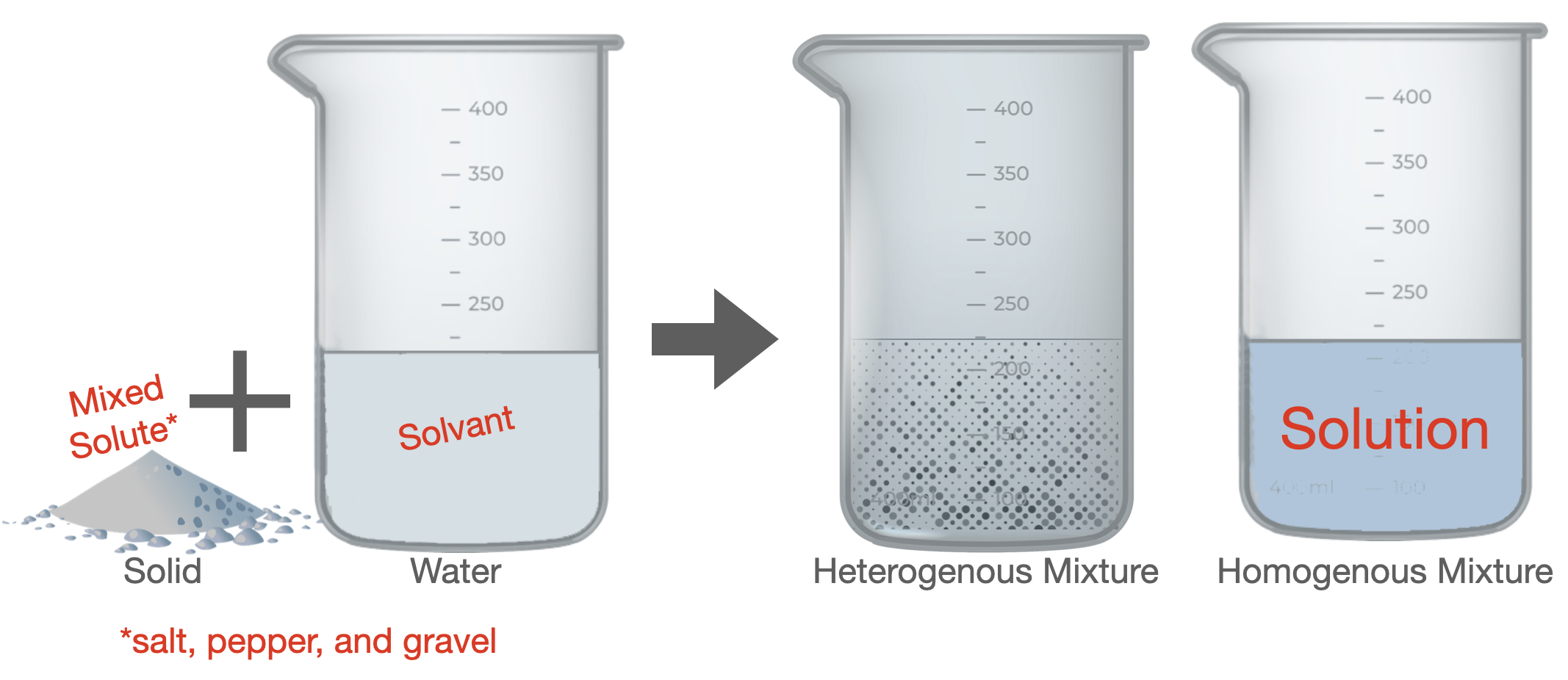
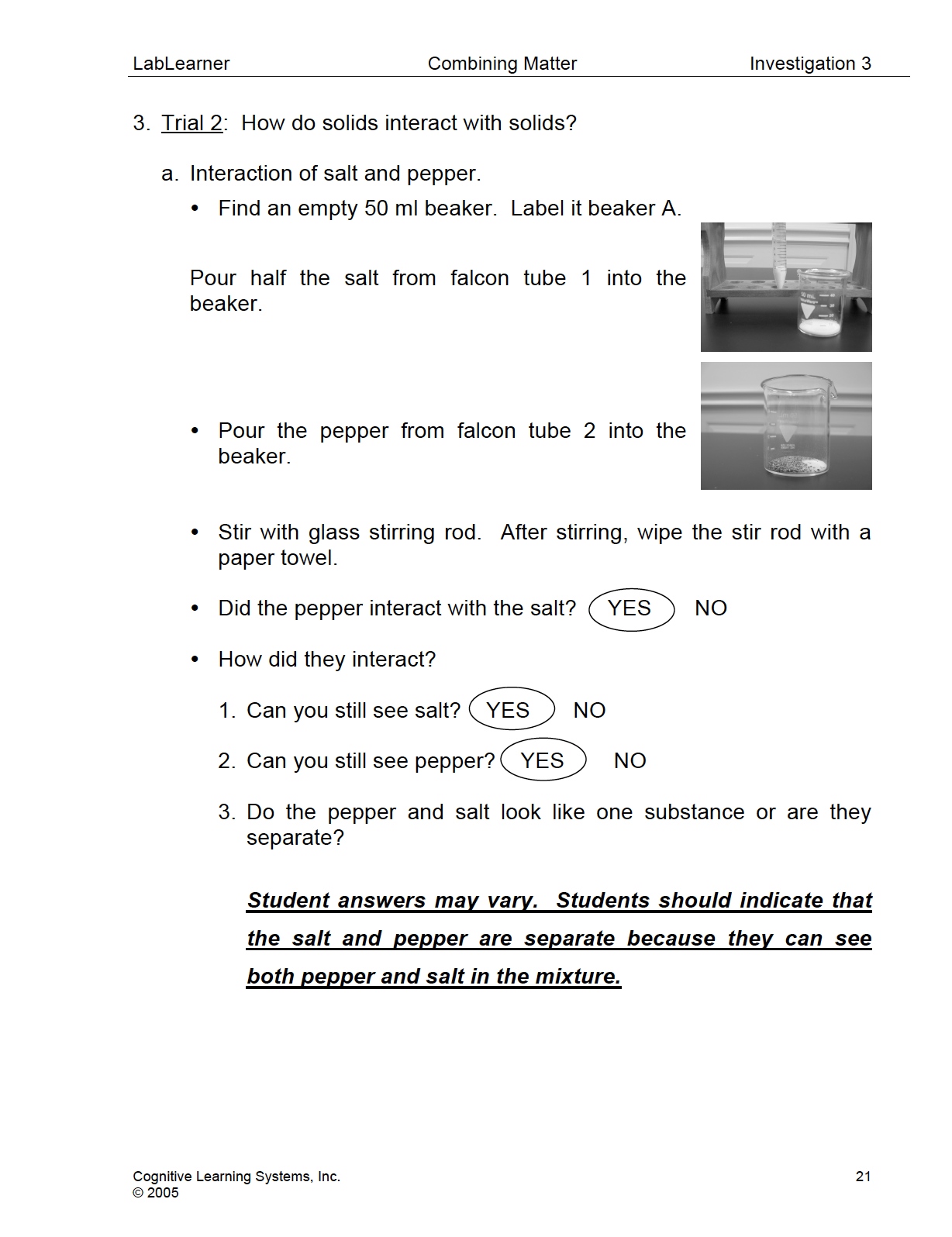
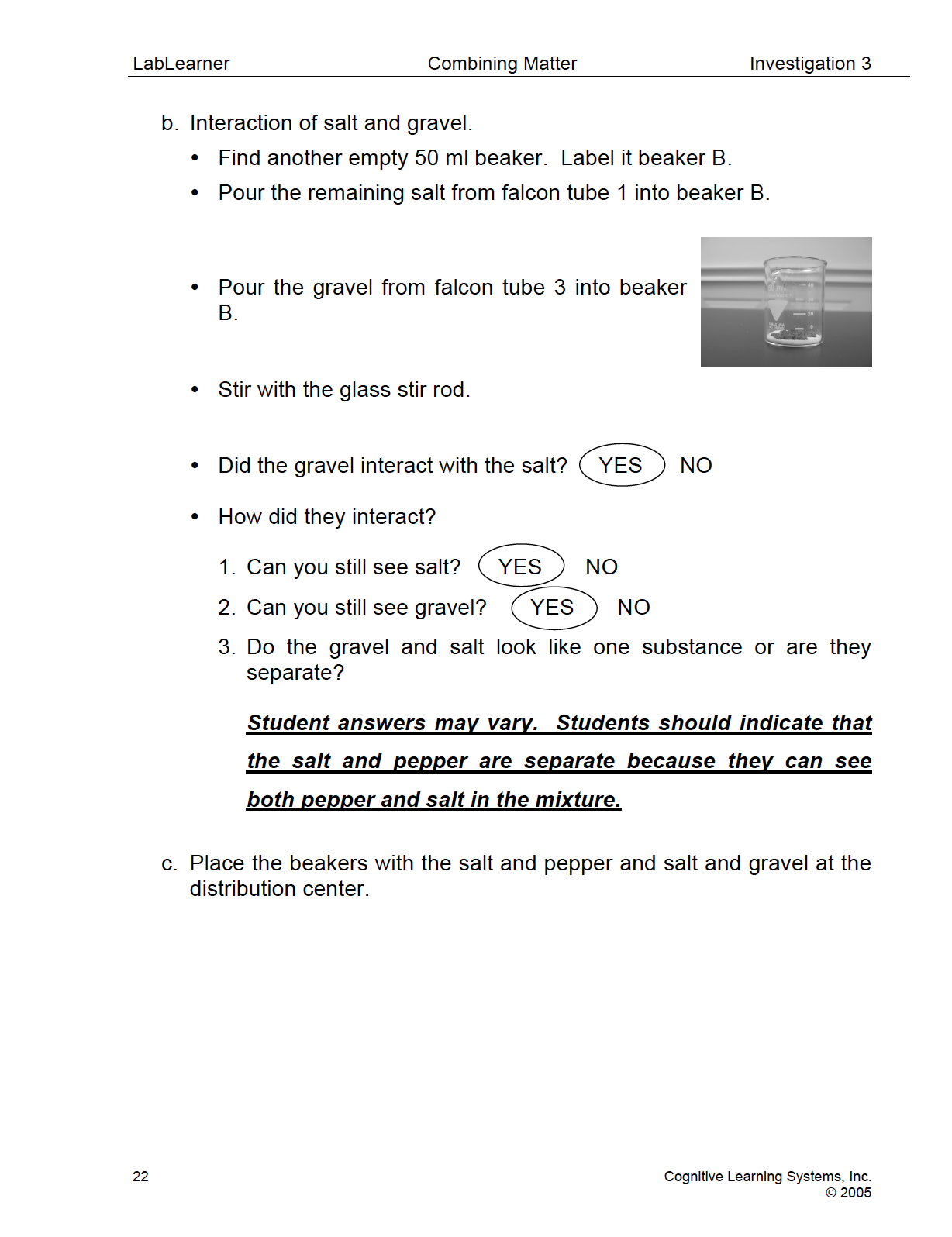
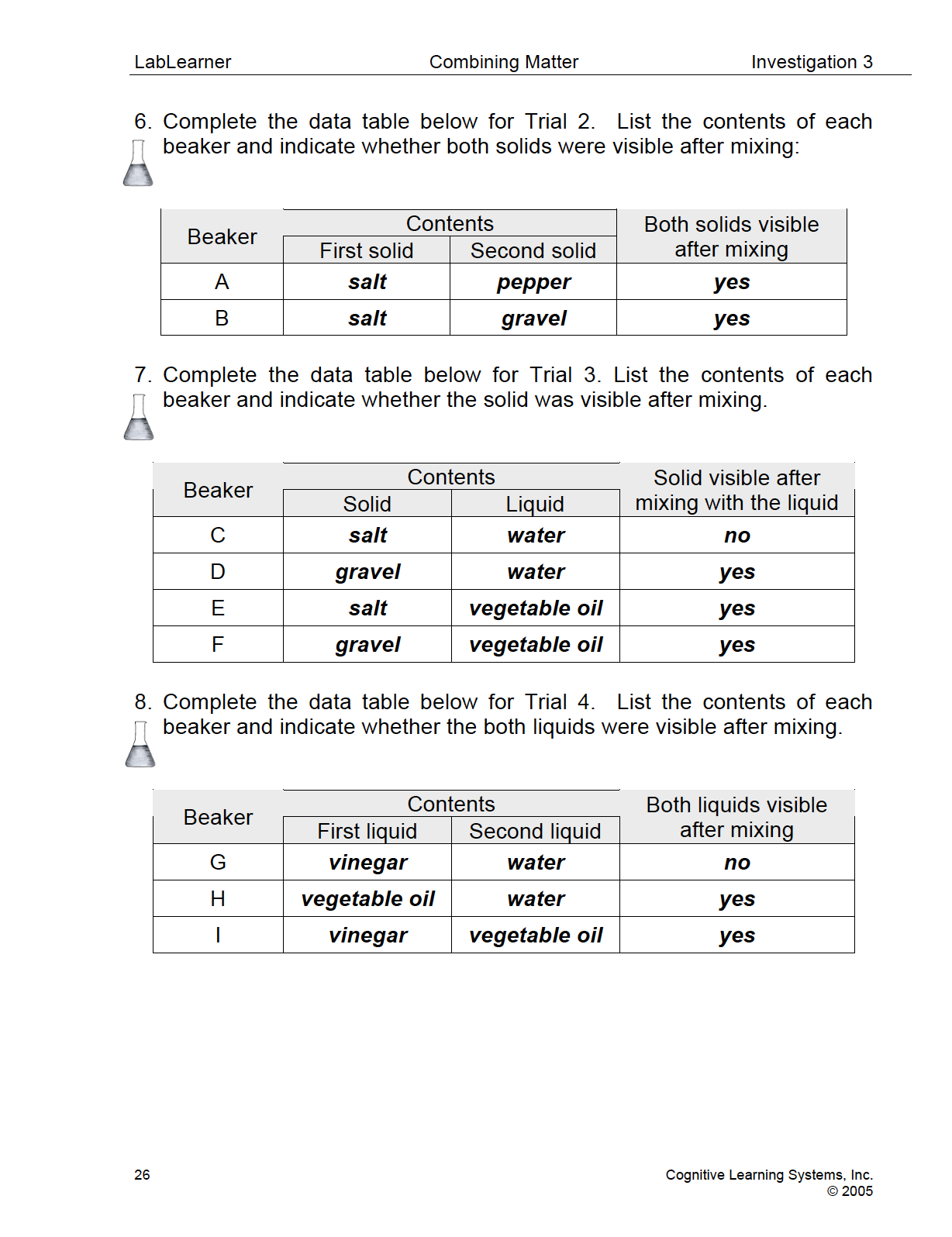
In this trial, students will explore how solids interact with one another. Students will be provided with samples of salt, pepper, and gravel, and asked to mix the salt with the pepper, and salt with the gravel. Students should observe that after mixing with the salt, pepper and gravel are spread throughout it, but each is still visible after mixing. As a result, students will discover that salt forms mixtures with pepper and gravel, but that the mixtures formed are not uniform in appearance.
In terms of classification, the interaction of salt, pepper, and gravel form a mixture but not a solution. A mixture is described as a combination of two or more substances. Mixtures can generally be described as heterogeneous mixtures and homogeneous mixtures. Heterogeneous mixtures are those mixtures in which the dispersion of the substances is not uniform. Homogeneous mixtures have a uniform dispersion of the combining substances. Solutions are one type of homogeneous mixture.
The salt, pepper, and gravel mixtures would be classified as a heterogeneous mixture. Although the terms heterogeneous and homogeneous mixture are not concepts students are expected to learn in this CELL, the experiments in this Trial are designed to show students that one way solids interact is to form heterogeneous mixtures in which each component substance can still be seen and areas of unequal distribution of the combining substances are present.
Encourage students to follow the protocol and record their results in Problem 3a of their Student Data Records.
Trial 3
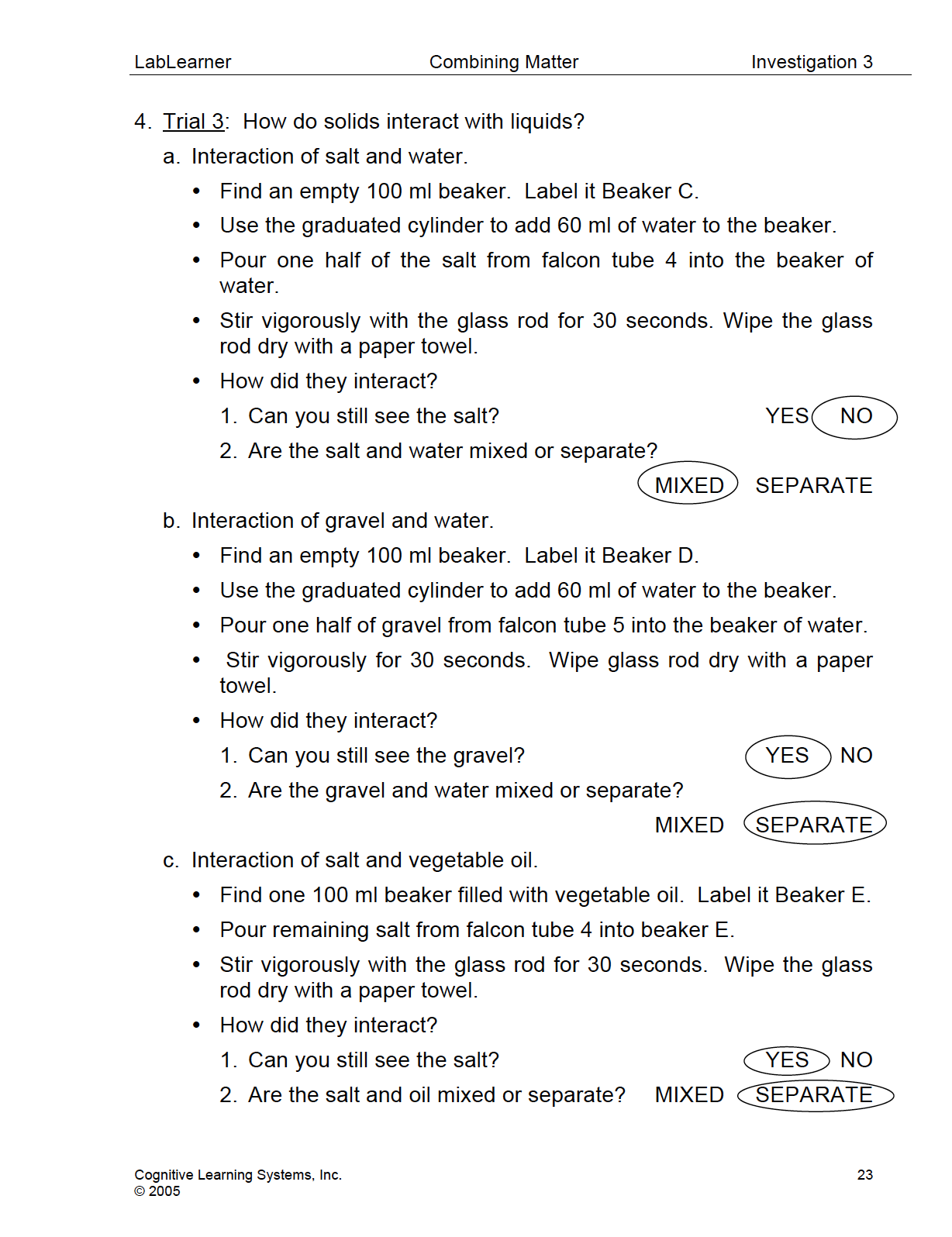
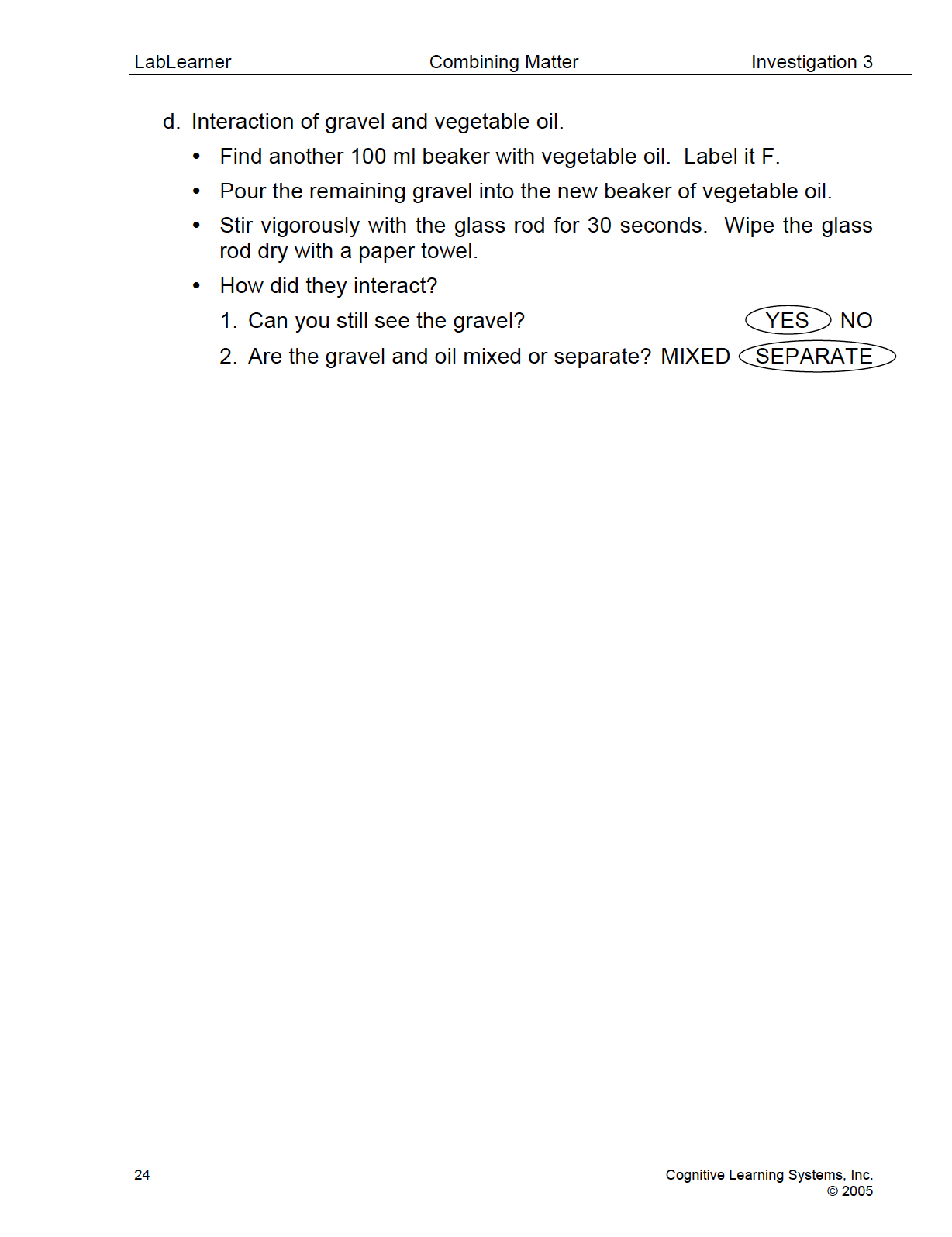
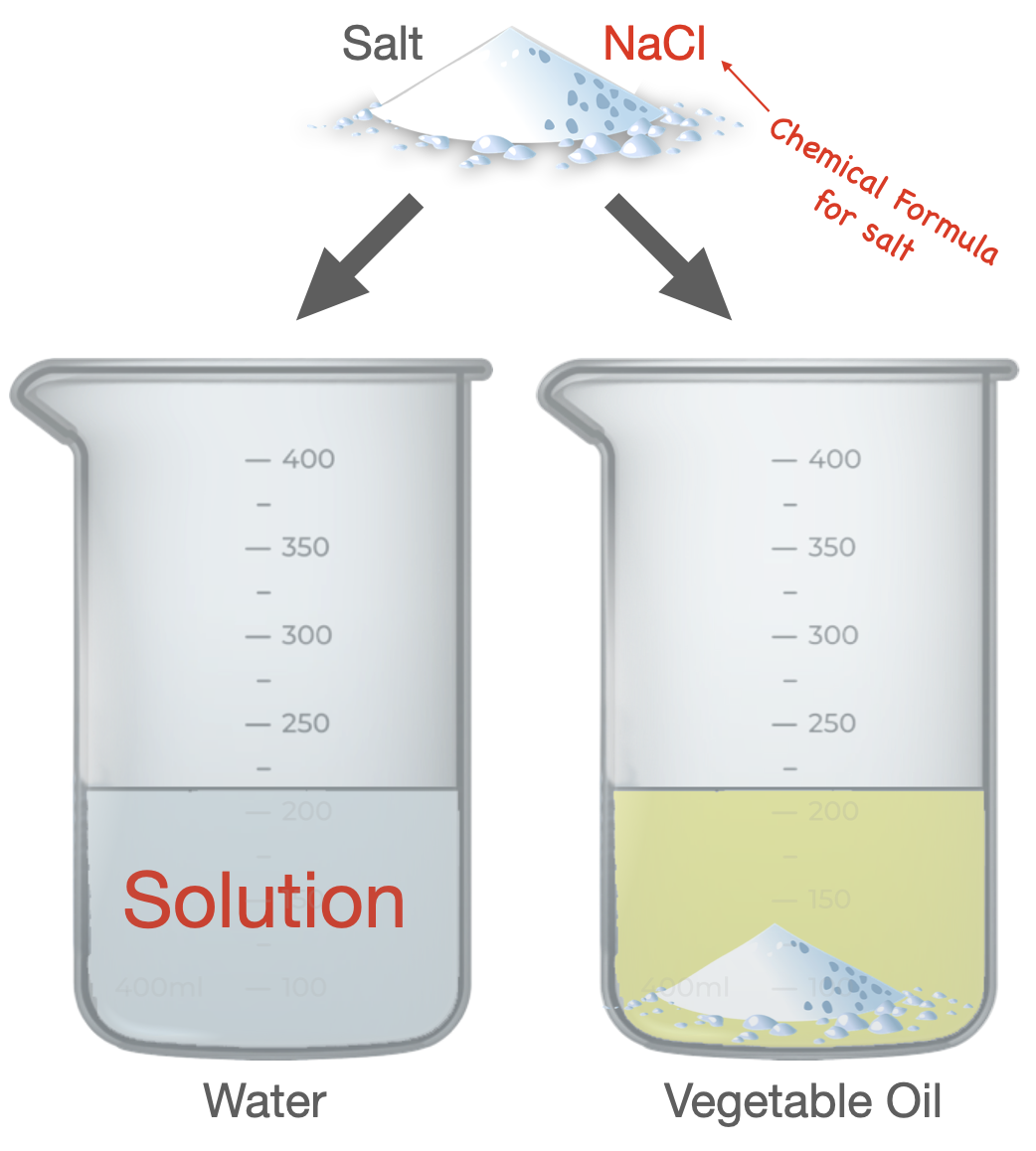 In this Trial, students will explore how solids interact with liquids by adding salt and gravel to both oil and water. Students will discover that salt dissolves in water but not in oil, introducing the concept that while a solid is soluble in one liquid, it is not necessarily soluble in all liquids. This investigation also demonstrates that while a liquid may dissolve some solids, it does not necessarily dissolve all solids. For example, salt dissolves in water, but gravel does not.
This Trial is also designed to illustrate the difference between a mixture that is considered a solution and one that is not. As salt dissolves in water, a solution is created. The interaction of salt and oil, gravel and oil, and gravel and water produce mixtures, but not solutions. In terms of the salt solution, students will associate the term solute with the salt and solvent to the water when analyzing their results during PostLab. Encourage students to follow the protocol and record their results in Problem 4a of their Student Data Records.
Trial 4
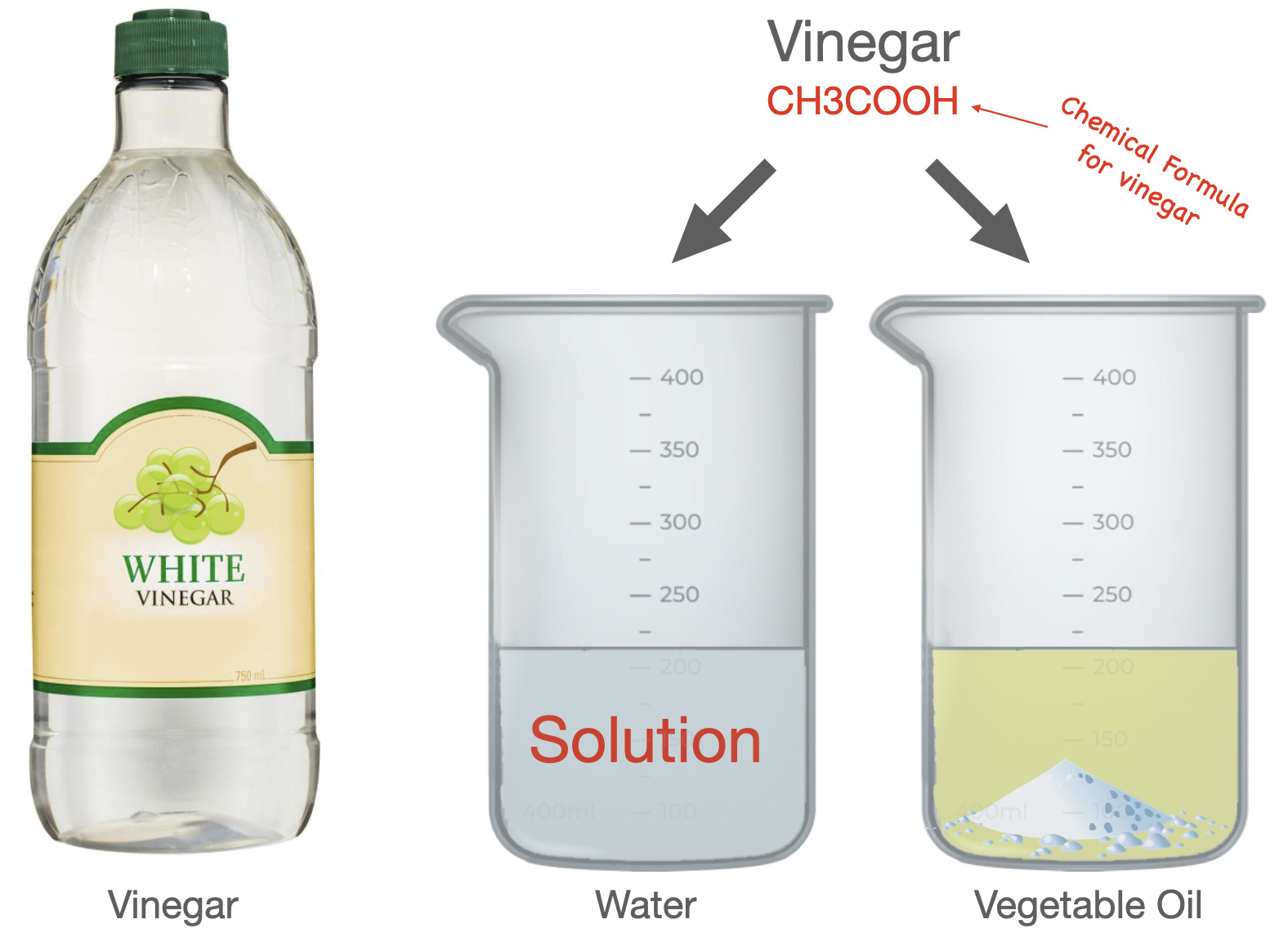
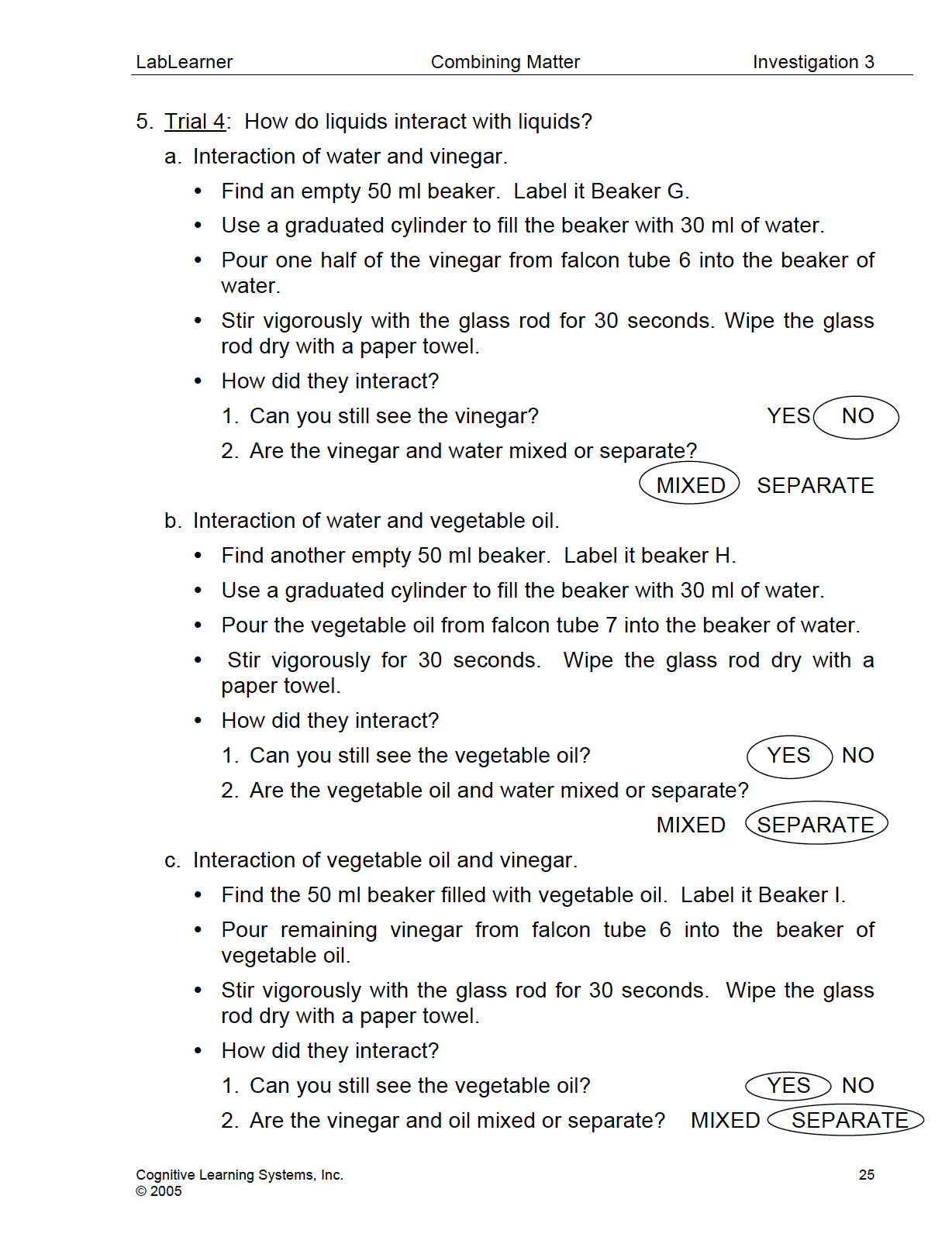
Trial 4 is designed to introduce the students to the concept of miscibility, the term used to describe whether two or more liquids combine to form a solution. Liquids that mix together forming a solution are termed miscible. Those that remain in separate phases are described as immiscible. Miscible is similar to the term soluble or dissolve. However, the terms soluble and dissolve generally refer to the process that occurs when different states of matter such as a solid and liquid form a solution.
During this Trial, students will observe how liquids interact with each other. Students will be instructed to mix water with both vinegar and oil, and vinegar with oil, observing that, as in Trial 3, water mixes with some liquids but not all liquids. They will also observe that what is miscible in water may not necessarily be miscible in oil.
Although students will not use the term miscible during the lab, they will reflect on their observations during the PostLab analysis as they are introduced to the term. Their observations during the lab should provide a basis for understanding this new term.
Encourage students to follow the protocol and record their results in Problem 5a of their Student Data Records.
KEYS
CLEAN UP
Let students know your expectations for clean-up. Ask them to clean up.