
Teacher Portal:
Chemistry, Matter and Interactions
Investigation 1 – PreLab
 ASK WHY
There are five major branches of chemistry today – organic chemistry, analytic chemistry, physical chemistry, inorganic chemistry, and biochemistry. Organic chemistry is a brank of chemistry that focuses upon molecules and compounds that contain the carbon atom. Since living organisms contain many thousands of types of carbon-containing molecules, organic chemistry is sometimes associated with compounds derived from living organisms.
BRANCH OUT
Organic chemists work in many different fields. Many consumer products are made of organic molecules such as cosmetics, food products, pharmaceuticals (medicines), petroleum products, and products made from byproducts of petroleum. A very short list of such products includes nylon, plastics, perfumes, detergents, insecticides, ink, automobile tires, dyes, candles, crayons, and many, many others.
PRINT IT
Use your browser to download a printable PDF as help during the slide presentation and to make additional notes. In your browser, go to File > Print and then choose to save as PDF.
MINDSET
This Investigation is designed to:
- introduce students to the science of chemistry as the study of matter.
- demonstrate that matter has both qualitative and quantitative properties.
- teach students to differentiate between qualitative and quantitative properties.
- demonstrate the proper use of the triple beam balance as a scientific tool for measuring mass.
- demonstrate through comparison of the pan balance and triple beam balance that exact measurements are necessary for quantitatively determining the difference in amounts of matter between samples.
- promote understanding that both qualitative and quantitative properties are necessary for accurately describing and identifying matter.
SCIENTIST’S GLOSSARY
- Chemist: A scientist who studies chemistry.
- Chemistry: The science that investigates the composition, properties and structures of matter.
- Properties: Characteristics of a substance that can be seen or measured.
- Qualitative properties: Properties of matter that describe matter but are generally not measured.
- Quantitative properties: Properties of matter that can be measured.
- Mass: The quantity of matter in a body, object, or substance. Mass is measured in the metric system in units of grams (g), kilograms, milligrams, etc.
- Volume: The quantity of space an object or substance occupies. Volume is measured in the metric system in units of liters (L), milliliters (ml), and cubic centimeters (cm3).
- Gram: A basic unit in the metric system used to measure mass. Grams are represented mathematically as “g”.
- Liter: A basic unit in the metric system used to measure volume. Liters are represented mathematically as “L”.
- Milliliter: One one-thousandth (1/1000, 0.001) of a liter. Milliliters are represented mathematically as “ml”.
- Triple beam balance: A scientific tool that measures mass in grams (g).
BE PREPARED
Watch the Investigation 1 Teacher Video and Student Video below to prepare for the PreLab.
SET FOR SUCCESS
- Tell students that they are about to begin the Chemistry, Matter and Interactions CELL.
- Ask students to share the kinds of things they might learn in these Investigations.
- Tell students to think about all of the different things around them, that they come in contact with every day that is made of chemicals.
Begin the PreLab Concept Slides to start students on their learning journey. Then watch the Pre-Lab Student Video afterward as a class.
NAVIGATE IT
Once the slide presentation is launched
- use your left and right arrows to advance or go back in the slide presentation, and
- hover your mouse over the left edge of the presentation to get a view of the thumbnails for all the slides so that you can quickly move anywhere in the presentation.
- Click HERE to launch the slide presentation for the CELL.
SHARE IT
SLIDE VCHEM1-pre-1
This is the first slide in the CELL Chemistry, Matter and Interactions. Investigation One introduces students to the science of chemistry as the study of properties of matter. Through observation and experimentation students will learn to differentiate between qualitative and quantitative properties.
______________________________________________
SLIDE VCHEM1-pre-2
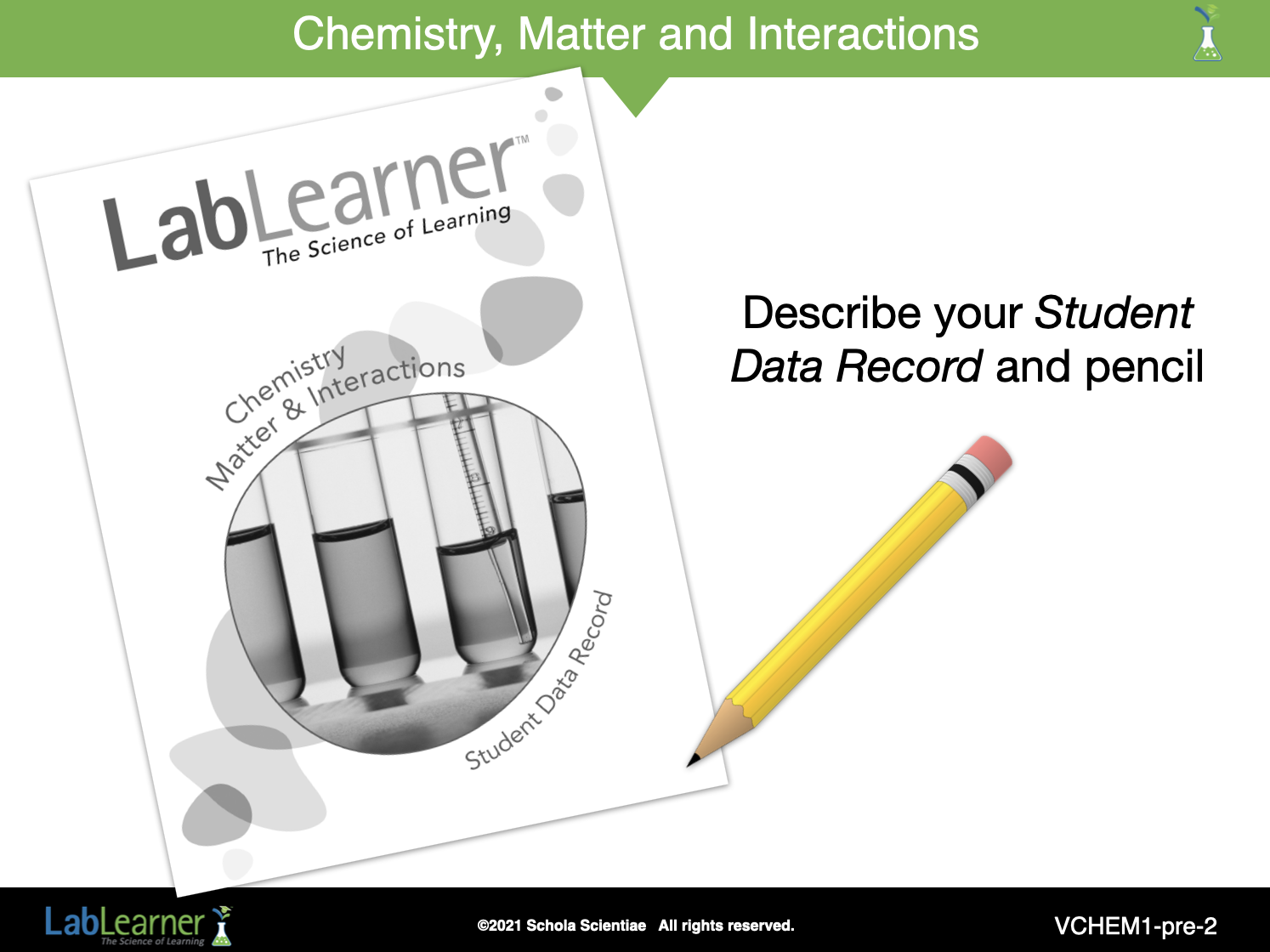
Allow students to share what they can recall. Then continue to encourage students to answer the following questions as a way to further guide their recall:
How would you describe your Scientist Data Record? Student answers will vary. Students should indicate that their Scientist Data Records are white with black and gray ink, and may indicate that they contain pictures, words, and numbers. If Scientist Data Records are assembled with colored covers, students may refer to the color of the cover.
How would you describe your pencil? Student answers will vary. Students should refer to color, feel, whether the pencil is wood or mechanical, what color eraser it has, what shape it is, and so forth.
What is your Scientist Data Record made of? What is your pencil made of? Student answers may vary. The Scientist Data Record is made of paper, ink, and perhaps staples. Pencils are made of wood or plastic, metal, graphite, rubber, paint, and ink.
Which state of matter are your Scientist Data Record and your pencil? The Scientist Data Record and pencil are solids.
How do you know they are not liquids or gases? Student answers will vary. Answers will probably indicate that the Scientist Data Record and the pencil are dry, not wet, and can be seen, felt, and held without having to be in a container. Liquids are wet and cannot be held without a container. Many gases cannot be seen or felt except under special conditions. Steam, the gas form of water, is an exception as it can be both seen and felt under normal conditions.
Which one is heavier, your Scientist Data Record or your pencil? The Scientist Data Record is heavier than the pencil.
Which one takes up less space? The pencil occupies less space.
Explain to students that the questions they just answered were the types of questions that chemists explore in their study of matter. Explain that paper, ink, paint, wood, and plastic all refer to the composition of the Scientist Data Record and the pencil and these descriptions of structure can be considered properties of matter. Explain that color, feel (texture), shape, mass, volume, and whether or not pencils are wood or mechanical are also properties of matter.
______________________________________________
SLIDE VCHEM1-pre-3
Divide students into cooperative groups. Explain that they will again investigate some properties of matter. Direct students to place their pencils in the middle of their table and to record their answers to the following questions on a piece of paper:
Ask students: How many pencils are in the center of the table? Student answers will vary based on the number of students in the group who are using pencils.
Ask students: How can you tell your pencils apart? Student answers will vary, but most likely will focus on color, shape, composition, eraser color, length, mass, and sharpness.
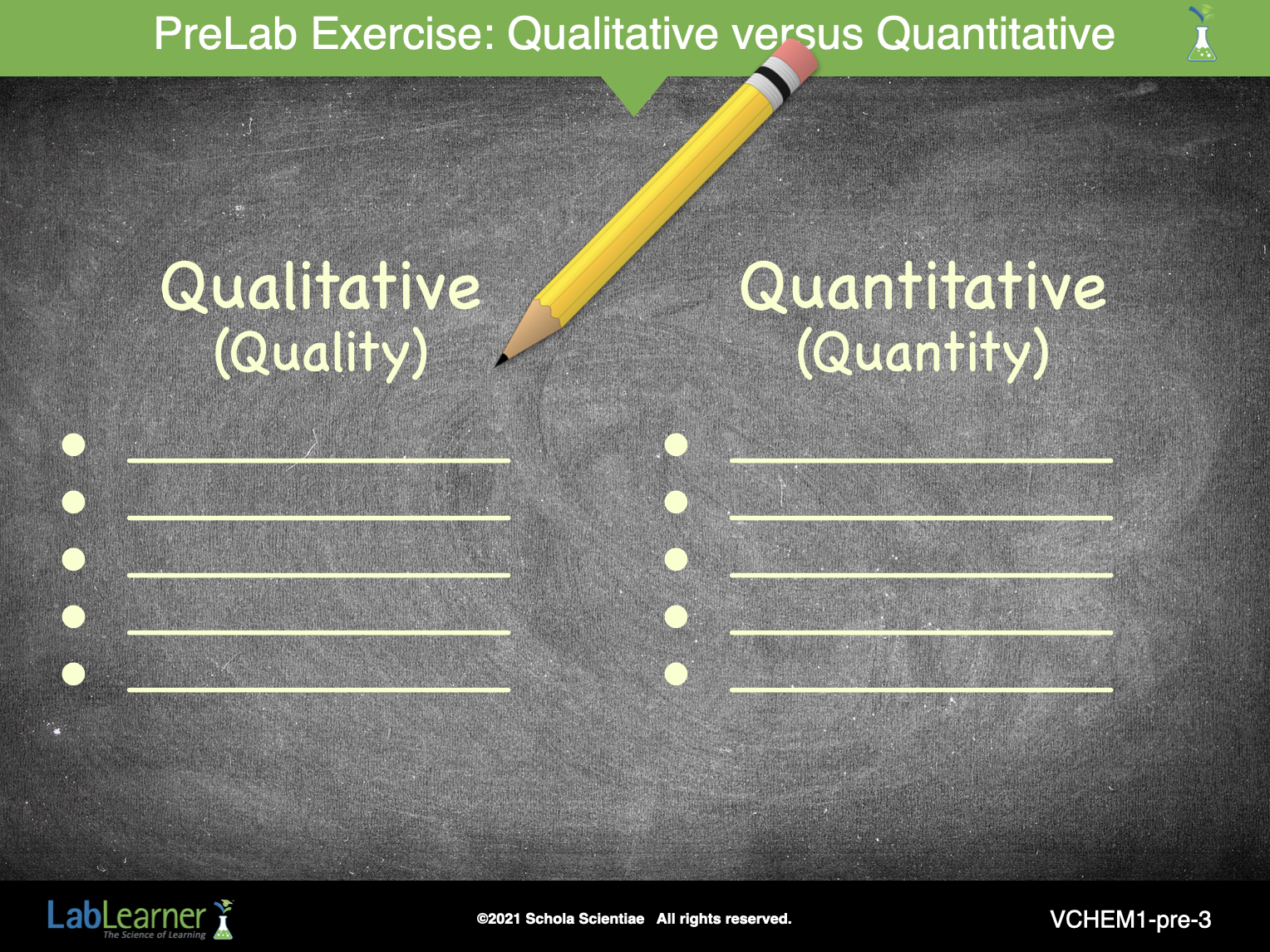
Direct students’ attention to the terms qualitative properties and quantitative properties in their Scientist’s Glossary. Students have most likely not been exposed to the words qualitative and quantitative before. Use the following activity to help students understand these terms:
- Write qualitative and quantitative side by side on the board.
- Ask students: What are the root words of qualitative and quantitative? The root word of qualitative is quality. Write the word quality under qualitative. The root word of quantitative is quantity. Write the word quantity under quantitative.
- Cover the endings on quality and qualitative to demonstrate that the roots of the two words are the same. Repeat with the terms quantity and quantitative.
SLIDE VCHEM1-pre-4
Important Note to Teacher: The following slides (VCHRM1-pre-3 through VCHRM1-pre-7) do not precisely follow the Teacher Manual or Student Data Record but provide essential information that will help all students as they begin the Chemistry, Matter and Interactions CELL.
___________________________________________
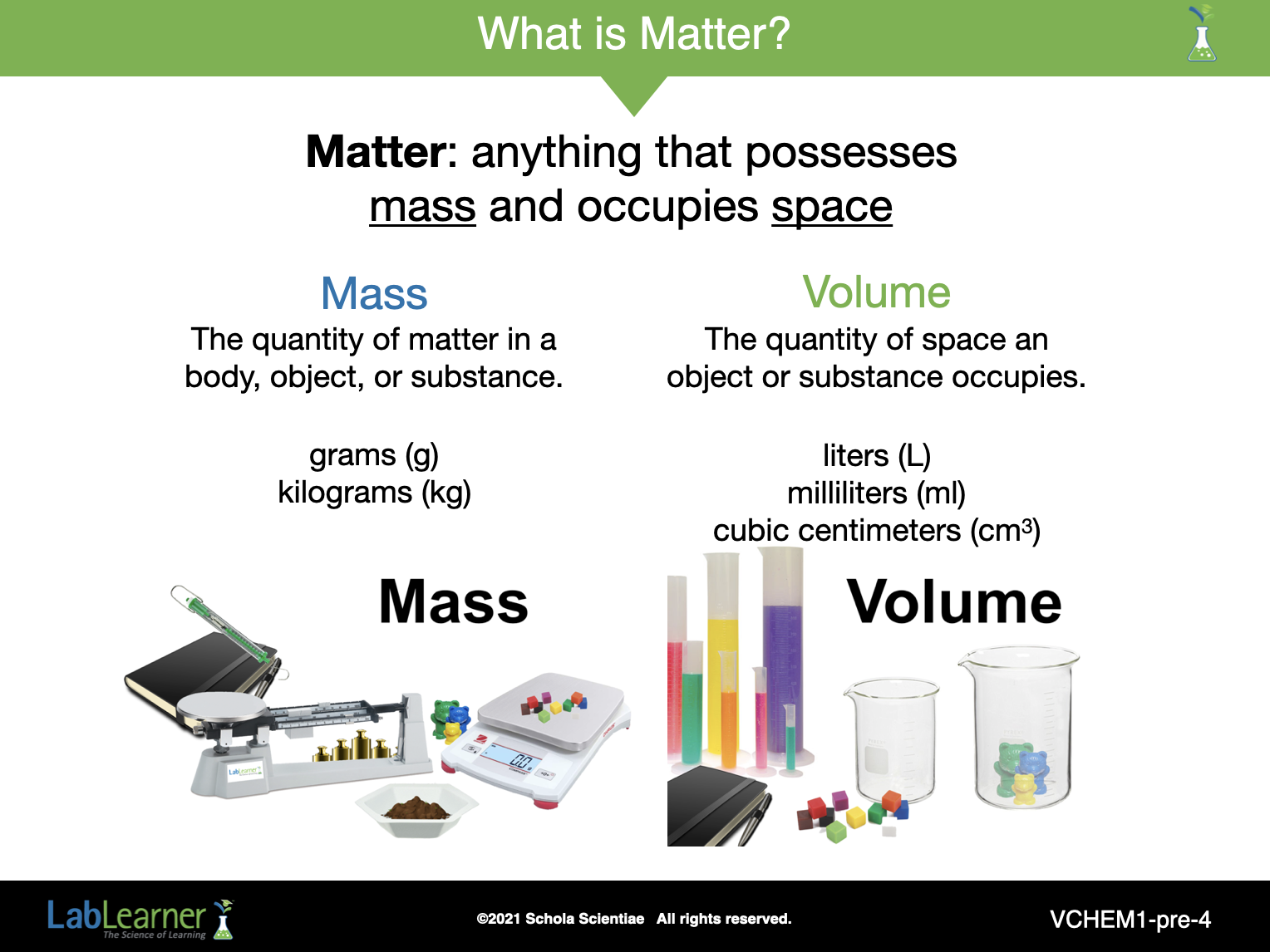
Let’s begin with an introduction to matter. Matter is anything that possesses mass and occupies space, volume. But, what are mass and volume and how do scientists work with them?
Mass is simply the quantity of matter in a substance. In the real world, it is what you “feel” when you hold an object in your hand. It is also much like weight, but not exactly and we will learn more about the differences between mass and weight in a later CELL. We measure mass in grams (g) and kilograms (kg).
Volume is the quantity of space an object occupies. In the real world, volume often is thought of as “how big something is”. The important point about volume is that it is three-dimensional. Thus, the volume of the box (cuboid) below would be calculated by multiplying its three dimensions (Length x Width x Height):
SLIDE VCHEM1-pre-5
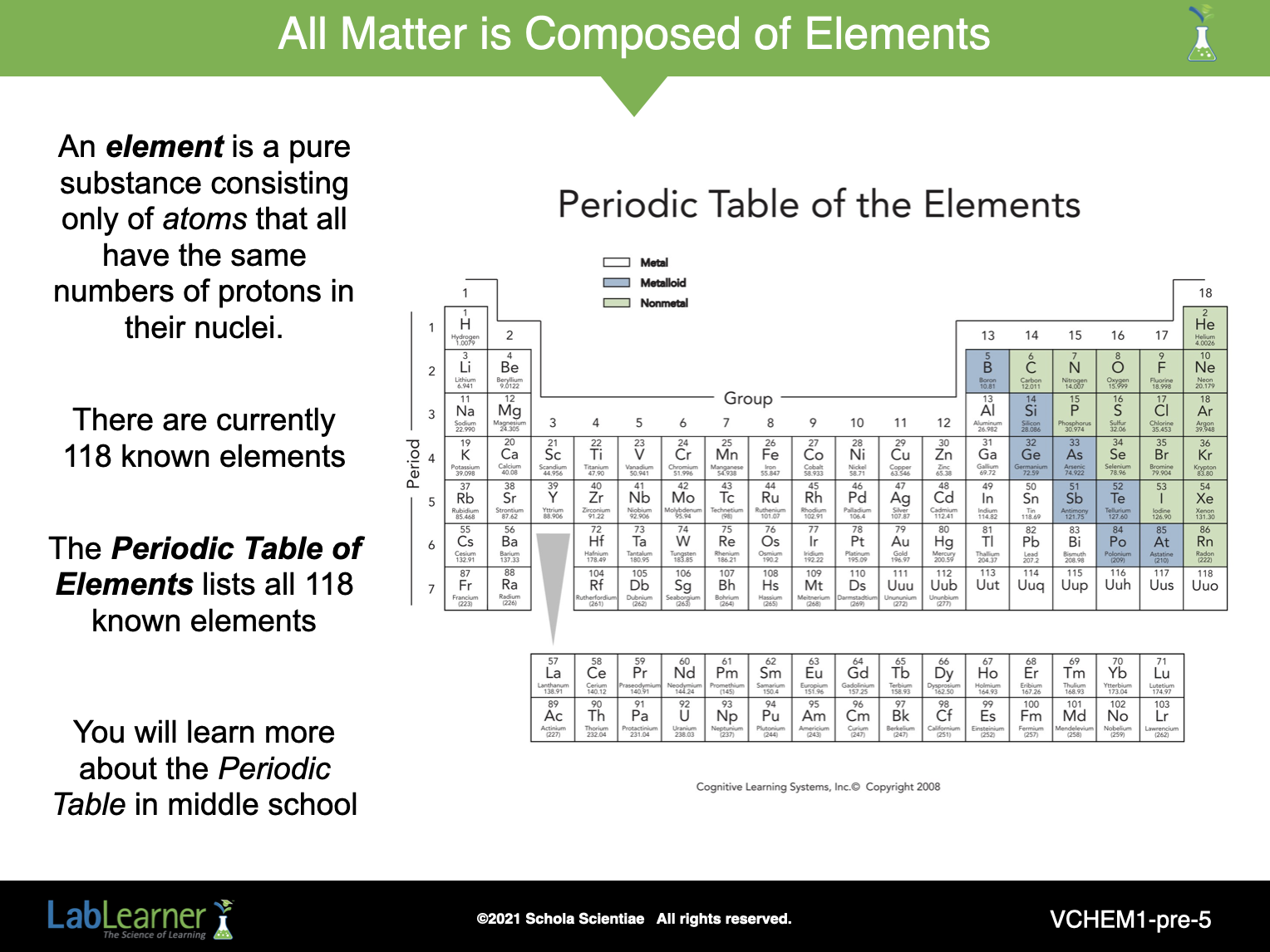
The Periodic Table of the Elements is presented to students on this slide, at this point in their science education, simply as an initial impression/imprint for future reference. No attempt to explain the Table is appropriate at this time except to say that these are the only elements we currently know that exist in the entire Universe.
Even though there are 118 known elements, many of them are present at vanishingly small amounts or exist only for fractions of seconds when created in labs. Hydrogen and helium alone account for about 98% of the elements in the Universe, with oxygen and carbon following far behind, as well as the other elements listed in the Periodic Table of the Elements.
______________________________________________
SLIDE VCHEM1-pre-6
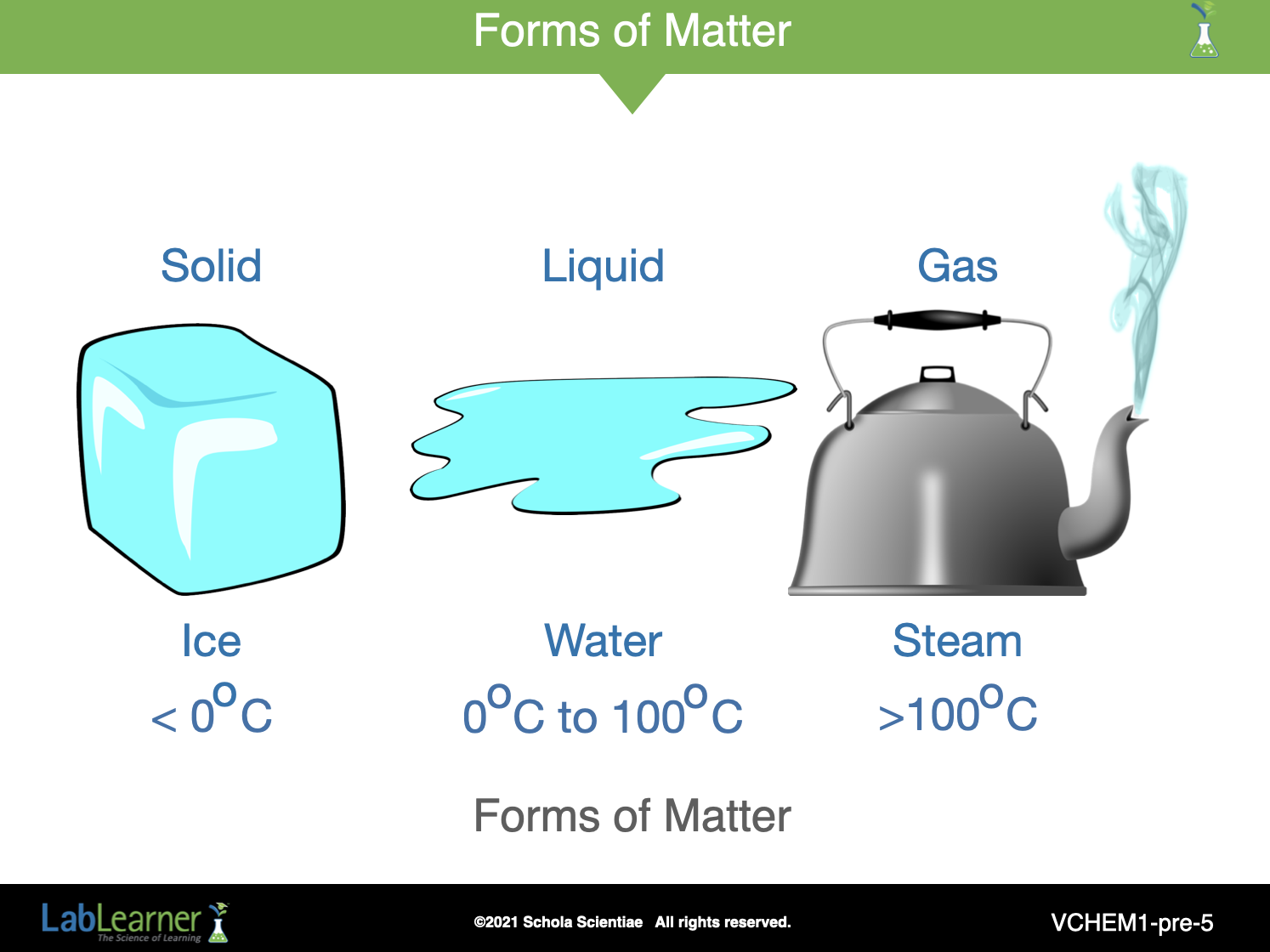
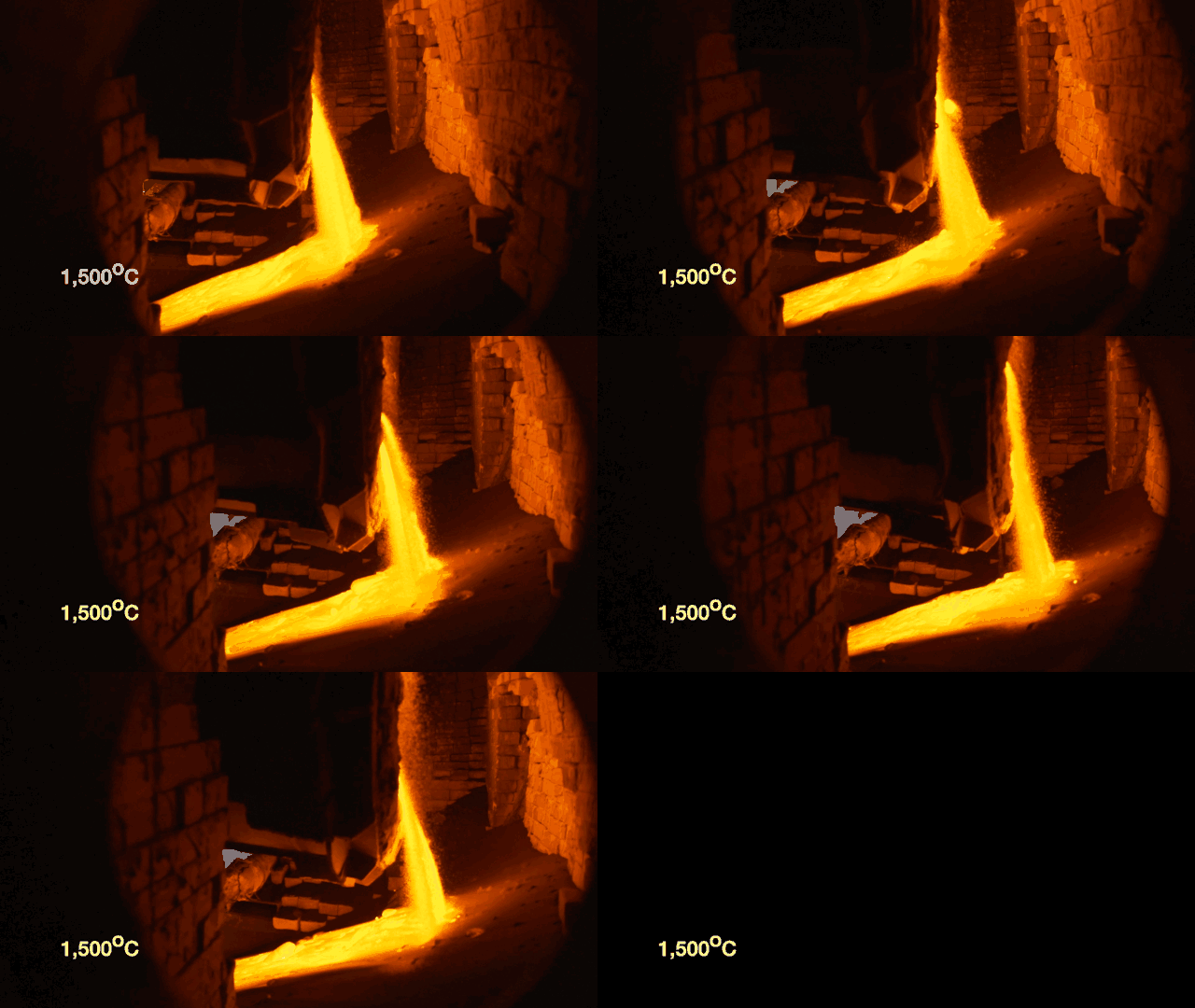
This slide simply refreshes students’ memory of the three phases of matter: solids, liquid, and gas. Each phase is associated with a temperature range. However, it should be pointed out that the temperature that matter changes from one phase to another can be very different depending on its composition. For example, water melts above 0oC, whereas steel (below) melts at well over a thousand degrees Centigrade.
______________________________________________
SLIDE VCHEM1-pre-7
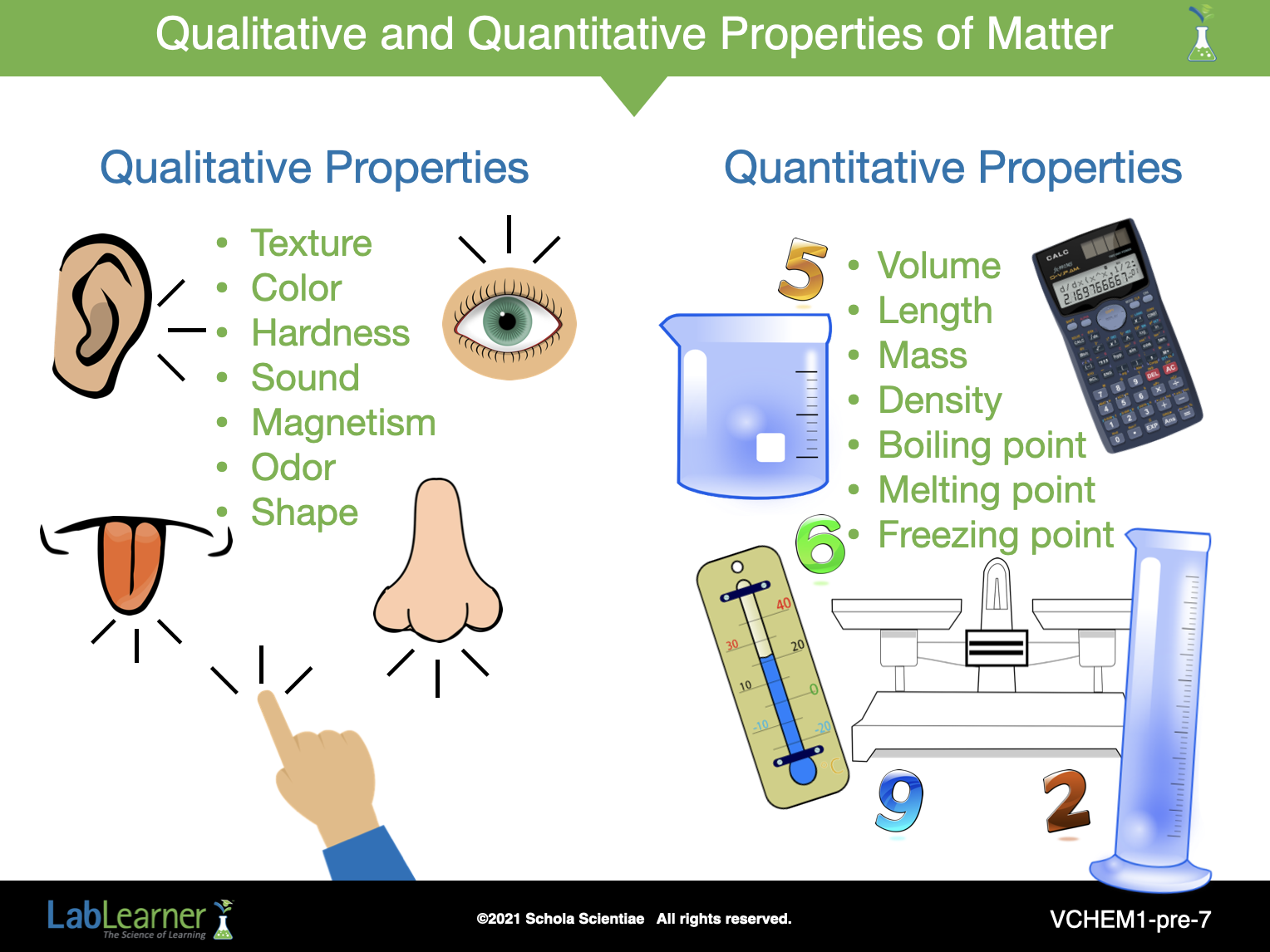
Qualitative and Quantitative Properties:
In general, qualitative properties can be experienced directly with our five senses and results reported in words (smooth, loud, salty, stinky). Quantitative properties, on the other hand, typically require some kind of an instrument to determine and are reported as numbers with units (12 g, 1.5 meters, 3 liters, 27.4 cm).
______________________________________________
SLIDE VCHEM1-pre-8
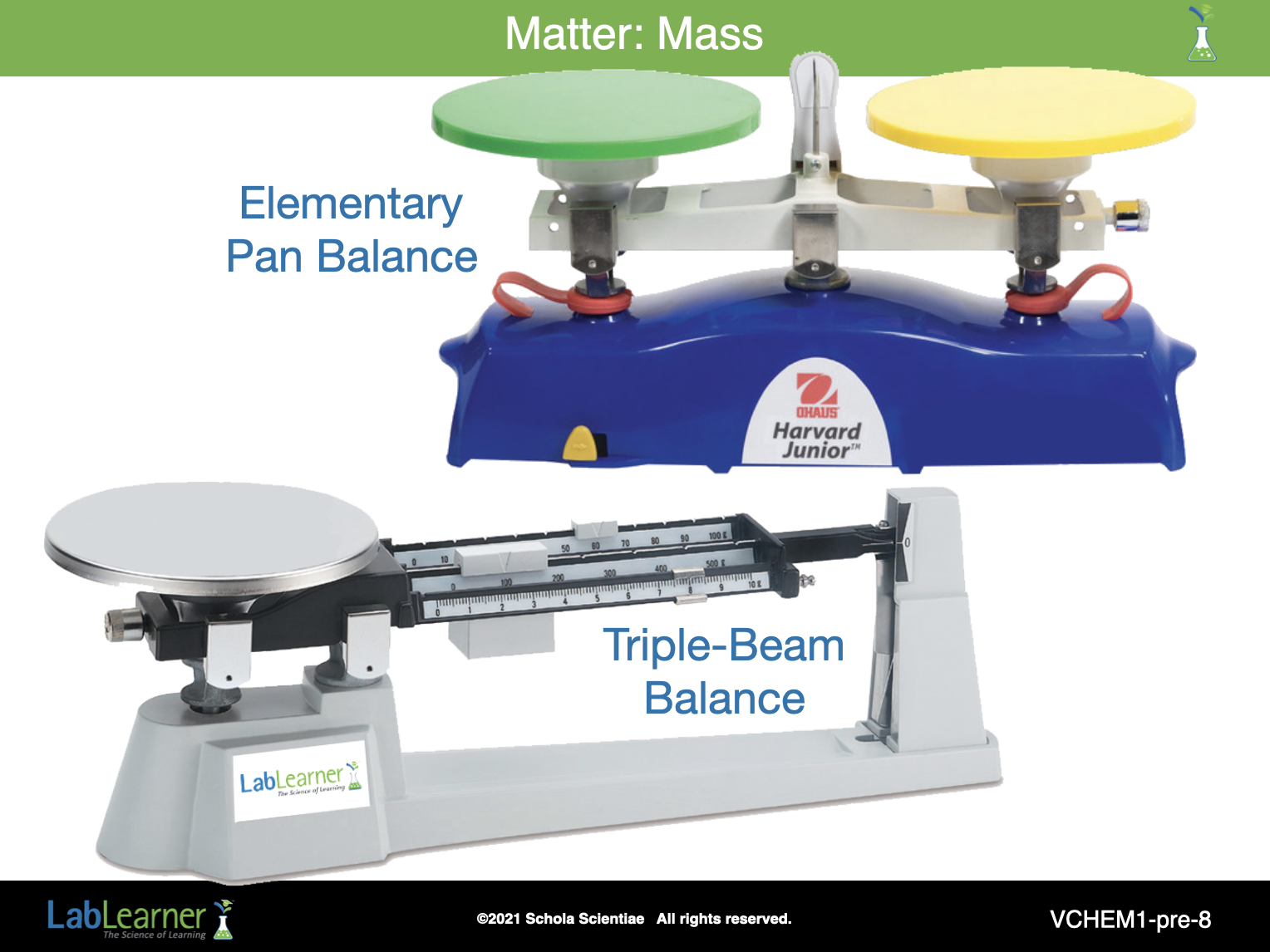
This slide shows two of the pieces of equipment students will use in Investigation 1 Lab. In the lab, students will see that one of these two instruments can easily compare the mass of two objects, that is a qualitative property (heavier, lighter, same as). The other can give us an exact mass, which is a quantitative property (17 g, 1 kg, 117.5 g). Ask students: Can you guess which is which? The pan balance gives us qualitative information, while the triple-beam balance gives us quantitative information.
______________________________________________
SLIDE VCHEM1-pre-9
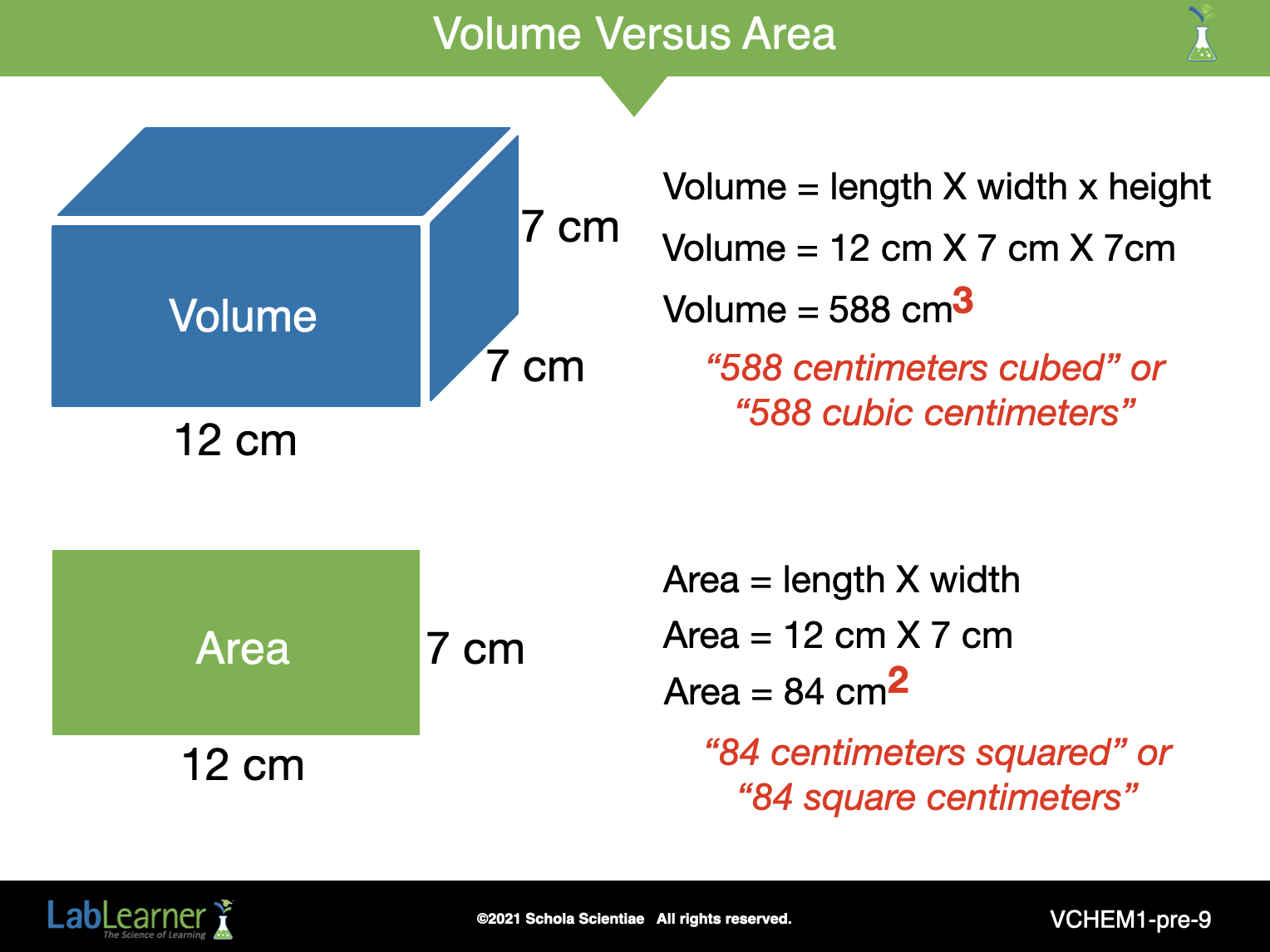
This final slide is intended to clearly show students the difference between volume and area.
The volume of a regular shape like the blue box requires three measurements – length, width, and height. These dimensions are multiplied with each other and the product is therefore reported as cm3 (cubic centimeters), with the 3 representing the three measured dimensions.
The area of a regular rectangle shape like the green rectangle requires only two measurements – length and width. These dimensions are multiplied with each other and the product is therefore reported as cm2 (square centimeters), with the 2 representing the two measured dimensions.
______________________________________________