Teacher Portal:
Chemistry, Matter and Interactions
Investigation 1 – PostLab
 ASK WHY
There are five major branches of chemistry today – organic chemistry, analytic chemistry, physical chemistry, inorganic chemistry, and biochemistry. Organic chemistry is a brank of chemistry that focuses upon molecules and compounds that contain the carbon atom. Since living organisms contain many thousands of types of carbon-containing molecules, organic chemistry is sometimes associated with compounds derived from living organisms.
BRANCH OUT
Organic chemists work in many different fields. Many consumer products are made of organic molecules such as cosmetics, food products, pharmaceuticals (medicines), petroleum products, and products made from byproducts of petroleum. A very short list of such products includes nylon, plastics, perfumes, detergents, insecticides, ink, automobile tires, dyes, candles, crayons, and many, many others.
PRINT IT
Use your browser to download a printable PDF as help during the slide presentation and to make additional notes. In your browser, go to File > Print and then choose to save as PDF.
NAVIGATE IT
Once the slide presentation is launched
- use your left and right arrows to advance or go back in the slide presentation, and
- hover your mouse over the left edge of the presentation to get a view of the thumbnails for all the slides so that you can quickly move anywhere in the presentation.
- Click HERE to launch the slide presentation for the CELL.
SHARE IT
SLIDE VCHEM1-post-1
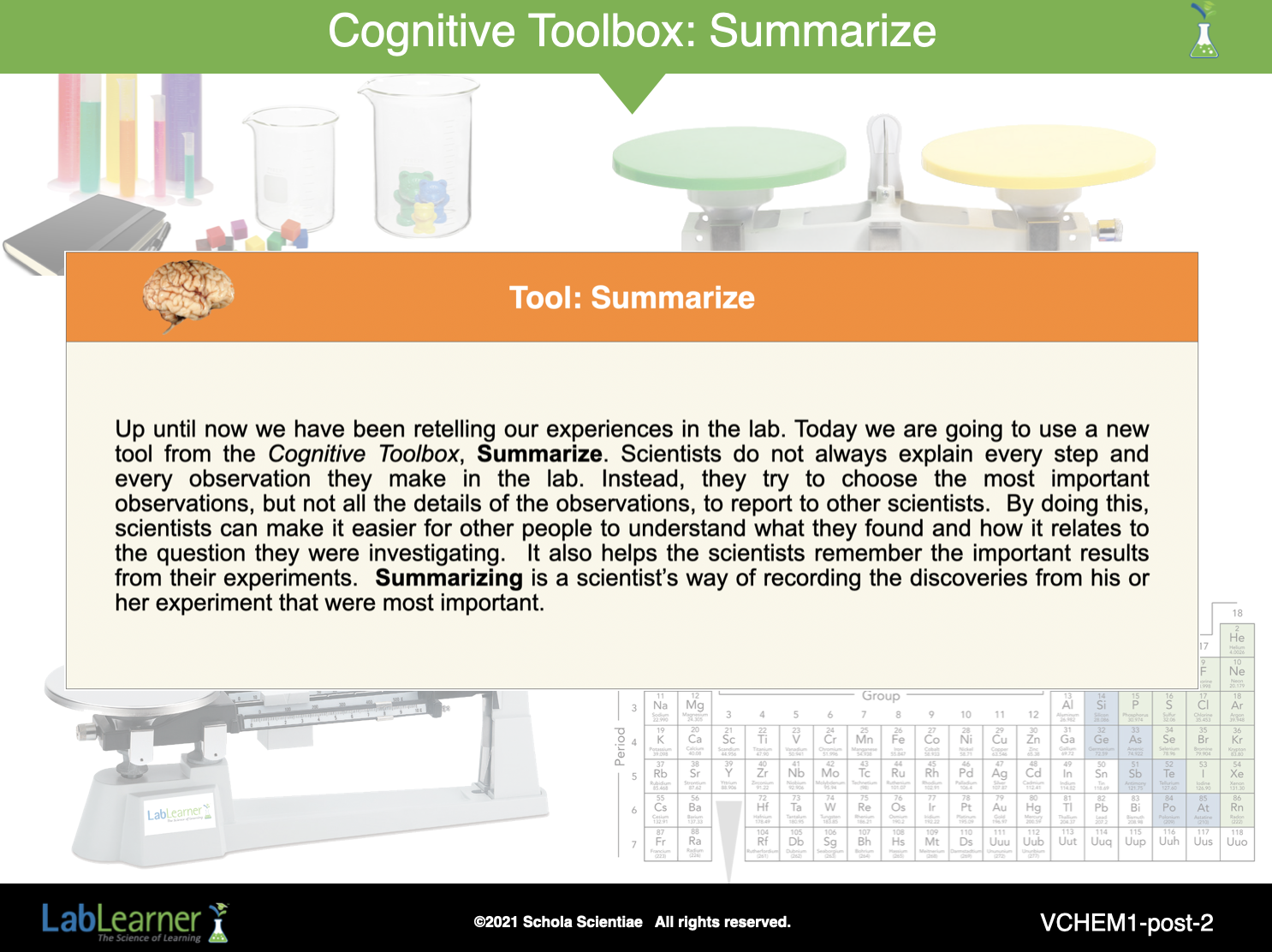
Begin this part of the Investigation by introducing students to a new Cognitive Tool called Summarize that can be used when analyzing their experiments.
Ask students: What did you do in the lab? Student answers will vary but should retell the tasks accomplished in the lab, such as describing the different objects they tested, using the pan balance to determine differences in the amount of matter in the five samples, and learning to use the triple beam balance to measure the exact amount of matter or mass of the five samples.
______________________________________________
SLIDE VCHEM1-post-2
Begin leading students through the process of summarizing their results by explaining that the first step in summarization is to bring all their observations together in one place.
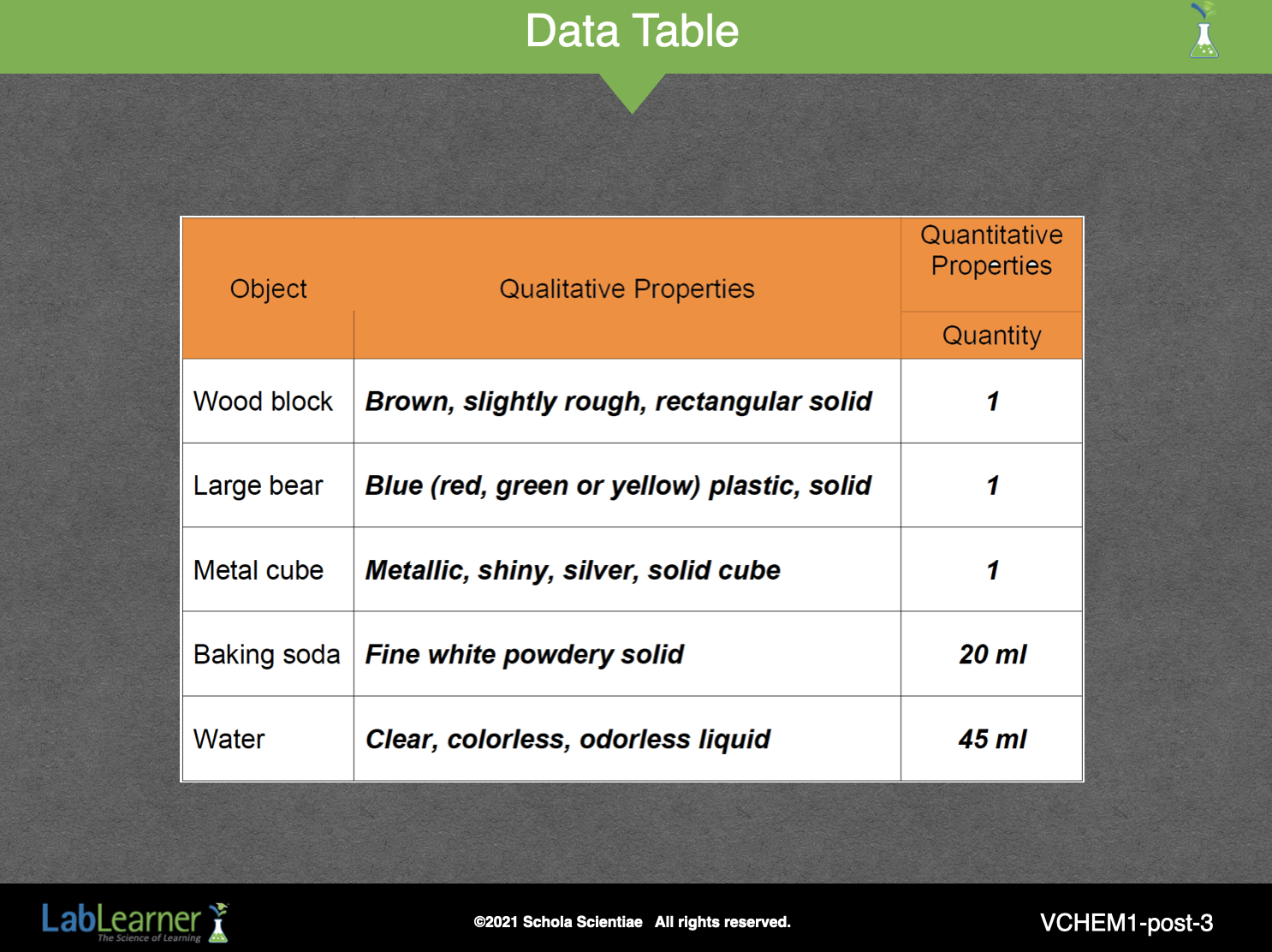
Explain that scientists often use data tables so that they can organize their observations or results and study all of them at one time.
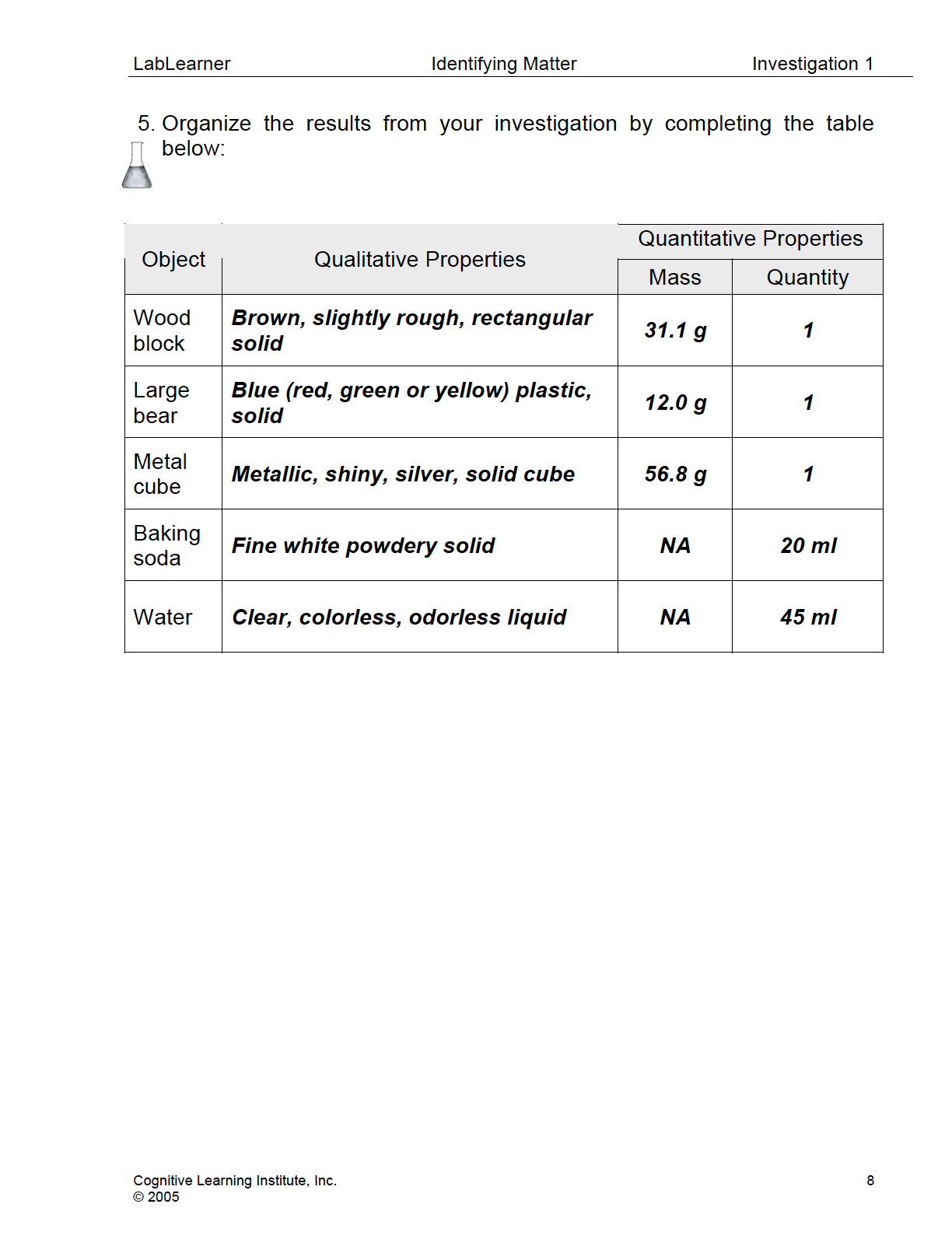
Direct students to turn to Problem 5 in their Student Data Record.
b. Tell students to complete the data table using the data from their experiments. Provide 5-10 minutes for students to complete their tables.
c. Next direct students to study their completed data tables. Help students to answer the question “How would you summarize your observations about properties of the five samples?” by asking the following questions:
Look at your data tables. How did you describe each of the samples? Student answers may vary, but should suggest that the metal cube was metallic, shiny, solid, the woodblock was a brown, smooth or slightly rough solid, the bear was a plastic blue (red, green, yellow) solid with a rough texture, the baking soda was a fine white powdery solid, and the water was a clear, colorless, odorless liquid.
Did all of the samples have the same properties? Students should indicate that all samples did not have the same properties.
Were any of the properties different? Students should indicate that the samples each had different colors, shapes, and textures and that there were two different states of matter.
Continued on the next slide…
______________________________________________
SLIDE VCHEM1-post-3
Continued from the previous slide:
Did you measure things like “metallic”, “shiny”, “silver”, or “solid”? Students should indicate that they did not measure any of these properties.
So these are properties that describe the five samples but were not measured. What are these type of properties called? Students should indicate that these are qualitative properties.
What other types of properties did you record for the samples? Students should indicate that there was a “1” in the “Amount” column for the woodblock, the metal cube, and the bear, 20 ml for the baking soda, and 45 ml for the water. Students should also indicate that they measured the mass of the gram bear, the woodblock, and the metal cube.
Were all the samples present in the same amount? Students should indicate that all samples were not present in the same amount. They determined this through a comparison of the samples using the pan balance.
Did the woodblock, the metal cube, and the gram bear have the same mass? Students should indicate that the woodblock, the metal cube, and the gram bear did not have the same mass.
What kind of property describes the quantity of a sample, the quantity of matter, or the mass of a sample? Students should indicate that the amount of matter, quantity of sample, or mass are all quantitative properties or properties that use measurements to describe matter.
______________________________________________
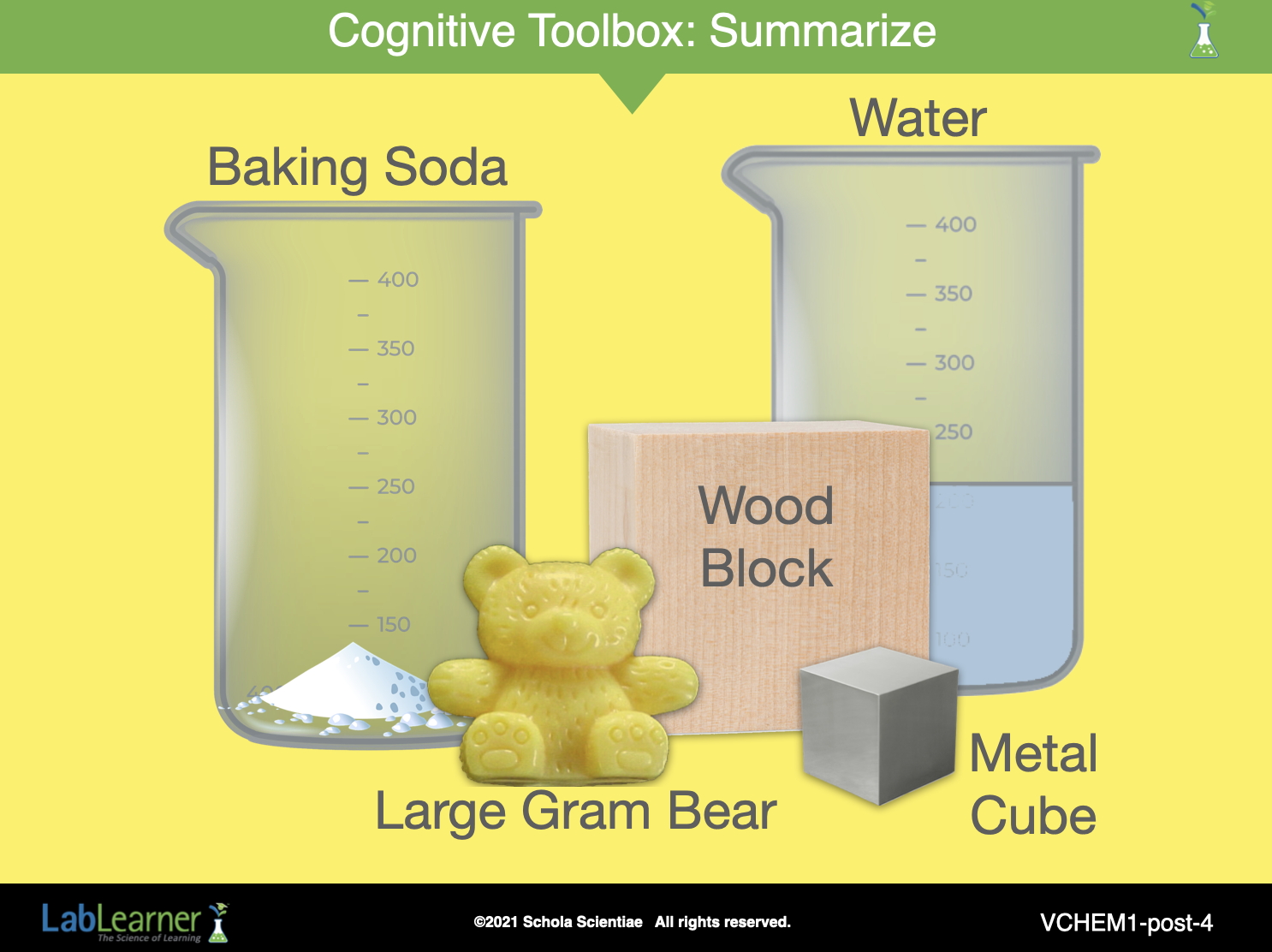
SLIDE VCHEM1-post-4
Encourage students to consider other information they may have learned from Trials 3 and 4.
Ask students: Are some scientific tools better suited for determining quantitative properties than others? Student answers may vary. Students should indicate that some scientific tools are better for determining quantitative properties than others, and should point out the difference in the pan and triple beam balances as an example. If necessary, use the following suggestions to lead students to the correct conclusion.
What did you find when you compared the amount of matter in each sample with the pan balance? Student answers may vary. Students should indicate that they were able to determine whether one sample was heavier than another.
Were you able to determine the exact amount of matter in each sample? Students should indicate that they were not able to determine the exact amount of matter in any of the samples.
Were you able to determine the exact difference in mass or amount of matter between samples? Students should indicate that they were not able to determine the exact difference in mass between samples, only that they were able to rank the samples in order from heaviest to lightest.
Which tool would enable you to do this? Why? Students should indicate that the triple beam balance would allow them to find the difference in exact mass between samples because the triple beam balance is designed for measuring exact mass.
Explain that thus far in the CELL, students have concluded that matter has both qualitative and quantitative properties.
Ask students: Is one type of property more important than another? Student answers may vary.
To help students answer the question, describe the qualitative properties of an object in the classroom, such as a textbook. Ask students: Could this item fit in my house? Could it fit in my purse/briefcase? Student answers will vary depending upon the object selected.
______________________________________________
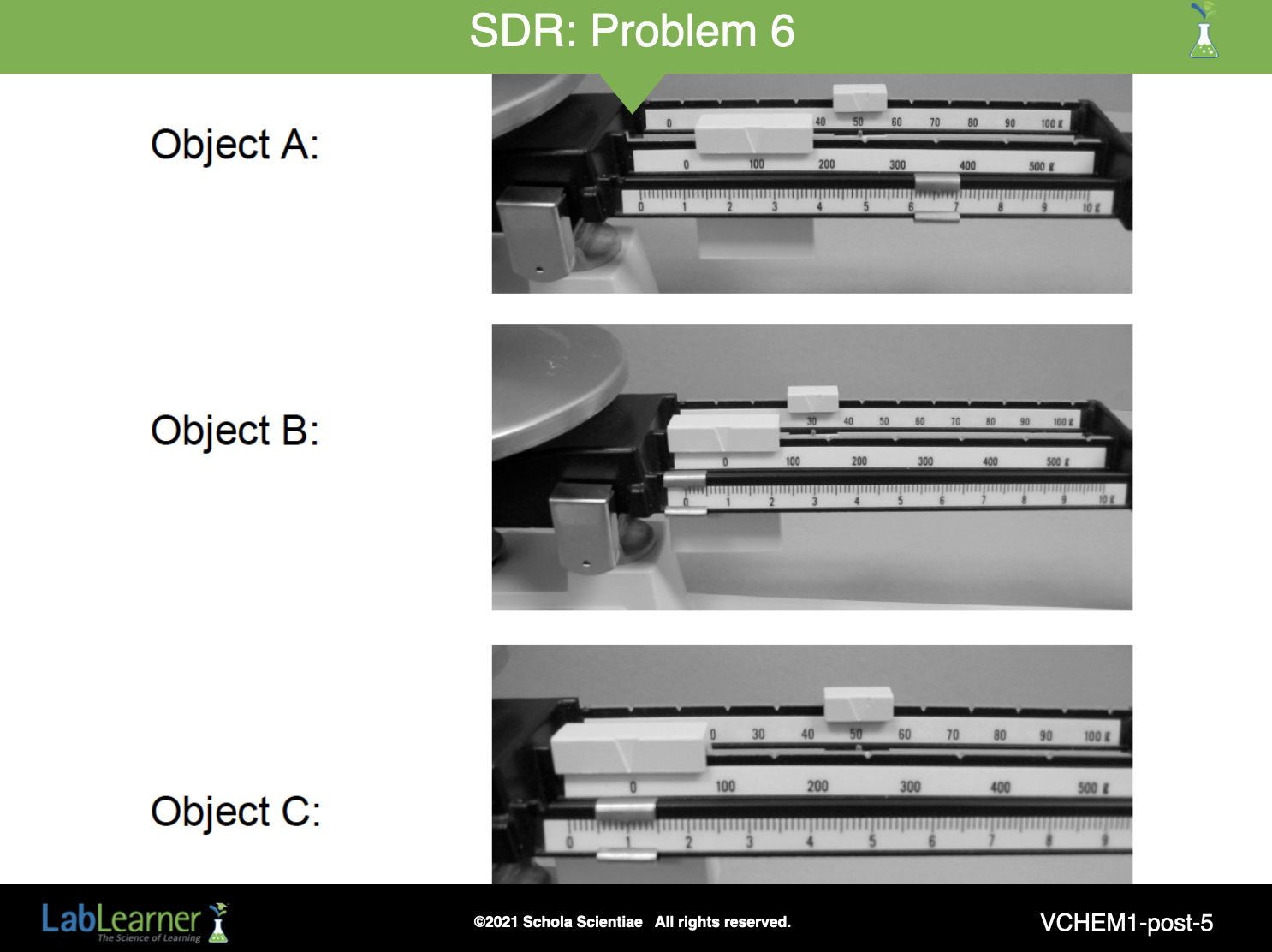
SLIDE VCHEM1-post-5
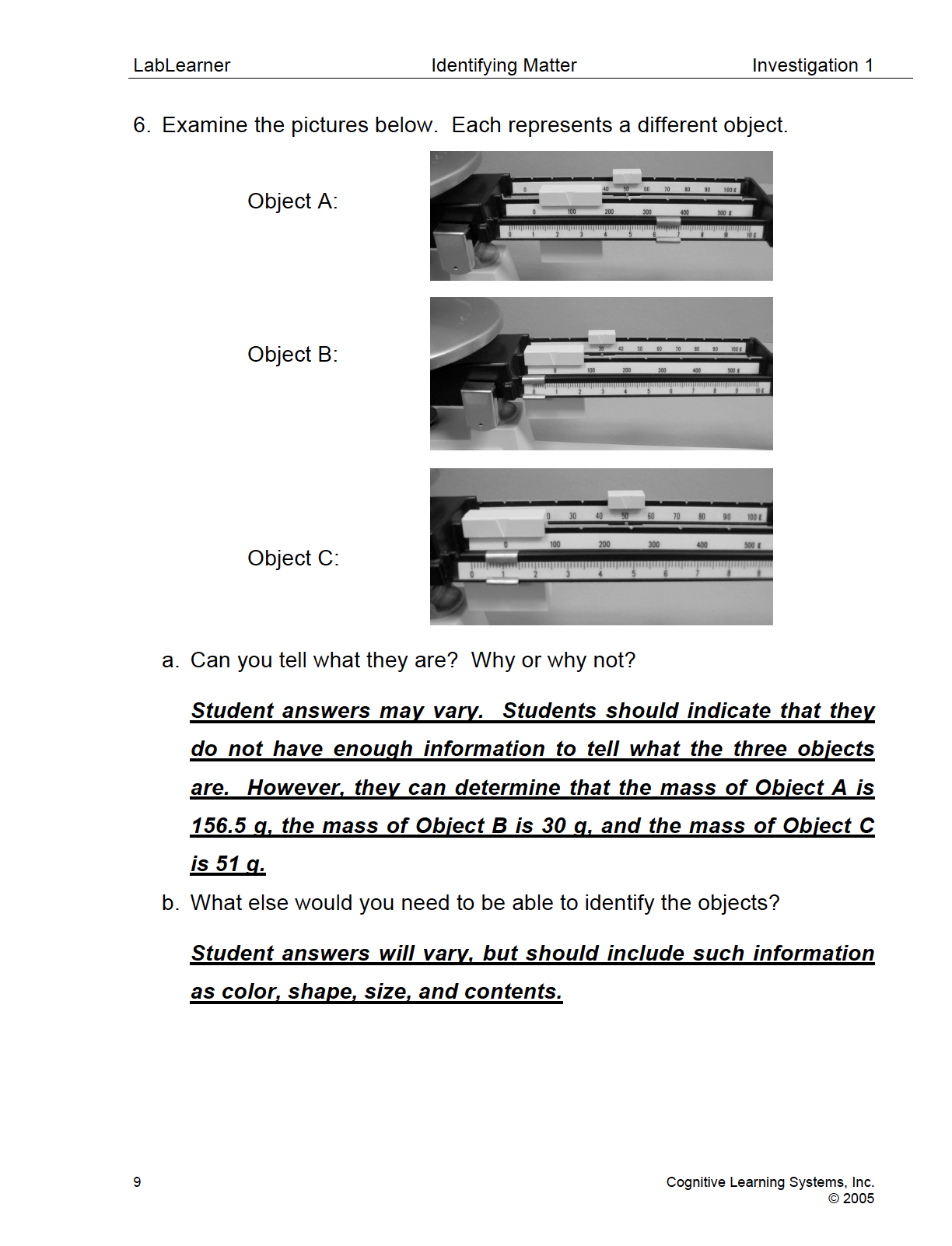
Continue the discussion of qualitative and quantitative properties by directing students’ attention to Problem 6 in their Student Data Record. Explain to students that the pictures represent three different objects.
Ask students: What can you tell from the pictures? Students should indicate that the objects have three different masses.
Ask students: How would you describe these objects? Student answers may vary. Students should indicate that object B has the lowest mass, object A has the highest mass, and object C has a mass between A and B.
Ask students: Can you tell what the objects are? Student answers may vary but should demonstrate that students lack the information to identify the objects based solely on mass.
Ask students: What else would you need to determine the identity of the objects? Student answers may vary. Students should indicate that they need descriptions, pictures, and perhaps quantities to be able to identify the three substances.
Ask students: How do the activities you just performed relate to the experiment you performed in the lab? Each sample is best described by its combination of qualitative and quantitative properties.
Encourage students to record their answers in Problems 6a-b of their Student Data Record.
______________________________________________
SLIDE VCHEM1-post-6
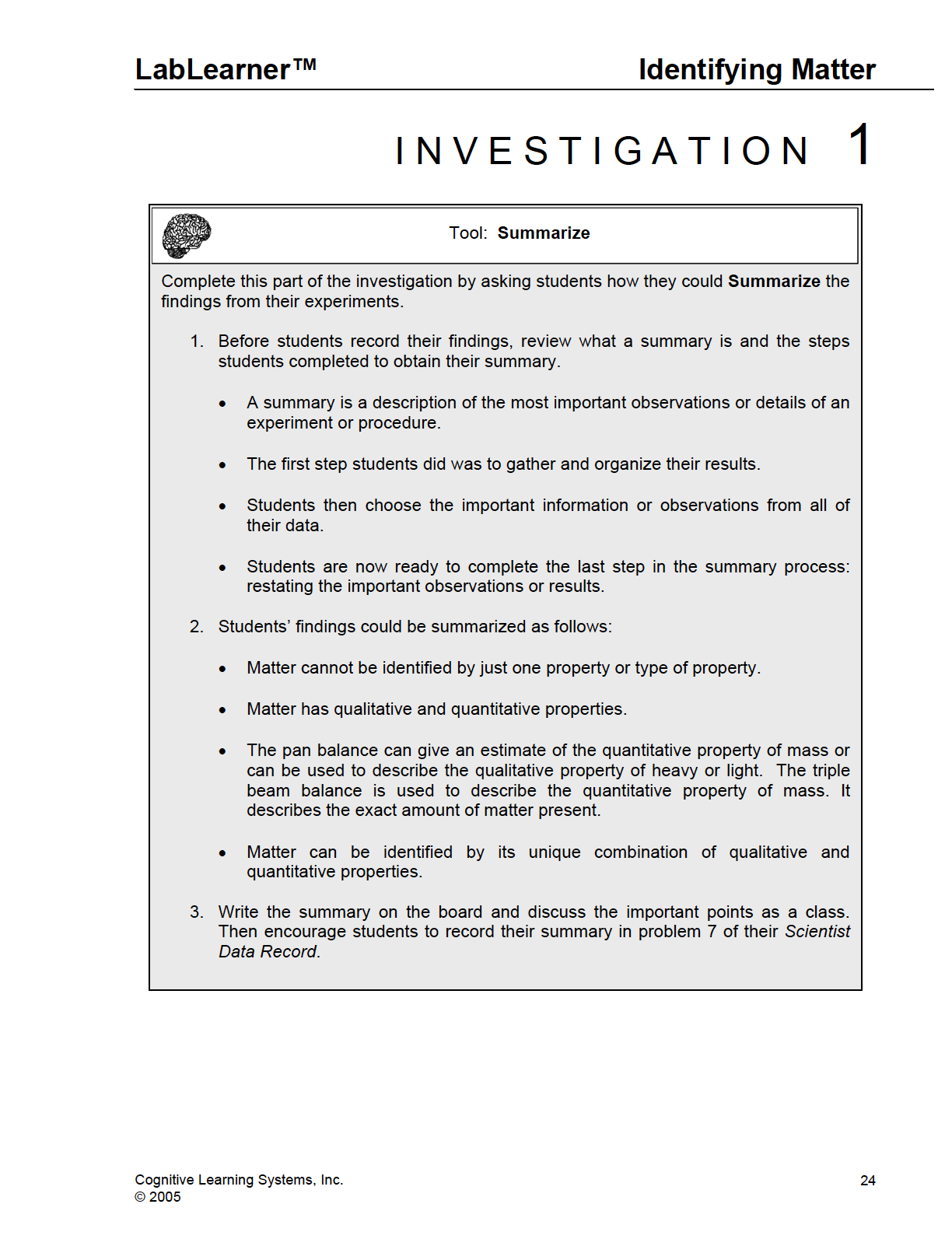
Before students record their findings, review what a summary is and the steps students completed to obtain their summary.
-
- A summary is a description of the most important observations or details of an experiment or procedure.
- The first step students did was to gather and organize their results.
- Students then choose the important information or observations from all of their data.
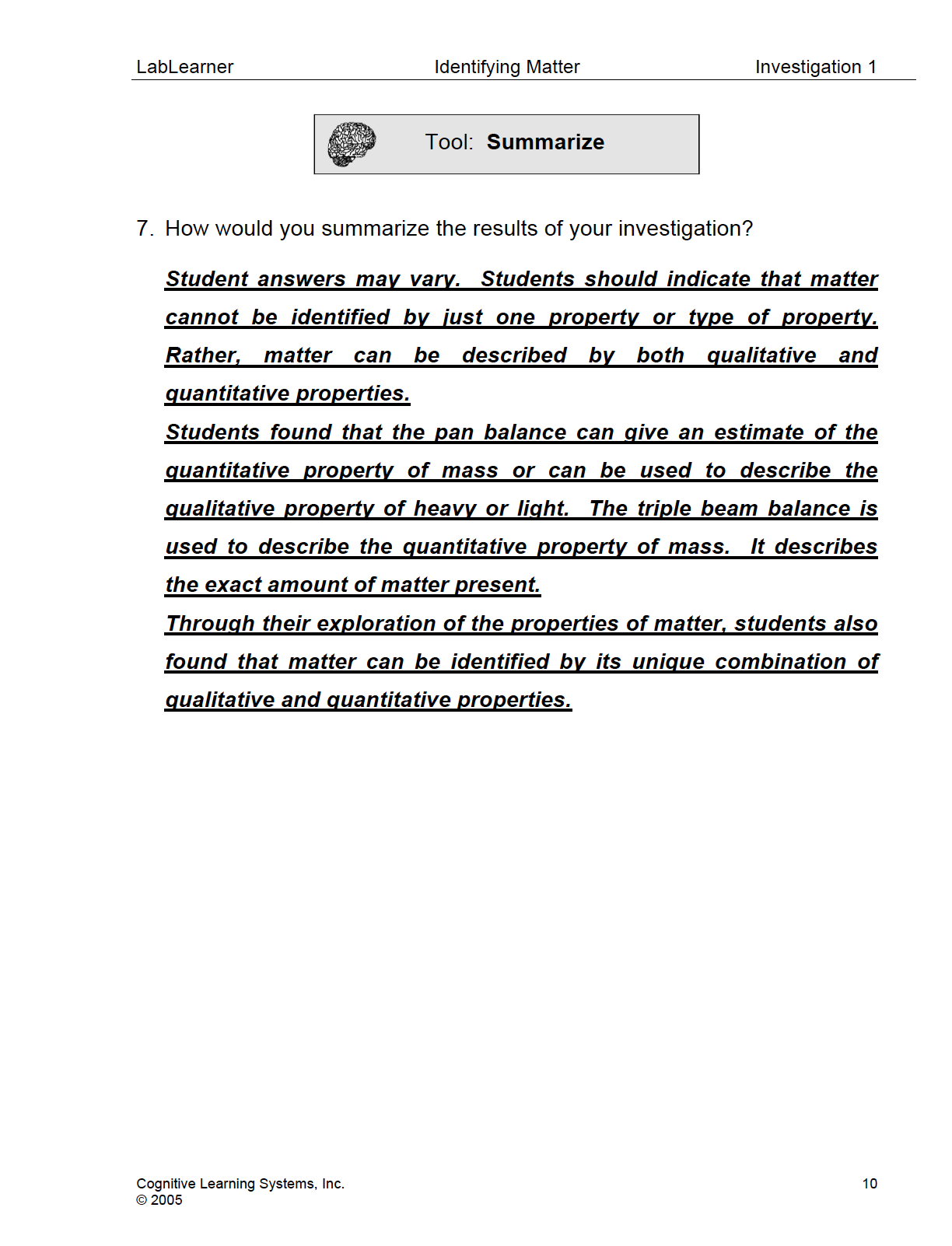
Students are now ready to complete the last step in the summary process: restating the important observations or results. Based on their results and analysis, have students complete their written summary on Problem 7 of their Student Data Record.
KEYS: POSTLAB