
Teacher Portal:
Chemistry, Matter and Interactions
Investigation 1 – Lab
 ASK WHY
There are five major branches of chemistry today – organic chemistry, analytical chemistry, physical chemistry, inorganic chemistry, and biochemistry. Organic chemistry is a brank of chemistry that focuses upon molecules and compounds that contain the carbon atom. Since living organisms contain many thousands of types of carbon-containing molecules, organic chemistry is sometimes associated with compounds derived from living organisms.
BRANCH OUT
Organic chemists work in many different fields. Many consumer products are made of organic molecules such as cosmetics, food products, pharmaceuticals (medicines), petroleum products, and products made from byproducts of petroleum. A very short list of such products includes nylon, plastics, perfumes, detergents, insecticides, ink, automobile tires, dyes, candles, crayons, and many, many others.
BE PREPARED
Supplies and Equipment:
Class Materials:
- 175 g baking soda
- 225 ml water
- 1 roll of masking tape
- 1 100 ml graduated cylinder
Group Materials:
- 2 100 ml beakers
- 1 pan balance
- 1 triple beam balance 1 wood block
- 1 metal cube
- 1 large gram bear (12 g)
Individual Materials:
- 1 Student Data Record
- 1 pair safety goggles
Teacher Preparation
-
- Assemble materials at a distribution point.
- Use a graduated cylinder to fill five 100 ml beakers with 45 ml of water.
- Fill the remaining five 100 ml beakers with 35 g of baking soda. This can be estimated by filling each beaker to the 20 ml mark with baking soda.
- Place one (1) triple beam balance on each work table.
- Divide class into five cooperative groups.
GET FOCUSED
In this CELL, students will be introduced to chemistry by exploring properties and interactions of matter and will learn to use the properties of matter such as mass, volume, and pH to identify substances they encounter during their investigations.
Students will begin their exploration in Investigation One by learning to distinguish between qualitative and quantitative properties of matter and how to determine the quantitative property of mass with a new Procedural Tool, the triple beam balance.
INVESTIGATE
1. Remind students that safety goggles are to be worn while handling chemicals.
2. Direct each student group to obtain the following necessary materials from the distribution point: one (1) woodblock, one (1) metal cube, one (1) gram bear, one (1) 100 ml beaker of water, one (1) 100 ml beaker of baking soda and one (1) pan balance.
Trial 1
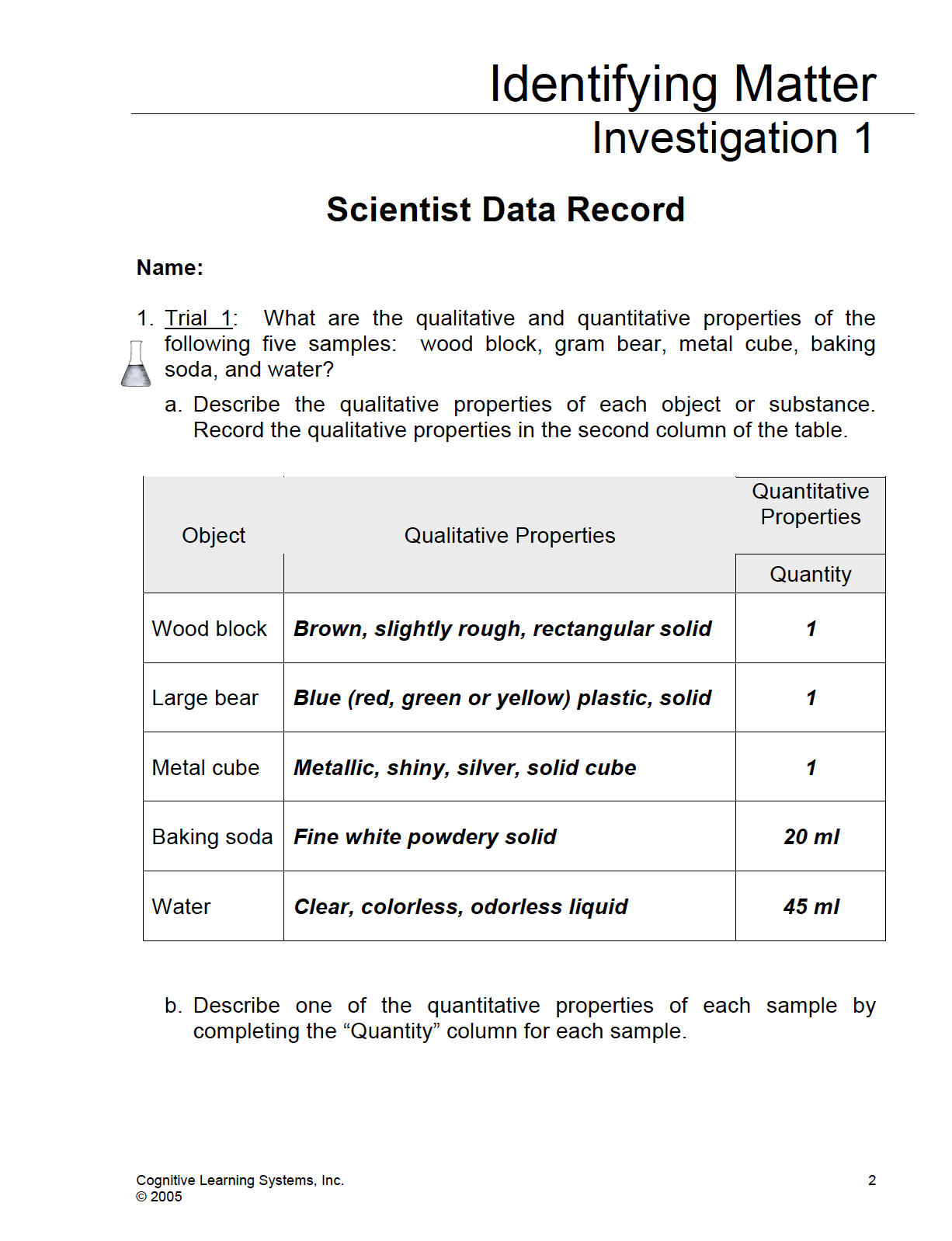
This trial has been designed to provide students with an opportunity to observe and describe some qualitative and quantitative properties of matter. Students will begin the trial by describing the visual appearance, texture, and quantity of the following examples of matter and record their descriptions in a data table: large plastic bear, metal cube, woodblock, baking soda, and water.
a. Initiate the investigation by posing the following question to students: What are the qualitative and quantitative properties of the five samples on your table?
b. Encourage students to observe each type of matter and to record the qualitative and quantitative properties of each in the table provided in Problem 1a of their Student Data Record. Review the types of properties if necessary. Qualitative properties are properties such as texture, color, shape, and state of matter. Quantitative properties are properties such as amount or number.
c. Students may need assistance identifying quantitative properties of the items and substances at their table. If necessary, facilitate how the quantity of the types of matter can be identified: The number of bears, metal cubes, and wood blocks can be counted while the volume of the baking soda and water can be recorded.
Trial 2
In this Trial, students will investigate differences in the amount of matter present in each sample. Students will be asked to compare the relative amount of matter or mass of each sample through the use of the pan balance. Ultimately they will be asked to determine the exact mass or amount of matter present in each sample by using a new piece of science equipment, the triple beam balance. In this Trial, students should find that they cannot quantitatively describe the differences in mass when using the pan balance. This discovery is important as it provides a basis for the use of the triple-beam balance as a tool for the quantitative determination of mass in Trial 3.
a. Begin by posing the following question to students: How much matter is present in each of the samples?
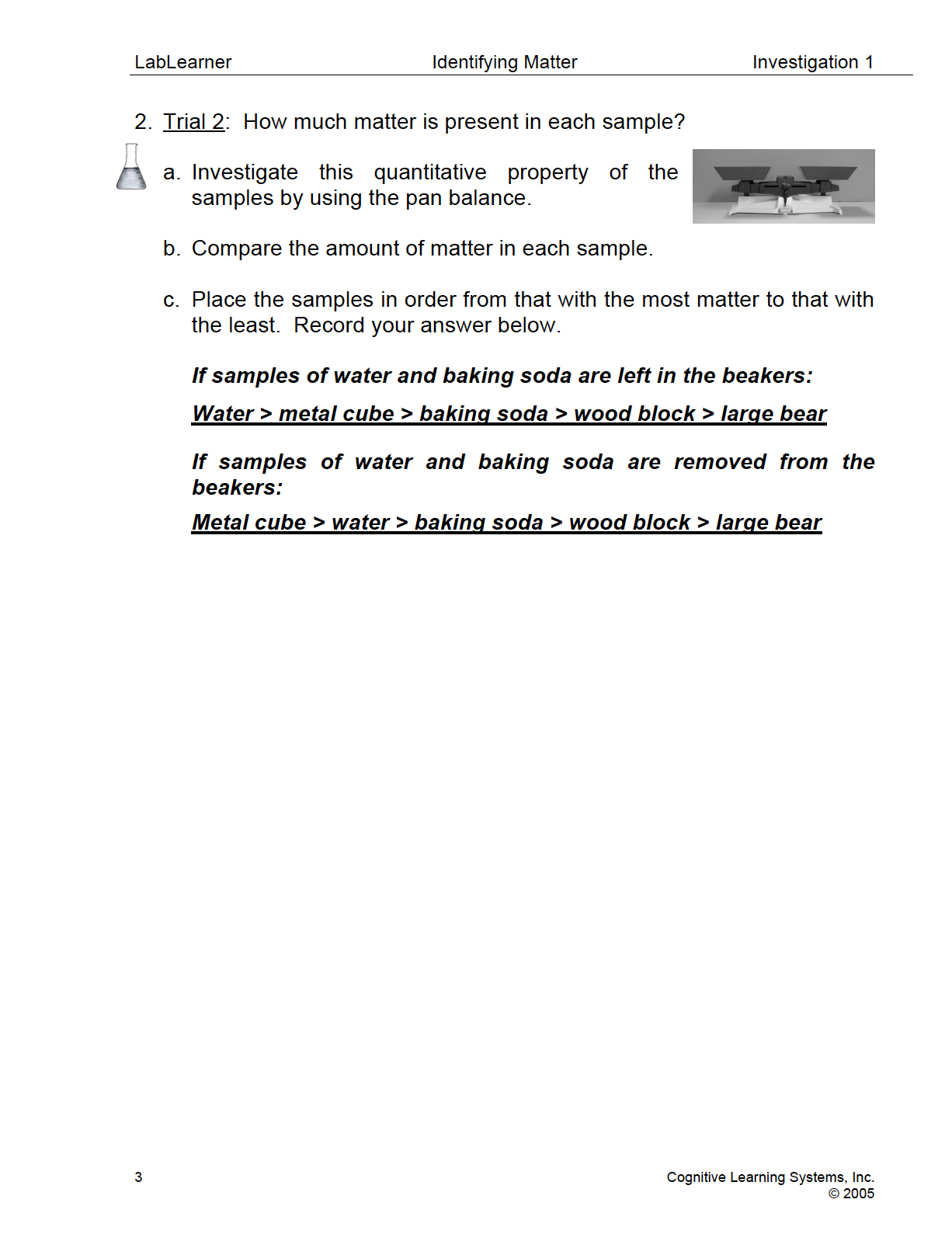
b. Encourage students to use the pan balance to determine which sample has the most matter and which has the least. Direct them to place the samples in order from that with the most matter to that with the least amount of matter and record their answers in Problem 2 of their Student Data Record.
c. Students may observe that the samples of baking soda and water are in beakers and suggest removing the substances from the beakers for a more accurate comparison of mass. If students choose to remove the substances from their beakers, encourage them to clean the pans of the balance before adding another sample. If students simply place the beakers on the pans when testing, you may want to ask them either now or when they analyze their data, whether the measurement assessed only the sample or the additional mass of the beaker.
d. After students have determined the sequence of samples from that with the most matter to the least, ask: Were you able to tell exactly how much more matter one sample had as compared to the others? Student answers will vary but should indicate that although they could describe the difference as more or less mass, they were unable to provide an exact value for the difference.
e. Ask students: Why can’t you find the actual difference in the amount of matter between the samples? Students’ answers should indicate that they do not have enough information because the pan balance does not have a scale to use for the comparison of mass.
f. Ask students: How could you measure the exact difference in matter between the samples? Students may or may not suggest the use of a scale or triple beam balance.
g. Explain that scientists have a Procedural Tool for measuring the quantity of mass, called a triple beam balance.
Trial 3
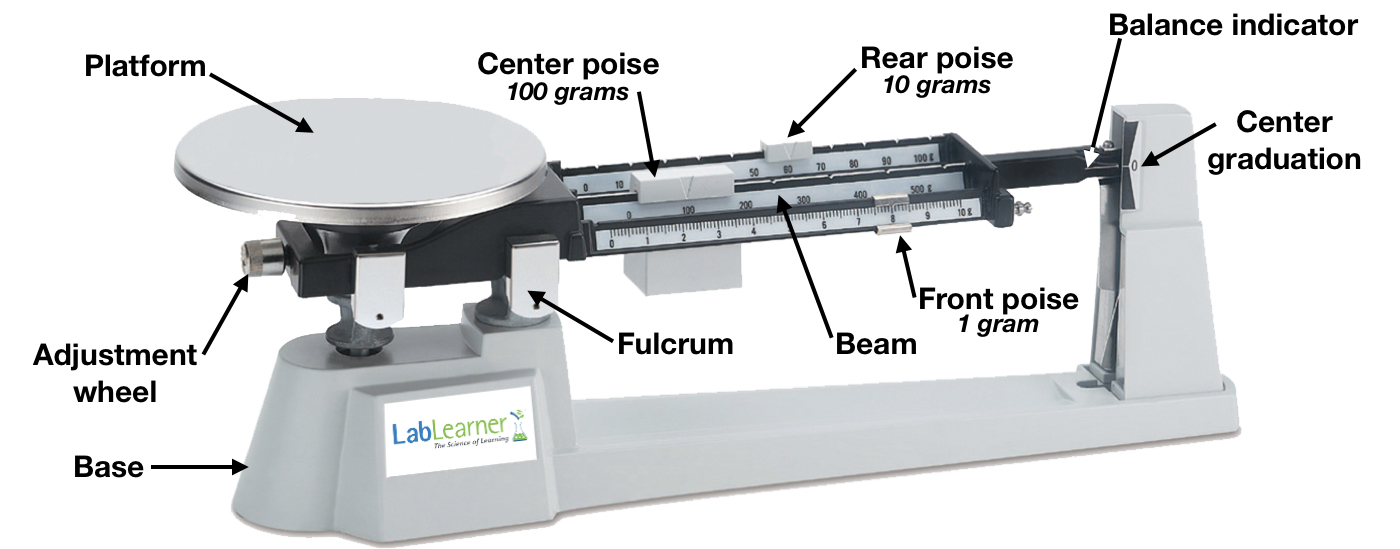 Explain to students that they will use the triple beam balance to determine the exact mass or exact amount of matter present in each sample. At this time, direct student groups to place the pan balances at the distribution center and obtain a triple beam balance. Use the passages that follow to assist students in this part of the investigation and to assist students with using the triple beam balance as a tool for the measurement of mass.
a. Introduce the triple beam balance as a scientific tool that can be used to measure and quantify mass.
-
 Tell student groups to examine their triple beam balance.
- Explain that this tool is called a balance because the mass on the right side is adjusted until it balances the mass of the object or material placed on the platform on the left side.
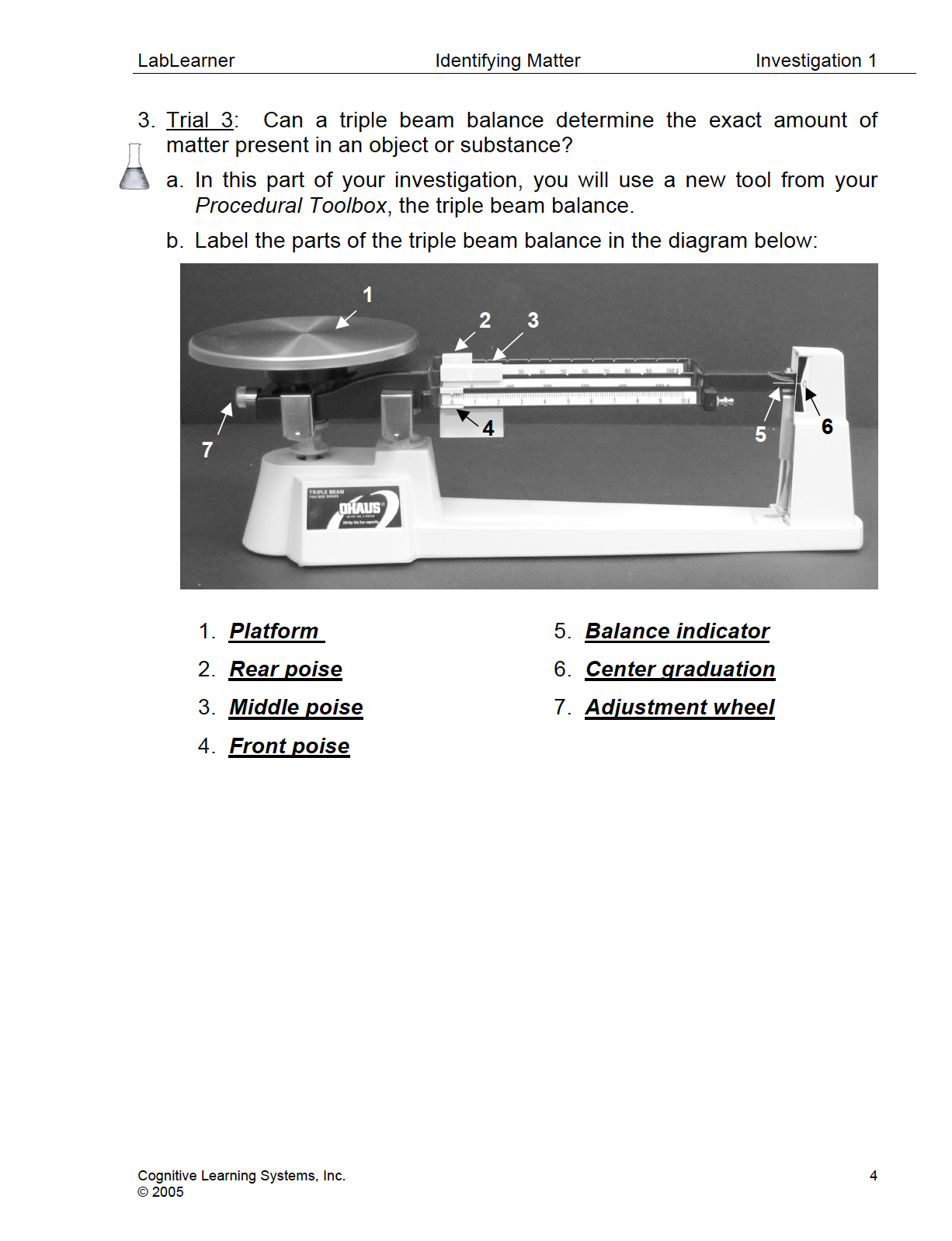
- Ask students to observe that the balance has three beams with different increments of grams. Grams are the metric units used to describe mass.
- Direct students’ attention to the picture of the triple beam balance in Problem 3b of their Student Data Record.
- Instruct students to label the parts of the balance as they identify them.
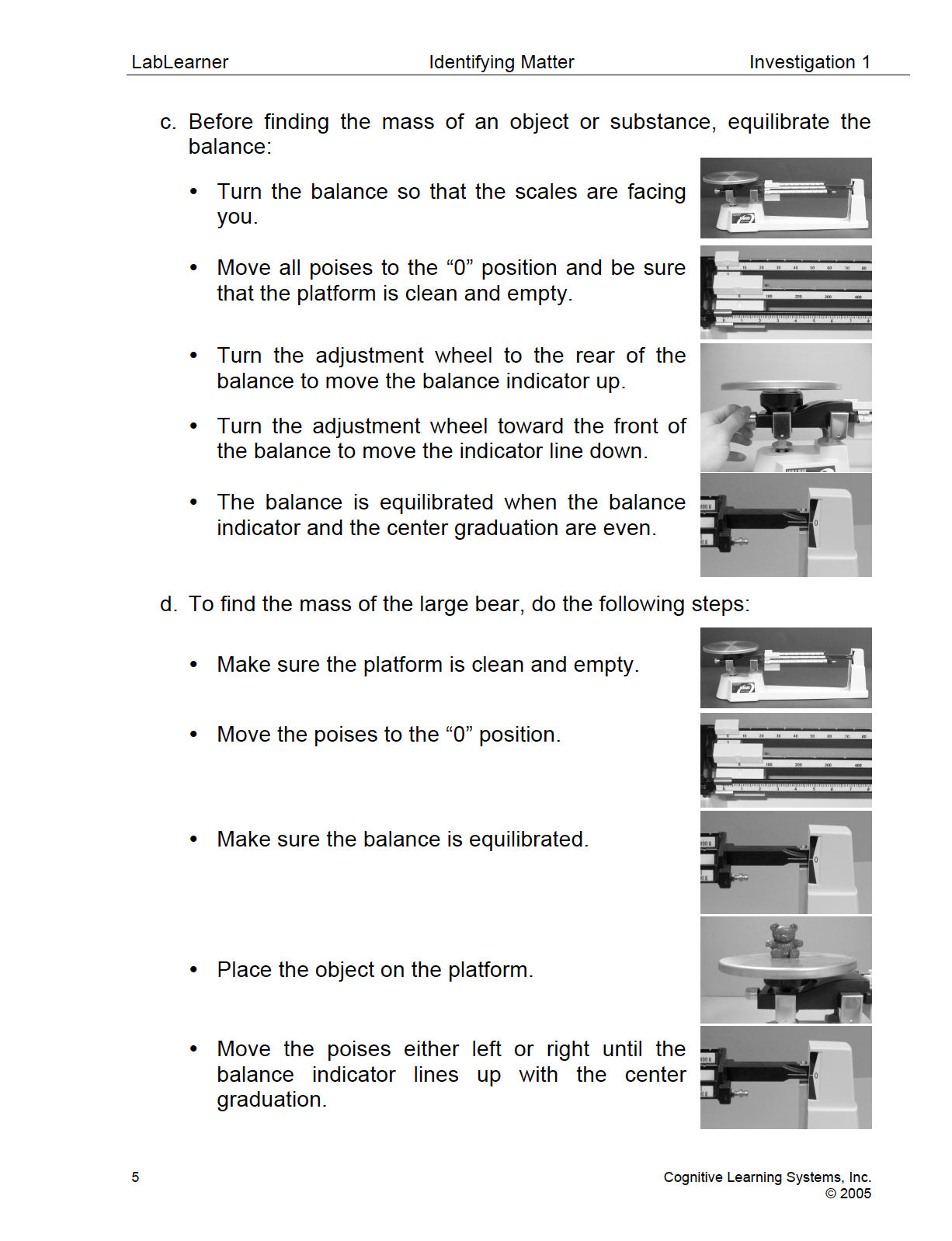
b. Explain to students that before using the triple beam balance, it should be equilibrated or calibrated to be sure that the beam is perfectly level. Encourage students to complete the following steps, listed in Problem 1c, to equilibrate the triple beam balance:
-
- Turn the balance so the platform is on the left and the scales on the beams are clearly visible.
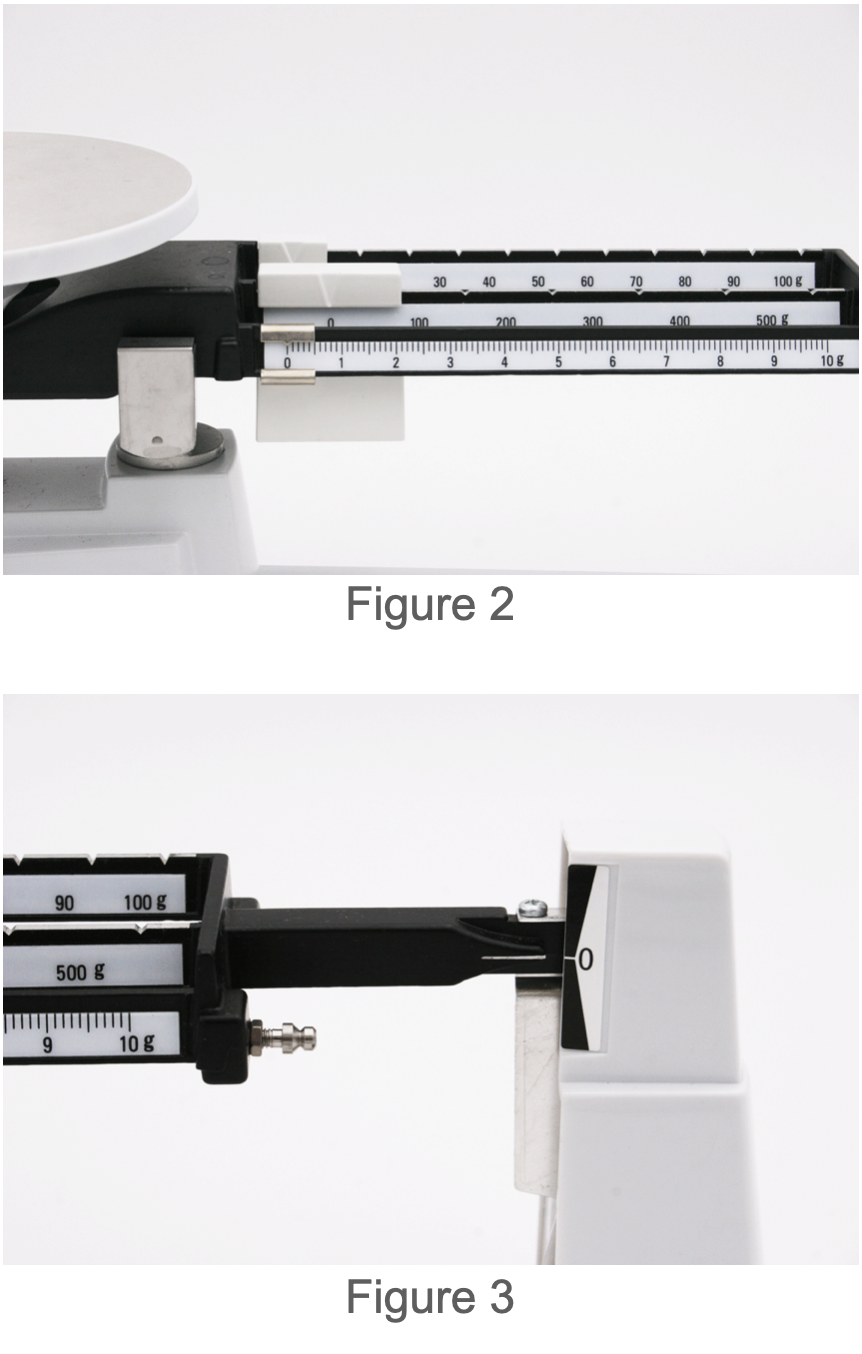
- Be sure all the poises are set to “0” and the platform is free of any objects or substances (Figure 2).
- The balance is equilibrated or calibrated when the balance indicator is aligned with the center graduation (Figure 3).
- If the indicator line is below the center graduation, rotate the adjustment wheel under the platform toward the rear of the balance to move the indicator up (Figure 4).
- If the indicator is above the center graduation, rotate the adjustment wheel toward the front of the balance to move the indicator down.
Note: To assist students in remembering which direction to rotate the adjustment wheel during equilibration of the balance, explain to them that they may use the mnemonic “up, up and away” to remember that turning the adjustment 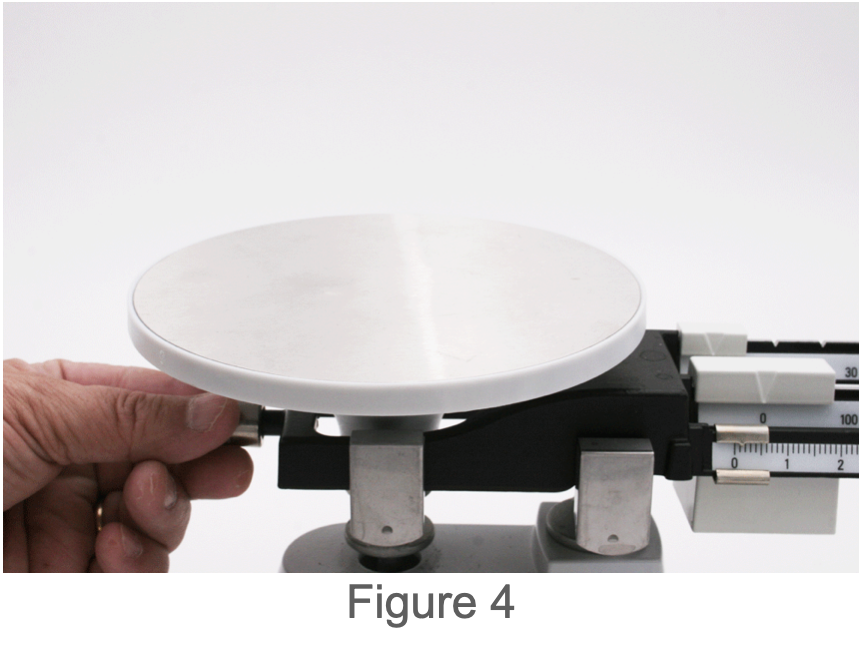 wheel away from themselves moves the indicator up.
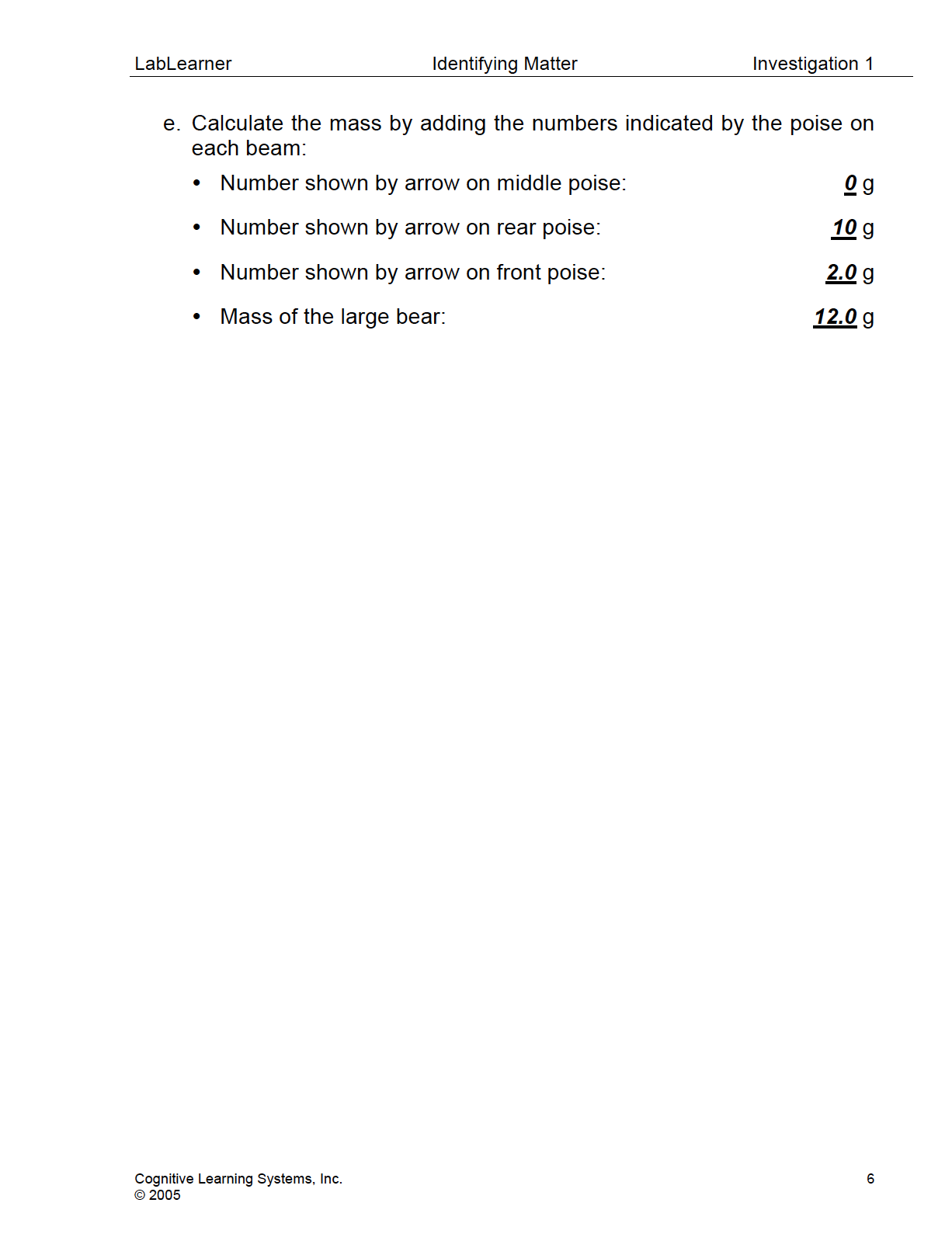
c. Guide students through the steps of using the triple beam balance by determining the mass of the large gram bear. The steps are also listed in Problem 1d and 1e of students’ Student Data Record.
-
- Remind students to be sure their balances are equilibrated before starting.
- Remind students to be sure the platform is clean and empty.
- Direct students to move all poises to the “0” position.
- Direct students to place the gram bear on the platform.
- Explain to students that the rear and middle poises should be lifted slightly before moving.
- Explain to students that when moving the front poise, it should be nudged gently with a finger to slide it along the beam.
- Direct students to adjust the poises one at a time until the indicator and graduation marks align. Students should then record the mass of the bear in Problem 3e of their Student Data Record.
- Assist students if necessary by demonstrating movement of the poises on a per-group basis.
Trial 4
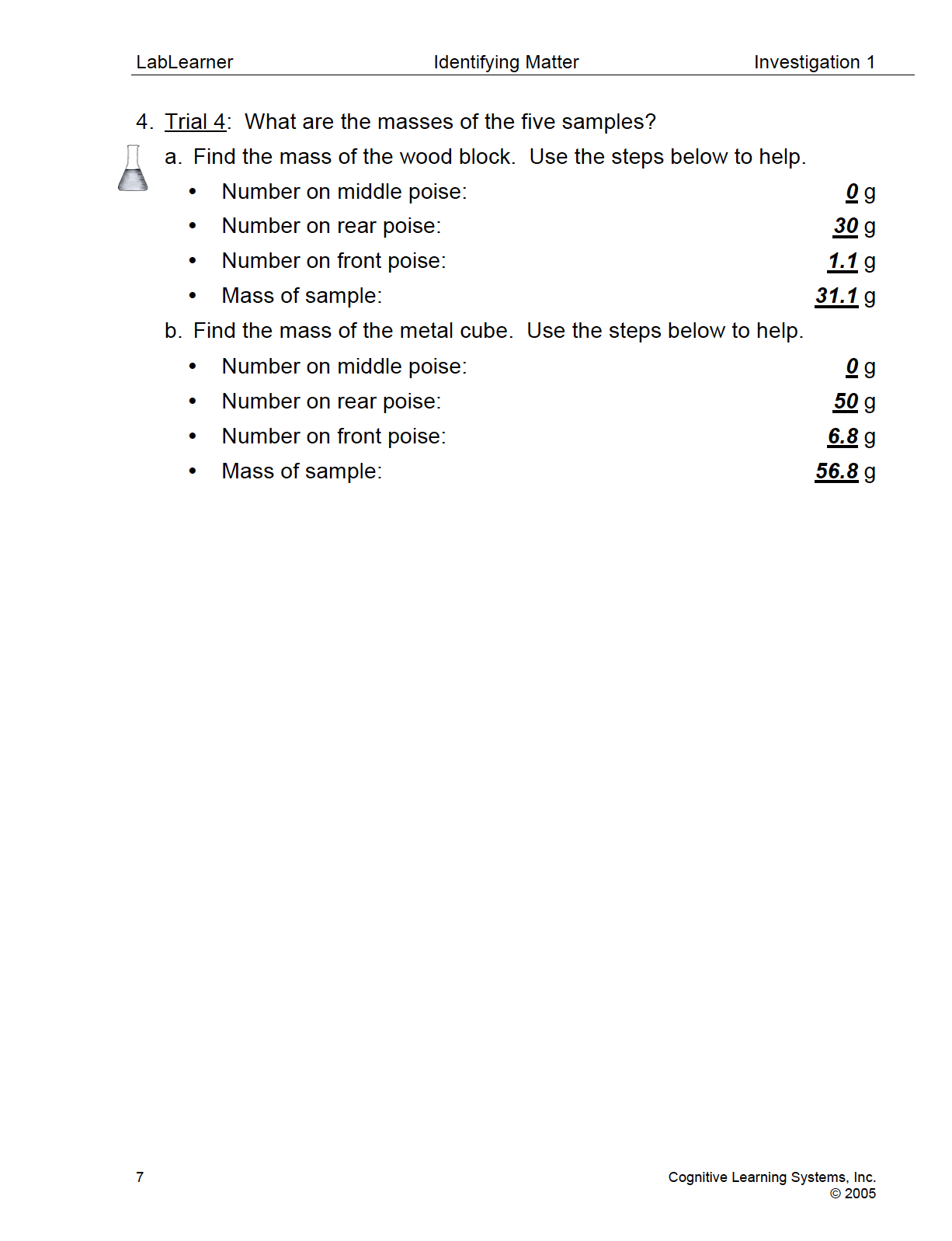
In Trial 2, students discovered that each sample differs in its mass. In this trial, students will use the triple beam balance to show that matter can be quantified by describing its mass. Although students will have an opportunity to determine the mass of all five samples, in this trial students will only determine and record the mass of the woodblock and the metal cube as it is likely that this procedure will require the remainder of the lab time. Students will have an opportunity to determine the mass of the other three samples in Investigation Two. Students will be asked to answer the following question as they begin Trial 4: What are the masses of the five samples?
a. Direct students to Problem 4 in their Student Data Record and read the question together: What are the masses of the five samples?
b. Tell students to begin by determining the mass of the wood block and metal cube. Indicate that the masses of the other samples will be determined in Investigation Two.
c. Assist students during their measurements as necessary.
KEYS
CLEAN UP
Let students know your expectations for clean-up. Ask them to clean up.