
Teacher Portal:
Biomes Journey
Two: Biomes and Rainfall
 PRINT IT
Use your browser to download a printable PDF as help during the slide presentation and to make additional notes. In your browser, go to File > Print and then choose to save as PDF.
NAVIGATE IT
Once the slide presentation is launched
- use your left and right arrows to advance or go back in the slide presentation, and
- hover your mouse over the left edge of the presentation to get a view of the thumbnails for all the slides so that you can quickly move anywhere in the presentation.
- Click HERE to launch the slide presentation for the CELL.
SHARE IT
SLIDE 2BIOME-1
In the first presentation of the Biomes Journey, we discussed the importance of climate in determining the characteristics of the different biomes on Earth. In this short presentation, we will focus specifically on the effect of one of the very important climatic features – annual rainfall – in determining the types of plants and animals that may occupy and survive in three specific biomes, desert, temperate forest, and tropical rainforest.
______________________________________________
SLIDE 2BIOME-2
Many factors, both physical and biological, go into making a unique biome. One of the most obvious physical factors that influence terrestrial (land-based) biomes is the amount of rain that falls on the area during the year. In this section, students will look at both extremes: deserts, with very little rainfall, and tropical rainforests, which are soaked with an enormous amount of rain each year. We will also look at a temperate forest biome that receives a moderate amount of rainfall.
Often, students think of rain in terms of how it affects their day – whether or not they can play outside, for example. In this short section, students will learn that the amount of rain that falls in various areas of the Earth has a great deal to do with the characteristics of the environment. Biomes are large natural areas of habitat home to specific types of plants and animals.
______________________________________________
SLIDE 2BIOME-3
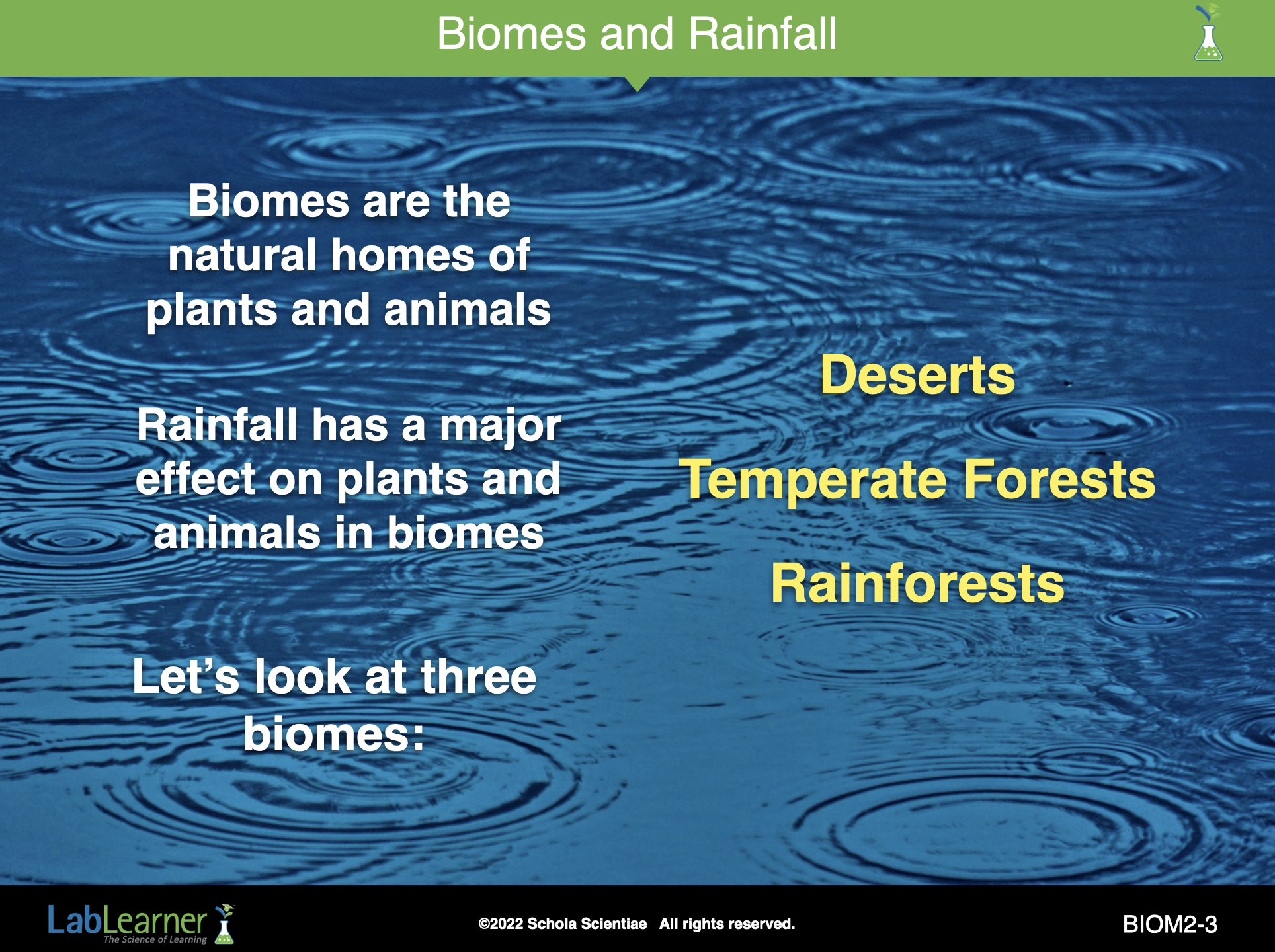
As suggested in this slide, the amount of rainfall a biome gets has a major impact on the nature and characteristics of that biome. In this section, we will only examine three individual biomes: Deserts, Temperate Forests, and Rainforests. There are many other biomes that we will consider in later sections, such as tundra, savanna, oceans, salt marshes, and others.
______________________________________________
SLIDE 2BIOME-4
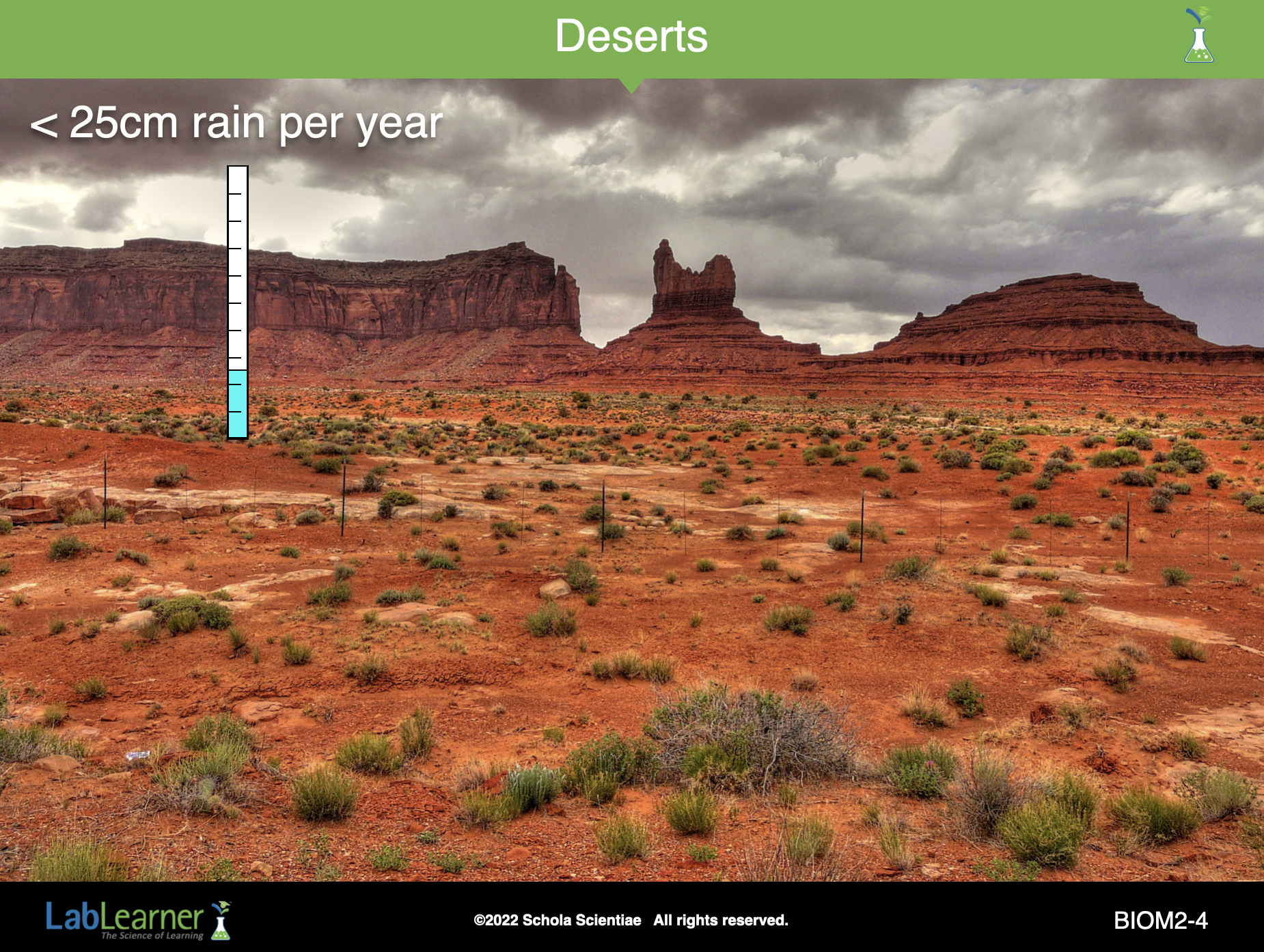
The desert biome receives less than 25 cm of rain per year. This amount of annual rainfall is indicated by the cartoon metric stick shown in the upper left.
Have students look at this scene from a North American desert and discuss their observations. In particular, have them observe and discuss the plants that they see.
Ask students: Are there many trees? Do the plants look soft and moist or prickly and dry? Student answers will vary. Because plants need water to photosynthesize and grow, there are relatively few plants in a desert. Desert plants tend to be rather short and stocky.
Imagine how quickly 25 cm of rainfall would be absorbed by the dry desert soil. In addition, the extreem heat of the desert surface will cause much of the rainfall to quickly evaporate before plants can capture it for growth!
______________________________________________
SLIDE 2BIOME-5
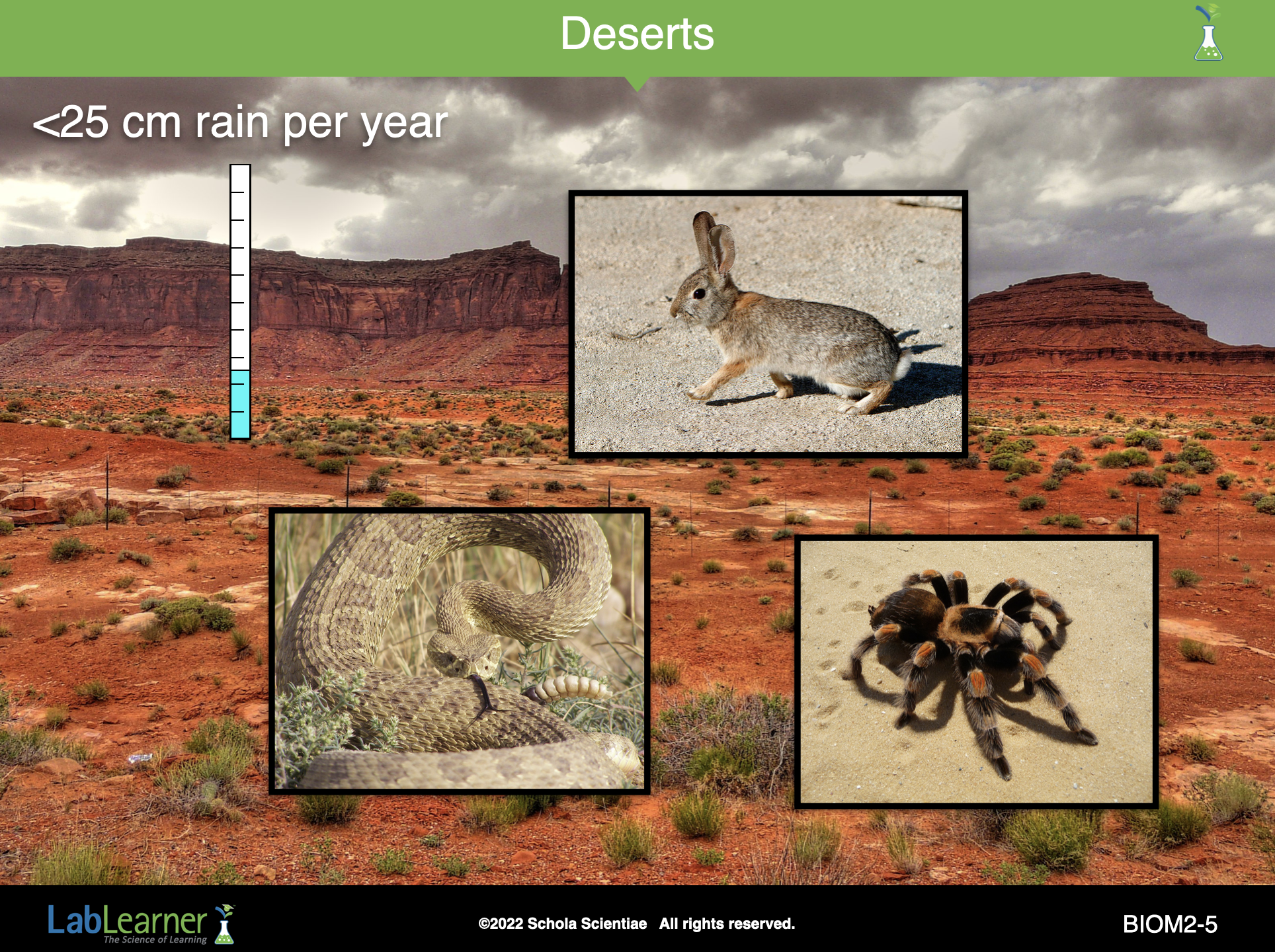
This slide shows several animals that might be found in a desert biome. There is a desert rabbit, a rattlesnake, and a tarantula spider.
Ask students to make observations and discuss these desert animals. Student answers will vary. For example, the animals’ coloring blend in with their surroundings.
Once again, the metric stick on the upper left indicates the low amount of rainfall.
______________________________________________
SLIDE 2BIOME-6
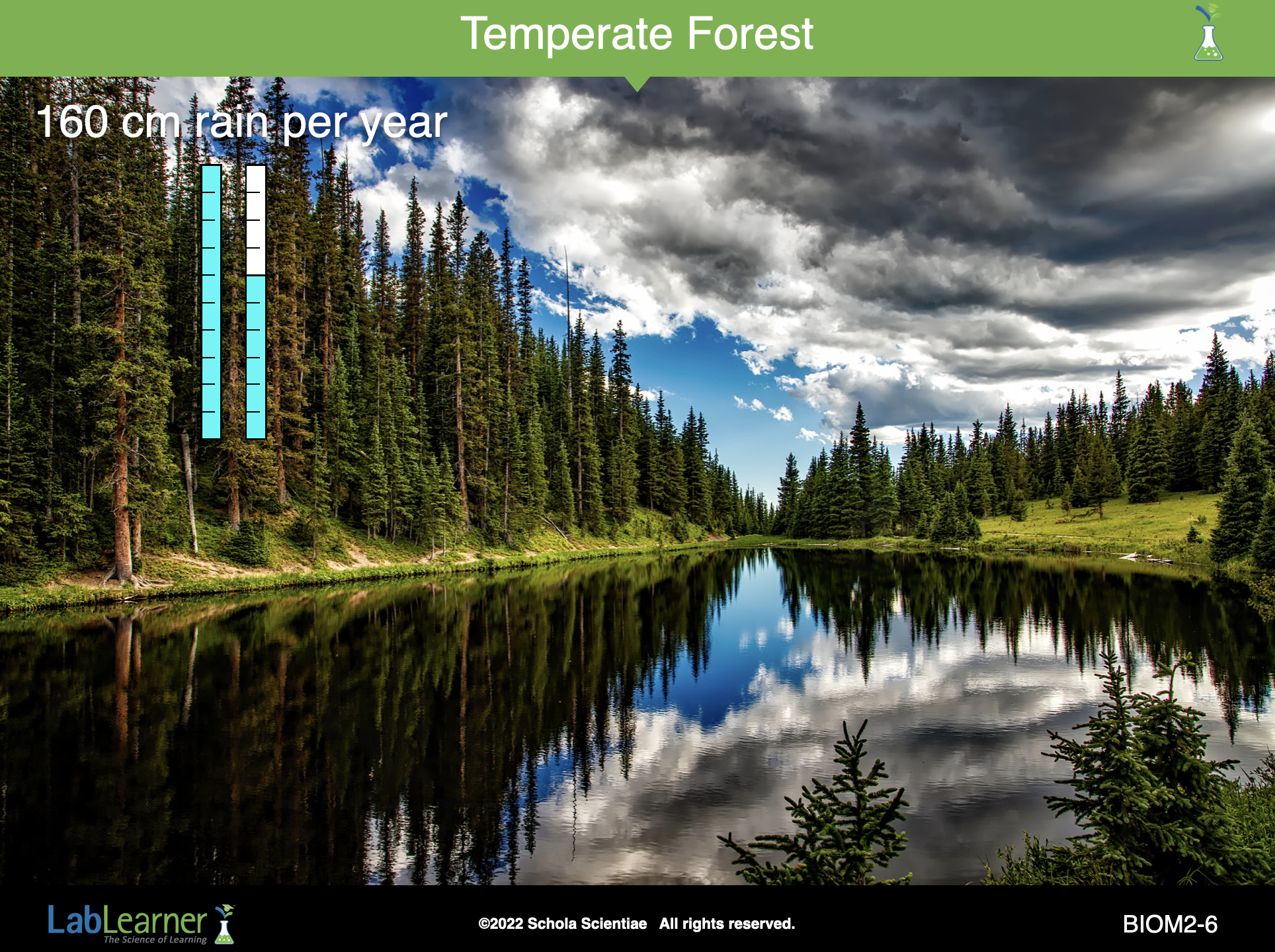
This slide depicts a typical temperate forest biome. Students may notice that there is an abundance of water and green plants present in this biome.
Have students focus on the types of plants they see.
Ask students: Are there trees? Do the plants look dry like in the desert biome? Student answers will vary. There are clearly many more plants than in the desert biome. In addition, many of the plants and trees are much larger than those found in a desert. This is due to the vastly increased amount of annual rainfall in temperate forst biomes.
Also, focus discussion on the amount of average annual rainfall a biome like this one receives. The meter sticks show 160 cm of average annual rainfall. Notice that it takes two meter sticks to depict all the rainfall this type of biome receives in an average year. If meter sticks are handy measure 160 cm to visualize thr amount of rainfall.
______________________________________________
SLIDE 2BIOME-7
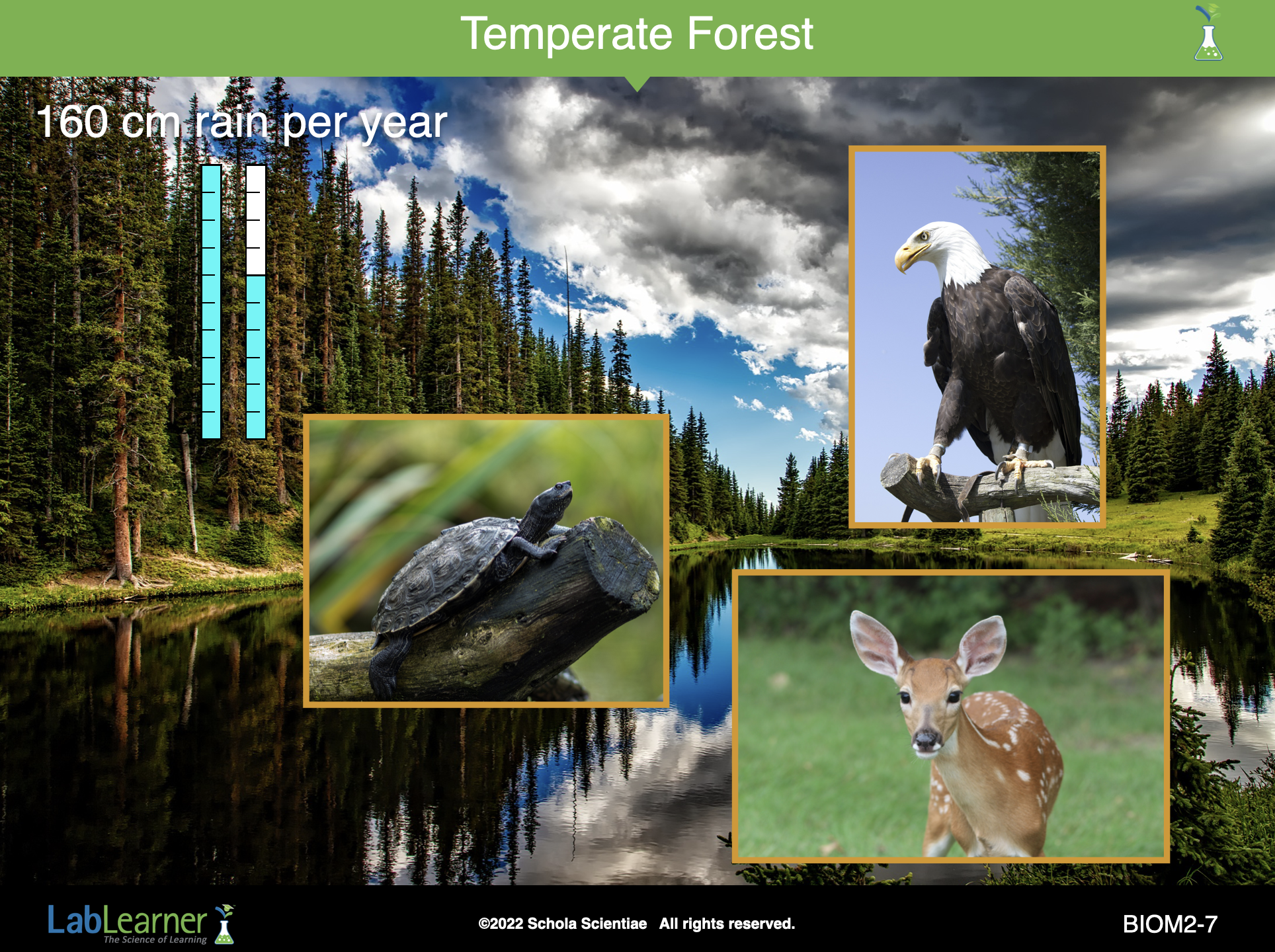
This slide shows several of the animals that live in temperate forest biomes. Notice that one of the examples, the turtle, actually spends much of its time in water. The turtle is a reptile, as is the rattlesnake in the desert biome. The deer is a mammal, as is the jack rabbit in the desert biome. Thus, similar animals can live in different biomes IF they have adaptations to do so.
______________________________________________
SLIDE 2BIOME-8
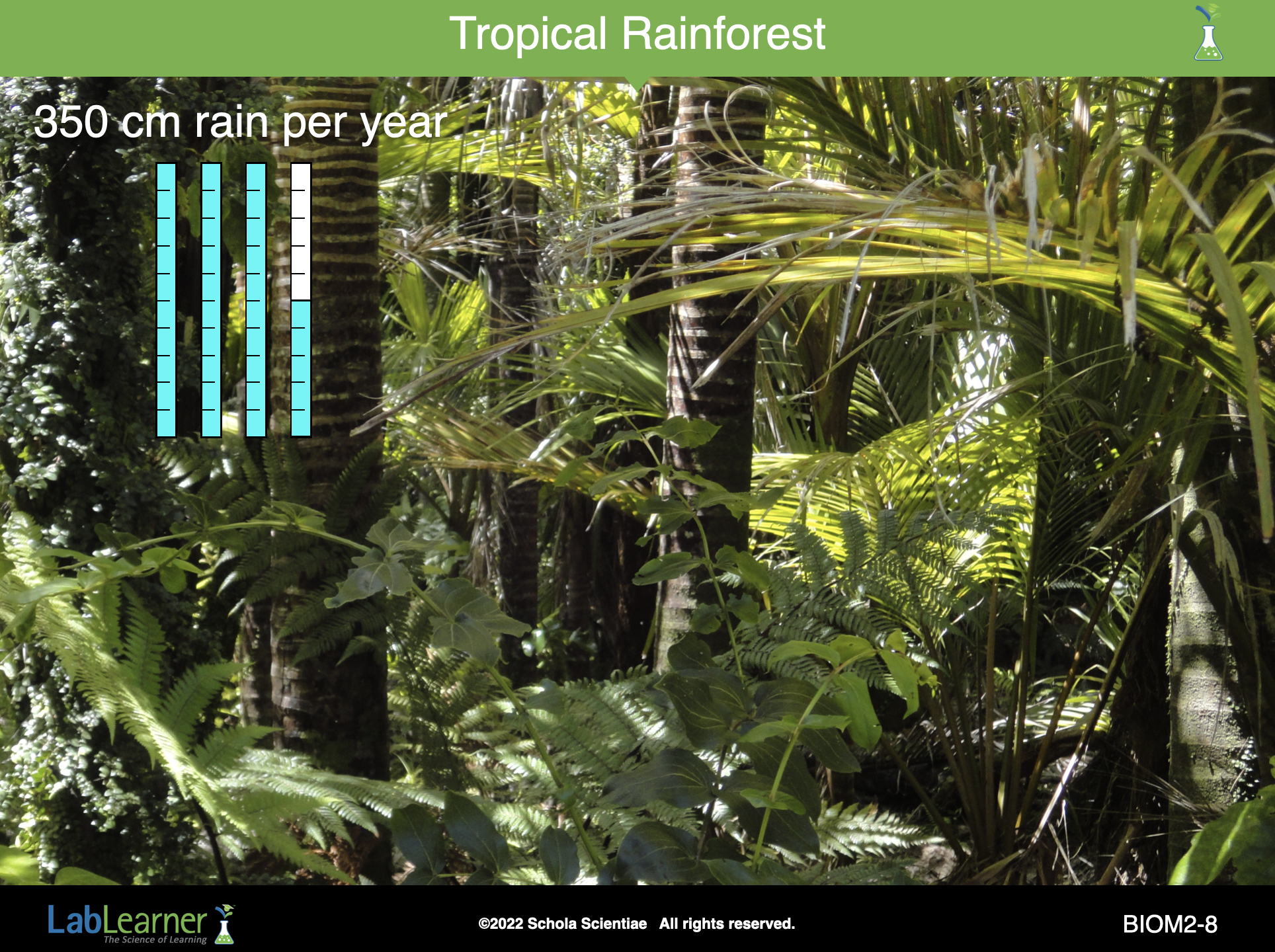
This is a tropical rainforest biome. Such biomes are found near the equator. Notice the high level of rainfall indicated by the meter sticks in the upper left, suggesting an average rainfall of about 350 cm per year. Some rainforests on some years may see a great deal more rainfall than the average indicated here. Even so, 360 cm (over three and a half meters) is about the hight of a typical classroom ceiling! Comepare that amount to the less than 25 cm of rain that falls in the desert.
Have your students to observe the plants in the picture.
Ask students: Are there trees? Do the plants look dry and brownish as in the desert biome or more like the plants of the temperate forest? Students answers will vary.
Have students observe and comment on the density of plant life in this rainforest. Look at how many more plants can grow in a rainforest compared to a desert. This is largely the result of the big difference in rain that falls in a desert compared to a tropical rainforest.
______________________________________________
SLIDE 2BIOME-9
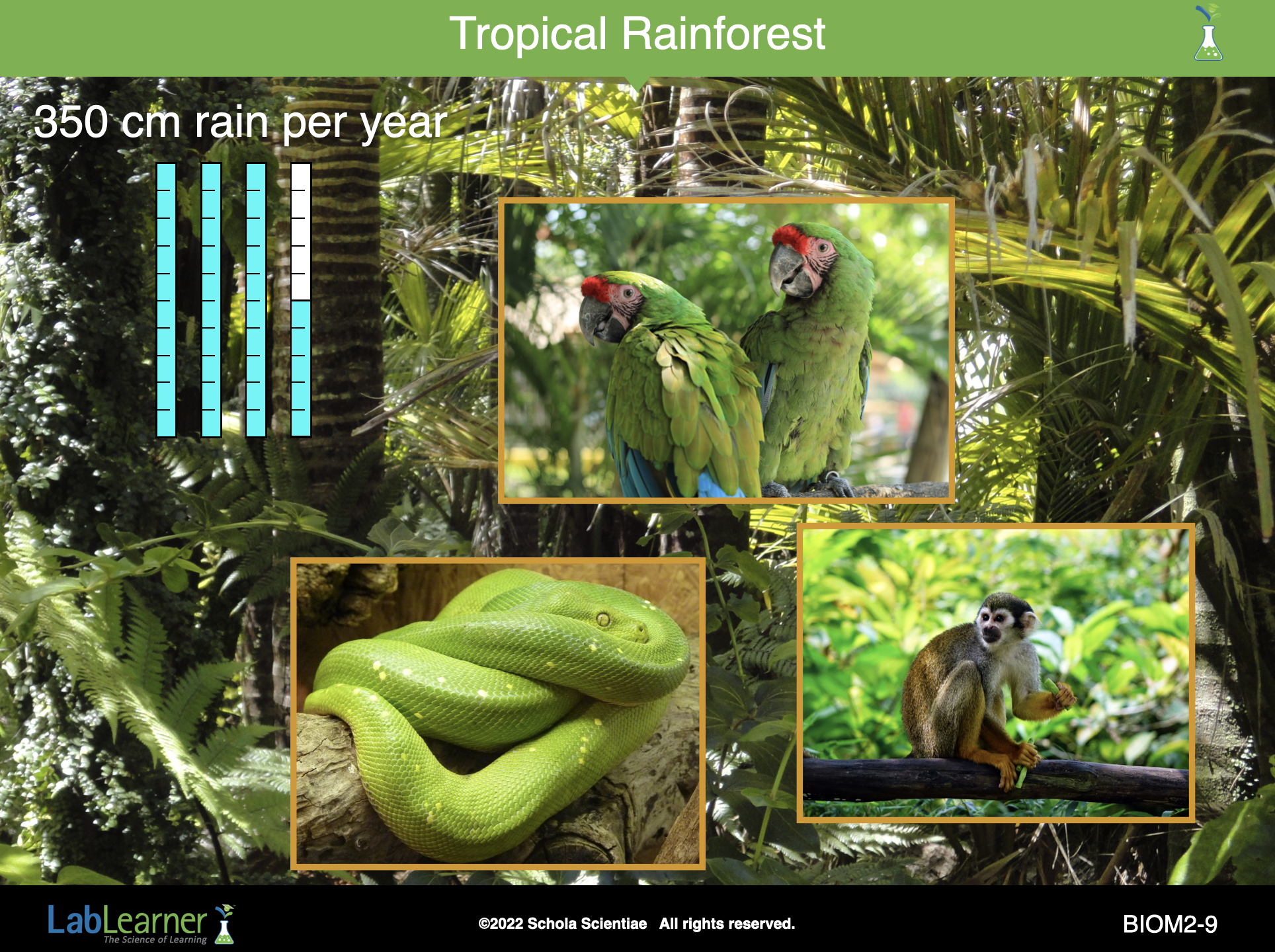
This slide shows some of the animals that live in a rainforest. There are a couple green parrots, a monkey, and a green tree python.
Have students observe the animals’ colors and how it helps them blend in with their surroundings. Also, notice that the picture includes a reptile and a mammal, just like in the desert and temperate forest. In this case, however, these animals have adaptations for their rainforest biome.
______________________________________________
SLIDE 2BIOME-10
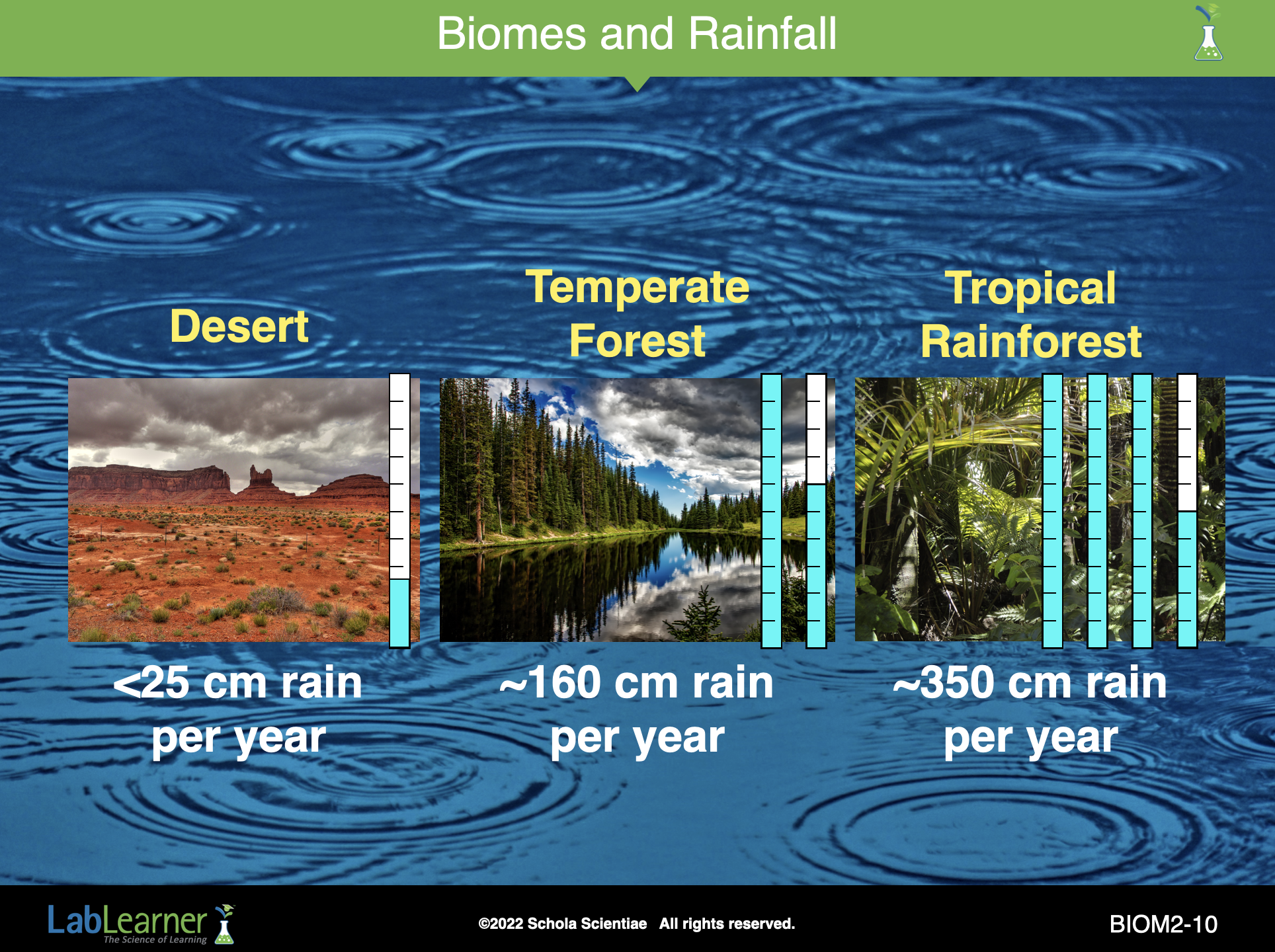
This final slide simply consolidates rainfall information for the three biomes that where encountered in previous images. Students may conclude that the amount of rainfall in a given biome has a major impact on the kinds of plants and animals that can live in it, and they would be correct!