
Teacher Portal:
Science and Art
Investigation 4 – Lab
 BE PREPARED
Supplies and Equipment:
Group Materials:
- 1 rectangular mirror (or can of vegetables or any cylindrical can)
- 1 200 g mass
- 1 stuffed bear (or similar stuffed animal)
- 1 baseball (or other ball)
- 1 basketball (or other ball)
- 1 Moon ball
- 1 ping pong ball
- 1 plastic dropper
- 1 wood block (or any small rectangular box)
- 1 100 ml beaker (or plain round drinking glass)
Individual Materials:
- 1 Student Data Record
Teacher Preparation:
1. Organize the required materials at a distribution point.
2. Divide students into five (5) cooperative groups.
Instruction:
1. Direct each student group to obtain the following necessary materials from the distribution point: one (1) rectangular mirror, one(1) 200 g mass, one (1) stuffed bear, one (1) wood block, one (1) ping pong ball, one (1) moon ball, one (1) 100 ml beaker, and one (1) plastic dropper.

GET FOCUSED
Investigation Four continues to familiarize students with concept of perspective in nature and, more specifically, perspective in art. However, in this Investigation, students will explore yet another important element in both science and art – symmetry.
 INVESTIGATE
1. The Trials in this Investigation focus on how many planes of symmetry exist for certain objects. Students will use a mirror to find planes of symmetry and to determine if the mirror creates an image that makes the object appear similar to its appearance without the mirror. If this occurs, then the plane where the mirror is located is a plane of symmetry.
Each Trial includes steps that are used to set-up the experiment. In following the directions for set-up, students may be tempted to focus more on the steps of the procedure and less on the observations they will make after the experiment design has been prepared.
Trial 1
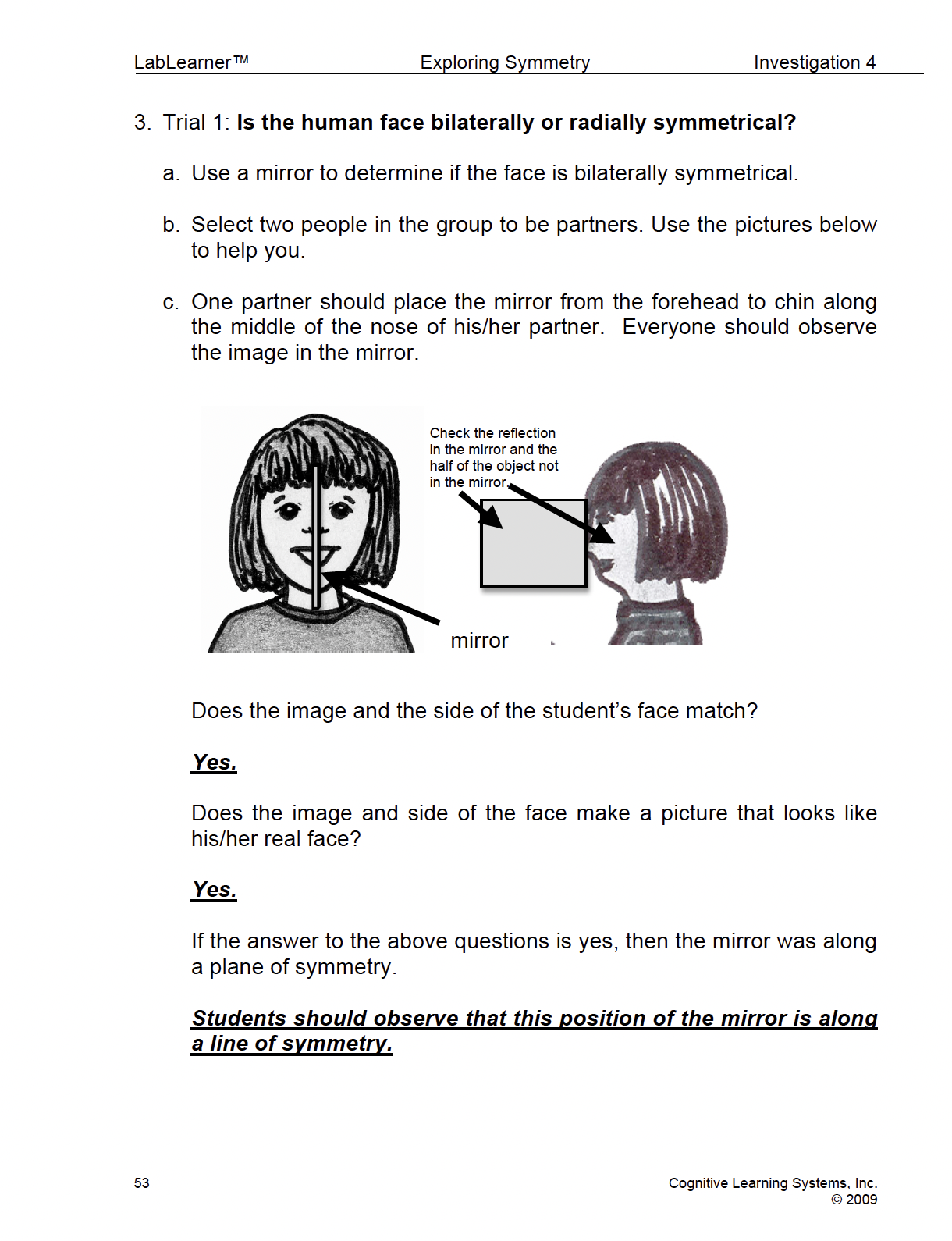
Trial 1 has been designed to illustrate an example of bilateral symmetry to students. Students will determine how many planes of symmetry exist for the human face by placing along different planes that divide the object. The directions in the trial show students how to think about the possible orientations for a plane of symmetry.
Students begin by placing the mirror down the middle of face along a longitudinal axis. When students observe the image formed by the image in the mirror and the side of the face, they should see what appears to be a complete human face with a left and right side.
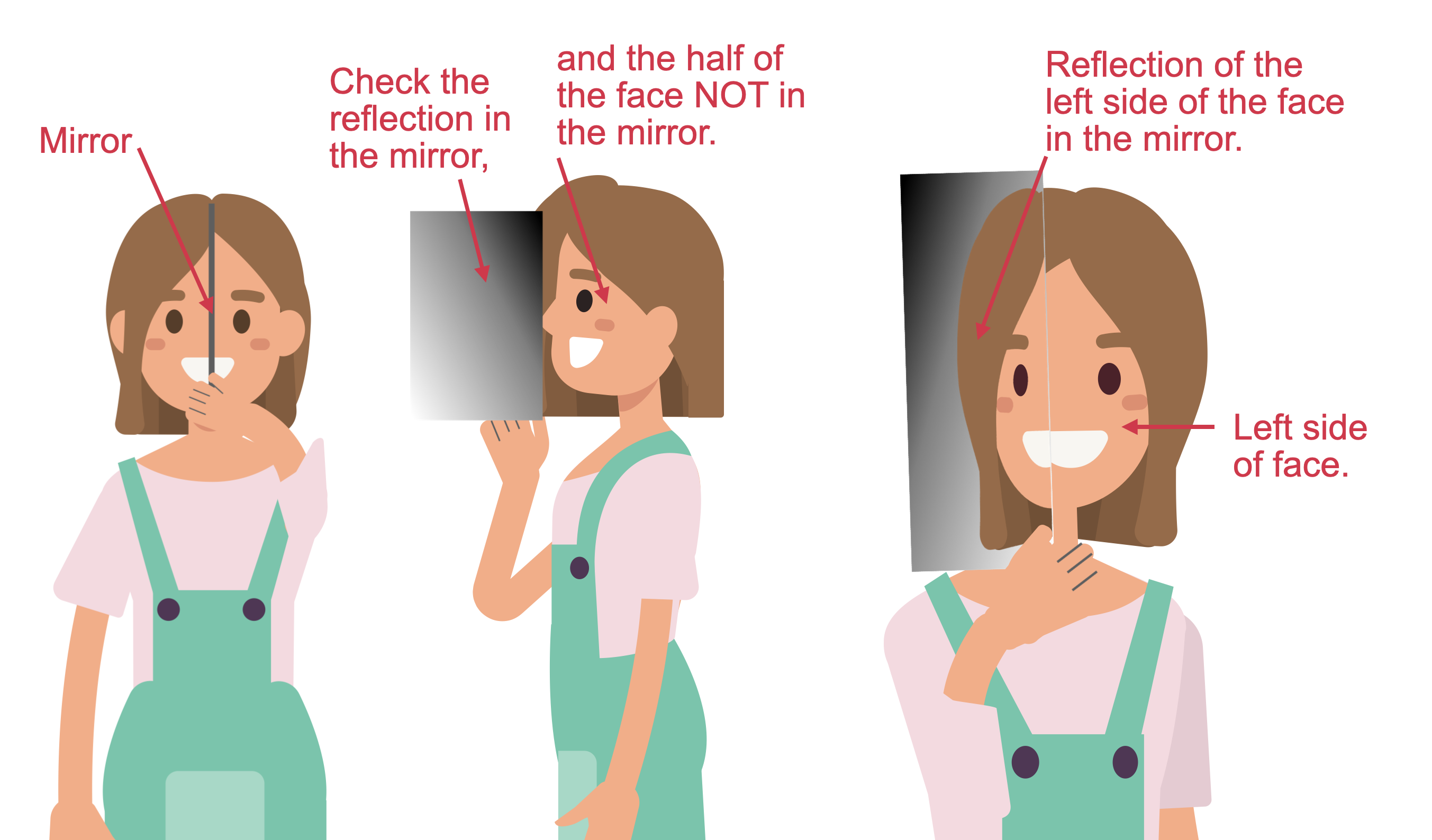
The text in their Student Data Record indicates that the object appears “real” when the mirror is used, then a true plane of symmetry has been established. Students should then recognize that the line from the forehead to the chin down the middle of the face is a plane of symmetry.
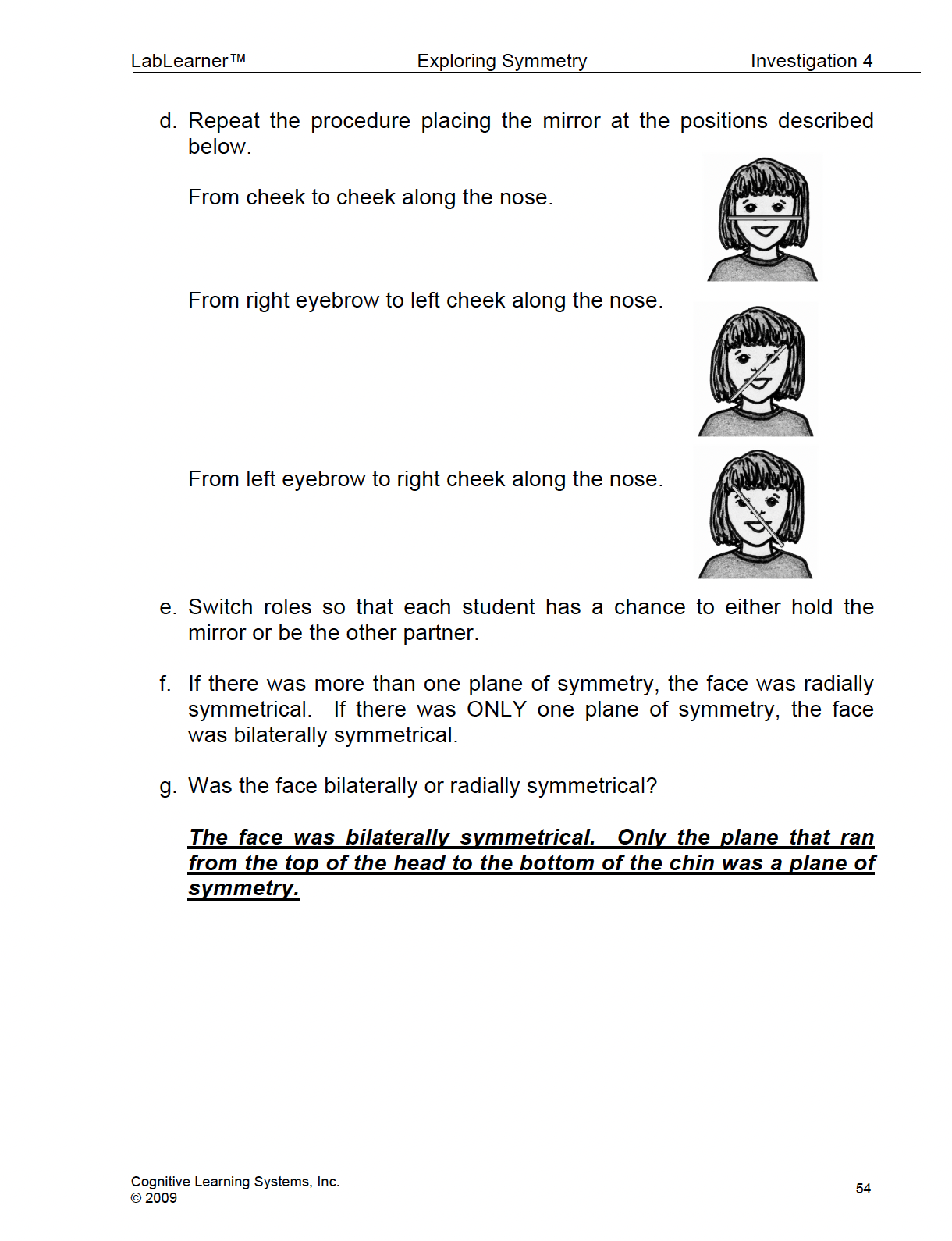
Students next test a plane that runs across the latitudinal axis of the face and then two planes that run diagonally across the face. As they observe each image they should see a distorted appearance of a face rather than a “normal” face.
Based on these observations, students should discern that these are not planes of symmetry for the human face. As a result, students should categorize the human face as an example of bilateral rather than radial symmetry since only one plane of symmetry is present.
Objects that are radially symmetrical have more than one plane of symmetry. As students complete this Trial, ask them to consider the following question: Is the human face bilaterally or radially symmetrical?
Trial 2
Trial 2 has been designed to illustrate an example of radial symmetry to students. Students will determine how many planes of symmetry exist for a 200 g mass by using a mirror to find planes of symmetry.
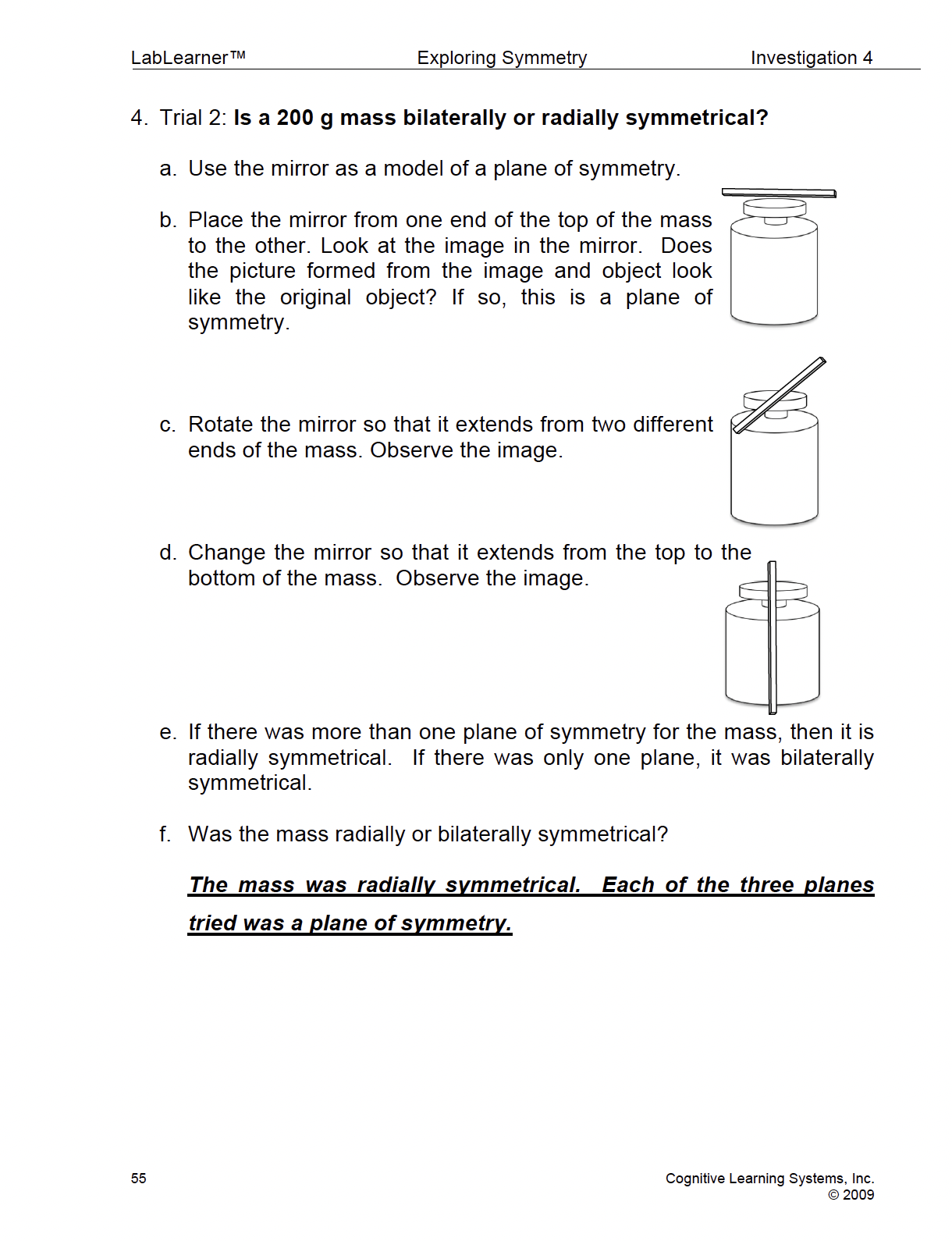
The directions in their Student Data Record for this Trial show students how to think about the possible orientations for a plane of symmetry. When students observe the image formed by the image in the mirror and the other portion of the 200 g mass, they should see what appears to be a complete 200g mass cylinder. However, they must first adjust the angle of the mirror and their viewing position, as shown below:
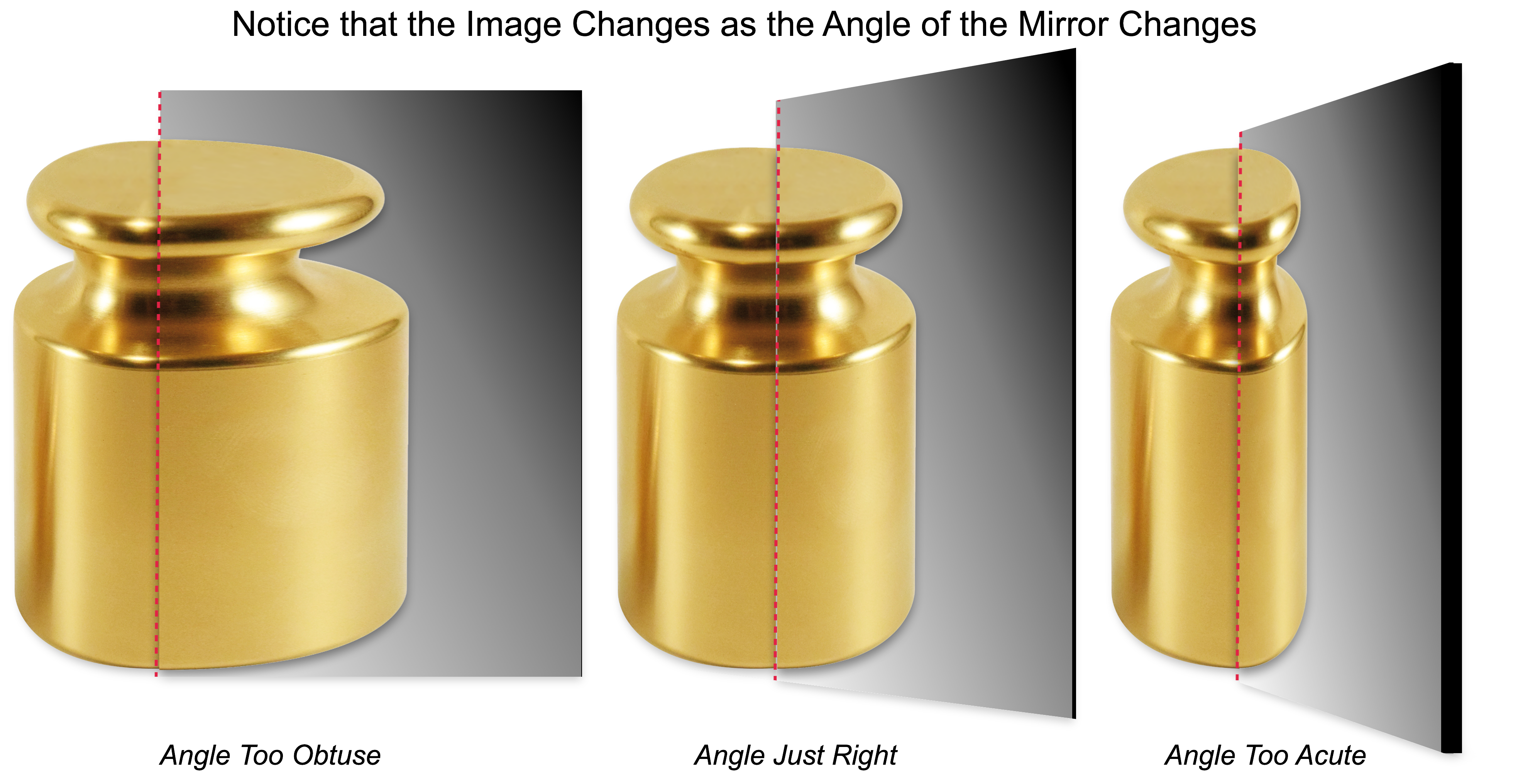
The text in their Scientist Data Record indicates that if the object appears “real” when the mirror is used, then a true plane of symmetry has been established. Students should then recognize that the line from one end of the top of the cylinder to the other is a plane of symmetry.
Students next test a plane that runs from two other points of the top of the 200g mass across its center. As they observe each image, they should see a complete cylinder. Based on these observations, students should discern that these are also planes of symmetry for the 200g mass.
Students continue testing different planes, finding each time the plane produces a “real” image of a cylinder. As a result, students should categorize the 200g mass as an example of radial rather than bilateral symmetry since many planes of symmetry are present.
Radially symmetrical objects have more than one plane of symmetry. Bilaterally symmetrical objects have ONLY ONE plane of symmetry. As students complete this trial, ask them to consider the following question:
Ask students: Is the 200g mass bilaterally or radially symmetrical? Students should indicate that the 200 g mass is radially symmetrical.
Trial 3
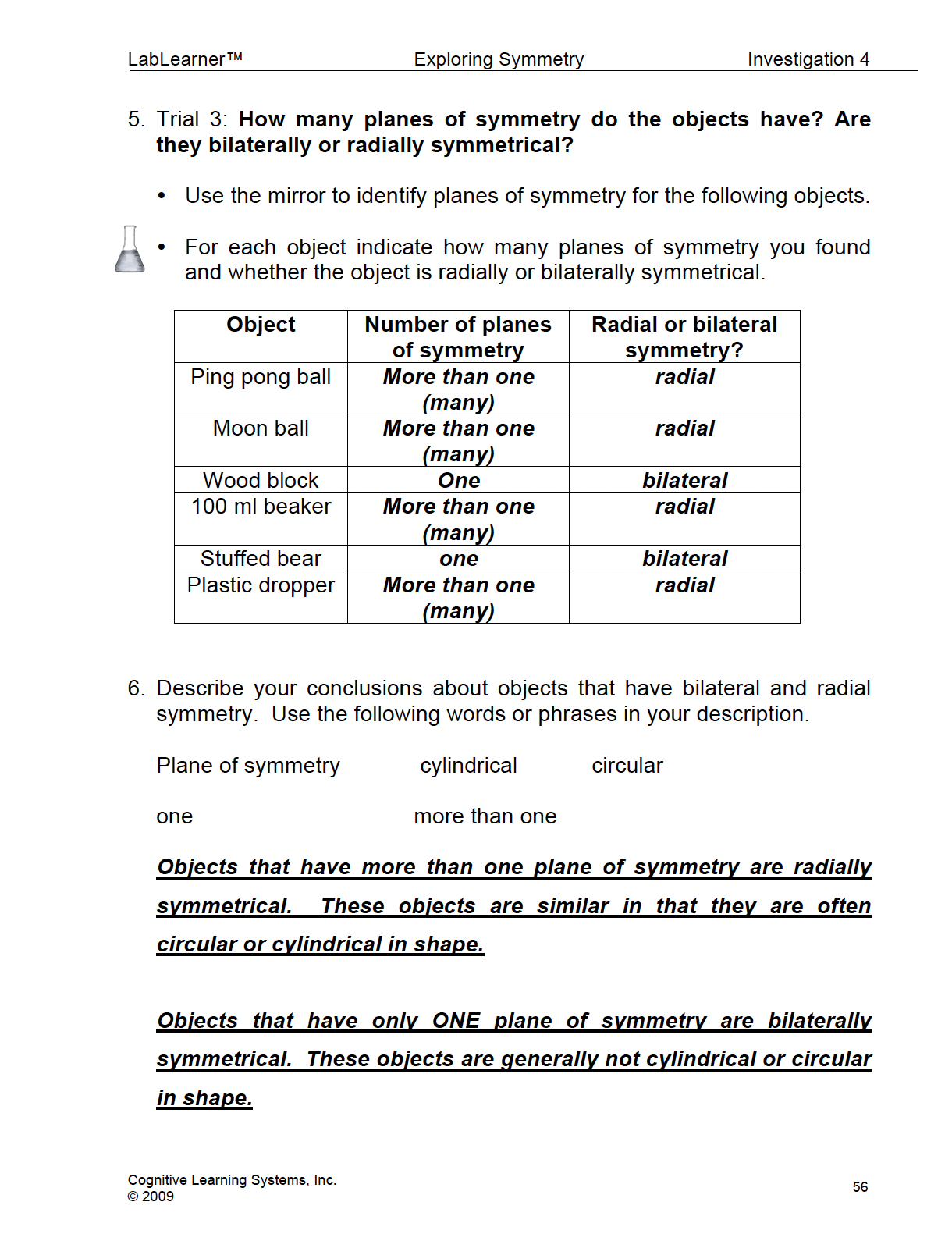
In Trial 3 students apply what they learned in Trials 1 and 2 about how to test for planes of symmetry and how to identify objects with radial and bilateral symmetry.
As in Trials 1 and 2, they use a mirror to find planes of symmetry and determine whether six different objects from the distribution center exhibit bilateral or radial symmetry. As students complete this trial, ask them to consider the following question:
How many planes of symmetry do the objects have?
Are they bilaterally or radially symmetrical?
KEYS
CLEAN UP
Let students know your expectations for clean-up. Ask them to clean up.