Teacher Portal:
Science and Art
Performance Assessment – PreLab
 PRINT IT
Use your browser to download a printable PDF as help during the slide presentation and to make additional notes. In your browser, go to File > Print and then choose to save as PDF.
NAVIGATE IT
Once the slide presentation is launched
- use your left and right arrows to advance or go back in the slide presentation, and
- hover your mouse over the left edge of the presentation to get a view of the thumbnails for all the slides so that you can quickly move anywhere in the presentation.
- Click HERE to launch the slide presentation for the CELL.
SHARE IT

VARTPApre-1
This is the Performance Assessment of the LabLearner CELL Science and Art. In it, students review perspective and the illusion of depth in paintings. In addition, students will review bilateral symmetry and its use in art.
______________________________________________
VARTPApre-2
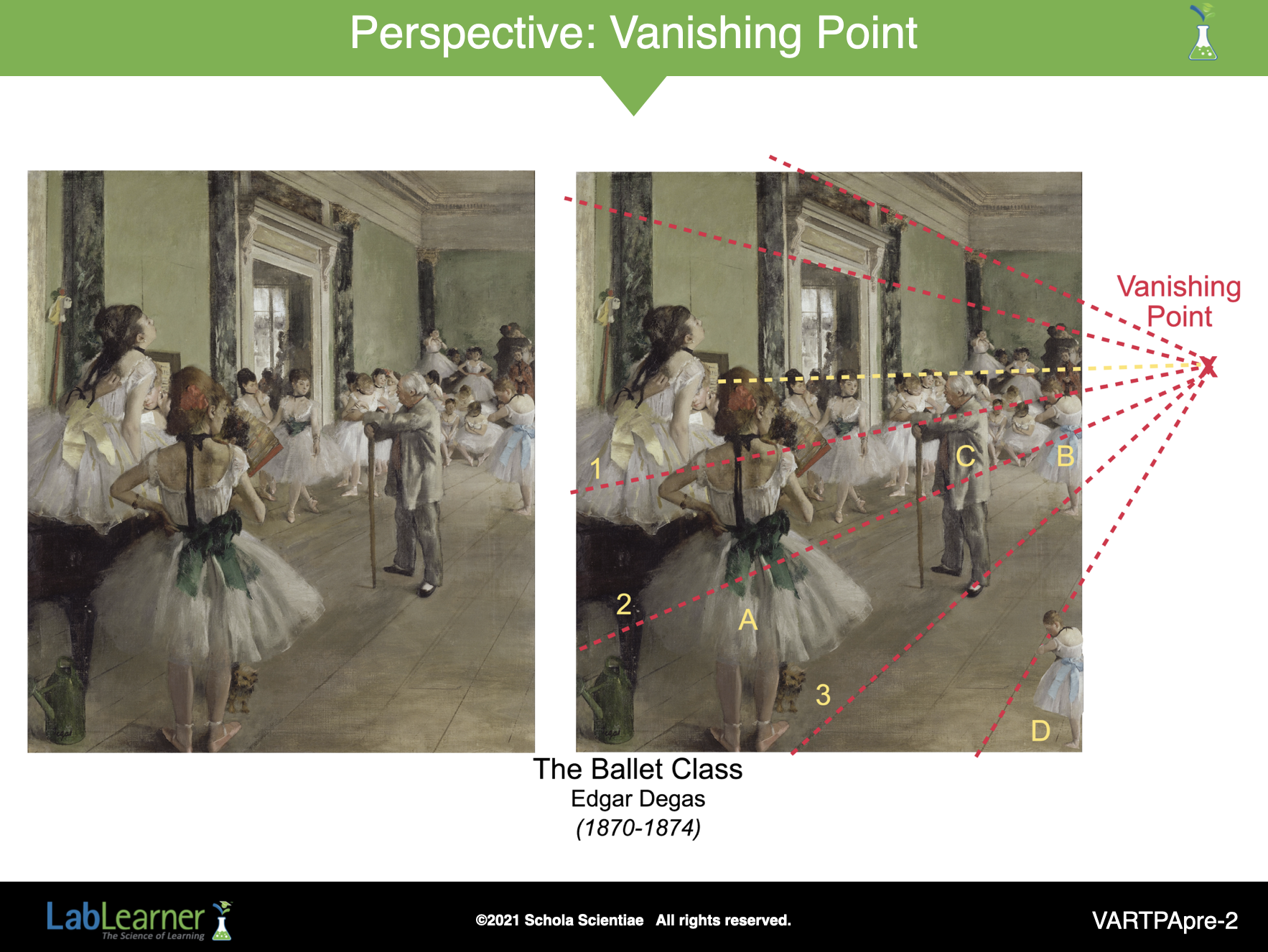
A. Perspective in painting is chiefly achieved through the use of vanishing points. In addition, by using overlapping objects, artists can simulate the order of objects we observe in their paintings.
1. An excellent example of these techniques of artistic perspective is shown in Edgar Degas’s painting, The Ballet Class, on this slide.
a. Tell students to look at Lines 1, 2, and 3 as well as the persons A, B, and C in the painting on the right side of the slide.
b. Notice that Line 1 touches the shoulders of the closeup dance with her back to us (A). It then does the same for the instructor (C) and the distant dancer (B).
c. Next, follow Line 2, which passes roughly through the midsection of each of the three individuals, and Line 3 which runs to the vanishing point along the feet of all three. This results in progressively “smaller” individuals as their position is removed further and further from the foreground.
d. Notice also the small insert (at the very bottom right, D), which reproduces dancer B‘s actual size in relation to dancer A. look how much smaller she is! Yet, in the painting, dancer B appears to be approximately the same height as both dancer A and instructor C. Such use of perspective gives Degas’ painting both depth and interest.
e. Finally, notice the placement of figures A, B, and C causes them to overlap with other portions of the picture. The instructor (C), for example, is placed in front of the group of dancers near the door on the left, and dancer A is in front of the piano, and the dancer seated atop it. This further produces a sense of depth in the painting.
______________________________________________
VARTPApre-3
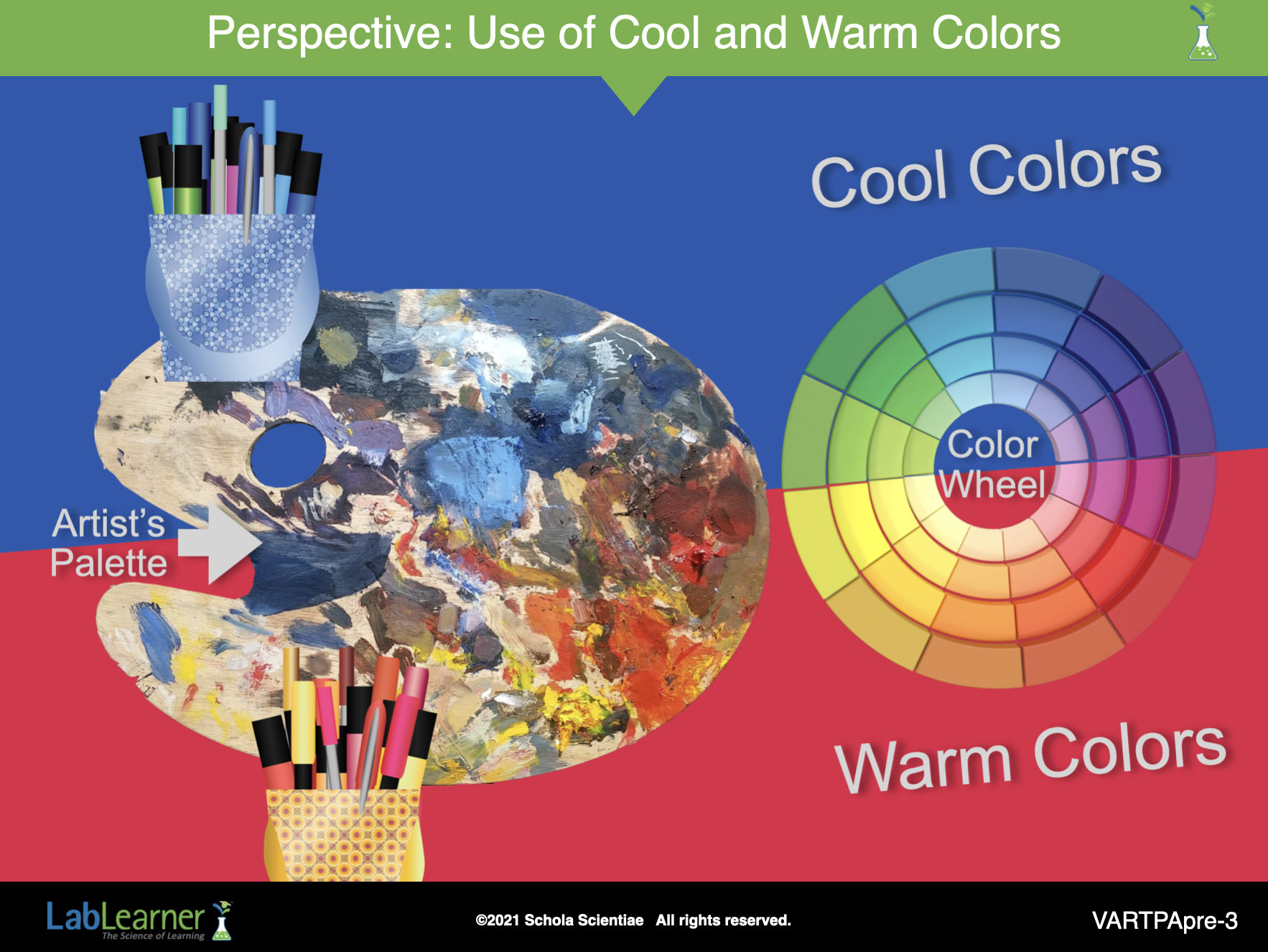
2. Artists can also portray depth and distance through color and detail. Generally, warm colors appear nearer, while cooler colors appear more distant. Notice that the artist has even separated the paint on her palette by their warmth in the illustration on this slide.
______________________________________________
VARTPApre-4
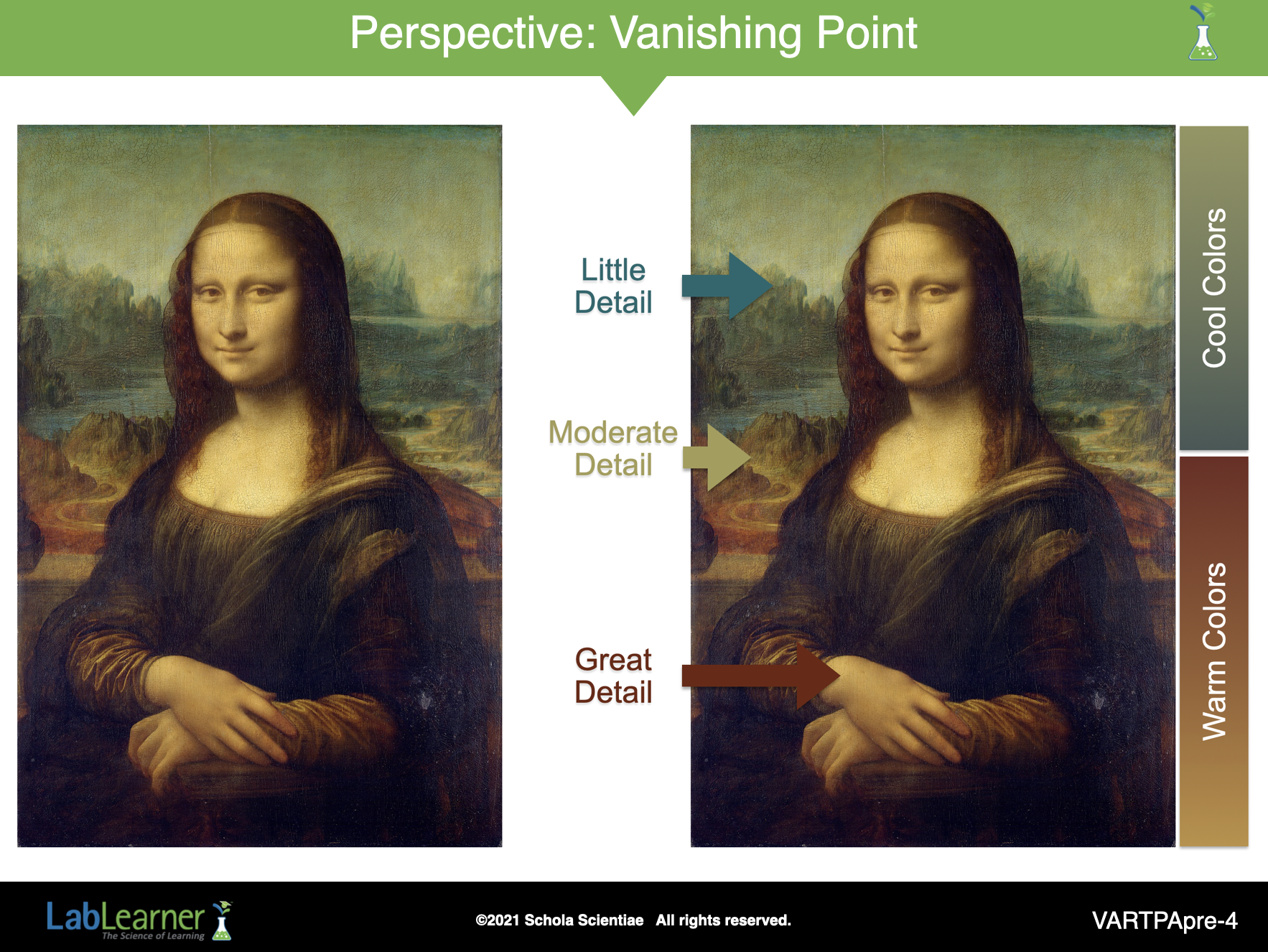
3. In addition, when great distance is represented, there is usually a loss of sharp details as the perceived distance from the foreground increases. That is, less detail is seen the further away an object appears in a painting.
4. One of the most famous paintings of all time, Leonardo da Vinci’s Mona Lisa, clearly uses color and loss of detail in the background landscape behind his subject.
______________________________________________
VARTPApre-5
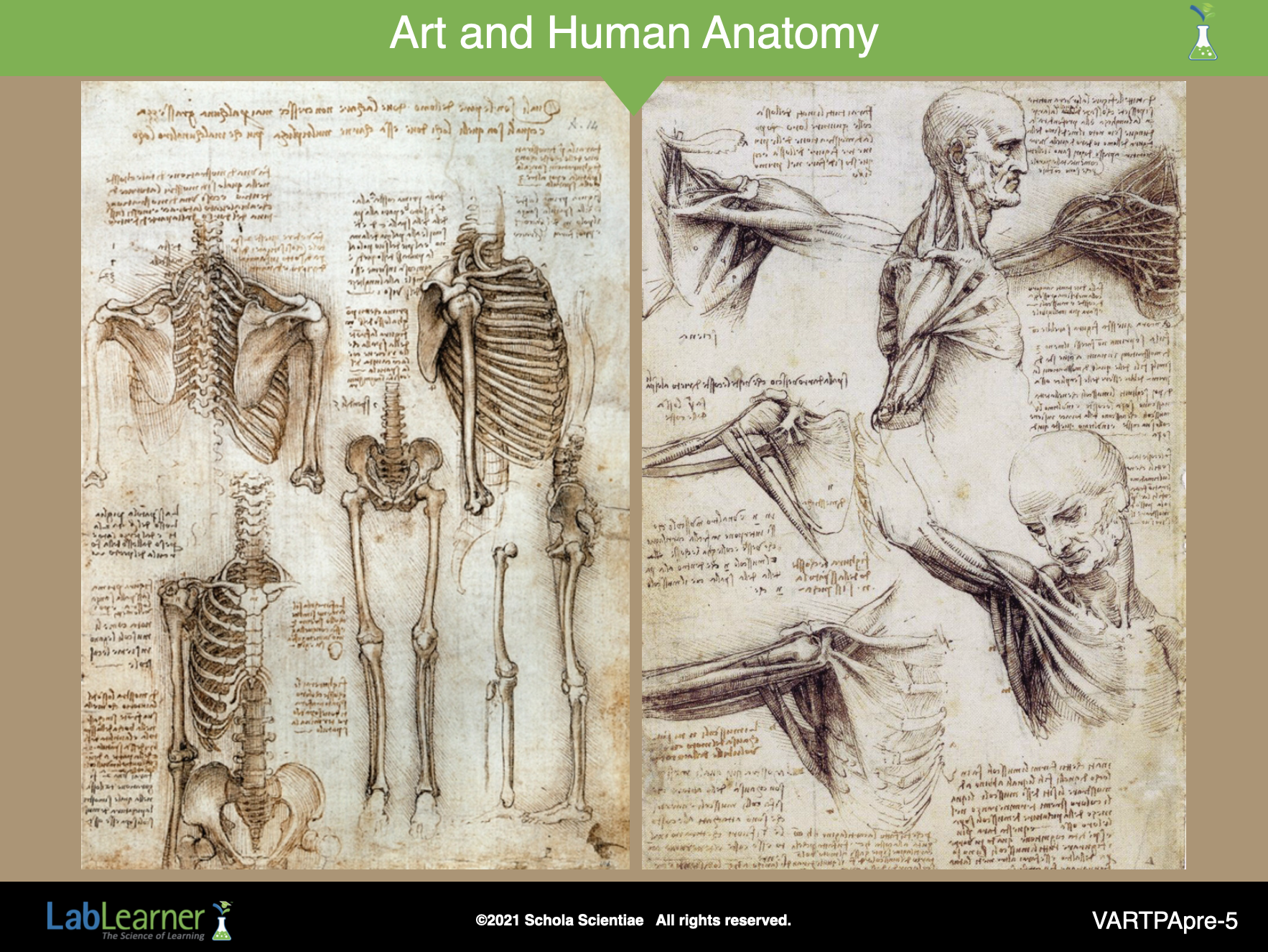
5. Among the many artists that achieved fame during the Renaissance, perhaps no other artist exemplified the close ties between science and art as Leonardo da Vinci.
- One of the reasons his portraits look so life-like is that he dissected dozens of human cadavers and studied the muscles, bones, nerves, and other essential details of human anatomy. He was then able to use this knowledge in his rendition of the human form in his artwork. Two pages from one of his many journals are shown on this slide. His hundreds of drawings were amazingly accurate.
______________________________________________
VARTPApre-6
B. Bilateral Symmetry
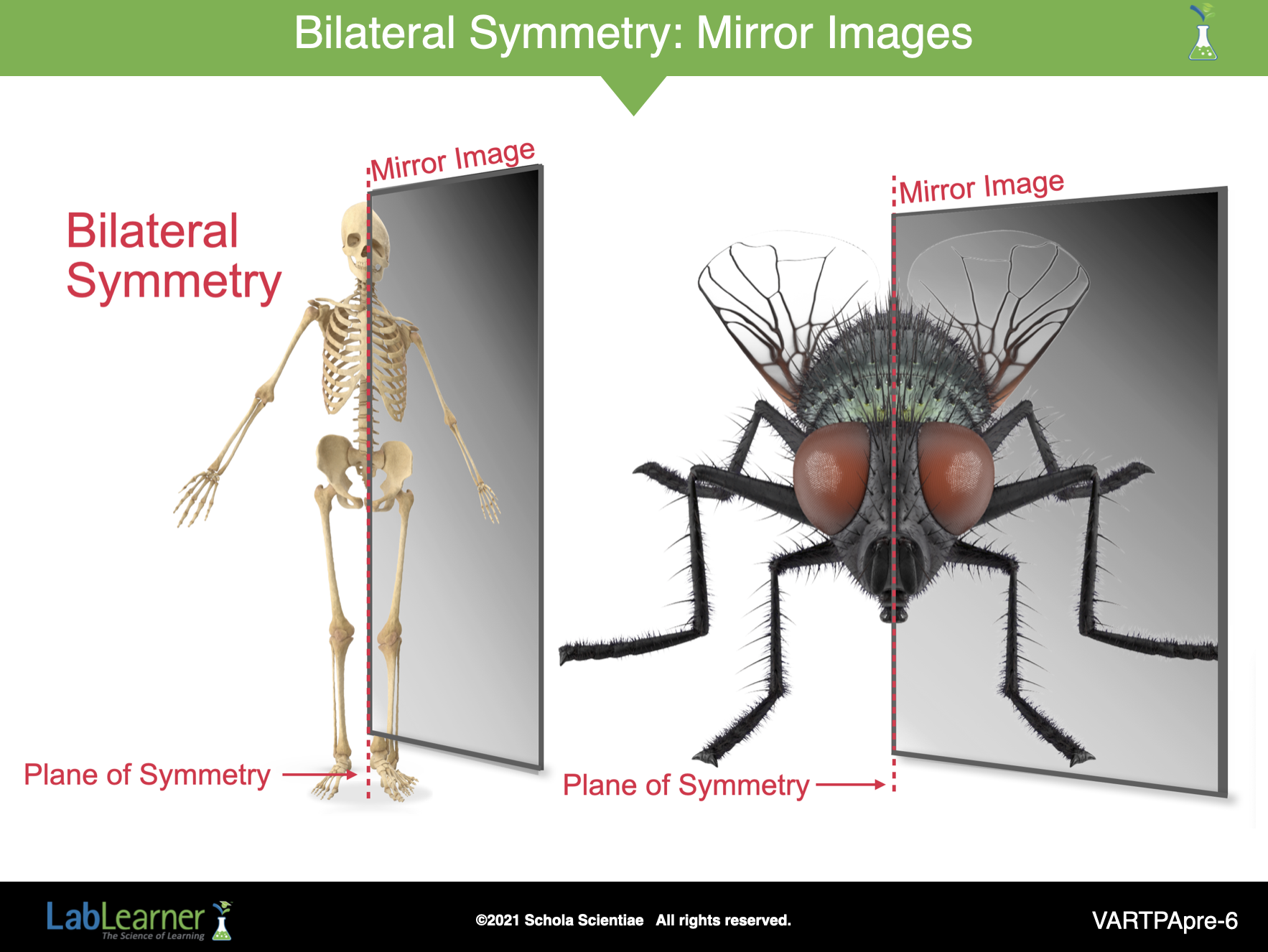
1. Students sometimes need help with the concept of plane of symmetry and mirror images. Proper bilateral symmetry displays a single, central plane of symmetry. However, as we have seen in Investigation 4, this does not mean the two halves are identical. They are different in that one side of the plane of symmetry is the mirror image of the other side.
- This slide gives an illustration of the human skeleton and an ordinary housefly showing the placement of a mirror along the body’s midline. Because both the human and fly are bilaterally symmetric, the reflected mirror image accurately represents the complete animal.
______________________________________________
VARTPApre-7
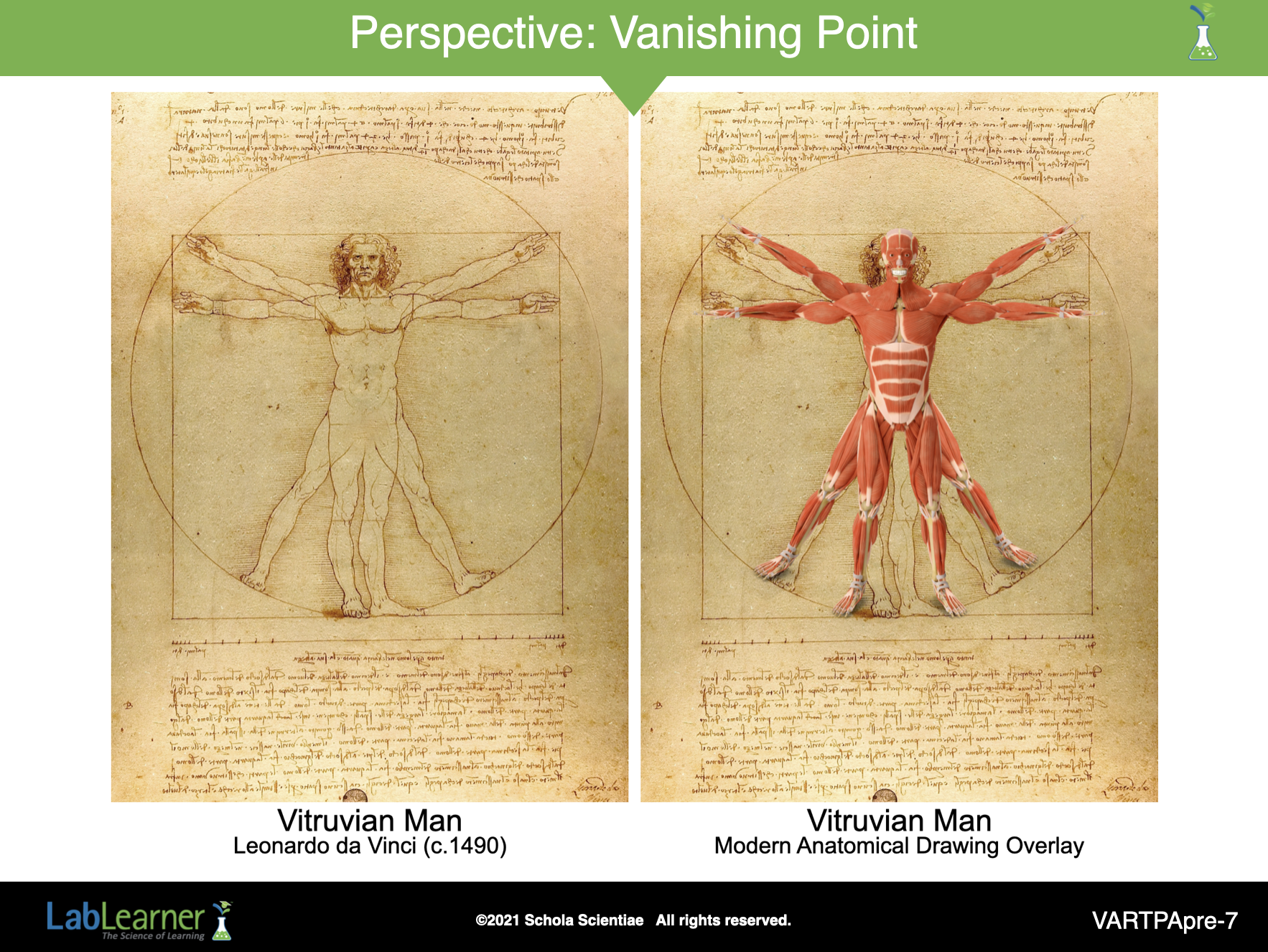
2. Leonardo da Vinci stressed the perfect bilateral symmetry of the human body in his famous Vitruvian Man sketch. This drawing was found among his many journals and depicts the beauty and art of science and, while at the same time, the science in art.
KEYS