
Teacher Portal:
Microscopic Explorations
Investigation 1
Microscopic Explorations: Investigation 1
Microscopy is defined as the science of observing substances and objects using a microscope. Central to microscopy is the use of lenses to refract light and produce magnified images. Refraction of light occurs when light passes from one transparent medium to another and in the process, changes the speed with which it travels. It is this change in the speed of light that produces bending of light waves and often a change in the appearance of objects viewed through the transparent media. For example, light travels close to 299,700,000 meters per second in the medium of air but slows to 225,400,000 meters per second in the medium of water. Therefore, as the light waves move from air to the water they bend or refract.
One of the factors that affect the extent to which light is refracted or bent is the difference in the speed of light between the two media. Larger differences in speed produce greater refraction. If the refraction is large enough, the refracted light can change the way in which objects appear. The changed appearance of an object is referred to as an image.
One 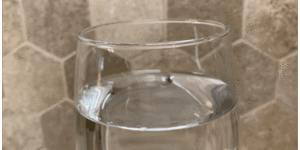 example often used to illustrate the difference between an object and its image is to imagine a penny located at the bottom of a swimming pool. If you were in a pool, looking at a penny on the bottom, the penny would be called the object. When you surfaced and looked at the penny through the air into the water, you would see the image of the penny. If you were to compare the two views of the penny you would indicate that they were different and that the penny viewed from on top of the pool was larger than the penny you saw when you were in the water. In fact, the penny does not change size. However, because light changes speed as it passes from water to air, it is refracted. The refraction causes the penny to appear larger when it is viewed from the surface because the light has changed speeds before it reaches your eyes and bends. This “larger penny” scientists refer to as the image of the penny.
 For centuries man has used refraction of light for everyday conveniences as well as scientific discoveries. Lenses, which are curved pieces of transparent substances such as glass or plastic, refract light. Some of the earliest lenses date back to Ancient Greece and the Roman Empire. In ancient Rome, it is thought that lenses were used to correct eyesight and by some emperors as they watched gladiatorial games. Around the first century, Arabian scientists wrote what may be considered the first scientific paper describing how the lens in the human eye focuses light on the retina. Today, we use lenses that refract light for eyeglasses, contact lenses, telescopes, hand lenses, and microscopes.
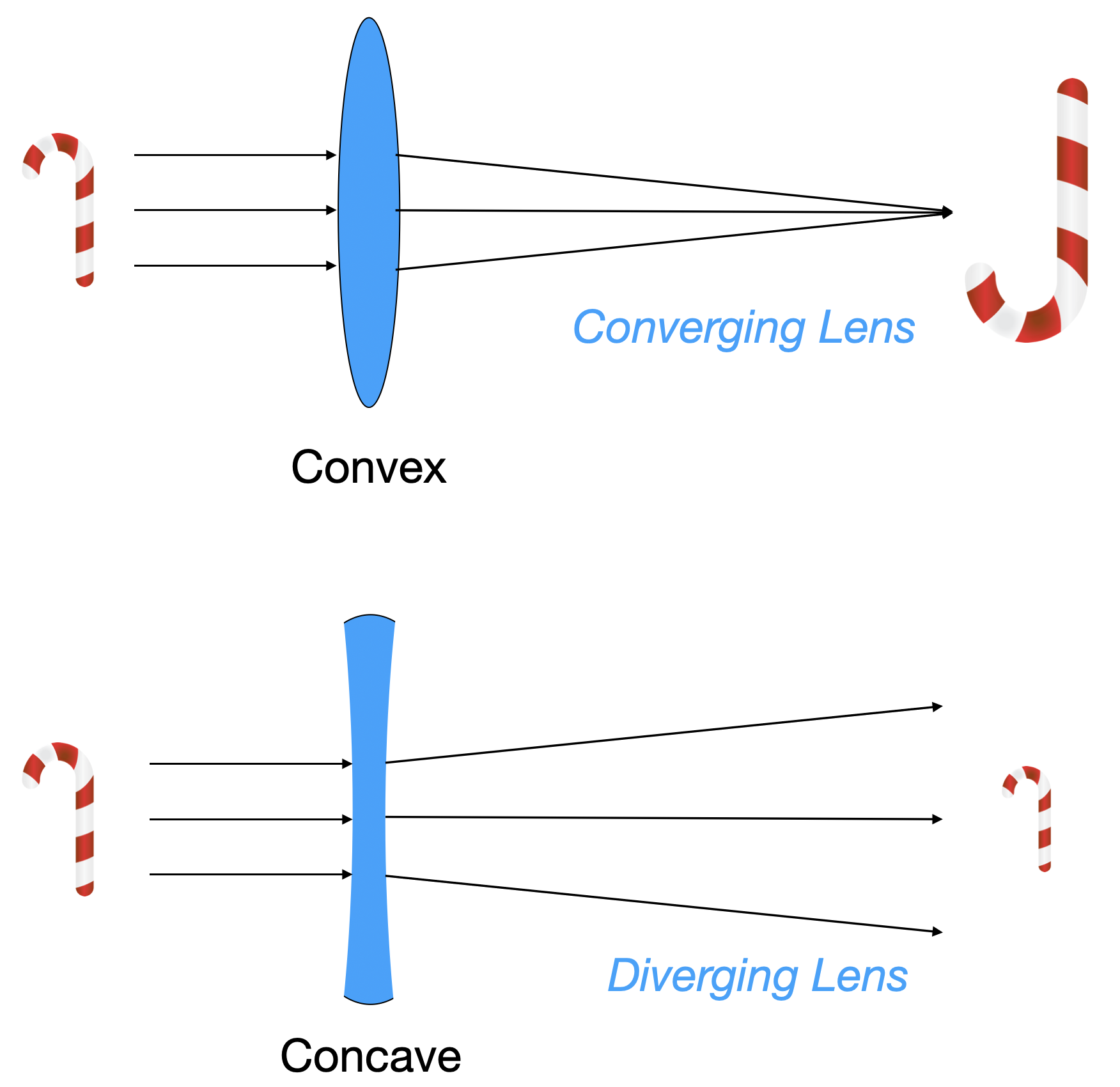
Lenses can be classified by their function and shape. In general, there are two basic shapes of lenses: convex and concave. The term convex describes a lens whose surface bulges outward. Concave describes a lens whose surface curves inward. The diagram below illustrates each type of lens.
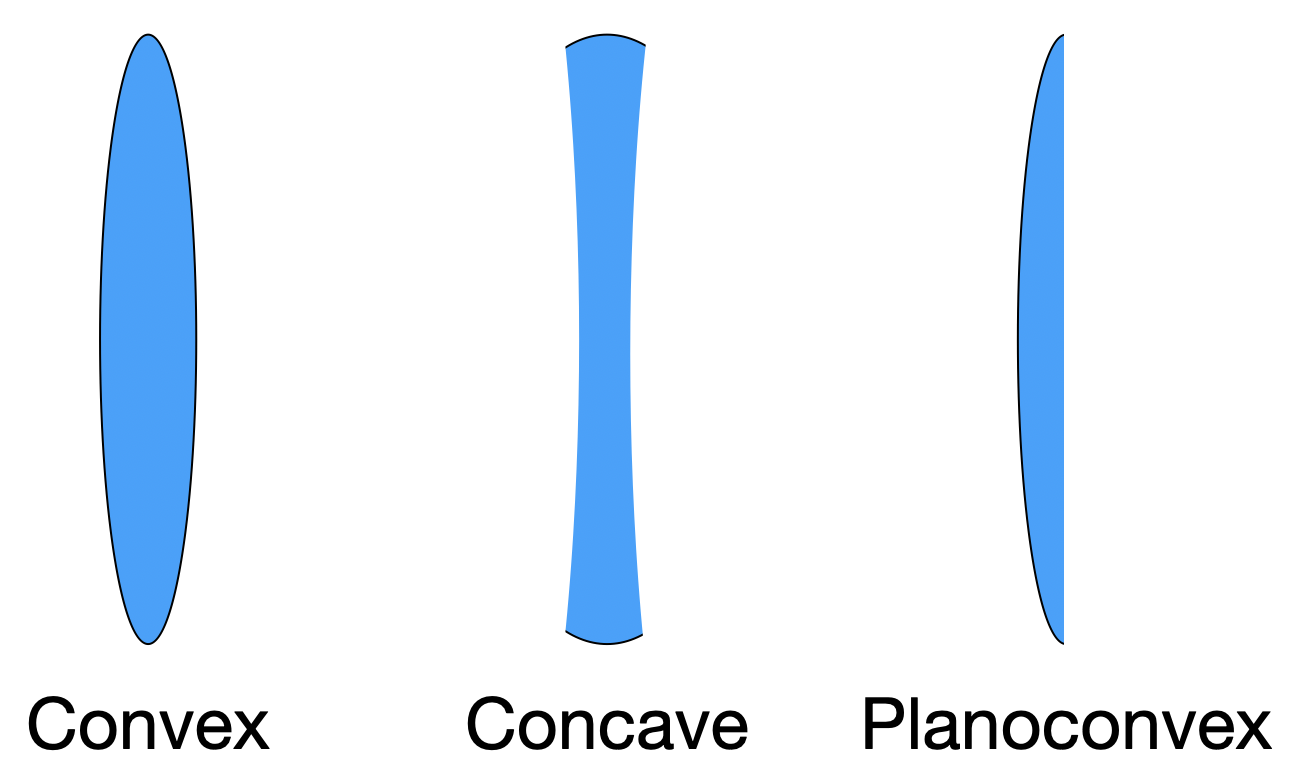
Lenses have two surfaces and are named for the direction of their surfaces. A lens whose two surfaces curve outward is referred to as a biconvex or double convex lens. A lens whose two surfaces curve inward is referred to as a biconcave or double-concave lens. If one surface of a lens is straight, the term Plano is used in its name.
Although the use of the “bi” prefix is preferable when working with different types of lenses, the biconvex and biconcave lenses are often simply referred to as convex and concave lenses when first introduced to students. Such is the case in this CELL.
In addition to their shape, lenses are often described according to their function or effect on parallel rays of light. Planoconvex and biconvex lenses are also referred to as converging lenses because as parallel rays of light pass through these lenses they are refracted in such a way as to converge or come together to a central point. Planoconcave or biconcave lenses on the other hand are referred to as diverging lenses because as parallel rays of light pass through these lenses, they are refracted in such a way as to diverge or spread apart.
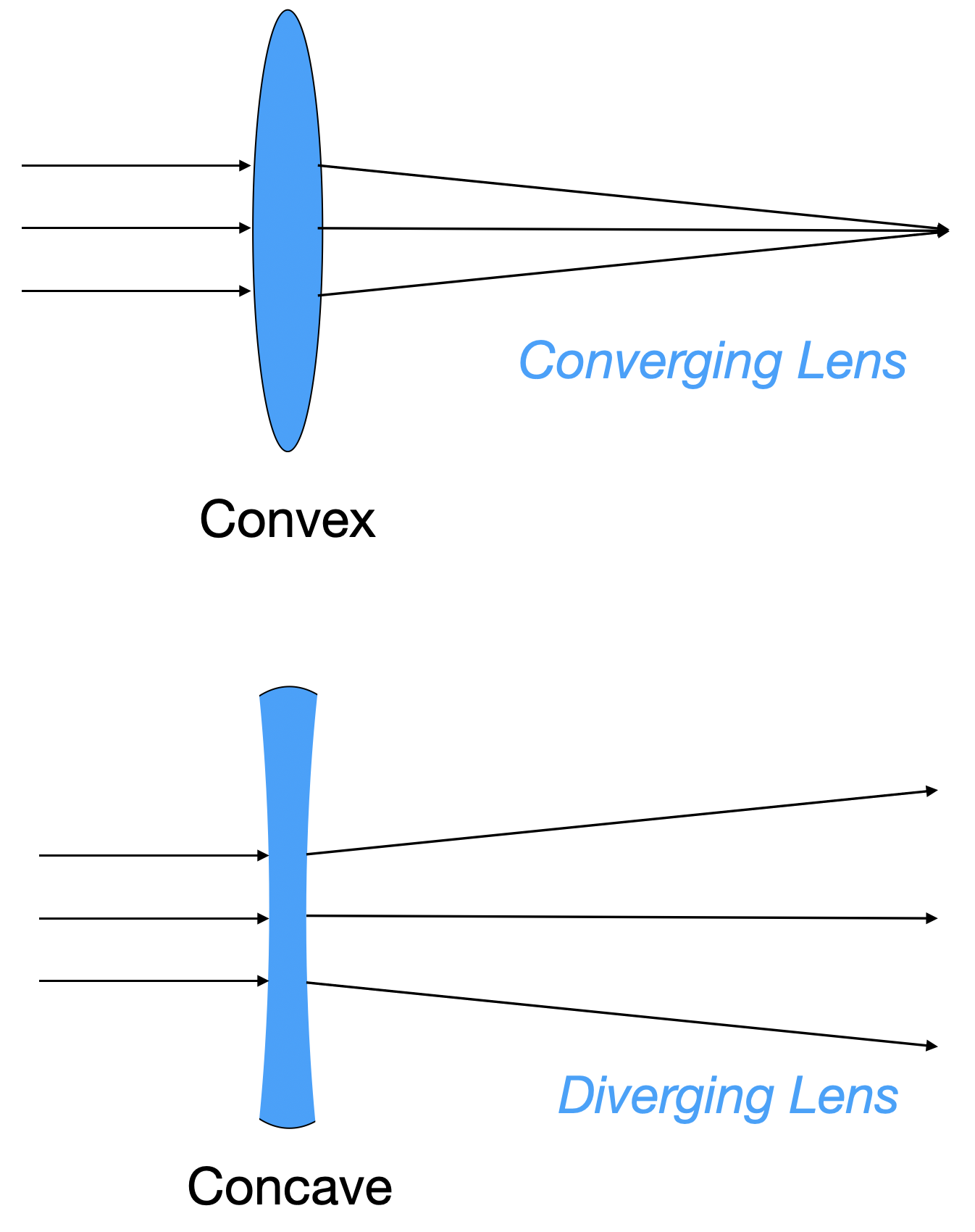
The way in which lenses and other transparent media refract light affects the image that is produced. The effect of the refraction of light by a double convex lens can be an image that is magnified as compared to the size of the object or that is inverted and reduced in size as compared to the object. Refraction of light by a double concave lens produces an image that has the same orientation as the object but is reduced in size.
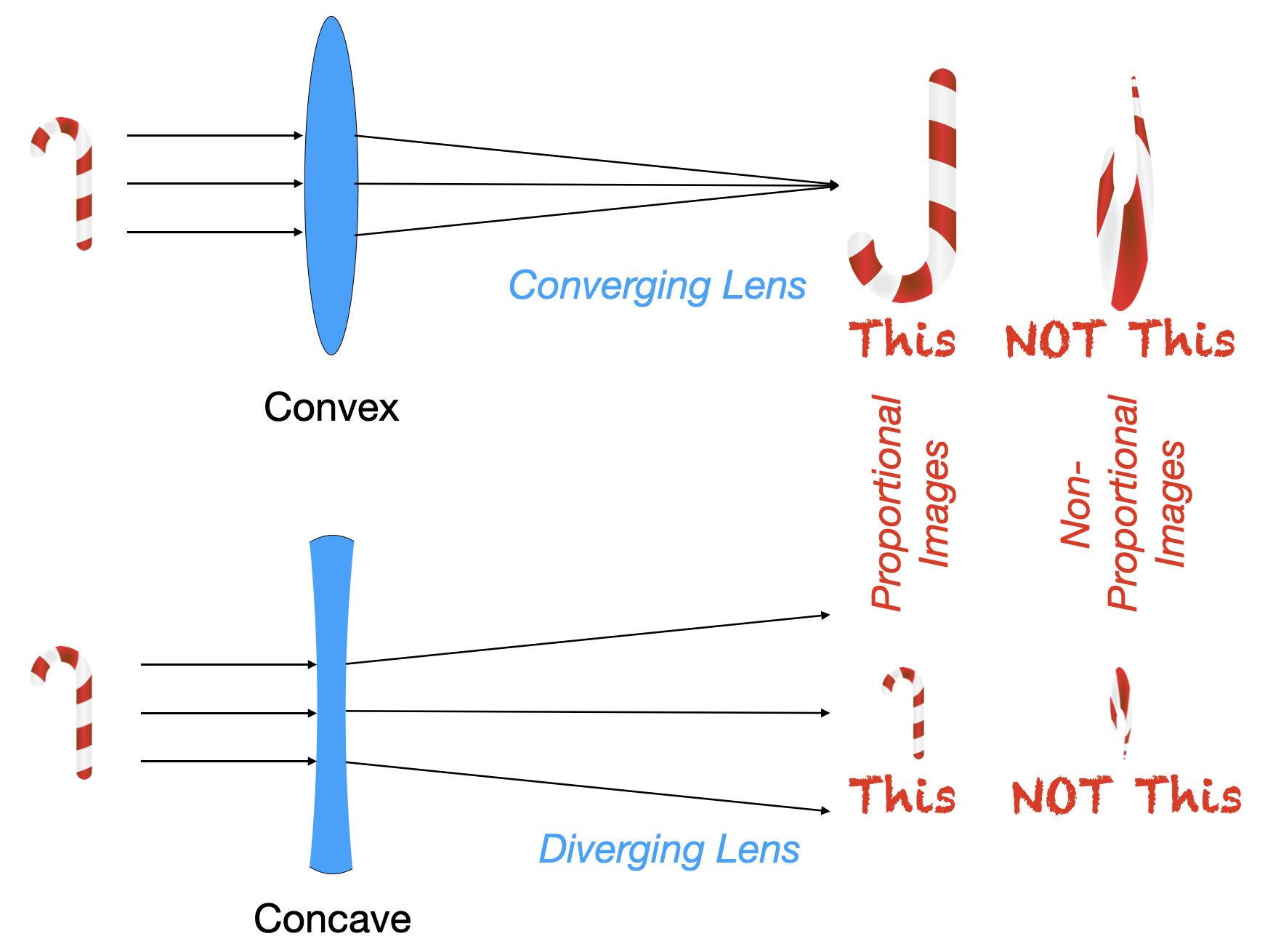
However, one important feature of double convex and double concave lenses is that the proportions of the images produced by the lenses are the same as those of the object. In other words, although the image may appear larger or smaller than the object, its proportions are the same. Thus the lenses used in microscopes, telescopes, cameras, eyeglasses, and contact lenses allow us to view objects as either larger or smaller images without additional distortion of the object. If lenses distorted the proportions of an object, they would not be of much use in any of these inventions.
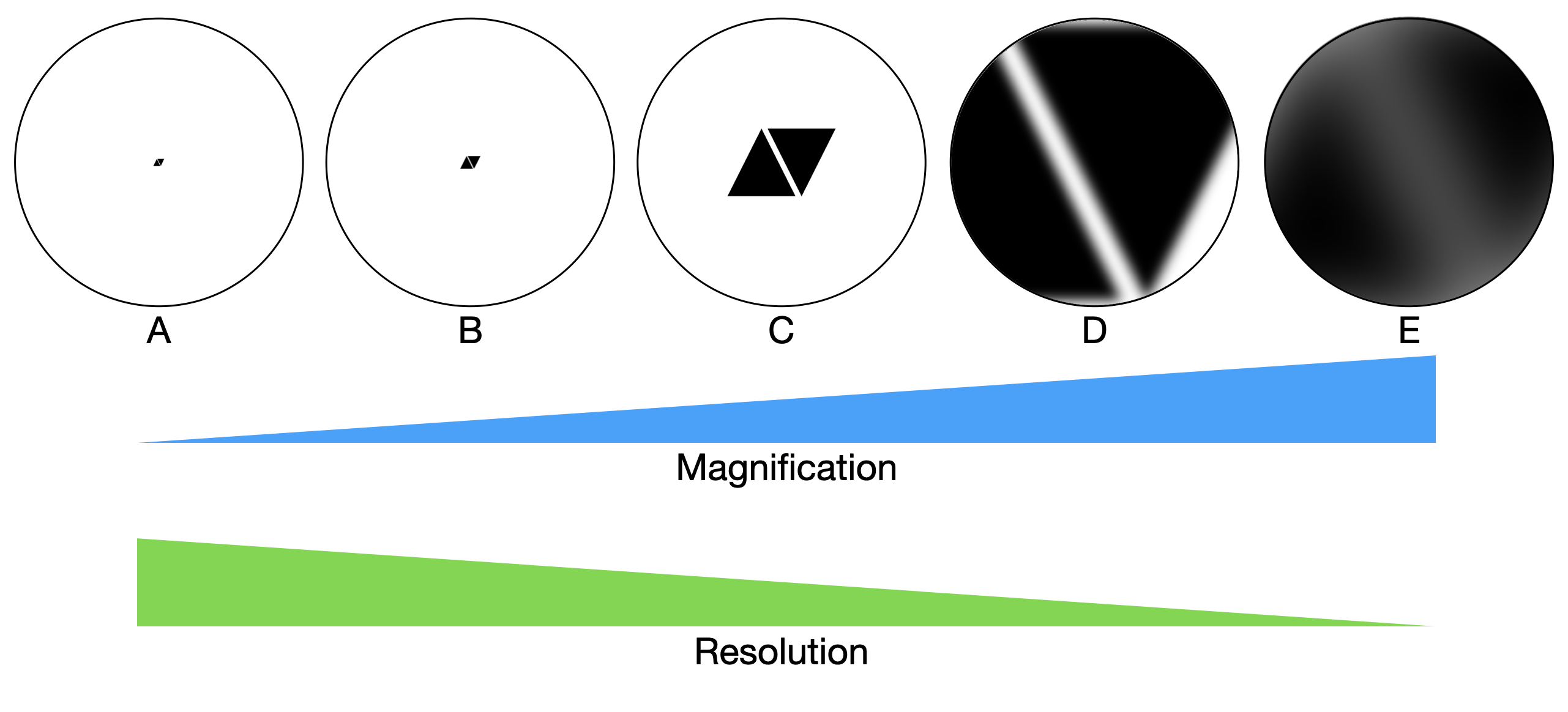
When lenses are used, a change in resolution accompanies the change in size between an object and its image. Within the field of optics, resolution is a term used to describe the ability to discern the small details of an object. Increases in resolution allow the viewer to see the small details of an object more clearly in its image than in the object itself. For example, the fine details of a diamond are more easily discerned if the diamond is viewed with a convex lens (magnifying glass) than with the unassisted eye. Decreases in resolution produce an image in which less detail is visible in the image than when viewing the object.
In this CELL, students will delve into the field of microscopy, investigating non-organic and organic specimens such as paper, thread, and plant and animal cells with the microscope. As a precursor to  understanding how the microscope works and its uses and limitations, you will study the effect of the refraction of light by lenses in the first two Investigations of this CELL. Through your experiments in Investigation One, you will observe differences and similarities in the refraction of light by double convex and double concave lenses, including changes in the resolution of images and the maintenance of an object’s proportions in its image. In addition, you will compare and contrast the images produced by the double convex and double concave lenses to the lenses contained within a compound microscope.
Microscopic Explorations: Investigation 1 - Mathematics Concepts
Prelab
• comparing (non)measurable characteristics
• (in)direct relationships
Lab
• diameter in mm
• comparing (non)measurable characteristics
• data table
• height/width in mm
Postlab
• data analysis
• ratio
• geometry
• comparing (non)measurable characteristics
• greater than/less than/equal to
• drawing to scale
• calculating magnification
• multiplication/division
• problem solving
Microscopic Explorations: Investigation 1 - Procedural Tools

Microscopic Explorations: Investigation 1 - Cognitive Tools

Microscopic Explorations:
Investigation 1 Quiz

