
Teacher Portal:
Eukaryotes Journey
Day 2: Multicellular and Unicellular Organisms
 PRINT IT
Use your browser to download a printable PDF as help during the slide presentation and to make additional notes. In your browser, go to File > Print and then choose to save as PDF.
NAVIGATE IT
Once the slide presentation is launched
- use your left and right arrows to advance or go back in the slide presentation, and
- hover your mouse over the left edge of the presentation to get a view of the thumbnails for all the slides so that you can quickly move anywhere in the presentation.
- Click HERE to launch the slide presentation for the CELL.
SHARE IT
SLIDE 2VEUK-1
______________________________________________
SLIDE 2VEUK-2
Answers:
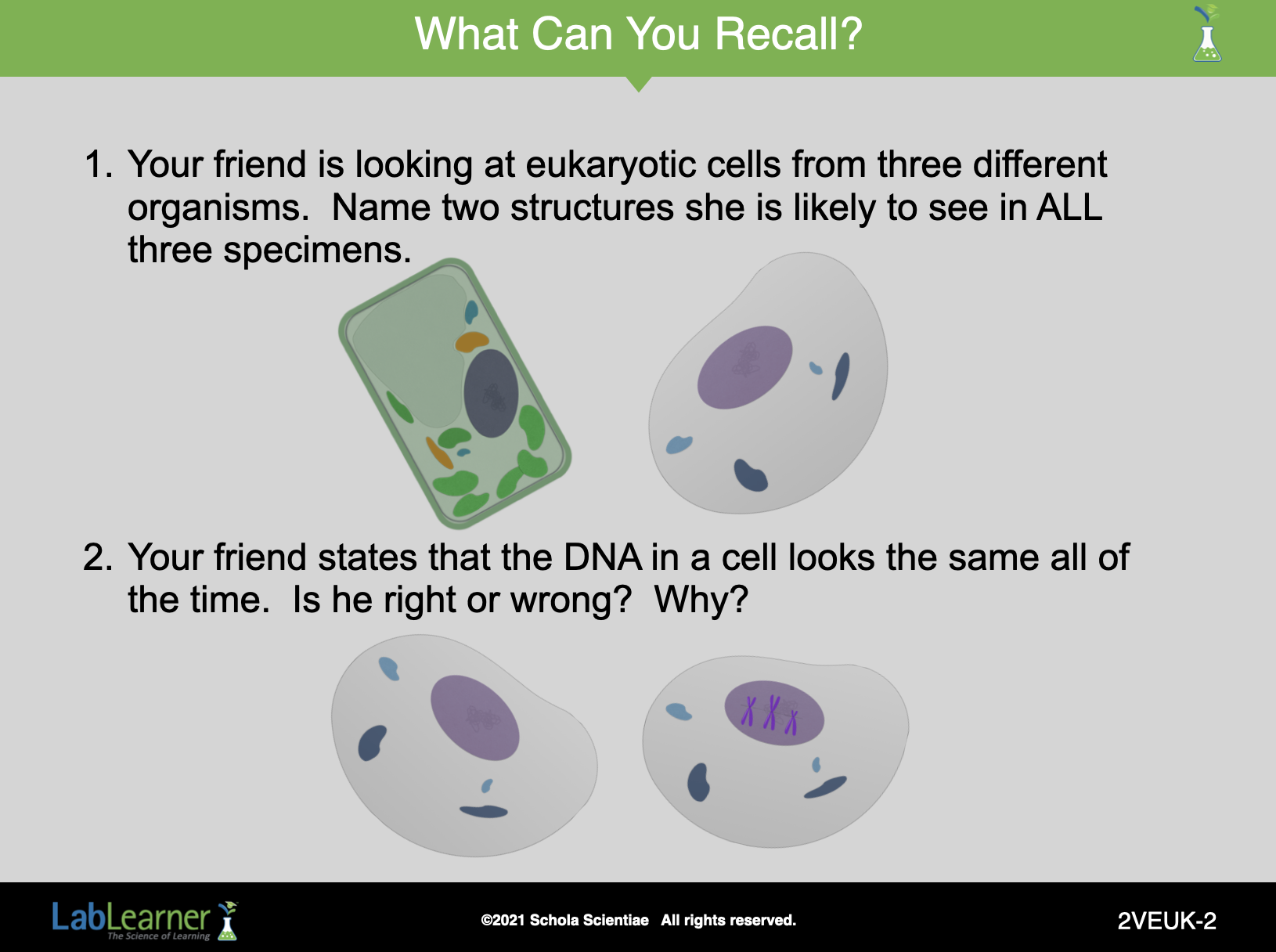
1. Your friend is looking at eukaryotic cells from three different organisms. Name two structures she is likely to see in ALL three specimens.
Students should indicate that all three specimens will most likely have a cell membrane and cytoplasm. These two structures are found in all eukaryotic cells. Some students may also give examples of a nucleus, DNA, endoplasmic reticulum, mitochondria, lysosomes and peroxisomes.
2. Your friend states that the DNA in a cell looks the same all of the time. Is he right or wrong? Why?
Students should indicate that the friend is incorrect. DNA appears differently when the cell is actively dividing as opposed to when it is not actively dividing. During cell division, DNA is organized into structures called chromosomes which appear in the shape of an “X.” At times other than cell division, DNA is usually appears similar to a mass of tangled thread.
______________________________________________
SLIDE 2VEUK-3
In the first section of the Journey, students spent time understanding three structures that are characteristics of almost all eukaryotic cells. In this section of the Journey, students will explore some structures that differ between eukaryotic cells and between unicellular and multicellular organisms.
- Students begin this section by learning about some examples of unicellular eukaryotes. They should remember that eukaryotic cells are found in both unicellular organisms and multicellular organisms.
- Unicellular organisms are those that consist of a single cell.
- There are two types of unicellular eukaryotes. Those that are protists and those that are fungi. This slide begins by focusing on protists.
- Explain that just like scientists use the terms plant and animal to classify or group organisms that share certain similarities, they use the term protists to describe another group of organisms that are neither plants or animals.
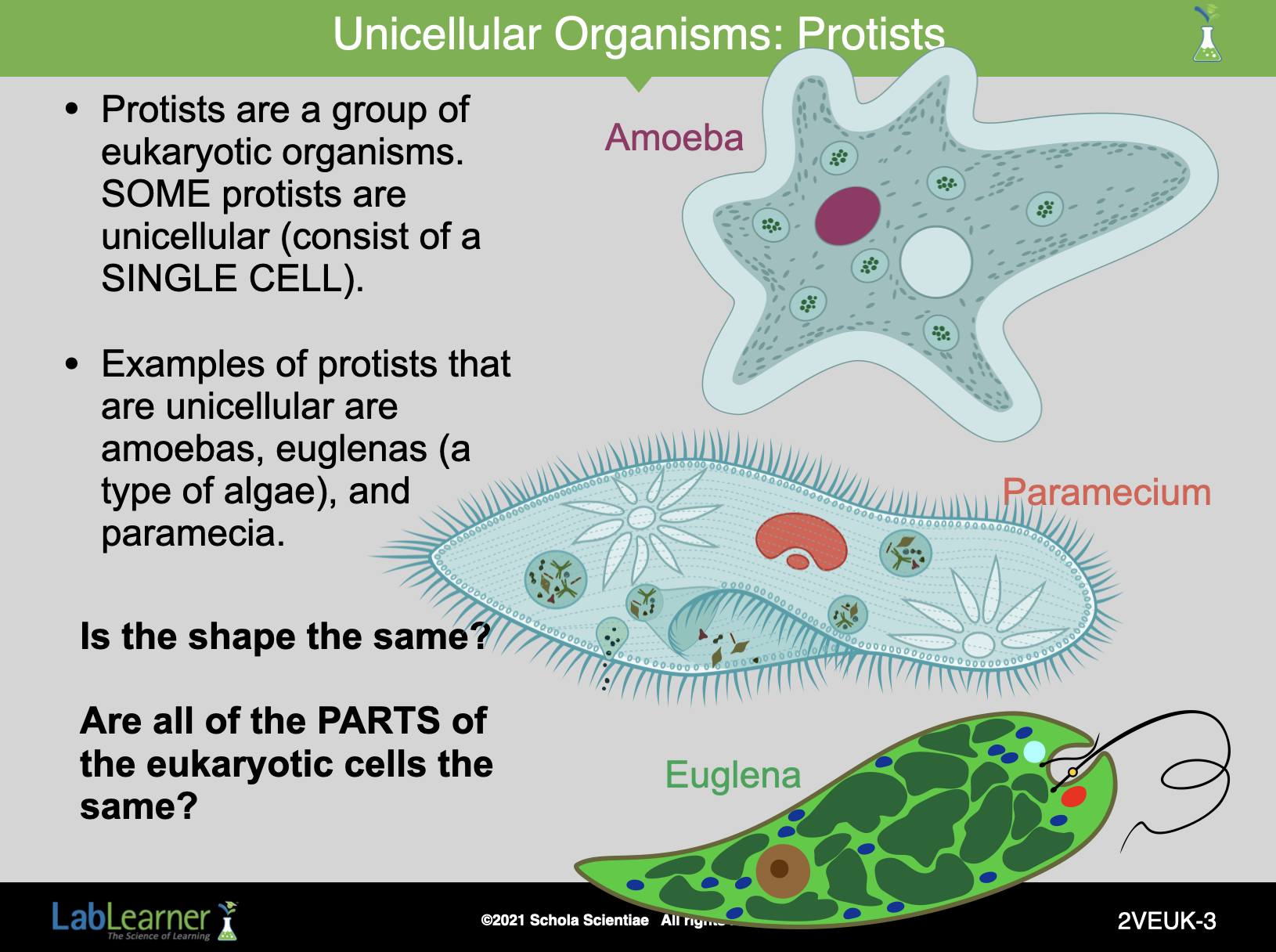
- Some protists are unicellular. Some are multicellular. The information in the slide above focuses on three examples of unicellular protists. As students view the images of the amoeba, euglena, and paramecium, they should remember that each of these would have a cell membrane, cytoplasm, and nucleus. These are common characteristics of eukaryotic cells. However, students should also focus on how these unicellular eukaryotes are different.
- Ask students the two questions on the slide. Allow time for discussion. Students should point to the differences in shape between the three as well as some of the structures that differ. These differences will be explored in the three slides that follow.
______________________________________________
SLIDE 2VEUK-4
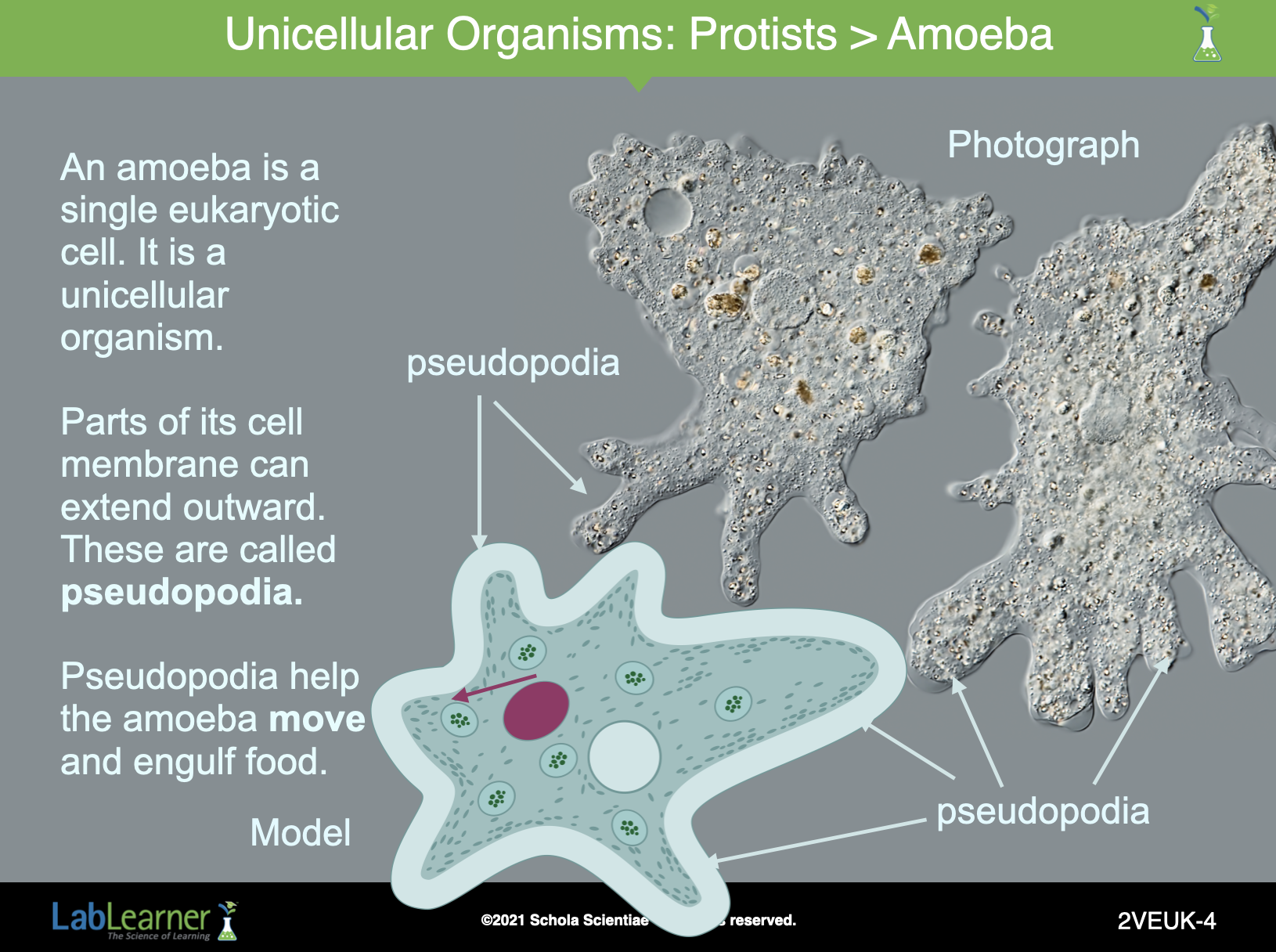
- One of the ways in which an amoeba (pronounced “uh me ba”) differs from the cheek or onion cell or the euglena or paramecium is its distinctive shape.
- This results from the extension of parts of its cell membrane into structures call pseudopodia (pronounced “su do po de ah”). Pseudopodia in latin means “false feet”.
- These extensions of the cell were named pseudopodia because they resembled feet or legs and they function to help the amoeba move.
- In addition to locomotion, pseudopodia also help the amoeba engulf its food, a process by which the cell membrane wraps around food and pulls the food into the inside of the cell.
______________________________________________
SLIDE 2VEUK-5
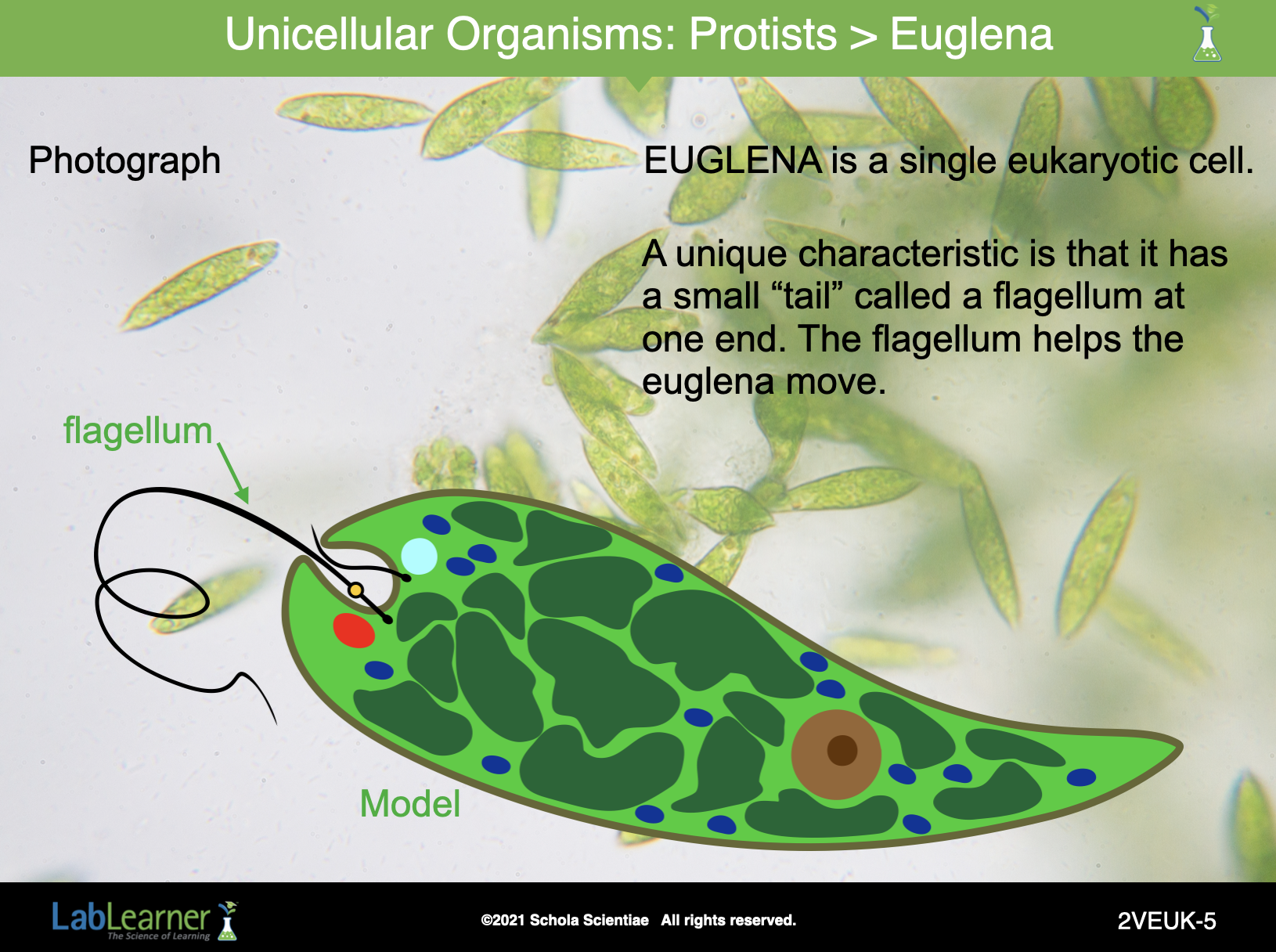
- The euglena is an example of a protist that has another unique structure, a flagellum (plural- flagella).
- In terms of function, the flagellum acts like a tail or rotor. It moves in a whip like or undulating fashion. As it moves, it propels the euglena through fluid.
- Flagella are not only found on euglena. They are found on many different types of cells.
______________________________________________
SLIDE 2VEUK-6
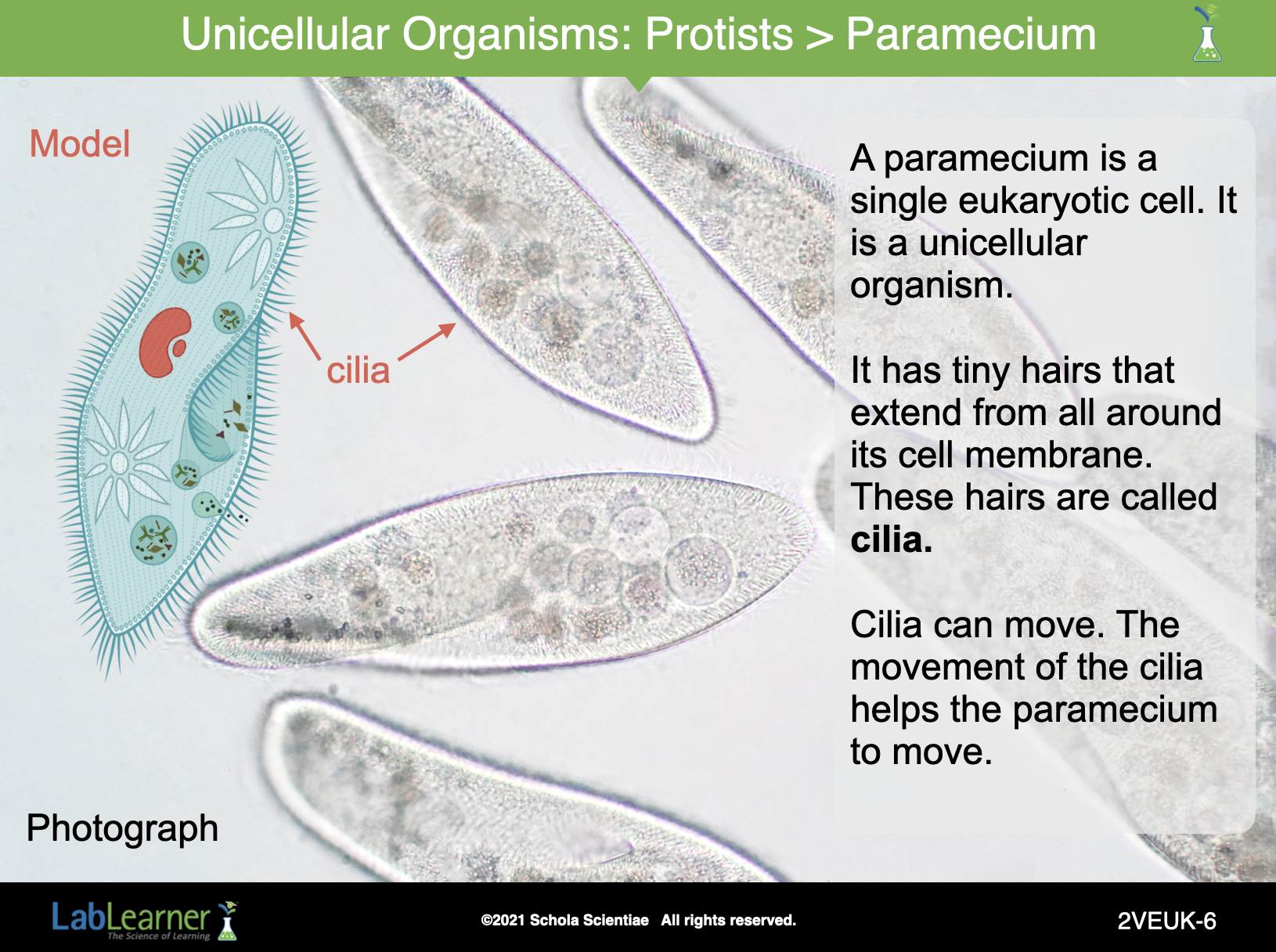
- The paramecium can also move. It does so through the use of cilia. Cilia are structurally similar to flagella. One of the only differences is in their length. Cilia are shorter than flagella. They move the cell through the fluid-like oars on a boat.
- Paramecium is not the only eukaryotic cell on which cilia are found. For example, within the human body, cilia are found on the cells that line the respiratory tract and catch dust and other particles within that air that may harm the lungs.
______________________________________________
SLIDE 2VEUK-7
- Students just explored three examples of unicellular eukaryotic protists. In addition to protists, there is another group of organisms that contains unicellular eukaryotes: fungi. As with protists, it is not expected that students will have extensive background knowledge about fungi.
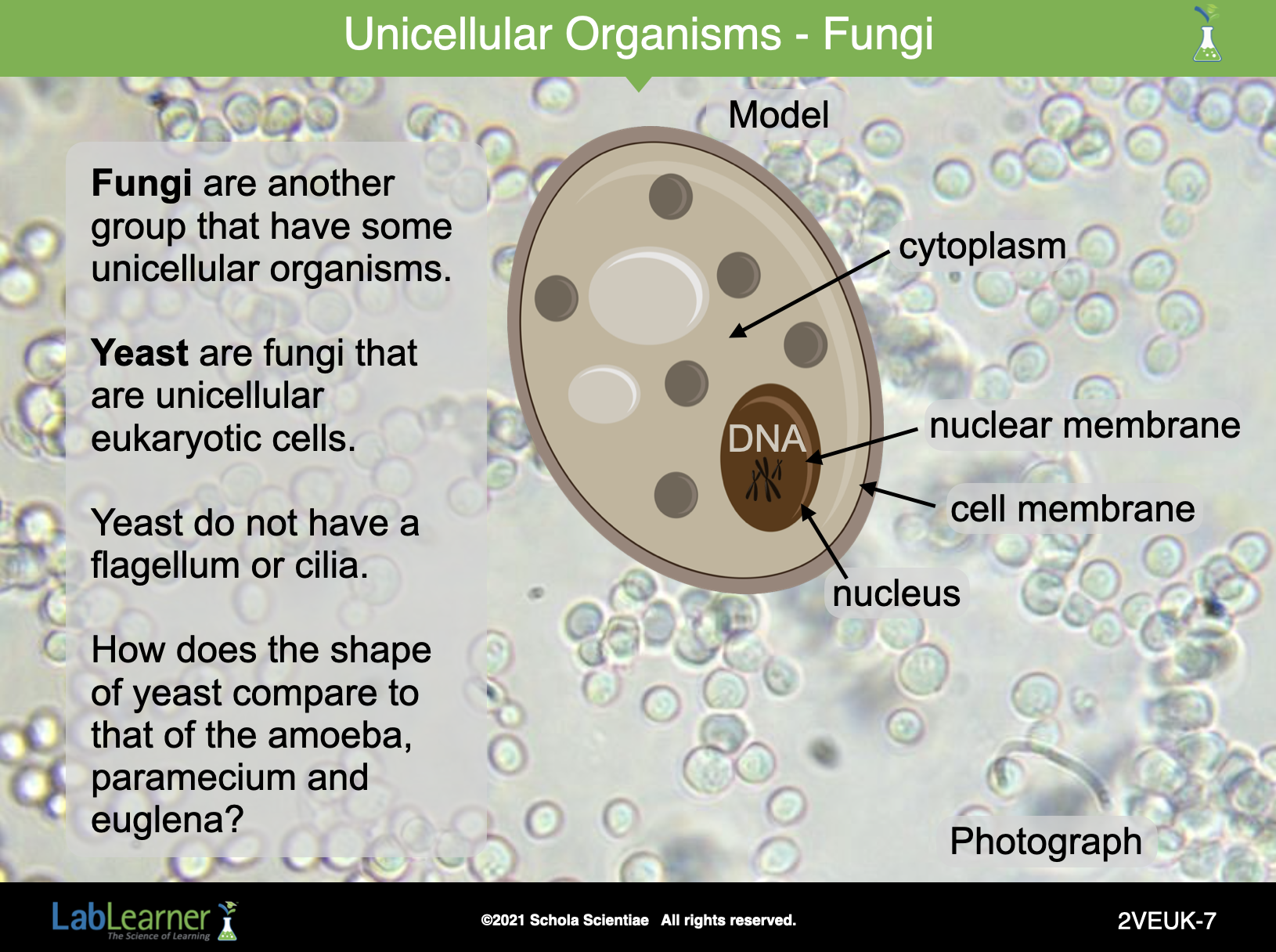
- Just like plants and animals, fungi is the name given to the category of organisms that share certain characteristics. Some fungi are multicellular, some are unicellular. This slide gives an example of a unicellular fungi – yeast. Yeast is used widely throughout the culinary world for baking bread and making beer.
- As students view the image, they should see that yeast does not have flagella or cilia. In addition, they should compare its shape to that of the other unicellular organisms they just explored.
- The goal of this slide and the three that preceded it are to emphasize some of the differences that exist in eukaryotic cells and to show students examples of unicellular eukaryotes.
______________________________________________
SLIDE 2VEUK-8
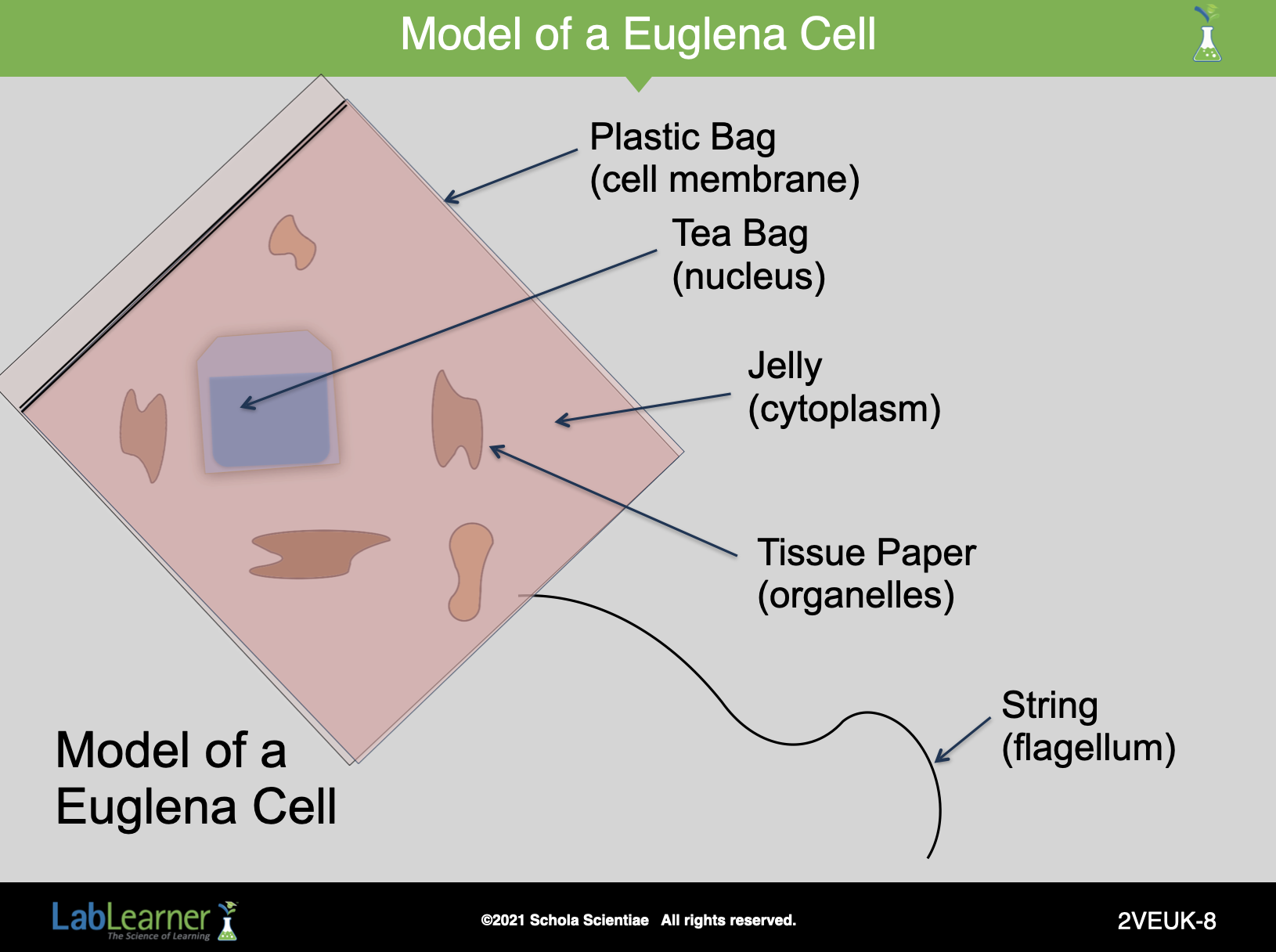
As students view the model of a euglena, they should note the addition of the flagellum. The flagellum is represented in this model by a piece of string attached to one side of the plastic bag. Students should observe that the flagellum would have some flexibility to undulating or rotational motion.
______________________________________________
SLIDE 2VEUK-9
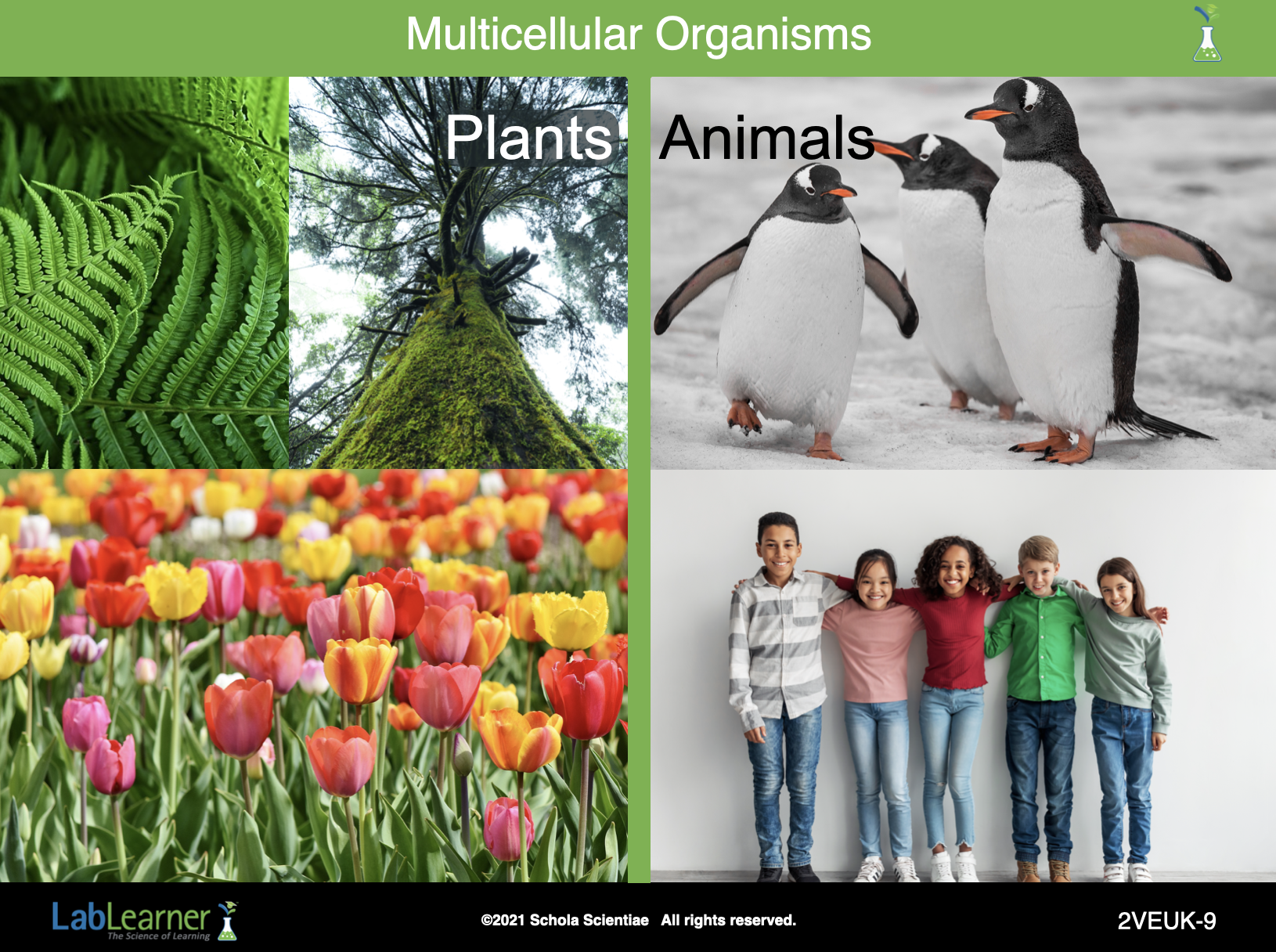
- All multicellular organisms consist of eukaryotic cells. Multicellular organisms are those made up of many eukaryotic cells.
- Just as there are different types of unicellular organisms, there are different groups or categories of multicellular organisms.
- This slide reviews two categories of multicellular organisms: plants and animals. All plants and animals consist of eukaryotic cells.
______________________________________________
SLIDE 2VEUK-10
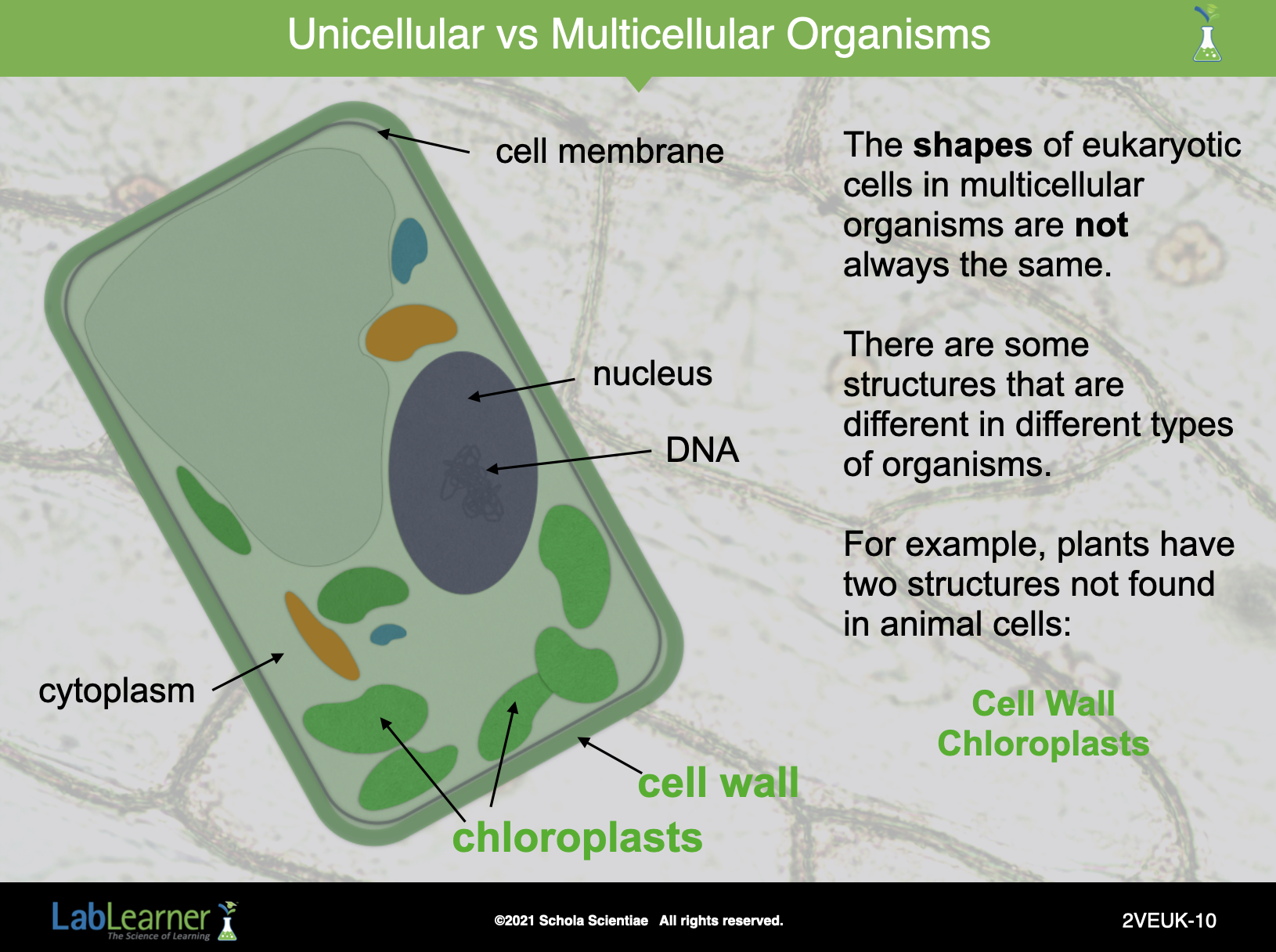
Students should conclude from this slide that the shape and some of the structures of eukaryotic cells in multicellular organisms can differ.
As students view this slide, they should observe that the characteristics structures of a cell membrane, nucleus, and cytoplasm are found in this plant cell. However, as illustrated by the green shading, there are at least two structures, the cell wall and chloroplasts that are found in eukaryotic plant cells but not in eukaryotic animal cells.
It should be mentioned that this slide does not highlight all of the differences between eukaryotic plant and animal cells. However, this example should help students understand that while there are common characteristic structures that are found in almost all eukaryotic cells, there are some structures that can differ between eukaryotic cells.
______________________________________________
SLIDE 2VEUK-11
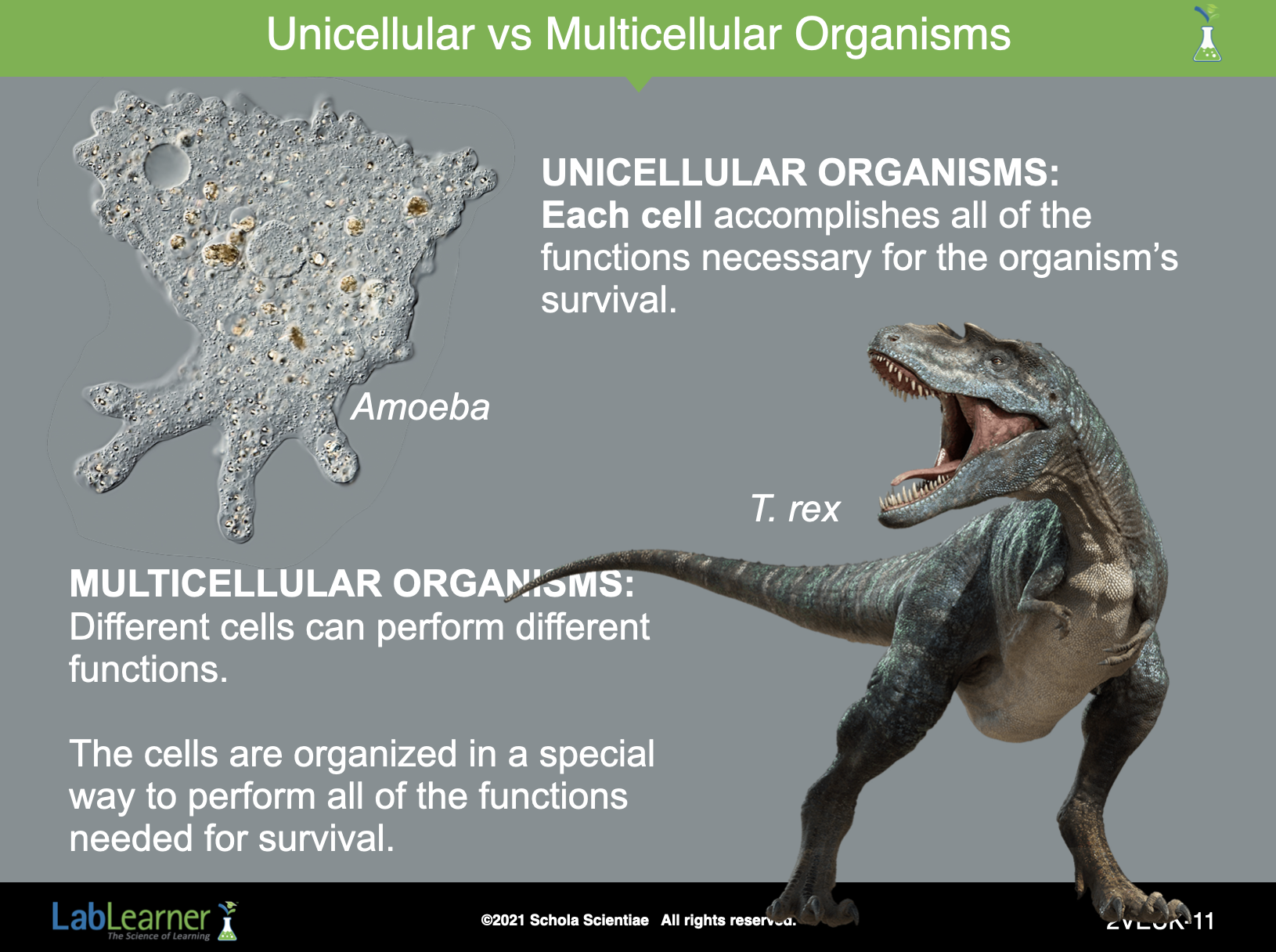
Having discussed and observed eukaryotic cells from both unicellular and multicellular organisms, students may wonder how these cells function and whether there is a difference in function between cells of unicellular and multicellular organisms.
One of the ways in which unicellular and multicellular organisms differ is in the functions carried out by individual eukaryotic cells. In unicellular organisms, each cell accomplishes all of the functions necessary for the organism’s (the cell’s) survival. This includes locomotion, if necessary, nourishment, gas exchange, respiration, etc.
Such is not the case for most cells within a multicellular organism. In general, there are different cells within a multicellular organism that perform different functions.
For example, in a dinosaur (extinct now but similar to living reptiles), lung cells are responsible for the exchange of carbon dioxide and oxygen within the lung. Muscle cells are responsible for the contraction of muscles and thus for locomotion. The organism survives because the different cells are organized such that when they all work together, all functions necessary for life are coordinated and completed.
______________________________________________
SLIDE 2VEUK-12
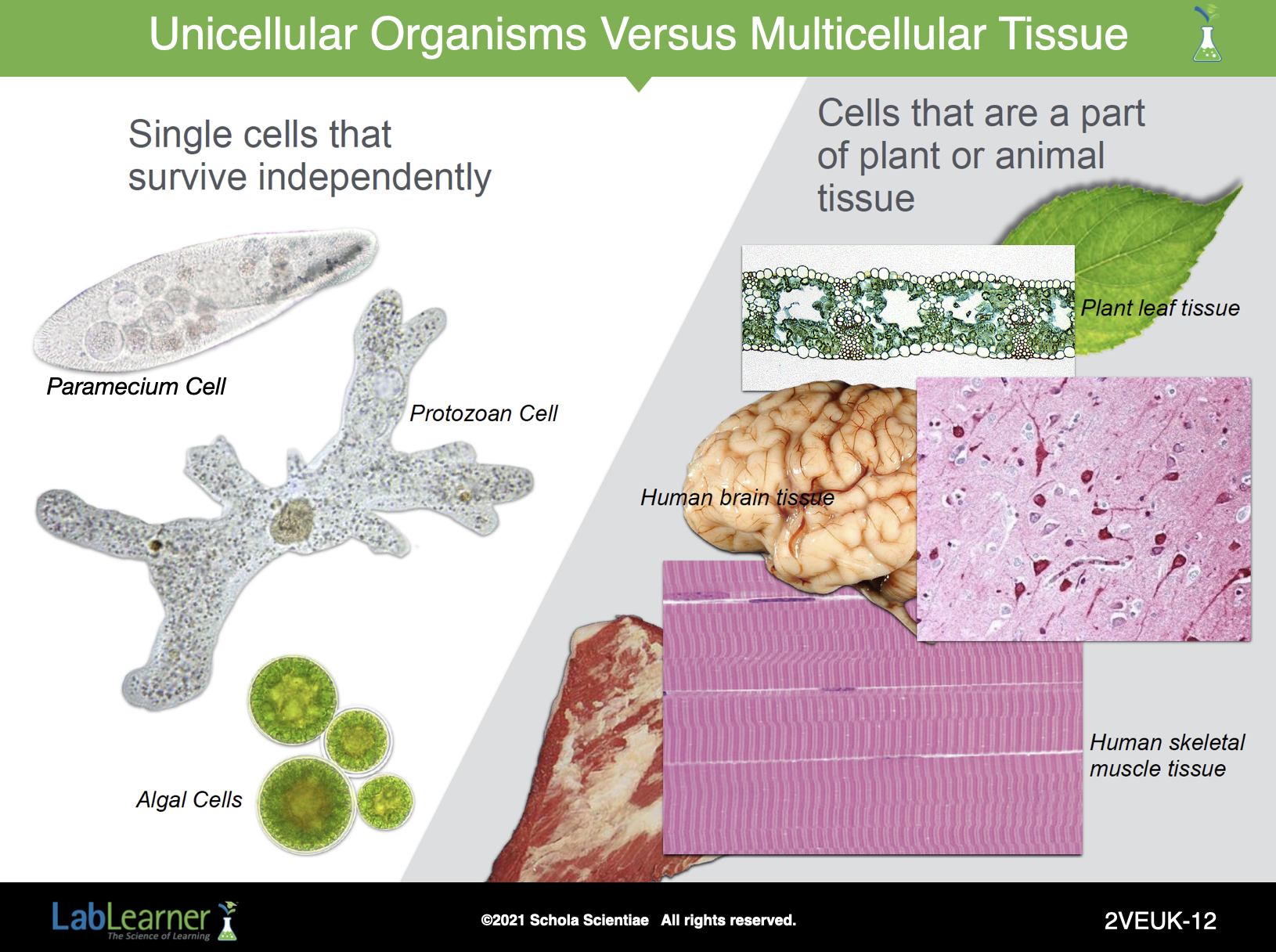
In multicellular organisms like plants and animals, individual cells are associate with each other to form tissue. Tissue is basically a collection of cells that together perform a specific function to help a multicellular organism survive.
On the right side of this slide we see from top to bottom:
Plant leaf tissue
Human brain tissue
Human muscle tissue
Each of these tissues is represented by a “gross” (simply meaning “large”) anatomy photograph and a microscope image of the tissue.
The left side of this slide depicts three unicellular eukaryotes, a paramecium cell, amoeba cell, and algal cells. Each of these individual cells are capable of doing everything required to survive, grow, and reproduce. In fact, these types of unicellular organisms, along with bacteria (which are not eukaryotes) are among the oldest forms of life on Earth.
______________________________________________
SLIDE 2VEUK-13
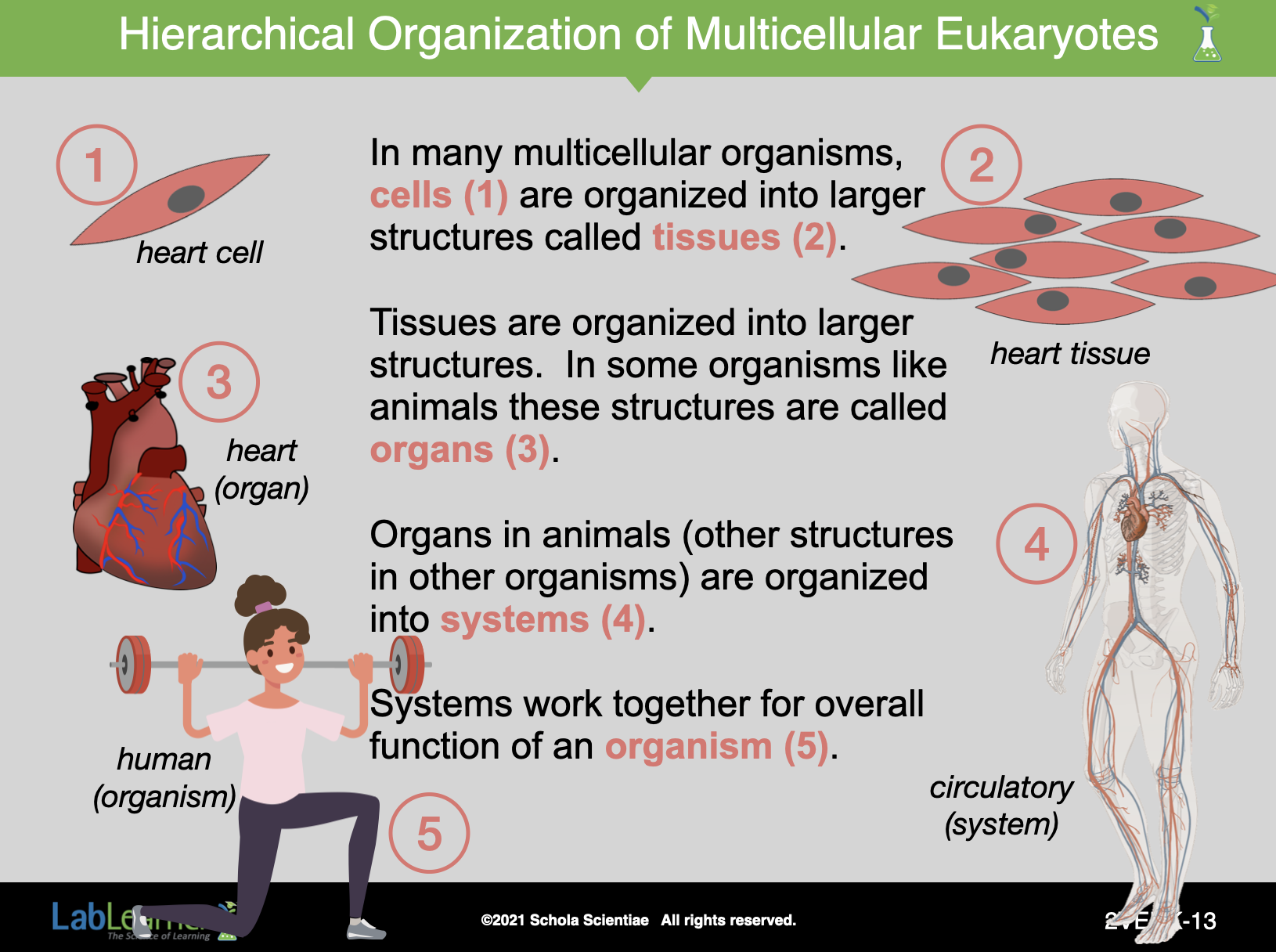
This Journey ends with a discussion of how cells are organized within most multicellular organisms. This type of organization is described as hierarchical because each level of organization depends upon and builds upon the one below it. The example shown here is given in the context of a human, a type of multicellular animal.
Most plants and animals follow the hierarchy described on this slide: an organization of cells to tissues, tissues to organs, organs to systems, and systems to full organisms. This concept should be familiar to students as they should have discussed and investigated it during the Microscopic Explorations CELL.
______________________________________________
SLIDE 2VEUK-14
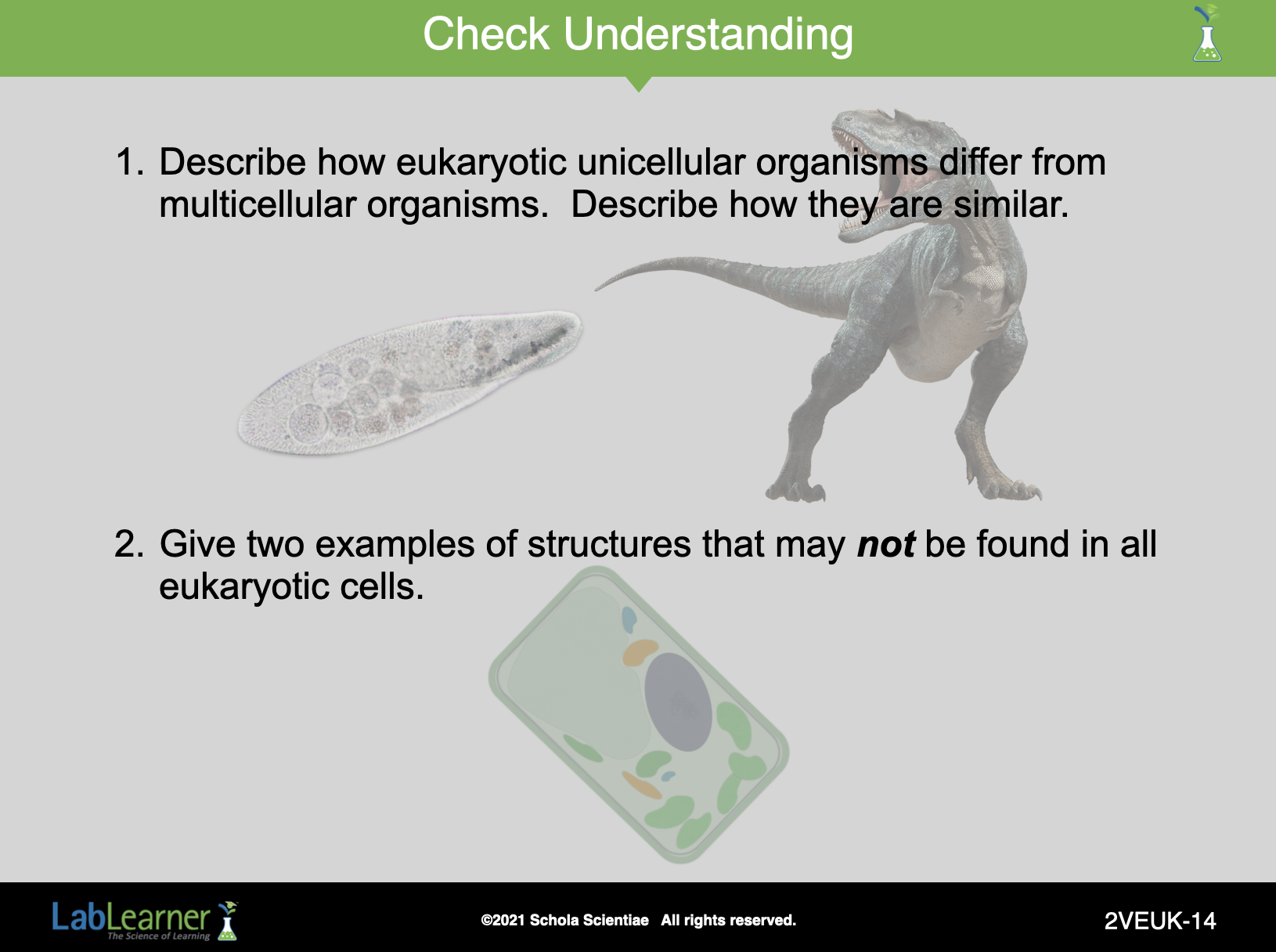
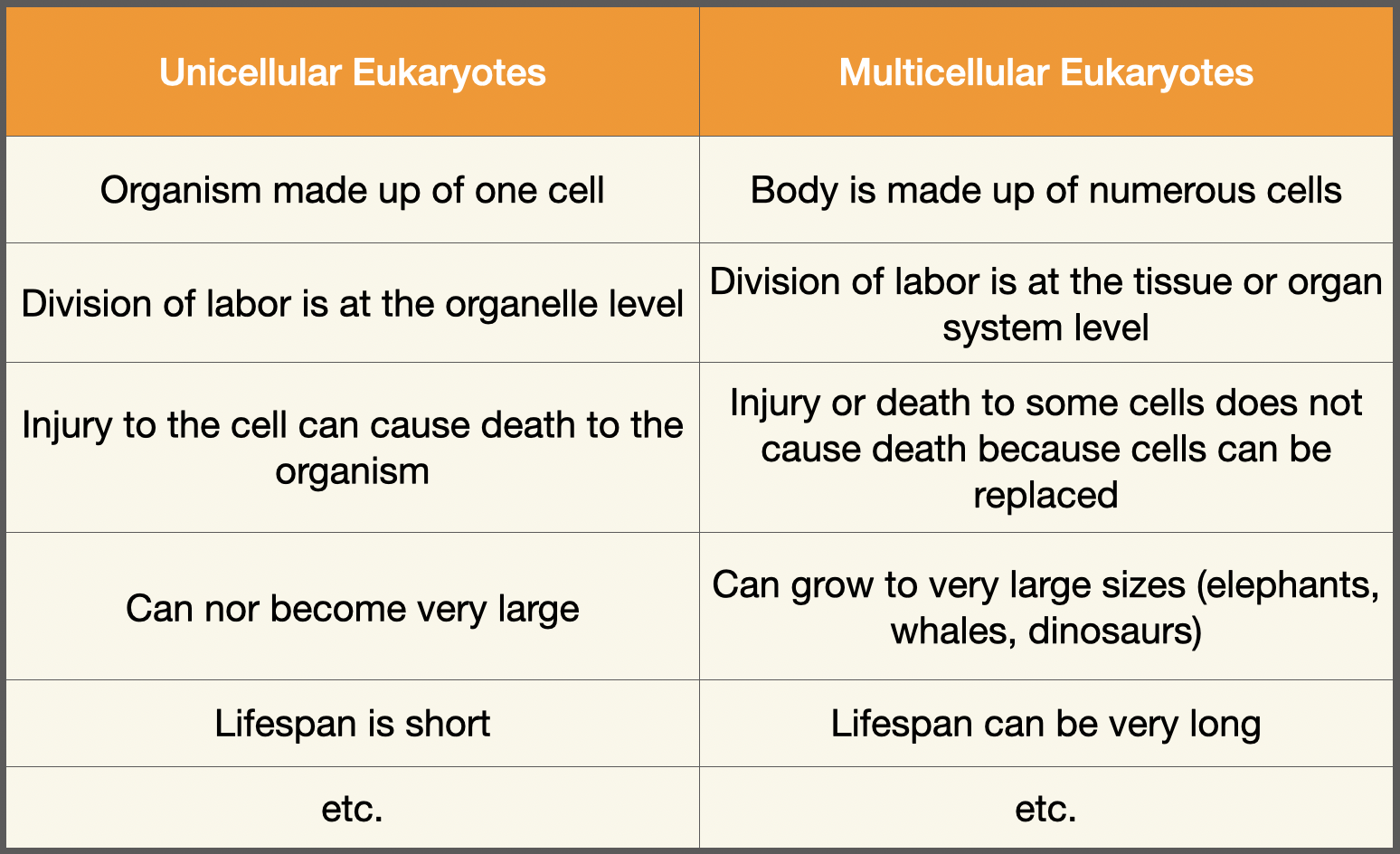
Question 1: Describe how eukaryotic unicellular organisms differ from multicellular organisms. Describe how they are similar. Student answers may vary. See the Table below for just some of the differences.
Differences Between Unicellular and Multicellular Organisms
Question 2: Give two examples of structures that may not be found in all eukaryotic cells. Student answers may.
-
- Chloroplasts are only found in plants and algae, not animals
- Flagella and cilia a found on some cells but not others
- Cell walls are not found in animal cells, whereas they are found on plant and other cells
etc.