
Teacher Portal:
Eukaryotes Journey
Day 1: Understanding Eukaryotic Cell
 PRINT IT
Use your browser to download a printable PDF as help during the slide presentation and to make additional notes. In your browser, go to File > Print and then choose to save as PDF.
NAVIGATE IT
Once the slide presentation is launched
- use your left and right arrows to advance or go back in the slide presentation, and
- hover your mouse over the left edge of the presentation to get a view of the thumbnails for all the slides so that you can quickly move anywhere in the presentation.
- Click HERE to launch the slide presentation for the CELL.
SHARE IT
SLIDE 1VEUK-1
______________________________________________
SLIDE 1VEUK-2
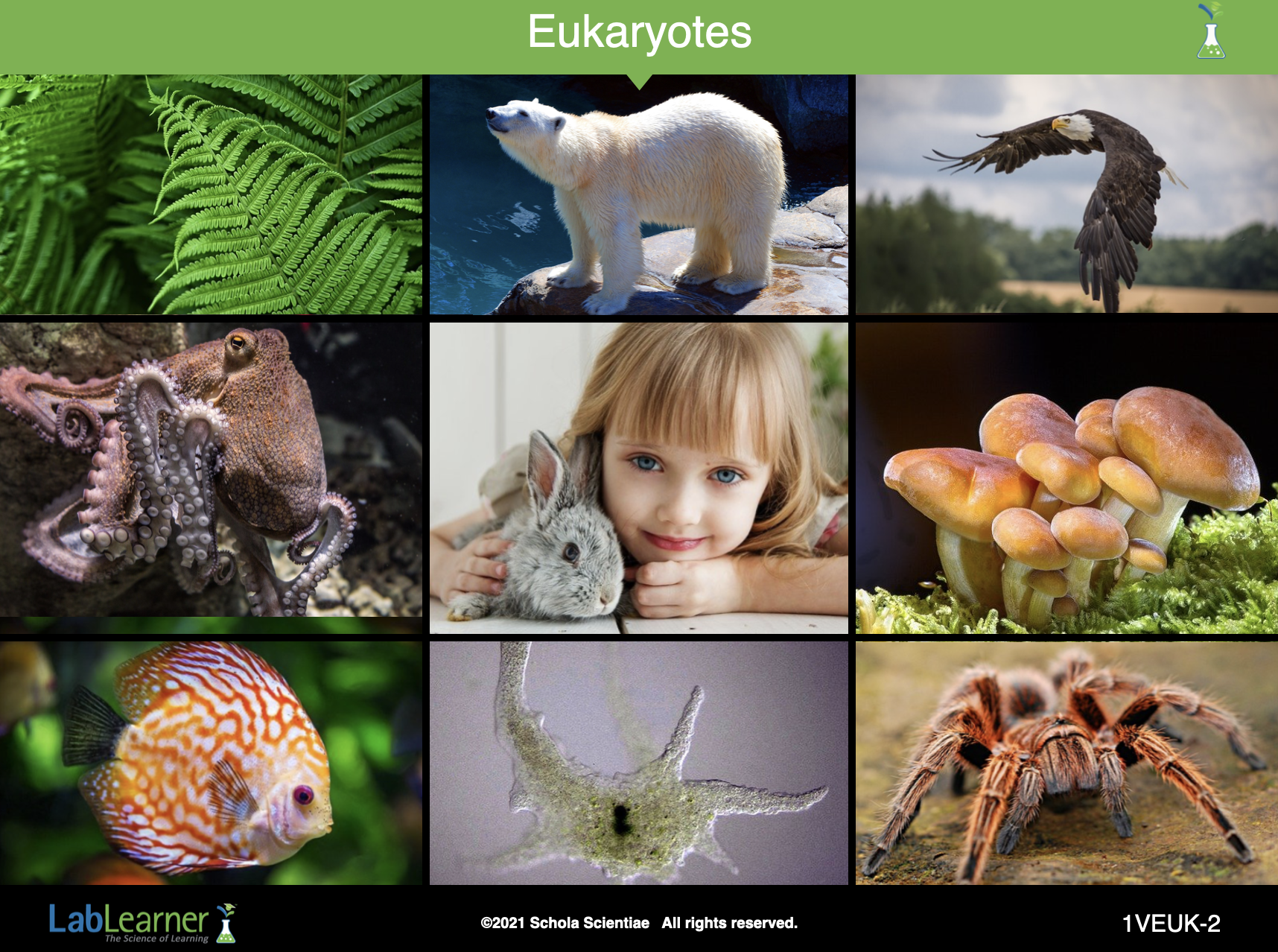
Begin the Journey by asking students the following question:
Ask students: What do all of these organisms have in common?
Allow time for students to discuss the question and their various answers. The grid below is a legend for the pictures on this slide:
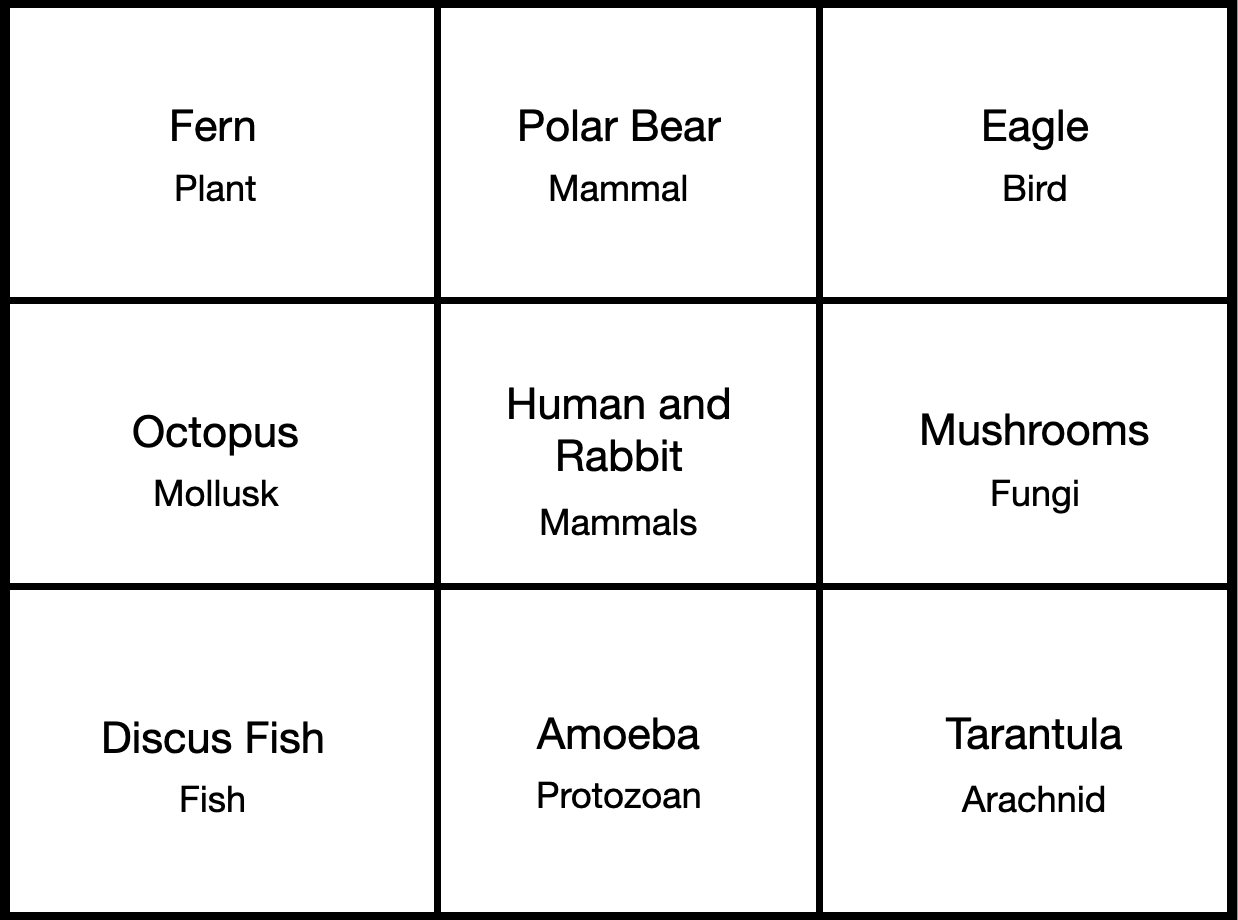
- Use the grid above to go through each picture with students.
- Tell students that one thing that all of the organisms pictured in the slide have in common is that they are all composed of cells.
- Reinforce that some of the organisms are unicellular or only a single cell (amoeba).
- Explain that in addition to unicellular organisms, some of the organisms pictured here are made up of many cells. They are multicellular.
- Tell students that they will have a chance to learn more about unicellular and multicellular organisms later in the Journey. Thus, if the distinction is not clear here, it may become more clear later.
- End the discussion of this slide by focusing on the fact that regardless whether the organisms are unicellular or multicellular, the cells of each organism are eukaryotic cells. Eukaryotic cells are a particular type of cell that has certain characteristics. As students explore this Journey, they will learn more about the characteristics of eukaryotic cells.
Note to Teacher: Should students ask whether there are other categories of cells, remind them that they learned one way to classify cells in the Microscopic Exploration CELL. Cells could be classified as either eukaryotic or prokaryotic cells. Therefore, another category of cells would be prokaryotic cells. Prokaryotic cells lack a nucleus and other organelles found in eukaryotic cells. They also tend to be about 10 times smaller and have 1000 times less volume than eukaryotic cells. However, characteristics of prokaryotic cells will not be a focus for students within this Journey.
______________________________________________
SLIDE 1VEUK-3
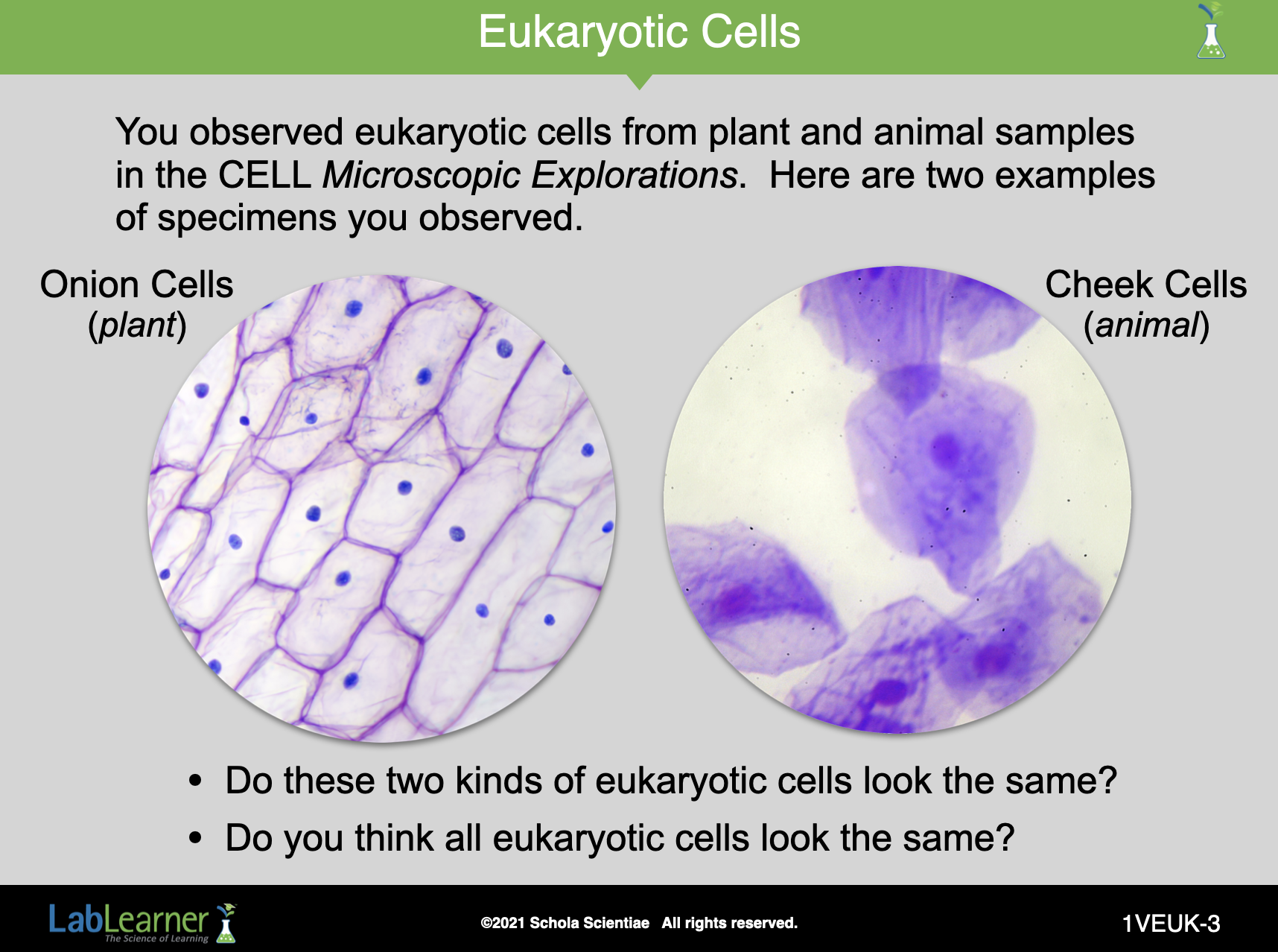
- Remind students that they observed eukaryotic cells from plant and animal specimens in the Microscopic Explorations CELL. Two of the specimens they observed were from the human cheek (animal cells) and from an onion (plant cells). The two images on this slide are a human cheek cell (left side) and an onion cell from the onion bulb (right side).
- Ask students: Do these two eukaryotic cells look the same?
Students should be able to competently discuss and provide answers for this question based on the two images on this slide as well as from other specimens they observed in the Microscopic Explorations CELL (elodea leaf, pinus stem, large intestine, blood smear).Based solely on the two cells shown above, student should indicate that the cells have both similarities and differences.The cells are different shapes.Students may also indicate that the cells are different colors.Should this characteristic arise, discuss that this difference is the result of the drawings rather than the color of the actual cells.Help students recallthat both the cheek and onion cells were clear or colorless when viewed with the microscope.
- Ask students: Do you think all eukaryotic cells look the same?
Students should discuss whether they believe that all eukaryotic cells have the same two shapes as the cheek and onion cells. Encourage students to recall the cells they observed in the pinus stem, large intestine, elodea leaf and blood smear. Some of these cells were different in shape than the cheek and onion cells, some were similar.
- Allow time for open discussion. There does NOT need to be a consensus at the end of the discussion as the next section of the Journey will focus on discussing and answering these questions.
______________________________________________
SLIDE 1VEUK-4
-
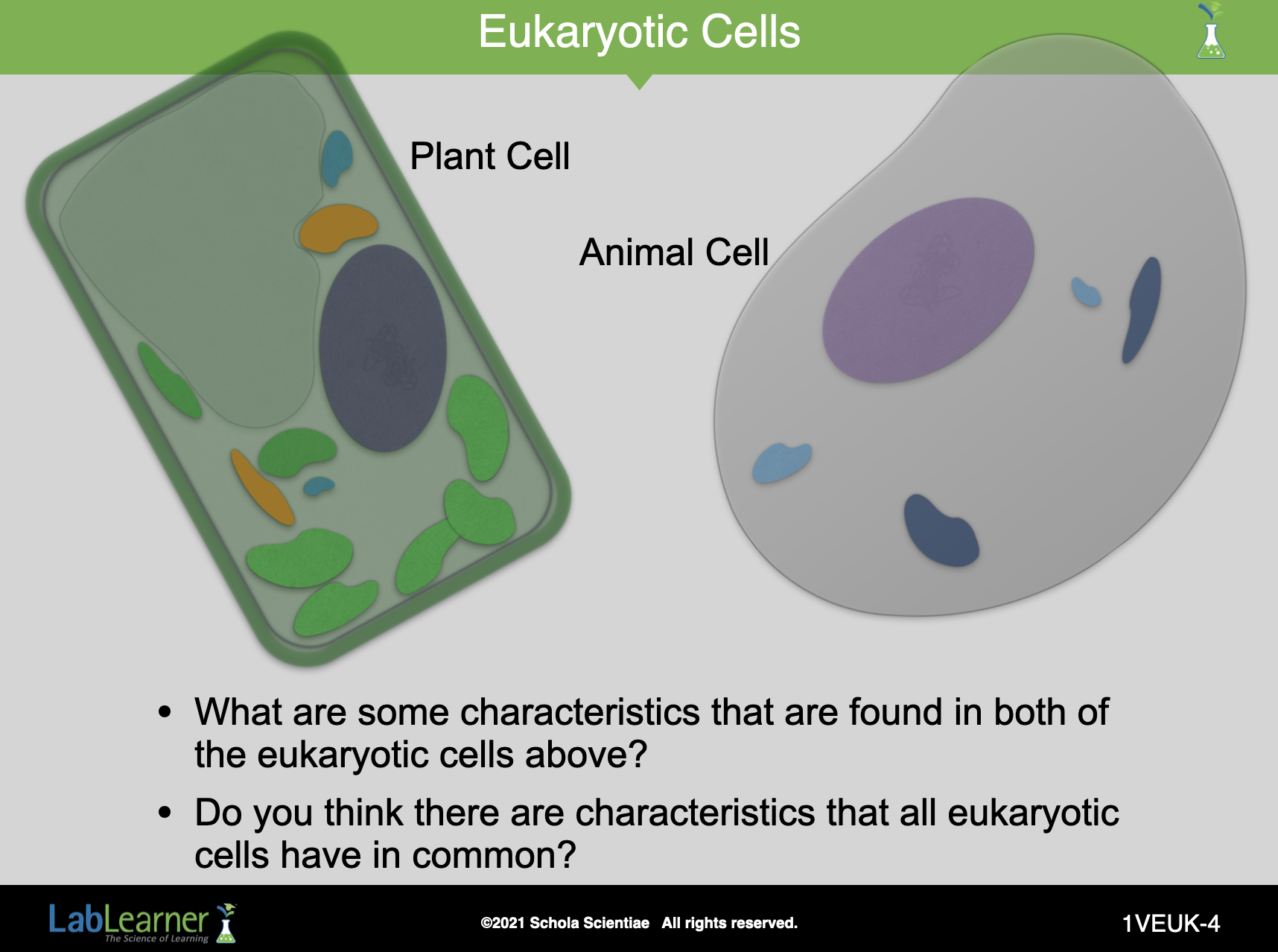
Continue the comparison of the cheek and onion cells. Although some students may have already discussed structures within each cell such as the nucleus, cytoplasm, and cell membrane, this slide provides the opportunity to focus all students’ attention on these structures.
- Ask the two questions on this slide in order to direct students’ attention to characteristics of eukaryotic cells other than shape.
Ask students: What are some characteristics that are found in both the eukaryotic cells above?
Students should be able to describe certain similarities such as a cell membrane, nucleus and cytoplasm in each cell.
- Ask students: Do you think there are characteristics that all eukaryotic cells have in common?
Encourage students to think beyond simple shape to the components of the cells: the nucleus, cytoplasm and cell membrane. Are these structures that are found in ALL eukaryotic cells?
- Allow time for open discussion. There does NOT need to be a consensus at the end of the discussion as the next section of the Journey will focus on discussing and answering these questions.
______________________________________________
SLIDE 1VEUK-5
- Explain that in answer to the question about eukaryotic characteristics that they discussed on the previous slide, there ARE certain characteristics that eukaryotic cells have in common.
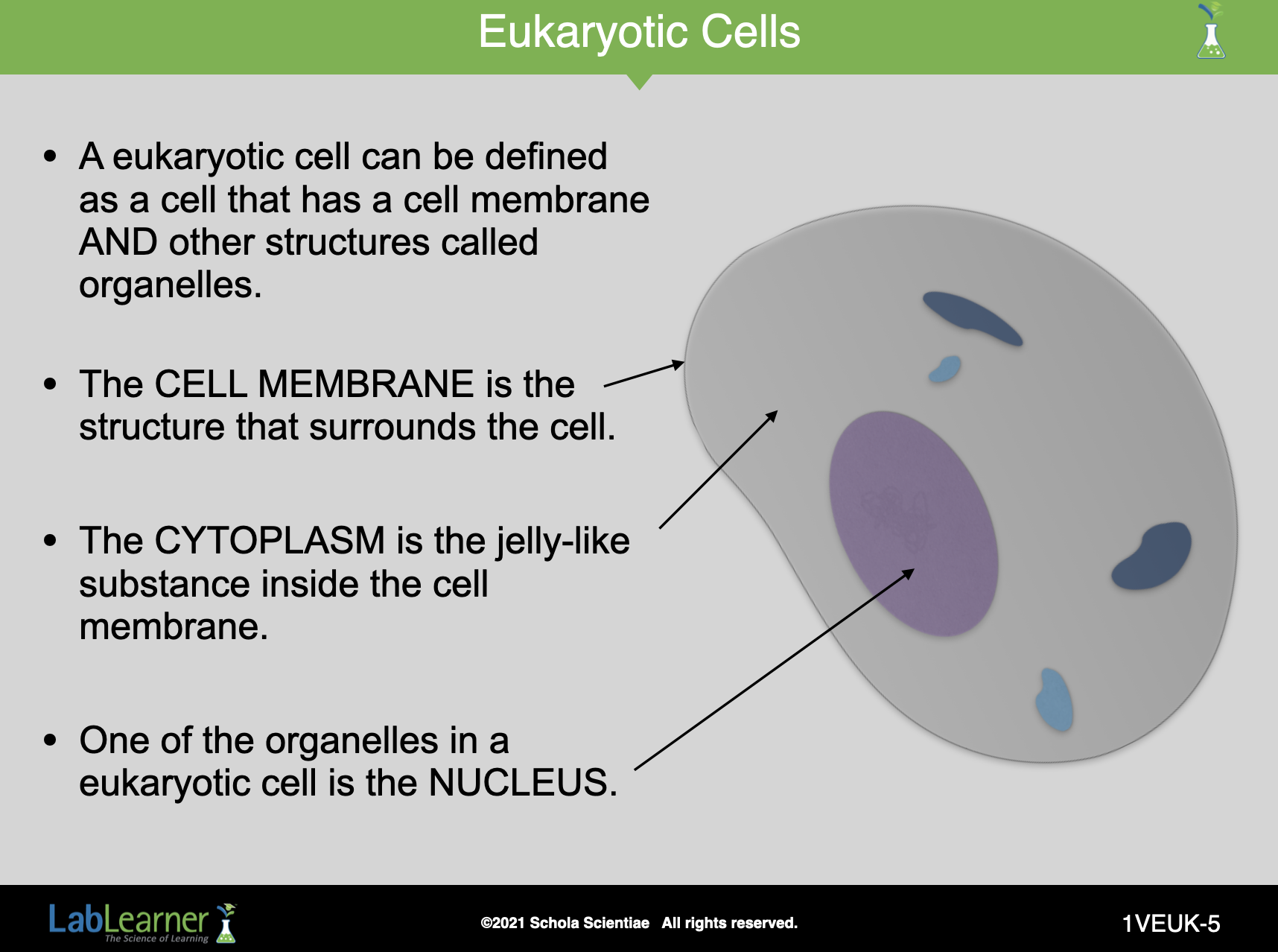
- This slide points to three of those characteristics or structures: the cell membrane, the cytoplasm and the nucleus. The image here shows these three structures in a human cheek cell. However, students should also recall having seen these structures in onion and elodea cells as well as in the cells of the large intestine.
- One of the concepts that this slide should drive home is that the structures of cell membrane, cytoplasm and nucleus are key characteristics of almost all eukaryotic cells.
______________________________________________
SLIDE 1VEUK-6
1. As students think about eukaryotic cells and their structures, it may be helpful for them to think of a concrete model. This slide introduces one model of an eukaryotic cell using everyday items with which students should be familiar.
2. As you introduce the model, encourage students to think about why certain materials may have been chosen to represent each part of the eukaryotic cell.
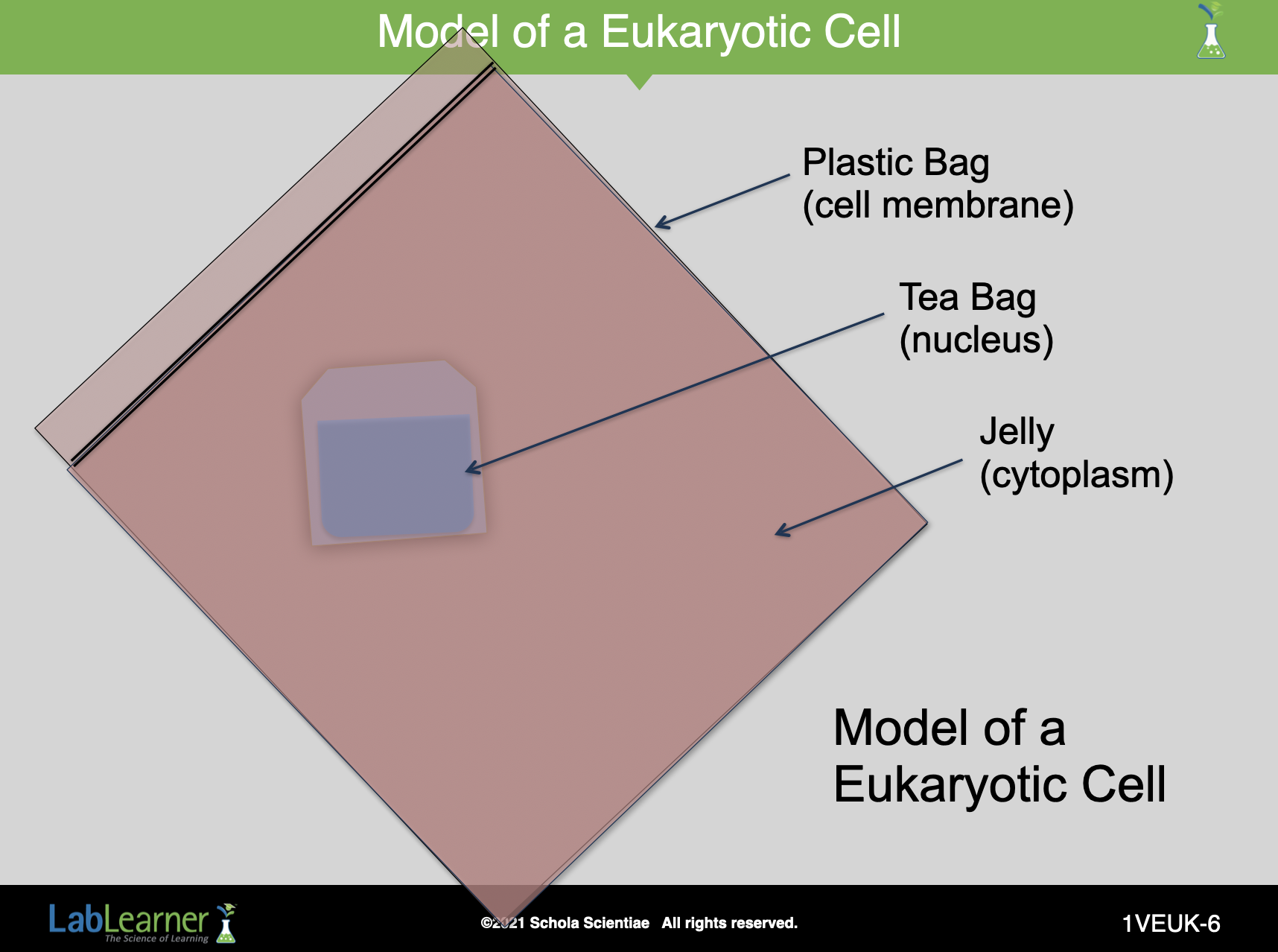
- This model of an eukaryotic cell uses a plastic sealable bag filled with strawberry jelly and a tea bag.
- The plastic bag represents the cell membrane of the cell. This is the structure of the cell that forms the boundary between the inside and outside of the cell. As such, the cell membrane separates the inside and outside of the cell. Note to Teacher: Although students are not required to know the function of the cell membrane, this question may arise. As a boundary, the cell membrane regulates substances that can enter and exit the cell.
- The strawberry jelly represents the cytoplasm of the cell. The cytoplasm refers to both the space inside the cell membrane and the fluid/jelly like substance found within that space. Jelly is an appropriate substance because its gelatinous consistency may in some cases be similar to the consistency of a cell’s cytoplasm. Thus, students should be able to see how flexible the cell and its cytoplasm are because of both the flexibility of the jelly and plastic bag. Note to Teacher: However, it may be important to mention that the color of the jelly does NOT reflect the color of the cytoplasm. Students should not be misled into to thinking that the cytoplasm of a cell is red. For many cells, the cytoplasm may be clear or colorless.
- The tea bag represents the nucleus of the cell. Students should note that it is a self-contained structure. The contents of the tea bag are enclosed within the fabric or paper of the tea bag. Thus, the nucleus is in contact with the cytoplasm, but the inner contents of the nucleus do not spill into the cytoplasm. Likewise, the cytoplasm does not spill into the inner part of the nucleus. In terms of the model, the jelly and tea in the tea bag do not directly mix. In addition, the tea bag can move with movements of the jelly, a situation that mimics circumstances inside an actual eukaryotic cell.
3. Before leaving this slide, encourage students to envision this model. Have students imagine holding the model.
Ask students: Is it two dimensional like a drawing on paper or three dimensional ?
Students should realize that the model is three dimensional. This is purposeful. It emphasizes that a cell is three dimensional. Students may often forget this feature as they view cells through the microscope or on slides because of the two dimensional nature of both mediums.
______________________________________________
SLIDE 1VEUK-7
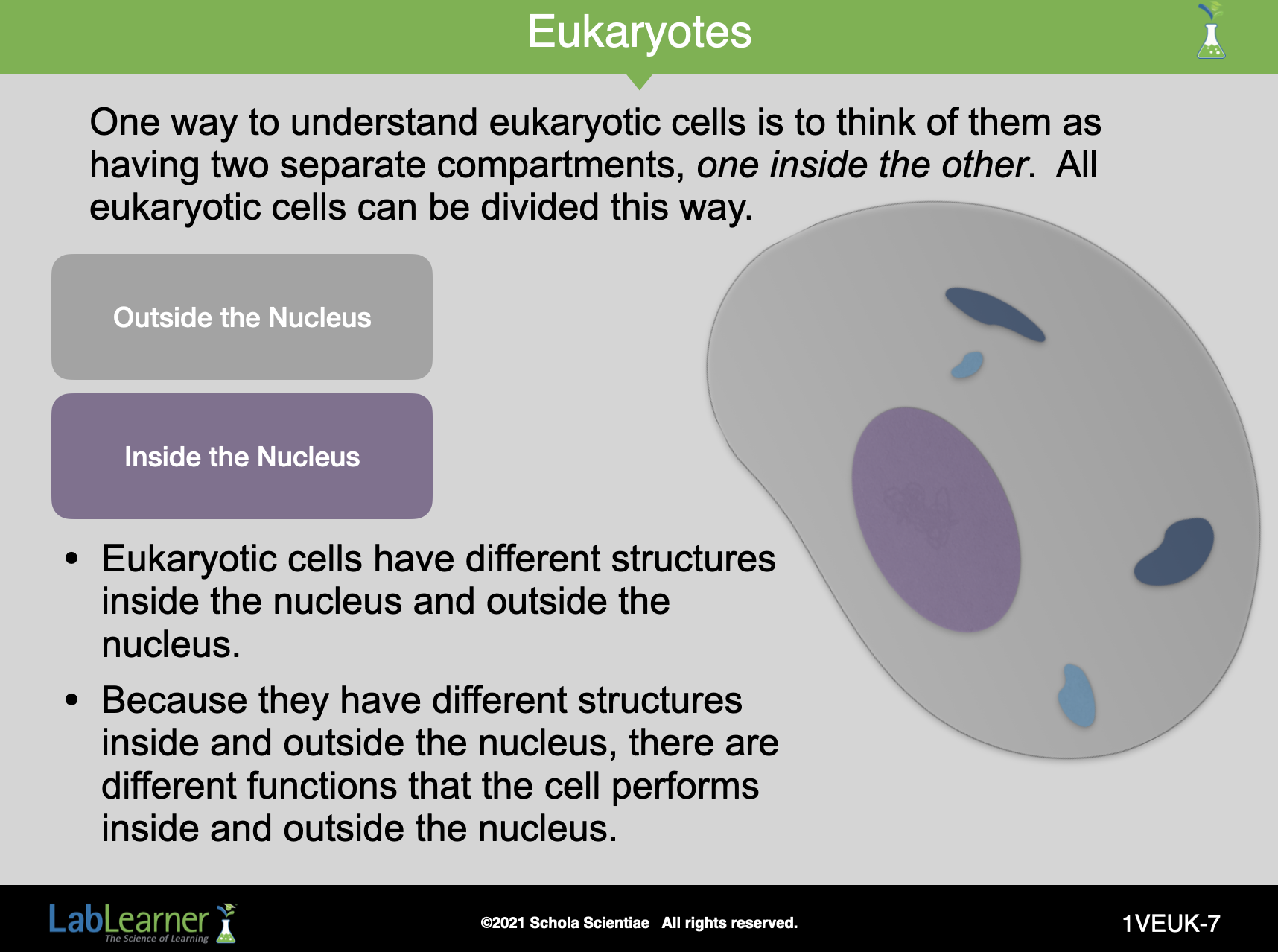
1. Continue exploring the structure of eukaryotic cells by explaining that one way to understand these types of cells is to think of them as having two separate compartments: one compartment inside the other. Thought of this way, the eukaryotic cell can be divided into those two compartments: outside the nucleus and inside the nucleus.
- Use the color-coding on the slide to point out the location of these two compartments. The area inside the nucleus is shaded purple. The area outside the nucleus is shaded grey.
- Discuss how different structures are found in the two compartments. Emphasize the relationship between structure and function: function relates to structure and structure relates to function.
- The same concept applies here. Because there are different structures inside and outside the nucleus, there are different functions that the cell performs inside and outside the nucleus.
______________________________________________
SLIDE 1VEUK-8
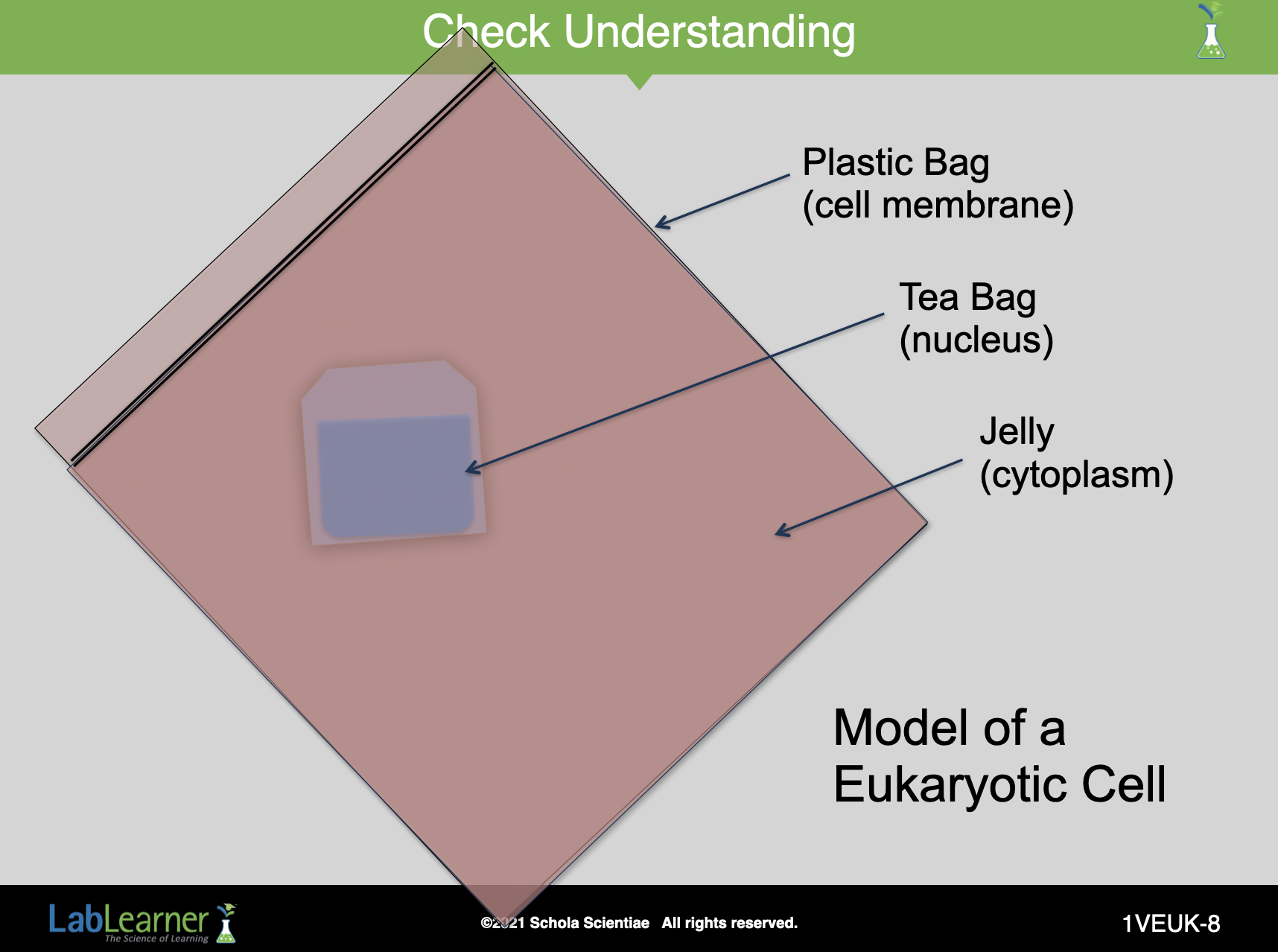
Before moving forward to investigate the two compartments, allow some time for students to think about this concept and relate it to the model of the eukaryotic cell. Encourage them to look at the slide and think about the model of the eukaryotic cell.
- Ask students: Can you describe the parts of this model that would be the outside the nucleus- the outer compartment?
Students should describe the outer compartment or the area outside the nucleus as the area between the boundaries of the plastic bag and the fabric of the teabag. It would include all of the jelly.
- Ask students: Can you describe the parts of this model that would be inside the nucleus- the inner compartment?
Students should describe the inner compartment or the area inside the nucleus as the area inside the fabric of the tea bag. It is the tea inside the tea bag.
______________________________________________
SLIDE 1VEUK-9
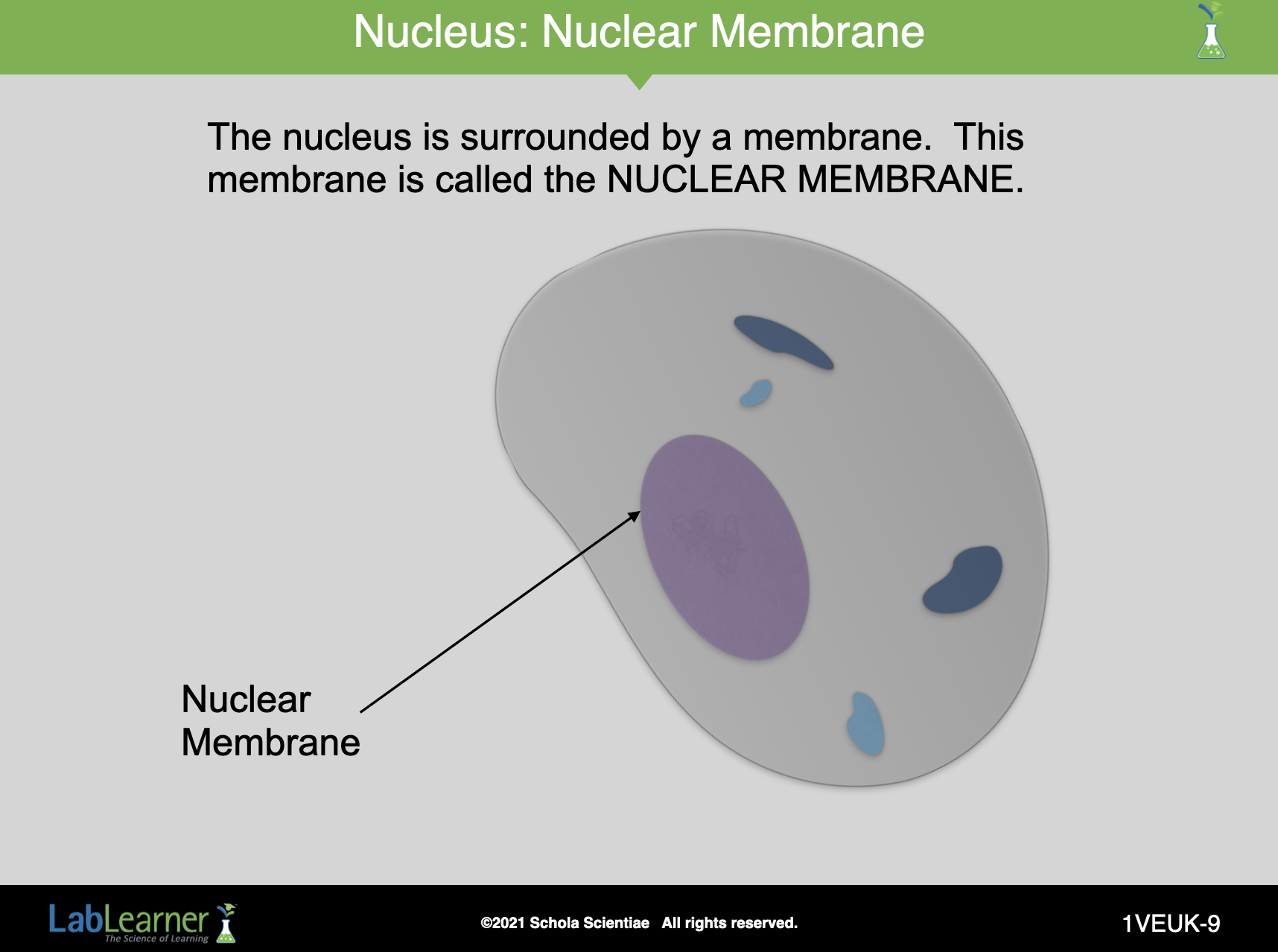
Begin a discussion of one of the compartments of a eukaryotic cell: inside the nucleus.
- Define the boundary of this compartment for students: the nuclear membrane. Explain that just like the entire cell has a cellular membrane, the nucleus has a membrane that separates the inside of the nucleus from the outside of the nucleus.
- Because the membrane surrounds the nucleus, it is called the nuclear membrane. The nuclear membrane is similar to the cell membrane in one of its functions: it controls the movement of substances across it. Therefore, the nuclear membrane determines which substances can enter and exit the nucleus.
______________________________________________
SLIDE 1VEUK-10
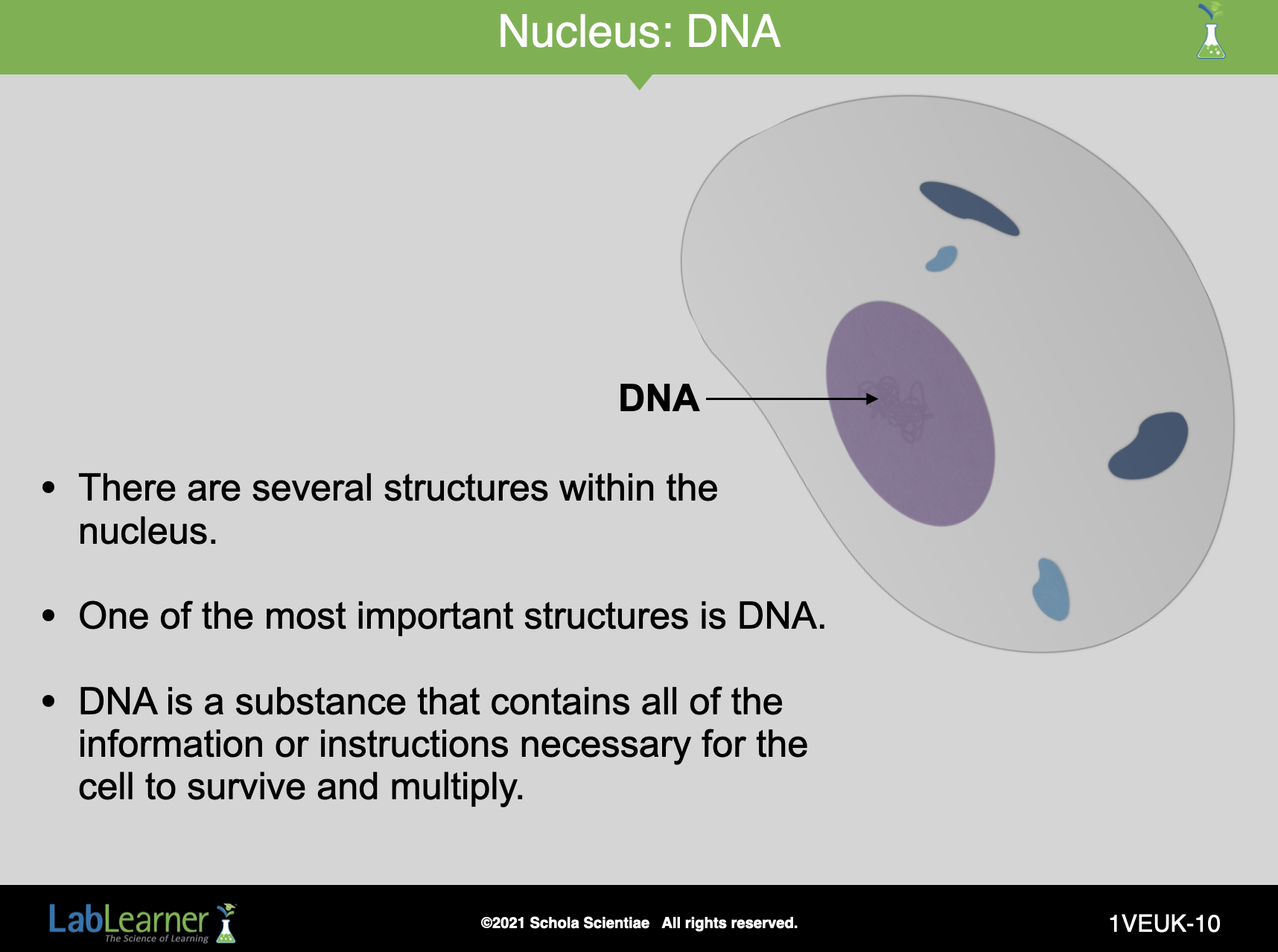
Continue to explore the inner compartment of the cell by discussing one structure that lies within the nucleus: DNA. Students may be curious about DNA, its structure, and its function. Explain that the very basic function of DNA will be discussed here, but that as students perform the experiments in the next LabLearner CELL Inheritance and Adaptations, they will learn more about the structure of DNA and its functions.
- For now, emphasize that DNA is the substance inside the nucleus that contains all of the instructions that the cell needs to multiply and survive.
- Before leaving this slide, tell students to think back to the model of a eukaryotic cell with the plastic bag. Ask students what part of that model would represent the DNA. Students should indicate that the tea inside the tea bag would represent the DNA.
______________________________________________
SLIDE 1VEUK-11
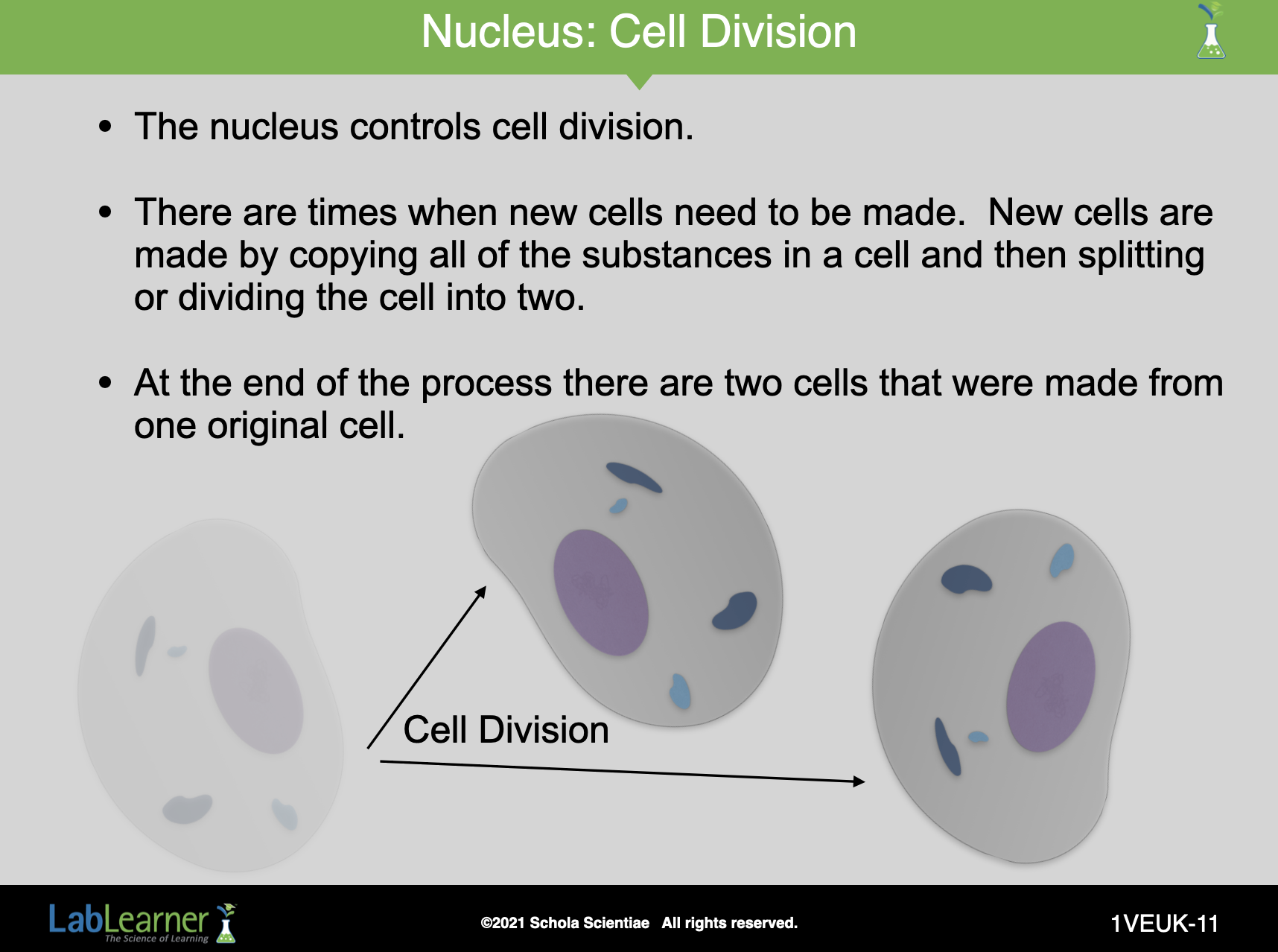
Use this slide to focus on one of the functions of the nucleus and the structures within the nucleus: cell division. In eukaryotic cells, there are two types of cell division. One is called mitosis and the other is called meiosis.
- The cell division that is discussed here is mitosis. However, for students at this level it is often easier to simply refer to the process as cell division (rather than mitosis) and describe the process by which a cell divides into two new cells. In this process, the original single cell becomes two cells. At the beginning of cell division, there is one cell. At the end of cell division, there are two cells.
- It is important as students view this slide that they understand that eukaryotic cell division results in the production of two cells from one original cell and that at the end of the process there are only two cells. The “original cell” no longer exists. As students view the diagram on this slide, they may be tempted to think that the original cell remains and that there are three cells at the end of cell division. This would be incorrect.
- Students may wonder why cells divide. Within eukaryotic organisms, cell division occurs mainly to replace worn-out or damaged cells.
______________________________________________
SLIDE 1VEUK-12
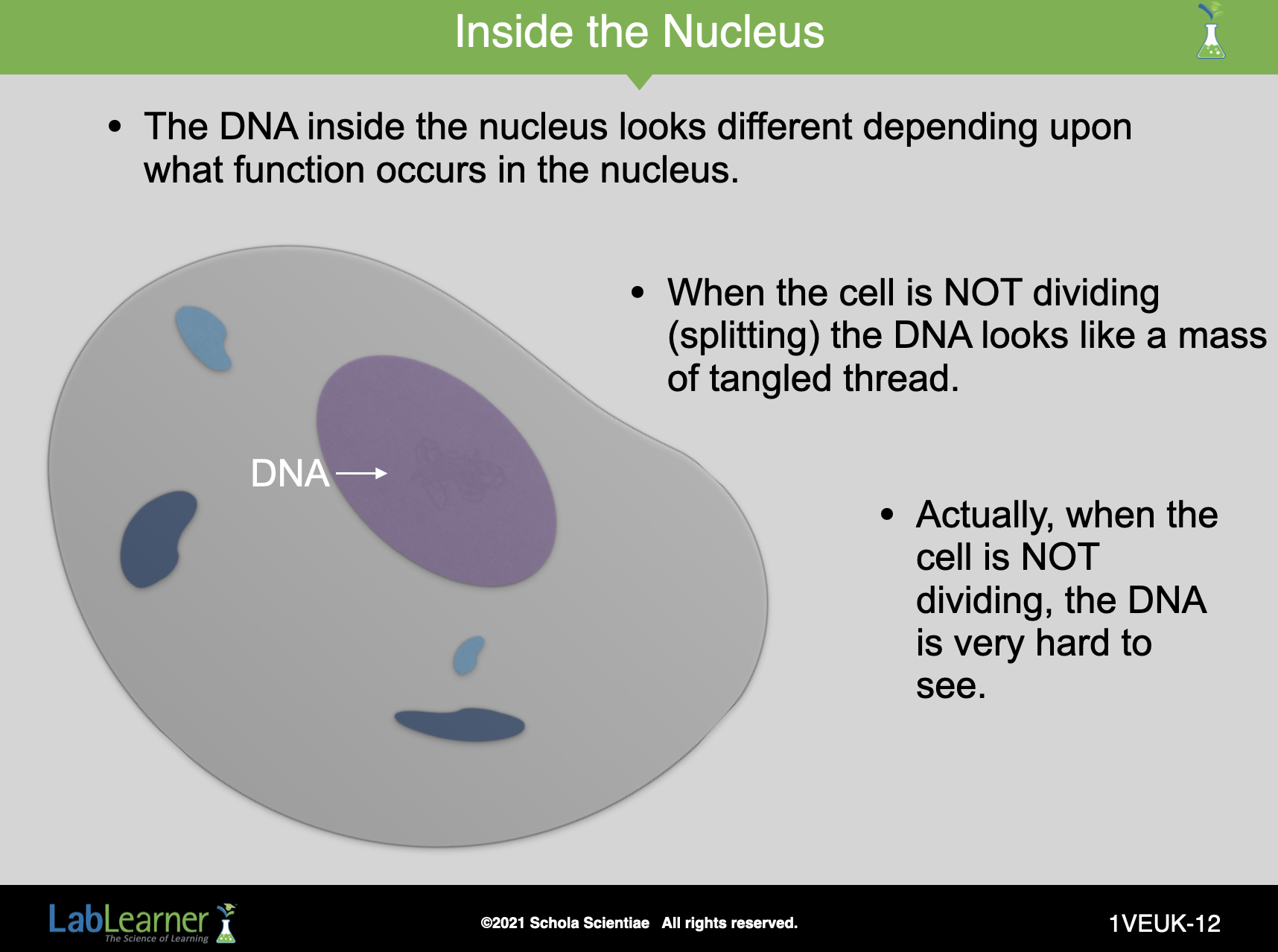
Although students will learn more about cell division and DNA structure in their middle school LabLearner science years, one of the concepts that students should be ready to understand at this level is that the DNA within the nucleus is organized differently when the cell is actively dividing as compared to when it is not actively dividing.
- When the cell is not actively dividing the DNA looks like a mass of tangled thread and the DNA is hard to see in a light microscope (as opposed to an electron microscope). Although students are NOT required to know this, scientists call this tangled mass chromatin.
______________________________________________
SLIDE 1VEUK-13
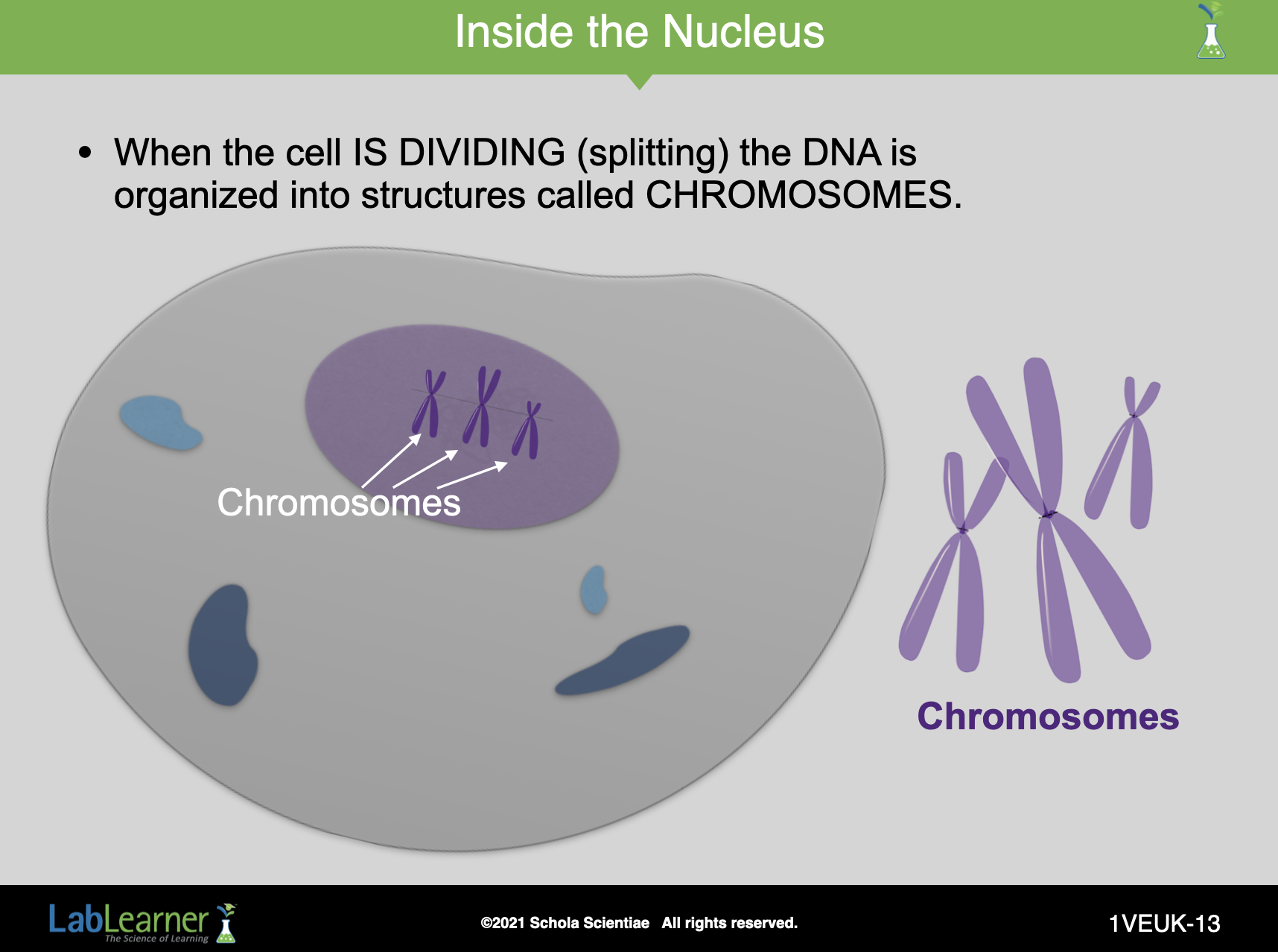
As explained in this slide, when eukaryotic cells are dividing, the DNA is organized differently. It is organized into structures called chromosomes. Students will learn more about chromosomes, their structure, and their role in genetics and heredity as they complete the Inheritance and Adaptation CELL.
______________________________________________
SLIDE 1VEUK-14
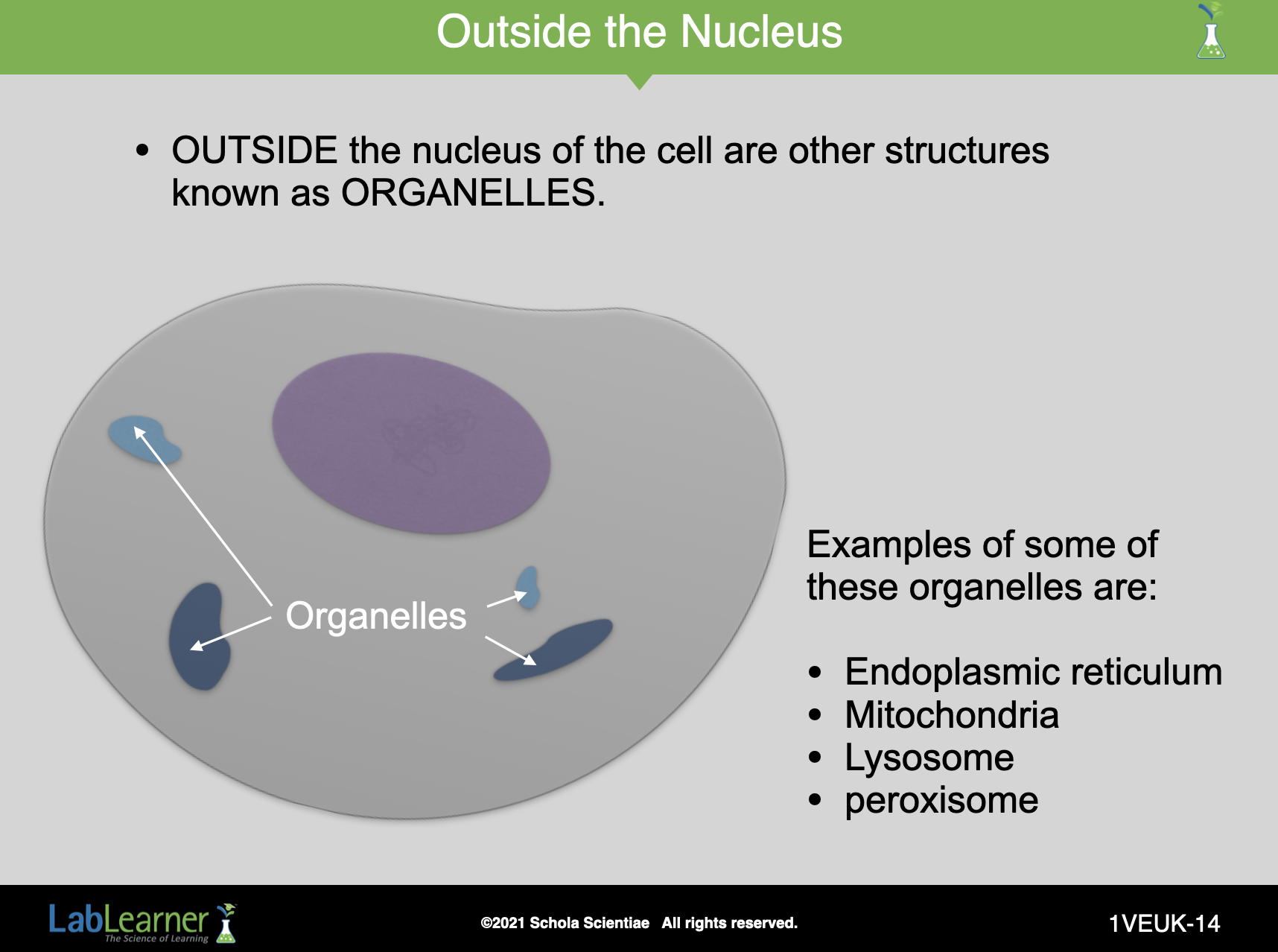
This section of the Journey ends with a discussion of the second compartment of the cell: outside the nucleus. Students should be able to see from the diagram that the boundaries of this compartment are between the nuclear membrane and the cell membrane. In addition, students should remember that this area is filled with cytoplasm.
- Contained within the cytoplasm are other structures known as organelles. Examples of organelles are provided on the slide. They include the endoplasmic reticulum, mitochondria, lysosomes, and peroxisomes. There are additional organelles within a eukaryotic cell that are not listed here. Some of these include ribosomes, vacuoles, and Golgi.
Note to Teacher: Although it may be tempting to ask students to memorize each of these organelles and their functions, this type of process is not likely to result in their true conceptualization of the functions of these organelles. Instead, learning the structure and function of these organelles is a concept that may be better received and understood during students’ middle school years.
______________________________________________
SLIDE 1VEUK-15
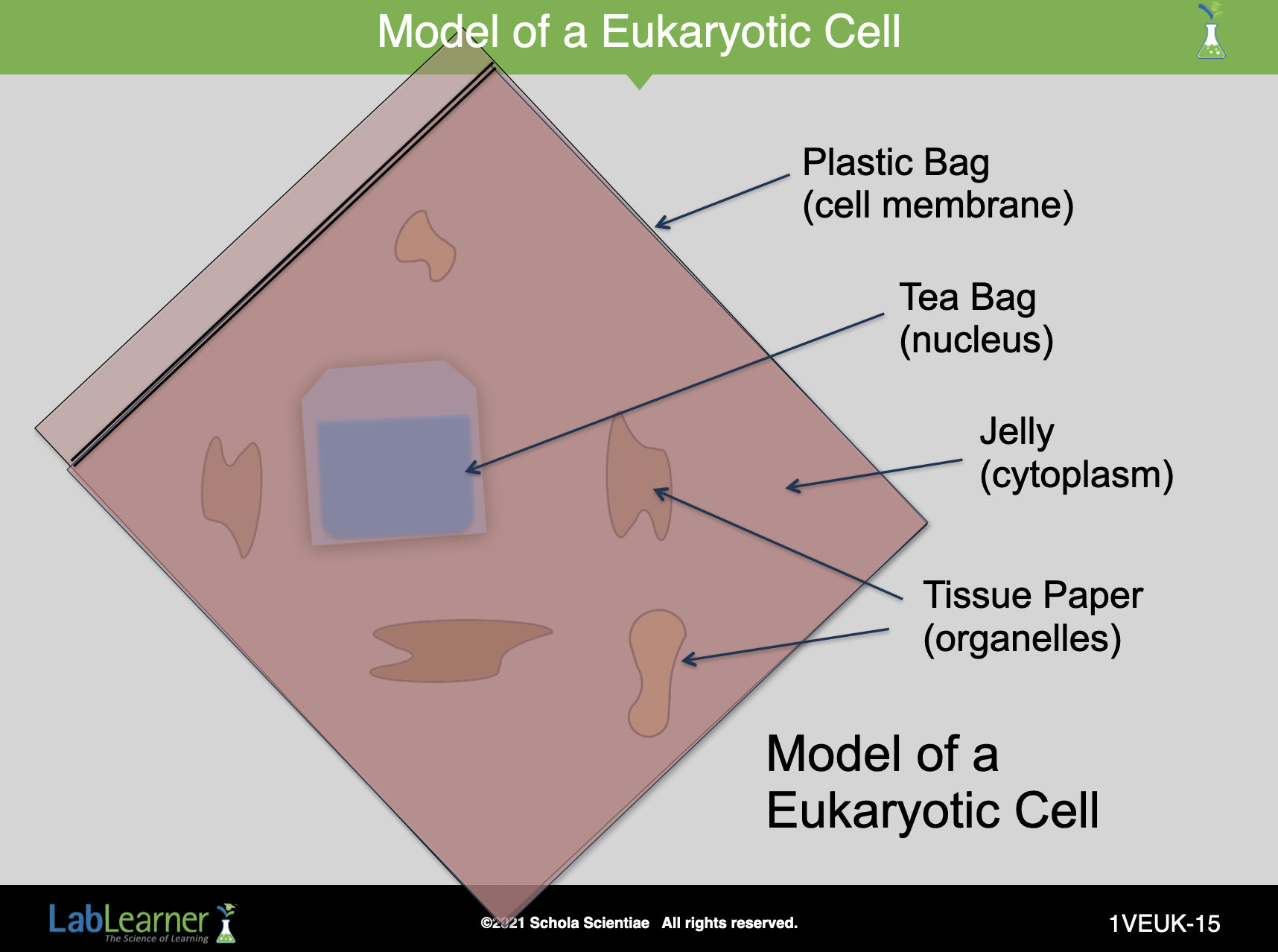
This slide provides a way in which students can revisit the model of the eukaryotic cell and incorporate new information about organelles other than the nucleus.
- In this model, the organelles within the “outer compartment” (outside the nucleus) are represented by tissue paper that would be in the jelly inside the plastic bag. The interaction between the jelly and the tissue paper would be similar to that between the cytoplasm and organelles in that the organelles would be immersed within the cytoplasm and would have some freedom of movement as the cytoplasm moved.
- In addition, the organelles outside the nucleus would REMAIN SEPARATE from the contents of the nucleus, including DNA, as a result of the nuclear membrane.
______________________________________________
SLIDE 1VEUK-16
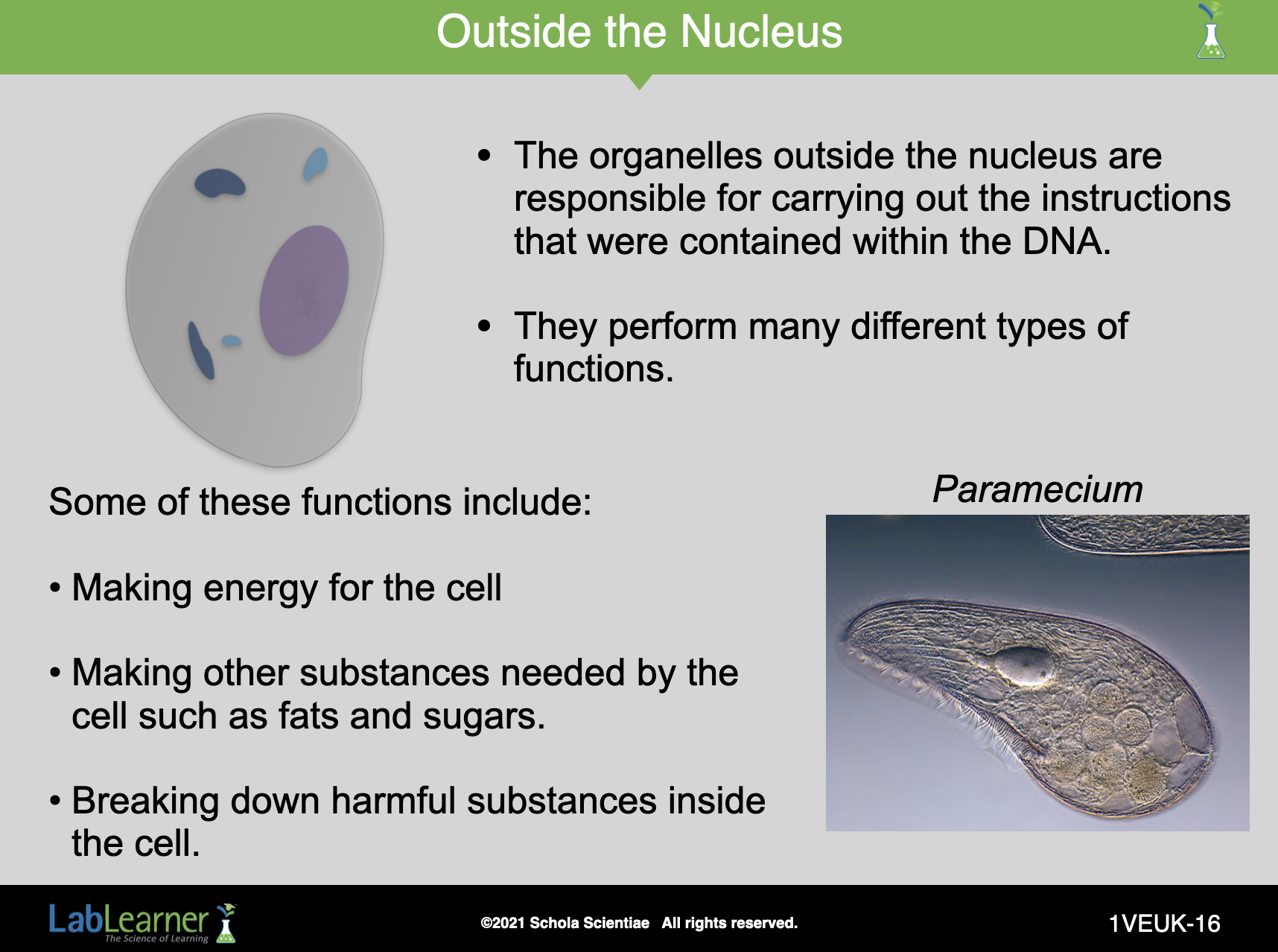
This section of the Journey ends by discussing some of the functions of the organelles found outside the nucleus. In general, each organelle has a specific function that differs from other organelles. In addition, each of these functions is DIFFERENT from the functions of the structures inside the nucleus. It is important to emphasize this point.
- However, it is also important to help students understand that the functions of organelles outside the nucleus are RELATED to the functions inside the nucleus. The organelles outside the nucleus are responsible for carrying out the instructions that were contained within the DNA that is inside the nucleus.
- Examples of some functions that occur outside the nucleus are listed on this slide.
The Paramecium cell (a single-cell protozoan) is shown at the lower right to illustrate just how many different organelles are packed into the cytoplasm.
______________________________________________
SLIDE 1VEUK-17
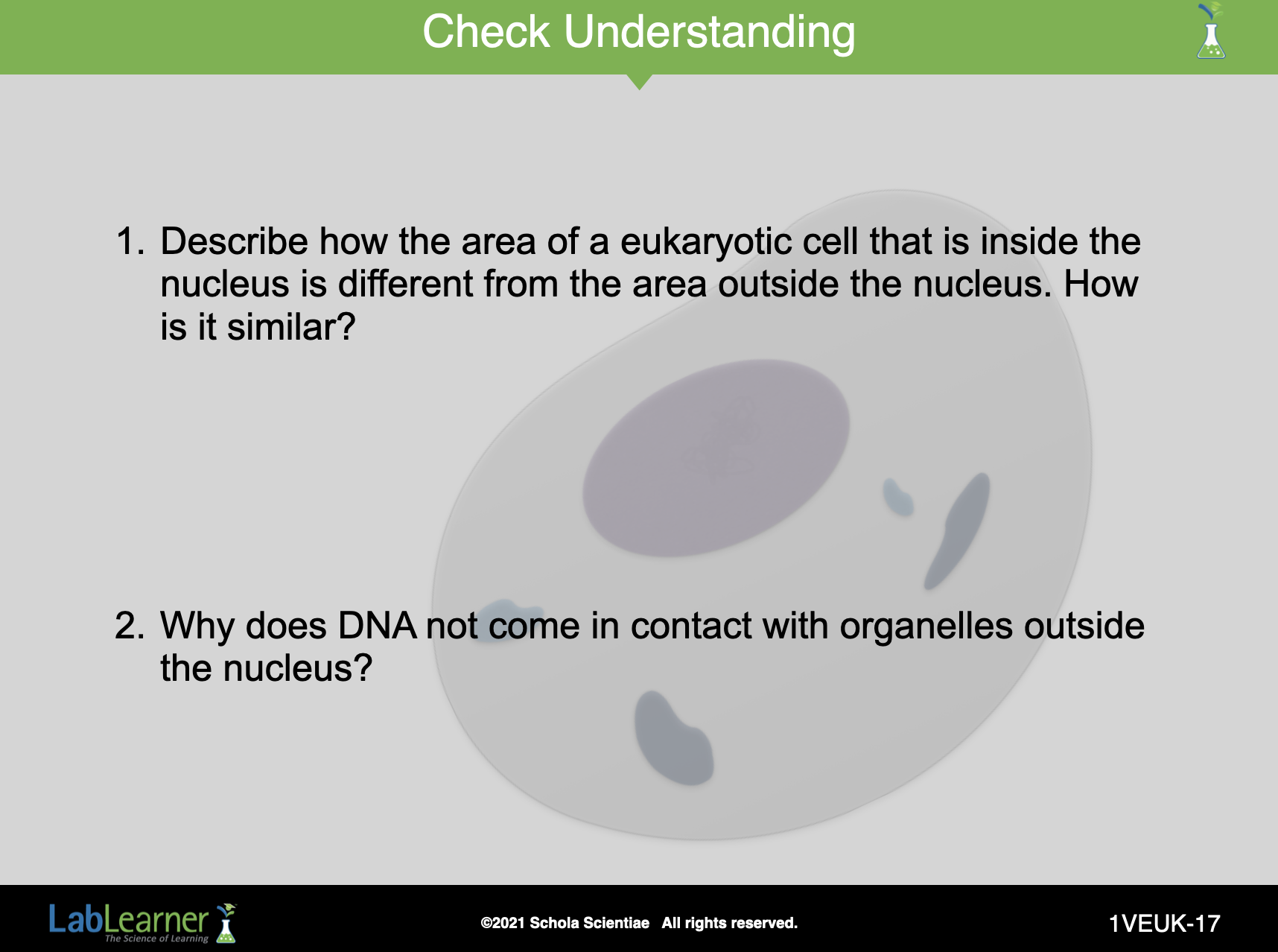
Answers to the questions on the slide:
Question 1. Describe how the area of a eukaryotic cell that is inside the nucleus is different from the area outside the nucleus. How is it similar?
- Students’ answers may vary. Students should suggest that there are different organelles inside the nucleus and outside the nucleus. DNA is found inside the nucleus while the endoplasmic reticulum, mitochondria, lysosomes, and peroxisomes are found outside the nucleus.
- Because there are different structures found inside and outside the nucleus, there are different functions of the cell performed inside and outside the nucleus. For example, the instructions for carrying out cell division and all other cellular processes are contained within DNA and found within the nucleus.
- Thus, much of the coordination of cellular events is controlled from within the nucleus. Functions such as the production of fats, sugars, and proteins and the breakdown of substances occur in the cytoplasm.
- Some of the similarities between the areas inside and outside the nucleus are that both areas are contained within the cell membrane. In addition, both areas HAVE organelles and both areas are important for the complete functioning of the cell.
Question 2. Why does DNA not come in contact with organelles outside the nucleus?
- DNA does not come in contact with organelles outside the nucleus because of the nuclear membrane. This membrane separates the DNA from the area outside it- the rest of the cytoplasm.